
Intels Product Security Maturity Model PSMM 8 Mar


- Slides: 50
Intel's Product Security Maturity Model (PSMM) 8 Mar 2016 Harold Toomey | Sr. Product Security Architect & PSIRT Manager, Intel Security James Ransome | Sr. Director Product Security, Intel Security Intel Public
Introduction Responsibilities § § § PSIRT Manager Manage a team of 72 Sr. Security Architects (PSCs) Manage the PSG program, Agile SDL and policies Training program Metrics / Reporting Experience § § 4 Years: Software / Application Security 2 Years: IT Operational Security 11 Years: Product Management 10 Years: Software Development (C++) CVSS Special Interest Group (SIG) ISSA North Texas Chapter, Past President CISSP, CISA, CISM, CRISC, CGEIT, … Intel Public Harold Toomey Sr. Product Security Architect 2
Agenda Intel Public § § § § SDLC / SDL Maturity Models PSMM Reports PSMM Design Criteria Org. Structure 20 PSMM Parameters MS Excel / Word Metrics 3
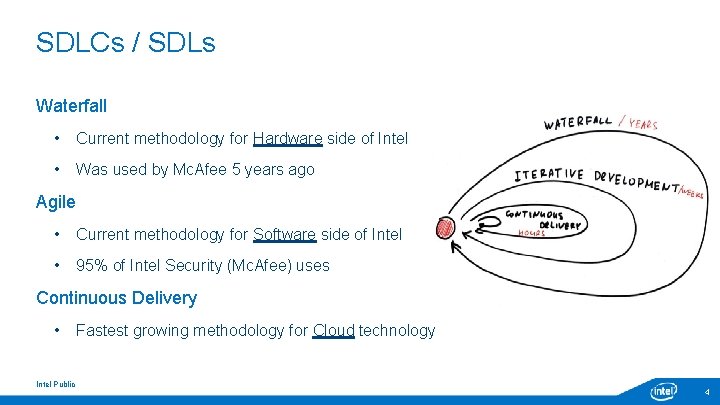
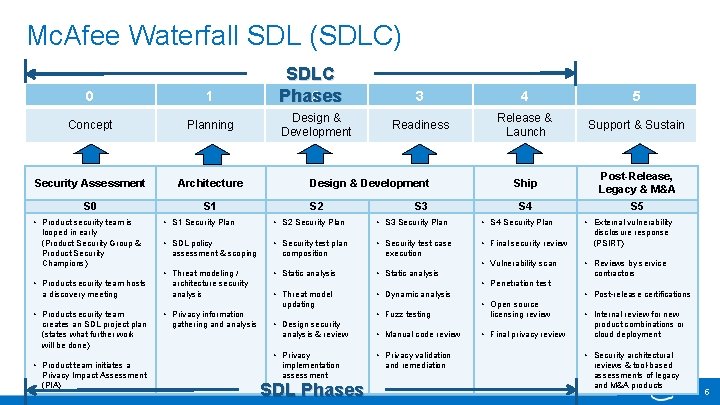
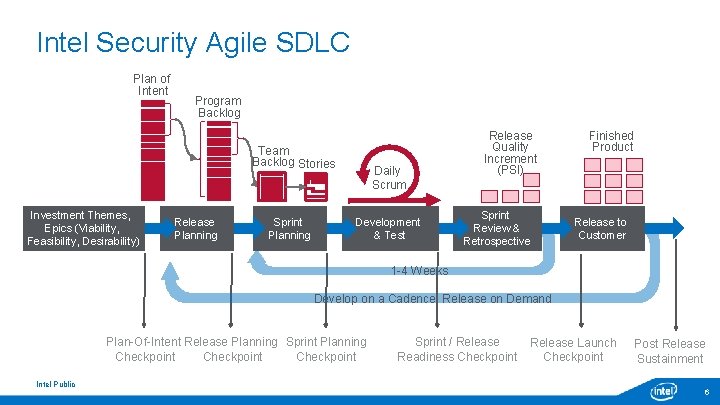
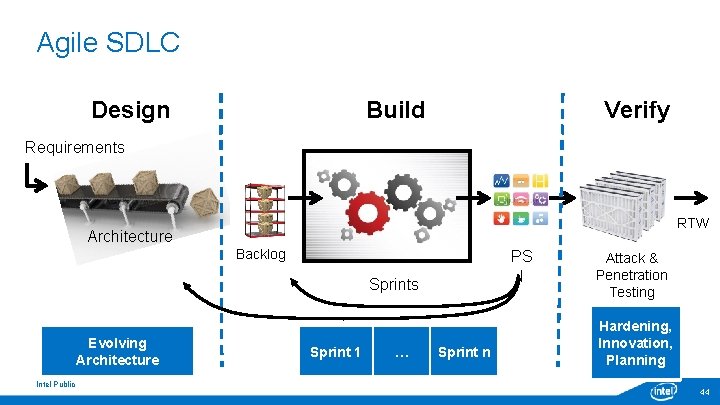
SDLCs / SDLs Waterfall • Current methodology for Hardware side of Intel • Was used by Mc. Afee 5 years ago Agile • Current methodology for Software side of Intel • 95% of Intel Security (Mc. Afee) uses Continuous Delivery • Intel Public Fastest growing methodology for Cloud technology 4
Mc. Afee Waterfall SDL (SDLC) 0 1 Concept Planning Security Assessment Architecture S 0 S 1 • Product security team is looped in early (Product Security Group & Product Security Champions) a discovery meeting Design & Development 3 4 5 Readiness Release & Launch Support & Sustain Ship Post-Release, Legacy & M&A S 4 S 5 Design & Development S 2 S 3 • S 1 Security Plan • S 2 Security Plan • S 3 Security Plan • S 4 Security Plan • SDL policy • Security test plan • Security test case • Final security review assessment & scoping composition architecture security analysis • Static analysis creates an SDL project plan (states what further work will be done) • Threat model • Privacy information gathering and analysis Privacy Impact Assessment Intel Public (PIA) • Reviews by service contractors • Dynamic analysis • Post-release certifications • Open source • Fuzz testing licensing review • Design security analysis & review • Privacy • Product team initiates a disclosure response (PSIRT) • Penetration test updating • Product security team • External vulnerability execution • Vulnerability scan • Threat modeling / • Product security team hosts SDLC 2 Phases implementation assessment SDL Phases • Manual code review • Privacy validation and remediation • Final privacy review • Internal review for new product combinations or cloud deployment • Security architectural reviews & tool-based assessments of legacy and M&A products 5
Intel Security Agile SDLC Plan of Intent Program Backlog Team Backlog Stories Investment Themes, Epics (Viability, Feasibility, Desirability) Release Planning Sprint Planning Daily Scrum Development & Test Release Quality Increment (PSI) Sprint Review & Retrospective Finished Product Release to Customer 1 -4 Weeks Develop on a Cadence, Release on Demand Plan-Of-Intent Release Planning Sprint Planning Checkpoint Intel Public Sprint / Release Readiness Checkpoint Release Launch Checkpoint Post Release Sustainment 6
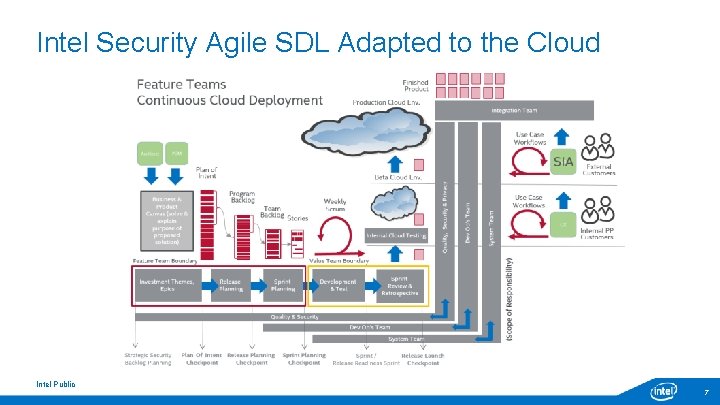
Intel Security Agile SDL Adapted to the Cloud Intel Public 7
Problem Statement Problem: We have an SDL. How well are the product teams following it? Intel Public 8
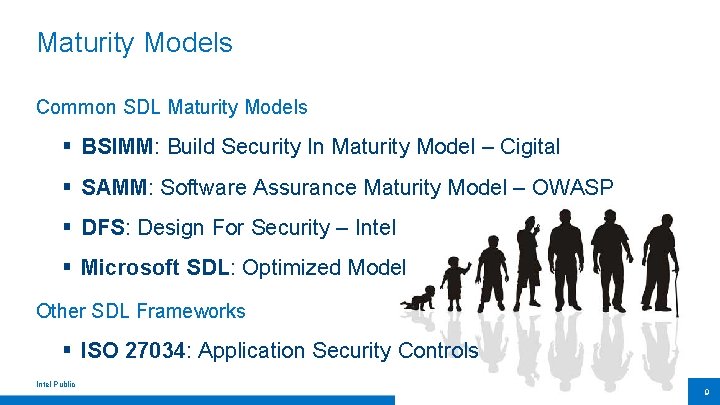
Maturity Models Common SDL Maturity Models § BSIMM: Build Security In Maturity Model – Cigital § SAMM: Software Assurance Maturity Model – OWASP § DFS: Design For Security – Intel § Microsoft SDL: Optimized Model Other SDL Frameworks § ISO 27034: Application Security Controls Intel Public 9
PSMM Design Constraints 1. No budget for cool applications • Use COTS tools 2. No budget for additional auditors • Peer review 3. Be simple • Automated, not weighted, minimal training and effort 4. Low overhead • Minimal burden on engineering teams 5. Produce insightful metrics Intel Public 10
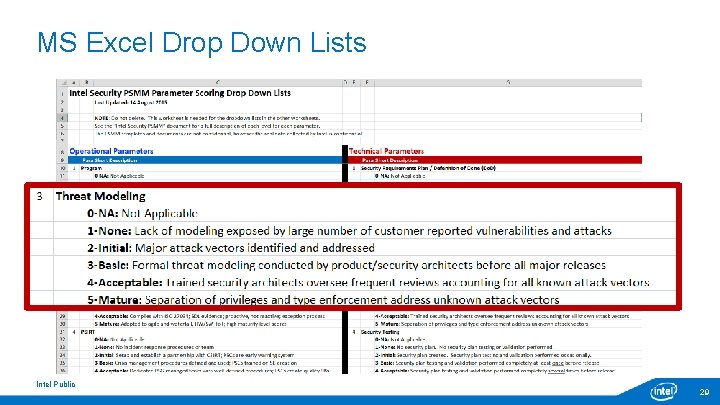
PSMM Implementation Requirements 1. Provide a detailed MS Word doc fully listing requirements for each parameter level 2. Provide simple drop-down lists in MS Excel 3. Allow and adjust for “ 0 – Not Applicable” 4. Map PSMM to other maturity models 5. Allow for phased roll-out, reporting at different org. levels Intel Public 11
Solution: The Intel Product Security Maturity Model (PSMM) • Measures how well both the operational and technical aspects of product security are being performed • Provides a simple, yet powerful, model which has been adopted and is being used company-wide • Data is collected at multiple levels to improve accuracy Intel Public 12
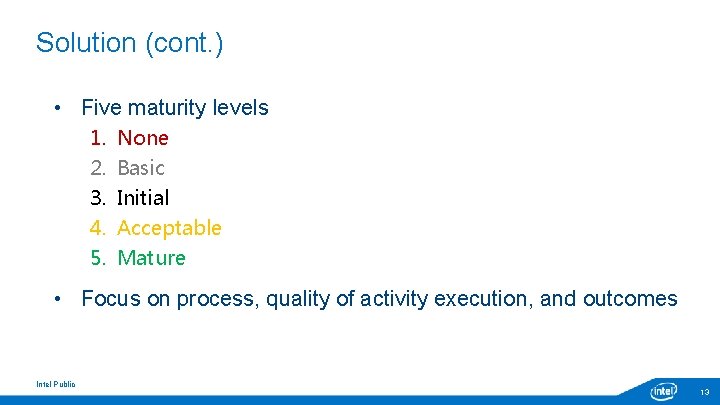
Solution (cont. ) • Five maturity levels 1. 2. 3. 4. 5. None Basic Initial Acceptable Mature • Focus on process, quality of activity execution, and outcomes Intel Public 13
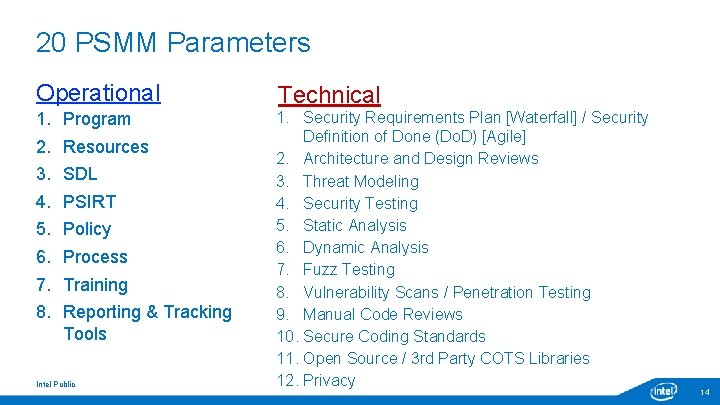
20 PSMM Parameters Operational 1. 2. 3. 4. 5. 6. 7. 8. Program Resources SDL PSIRT Policy Process Training Reporting & Tracking Tools Intel Public Technical 1. Security Requirements Plan [Waterfall] / Security Definition of Done (Do. D) [Agile] 2. Architecture and Design Reviews 3. Threat Modeling 4. Security Testing 5. Static Analysis 6. Dynamic Analysis 7. Fuzz Testing 8. Vulnerability Scans / Penetration Testing 9. Manual Code Reviews 10. Secure Coding Standards 11. Open Source / 3 rd Party COTS Libraries 12. Privacy 14
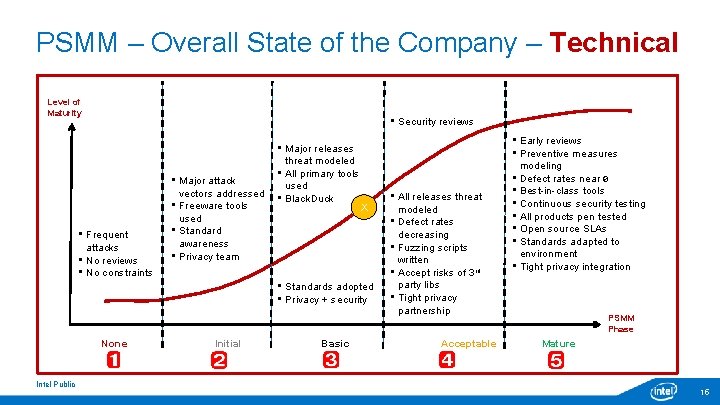
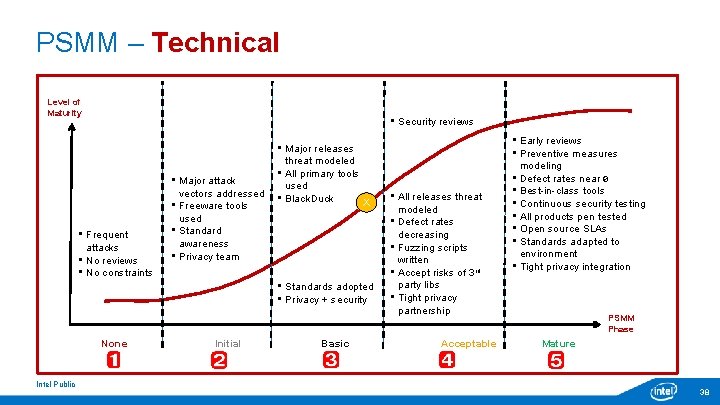
PSMM – Overall State of the Company – Technical Level of Maturity • Security reviews • Frequent attacks • No reviews • No constraints • Major attack vectors addressed • Freeware tools used • Standard awareness • Privacy team • Major releases threat modeled • All primary tools used • Black. Duck X • Standards adopted • Privacy + security None Intel Public Initial Basic • All releases threat modeled • Defect rates decreasing • Fuzzing scripts written • Accept risks of 3 rd party libs • Tight privacy partnership Acceptable • Early reviews • Preventive measures modeling • Defect rates near 0 • Best-in-class tools • Continuous security testing • All products pen tested • Open source SLAs • Standards adapted to environment • Tight privacy integration PSMM Phase Mature 15
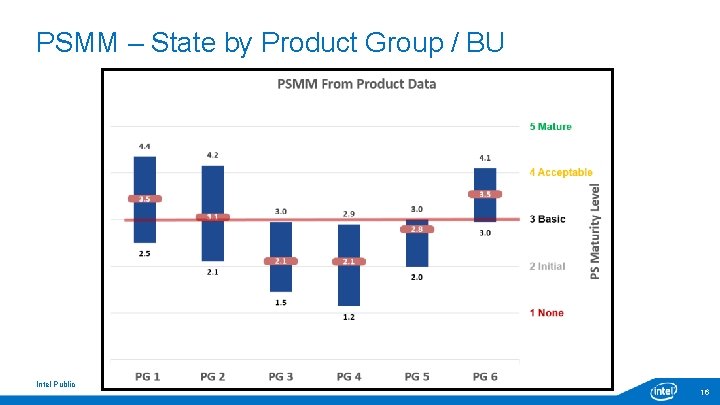
PSMM – State by Product Group / BU Intel Public 16
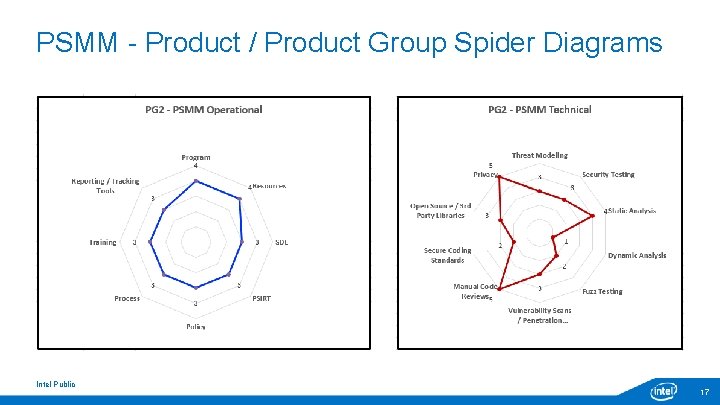
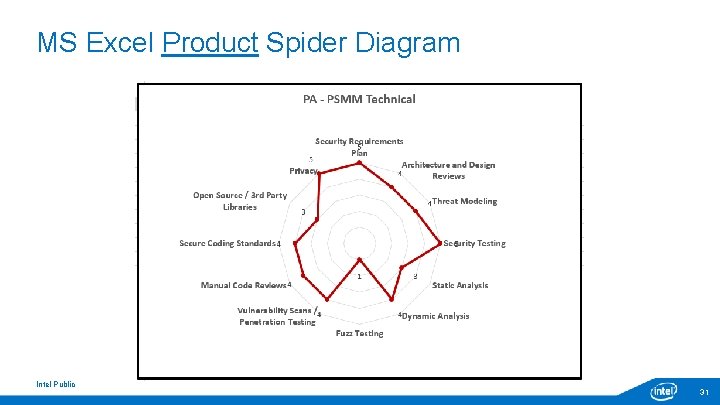
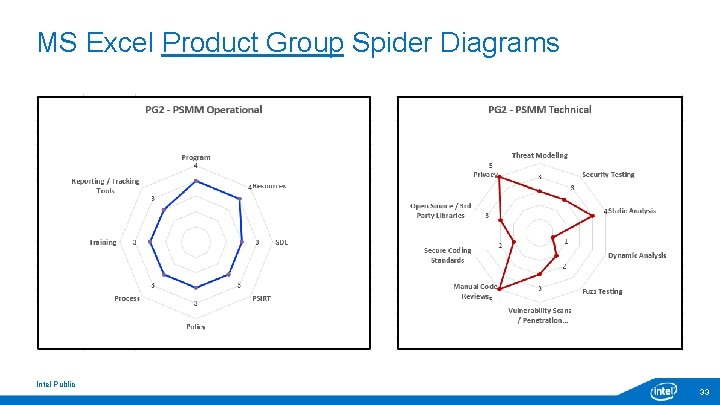
PSMM - Product / Product Group Spider Diagrams Intel Public 17
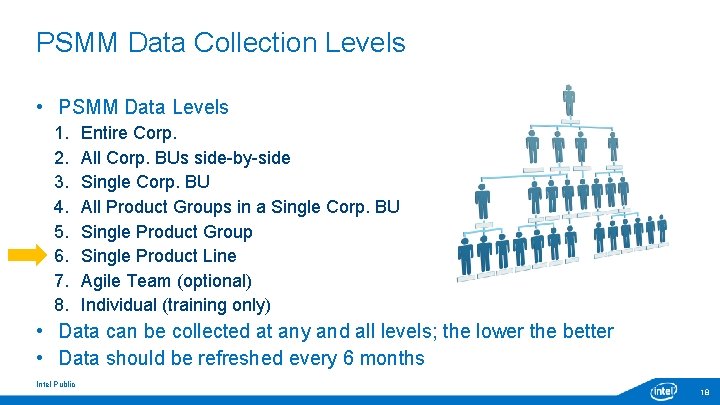
PSMM Data Collection Levels • PSMM Data Levels 1. 2. 3. 4. 5. 6. 7. 8. Entire Corp. All Corp. BUs side-by-side Single Corp. BU All Product Groups in a Single Corp. BU Single Product Group Single Product Line Agile Team (optional) Individual (training only) • Data can be collected at any and all levels; the lower the better • Data should be refreshed every 6 months Intel Public 18
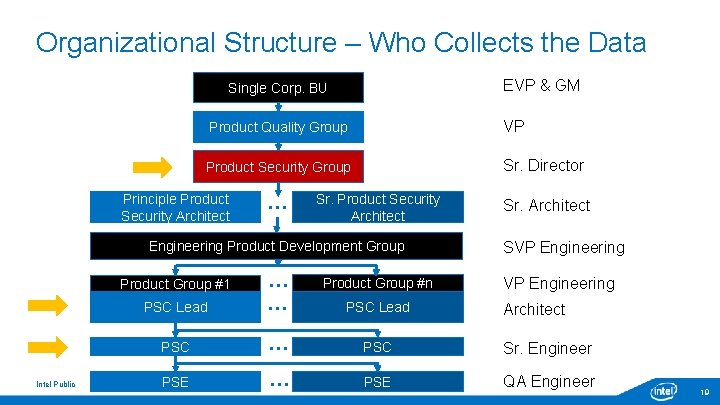
Organizational Structure – Who Collects the Data EVP & GM Single Corp. BU Product Quality Group VP Product Security Group Sr. Director … Sr. Architect Principle Product Security Architect Sr. Product Security Architect Engineering Product Development Group PSC Lead … … PSC Sr. Engineer PSE … PSE QA Engineer Product Group #1 Intel Public SVP Engineering Product Group #n PSC Lead VP Engineering Architect 19
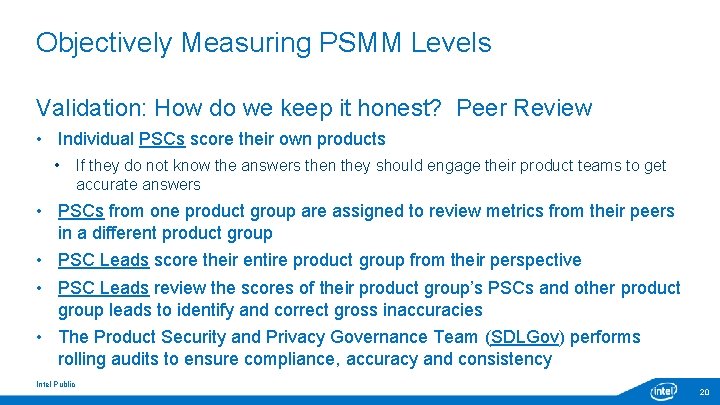
Objectively Measuring PSMM Levels Validation: How do we keep it honest? Peer Review • Individual PSCs score their own products • If they do not know the answers then they should engage their product teams to get accurate answers • PSCs from one product group are assigned to review metrics from their peers in a different product group • PSC Leads score their entire product group from their perspective • PSC Leads review the scores of their product group’s PSCs and other product group leads to identify and correct gross inaccuracies • The Product Security and Privacy Governance Team (SDLGov) performs rolling audits to ensure compliance, accuracy and consistency Intel Public 20
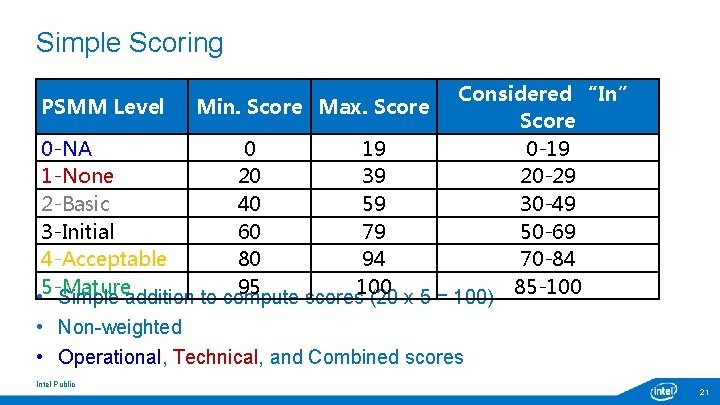
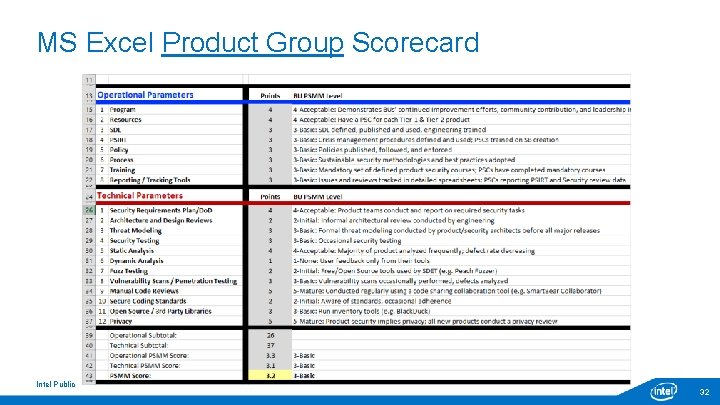
Simple Scoring Considered “In” Score 0 -NA 0 19 0 -19 1 -None 20 39 20 -29 2 -Basic 40 59 30 -49 3 -Initial 60 79 50 -69 4 -Acceptable 80 94 70 -84 95 100 85 -100 • 5 -Mature Simple addition to compute scores (20 x 5 = 100) • Non-weighted PSMM Level Min. Score Max. Score • Operational, Technical, and Combined scores Intel Public 21
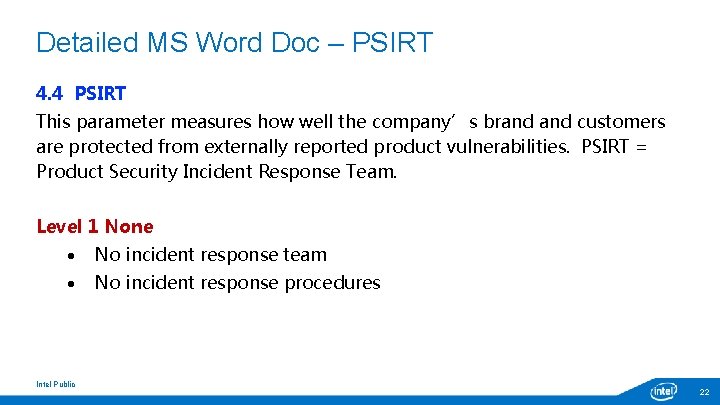
Detailed MS Word Doc – PSIRT 4. 4 PSIRT This parameter measures how well the company’s brand customers are protected from externally reported product vulnerabilities. PSIRT = Product Security Incident Response Team. Level 1 None No incident response team No incident response procedures Intel Public 22
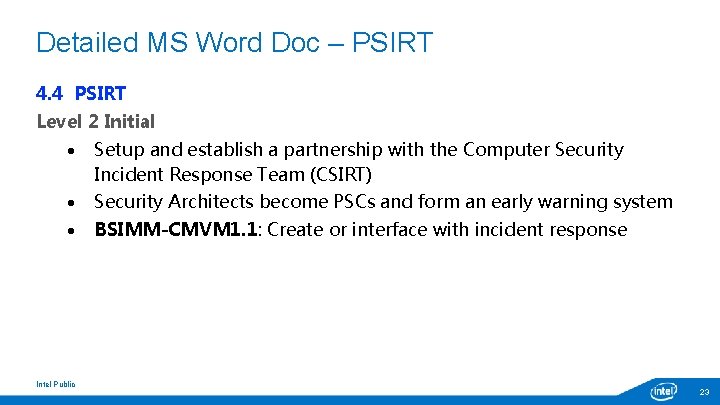
Detailed MS Word Doc – PSIRT 4. 4 PSIRT Level 2 Initial Setup and establish a partnership with the Computer Security Incident Response Team (CSIRT) Security Architects become PSCs and form an early warning system BSIMM-CMVM 1. 1: Create or interface with incident response Intel Public 23
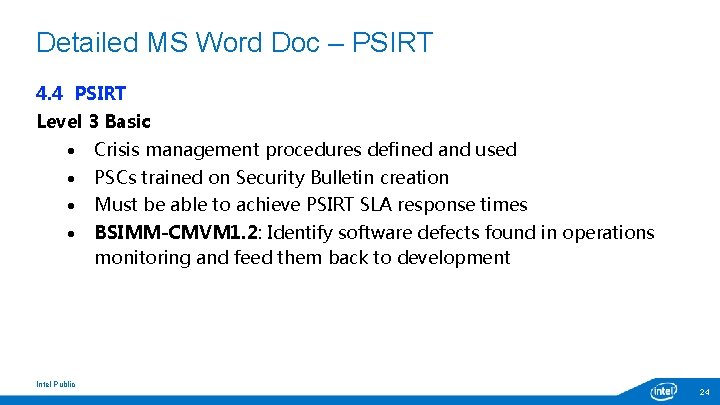
Detailed MS Word Doc – PSIRT 4. 4 PSIRT Level 3 Basic Crisis management procedures defined and used PSCs trained on Security Bulletin creation Must be able to achieve PSIRT SLA response times BSIMM-CMVM 1. 2: Identify software defects found in operations monitoring and feed them back to development Intel Public 24
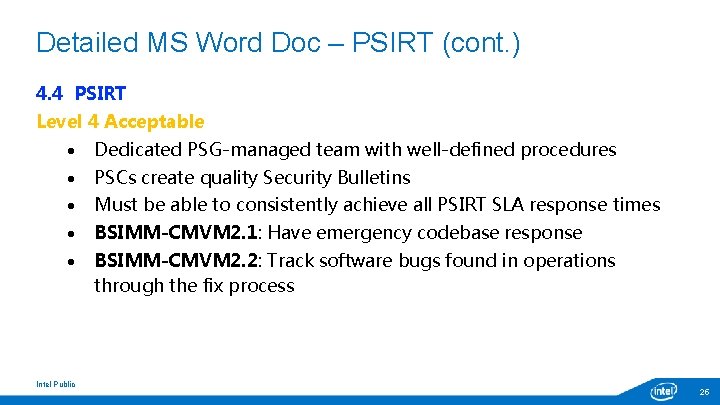
Detailed MS Word Doc – PSIRT (cont. ) 4. 4 PSIRT Level 4 Acceptable Dedicated PSG-managed team with well-defined procedures PSCs create quality Security Bulletins Must be able to consistently achieve all PSIRT SLA response times BSIMM-CMVM 2. 1: Have emergency codebase response BSIMM-CMVM 2. 2: Track software bugs found in operations through the fix process Intel Public 25
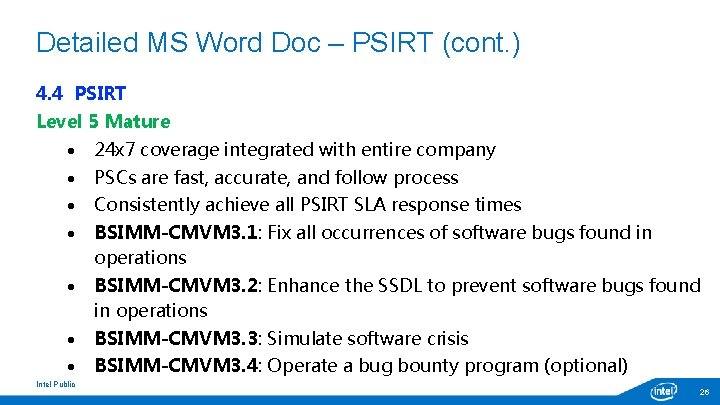
Detailed MS Word Doc – PSIRT (cont. ) 4. 4 PSIRT Level 5 Mature 24 x 7 coverage integrated with entire company PSCs are fast, accurate, and follow process Consistently achieve all PSIRT SLA response times BSIMM-CMVM 3. 1: Fix all occurrences of software bugs found in operations BSIMM-CMVM 3. 2: Enhance the SSDL to prevent software bugs found in operations BSIMM-CMVM 3. 3: Simulate software crisis BSIMM-CMVM 3. 4: Operate a bug bounty program (optional) Intel Public 26
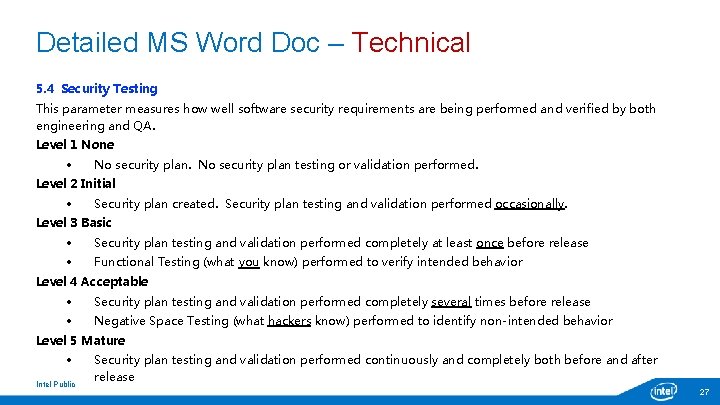
Detailed MS Word Doc – Technical 5. 4 Security Testing This parameter measures how well software security requirements are being performed and verified by both engineering and QA. Level 1 None No security plan testing or validation performed. Level 2 Initial Security plan created. Security plan testing and validation performed occasionally. Level 3 Basic Security plan testing and validation performed completely at least once before release Functional Testing (what you know) performed to verify intended behavior Level 4 Acceptable Security plan testing and validation performed completely several times before release Negative Space Testing (what hackers know) performed to identify non-intended behavior Level 5 Mature Intel Public Security plan testing and validation performed continuously and completely both before and after release 27
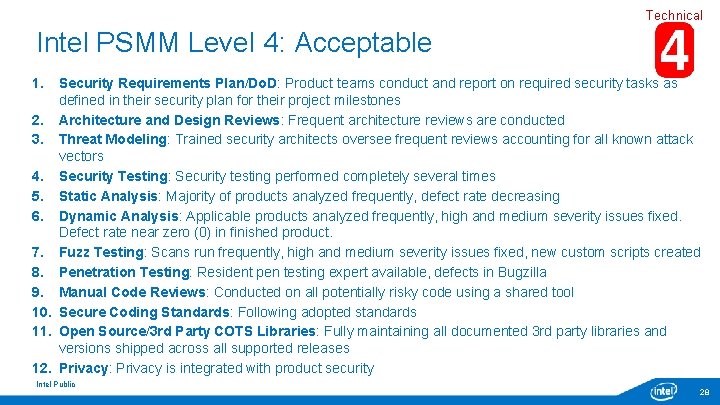
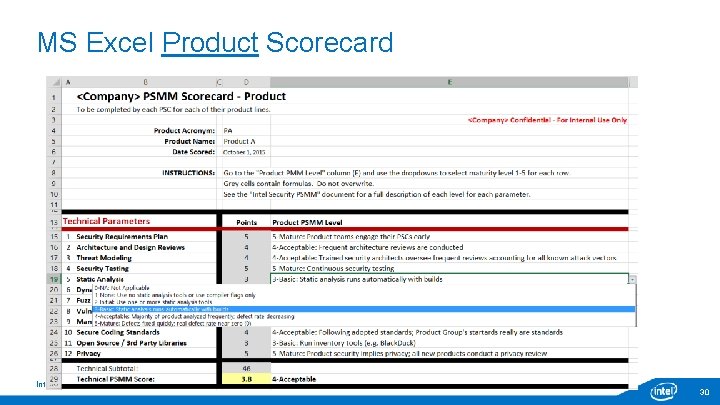
Technical Intel PSMM Level 4: Acceptable 1. Security Requirements Plan/Do. D: Product teams conduct and report on required security tasks as defined in their security plan for their project milestones 2. Architecture and Design Reviews: Frequent architecture reviews are conducted 3. Threat Modeling: Trained security architects oversee frequent reviews accounting for all known attack vectors 4. Security Testing: Security testing performed completely several times 5. Static Analysis: Majority of products analyzed frequently, defect rate decreasing 6. Dynamic Analysis: Applicable products analyzed frequently, high and medium severity issues fixed. Defect rate near zero (0) in finished product. 7. Fuzz Testing: Scans run frequently, high and medium severity issues fixed, new custom scripts created 8. Penetration Testing: Resident pen testing expert available, defects in Bugzilla 9. Manual Code Reviews: Conducted on all potentially risky code using a shared tool 10. Secure Coding Standards: Following adopted standards 11. Open Source/3 rd Party COTS Libraries: Fully maintaining all documented 3 rd party libraries and versions shipped across all supported releases 12. Privacy: Privacy is integrated with product security Intel Public 28
MS Excel Drop Down Lists Intel Public 29
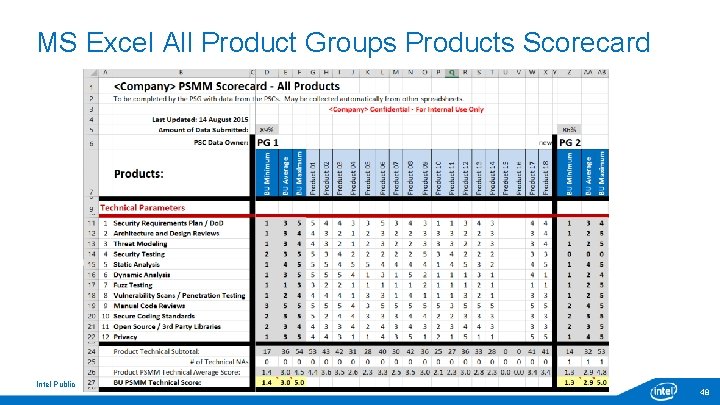
MS Excel Product Scorecard Intel Public 30
MS Excel Product Spider Diagram Intel Public 31
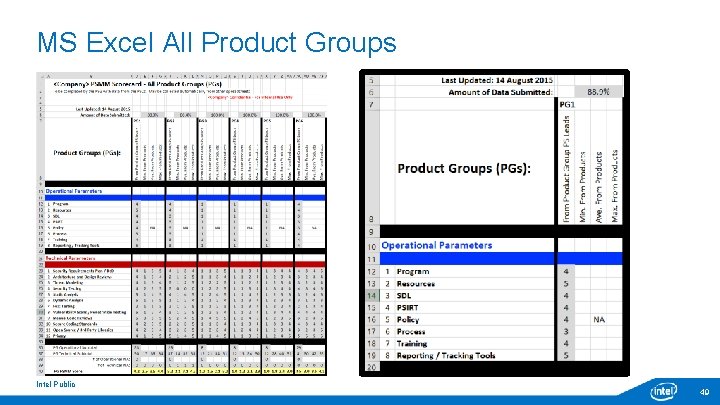
MS Excel Product Group Scorecard Intel Public 32
MS Excel Product Group Spider Diagrams Intel Public 33
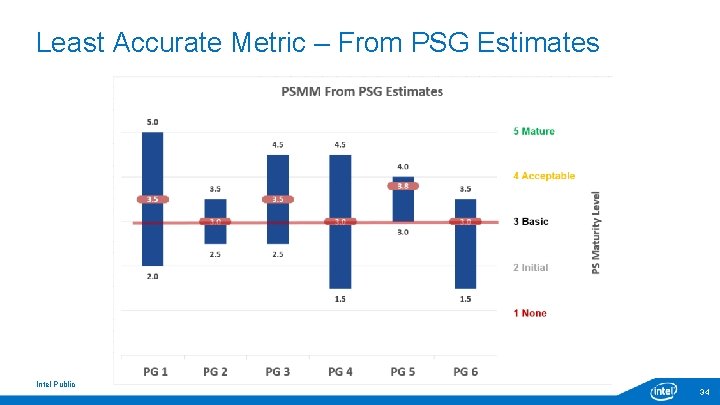
Least Accurate Metric – From PSG Estimates Intel Public 34
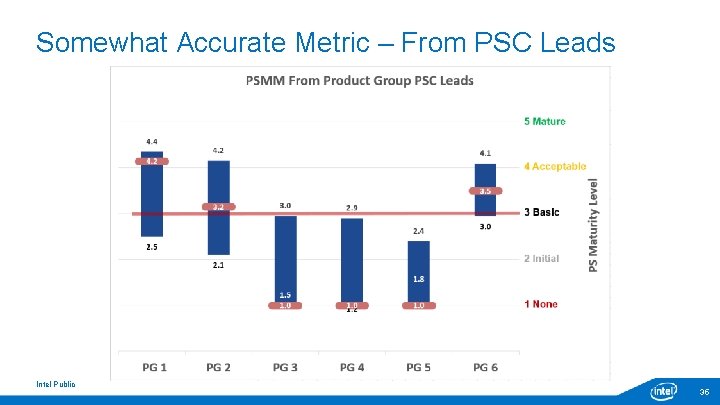
Somewhat Accurate Metric – From PSC Leads Intel Public 35
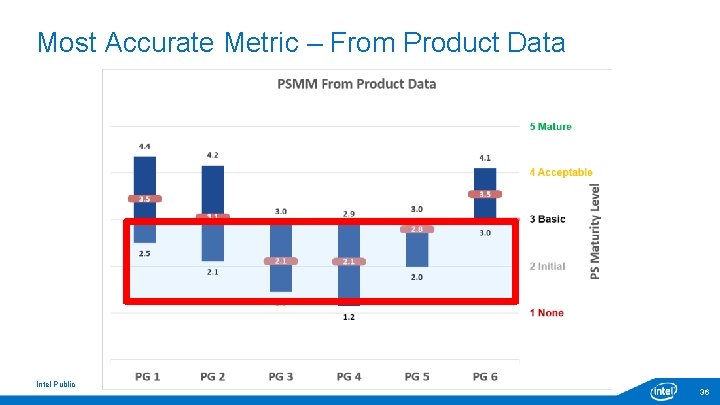
Most Accurate Metric – From Product Data Intel Public 36
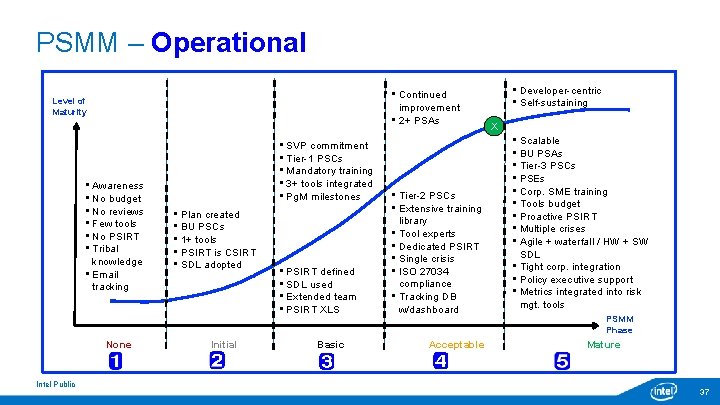
PSMM – Operational • Continued improvement • 2+ PSAs Level of Maturity • Awareness • No budget • No reviews • Few tools • No PSIRT • Tribal knowledge • Email tracking None Intel Public • SVP commitment • Tier-1 PSCs • Mandatory training • 3+ tools integrated • Pg. M milestones • Plan created • BU PSCs • 1+ tools • PSIRT is CSIRT • SDL adopted Initial • PSIRT defined • SDL used • Extended team • PSIRT XLS Basic • Tier-2 PSCs • Extensive training library • Tool experts • Dedicated PSIRT • Single crisis • ISO 27034 compliance • Tracking DB w/dashboard Acceptable • Developer-centric • Self-sustaining X • Scalable • BU PSAs • Tier-3 PSCs • PSEs • Corp. SME training • Tools budget • Proactive PSIRT • Multiple crises • Agile + waterfall / HW + SW SDL • Tight corp. integration • Policy executive support • Metrics integrated into risk mgt. tools PSMM Phase Mature 37
PSMM – Technical Level of Maturity • Security reviews • Frequent attacks • No reviews • No constraints • Major attack vectors addressed • Freeware tools used • Standard awareness • Privacy team • Major releases threat modeled • All primary tools used • Black. Duck X • Standards adopted • Privacy + security None Intel Public Initial Basic • All releases threat modeled • Defect rates decreasing • Fuzzing scripts written • Accept risks of 3 rd party libs • Tight privacy partnership Acceptable • Early reviews • Preventive measures modeling • Defect rates near 0 • Best-in-class tools • Continuous security testing • All products pen tested • Open source SLAs • Standards adapted to environment • Tight privacy integration PSMM Phase Mature 38
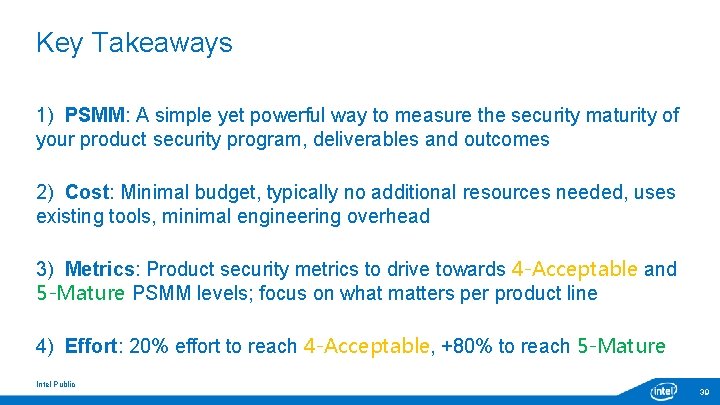
Key Takeaways 1) PSMM: A simple yet powerful way to measure the security maturity of your product security program, deliverables and outcomes 2) Cost: Minimal budget, typically no additional resources needed, uses existing tools, minimal engineering overhead 3) Metrics: Product security metrics to drive towards 4 -Acceptable and 5 -Mature PSMM levels; focus on what matters per product line 4) Effort: 20% effort to reach 4 -Acceptable, +80% to reach 5 -Mature Intel Public 39
Q&A Harold Toomey Sr. Product Security Architect Product Security Group Intel Security Harold. A. Toomey@Intel. com W: (972) 963 -7754 M: (801) 830 -9987 Intel Public 40
Intel Public
Backup Slides Intel Public 42
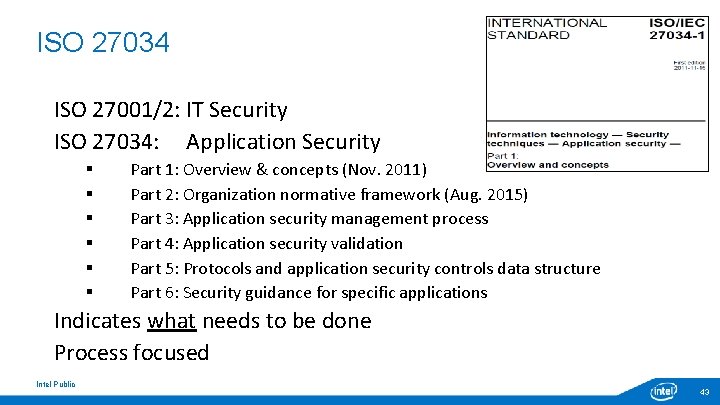
ISO 27034 ISO 27001/2: IT Security ISO 27034: Application Security § § § Part 1: Overview & concepts (Nov. 2011) Part 2: Organization normative framework (Aug. 2015) Part 3: Application security management process Part 4: Application security validation Part 5: Protocols and application security controls data structure Part 6: Security guidance for specific applications Indicates what needs to be done Process focused Intel Public 43
Agile SDLC Design Build Verify Requirements RTW Architecture Backlog PS I Sprints Evolving Architecture Intel Public Sprint 1 … Sprint n Attack & Penetration Testing Hardening, Innovation, Planning 44
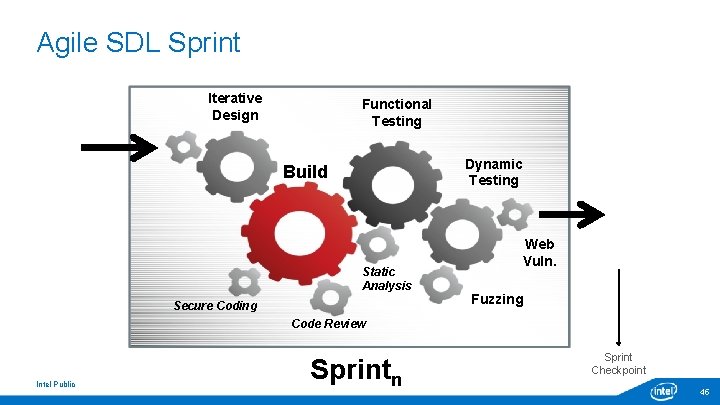
Agile SDL Sprint Iterative Design Functional Testing Dynamic Testing Build Static Analysis Secure Coding Web Vuln. Fuzzing Code Review Intel Public Sprintn Sprint Checkpoint 45
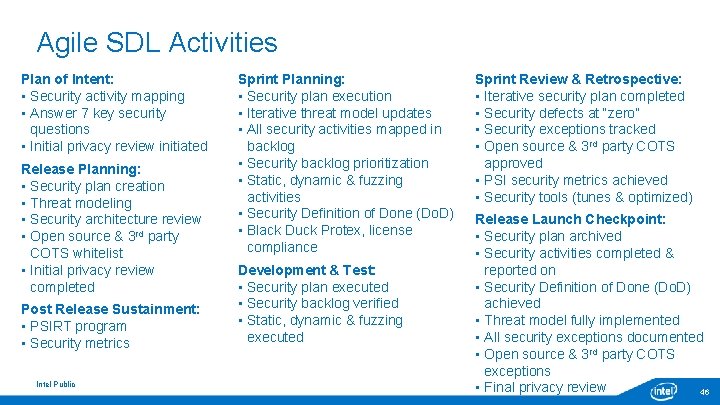
Agile SDL Activities Plan of Intent: • Security activity mapping • Answer 7 key security questions • Initial privacy review initiated Release Planning: • Security plan creation • Threat modeling • Security architecture review • Open source & 3 rd party COTS whitelist • Initial privacy review completed Post Release Sustainment: • PSIRT program • Security metrics Intel Public Sprint Planning: • Security plan execution • Iterative threat model updates • All security activities mapped in backlog • Security backlog prioritization • Static, dynamic & fuzzing activities • Security Definition of Done (Do. D) • Black Duck Protex, license compliance Development & Test: • Security plan executed • Security backlog verified • Static, dynamic & fuzzing executed Sprint Review & Retrospective: • Iterative security plan completed • Security defects at “zero” • Security exceptions tracked • Open source & 3 rd party COTS approved • PSI security metrics achieved • Security tools (tunes & optimized) Release Launch Checkpoint: • Security plan archived • Security activities completed & reported on • Security Definition of Done (Do. D) achieved • Threat model fully implemented • All security exceptions documented • Open source & 3 rd party COTS exceptions • Final privacy review 46
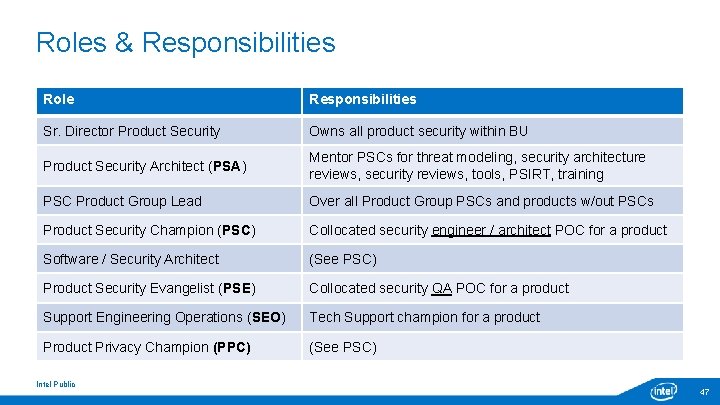
Roles & Responsibilities Role Responsibilities Sr. Director Product Security Owns all product security within BU Product Security Architect (PSA) Mentor PSCs for threat modeling, security architecture reviews, security reviews, tools, PSIRT, training PSC Product Group Lead Over all Product Group PSCs and products w/out PSCs Product Security Champion (PSC) Collocated security engineer / architect POC for a product Software / Security Architect (See PSC) Product Security Evangelist (PSE) Collocated security QA POC for a product Support Engineering Operations (SEO) Tech Support champion for a product Privacy Champion (PPC) (See PSC) Intel Public 47
MS Excel All Product Groups Products Scorecard Intel Public 48
MS Excel All Product Groups Intel Public 49
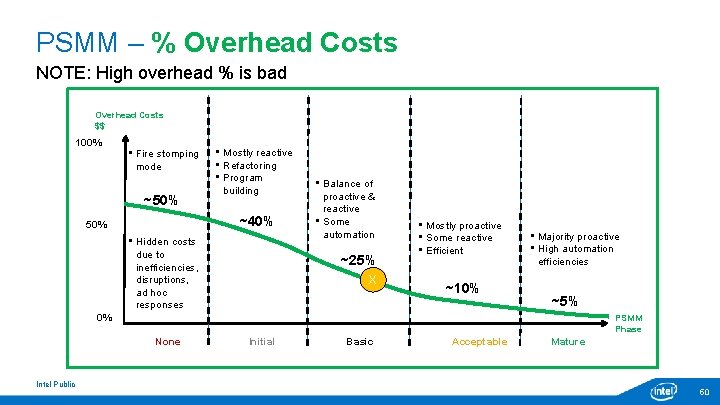
PSMM – % Overhead Costs NOTE: High overhead % is bad Overhead Costs $$ 100% • Fire stomping mode ~50% • Mostly reactive • Refactoring • Program building ~40% 50% • Hidden costs due to inefficiencies, disruptions, ad hoc responses • Balance of proactive & reactive • Some automation ~25% X • Mostly proactive • Some reactive • Efficient ~10% • Majority proactive • High automation efficiencies ~5% 0% PSMM Phase None Intel Public Initial Basic Acceptable Mature 50