
INTELLIGENT WIRELESS TECHNOLOGY USAGE EFFECT IN CONTEXT OF
- Slides: 1
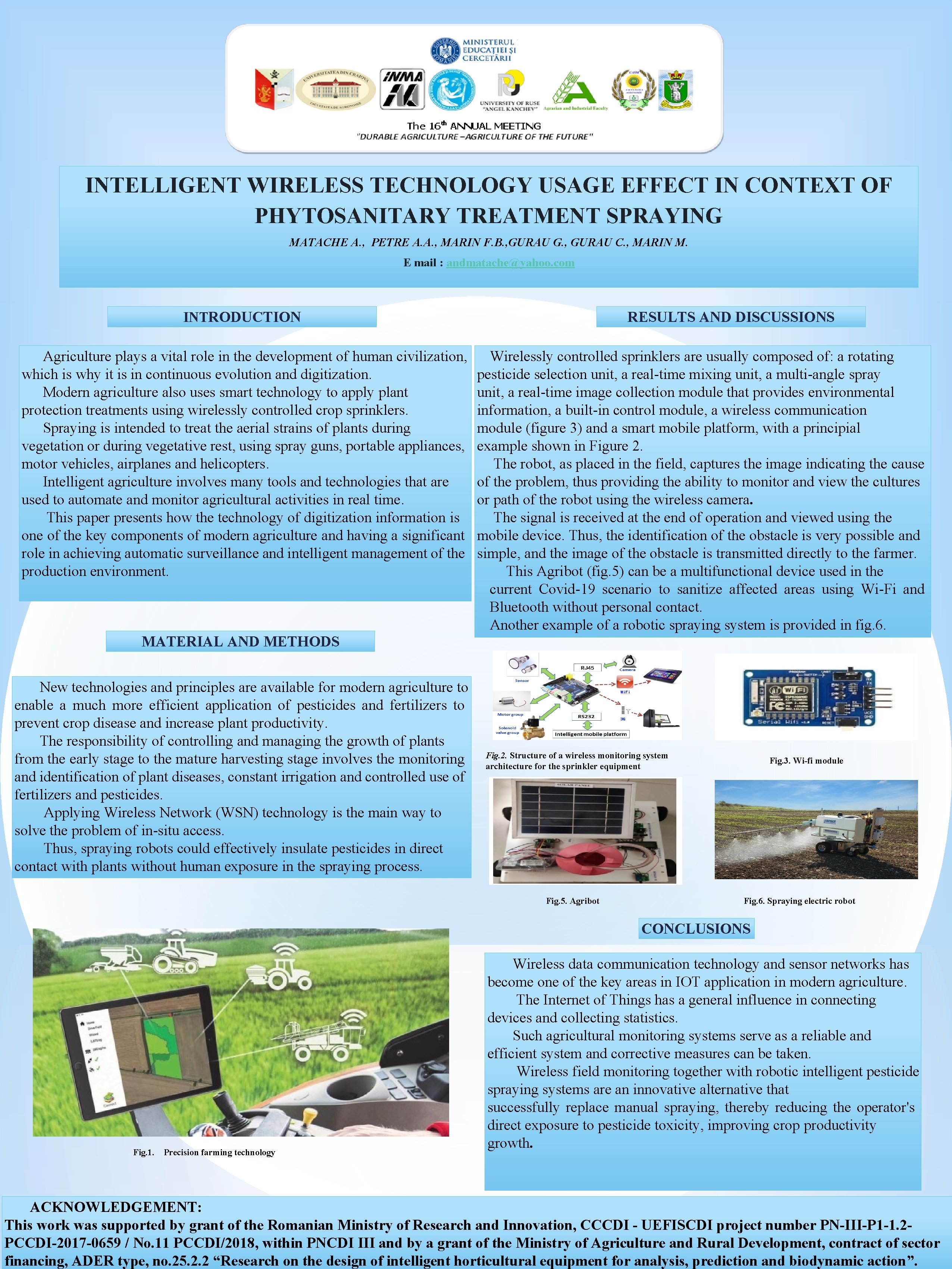
INTELLIGENT WIRELESS TECHNOLOGY USAGE EFFECT IN CONTEXT OF PHYTOSANITARY TREATMENT SPRAYING MATACHE A. , PETRE A. A. , MARIN F. B. , GURAU G. , GURAU C. , MARIN M. E mail : andmatache@yahoo. com INTRODUCTION Agriculture plays a vital role in the development of human civilization, which is why it is in continuous evolution and digitization. Modern agriculture also uses smart technology to apply plant protection treatments using wirelessly controlled crop sprinklers. Spraying is intended to treat the aerial strains of plants during vegetation or during vegetative rest, using spray guns, portable appliances, motor vehicles, airplanes and helicopters. Intelligent agriculture involves many tools and technologies that are used to automate and monitor agricultural activities in real time. This paper presents how the technology of digitization information is one of the key components of modern agriculture and having a significant role in achieving automatic surveillance and intelligent management of the production environment. RESULTS AND DISCUSSIONS Wirelessly controlled sprinklers are usually composed of: a rotating pesticide selection unit, a real-time mixing unit, a multi-angle spray unit, a real-time image collection module that provides environmental information, a built-in control module, a wireless communication module (figure 3) and a smart mobile platform, with a principial example shown in Figure 2. The robot, as placed in the field, captures the image indicating the cause of the problem, thus providing the ability to monitor and view the cultures or path of the robot using the wireless camera. The signal is received at the end of operation and viewed using the mobile device. Thus, the identification of the obstacle is very possible and simple, and the image of the obstacle is transmitted directly to the farmer. This Agribot (fig. 5) can be a multifunctional device used in the current Covid-19 scenario to sanitize affected areas using Wi-Fi and Bluetooth without personal contact. Another example of a robotic spraying system is provided in fig. 6. MATERIAL AND METHODS New technologies and principles are available for modern agriculture to enable a much more efficient application of pesticides and fertilizers to prevent crop disease and increase plant productivity. The responsibility of controlling and managing the growth of plants from the early stage to the mature harvesting stage involves the monitoring and identification of plant diseases, constant irrigation and controlled use of fertilizers and pesticides. Applying Wireless Network (WSN) technology is the main way to solve the problem of in-situ access. Thus, spraying robots could effectively insulate pesticides in direct contact with plants without human exposure in the spraying process. Fig. 2. Structure of a wireless monitoring system architecture for the sprinkler equipment Fig. 5. Agribot Fig. 3. Wi-fi module Fig. 6. Spraying electric robot CONCLUSIONS Fig. 1. Precision farming technology Wireless data communication technology and sensor networks has become one of the key areas in IOT application in modern agriculture. The Internet of Things has a general influence in connecting devices and collecting statistics. Such agricultural monitoring systems serve as a reliable and efficient system and corrective measures can be taken. Wireless field monitoring together with robotic intelligent pesticide spraying systems are an innovative alternative that successfully replace manual spraying, thereby reducing the operator's direct exposure to pesticide toxicity, improving crop productivity growth. ACKNOWLEDGEMENT: This work was supported by grant of the Romanian Ministry of Research and Innovation, CCCDI - UEFISCDI project number PN-III-P 1 -1. 2 PCCDI-2017 -0659 / No. 11 PCCDI/2018, within PNCDI III and by a grant of the Ministry of Agriculture and Rural Development, contract of sector financing, ADER type, no. 25. 2. 2 “Research on the design of intelligent horticultural equipment for analysis, prediction and biodynamic action”.