
INTELLIGENT SYSTEMS ENGINEERING Graduate Student Orientation August 13

- Slides: 25
INTELLIGENT SYSTEMS ENGINEERING Graduate Student Orientation August 13, 2018 INDIANA UNIVERSITY BLOOMINGTON
Hello! New Graduate Students • Third year of Ph. D. and Undergraduate • First year of Masters • Current Ph. D population- 40 • Incoming class of Ph. D students: 23 • Incoming class of MS - 10 • New students hail from - Columbia, China, India, Pakistan, Turkey, Sri Lanka, South Korea and the USA. INDIANA UNIVERSITY BLOOMINGTON
History of SICE • 2000: School of Informatics established—first of its kind in the United States. • 2005: Computer Science (established in 1971) becomes part of the school • 2009: Becomes School of Informatics and Computing • 2013: Library and Information Science (established in 1951) joins the school • 2015: Data Science Program launched • 2016: Intelligent Systems Engineering launches • 2017: Becomes School of Informatics, Computing, and Engineering INDIANA UNIVERSITY BLOOMINGTON
Size of School (2017 -18) Faculty Students Research Expenditures 129 Undergraduate $13 M (101 Tenure Track) 1, 904 Graduate Students 1, 101 INDIANA UNIVERSITY BLOOMINGTON (2017 -2018)
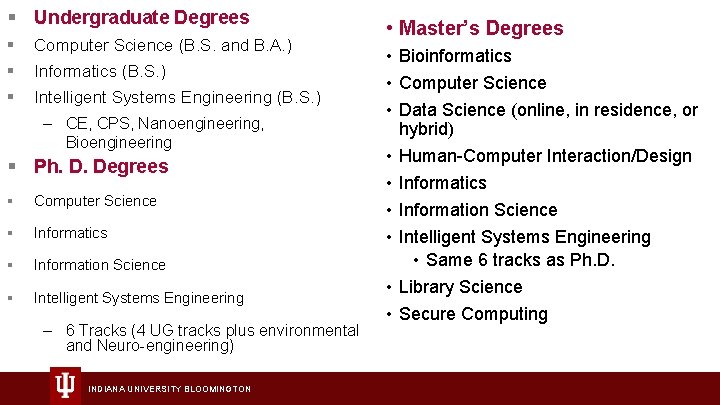
§ Undergraduate Degrees § Computer Science (B. S. and B. A. ) § Informatics (B. S. ) § Intelligent Systems Engineering (B. S. ) – CE, CPS, Nanoengineering, Bioengineering § Ph. D. Degrees § Computer Science § Informatics § Information Science § Intelligent Systems Engineering – 6 Tracks (4 UG tracks plus environmental and Neuro-engineering) INDIANA UNIVERSITY BLOOMINGTON • Master’s Degrees • Bioinformatics • Computer Science • Data Science (online, in residence, or hybrid) • Human-Computer Interaction/Design • Informatics • Information Science • Intelligent Systems Engineering • Same 6 tracks as Ph. D. • Library Science • Secure Computing
What is Intelligent Systems Engineering?
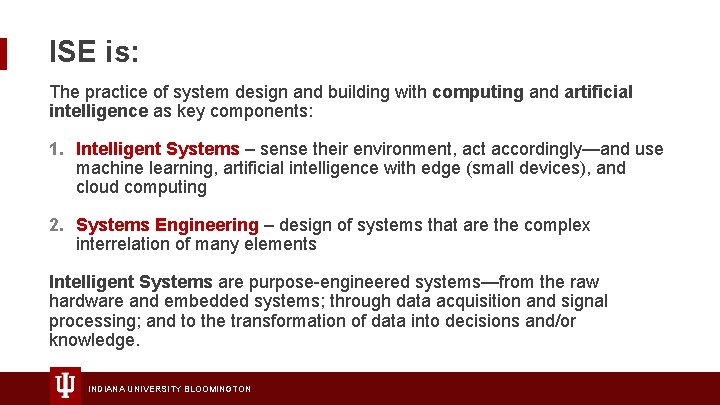
ISE is: The practice of system design and building with computing and artificial intelligence as key components: 1. Intelligent Systems – sense their environment, act accordingly—and use machine learning, artificial intelligence with edge (small devices), and cloud computing 2. Systems Engineering – design of systems that are the complex interrelation of many elements Intelligent Systems are purpose-engineered systems—from the raw hardware and embedded systems; through data acquisition and signal processing; and to the transformation of data into decisions and/or knowledge. INDIANA UNIVERSITY BLOOMINGTON
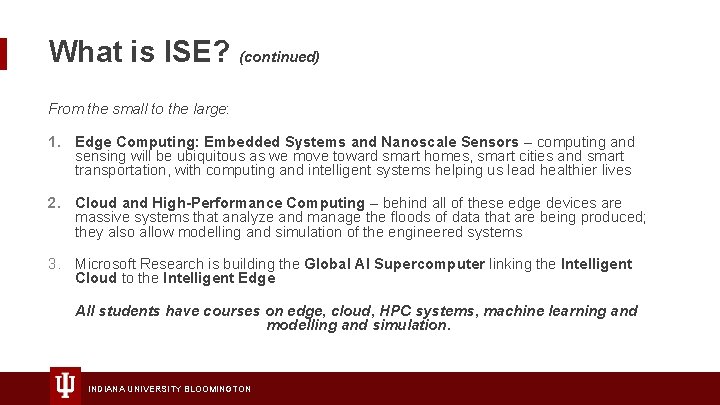
What is ISE? (continued) From the small to the large: 1. Edge Computing: Embedded Systems and Nanoscale Sensors – computing and sensing will be ubiquitous as we move toward smart homes, smart cities and smart transportation, with computing and intelligent systems helping us lead healthier lives 2. Cloud and High-Performance Computing – behind all of these edge devices are massive systems that analyze and manage the floods of data that are being produced; they also allow modelling and simulation of the engineered systems 3. Microsoft Research is building the Global AI Supercomputer linking the Intelligent Cloud to the Intelligent Edge All students have courses on edge, cloud, HPC systems, machine learning and modelling and simulation. INDIANA UNIVERSITY BLOOMINGTON
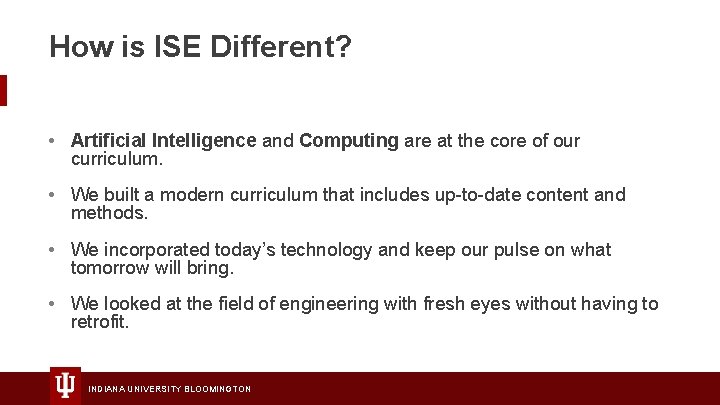
How is ISE Different? • Artificial Intelligence and Computing are at the core of our curriculum. • We built a modern curriculum that includes up-to-date content and methods. • We incorporated today’s technology and keep our pulse on what tomorrow will bring. • We looked at the field of engineering with fresh eyes without having to retrofit. INDIANA UNIVERSITY BLOOMINGTON
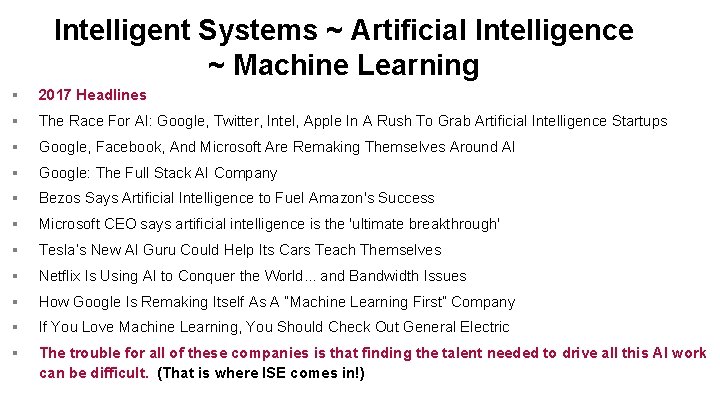
Intelligent Systems ~ Artificial Intelligence ~ Machine Learning § 2017 Headlines § The Race For AI: Google, Twitter, Intel, Apple In A Rush To Grab Artificial Intelligence Startups § Google, Facebook, And Microsoft Are Remaking Themselves Around AI § Google: The Full Stack AI Company § Bezos Says Artificial Intelligence to Fuel Amazon's Success § Microsoft CEO says artificial intelligence is the 'ultimate breakthrough' § Tesla’s New AI Guru Could Help Its Cars Teach Themselves § Netflix Is Using AI to Conquer the World. . . and Bandwidth Issues § How Google Is Remaking Itself As A “Machine Learning First” Company § If You Love Machine Learning, You Should Check Out General Electric § The trouble for all of these companies is that finding the talent needed to drive all this AI work can be difficult. (That is where ISE comes in!)
Graduate Program in Intelligent Systems Engineering?
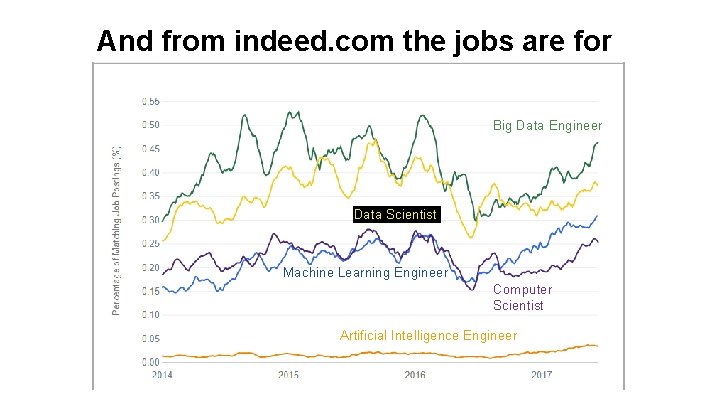
And from indeed. com the jobs are for Big Data Engineer Data Scientist Machine Learning Engineer Computer Scientist Artificial Intelligence Engineer
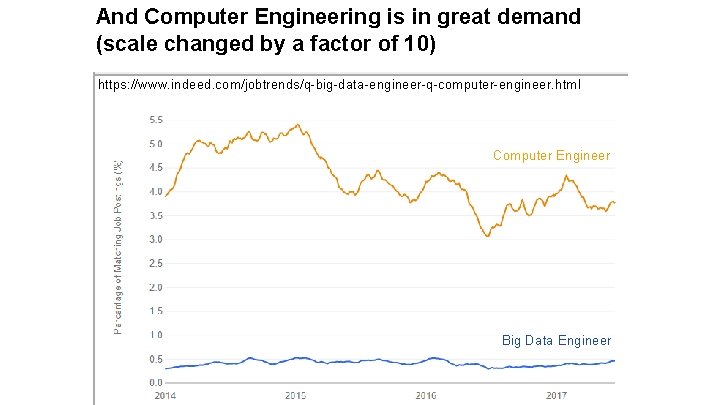
And Computer Engineering is in great demand (scale changed by a factor of 10) https: //www. indeed. com/jobtrends/q-big-data-engineer-q-computer-engineer. html Computer Engineer Big Data Engineer
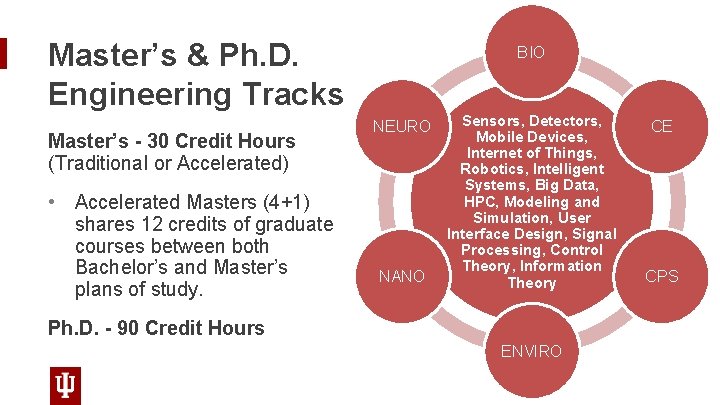
Master’s & Ph. D. Engineering Tracks Master’s - 30 Credit Hours (Traditional or Accelerated) • Accelerated Masters (4+1) shares 12 credits of graduate courses between both Bachelor’s and Master’s plans of study. BIO NEURO NANO Sensors, Detectors, Mobile Devices, Internet of Things, Robotics, Intelligent Systems, Big Data, HPC, Modeling and Simulation, User Interface Design, Signal Processing, Control Theory, Information Theory Ph. D. - 90 Credit Hours ENVIRO CE CPS
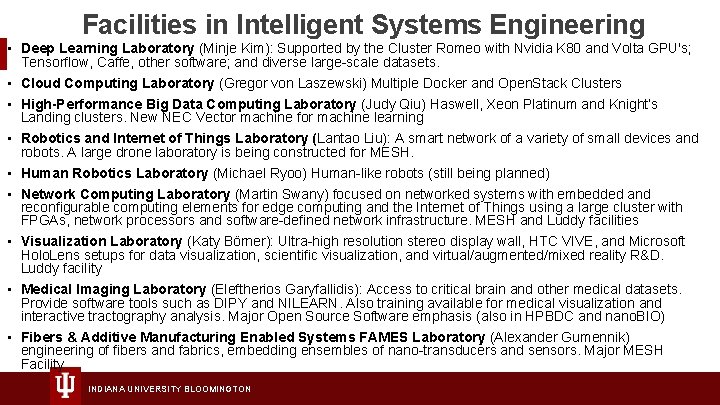
Facilities in Intelligent Systems Engineering • Deep Learning Laboratory (Minje Kim): Supported by the Cluster Romeo with Nvidia K 80 and Volta GPU's; Tensorflow, Caffe, other software; and diverse large-scale datasets. • Cloud Computing Laboratory (Gregor von Laszewski) Multiple Docker and Open. Stack Clusters • High-Performance Big Data Computing Laboratory (Judy Qiu) Haswell, Xeon Platinum and Knight’s Landing clusters. New NEC Vector machine for machine learning • Robotics and Internet of Things Laboratory (Lantao Liu): A smart network of a variety of small devices and robots. A large drone laboratory is being constructed for MESH. • Human Robotics Laboratory (Michael Ryoo) Human-like robots (still being planned) • Network Computing Laboratory (Martin Swany) focused on networked systems with embedded and reconfigurable computing elements for edge computing and the Internet of Things using a large cluster with FPGAs, network processors and software-defined network infrastructure. MESH and Luddy facilities • Visualization Laboratory (Katy Börner): Ultra-high resolution stereo display wall, HTC VIVE, and Microsoft Holo. Lens setups for data visualization, scientific visualization, and virtual/augmented/mixed reality R&D. Luddy facility • Medical Imaging Laboratory (Eleftherios Garyfallidis): Access to critical brain and other medical datasets. Provide software tools such as DIPY and NILEARN. Also training available for medical visualization and interactive tractography analysis. Major Open Source Software emphasis (also in HPBDC and nano. BIO) • Fibers & Additive Manufacturing Enabled Systems FAMES Laboratory (Alexander Gumennik) engineering of fibers and fabrics, embedding ensembles of nano-transducers and sensors. Major MESH Facility INDIANA UNIVERSITY BLOOMINGTON
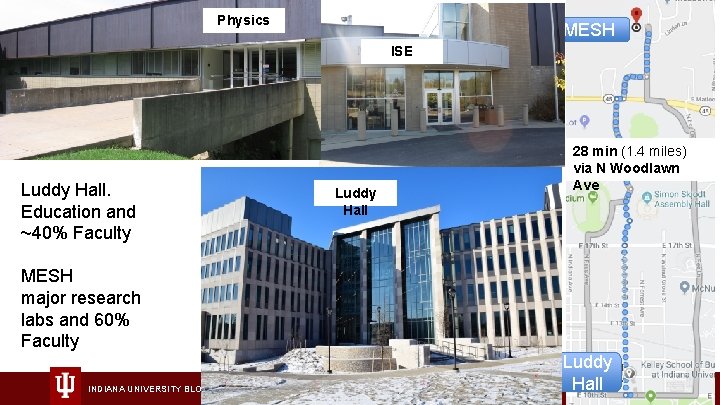
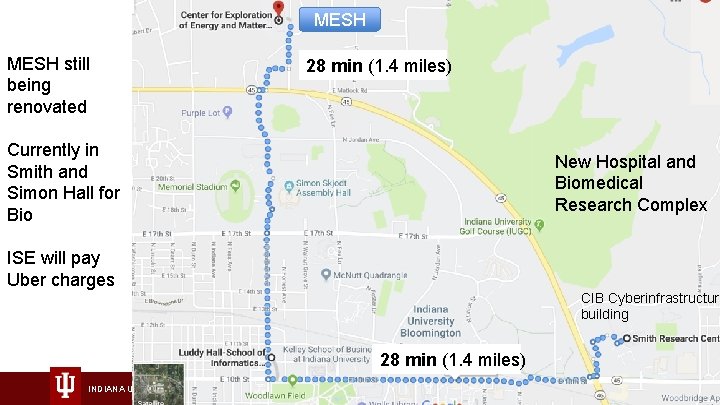
Physics MESH ISE Luddy Hall. Education and ~40% Faculty Luddy Hall 28 min (1. 4 miles) via N Woodlawn Ave MESH major research labs and 60% Faculty INDIANA UNIVERSITY BLOOMINGTON Luddy Hall
MESH still being renovated 28 min (1. 4 miles) Currently in Smith and Simon Hall for Bio New Hospital and Biomedical Research Complex ISE will pay Uber charges CIB Cyberinfrastructure building 28 min (1. 4 miles) INDIANA UNIVERSITY BLOOMINGTON
Intelligent Systems Engineering Meet Our Faculty
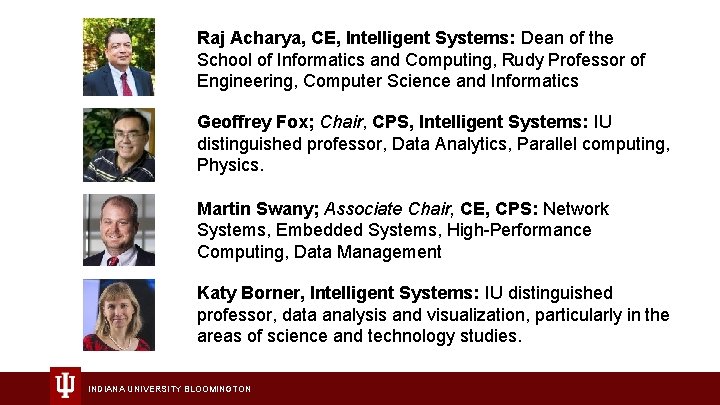
Raj Acharya, CE, Intelligent Systems: Dean of the School of Informatics and Computing, Rudy Professor of Engineering, Computer Science and Informatics Geoffrey Fox; Chair, CPS, Intelligent Systems: IU distinguished professor, Data Analytics, Parallel computing, Physics. Martin Swany; Associate Chair, CE, CPS: Network Systems, Embedded Systems, High-Performance Computing, Data Management Katy Borner, Intelligent Systems: IU distinguished professor, data analysis and visualization, particularly in the areas of science and technology studies. INDIANA UNIVERSITY BLOOMINGTON
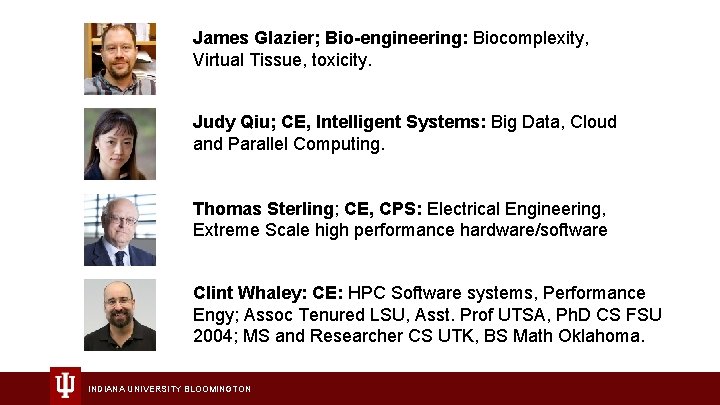
James Glazier; Bio-engineering: Biocomplexity, Virtual Tissue, toxicity. Judy Qiu; CE, Intelligent Systems: Big Data, Cloud and Parallel Computing. Thomas Sterling; CE, CPS: Electrical Engineering, Extreme Scale high performance hardware/software Clint Whaley: CE: HPC Software systems, Performance Engy; Assoc Tenured LSU, Asst. Prof UTSA, Ph. D CS FSU 2004; MS and Researcher CS UTK, BS Math Oklahoma. INDIANA UNIVERSITY BLOOMINGTON
Lei Jiang, CE: HPC hardware studies; Undergrad Computer Science, MS and Ph. D (Pittsburgh) in Computer Engineering; Industry work with AMD as Senior Design Engineer. Minje Kim, Intelligent Systems: signal processing & machine learning in multimedia area; Undergrad and MS in computer engineering; Ph. D (UIUC) in Computer Science Vikram Jadhao, Nanoengineering: HPC simulation; Physics (UIUC Ph. D); Postdocs in Department of Materials Science and Engineering at Northwestern; Physics at JHU Alexander Gumennik, Nanoengineering; Intelligent fibers & 3 D printing; Physics & Math Undergraduate, Applied Physics Masters & Ph. D (Hebrew University), Postdoc Materials Science & Engineering (MIT), Industry Process Engineer in 3 D printing INDIANA UNIVERSITY BLOOMINGTON
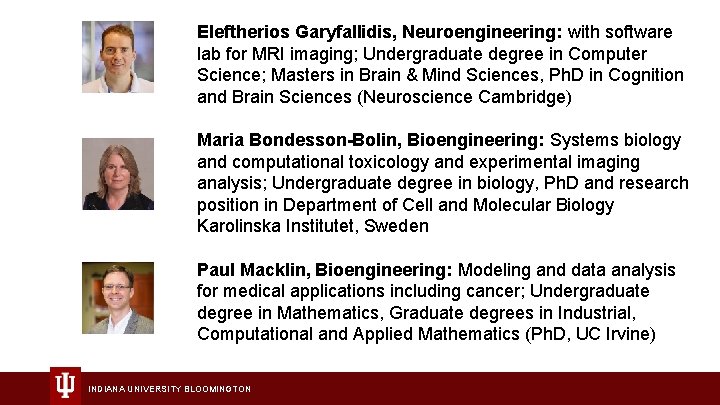
Eleftherios Garyfallidis, Neuroengineering: with software lab for MRI imaging; Undergraduate degree in Computer Science; Masters in Brain & Mind Sciences, Ph. D in Cognition and Brain Sciences (Neuroscience Cambridge) Maria Bondesson-Bolin, Bioengineering: Systems biology and computational toxicology and experimental imaging analysis; Undergraduate degree in biology, Ph. D and research position in Department of Cell and Molecular Biology Karolinska Institutet, Sweden Paul Macklin, Bioengineering: Modeling and data analysis for medical applications including cancer; Undergraduate degree in Mathematics, Graduate degrees in Industrial, Computational and Applied Mathematics (Ph. D, UC Irvine) INDIANA UNIVERSITY BLOOMINGTON
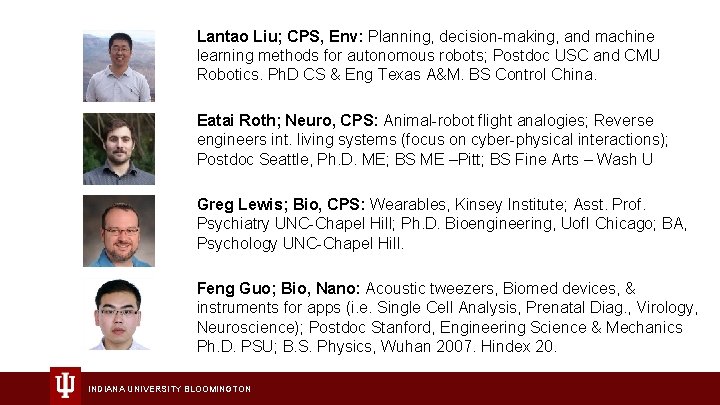
Lantao Liu; CPS, Env: Planning, decision-making, and machine learning methods for autonomous robots; Postdoc USC and CMU Robotics. Ph. D CS & Eng Texas A&M. BS Control China. Eatai Roth; Neuro, CPS: Animal-robot flight analogies; Reverse engineers int. living systems (focus on cyber-physical interactions); Postdoc Seattle, Ph. D. ME; BS ME –Pitt; BS Fine Arts – Wash U Greg Lewis; Bio, CPS: Wearables, Kinsey Institute; Asst. Prof. Psychiatry UNC-Chapel Hill; Ph. D. Bioengineering, Uof. I Chicago; BA, Psychology UNC-Chapel Hill. Feng Guo; Bio, Nano: Acoustic tweezers, Biomed devices, & instruments for apps (i. e. Single Cell Analysis, Prenatal Diag. , Virology, Neuroscience); Postdoc Stanford, Engineering Science & Mechanics Ph. D. PSU; B. S. Physics, Wuhan 2007. Hindex 20. INDIANA UNIVERSITY BLOOMINGTON
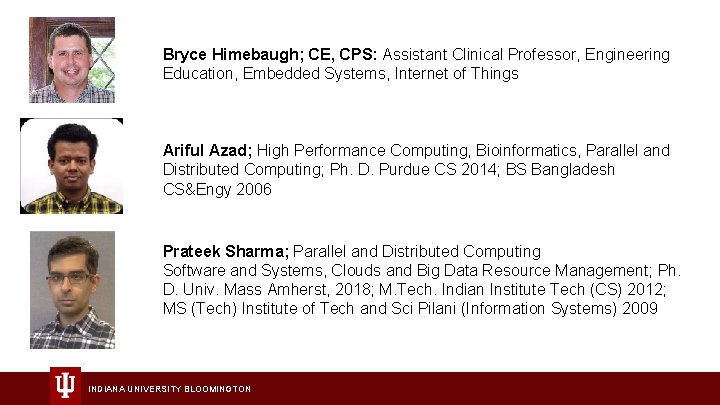
Bryce Himebaugh; CE, CPS: Assistant Clinical Professor, Engineering Education, Embedded Systems, Internet of Things Ariful Azad; High Performance Computing, Bioinformatics, Parallel and Distributed Computing; Ph. D. Purdue CS 2014; BS Bangladesh CS&Engy 2006 Prateek Sharma; Parallel and Distributed Computing Software and Systems, Clouds and Big Data Resource Management; Ph. D. Univ. Mass Amherst, 2018; M. Tech. Indian Institute Tech (CS) 2012; MS (Tech) Institute of Tech and Sci Pilani (Information Systems) 2009 INDIANA UNIVERSITY BLOOMINGTON
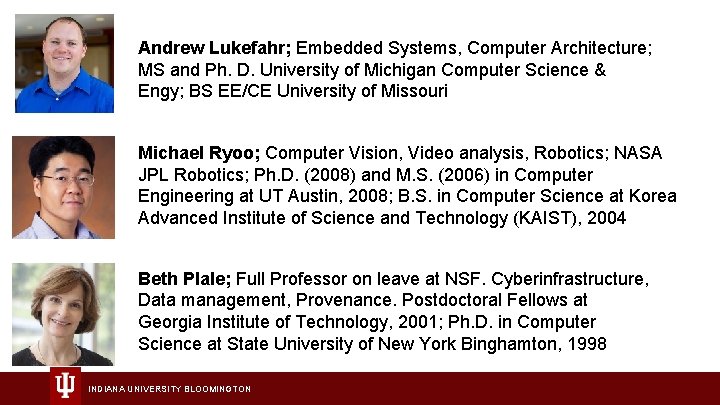
Andrew Lukefahr; Embedded Systems, Computer Architecture; MS and Ph. D. University of Michigan Computer Science & Engy; BS EE/CE University of Missouri Michael Ryoo; Computer Vision, Video analysis, Robotics; NASA JPL Robotics; Ph. D. (2008) and M. S. (2006) in Computer Engineering at UT Austin, 2008; B. S. in Computer Science at Korea Advanced Institute of Science and Technology (KAIST), 2004 Beth Plale; Full Professor on leave at NSF. Cyberinfrastructure, Data management, Provenance. Postdoctoral Fellows at Georgia Institute of Technology, 2001; Ph. D. in Computer Science at State University of New York Binghamton, 1998 INDIANA UNIVERSITY BLOOMINGTON