
Intelligent Systems AI2 Computer Science cpsc 422 Lecture


- Slides: 31
Intelligent Systems (AI-2) Computer Science cpsc 422, Lecture 21 Oct, 23, 2019 Slide credit: some slides adapted from Stuart Russell (Berkeley), some from Prof. Carla P. Gomes (Cornell) CPSC 422, Lecture 21 Slide 1
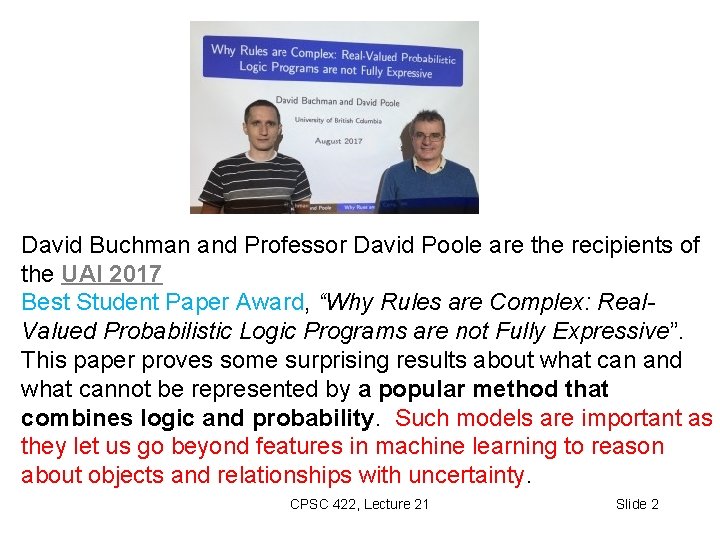
David Buchman and Professor David Poole are the recipients of the UAI 2017 Best Student Paper Award, “Why Rules are Complex: Real. Valued Probabilistic Logic Programs are not Fully Expressive”. This paper proves some surprising results about what can and what cannot be represented by a popular method that combines logic and probability. Such models are important as they let us go beyond features in machine learning to reason about objects and relationships with uncertainty. CPSC 422, Lecture 21 Slide 2
Lecture Overview • • Finish Resolution in Propositional logics Satisfiability problems Walk. SAT Start Encoding Example CPSC 422, Lecture 21 3
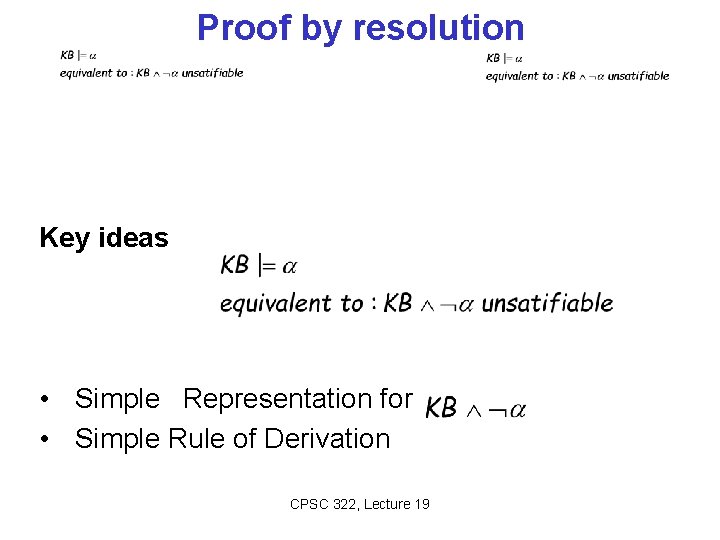
Proof by resolution Key ideas • Simple Representation for • Simple Rule of Derivation CPSC 322, Lecture 19
Conjunctive Normal Form (CNF) Rewrite into conjunction of disjunctions literals (A B) (B C D) Clause • Any KB can be converted into CNF ! CPSC 322, Lecture 19 5
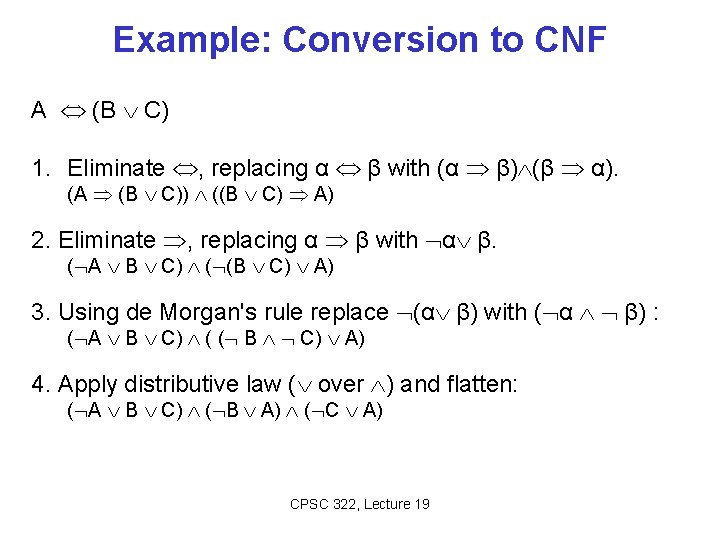
Example: Conversion to CNF A (B C) 1. Eliminate , replacing α β with (α β) (β α). (A (B C)) ((B C) A) 2. Eliminate , replacing α β with α β. ( A B C) ( (B C) A) 3. Using de Morgan's rule replace (α β) with ( α β) : ( A B C) ( ( B C) A) 4. Apply distributive law ( over ) and flatten: ( A B C) ( B A) ( C A) CPSC 322, Lecture 19
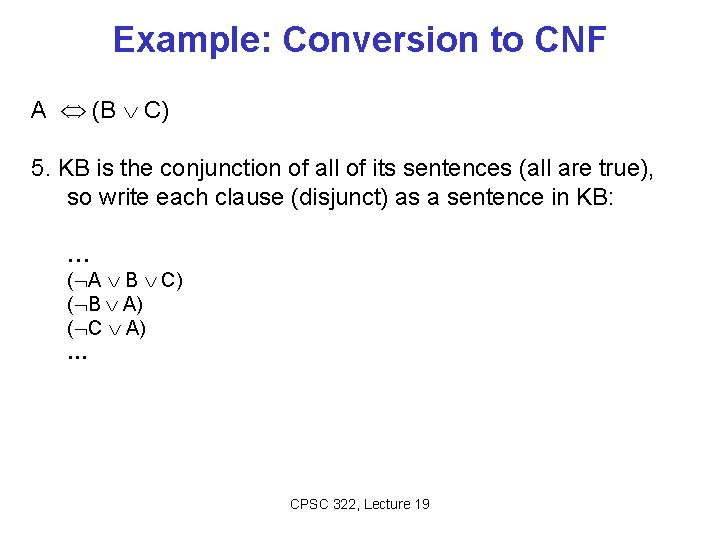
Example: Conversion to CNF A (B C) 5. KB is the conjunction of all of its sentences (all are true), so write each clause (disjunct) as a sentence in KB: … ( A B C) ( B A) ( C A) … CPSC 322, Lecture 19
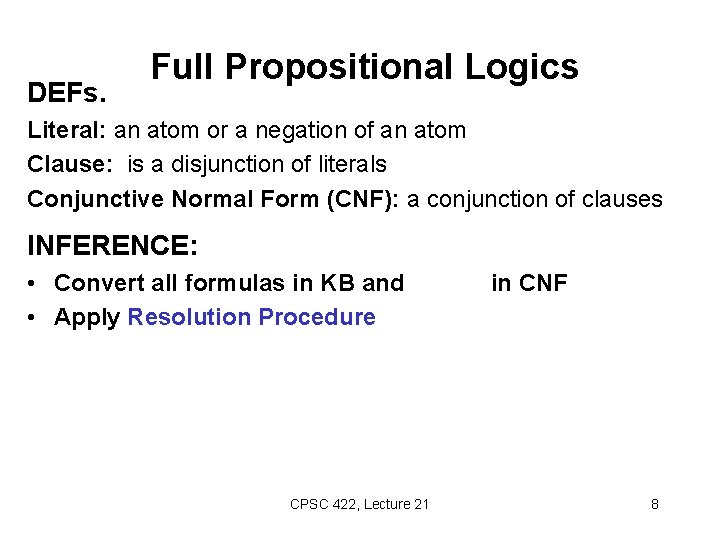
DEFs. Full Propositional Logics Literal: an atom or a negation of an atom Clause: is a disjunction of literals Conjunctive Normal Form (CNF): a conjunction of clauses INFERENCE: • Convert all formulas in KB and • Apply Resolution Procedure CPSC 422, Lecture 21 in CNF 8
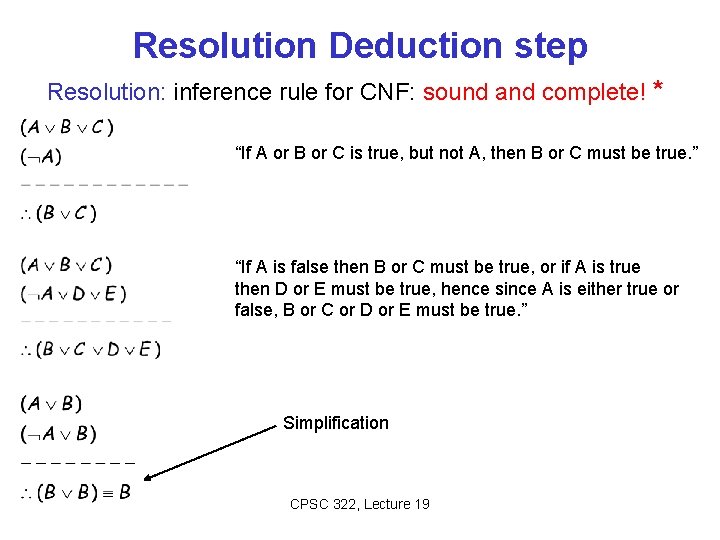
Resolution Deduction step Resolution: inference rule for CNF: sound and complete! * “If A or B or C is true, but not A, then B or C must be true. ” “If A is false then B or C must be true, or if A is true then D or E must be true, hence since A is either true or false, B or C or D or E must be true. ” Simplification CPSC 322, Lecture 19
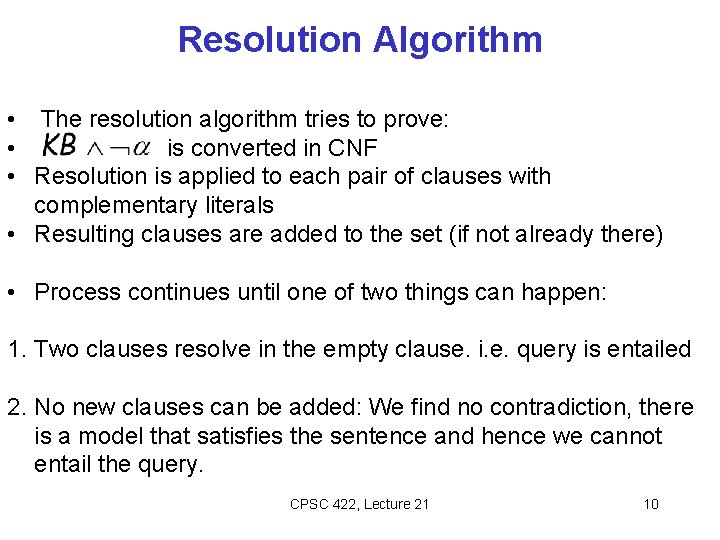
Resolution Algorithm • The resolution algorithm tries to prove: • is converted in CNF • Resolution is applied to each pair of clauses with complementary literals • Resulting clauses are added to the set (if not already there) • Process continues until one of two things can happen: 1. Two clauses resolve in the empty clause. i. e. query is entailed 2. No new clauses can be added: We find no contradiction, there is a model that satisfies the sentence and hence we cannot entail the query. CPSC 422, Lecture 21 10
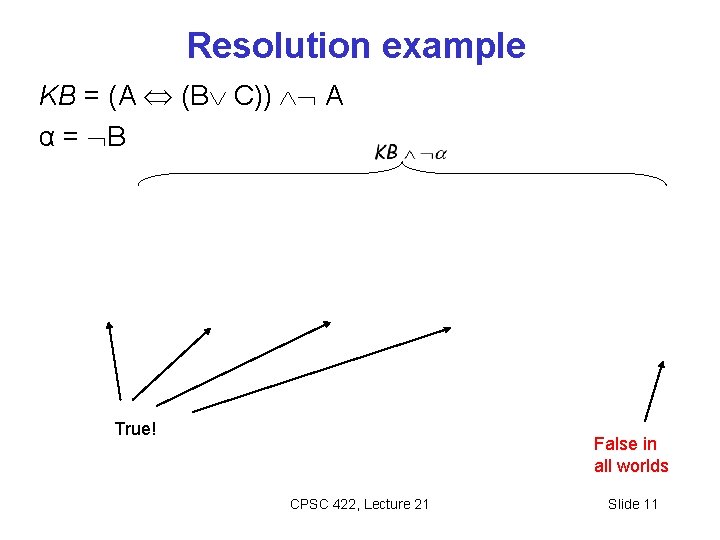
Resolution example KB = (A (B C)) A α = B True! False in all worlds CPSC 422, Lecture 21 Slide 11
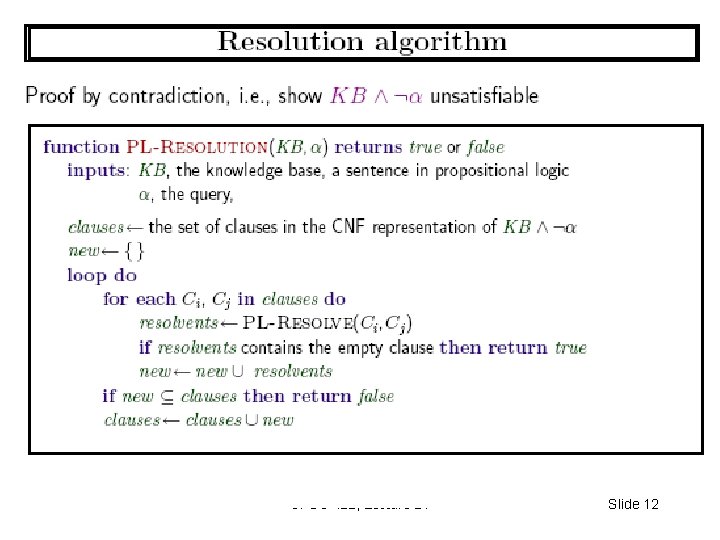
CPSC 422, Lecture 21 Slide 12
Lecture Overview • • • Finish Resolution in Propositional logics Satisfiability problems Walk. SAT Hardness of SAT Start Encoding Example CPSC 422, Lecture 21 13
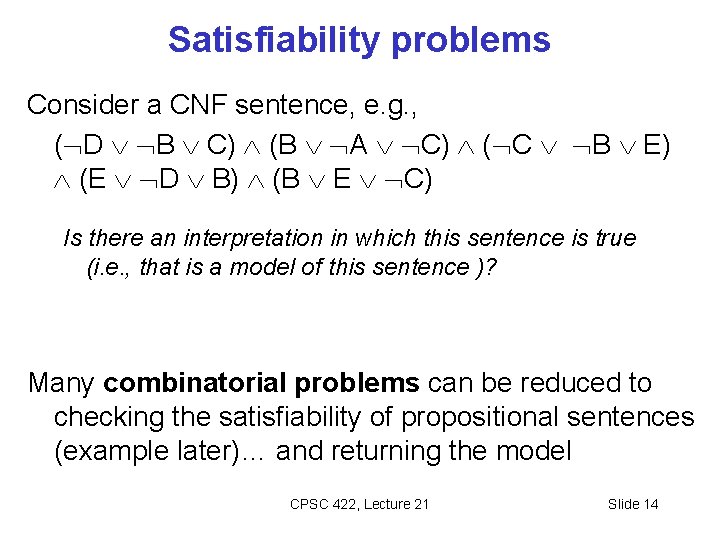
Satisfiability problems Consider a CNF sentence, e. g. , ( D B C) (B A C) ( C B E) (E D B) (B E C) Is there an interpretation in which this sentence is true (i. e. , that is a model of this sentence )? Many combinatorial problems can be reduced to checking the satisfiability of propositional sentences (example later)… and returning the model CPSC 422, Lecture 21 Slide 14
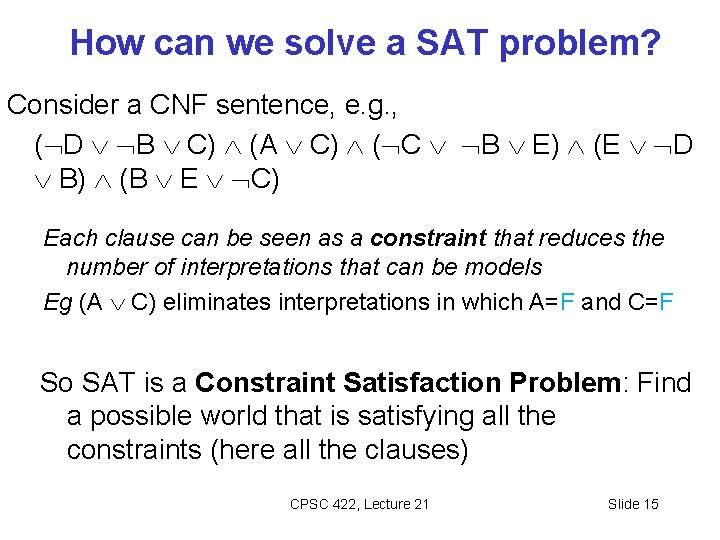
How can we solve a SAT problem? Consider a CNF sentence, e. g. , ( D B C) (A C) ( C B E) (E D B) (B E C) Each clause can be seen as a constraint that reduces the number of interpretations that can be models Eg (A C) eliminates interpretations in which A=F and C=F So SAT is a Constraint Satisfaction Problem: Find a possible world that is satisfying all the constraints (here all the clauses) CPSC 422, Lecture 21 Slide 15
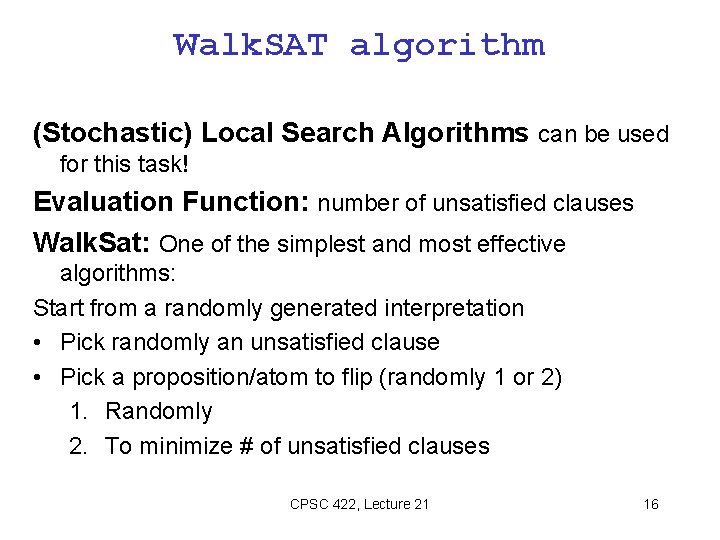
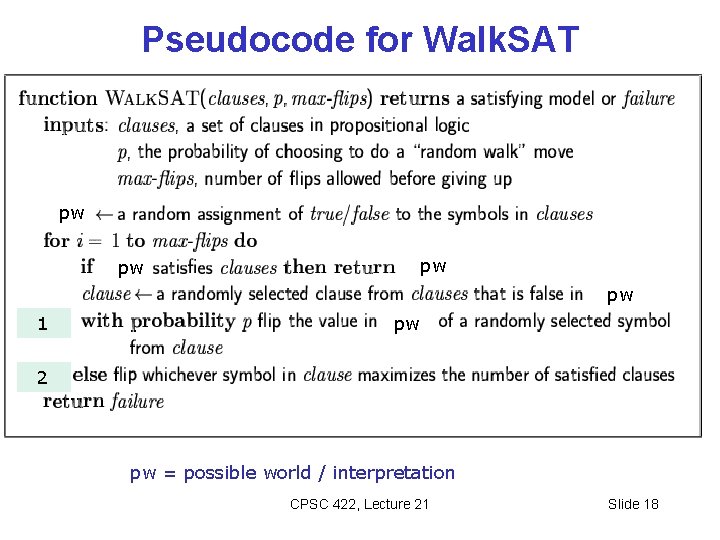
Walk. SAT algorithm (Stochastic) Local Search Algorithms can be used for this task! Evaluation Function: number of unsatisfied clauses Walk. Sat: One of the simplest and most effective algorithms: Start from a randomly generated interpretation • Pick randomly an unsatisfied clause • Pick a proposition/atom to flip (randomly 1 or 2) 1. Randomly 2. To minimize # of unsatisfied clauses CPSC 422, Lecture 21 16
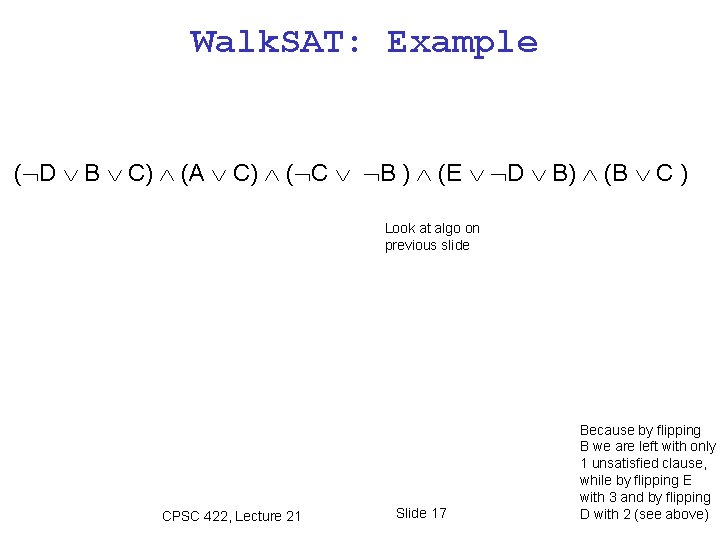
Walk. SAT: Example ( D B C) (A C) ( C B ) (E D B) (B C ) Look at algo on previous slide CPSC 422, Lecture 21 Slide 17 Because by flipping B we are left with only 1 unsatisfied clause, while by flipping E with 3 and by flipping D with 2 (see above)
Pseudocode for Walk. SAT pw pw 1 pw 2 pw = possible world / interpretation CPSC 422, Lecture 21 Slide 18
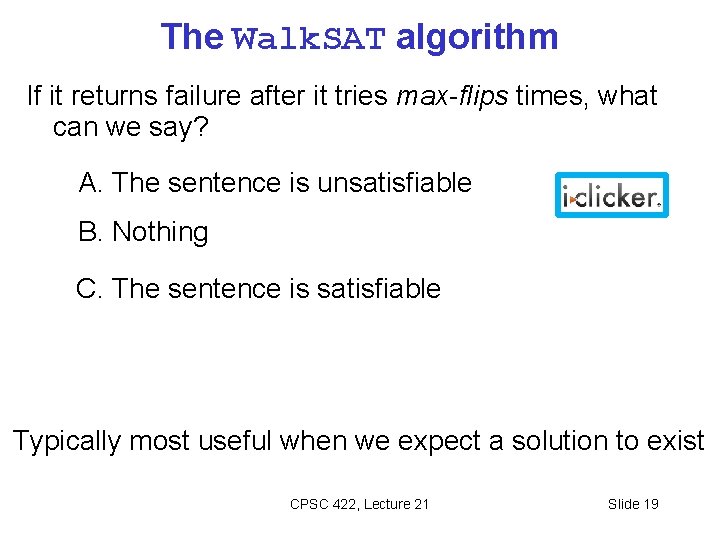
The Walk. SAT algorithm If it returns failure after it tries max-flips times, what can we say? A. The sentence is unsatisfiable B. Nothing C. The sentence is satisfiable Typically most useful when we expect a solution to exist CPSC 422, Lecture 21 Slide 19
Hard satisfiability problems Consider random 3 -CNF sentences. e. g. , ( D B C) (B A C) ( C B E) (E D B) (B E C) m = number of clauses (5) n = number of symbols (5) • Under constrained problems: ü Relatively few clauses constraining the variables ü Tend to be easy E. g. For the above problem 16 of 32 possible assignments are solutions – (so 2 random guesses will work on average) CPSC 422, Lecture 21 Slide 20
Hard satisfiability problems What makes a problem hard? • Increase the number of clauses while keeping the • number of symbols fixed Problem is more constrained, fewer solutions • You can investigate this experimentally…. CPSC 422, Lecture 21 Slide 21
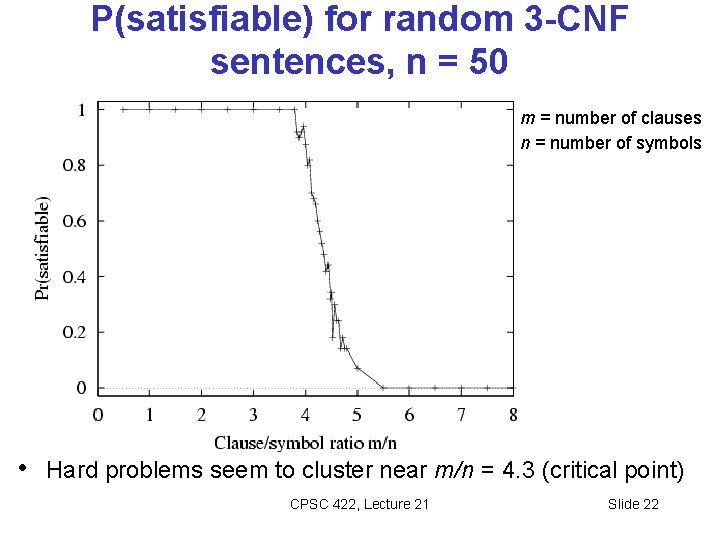
P(satisfiable) for random 3 -CNF sentences, n = 50 m = number of clauses n = number of symbols • Hard problems seem to cluster near m/n = 4. 3 (critical point) CPSC 422, Lecture 21 Slide 22
Lecture Overview • • Finish Resolution in Propositional logics Satisfiability problems Walk. SAT Start Encoding Example CPSC 422, Lecture 21 23
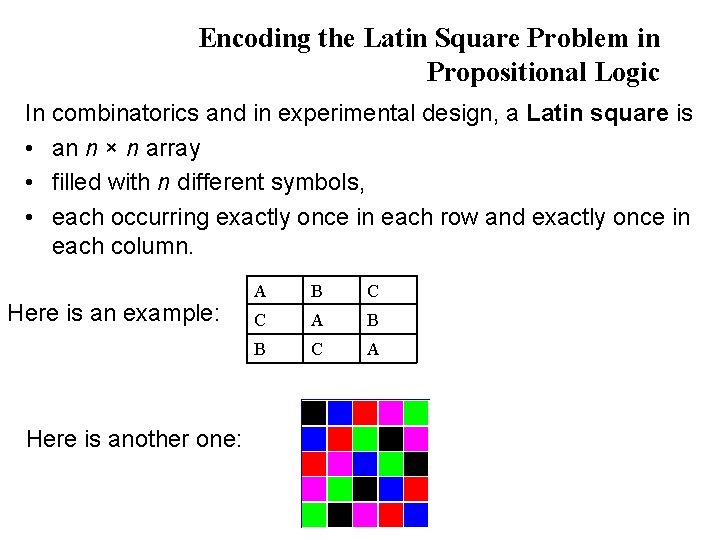
Encoding the Latin Square Problem in Propositional Logic In combinatorics and in experimental design, a Latin square is • an n × n array • filled with n different symbols, • each occurring exactly once in each row and exactly once in each column. Here is an example: Here is another one: A B C C A B B C A
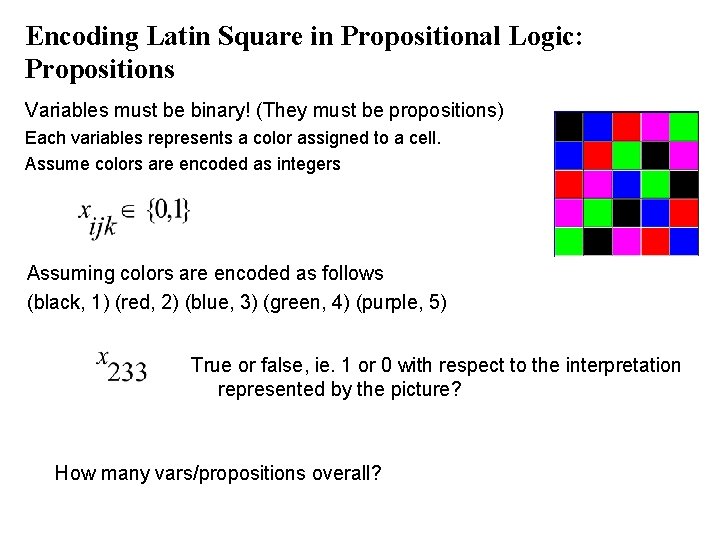
Encoding Latin Square in Propositional Logic: Propositions Variables must be binary! (They must be propositions) Each variables represents a color assigned to a cell. Assume colors are encoded as integers Assuming colors are encoded as follows (black, 1) (red, 2) (blue, 3) (green, 4) (purple, 5) True or false, ie. 1 or 0 with respect to the interpretation represented by the picture? How many vars/propositions overall?
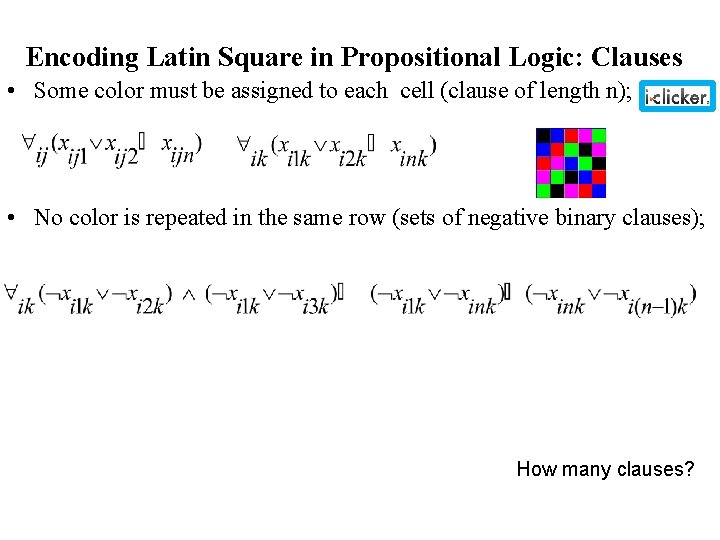
Encoding Latin Square in Propositional Logic: Clauses • Some color must be assigned to each cell (clause of length n); • No color is repeated in the same row (sets of negative binary clauses); How many clauses?
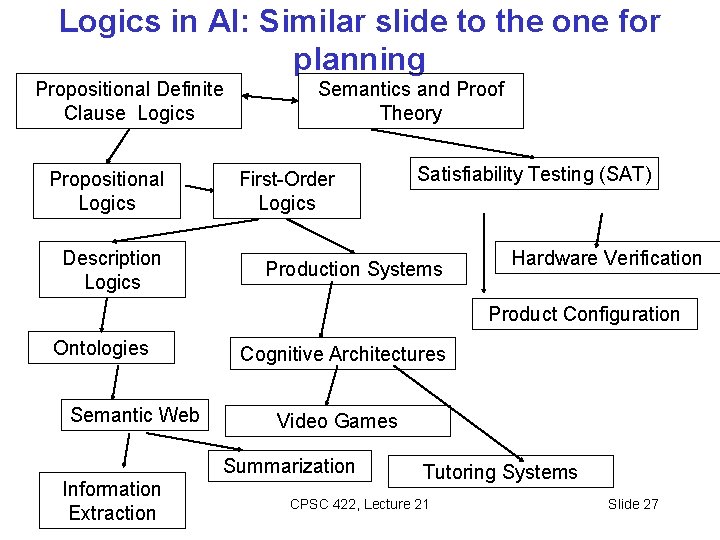
Logics in AI: Similar slide to the one for planning Propositional Definite Clause Logics Propositional Logics Description Logics Semantics and Proof Theory First-Order Logics Satisfiability Testing (SAT) Production Systems Hardware Verification Product Configuration Ontologies Semantic Web Cognitive Architectures Video Games Summarization Information Extraction Tutoring Systems CPSC 422, Lecture 21 Slide 27
Relationships between different Logics (better with colors) CPSC 422, Lecture 21 Slide 28
Learning Goals for today’s class You can: • Specify, Trace and Debug the resolution proof procedure for propositional logics • Specify, Trace and Debug Walk. Sat • Encode the Latin square problem in propositional logics (basic ideas) CPSC 422, Lecture 21 Slide 29
Next class Mon • Finish SAT example • First Order Logic • Extensions of FOL • Assignment-3 will be posted on Wed! CPSC 422, Lecture 21 30
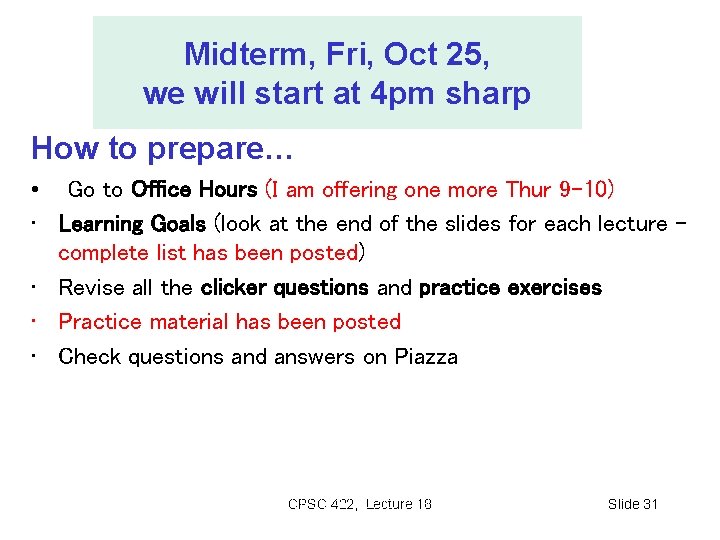
Midterm, Fri, Oct 25, we will start at 4 pm sharp How to prepare… • Go to Office Hours (I am offering one more Thur 9 -10) • Learning Goals (look at the end of the slides for each lecture – complete list has been posted) • Revise all the clicker questions and practice exercises • Practice material has been posted • Check questions and answers on Piazza CPSC 422, Lecture 19 CPSC 422, Lecture 18 Slide 31 31