
Intelligent Systems AI2 Computer Science cpsc 422 Lecture

- Slides: 72
Intelligent Systems (AI-2) Computer Science cpsc 422, Lecture 23 Oct 30, 2019 Slide credit: Probase Microsoft Research Asia, YAGO Max Planck Institute, National Lib. Of Medicine, NIH CPSC 422, Lecture 23 Slide 1
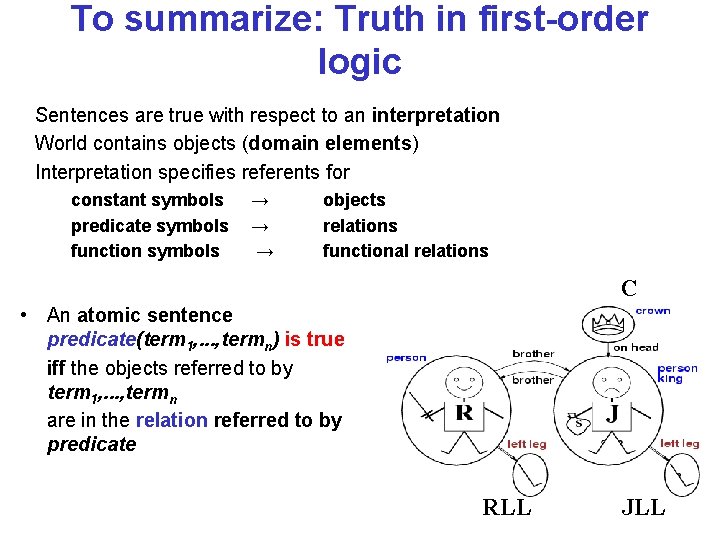
To summarize: Truth in first-order logic Sentences are true with respect to an interpretation World contains objects (domain elements) Interpretation specifies referents for constant symbols predicate symbols function symbols → → → objects relations functional relations C • An atomic sentence predicate(term 1, . . . , termn) is true iff the objects referred to by term 1, . . . , termn are in the relation referred to by predicate RLL JLL
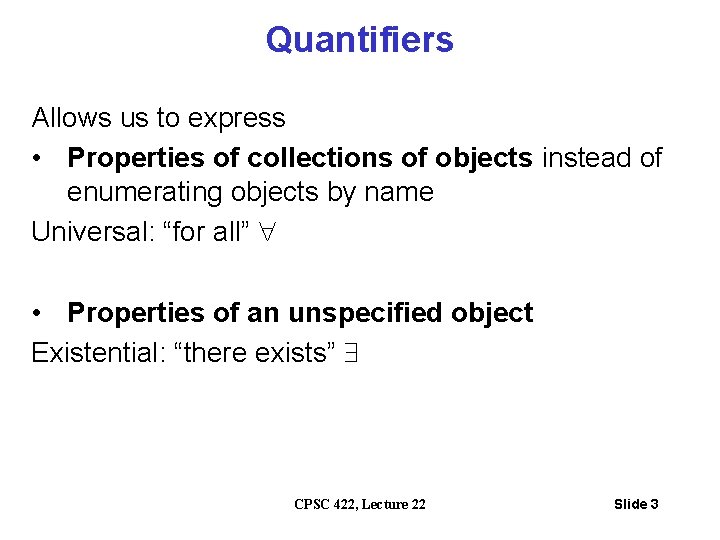
Quantifiers Allows us to express • Properties of collections of objects instead of enumerating objects by name Universal: “for all” • Properties of an unspecified object Existential: “there exists” CPSC 422, Lecture 22 Slide 3
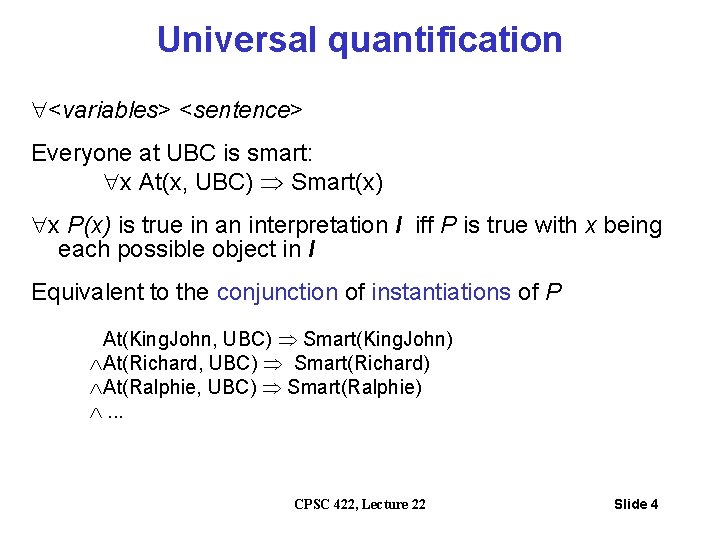
Universal quantification <variables> <sentence> Everyone at UBC is smart: x At(x, UBC) Smart(x) x P(x) is true in an interpretation I iff P is true with x being each possible object in I Equivalent to the conjunction of instantiations of P At(King. John, UBC) Smart(King. John) At(Richard, UBC) Smart(Richard) At(Ralphie, UBC) Smart(Ralphie) . . . CPSC 422, Lecture 22 Slide 4
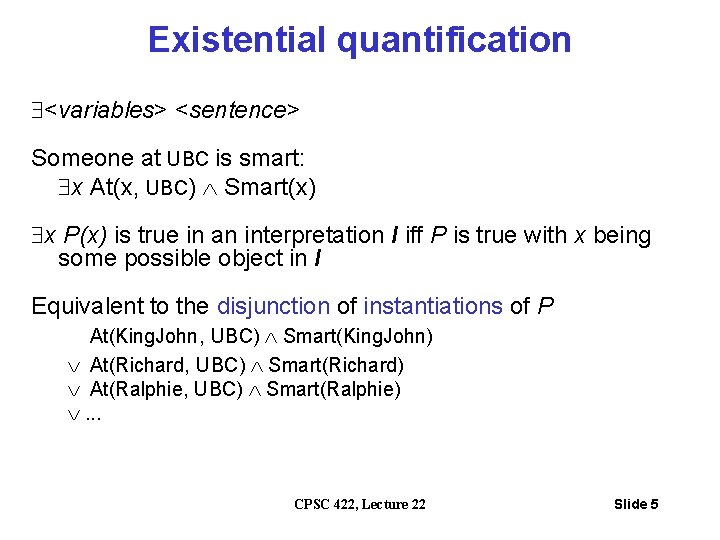
Existential quantification <variables> <sentence> Someone at UBC is smart: x At(x, UBC) Smart(x) x P(x) is true in an interpretation I iff P is true with x being some possible object in I Equivalent to the disjunction of instantiations of P At(King. John, UBC) Smart(King. John) At(Richard, UBC) Smart(Richard) At(Ralphie, UBC) Smart(Ralphie) . . . CPSC 422, Lecture 22 Slide 5
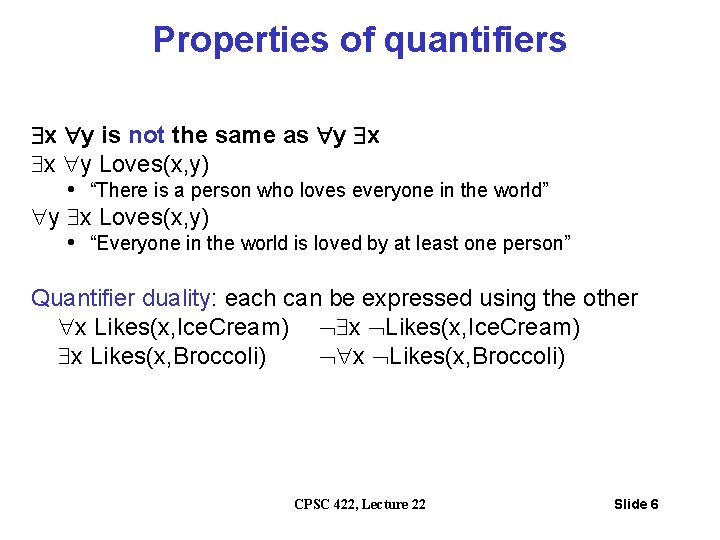
Properties of quantifiers x y is not the same as y x x y Loves(x, y) • “There is a person who loves everyone in the world” y x Loves(x, y) • “Everyone in the world is loved by at least one person” Quantifier duality: each can be expressed using the other x Likes(x, Ice. Cream) x Likes(x, Broccoli) CPSC 422, Lecture 22 Slide 6
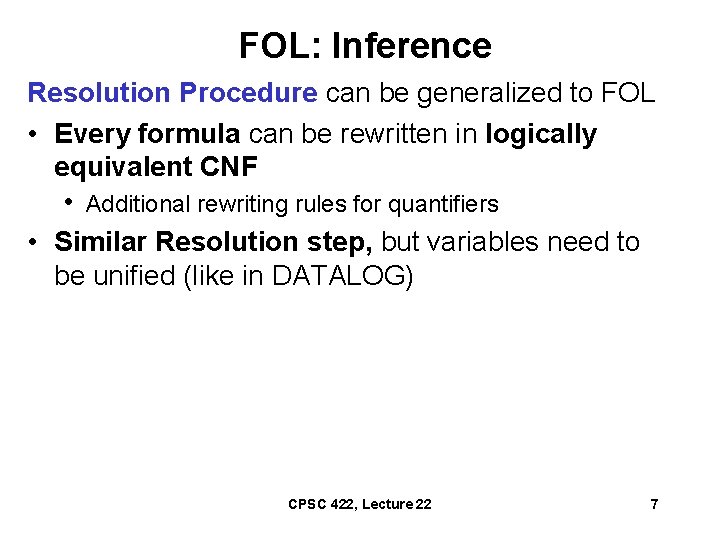
FOL: Inference Resolution Procedure can be generalized to FOL • Every formula can be rewritten in logically equivalent CNF • Additional rewriting rules for quantifiers • Similar Resolution step, but variables need to be unified (like in DATALOG) CPSC 422, Lecture 22 7
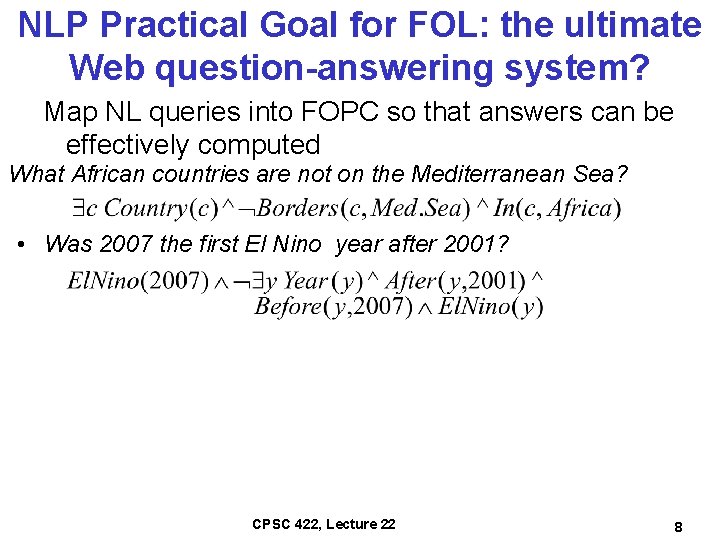
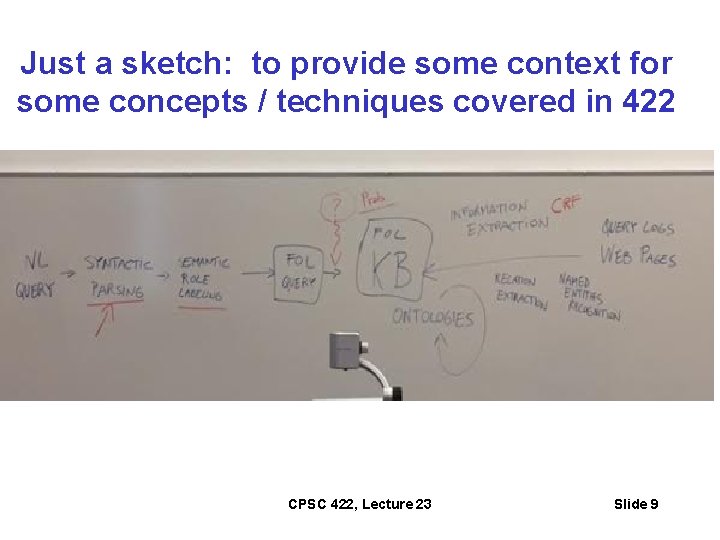
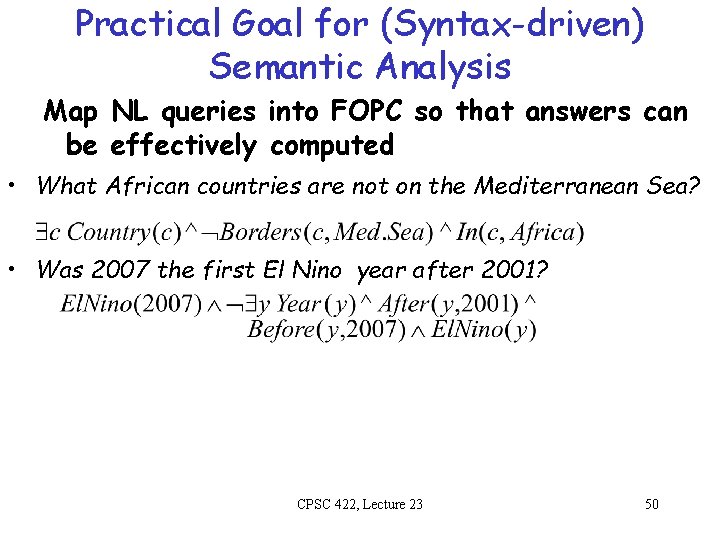
NLP Practical Goal for FOL: the ultimate Web question-answering system? Map NL queries into FOPC so that answers can be effectively computed What African countries are not on the Mediterranean Sea? • Was 2007 the first El Nino year after 2001? CPSC 422, Lecture 22 8
Just a sketch: to provide some context for some concepts / techniques covered in 422 CPSC 422, Lecture 23 Slide 9
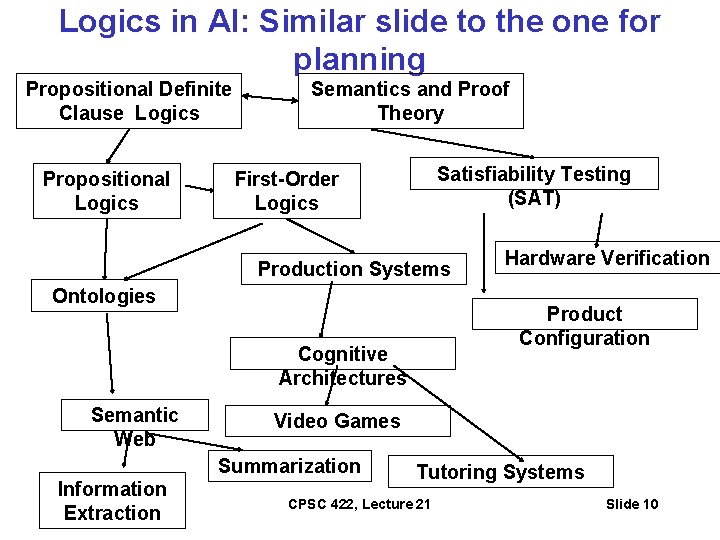
Logics in AI: Similar slide to the one for planning Propositional Definite Clause Logics Propositional Logics Semantics and Proof Theory Satisfiability Testing (SAT) First-Order Logics Production Systems Ontologies Product Configuration Cognitive Architectures Semantic Web Video Games Summarization Information Extraction Hardware Verification Tutoring Systems CPSC 422, Lecture 21 Slide 10
Lecture Overview • Ontologies – what objects/individuals should we represent? what relations (unary, binary, . . )? • Inspiration from Natural Language: Word. Net and Frame. Net • Extensions based on Wikipedia and mining the Web (YAGO, Pro. Base, Freebase) • Domain Specific Ontologies (e. g. , Medicine: Me. SH, UMLS) Links to Web Interfaces on course webpage Each can be downloaded CPSC 422, Lecture 23 11
Ontologies Given a logical representation (e. g. , FOL) What individuals and relations are there and we need to model? In AI an Ontology is a specification of what individuals and relationships are assumed to exist and what terminology is used for them • What types of individuals • What properties of the individuals • . . . CPSC 422, Lecture 23 Slide 12
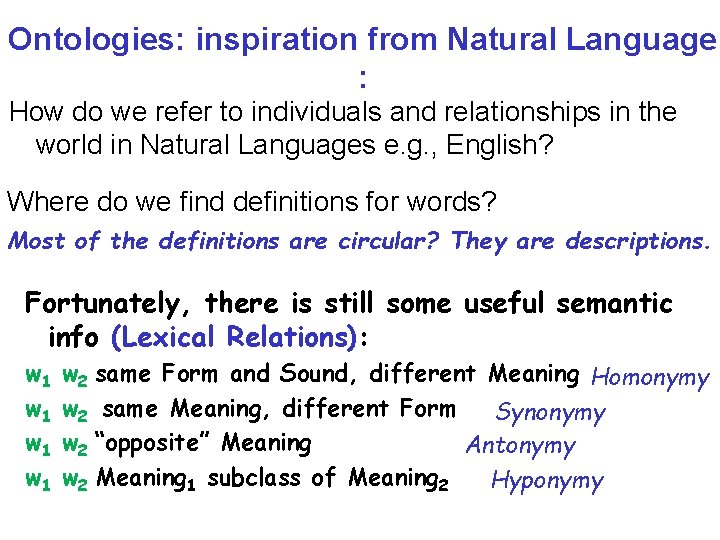
Ontologies: inspiration from Natural Language : How do we refer to individuals and relationships in the world in Natural Languages e. g. , English? Where do we find definitions for words? Most of the definitions are circular? They are descriptions. Fortunately, there is still some useful semantic info (Lexical Relations): w 1 w 1 w 2 same Form and Sound, different Meaning Homonymy w 2 same Meaning, different Form Synonymy w 2 “opposite” Meaning Antonymy w 2 Meaning 1 subclass of Meaning 2 Hyponymy CPSC 422, Lecture 23 13
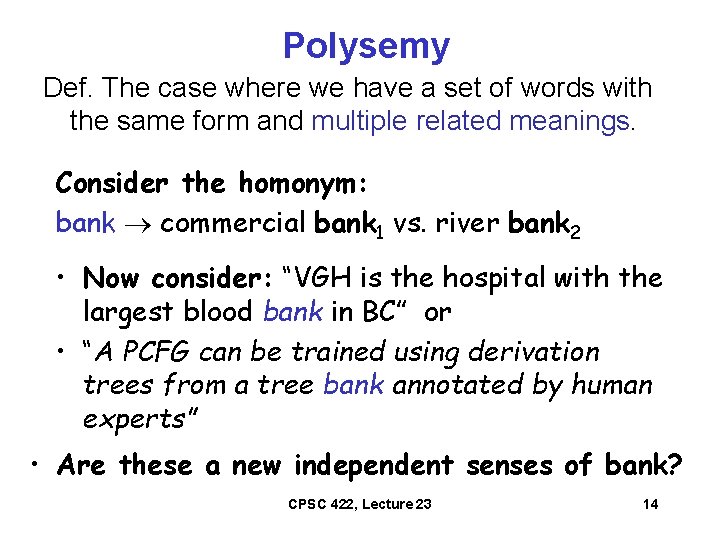
Polysemy Def. The case where we have a set of words with the same form and multiple related meanings. Consider the homonym: bank commercial bank 1 vs. river bank 2 • Now consider: “VGH is the hospital with the largest blood bank in BC” or • “A PCFG can be trained using derivation trees from a tree bank annotated by human experts” • Are these a new independent senses of bank? CPSC 422, Lecture 23 14
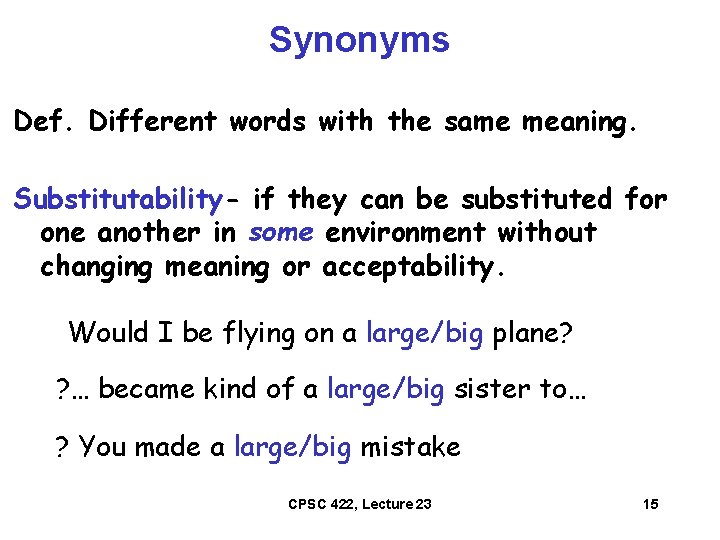
Synonyms Def. Different words with the same meaning. Substitutability- if they can be substituted for one another in some environment without changing meaning or acceptability. Would I be flying on a large/big plane? ? … became kind of a large/big sister to… ? You made a large/big mistake CPSC 422, Lecture 23 15
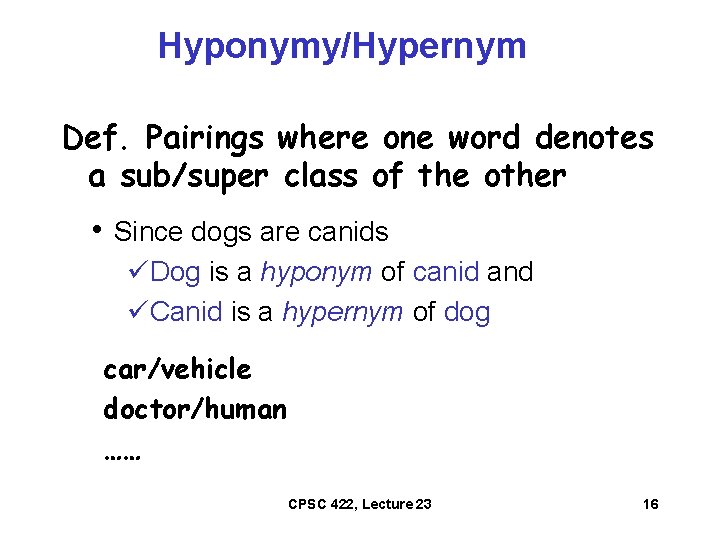
Hyponymy/Hypernym Def. Pairings where one word denotes a sub/super class of the other • Since dogs are canids üDog is a hyponym of canid and üCanid is a hypernym of dog car/vehicle doctor/human …… CPSC 422, Lecture 23 16
Lexical Resources Databases containing all lexical relations among all words • Development: – Mining info from dictionaries and thesauri – Handcrafting it from scratch • Word. Net: first developed with reasonable coverage and widely used, started with [Fellbaum… 1998] – for English (versions for other languages have been developed – see Multi. Word. Net) CPSC 422, Lecture 23 17
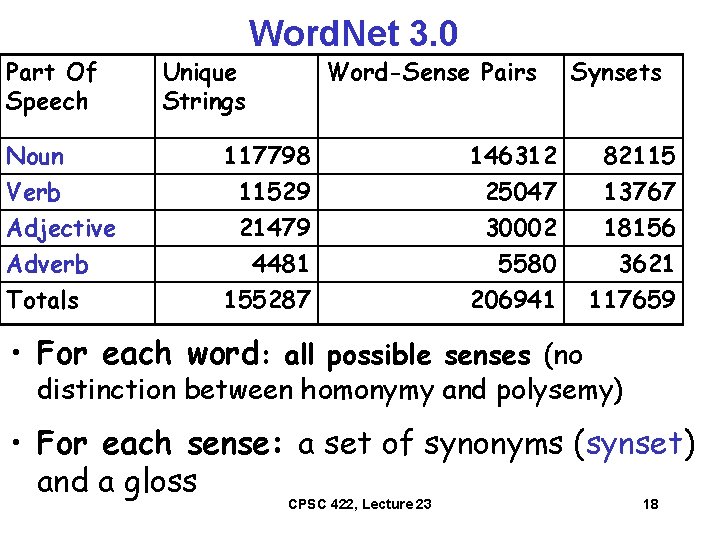
Part Of Speech Noun Verb Adjective Adverb Totals Unique Strings Word. Net 3. 0 Word-Sense Pairs Synsets 117798 11529 146312 25047 82115 13767 21479 4481 30002 5580 18156 3621 155287 206941 117659 • For each word: all possible senses (no distinction between homonymy and polysemy) • For each sense: a set of synonyms (synset) and a gloss CPSC 422, Lecture 23 18
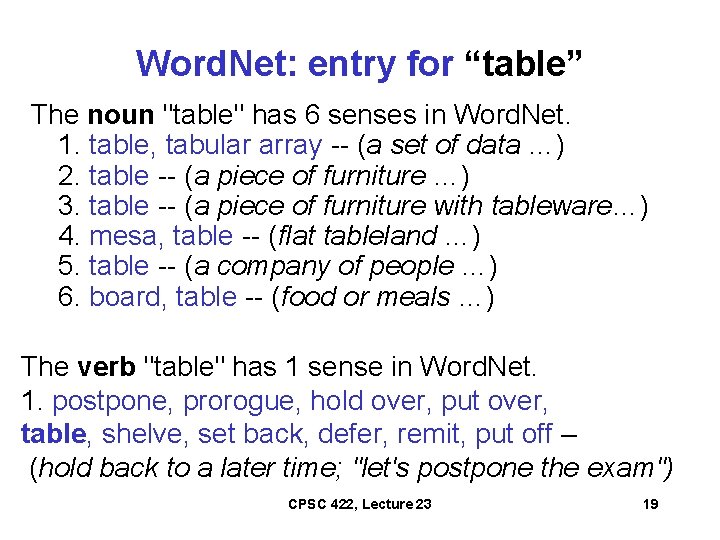
Word. Net: entry for “table” The noun "table" has 6 senses in Word. Net. 1. table, tabular array -- (a set of data …) 2. table -- (a piece of furniture …) 3. table -- (a piece of furniture with tableware…) 4. mesa, table -- (flat tableland …) 5. table -- (a company of people …) 6. board, table -- (food or meals …) The verb "table" has 1 sense in Word. Net. 1. postpone, prorogue, hold over, put over, table, shelve, set back, defer, remit, put off – (hold back to a later time; "let's postpone the exam") CPSC 422, Lecture 23 19
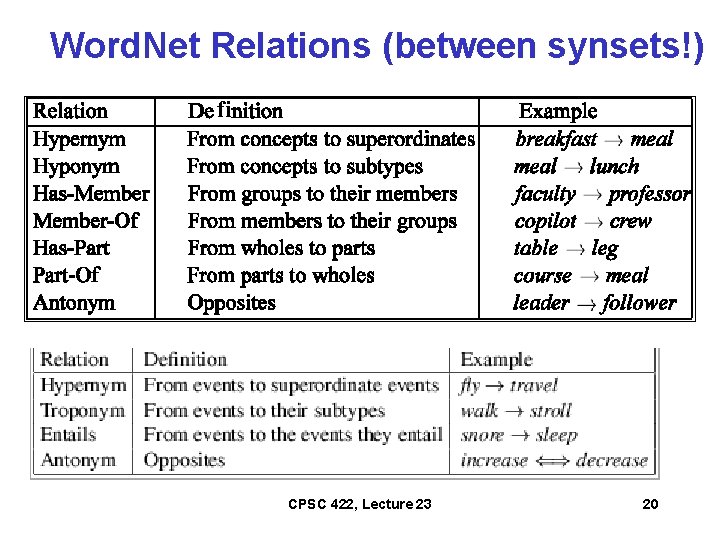
Word. Net Relations (between synsets!) fi CPSC 422, Lecture 23 20
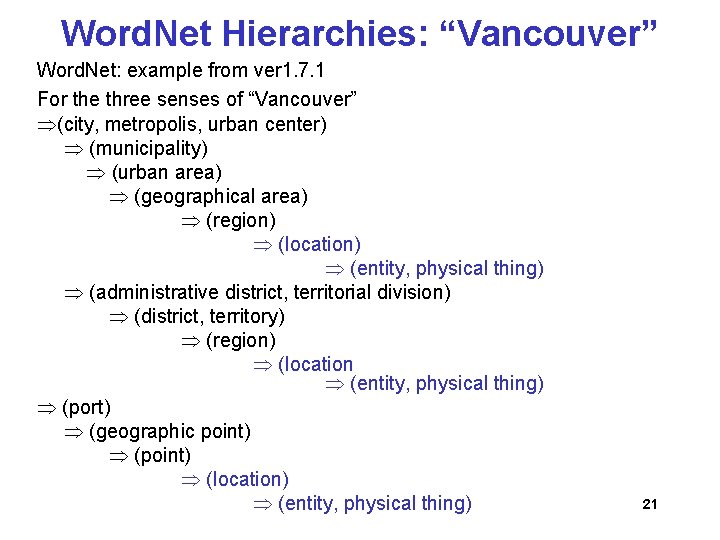
Word. Net Hierarchies: “Vancouver” Word. Net: example from ver 1. 7. 1 For the three senses of “Vancouver” (city, metropolis, urban center) (municipality) (urban area) (geographical area) (region) (location) (entity, physical thing) (administrative district, territorial division) (district, territory) (region) (location (entity, physical thing) (port) (geographic point) (location) CPSC 422, Lecture 23 (entity, physical thing) 21
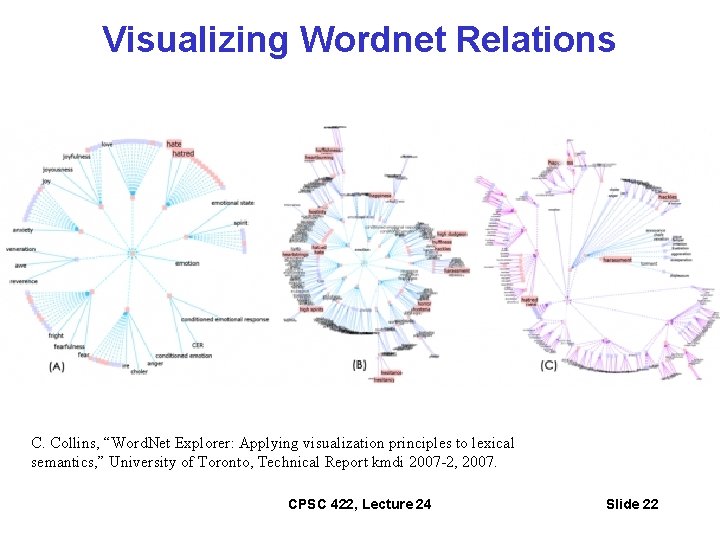
Visualizing Wordnet Relations C. Collins, “Word. Net Explorer: Applying visualization principles to lexical semantics, ” University of Toronto, Technical Report kmdi 2007 -2, 2007. CPSC 422, Lecture 24 Slide 22
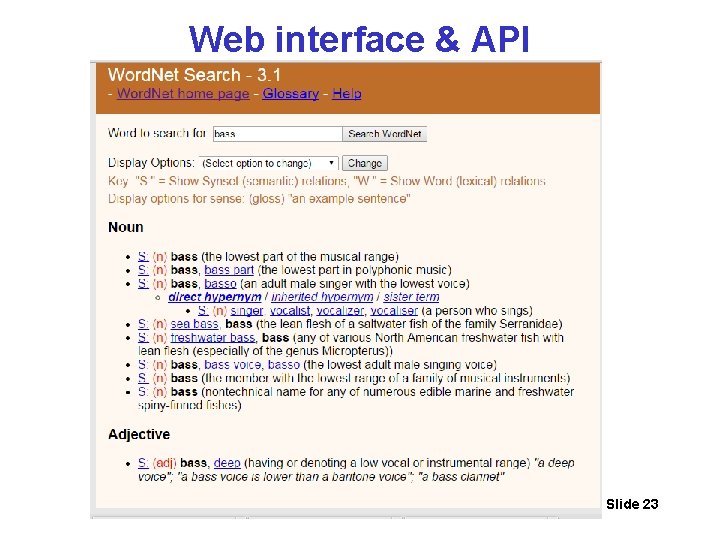
Web interface & API CPSC 422, Lecture 23 Slide 23
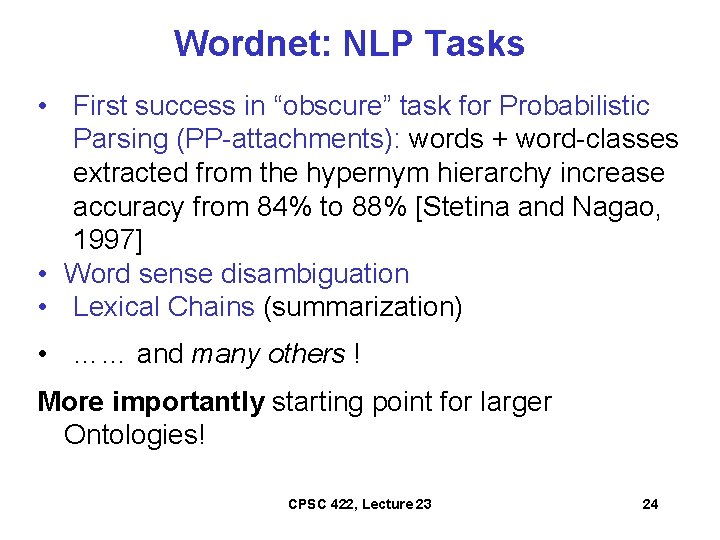
Wordnet: NLP Tasks • First success in “obscure” task for Probabilistic Parsing (PP-attachments): words + word-classes extracted from the hypernym hierarchy increase accuracy from 84% to 88% [Stetina and Nagao, 1997] • Word sense disambiguation • Lexical Chains (summarization) • …… and many others ! More importantly starting point for larger Ontologies! CPSC 422, Lecture 23 24
More ideas from NLP…. Relations among words and their meanings (paradigmatic) Internal structure of individual words (syntagmatic) CPSC 422, Lecture 23 25
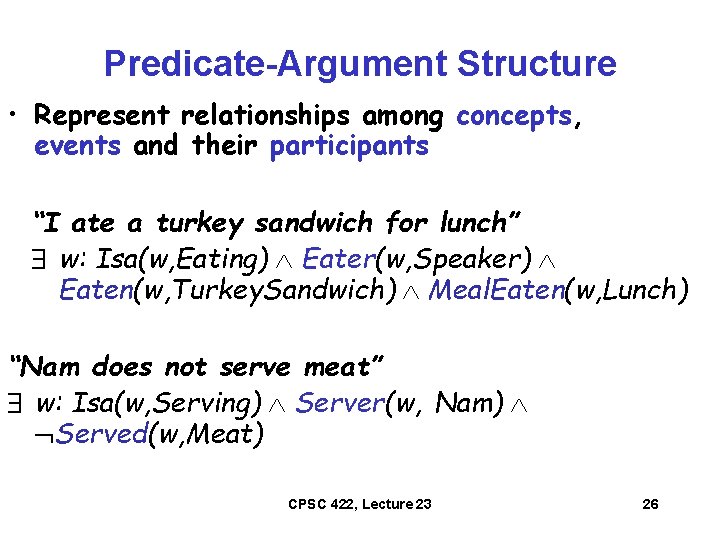
Predicate-Argument Structure • Represent relationships among concepts, events and their participants “I ate a turkey sandwich for lunch” w: Isa(w, Eating) Eater(w, Speaker) Eaten(w, Turkey. Sandwich) Meal. Eaten(w, Lunch) “Nam does not serve meat” w: Isa(w, Serving) Server(w, Nam) Served(w, Meat) CPSC 422, Lecture 23 26
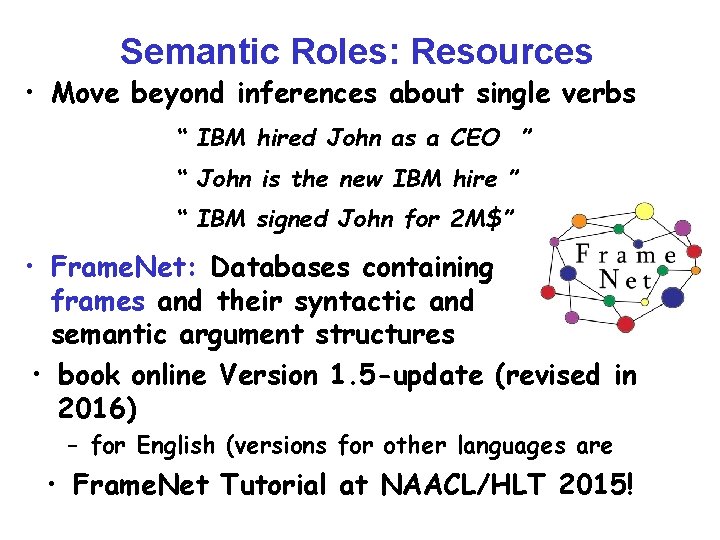
Semantic Roles: Resources • Move beyond inferences about single verbs “ IBM hired John as a CEO ” “ John is the new IBM hire ” “ IBM signed John for 2 M$” • Frame. Net: Databases containing frames and their syntactic and semantic argument structures • book online Version 1. 5 -update (revised in 2016) – for English (versions for other languages are under development) • Frame. Net Tutorial at NAACL/HLT 2015! CPSC 422, Lecture 23 27
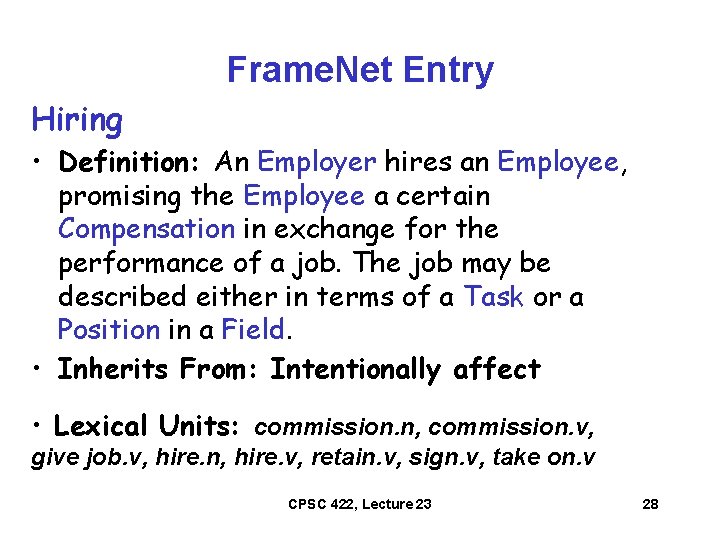
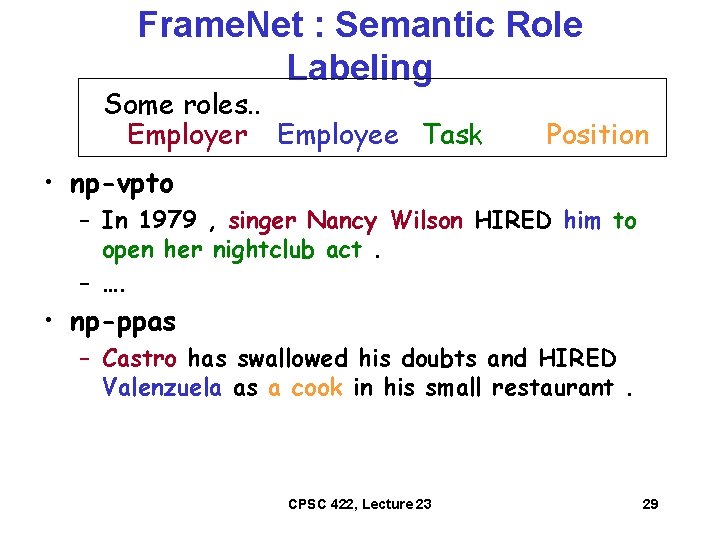
Frame. Net Entry Hiring • Definition: An Employer hires an Employee, promising the Employee a certain Compensation in exchange for the performance of a job. The job may be described either in terms of a Task or a Position in a Field. • Inherits From: Intentionally affect • Lexical Units: commission. n, commission. v, give job. v, hire. n, hire. v, retain. v, sign. v, take on. v CPSC 422, Lecture 23 28
Frame. Net : Semantic Role Labeling Some roles. . Employer Employee Task Position • np-vpto – In 1979 , singer Nancy Wilson HIRED him to open her nightclub act. – …. • np-ppas – Castro has swallowed his doubts and HIRED Valenzuela as a cook in his small restaurant. CPSC 422, Lecture 23 29
Lecture Overview • Ontologies – what objects/individuals should we represent? what relations (unary, binary, . . )? • Inspiration from Natural Language: Word. Net and Frame. Net • Extensions based on Wikipedia and mining the Web & Web search logs (YAGO, Pro. Base, Freebase, ……) • Domain Specific Ontologies (e. g. , Medicine: Me. SH, UMLS) CPSC 422, Lecture 23 30
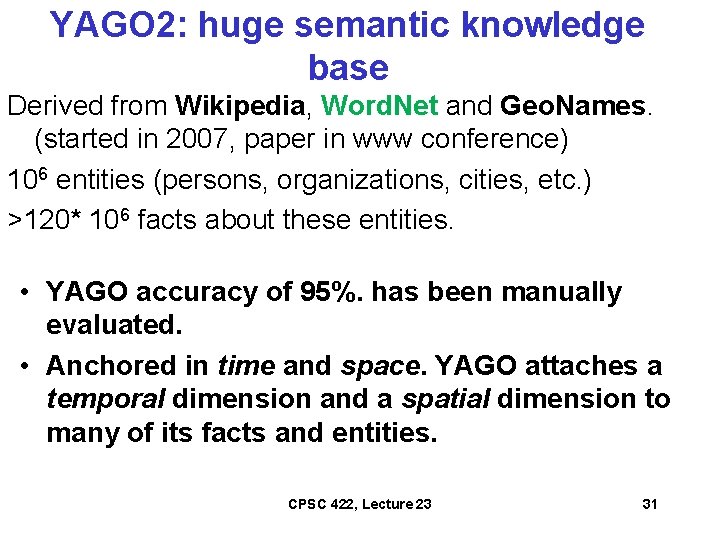
YAGO 2: huge semantic knowledge base Derived from Wikipedia, Word. Net and Geo. Names. (started in 2007, paper in www conference) 106 entities (persons, organizations, cities, etc. ) >120* 106 facts about these entities. • YAGO accuracy of 95%. has been manually evaluated. • Anchored in time and space. YAGO attaches a temporal dimension and a spatial dimension to many of its facts and entities. CPSC 422, Lecture 23 31
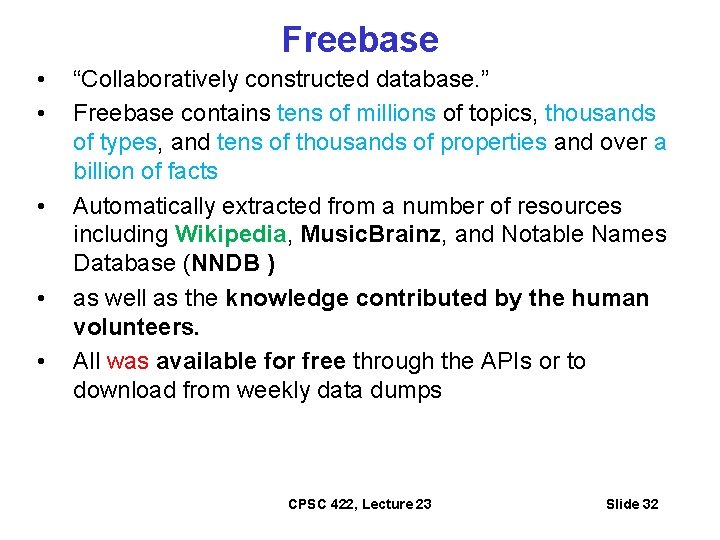
Freebase • • • “Collaboratively constructed database. ” Freebase contains tens of millions of topics, thousands of types, and tens of thousands of properties and over a billion of facts Automatically extracted from a number of resources including Wikipedia, Music. Brainz, and Notable Names Database (NNDB ) as well as the knowledge contributed by the human volunteers. All was available for free through the APIs or to download from weekly data dumps CPSC 422, Lecture 23 Slide 32
Fast Changing Landscape…. On 16 December 2015, Google officially announced the Knowledge Graph API, which is meant to be a replacement to the Freebase API. Freebase. com was officially shut down on 2 May 2016. [6] CPSC 422, Lecture 23 Slide 33
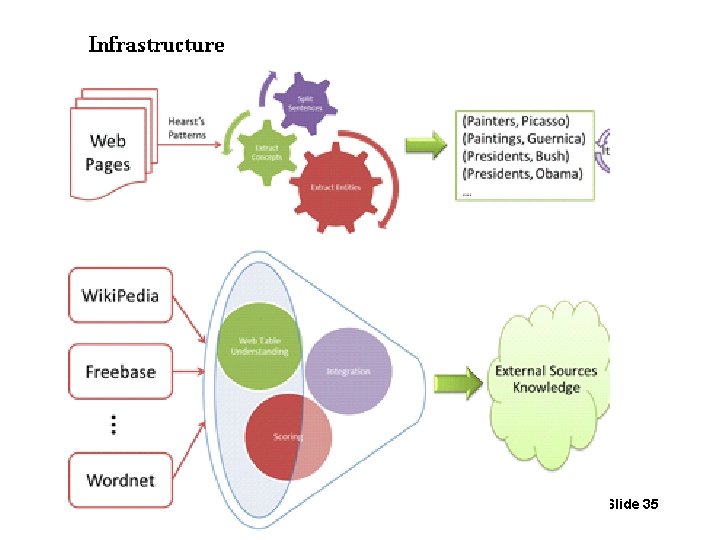
Probase (MS Research) • Harnessed from billions of web pages and years worth of search logs • Extremely large concept/category space (2. 7 million categories). • Probabilistic model for correctness, typicality (e. g. , between concept and instance) CPSC 422, Lecture 23 Slide 34
CPSC 422, Lecture 23 Slide 35
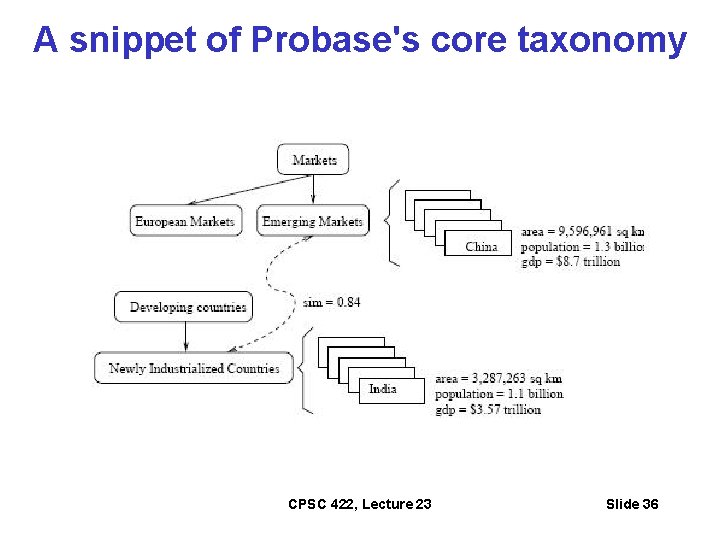
A snippet of Probase's core taxonomy CPSC 422, Lecture 23 Slide 36
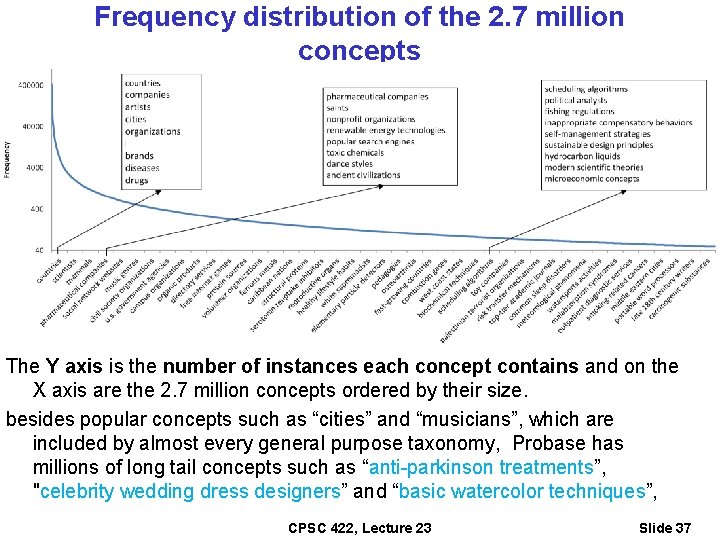
Frequency distribution of the 2. 7 million concepts The Y axis is the number of instances each concept contains and on the X axis are the 2. 7 million concepts ordered by their size. besides popular concepts such as “cities” and “musicians”, which are included by almost every general purpose taxonomy, Probase has millions of long tail concepts such as “anti-parkinson treatments”, "celebrity wedding dress designers” and “basic watercolor techniques”, CPSC 422, Lecture 23 Slide 37
Fast Changing Landscape…. From Probase page…… [Sept. 2016] Please visit our Microsoft Concept Graph release for up-to-date information of this project! Another one DBpedia is a crowd-sourced community effort to extract structured information from Wikipedia and make this information available on the Web. • allows you to ask sophisticated queries against Wikipedia, • link the different data sets on the Web to Slide 38 Wikipedia data CPSC 422, Lecture 23
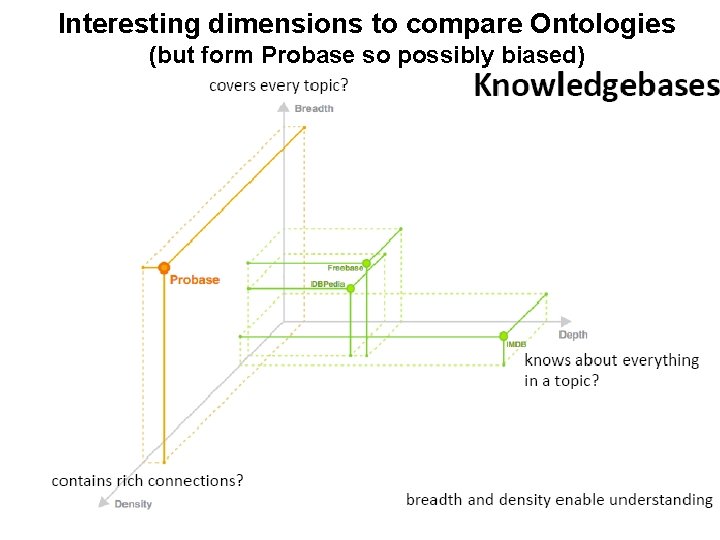
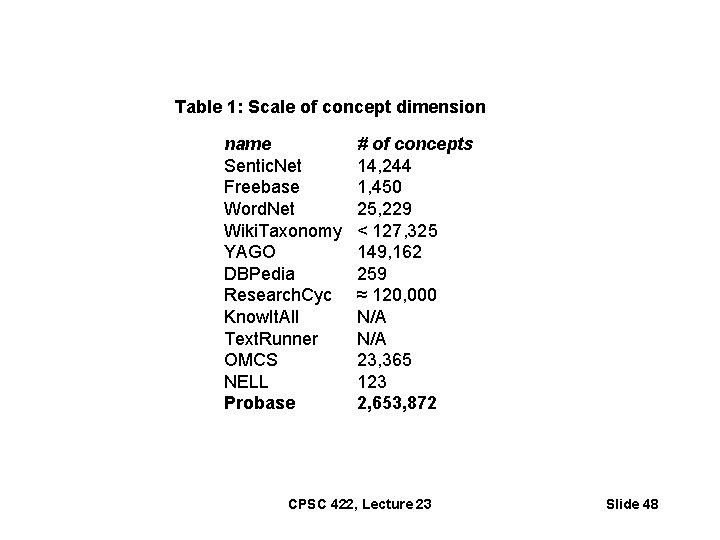
Interesting dimensions to compare Ontologies (but form Probase so possibly biased) CPSC 422, Lecture 23 Slide 39
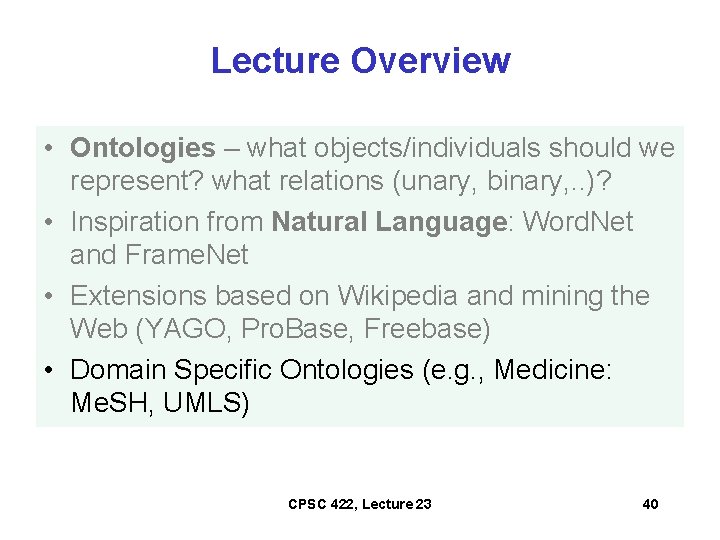
Lecture Overview • Ontologies – what objects/individuals should we represent? what relations (unary, binary, . . )? • Inspiration from Natural Language: Word. Net and Frame. Net • Extensions based on Wikipedia and mining the Web (YAGO, Pro. Base, Freebase) • Domain Specific Ontologies (e. g. , Medicine: Me. SH, UMLS) CPSC 422, Lecture 23 40
Domain Specific Ontologies: UMLS, Me. SH Unified Medical Language System: brings together many health and biomedical vocabularies • Enable interoperability (linking medical terms, drug names) • Develop electronic health records, classification tools • Search engines, data mining CPSC 422, Lecture 23 Slide 41
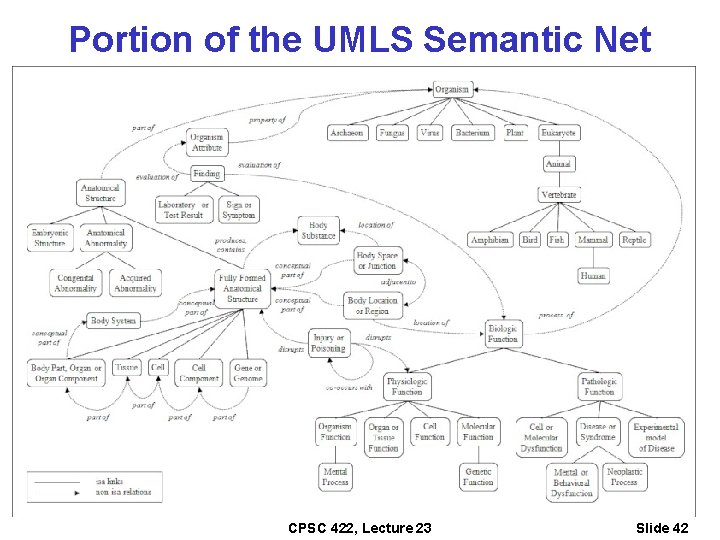
Portion of the UMLS Semantic Net CPSC 422, Lecture 23 Slide 42
Ontologies : Summary CPSC 422, Lecture 23 43
Learning Goals for today’s class You can: • Define an Ontology • Describe and Justify the information represented in Wordnet and Framenet • Describe and Justify the three dimensions for comparing ontologies CPSC 422, Lecture 23 Slide 44
Assignment-3 out – due Nov 18 (8 -18 hours – working in pairs on programming parts is strongly advised) Next class Fri • Similarity measures in ontologies (e. g. , Wordnet) CPSC 422, Lecture 23 45
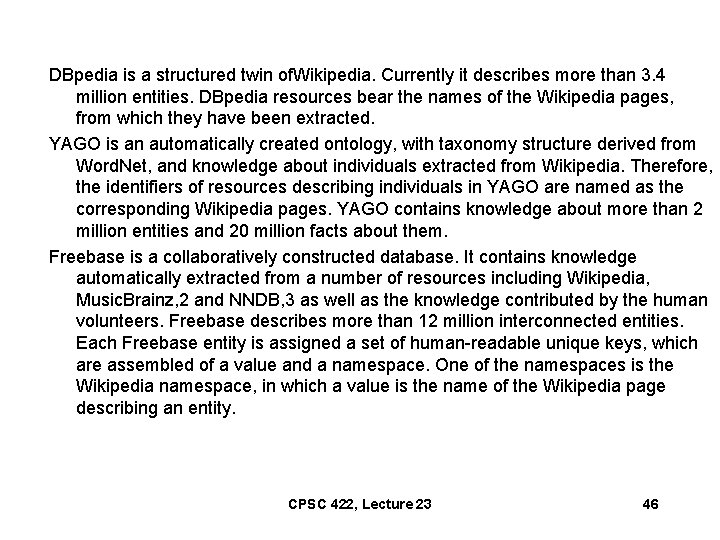
DBpedia is a structured twin of. Wikipedia. Currently it describes more than 3. 4 million entities. DBpedia resources bear the names of the Wikipedia pages, from which they have been extracted. YAGO is an automatically created ontology, with taxonomy structure derived from Word. Net, and knowledge about individuals extracted from Wikipedia. Therefore, the identifiers of resources describing individuals in YAGO are named as the corresponding Wikipedia pages. YAGO contains knowledge about more than 2 million entities and 20 million facts about them. Freebase is a collaboratively constructed database. It contains knowledge automatically extracted from a number of resources including Wikipedia, Music. Brainz, 2 and NNDB, 3 as well as the knowledge contributed by the human volunteers. Freebase describes more than 12 million interconnected entities. Each Freebase entity is assigned a set of human-readable unique keys, which are assembled of a value and a namespace. One of the namespaces is the Wikipedia namespace, in which a value is the name of the Wikipedia page describing an entity. CPSC 422, Lecture 23 46
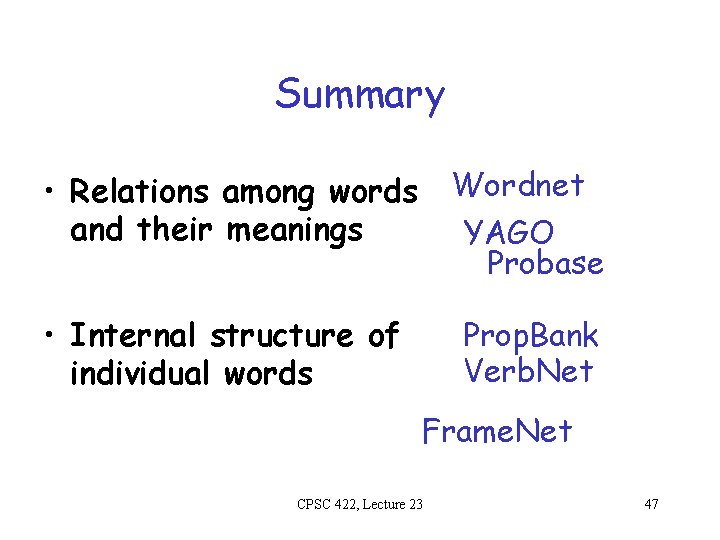
Summary • Relations among words and their meanings Wordnet YAGO Probase • Internal structure of individual words Prop. Bank Verb. Net Frame. Net CPSC 422, Lecture 23 47
Table 1: Scale of concept dimension name Sentic. Net Freebase Word. Net Wiki. Taxonomy YAGO DBPedia Research. Cyc Know. It. All Text. Runner OMCS NELL Probase # of concepts 14, 244 1, 450 25, 229 < 127, 325 149, 162 259 ≈ 120, 000 N/A 23, 365 123 2, 653, 872 CPSC 422, Lecture 23 Slide 48
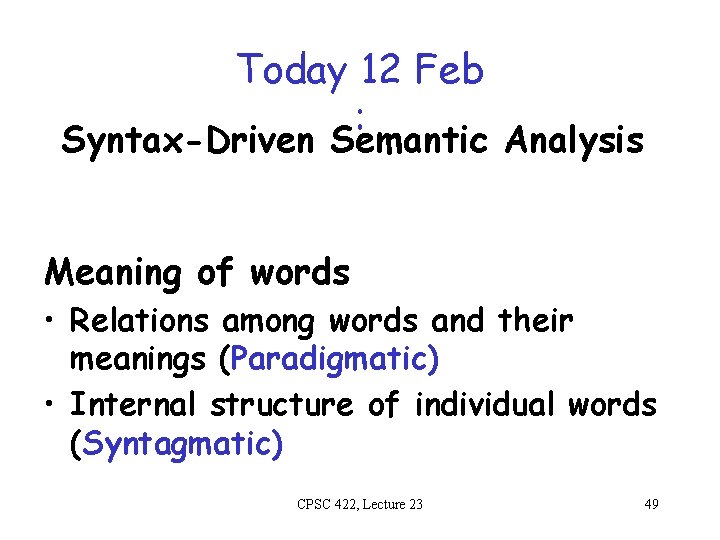
Today 12 Feb : Syntax-Driven Semantic Analysis Meaning of words • Relations among words and their meanings (Paradigmatic) • Internal structure of individual words (Syntagmatic) CPSC 422, Lecture 23 49
Practical Goal for (Syntax-driven) Semantic Analysis Map NL queries into FOPC so that answers can be effectively computed • What African countries are not on the Mediterranean Sea? • Was 2007 the first El Nino year after 2001? CPSC 422, Lecture 23 50
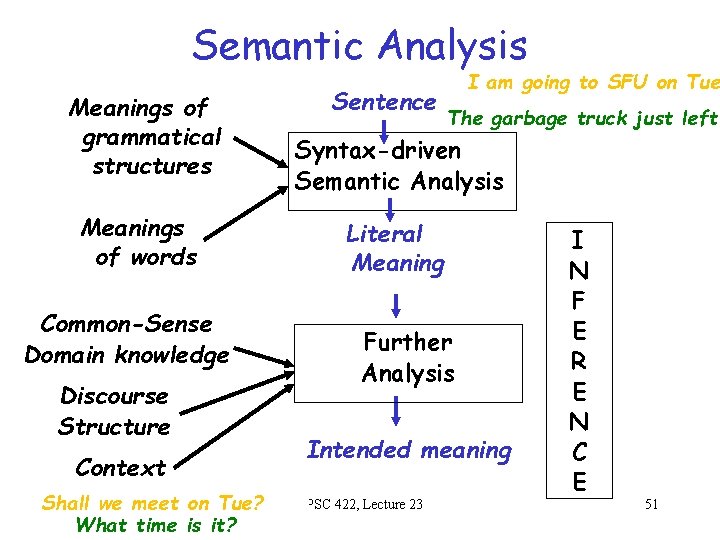
Semantic Analysis Meanings of grammatical structures Meanings of words Common-Sense Domain knowledge Discourse Structure Context Shall we meet on Tue? What time is it? Sentence I am going to SFU on Tue The garbage truck just left Syntax-driven Semantic Analysis Literal Meaning Further Analysis Intended meaning CPSC 422, Lecture 23 I N F E R E N C E 51
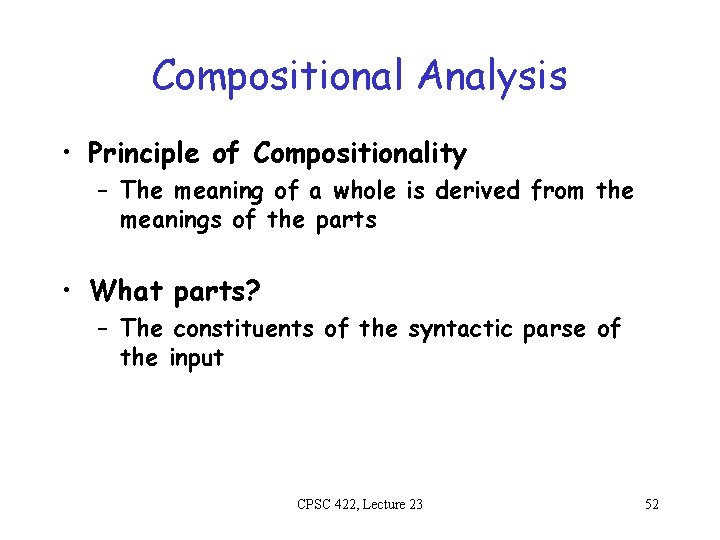
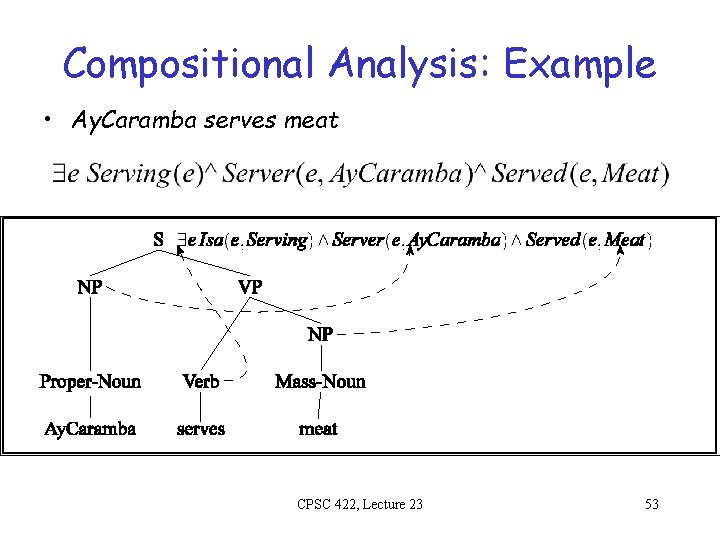
Compositional Analysis • Principle of Compositionality – The meaning of a whole is derived from the meanings of the parts • What parts? – The constituents of the syntactic parse of the input CPSC 422, Lecture 23 52
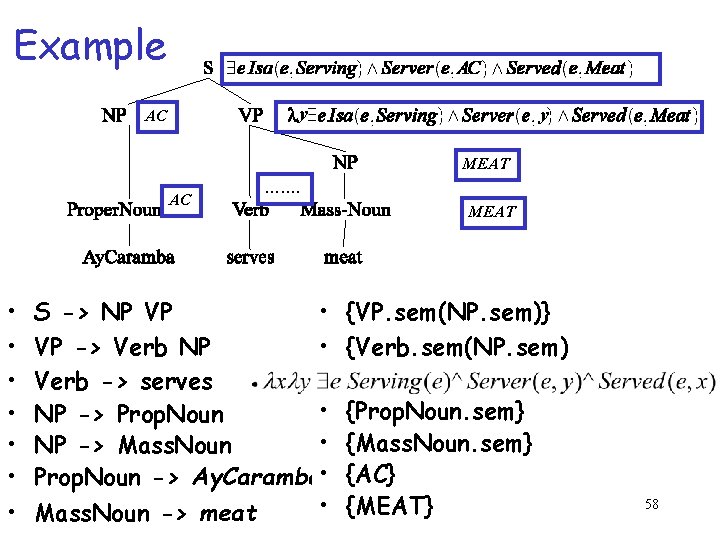
Compositional Analysis: Example • Ay. Caramba serves meat CPSC 422, Lecture 23 53
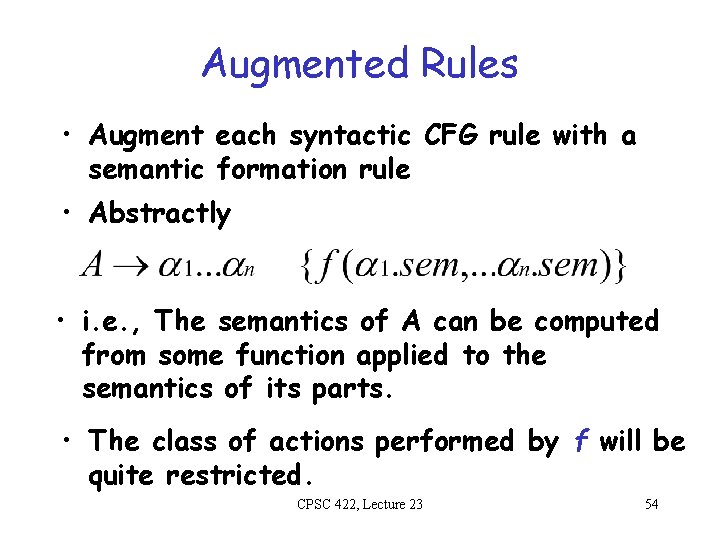
Augmented Rules • Augment each syntactic CFG rule with a semantic formation rule • Abstractly • i. e. , The semantics of A can be computed from some function applied to the semantics of its parts. • The class of actions performed by f will be quite restricted. CPSC 422, Lecture 23 54
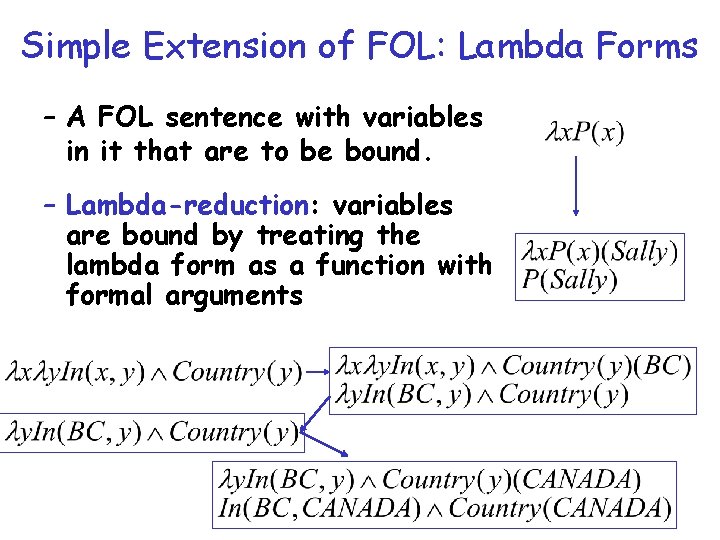
Simple Extension of FOL: Lambda Forms – A FOL sentence with variables in it that are to be bound. – Lambda-reduction: variables are bound by treating the lambda form as a function with formal arguments CPSC 422, Lecture 23 55
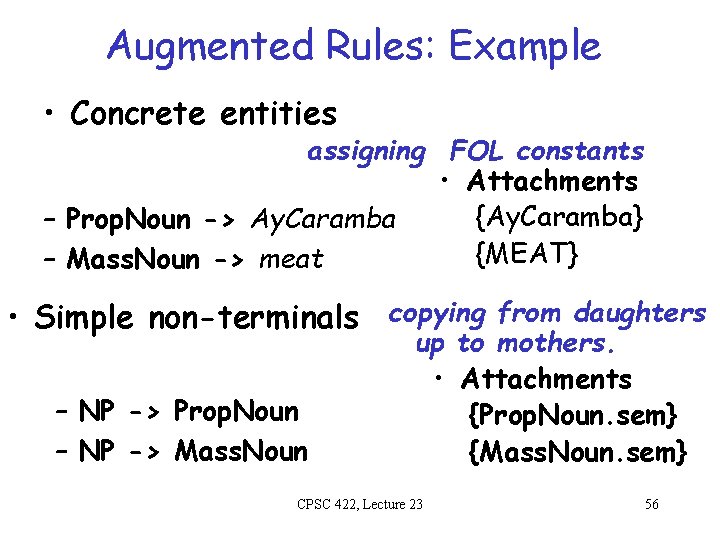
Augmented Rules: Example • Concrete entities assigning FOL constants • Attachments {Ay. Caramba} – Prop. Noun -> Ay. Caramba {MEAT} – Mass. Noun -> meat • Simple non-terminals copying from daughters – NP -> Prop. Noun – NP -> Mass. Noun up to mothers. • Attachments {Prop. Noun. sem} {Mass. Noun. sem} CPSC 422, Lecture 23 56
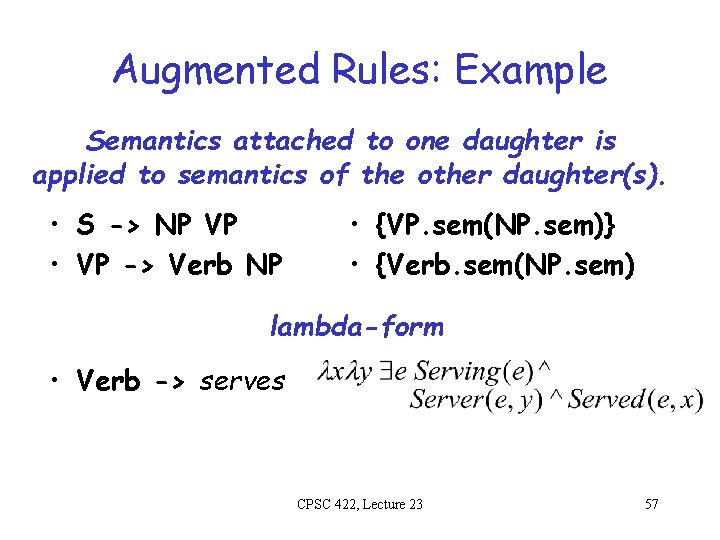
Augmented Rules: Example Semantics attached to one daughter is applied to semantics of the other daughter(s). • S -> NP VP • VP -> Verb NP • {VP. sem(NP. sem)} • {Verb. sem(NP. sem) lambda-form • Verb -> serves CPSC 422, Lecture 23 57
Example y AC y MEAT AC • • ……. MEAT S -> NP VP • {VP. sem(NP. sem)} VP -> Verb NP • {Verb. sem(NP. sem) Verb -> serves • {Prop. Noun. sem} NP -> Prop. Noun • {Mass. Noun. sem} NP -> Mass. Noun Prop. Noun -> Ay. Caramba • {AC} CPSC 422, Lecture 23 • {MEAT} Mass. Noun -> meat 58
References (Project? ) • Text Book: Representation and Inference for Natural Language : A First Course in Computational Semantics Patrick Blackburn and Johan Bos, 2005, CSLI • J. Bos (2011): A Survey of Computational Semantics: Representation, Inference and Knowledge in Wide-Coverage Text Understanding. Language and Linguistics Compass 5(6): 336– 366. Next Time • Read Chp. 19 (Lexical Semantics) CPSC 422, Lecture 23 59
Next Time Read Chp. 20 Computational Lexical Semantics • Word Sense Disambiguation • Word Similarity • Semantic Role Labeling CPSC 422, Lecture 23 60
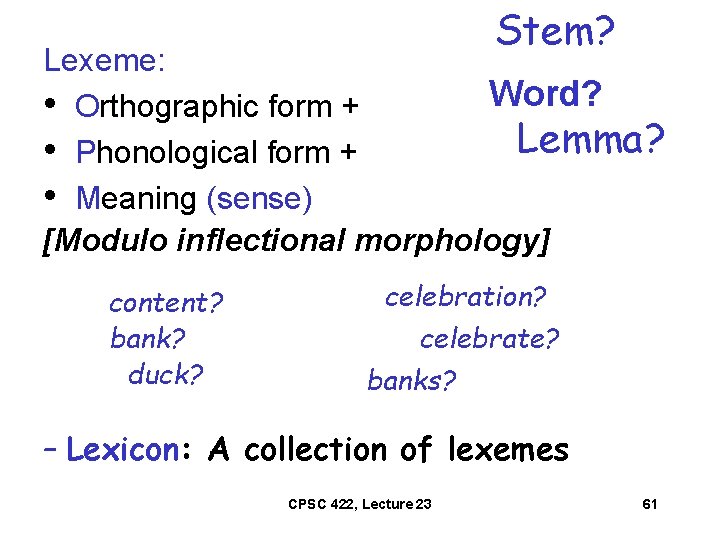
Stem? Lexeme: Word? • Orthographic form + Lemma? • Phonological form + • Meaning (sense) [Modulo inflectional morphology] content? bank? duck? celebration? celebrate? banks? – Lexicon: A collection of lexemes CPSC 422, Lecture 23 61
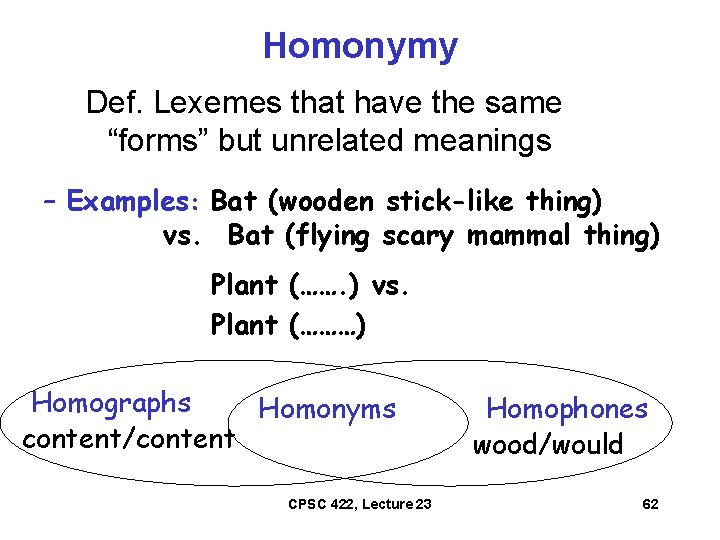
Homonymy Def. Lexemes that have the same “forms” but unrelated meanings – Examples: Bat (wooden stick-like thing) vs. Bat (flying scary mammal thing) Plant (……. ) vs. Plant (………) Homographs Homonyms content/content CPSC 422, Lecture 23 Homophones wood/would 62
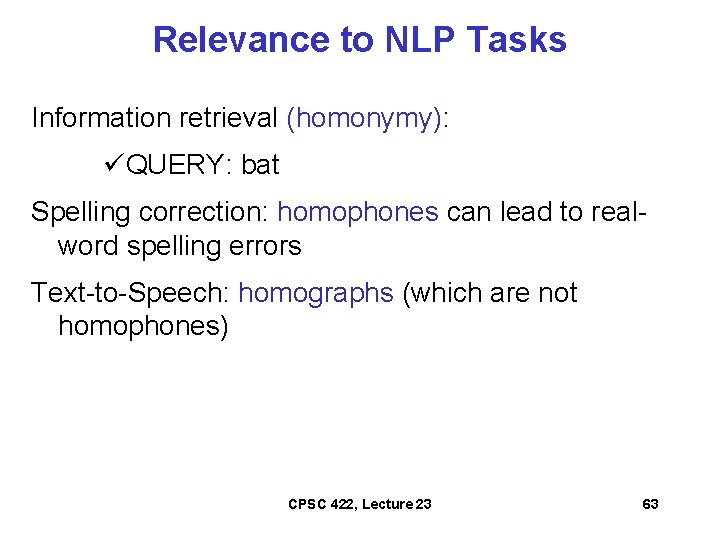
Relevance to NLP Tasks Information retrieval (homonymy): üQUERY: bat Spelling correction: homophones can lead to realword spelling errors Text-to-Speech: homographs (which are not homophones) CPSC 422, Lecture 23 63
Polysemy Lexeme (new def. ): – Orthographic form + Phonological form + – Set of related senses How many distinct (but related) senses? – They serve meat… – He served as Dept. Head… – She served her time…. Different subcat Intuition (prison) – Does AC serve vegetarian food? Zeugma – Does AC serve Rome? – (? )Does AC serve. CPSC vegetarian 422, Lecture 23 food and Rome? 64
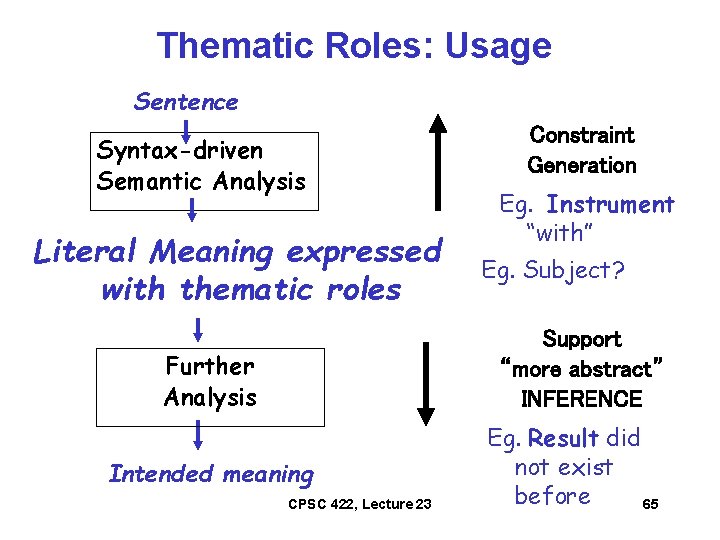
Thematic Roles: Usage Sentence Syntax-driven Semantic Analysis Literal Meaning expressed with thematic roles Constraint Generation Eg. Instrument “with” Eg. Subject? Support “more abstract” INFERENCE Further Analysis Intended meaning CPSC 422, Lecture 23 Eg. Result did not exist before 65
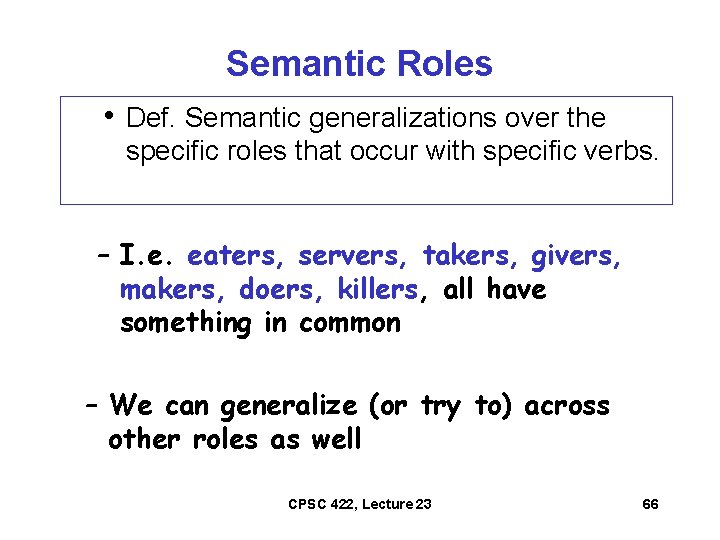
Semantic Roles • Def. Semantic generalizations over the specific roles that occur with specific verbs. – I. e. eaters, servers, takers, givers, makers, doers, killers, all have something in common – We can generalize (or try to) across other roles as well CPSC 422, Lecture 23 66
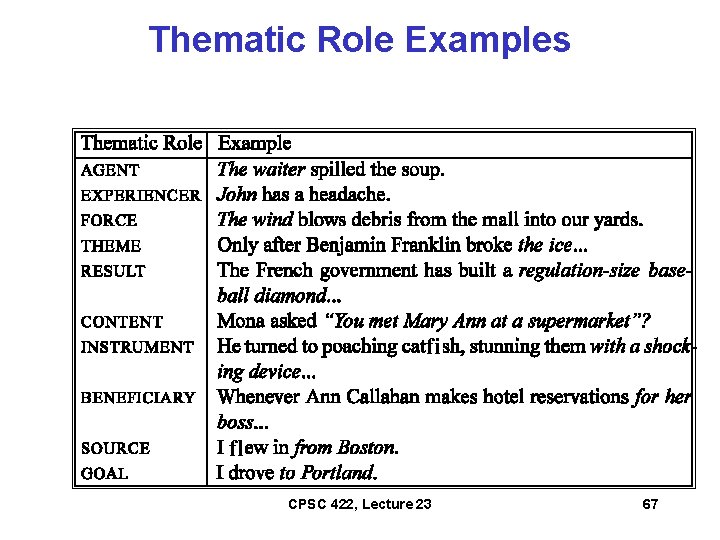
Thematic Role Examples fi fl CPSC 422, Lecture 23 67
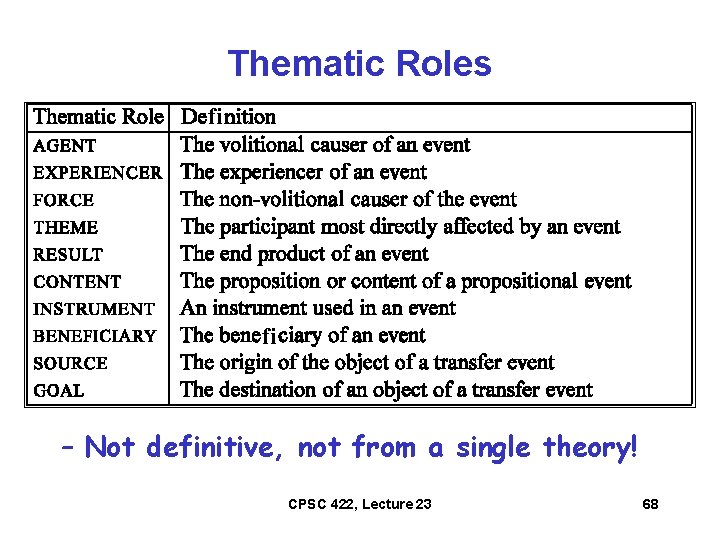
Thematic Roles fi fi – Not definitive, not from a single theory! CPSC 422, Lecture 23 68
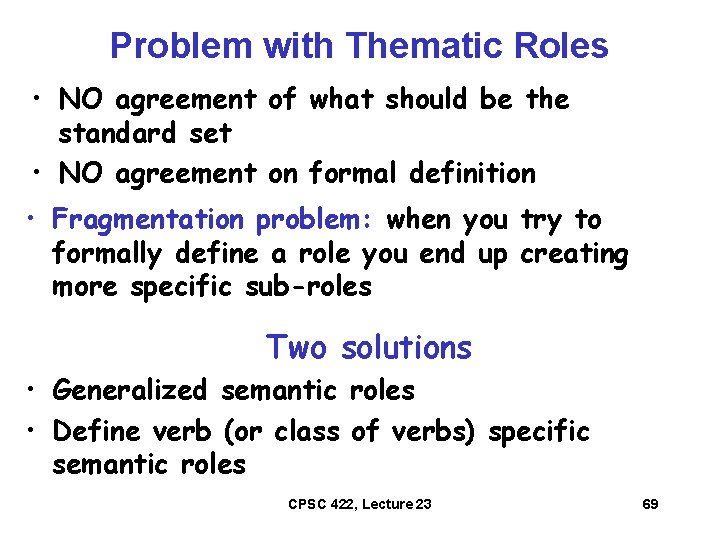
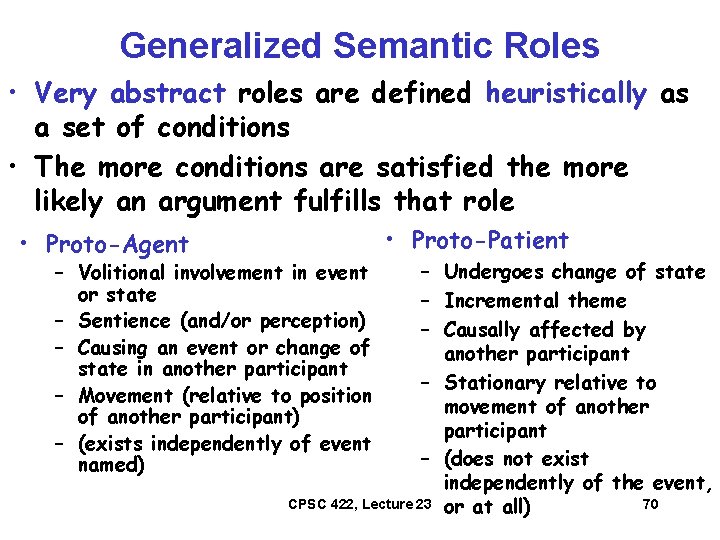
Problem with Thematic Roles • NO agreement of what should be the standard set • NO agreement on formal definition • Fragmentation problem: when you try to formally define a role you end up creating more specific sub-roles Two solutions • Generalized semantic roles • Define verb (or class of verbs) specific semantic roles CPSC 422, Lecture 23 69
Generalized Semantic Roles • Very abstract roles are defined heuristically as a set of conditions • The more conditions are satisfied the more likely an argument fulfills that role • Proto-Agent • Proto-Patient – Undergoes change of state – Incremental theme – Causally affected by another participant – Stationary relative to movement of another participant – (does not exist independently of the event, CPSC 422, Lecture 23 or at all) 70 – Volitional involvement in event or state – Sentience (and/or perception) – Causing an event or change of state in another participant – Movement (relative to position of another participant) – (exists independently of event named)
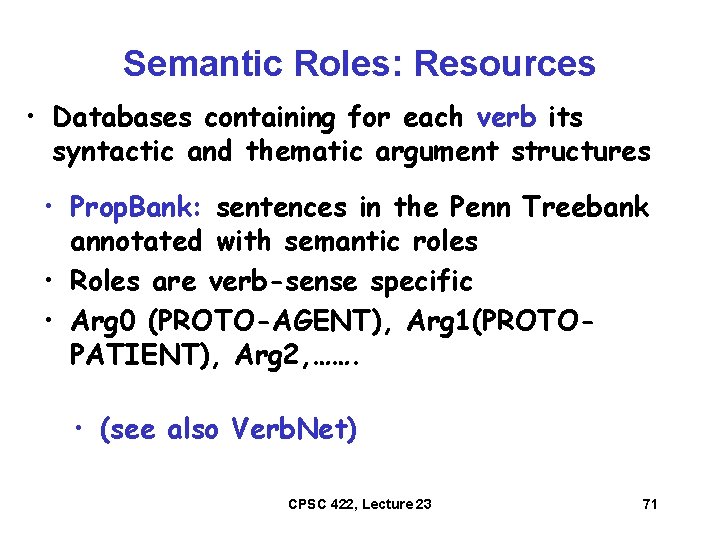
Semantic Roles: Resources • Databases containing for each verb its syntactic and thematic argument structures • Prop. Bank: sentences in the Penn Treebank annotated with semantic roles • Roles are verb-sense specific • Arg 0 (PROTO-AGENT), Arg 1(PROTOPATIENT), Arg 2, ……. • (see also Verb. Net) CPSC 422, Lecture 23 71
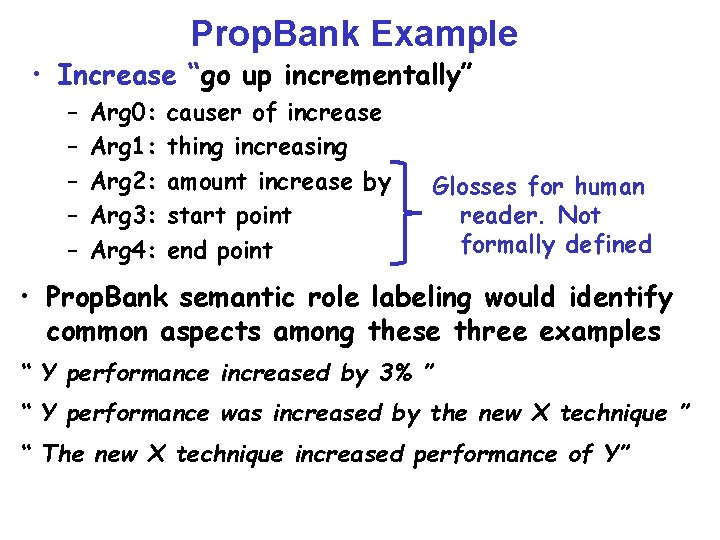
Prop. Bank Example • Increase “go up incrementally” – – – Arg 0: Arg 1: Arg 2: Arg 3: Arg 4: causer of increase thing increasing amount increase by start point end point Glosses for human reader. Not formally defined • Prop. Bank semantic role labeling would identify common aspects among these three examples “ Y performance increased by 3% ” “ Y performance was increased by the new X technique ” “ The new X technique increased performance of Y” CPSC 422, Lecture 23 72