
Intelligent Systems AI2 Computer Science cpsc 422 Lecture

- Slides: 30
Intelligent Systems (AI-2) Computer Science cpsc 422, Lecture 16 Feb, 22, 2021 CPSC 422, Lecture 16 Slide 1
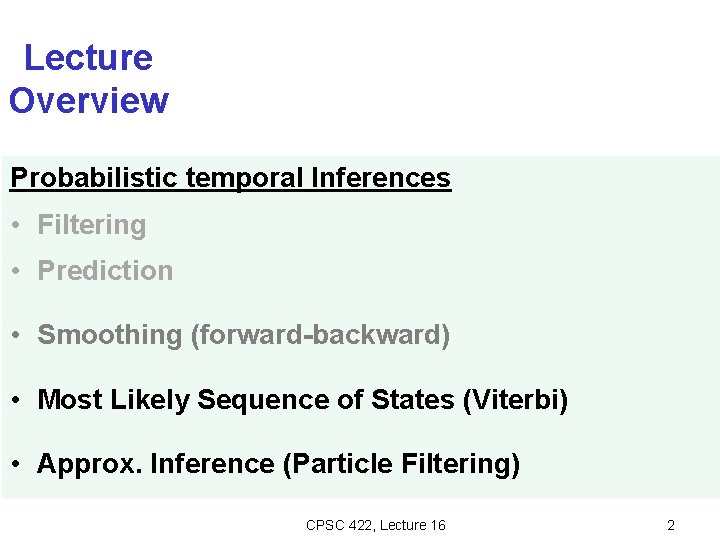
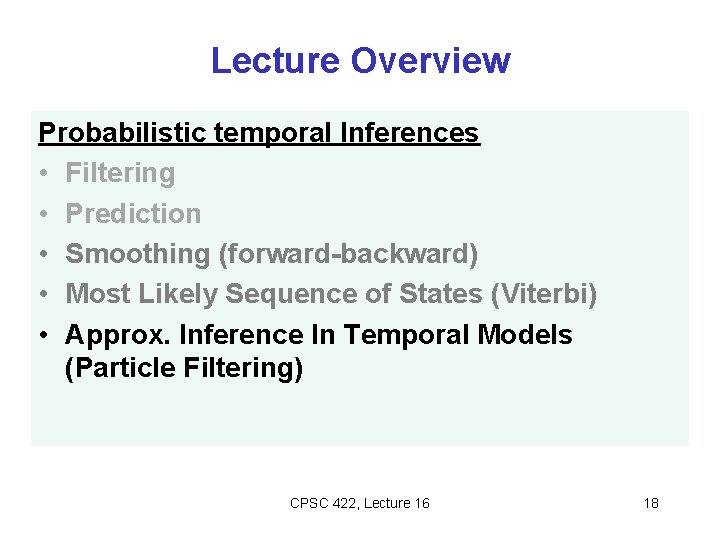
Lecture Overview Probabilistic temporal Inferences • Filtering • Prediction • Smoothing (forward-backward) • Most Likely Sequence of States (Viterbi) • Approx. Inference (Particle Filtering) CPSC 422, Lecture 16 2
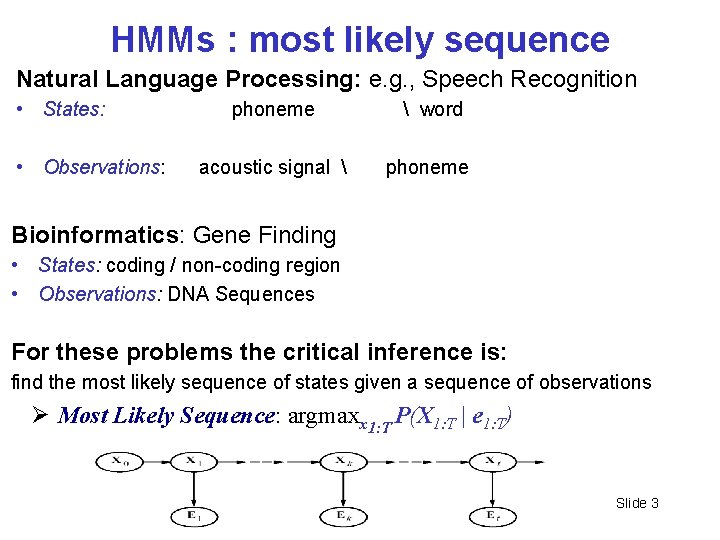
HMMs : most likely sequence Natural Language Processing: e. g. , Speech Recognition • States: • Observations: phoneme word acoustic signal phoneme Bioinformatics: Gene Finding • States: coding / non-coding region • Observations: DNA Sequences For these problems the critical inference is: find the most likely sequence of states given a sequence of observations Most Likely Sequence: argmaxx 1: T P(X 1: T | e 1: T) Slide 3
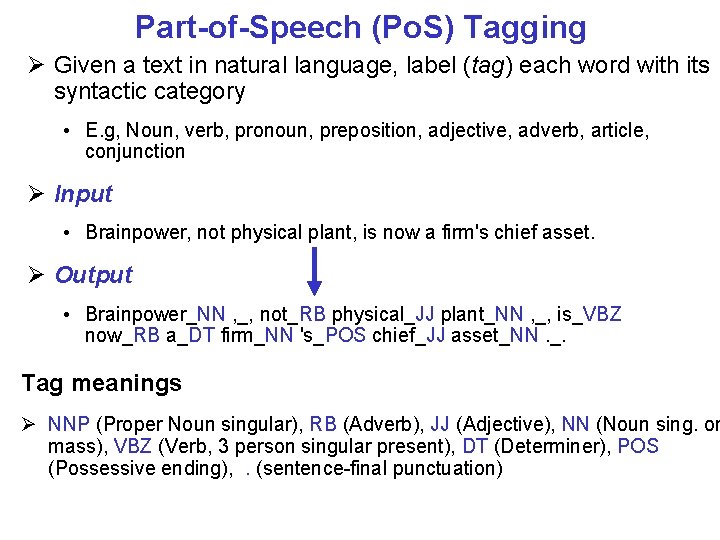
Part-of-Speech (Po. S) Tagging Given a text in natural language, label (tag) each word with its syntactic category • E. g, Noun, verb, pronoun, preposition, adjective, adverb, article, conjunction Input • Brainpower, not physical plant, is now a firm's chief asset. Output • Brainpower_NN , _, not_RB physical_JJ plant_NN , _, is_VBZ now_RB a_DT firm_NN 's_POS chief_JJ asset_NN. _. Tag meanings NNP (Proper Noun singular), RB (Adverb), JJ (Adjective), NN (Noun sing. or mass), VBZ (Verb, 3 person singular present), DT (Determiner), POS (Possessive ending), . (sentence-final punctuation)
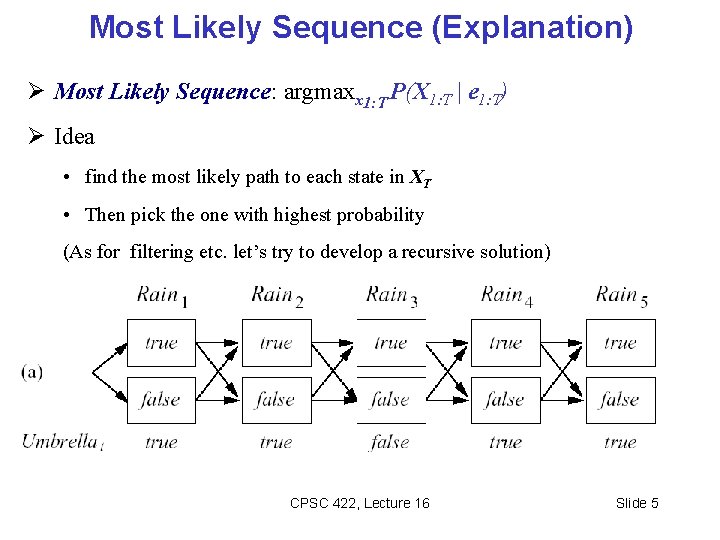
Most Likely Sequence (Explanation) Most Likely Sequence: argmaxx 1: T P(X 1: T | e 1: T) Idea • find the most likely path to each state in XT • Then pick the one with highest probability (As for filtering etc. let’s try to develop a recursive solution) CPSC 422, Lecture 16 Slide 5
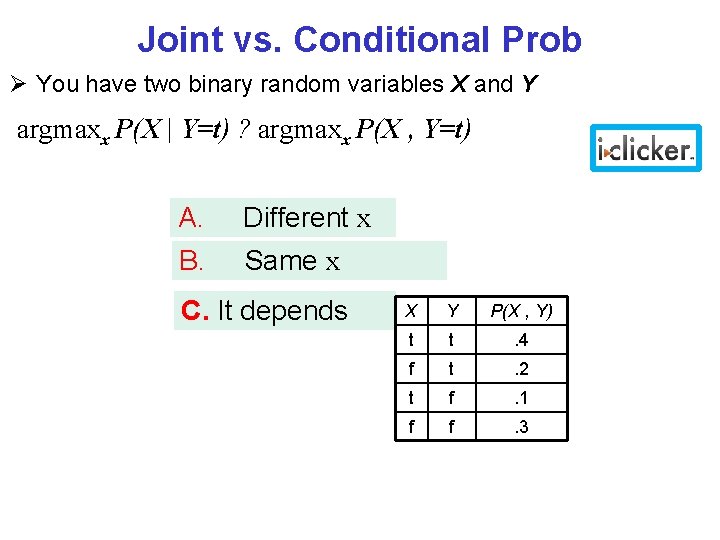
Joint vs. Conditional Prob You have two binary random variables X and Y argmaxx P(X | Y=t) ? argmaxx P(X , Y=t) A. Different x B. Same x C. It depends X Y P(X , Y) t t . 4 f t . 2 t f . 1 f f . 3
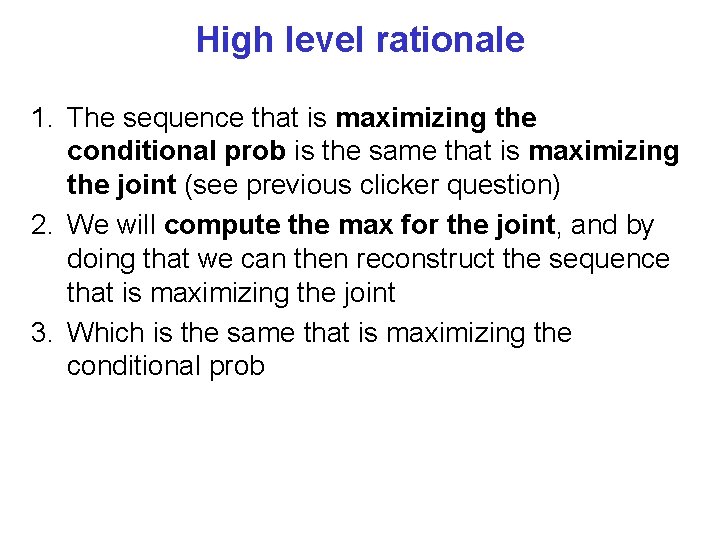
High level rationale 1. The sequence that is maximizing the conditional prob is the same that is maximizing the joint (see previous clicker question) 2. We will compute the max for the joint, and by doing that we can then reconstruct the sequence that is maximizing the joint 3. Which is the same that is maximizing the conditional prob
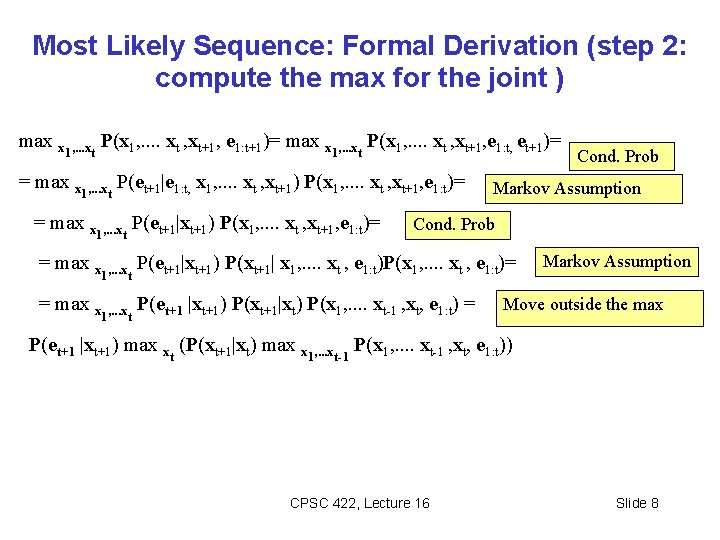
Most Likely Sequence: Formal Derivation (step 2: compute the max for the joint ) max x 1, . . . xt = max x P(x 1, . . xt , xt+1, e 1: t+1)= max x 1, . . . xt P(x 1, . . xt , xt+1, e 1: t, et+1)= P(et+1|e 1: t, x 1, . . xt , xt+1) P(x 1, . . xt , xt+1, e 1: t)= 1, . . . xt P(et+1|xt+1) P(x 1, . . xt , xt+1, e 1: t)= Markov Assumption Cond. Prob = max x 1, . . . xt P(et+1|xt+1) P(xt+1| x 1, . . xt , e 1: t)P(x 1, . . xt , e 1: t)= = max x 1, . . . xt P(et+1 |xt+1) P(xt+1|xt) P(x 1, . . xt-1 , xt, e 1: t) = P(et+1 |xt+1) max x (P(xt+1|xt) max x t 1, . . . xt-1 Cond. Prob Markov Assumption Move outside the max P(x 1, . . xt-1 , xt, e 1: t)) CPSC 422, Lecture 16 Slide 8
Most Likely Sequence: Formal Derivation (step 2 compute the max for the joint ) max x 1, . . . xt = max x P(x 1, . . xt , xt+1, e 1: t+1)= max x 1, . . . xt P(x 1, . . xt , xt+1, e 1: t, et+1)= P(et+1|e 1: t, x 1, . . xt , xt+1) P(x 1, . . xt , xt+1, e 1: t)= 1, . . . xt P(et+1|xt+1) P(x 1, . . xt , xt+1, e 1: t)= Markov Assumption Cond. Prob = max x 1, . . . xt P(et+1|xt+1) P(xt+1| x 1, . . xt , e 1: t)P(x 1, . . xt , e 1: t)= = max x 1, . . . xt P(et+1 |xt+1) P(xt+1|xt) P(x 1, . . xt-1 , xt, e 1: t) = P(et+1 |xt+1) max x (P(xt+1|xt) max x t 1, . . . xt-1 Cond. Prob Markov Assumption Move outside the max P(x 1, . . xt-1 , xt, e 1: t)) CPSC 422, Lecture 16 Slide 9
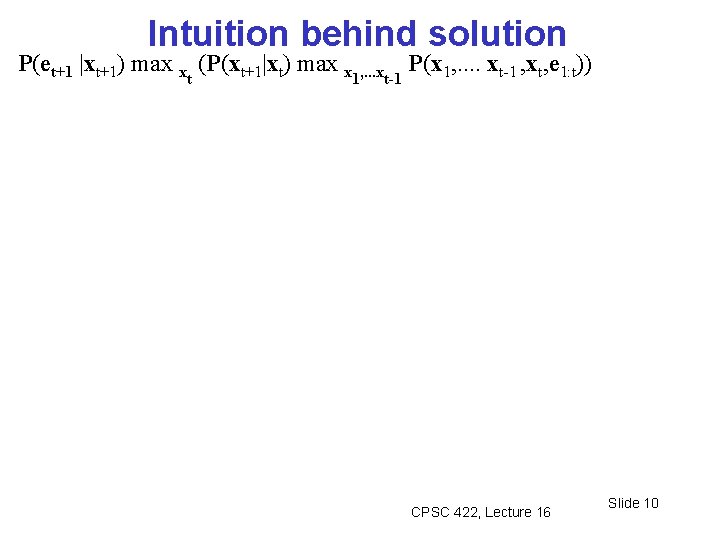
Intuition behind solution P(et+1 |xt+1) max x (P(xt+1|xt) max x t 1, . . . xt-1 P(x 1, . . xt-1 , xt, e 1: t)) CPSC 422, Lecture 16 Slide 10
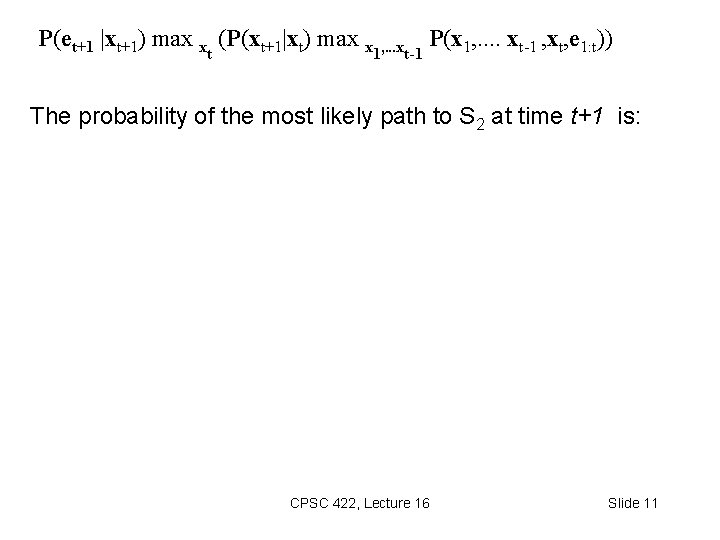
P(et+1 |xt+1) max x (P(xt+1|xt) max x t 1, . . . xt-1 P(x 1, . . xt-1 , xt, e 1: t)) The probability of the most likely path to S 2 at time t+1 is: CPSC 422, Lecture 16 Slide 11
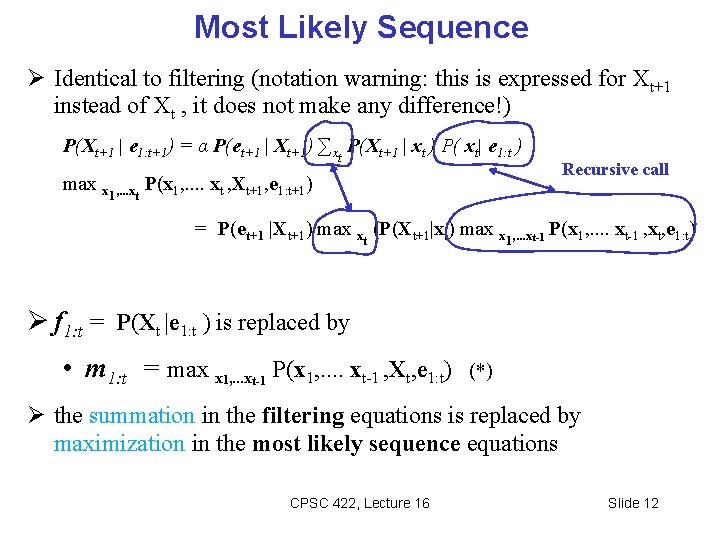
Most Likely Sequence Identical to filtering (notation warning: this is expressed for Xt+1 instead of Xt , it does not make any difference!) P(Xt+1 | e 1: t+1) = α P(et+1 | Xt+1) ∑xt P(Xt+1 | xt ) P( xt| e 1: t ) max x 1, . . . xt P(x 1, . . xt , Xt+1, e 1: t+1) = P(et+1 |Xt+1) max x (P(Xt+1|xt) max x t 1, . . . xt-1 Recursive call P(x 1, . . xt-1 , xt, e 1: t) f 1: t = P(Xt |e 1: t ) is replaced by • m 1: t = max x 1, . . . xt-1 P(x 1, . . xt-1 , Xt, e 1: t) (*) the summation in the filtering equations is replaced by maximization in the most likely sequence equations CPSC 422, Lecture 16 Slide 12
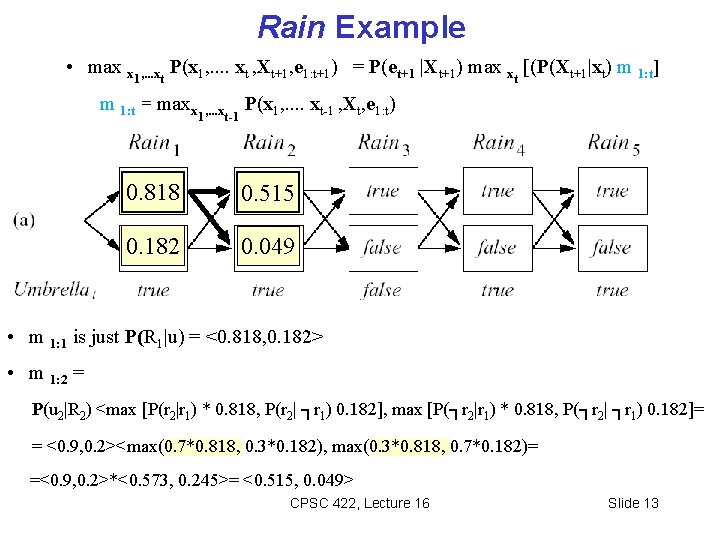
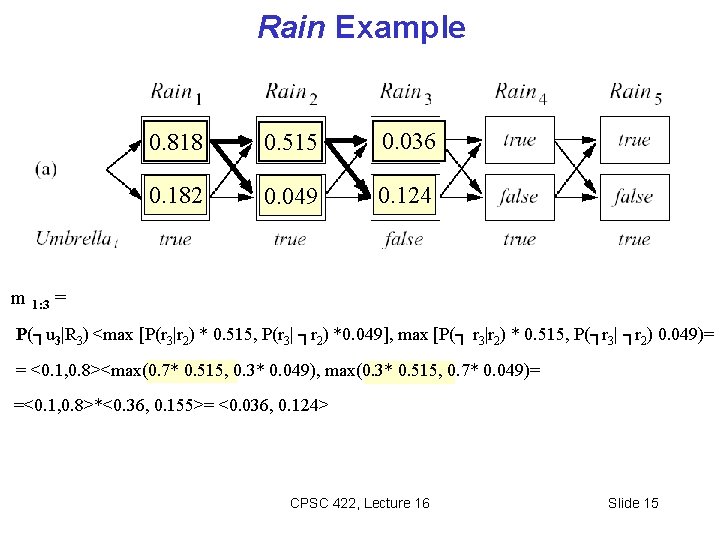
Rain Example • max x 1, . . . xt P(x 1, . . xt , Xt+1, e 1: t+1) = P(et+1 |Xt+1) max x [(P(Xt+1|xt) m 1: t] m 1: t = maxx t 1, . . . xt-1 P(x 1, . . xt-1 , Xt, e 1: t) 0. 818 0. 515 0. 182 0. 049 • m 1: 1 is just P(R 1|u) = <0. 818, 0. 182> • m 1: 2 = P(u 2|R 2) <max [P(r 2|r 1) * 0. 818, P(r 2| ┐r 1) 0. 182], max [P(┐r 2|r 1) * 0. 818, P(┐r 2| ┐r 1) 0. 182]= = <0. 9, 0. 2><max(0. 7*0. 818, 0. 3*0. 182), max(0. 3*0. 818, 0. 7*0. 182)= =<0. 9, 0. 2>*<0. 573, 0. 245>= <0. 515, 0. 049> CPSC 422, Lecture 16 Slide 13
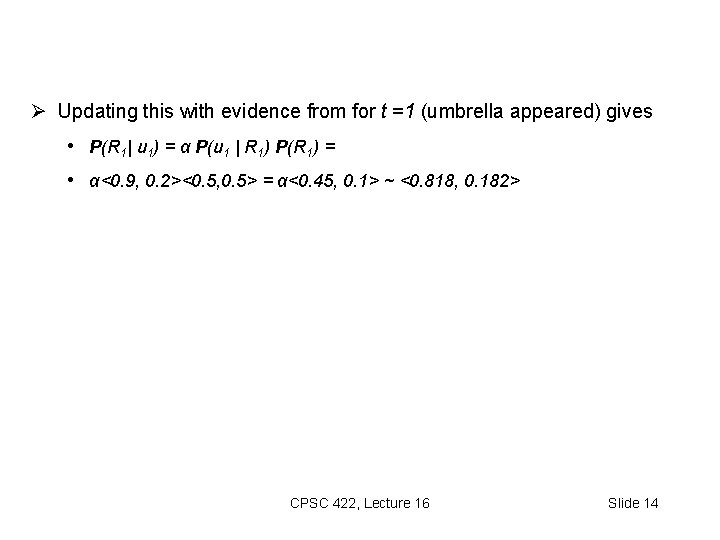
Updating this with evidence from for t =1 (umbrella appeared) gives • P(R 1| u 1) = α P(u 1 | R 1) P(R 1) = • α<0. 9, 0. 2><0. 5, 0. 5> = α<0. 45, 0. 1> ~ <0. 818, 0. 182> CPSC 422, Lecture 16 Slide 14
Rain Example 0. 818 0. 515 0. 036 0. 182 0. 049 0. 124 m 1: 3 = P(┐u 3|R 3) <max [P(r 3|r 2) * 0. 515, P(r 3| ┐r 2) *0. 049], max [P(┐ r 3|r 2) * 0. 515, P(┐r 3| ┐r 2) 0. 049)= = <0. 1, 0. 8><max(0. 7* 0. 515, 0. 3* 0. 049), max(0. 3* 0. 515, 0. 7* 0. 049)= =<0. 1, 0. 8>*<0. 36, 0. 155>= <0. 036, 0. 124> CPSC 422, Lecture 16 Slide 15
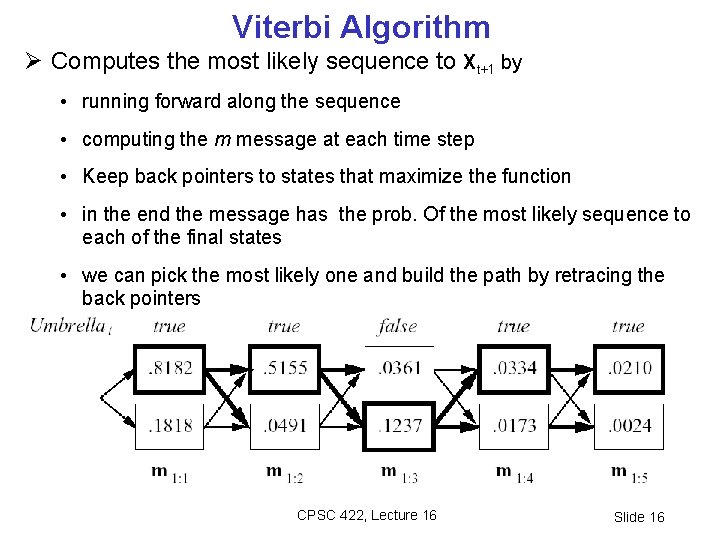
Viterbi Algorithm Computes the most likely sequence to Xt+1 by • running forward along the sequence • computing the m message at each time step • Keep back pointers to states that maximize the function • in the end the message has the prob. Of the most likely sequence to each of the final states • we can pick the most likely one and build the path by retracing the back pointers CPSC 422, Lecture 16 Slide 16
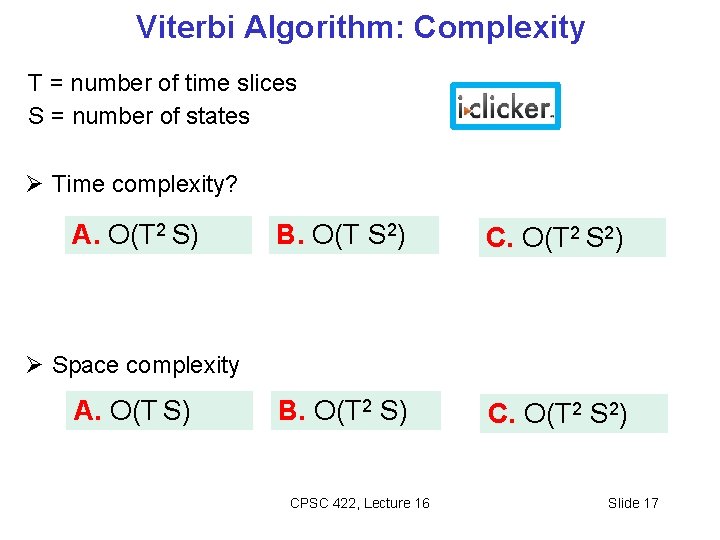
Viterbi Algorithm: Complexity T = number of time slices S = number of states Time complexity? A. O(T 2 S) B. O(T S 2) C. O(T 2 S 2) B. O(T 2 S) C. O(T 2 S 2) Space complexity A. O(T S) CPSC 422, Lecture 16 Slide 17
Lecture Overview Probabilistic temporal Inferences • Filtering • Prediction • Smoothing (forward-backward) • Most Likely Sequence of States (Viterbi) • Approx. Inference In Temporal Models (Particle Filtering) CPSC 422, Lecture 16 18
Limitations of Exact Algorithms • HMM has very large number of states • Our temporal model is a Dynamic Belief Network with several “state” variables Exact algorithms do not scale up What to do?
Approximate Inference Basic idea: • Draw N samples from known prob. distributions • Use those samples to estimate unknown prob. distributions Why sample? • Inference: getting N samples is faster than computing the right answer (e. g. with Filtering) CPSC 422, Lecture 11 20
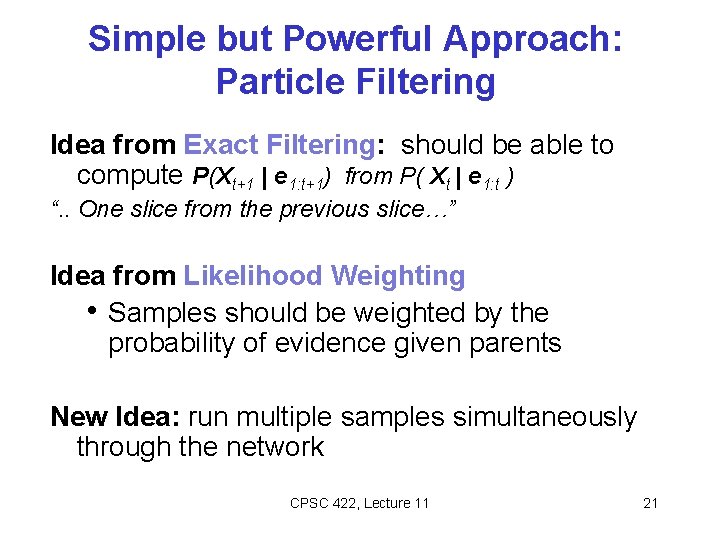
Simple but Powerful Approach: Particle Filtering Idea from Exact Filtering: should be able to compute P(Xt+1 | e 1: t+1) from P( Xt | e 1: t ) “. . One slice from the previous slice…” Idea from Likelihood Weighting • Samples should be weighted by the probability of evidence given parents New Idea: run multiple samples simultaneously through the network CPSC 422, Lecture 11 21
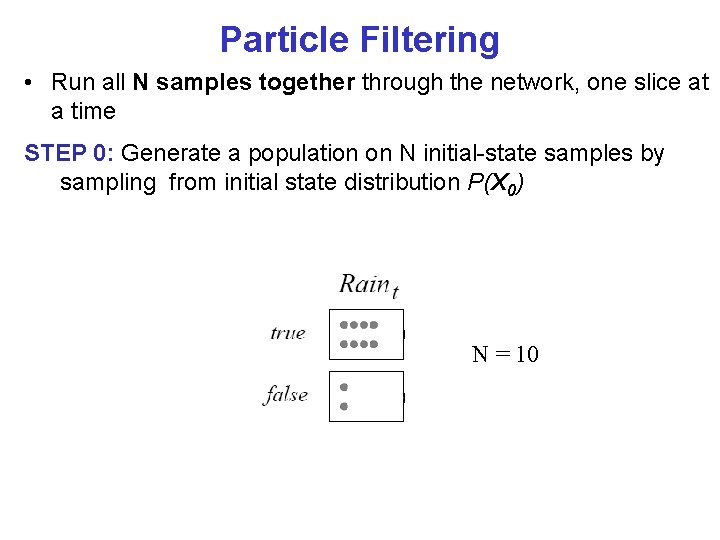
Particle Filtering • Run all N samples together through the network, one slice at a time STEP 0: Generate a population on N initial-state samples by sampling from initial state distribution P(X 0) N = 10
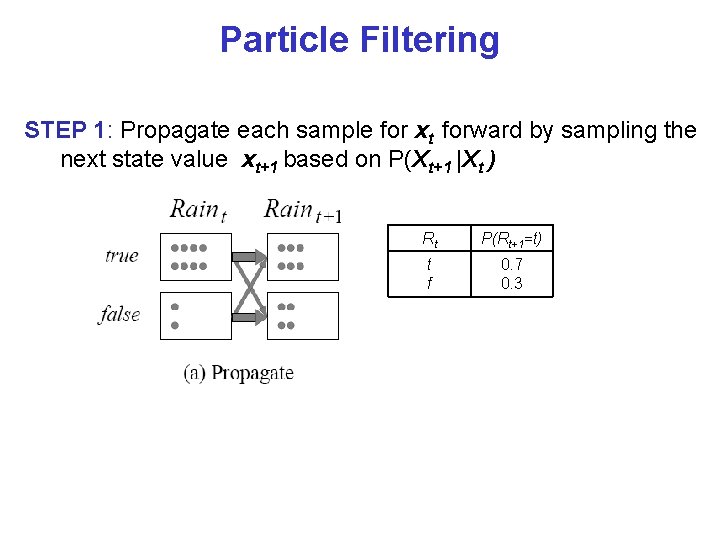
Particle Filtering STEP 1: Propagate each sample for xt forward by sampling the next state value xt+1 based on P(Xt+1 |Xt ) Rt P(Rt+1=t) t f 0. 7 0. 3
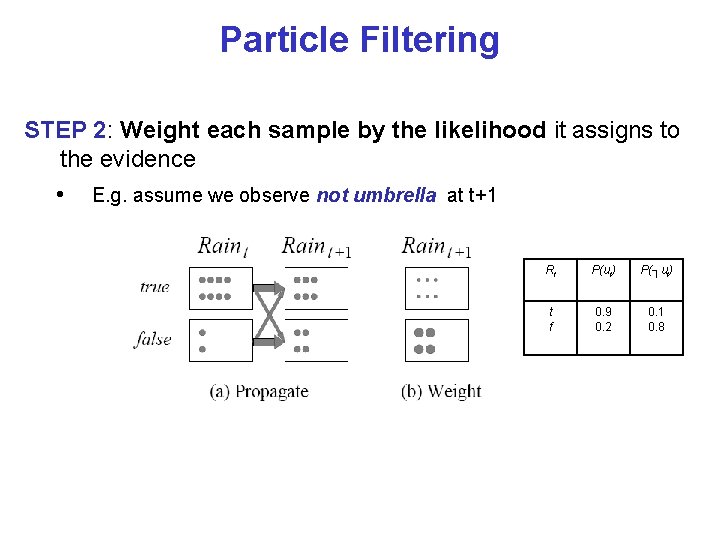
Particle Filtering STEP 2: Weight each sample by the likelihood it assigns to the evidence • E. g. assume we observe not umbrella at t+1 Rt P(ut) P(┐ut) t f 0. 9 0. 2 0. 1 0. 8
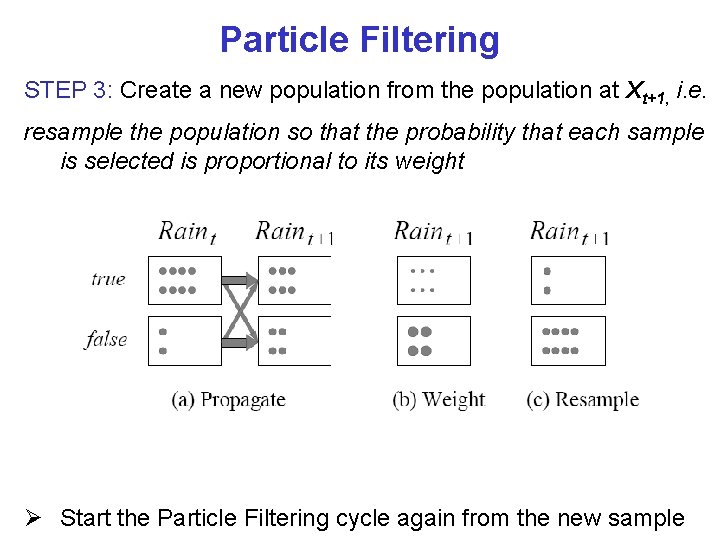
Particle Filtering STEP 3: Create a new population from the population at Xt+1, i. e. resample the population so that the probability that each sample is selected is proportional to its weight Start the Particle Filtering cycle again from the new sample
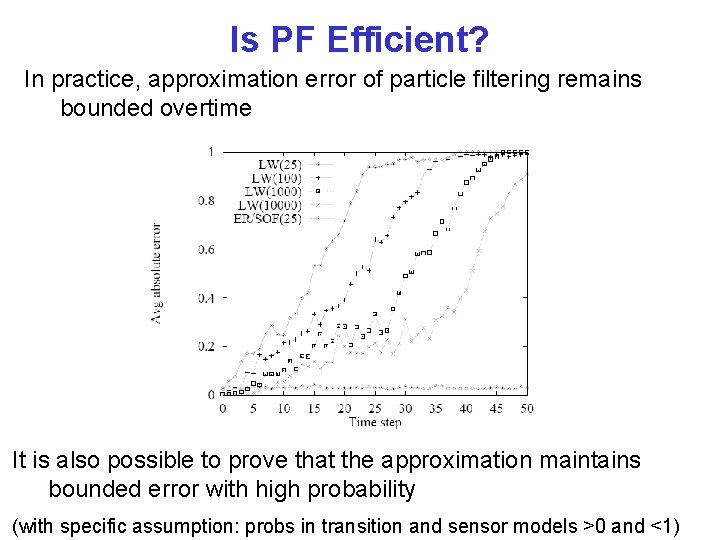
Is PF Efficient? In practice, approximation error of particle filtering remains bounded overtime It is also possible to prove that the approximation maintains bounded error with high probability (with specific assumption: probs in transition and sensor models >0 and <1)
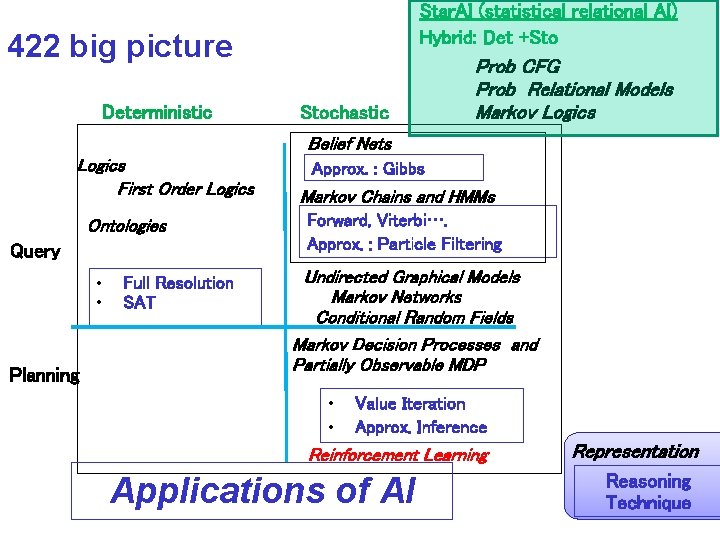
Star. AI (statistical relational AI) Hybrid: Det +Sto 422 big picture Deterministic Stochastic Prob CFG Prob Relational Models Markov Logics Belief Nets Logics First Order Logics Ontologies Query • • Planning Full Resolution SAT Approx. : Gibbs Markov Chains and HMMs Forward, Viterbi…. Approx. : Particle Filtering Undirected Graphical Models Markov Networks Conditional Random Fields Markov Decision Processes and Partially Observable MDP • • Value Iteration Approx. Inference Reinforcement Learning Applications of AI CPSC 422, Lecture 35 Representation Reasoning Technique Slide 27
Learning Goals for today’s class You can: • Describe the problem of finding the most likely sequence of states (given a sequence of observations), derive its solution (Viterbi algorithm) by manipulating probabilities and applying it to a temporal model • Describe and apply Particle Filtering for approx. inference in temporal models. CPSC 422, Lecture 16 Slide 28
TODO for Wed • Keep working on Assignment-2: due Mon March 1 • Midterm : Mon March 8 CPSC 422, Lecture 15 Slide 29
TODO for Fri • Keep working on Assignment-2: due Fri Oct 18 • Midterm : October 25 CPSC 422, Lecture 15 Slide 30