
Intelligent Software Correctness of Programs 2 Hoare Logic
![3.ホーア論理 (5/9) 代入(続き) (Assignment) 代入 Pが未知のとき: P = Q[x: =E] If P is unknown, let](https://slidetodoc.com/presentation_image/37b0e03337128571f2a77db647974943/image-9.jpg "3.ホーア論理 (5/9) 代入(続き) (Assignment) 代入 Pが未知のとき: P = Q[x: =E] If P is unknown, let")

- Slides: 25
知能ソフトウェア特論 Intelligent Software プログラムの正当性(2) ホーア論理 Correctness of Programs (2) Hoare Logic
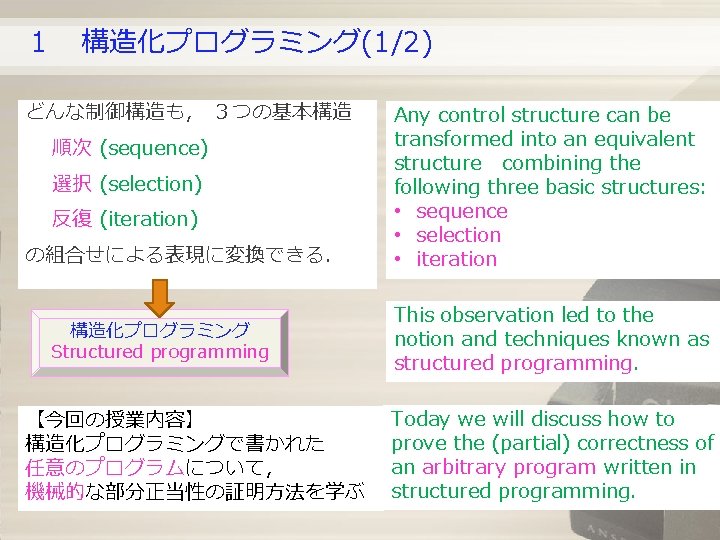
1 構造化プログラミング(1/2) どんな制御構造も, 3つの基本構造 順次 (sequence) 選択 (selection) 反復 (iteration) の組合せによる表現に変換できる. 構造化プログラミング Structured programming 【今回の授業内容】 構造化プログラミングで書かれた 任意のプログラムについて, 機械的な部分正当性の証明方法を学ぶ Any control structure can be transformed into an equivalent structure combining the following three basic structures: • sequence • selection • iteration This observation led to the notion and techniques known as structured programming. Today we will discuss how to prove the (partial) correctness of an arbitrary program written in structured programming.
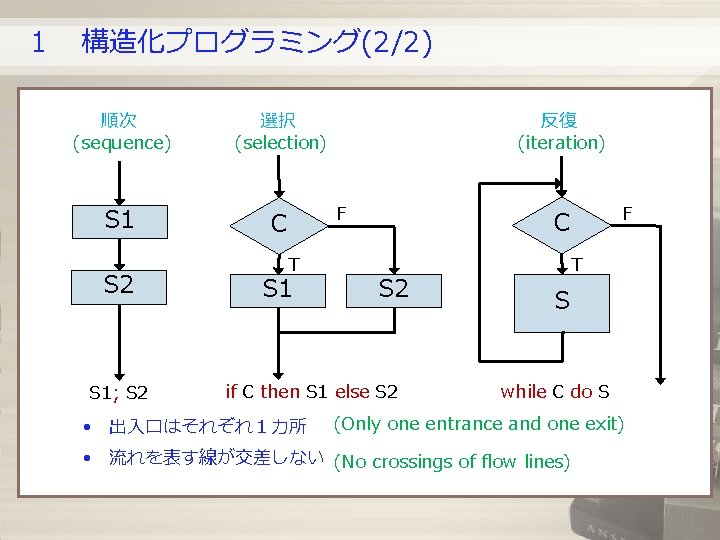
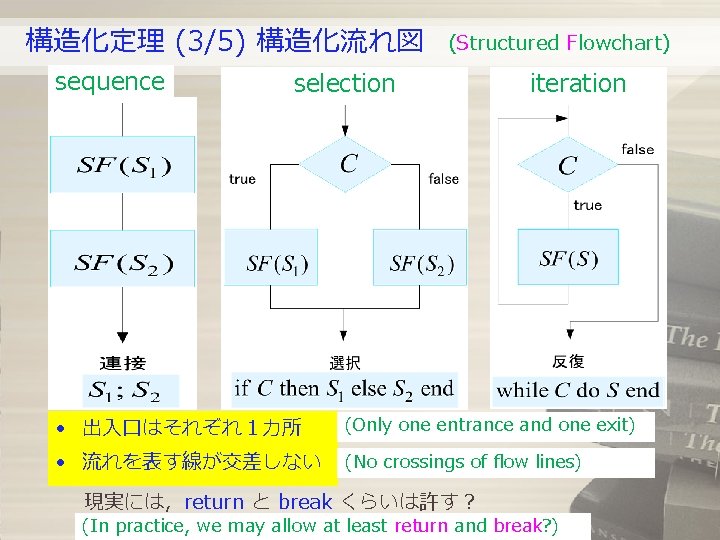
1 構造化プログラミング(2/2) 順次 (sequence) 選択 (selection) S 1 C S 2 S 1; S 2 反復 (iteration) F T S 1 S 2 if C then S 1 else S 2 • 出入口はそれぞれ1カ所 F C T S while C do S (Only one entrance and one exit) • 流れを表す線が交差しない (No crossings of flow lines)
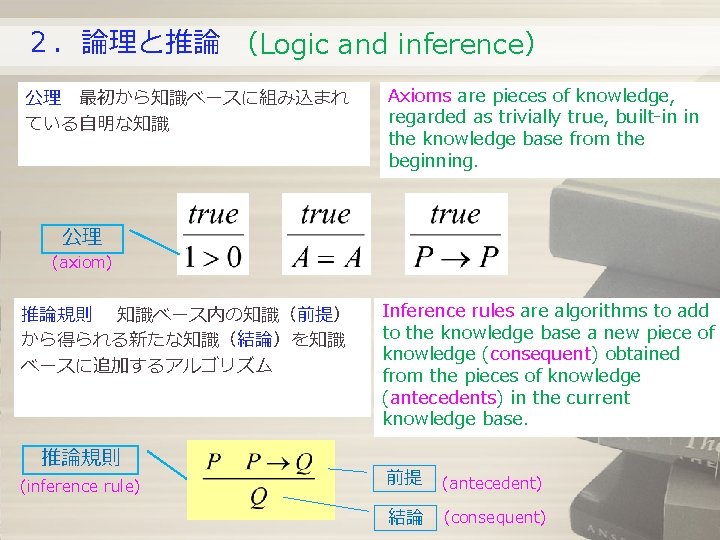
2.論理と推論 (Logic and inference) 公理 最初から知識ベースに組み込まれ ている自明な知識 Axioms are pieces of knowledge, regarded as trivially true, built-in in the knowledge base from the beginning. 公理 (axiom) 推論規則 知識ベース内の知識(前提) から得られる新たな知識(結論)を知識 ベースに追加するアルゴリズム 推論規則 (inference rule) Inference rules are algorithms to add to the knowledge base a new piece of knowledge (consequent) obtained from the pieces of knowledge (antecedents) in the current knowledge base. 前提 (antecedent) 結論 (consequent)
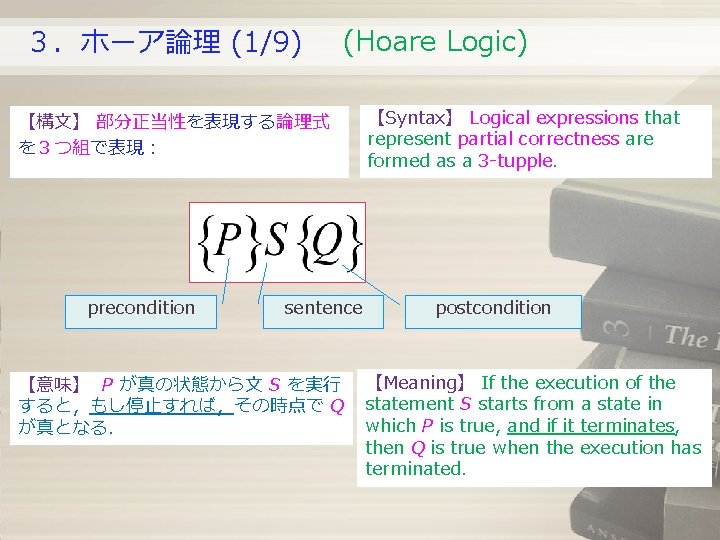
3.ホーア論理 (1/9) (Hoare Logic) 【構文】 部分正当性を表現する論理式 を3つ組で表現: precondition sentence 【意味】 P が真の状態から文 S を実行 すると,もし停止すれば,その時点で Q が真となる. 【Syntax】 Logical expressions that represent partial correctness are formed as a 3 -tupple. postcondition 【Meaning】 If the execution of the statement S starts from a state in which P is true, and if it terminates, then Q is true when the execution has terminated.
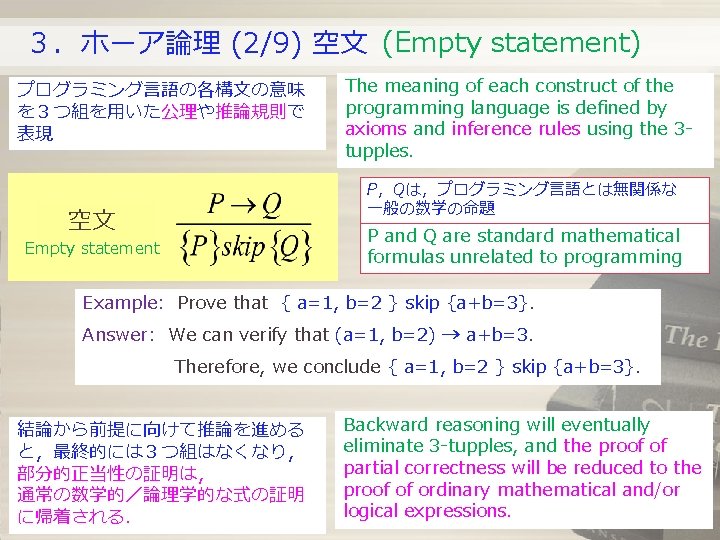
3.ホーア論理 (2/9) 空文 (Empty statement) プログラミング言語の各構文の意味 を3つ組を用いた公理や推論規則で 表現 The meaning of each construct of the programming language is defined by axioms and inference rules using the 3 tupples. P,Qは,プログラミング言語とは無関係な 一般の数学の命題 空文 P and Q are standard mathematical formulas unrelated to programming Empty statement Example: Prove that { a=1, b=2 } skip {a+b=3}. Answer: We can verify that (a=1, b=2) → a+b=3. Therefore, we conclude { a=1, b=2 } skip {a+b=3}. 結論から前提に向けて推論を進める と,最終的には3つ組はなくなり, 部分的正当性の証明は, 通常の数学的/論理学的な式の証明 に帰着される. Backward reasoning will eventually eliminate 3 -tupples, and the proof of partial correctness will be reduced to the proof of ordinary mathematical and/or logical expressions.
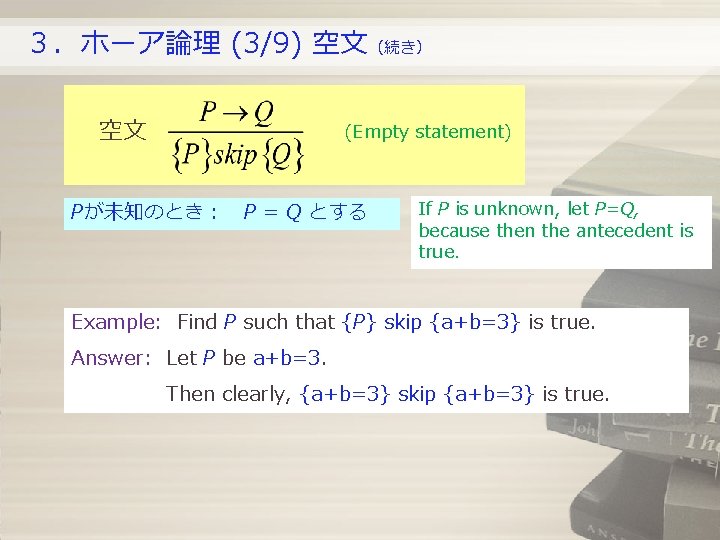
3.ホーア論理 (3/9) 空文(続き) 空文 (Empty statement) Pが未知のとき: P = Q とする If P is unknown, let P=Q, because then the antecedent is true. Example: Find P such that {P} skip {a+b=3} is true. Answer: Let P be a+b=3. Then clearly, {a+b=3} skip {a+b=3} is true.
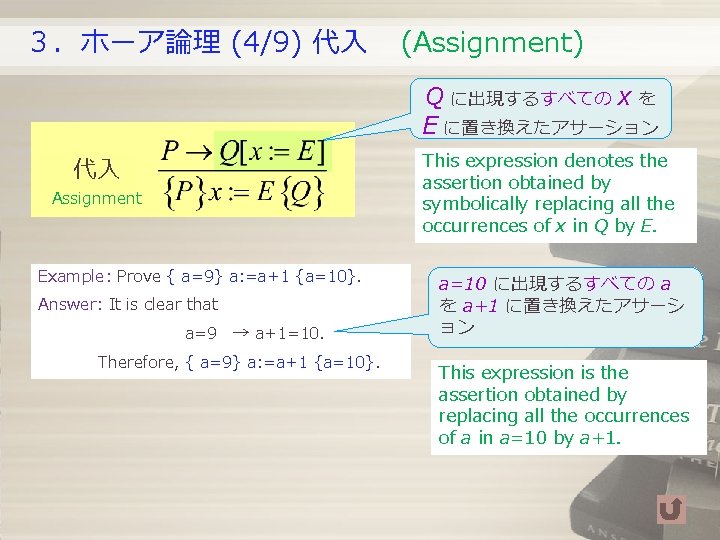
3.ホーア論理 (4/9) 代入 (Assignment) Q に出現するすべての x を E に置き換えたアサーション This expression denotes the assertion obtained by symbolically replacing all the occurrences of x in Q by E. 代入 Assignment Example: Prove { a=9} a: =a+1 {a=10}. Answer: It is clear that a=9 → a+1=10. Therefore, { a=9} a: =a+1 {a=10}. a=10 に出現するすべての a を a+1 に置き換えたアサーシ ョン This expression is the assertion obtained by replacing all the occurrences of a in a=10 by a+1.
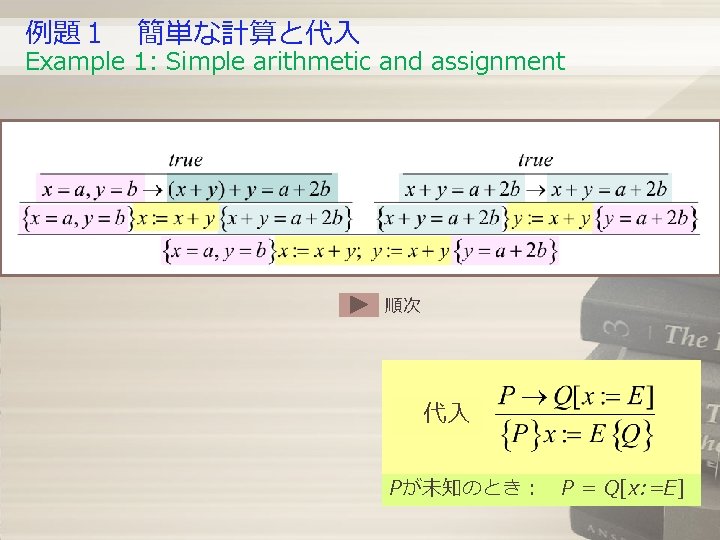
3.ホーア論理 (5/9) 代入(続き) (Assignment) 代入 Pが未知のとき: P = Q[x: =E] If P is unknown, let P=Q[x: =E], because then the antecedent is true. Example: Find P such that {P} a: = b+1 {a+b=3} is true. Answer: Let P be (b+1)+b=3, i. e. , b=1. Then clearly, {b=1} a: = b+1 {a+b=3} is true.
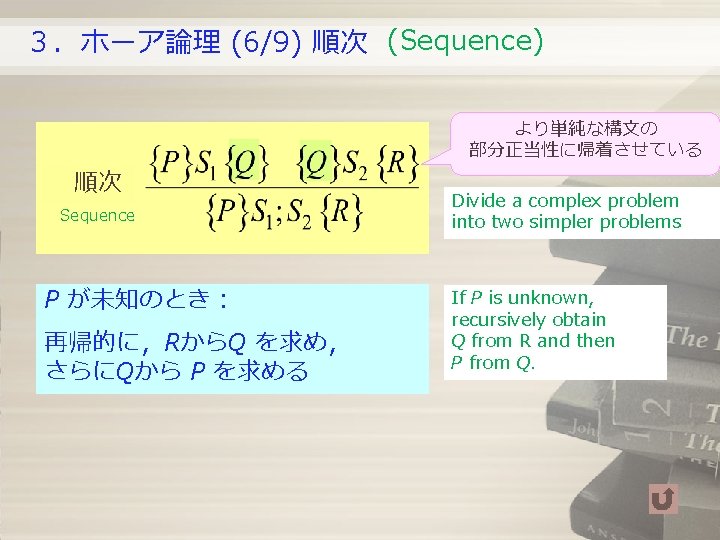
3.ホーア論理 (6/9) 順次 (Sequence) より単純な構文の 部分正当性に帰着させている 順次 Sequence P が未知のとき: 再帰的に,RからQ を求め, さらにQから P を求める Divide a complex problem into two simpler problems If P is unknown, recursively obtain Q from R and then P from Q.
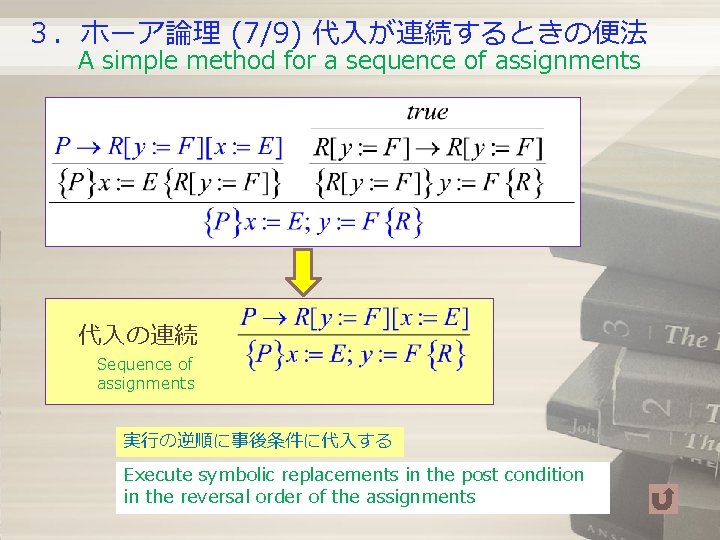
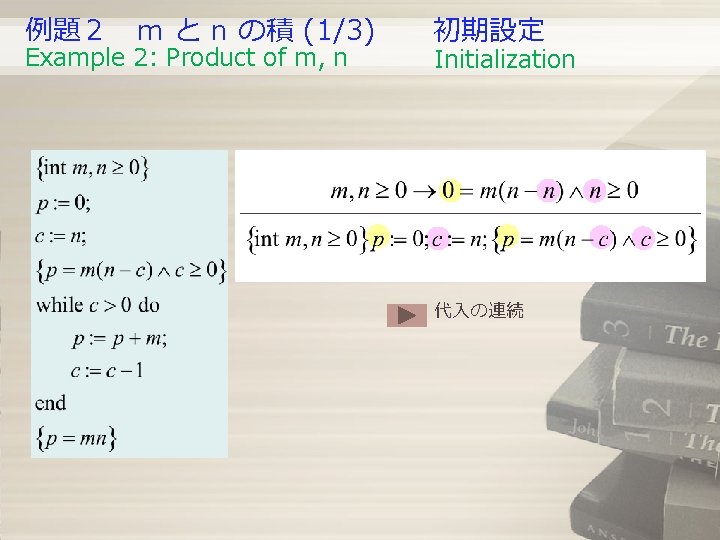
3.ホーア論理 (7/9) 代入が連続するときの便法 A simple method for a sequence of assignments 代入の連続 Sequence of assignments 実行の逆順に事後条件に代入する Execute symbolic replacements in the post condition in the reversal order of the assignments
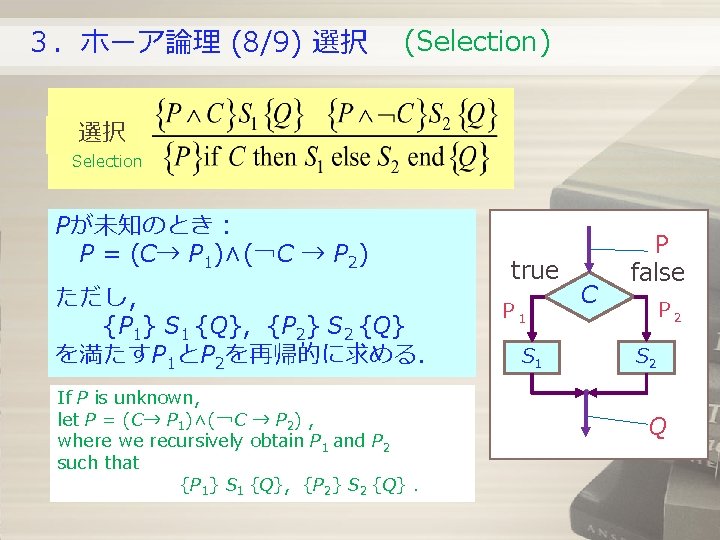
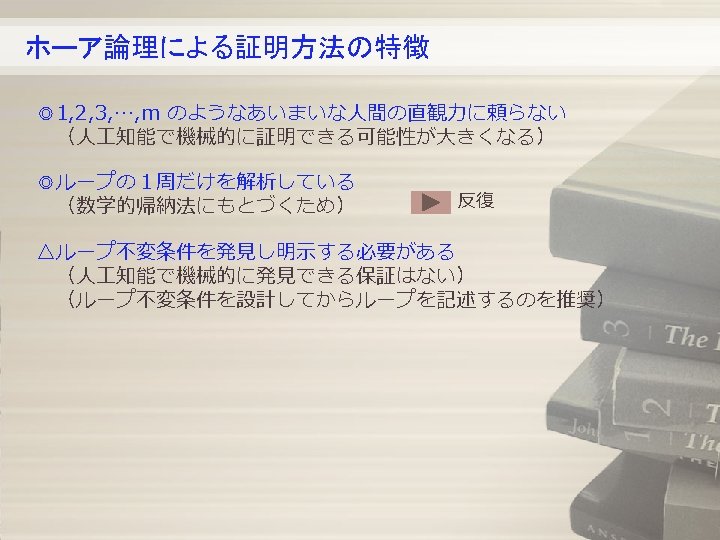
3.ホーア論理 (8/9) 選択 (Selection) 選択 Selection Pが未知のとき: P = (C→ P 1)∧(¬C → P 2) ただし, {P 1} S 1 {Q}, {P 2} S 2 {Q} を満たすP 1とP 2を再帰的に求める. If P is unknown, let P = (C→ P 1)∧(¬C → P 2) , where we recursively obtain P 1 and P 2 such that {P 1} S 1 {Q}, {P 2} S 2 {Q}. true P 1 S 1 C P false P 2 S 2 Q
例題2 m と n の積 (1/3) Example 2: Product of m, n 初期設定 Initialization 代入の連続
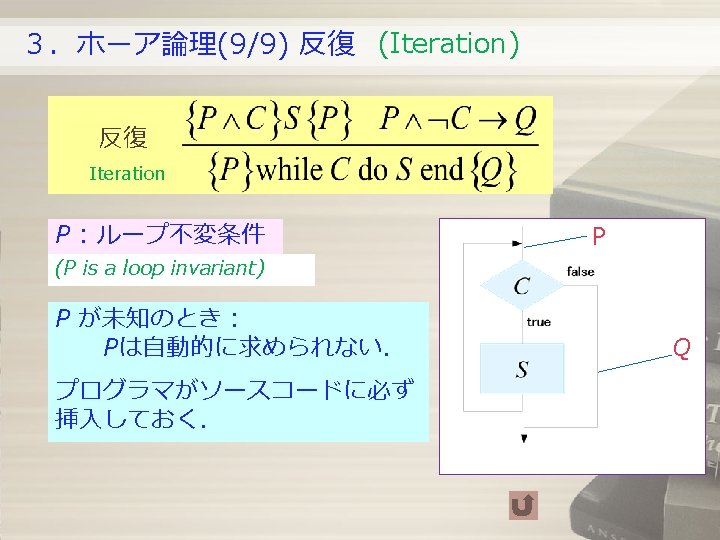
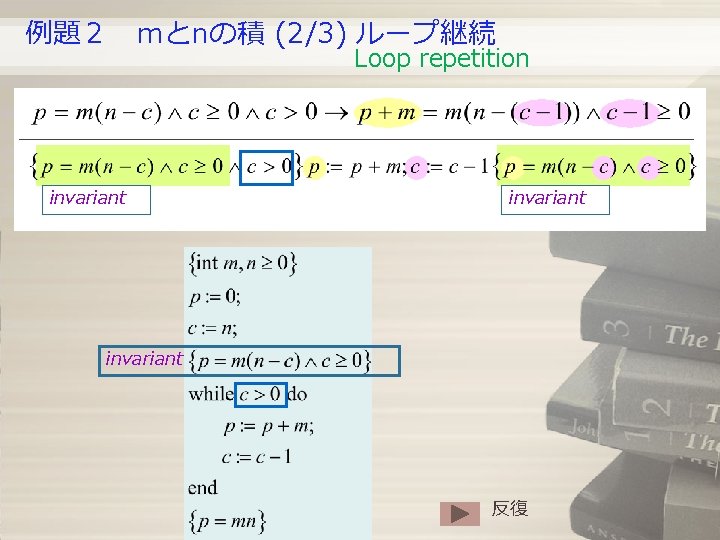
例題2 mとnの積 (2/3) ループ継続 Loop repetition invariant 反復
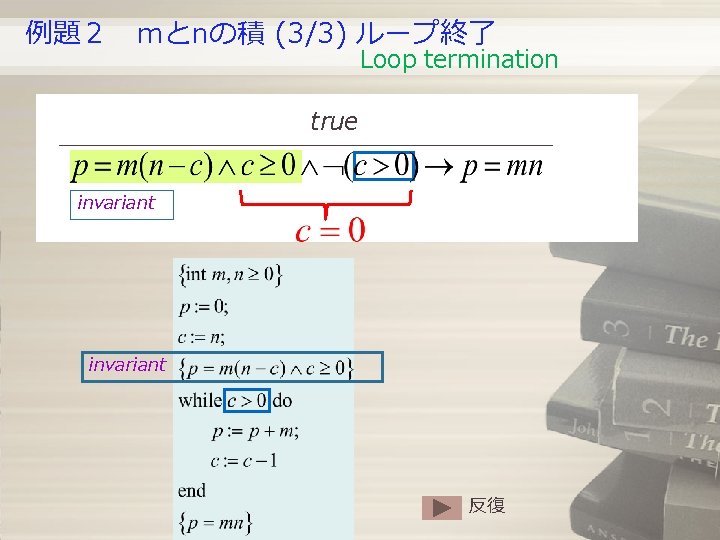
例題2 mとnの積 (3/3) ループ終了 Loop termination true invariant 反復
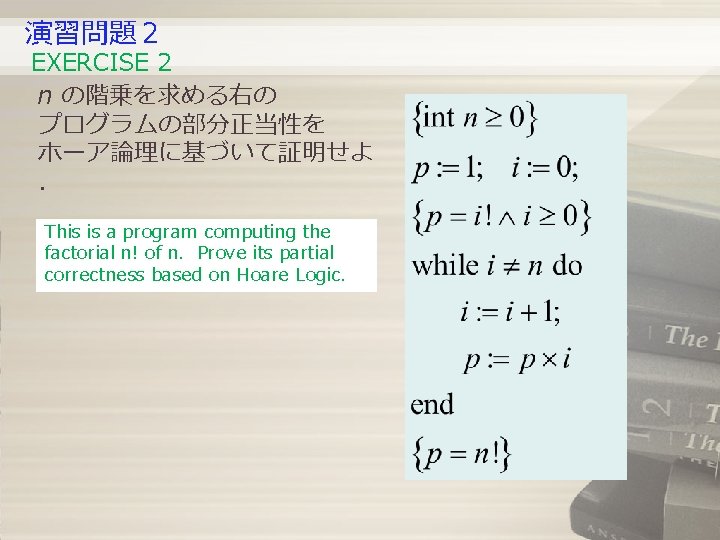
演習問題2 EXERCISE 2 n の階乗を求める右の プログラムの部分正当性を ホーア論理に基づいて証明せよ . This is a program computing the factorial n! of n. Prove its partial correctness based on Hoare Logic.
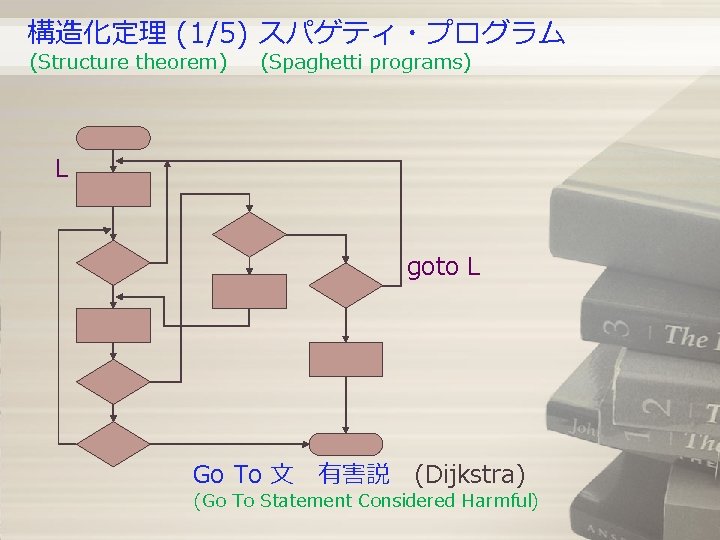
構造化定理 (1/5) スパゲティ・プログラム (Structure theorem) (Spaghetti programs) L goto L Go To 文 有害説 (Dijkstra) (Go To Statement Considered Harmful)
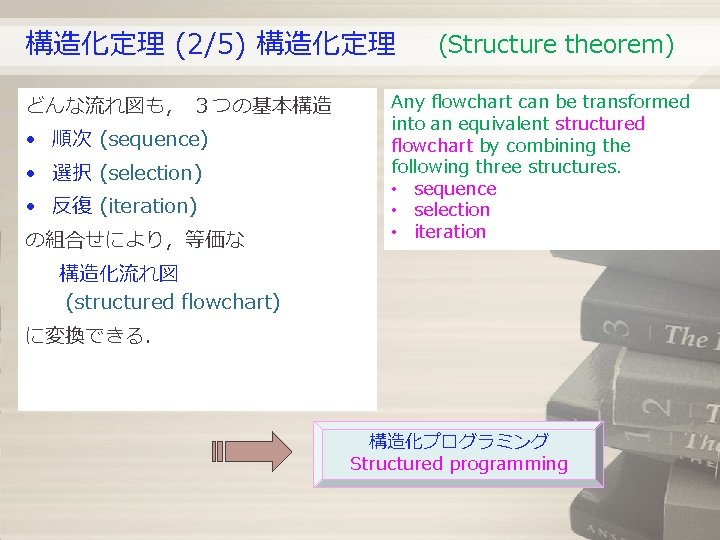
構造化定理 (2/5) 構造化定理 どんな流れ図も, 3つの基本構造 • 順次 (sequence) • 選択 (selection) • 反復 (iteration) の組合せにより,等価な (Structure theorem) Any flowchart can be transformed into an equivalent structured flowchart by combining the following three structures. • sequence • selection • iteration 構造化流れ図 (structured flowchart) に変換できる. 構造化プログラミング Structured programming
構造化定理 (3/5) 構造化流れ図 sequence (Structured Flowchart) selection iteration • 出入口はそれぞれ1カ所 (Only one entrance and one exit) • 流れを表す線が交差しない (No crossings of flow lines) 現実には,return と break くらいは許す? (In practice, we may allow at least return and break? )
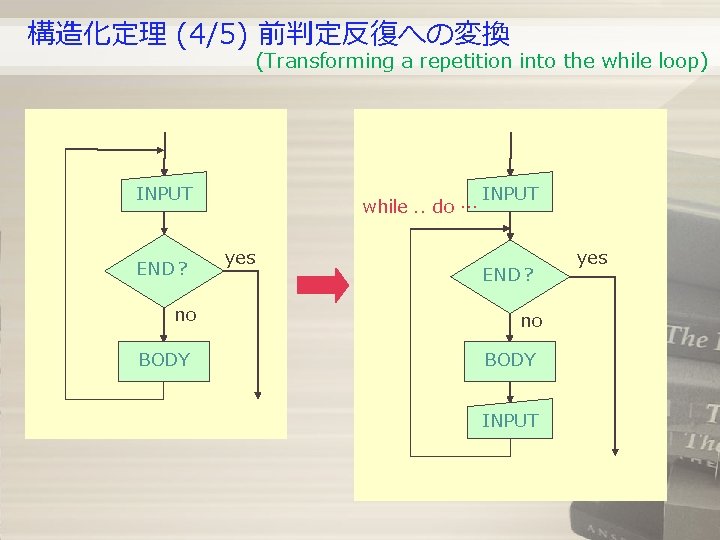
構造化定理 (4/5) 前判定反復への変換 (Transforming a repetition into the while loop) INPUT END? no BODY while. . do … yes INPUT END? no BODY INPUT yes
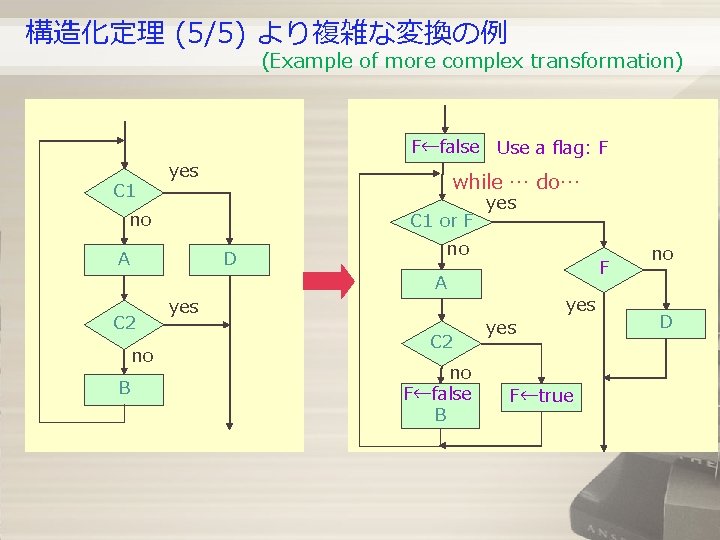
構造化定理 (5/5) より複雑な変換の例 (Example of more complex transformation) C 1 F←false Use a flag: F yes while … do… no C 1 or F A D C 2 no B yes no F A C 2 no F←false B yes F←true no D