
INTELLIGENT ROBOT WALKER AVAILABLE DEVICES The PAMAID Reactive
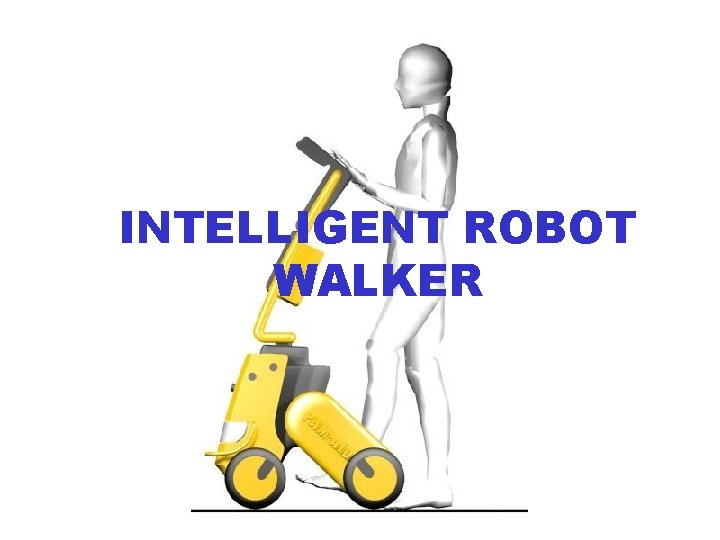
INTELLIGENT ROBOT WALKER
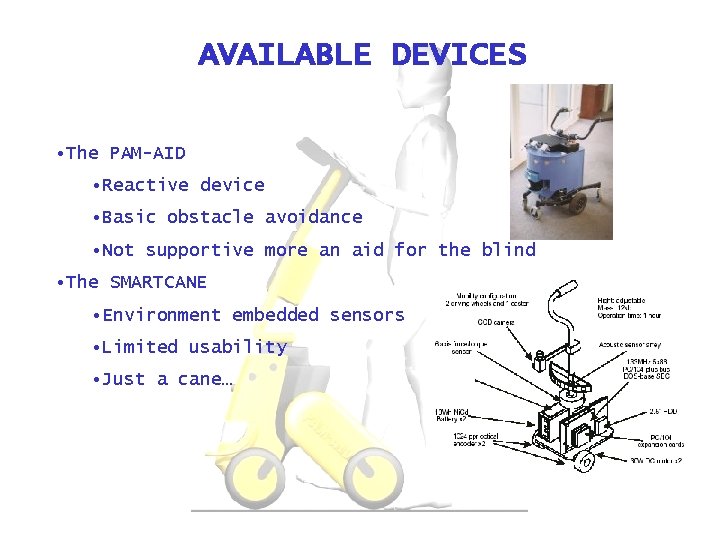
AVAILABLE DEVICES • The PAM-AID • Reactive device • Basic obstacle avoidance • Not supportive more an aid for the blind • The SMARTCANE • Environment embedded sensors • Limited usability • Just a cane…
What Were Up Against Show Clip
Project Objective 1. 2. 3. 4. Locate a user and configure itself to assist in the standing/sitting process Move in the appropriate direction and speed as directed by the user Correct the user’s course such as to avoid obstacles or locate a desired position in the user’s environment Monitor the activity patterns of the user to detect improvement/deterioration in user’s physical mobility
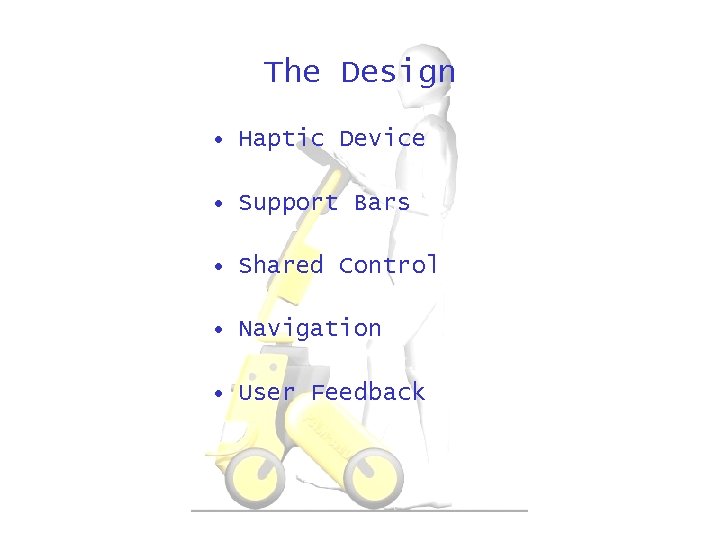
The Design • Haptic Device • Support Bars • Shared Control • Navigation • User Feedback
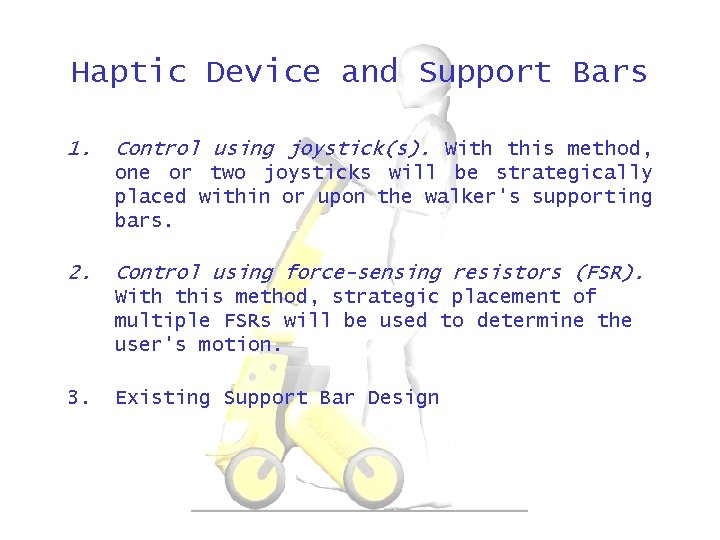
Haptic Device and Support Bars 1. Control using joystick(s). With this method, one or two joysticks will be strategically placed within or upon the walker's supporting bars. 2. Control using force-sensing resistors (FSR). With this method, strategic placement of multiple FSRs will be used to determine the user's motion. 3. Existing Support Bar Design
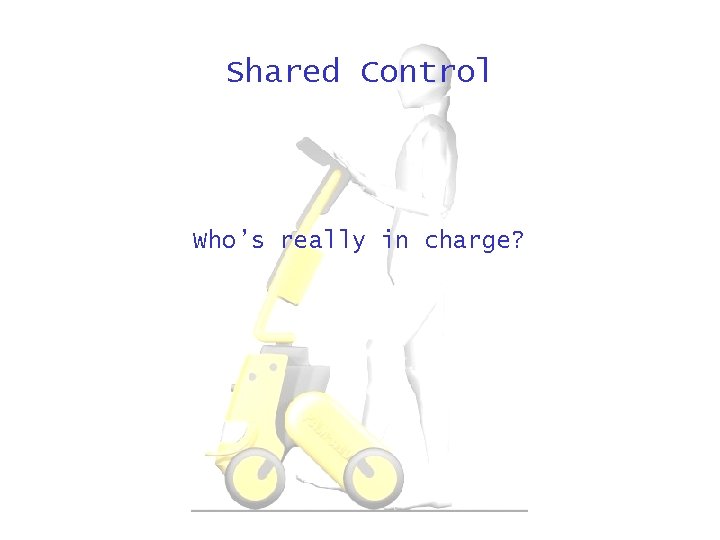
Shared Control Who’s really in charge?
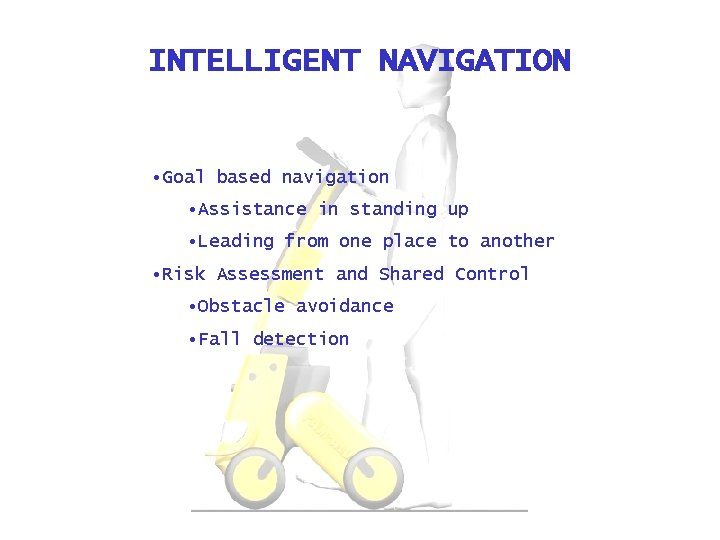
INTELLIGENT NAVIGATION • Goal based navigation • Assistance in standing up • Leading from one place to another • Risk Assessment and Shared Control • Obstacle avoidance • Fall detection
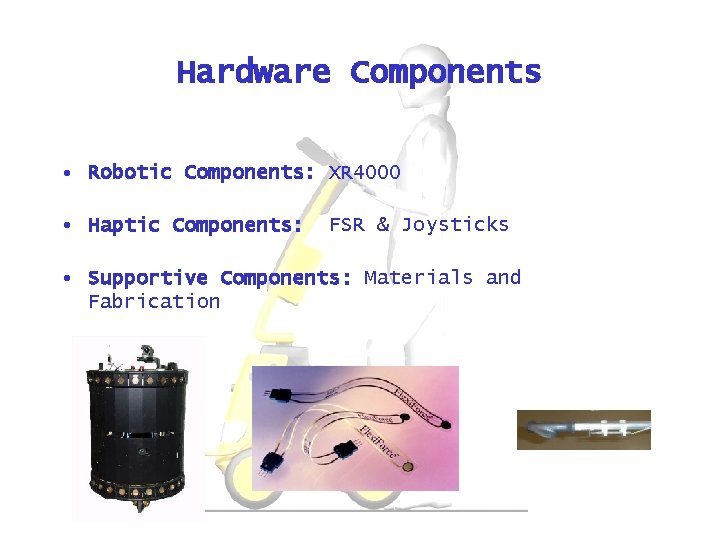
Hardware Components • Robotic Components: XR 4000 • Haptic Components: FSR & Joysticks • Supportive Components: Materials and Fabrication
Projected Costs • XR 4000 : Already acquired. • FSR & Joysticks: Interlink - $79. 95 for 16 FSR variations (4 sets of 4) Flexiforce - 4 -pack of sensors for $55 or 8 pack for $99 Joysticks range from $10 to $50+ • A basic walker (~$100) • Total ~$250
PROJECT OUTLINE Phase 1 : Preliminary hardware design, familiarizing and conducting basic tasks with the XR 4000. Phase 2 : Acquisition of various parts and fabrication of the hardware, preliminary software design Phase 3 : Interfacing of sensors, basic software implementation and data acquisition. Phase 4 : Software integration and preliminary testing. Phase 5 : Evaluation, further testing and modification.
- Slides: 11