
Intelligent Data Analysis IDA by Josipa Kern Ph
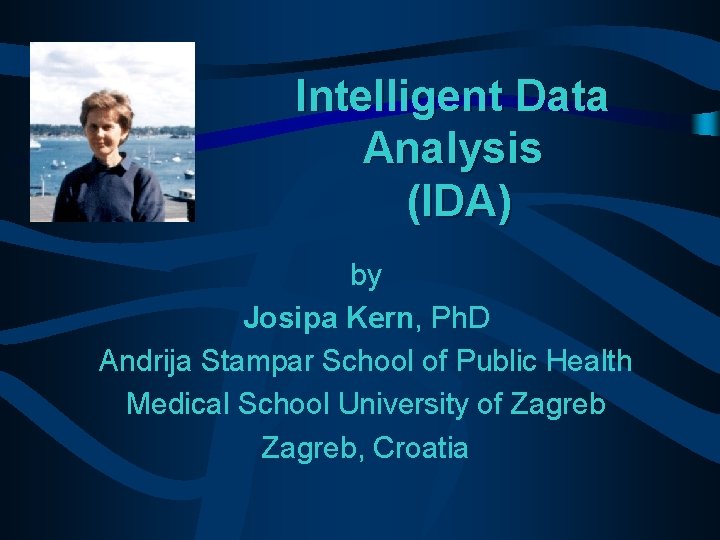
Intelligent Data Analysis (IDA) by Josipa Kern, Ph. D Andrija Stampar School of Public Health Medical School University of Zagreb, Croatia
Interest and Excitement for Intelligent Data Analysis Ø Decision making is asking for information and knowledge Ø Data processing can give them Ø Multidimensionality of problems is looking for methods for adequate and deep data processing and analysis
Learning Objectives Ø To understand the concept of the IDA Ø To meet web-sites and literature on IDA Ø To meet some tools for IDA Ø To learn how to use IDA tools and to validate the IDA results
Performance Objectives Ø Recognize problems asking for IDA Ø Preparing data and making analysis Ø Validating and interpreting results of IDA
IDA is… … an interdisciplinary study concerned with the effective analysis of data; … used for extracting useful information from large quantities of online data; extracting desirable knowledge or interesting patterns from existing databases;
IDA or … Ø Data mining Ø Knowledge acquisition from data Ø Genetic algorithm-based rule discovery Ø Knowledge discovery Ø Learning classifier system Ø Machine learning Ø etc.

IDA gives knowledge …
Knowledge is … Ø the distillation of information that has been collected, classified, organized, integrated, abstracted and value-added; Ø at a level of abstraction higher than the data, and information on which it is based and can be used to deduce new information and new knowledge; Ø usually in the context of human expertise used in solving problems.

Knowledge acquisition … Ø The process of eliciting, analyzing, transforming, classifying, organizing and integrating knowledge and representing that knowledge in a form that can be used in a computer system.
Knowledge in a domain can be expressed as a number of rules
Rule is … A formal way of specifying a recommendation, directive, or strategy, expressed as "IF premise THEN conclusion" or "IF condition THEN action".

How to discover rules hidden in the data?
Some tools for IDA … Ø See 5 - program for analyzing data and generating classifiers in the form of decision trees and/or rule sets. http: //www. rulequest. com
Some tools for IDA … Ø Cubist - analyzes data and generates rule-based piecewise linear models – collections of rules, each with an associated linear expression for computing a target value. . http: //www. rulequest. com
Some tools for IDA … ØILLM - the tool constructs classification models in the form of rules which represent knowledge about relations hidden in data. http: //dms. irb. hr
Some tools for IDA … ØMagnum Opus - finds association rules providing competitive advantage by revealing underlying interactions between factors within the data. http: //www. rulequest. com
Evaluation of IDA results Ø Absolute & relative accuracy Ø Sensitivity & specificity Ø False positive & false negative Ø Error rate Ø Reliability of rules Ø Etc.
Example of IDA Illustration of IDA by using See 5
See 5…application… Ø application. names - lists the classes to which cases may belong and the attributes used to describe each case. Ø Attributes are of two types: discrete attributes have a value drawn from a set of possibilities, and continuous attributes have numeric values.
See 5…application… Ø application. data - provides information on the training cases from which See 5 will extract patterns. Ø The entry for each case consists of one or more lines that give the values for all attributes.
See 5…application… Ø application. test - provides information on the test cases (used for evaluation of results). Ø The entry for each case consists of one or more lines that give the values for all attributes.
See 5…application…example… Ø Epidemiological study (1970 -1990) Ø Sample of examinees died from cardiovascular diseases during the period Ø Question: Did they know they were ill? 1 – they were healthy 2 – they were ill (drug treatment, positive clinical and laboratory findings)
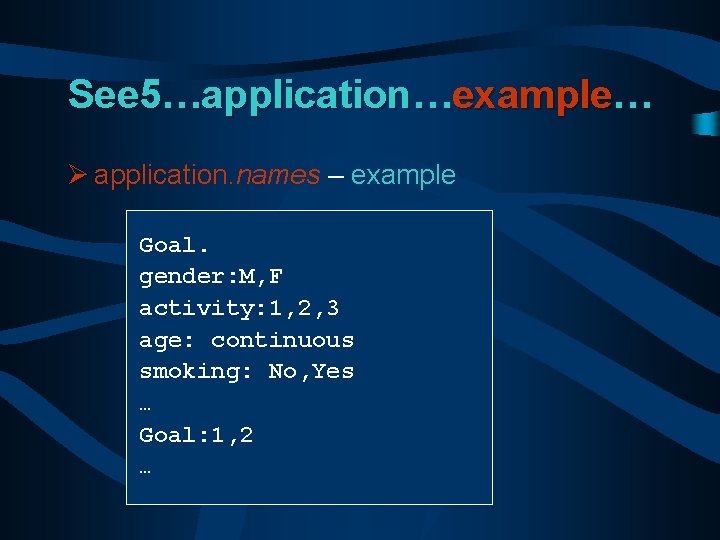
See 5…application…example… Ø application. names – example Goal. gender: M, F activity: 1, 2, 3 age: continuous smoking: No, Yes … Goal: 1, 2 …
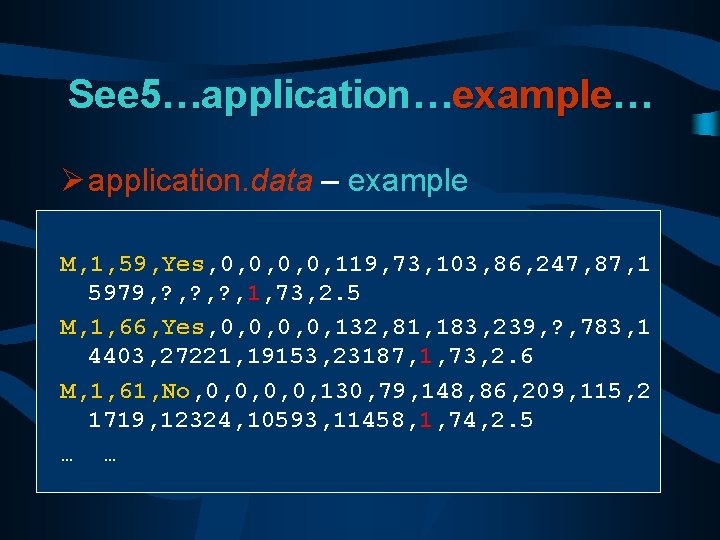
See 5…application…example… Ø application. data – example M, 1, 59, Yes, 0, 0, 119, 73, 103, 86, 247, 87, 1 5979, ? , ? , 1, 73, 2. 5 M, 1, 66, Yes, 0, 0, 132, 81, 183, 239, ? , 783, 1 4403, 27221, 19153, 23187, 1, 73, 2. 6 M, 1, 61, No, 0, 0, 130, 79, 148, 86, 209, 115, 2 1719, 12324, 10593, 11458, 1, 74, 2. 5 … …
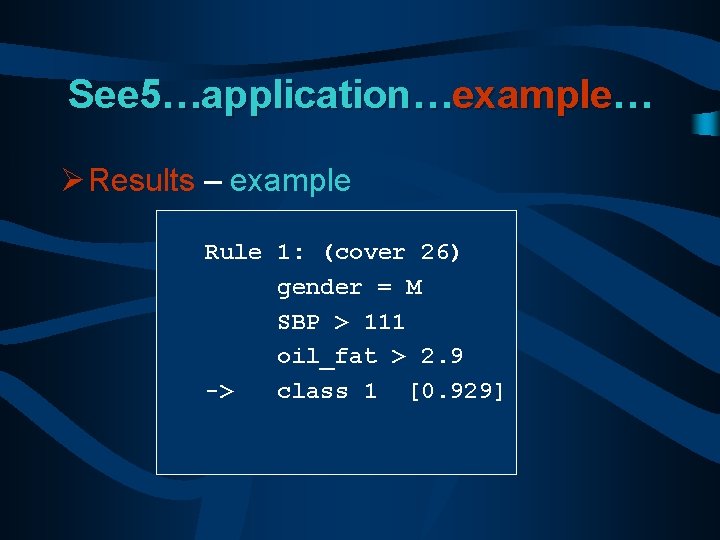
See 5…application…example… Ø Results – example Rule 1: (cover 26) gender = M SBP > 111 oil_fat > 2. 9 -> class 1 [0. 929]
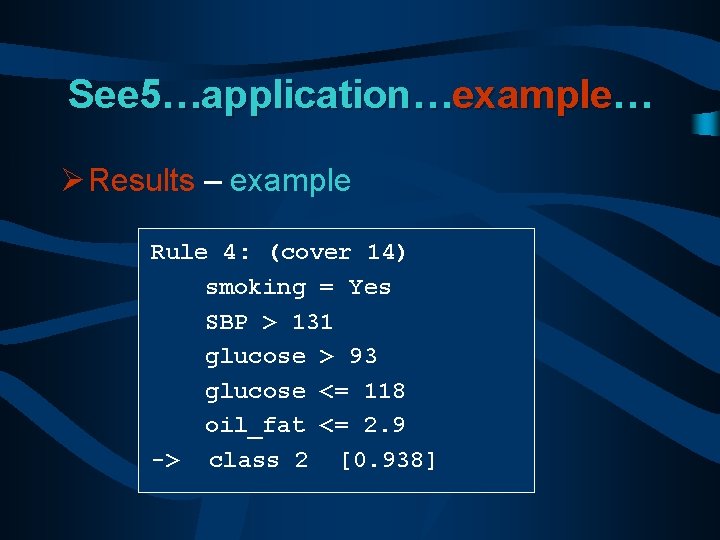
See 5…application…example… Ø Results – example Rule 4: (cover 14) smoking = Yes SBP > 131 glucose > 93 glucose <= 118 oil_fat <= 2. 9 -> class 2 [0. 938]
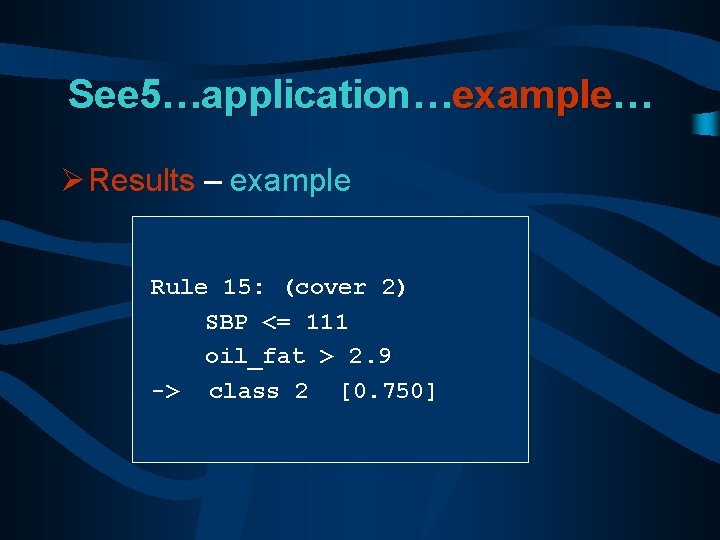
See 5…application…example… Ø Results – example Rule 15: (cover 2) SBP <= 111 oil_fat > 2. 9 -> class 2 [0. 750]
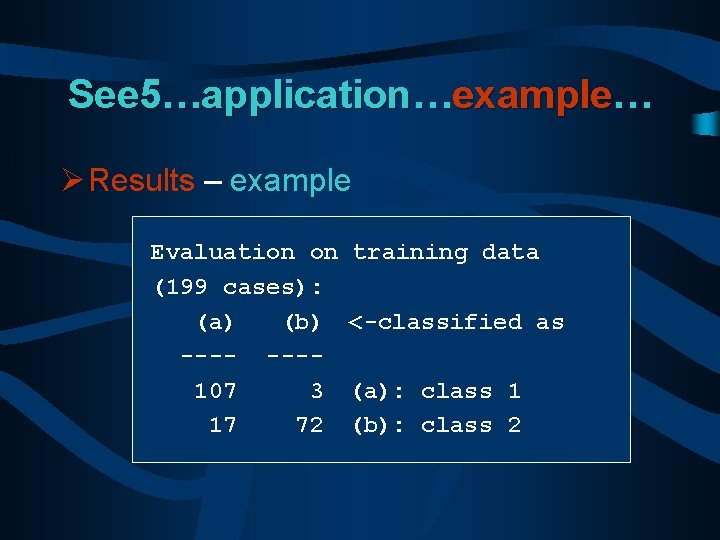
See 5…application…example… Ø Results – example Evaluation on training data (199 cases): (a) (b) <-classified as ---- 107 3 (a): class 1 17 72 (b): class 2
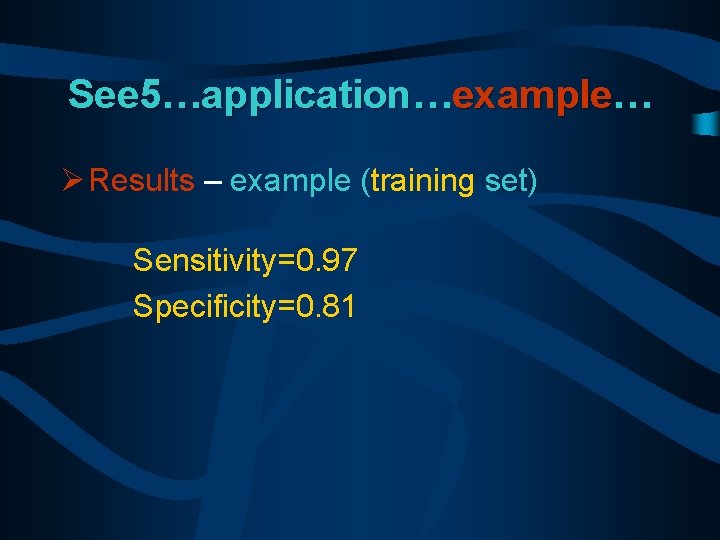
See 5…application…example… Ø Results – example (training set) Sensitivity=0. 97 Specificity=0. 81
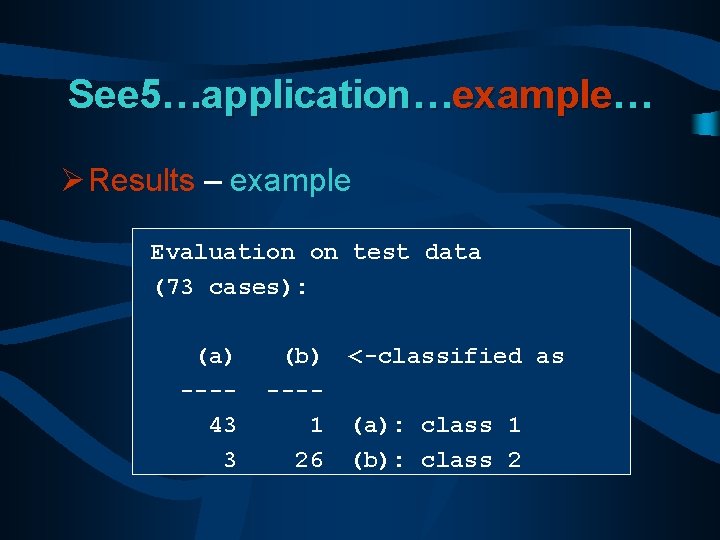
See 5…application…example… Ø Results – example Evaluation on test data (73 cases): (a) (b) ---- 43 1 3 26 <-classified as (a): class 1 (b): class 2
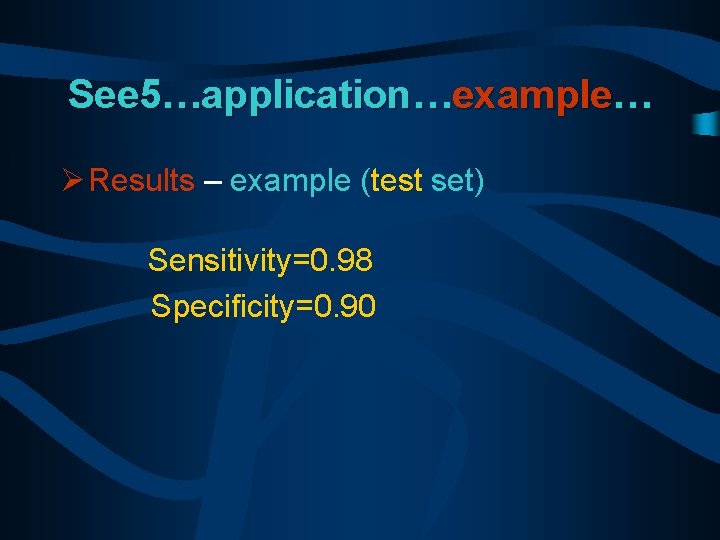
See 5…application…example… Ø Results – example (test set) Sensitivity=0. 98 Specificity=0. 90
All the suggested IDA tools are available at mentioned URLs, at least as demo version Try your own IDA… Thank you!
- Slides: 32