
INTELLIGENT AGENTS Structure of intelligent agents and environments

- Slides: 32
INTELLIGENT AGENTS Structure of intelligent agents and environments Omuya Erick - MSc (Uo. N), BSc (KU) AI- Intelligent Agents 1
DEFINITIONS Agent Several views exist on what an agent really is: Brenner et al(1998) Software or software/hardware that is autonomous (a relatively independently) and is characterized by � autonomy, � mobility, � reactivenes, � proactiveness, � intelligence. Examples: Internet search engines, robots Omuya Erick - MSc (Uo. N), BSc (KU) AI- Intelligent Agents 2
DEFINITIONS Agent Several views exist on what an agent really is: Nwana(1996) Are components of software or hardware, which are capable of acting exactingly in order to accomplish tasks on behalf of their users. Examples: Internet Search Engines, Robots, etc Omuya Erick - MSc (Uo. N), BSc (KU) AI- Intelligent Agents 3
Agent DEFINITIONS Several views exist on what an agent really is: Russell & Norvig(1995) Are objects in the environment that perceive and react to states in the environment. Examples: any thing for which an environment can be specified and that can act and react like humans, animals, ants, some Internet software, computational processes in operating systems context, etc. Omuya Erick - MSc (Uo. N), BSc (KU) AI- Intelligent Agents 4
DEFINITIONS Multi-agent system Wooldridge(2002) Is a system of agents which interact with one another through cooperation, competition, coordination or negotiation [usually to accomplish some goal]. Omuya Erick - MSc (Uo. N), BSc (KU) AI- Intelligent Agents 5
DEFINITIONS Multi-agent system Georgini et al. (2001) Is an organization of coordinated autonomou agents that interact in order to achieve common goals Vlassis(2003) Is a group of agents that can interact. Omuya Erick - MSc (Uo. N), BSc (KU) AI- Intelligent Agents 6
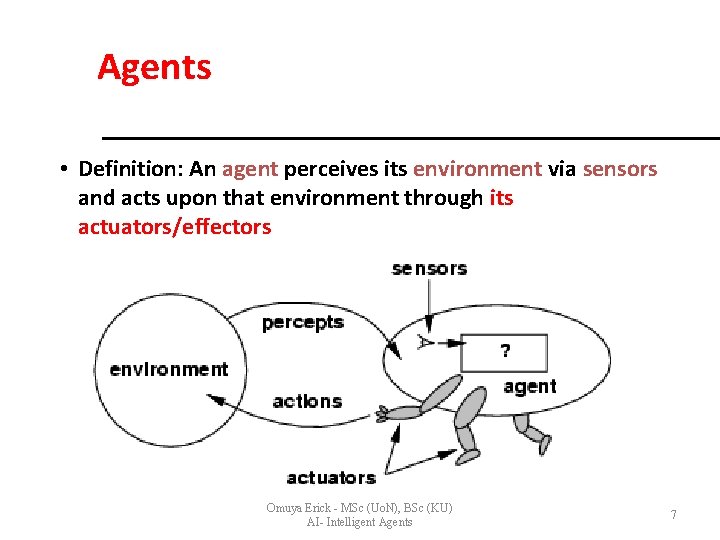
Agents • Definition: An agent perceives its environment via sensors and acts upon that environment through its actuators/effectors Omuya Erick - MSc (Uo. N), BSc (KU) AI- Intelligent Agents 7
CHARACTERISTICS OF AGENTS Agent characteristics Autonomy- acting independently & exercise control over their internal state. Reactiveness. -reactive systeminteracts with its environment; responds to changes that occur in it. Omuya Erick - MSc (Uo. N), BSc (KU) AI- Intelligent Agents 8
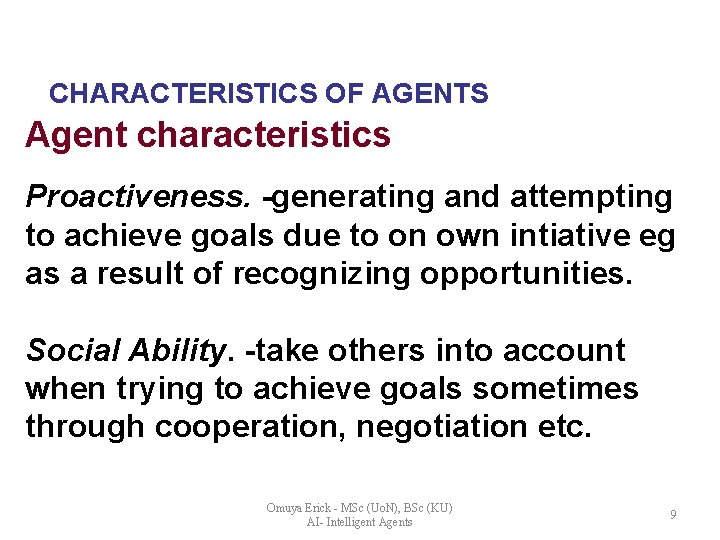
CHARACTERISTICS OF AGENTS Agent characteristics Proactiveness. -generating and attempting to achieve goals due to on own intiative eg as a result of recognizing opportunities. Social Ability. -take others into account when trying to achieve goals sometimes through cooperation, negotiation etc. Omuya Erick - MSc (Uo. N), BSc (KU) AI- Intelligent Agents 9
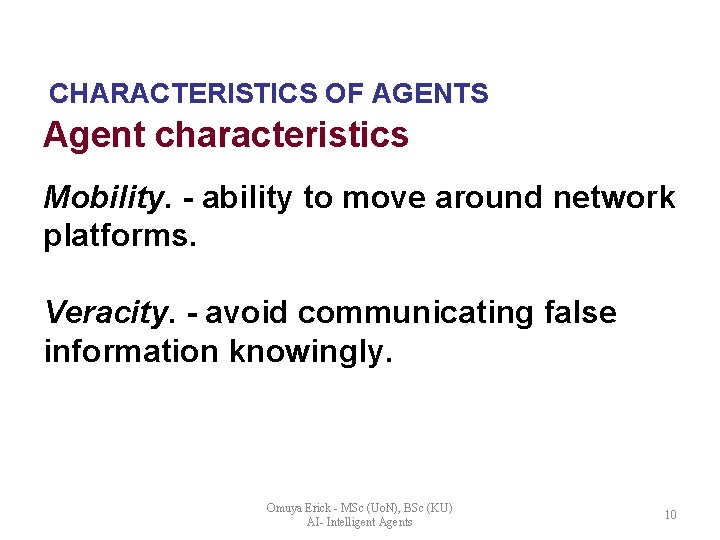
CHARACTERISTICS OF AGENTS Agent characteristics Mobility. - ability to move around network platforms. Veracity. - avoid communicating false information knowingly. Omuya Erick - MSc (Uo. N), BSc (KU) AI- Intelligent Agents 10
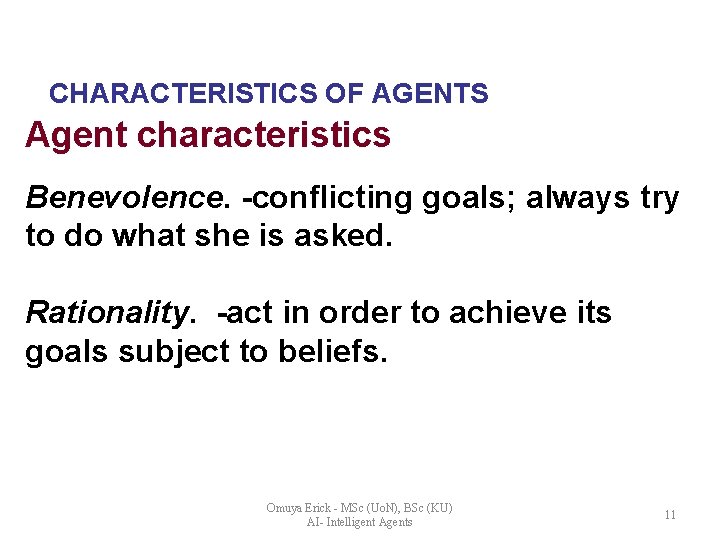
CHARACTERISTICS OF AGENTS Agent characteristics Benevolence. -conflicting goals; always try to do what she is asked. Rationality. -act in order to achieve its goals subject to beliefs. Omuya Erick - MSc (Uo. N), BSc (KU) AI- Intelligent Agents 11
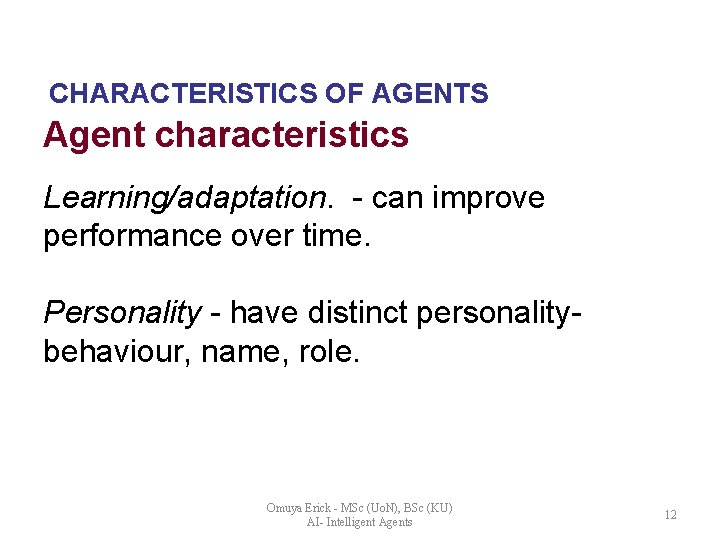
CHARACTERISTICS OF AGENTS Agent characteristics Learning/adaptation. - can improve performance over time. Personality - have distinct personalitybehaviour, name, role. Omuya Erick - MSc (Uo. N), BSc (KU) AI- Intelligent Agents 12
Agent applications Application Domains Areas : • 1. Distributed/concurrent systems; • 2. Networks; • 3. Human-computer interfaces. Omuya Erick - MSc (Uo. N), BSc (KU) AI- Intelligent Agents 13
Agent applications Application Domain 1: Distributed Systems Agents are seen as a natural metaphor. Example domains: � Air traffic control; � Business process management; � Power systems management; � Distributed sensing; Omuya Erick - MSc (Uo. N), BSc (KU) AI- Intelligent Agents 14
Agent applications Domain 2: Networks Mobile agents - can move around a network (e. g. , the Internet) operating on a user’s behalf. Applications include: Hand-held PDAs, mobile phones with limited bandwidth; � Information gathering. � Omuya Erick - MSc (Uo. N), BSc (KU) AI- Intelligent Agents 15
Agent applications Domain 3: Human Computer Interaction (HCI) Use of agent as mediators in the interfaces; � Agents sit ‘over’ applications, watching, learning, and eventually doing things without being told — taking the initiative. � Omuya Erick - MSc (Uo. N), BSc (KU) AI- Intelligent Agents 16
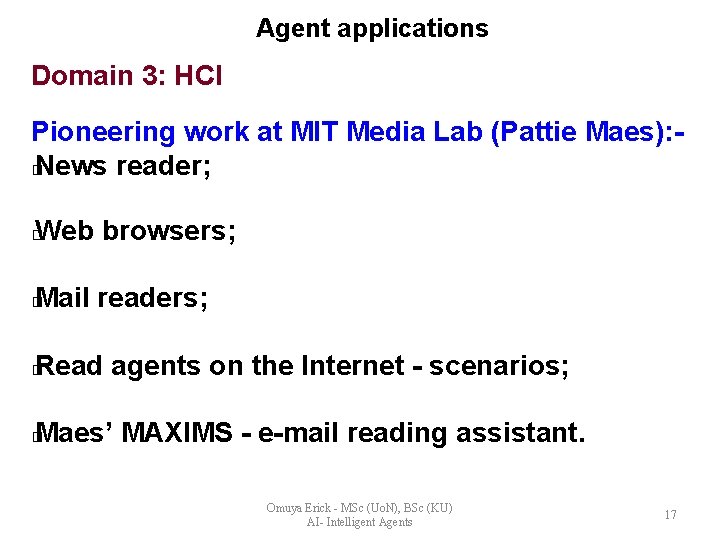
Agent applications Domain 3: HCI Pioneering work at MIT Media Lab (Pattie Maes): � News reader; Web browsers; � Mail readers; � Read agents on the Internet - scenarios; � Maes’ MAXIMS - e-mail reading assistant. � Omuya Erick - MSc (Uo. N), BSc (KU) AI- Intelligent Agents 17
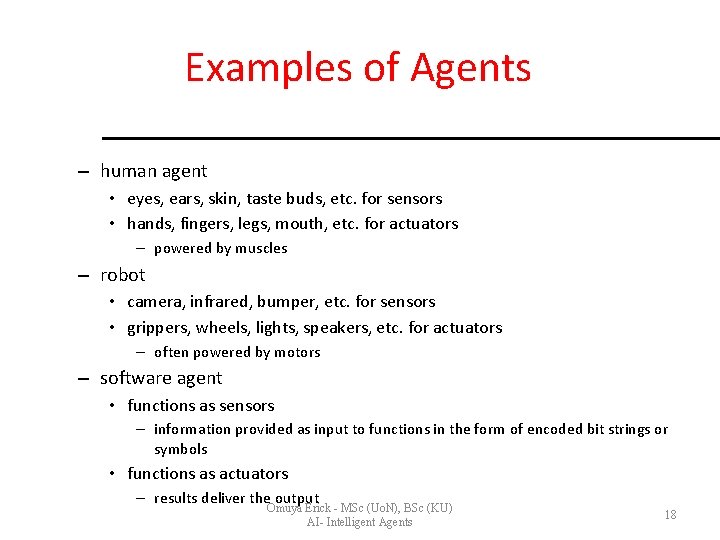
Examples of Agents – human agent • eyes, ears, skin, taste buds, etc. for sensors • hands, fingers, legs, mouth, etc. for actuators – powered by muscles – robot • camera, infrared, bumper, etc. for sensors • grippers, wheels, lights, speakers, etc. for actuators – often powered by motors – software agent • functions as sensors – information provided as input to functions in the form of encoded bit strings or symbols • functions as actuators – results deliver the output Omuya Erick - MSc (Uo. N), BSc (KU) AI- Intelligent Agents 18
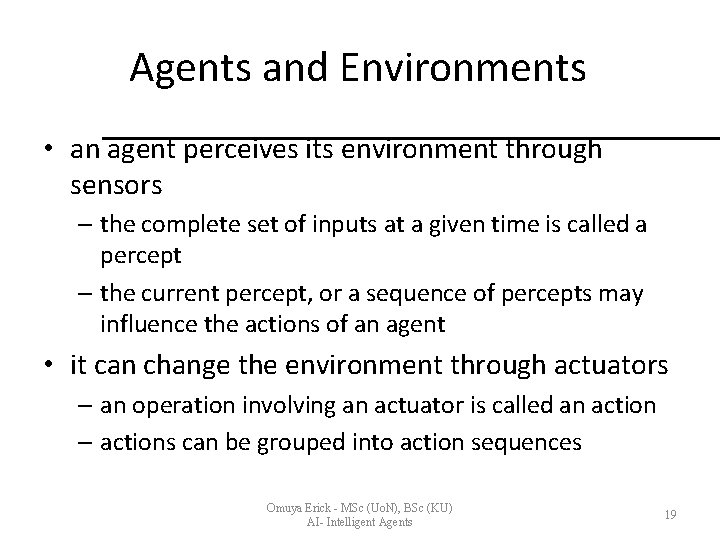
Agents and Environments • an agent perceives its environment through sensors – the complete set of inputs at a given time is called a percept – the current percept, or a sequence of percepts may influence the actions of an agent • it can change the environment through actuators – an operation involving an actuator is called an action – actions can be grouped into action sequences Omuya Erick - MSc (Uo. N), BSc (KU) AI- Intelligent Agents 19
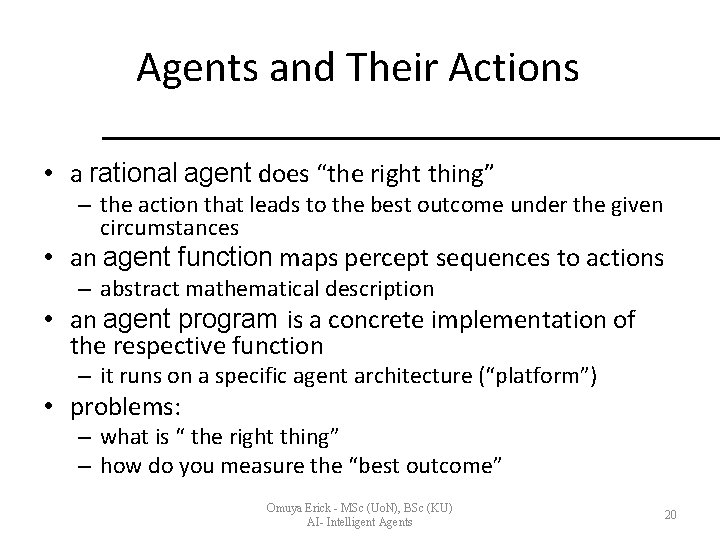
Agents and Their Actions • a rational agent does “the right thing” – the action that leads to the best outcome under the given circumstances • an agent function maps percept sequences to actions – abstract mathematical description • an agent program is a concrete implementation of the respective function – it runs on a specific agent architecture (“platform”) • problems: – what is “ the right thing” – how do you measure the “best outcome” Omuya Erick - MSc (Uo. N), BSc (KU) AI- Intelligent Agents 20
Rational Agent • selects the action that is expected to maximize its performance – based on a performance measure – depends on the percept sequence, background knowledge, and feasible actions Omuya Erick - MSc (Uo. N), BSc (KU) AI- Intelligent Agents 21
Rational Agent Considerations • performance measure for the successful completion of a task • complete perceptual history (percept sequence) • background knowledge – especially about the environment • dimensions, structure, basic “laws” – task, user, other agents • feasible actions – capabilities of the agent Omuya Erick - MSc (Uo. N), BSc (KU) AI- Intelligent Agents 22
Environments • determine to a large degree the interaction between the “outside world” and the agent – the “outside world” is not necessarily the “real world” as we perceive it • it may be a real or virtual environment the agent lives in • in many cases, environments are implemented within computers – they may or may not have a close correspondence to the “real world” Omuya Erick - MSc (Uo. N), BSc (KU) AI- Intelligent Agents 23
Environment Properties • fully observable vs. partially observable – sensors capture all relevant information from the environment • deterministic vs. stochastic (non-deterministic) – changes in the environment are predictable • episodic vs. sequential (non-episodic) – independent perceiving-acting episodes • static vs. dynamic – no changes while the agent is “thinking” • discrete vs. continuous – limited number of distinct percepts/actions • single vs. multiple agents – interaction and collaboration among agents – competitive, cooperative Omuya Erick - MSc (Uo. N), BSc (KU) AI- Intelligent Agents 24
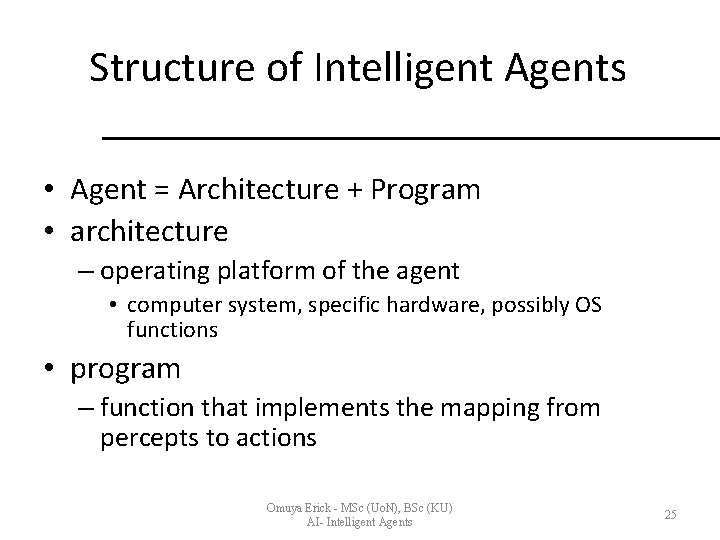
Structure of Intelligent Agents • Agent = Architecture + Program • architecture – operating platform of the agent • computer system, specific hardware, possibly OS functions • program – function that implements the mapping from percepts to actions Omuya Erick - MSc (Uo. N), BSc (KU) AI- Intelligent Agents 25
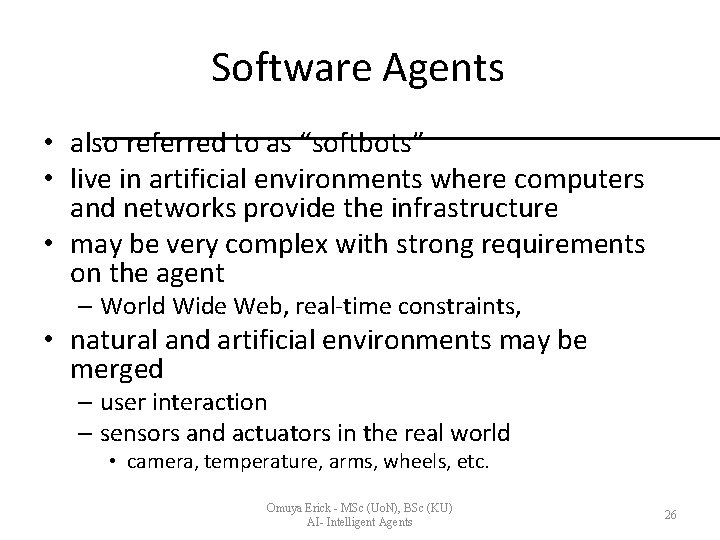
Software Agents • also referred to as “softbots” • live in artificial environments where computers and networks provide the infrastructure • may be very complex with strong requirements on the agent – World Wide Web, real-time constraints, • natural and artificial environments may be merged – user interaction – sensors and actuators in the real world • camera, temperature, arms, wheels, etc. Omuya Erick - MSc (Uo. N), BSc (KU) AI- Intelligent Agents 26
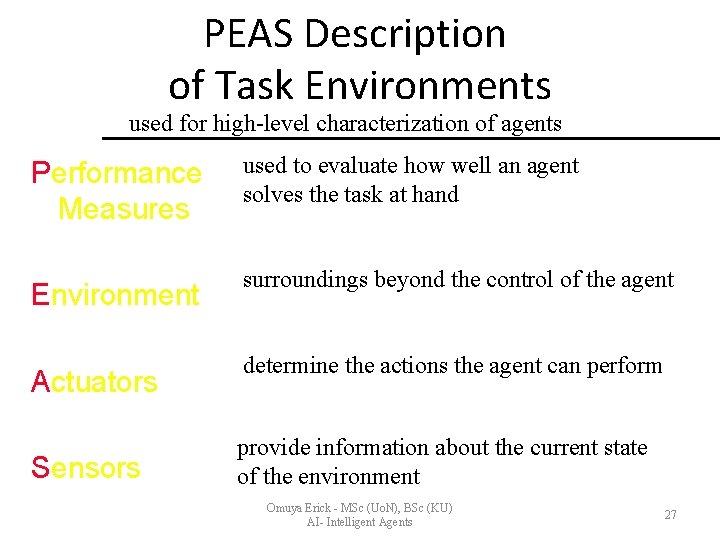
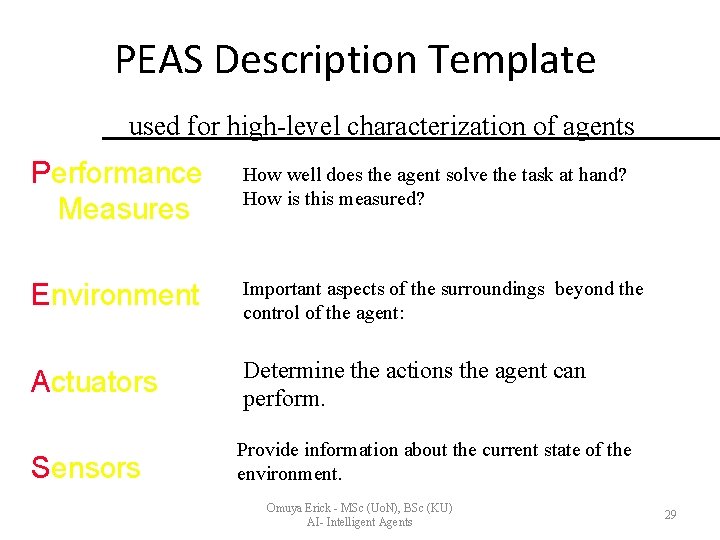
PEAS Description of Task Environments used for high-level characterization of agents Performance Measures Environment Actuators Sensors used to evaluate how well an agent solves the task at hand surroundings beyond the control of the agent determine the actions the agent can perform provide information about the current state of the environment Omuya Erick - MSc (Uo. N), BSc (KU) AI- Intelligent Agents 27
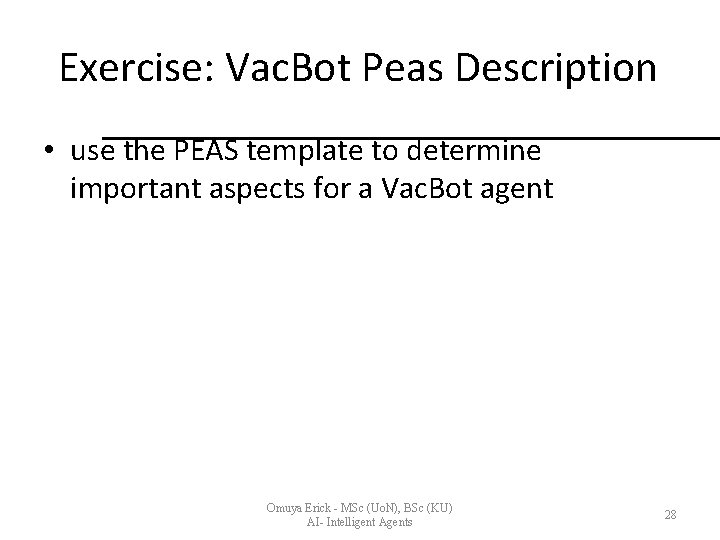
Exercise: Vac. Bot Peas Description • use the PEAS template to determine important aspects for a Vac. Bot agent Omuya Erick - MSc (Uo. N), BSc (KU) AI- Intelligent Agents 28
PEAS Description Template used for high-level characterization of agents Performance Measures How well does the agent solve the task at hand? How is this measured? Environment Important aspects of the surroundings beyond the control of the agent: Actuators Determine the actions the agent can perform. Sensors Provide information about the current state of the environment. Omuya Erick - MSc (Uo. N), BSc (KU) AI- Intelligent Agents 29
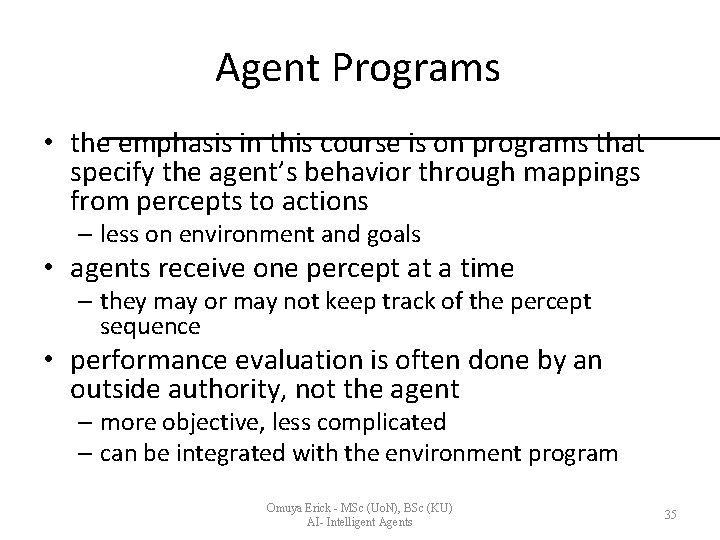
Agent Programs • the emphasis in this course is on programs that specify the agent’s behavior through mappings from percepts to actions – less on environment and goals • agents receive one percept at a time – they may or may not keep track of the percept sequence • performance evaluation is often done by an outside authority, not the agent – more objective, less complicated – can be integrated with the environment program Omuya Erick - MSc (Uo. N), BSc (KU) AI- Intelligent Agents 35
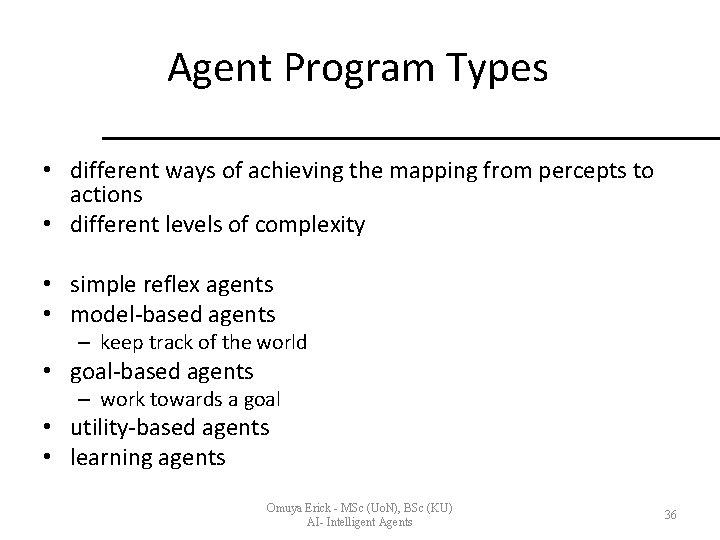
Agent Program Types • different ways of achieving the mapping from percepts to actions • different levels of complexity • simple reflex agents • model-based agents – keep track of the world • goal-based agents – work towards a goal • utility-based agents • learning agents Omuya Erick - MSc (Uo. N), BSc (KU) AI- Intelligent Agents 36
END!! THANK YOU!!! Omuya Erick - MSc (Uo. N), BSc (KU) AI- Intelligent Agents 37