
Intelligent Agents Ch 2 examples of agents webbots
Intelligent Agents (Ch. 2) • examples of agents • webbots, ticket purchasing, electronic assistant, Siri, news filtering, autonomous vehicles, printer/copier monitor, Robocup soccer, NPCs in Quake, Halo, Call of Duty. . . • agents are a unifying theme for AI • use search and knowledge, planning, learning. . . • focus on decision-making • must deal with uncertainty, other actors in environment
Characteristics of Agents • essential characteristics • agents are situated: • can sense and manipulate an environment that changes over time • agents are goal-oriented • agents are autonomous • other common aspects of agents: • • adaptive optimizing social (interactive, cooperative, multiagent) life-like
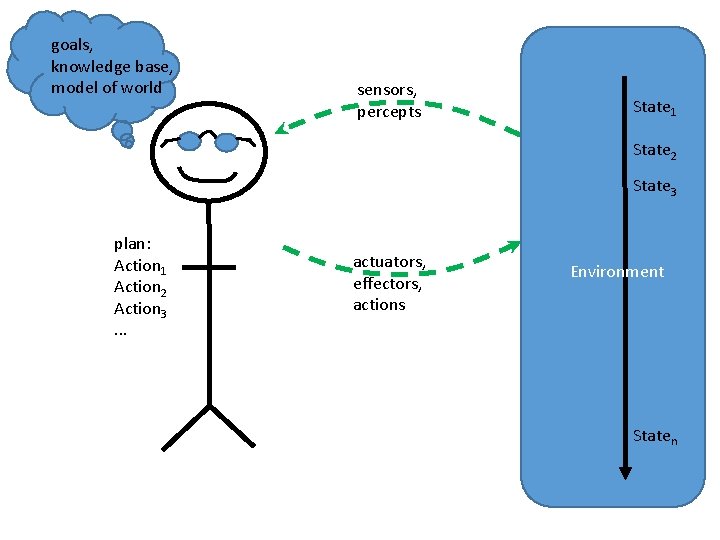
goals, knowledge base, model of world sensors, percepts State 1 State 2 State 3 plan: Action 1 Action 2 Action 3. . . actuators, effectors, actions Environment Staten
• Performance measures • Rationality • for each possible percept sequence, a rational agent should select an action that is expected to maximize its performance measure, given the evidence provideded by the percept sequence and whatever built-in knowledge the agent has
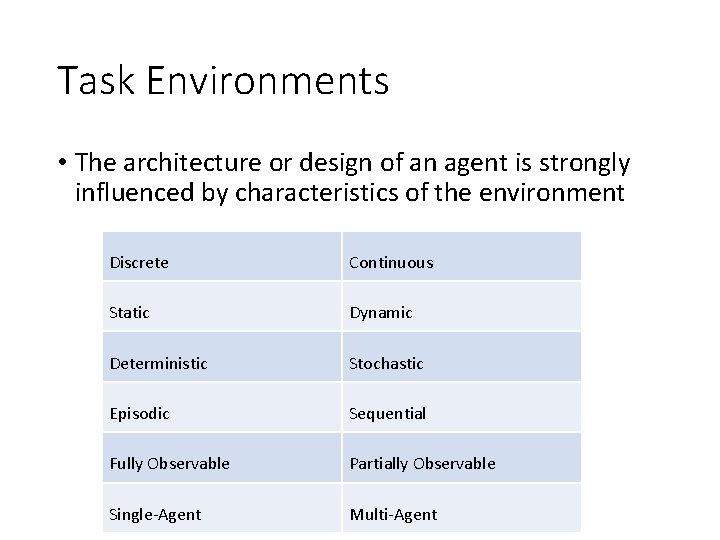
Task Environments • The architecture or design of an agent is strongly influenced by characteristics of the environment Discrete Continuous Static Dynamic Deterministic Stochastic Episodic Sequential Fully Observable Partially Observable Single-Agent Multi-Agent
Agent Architectures • Reactive • • stimulus-response condition-action lookup table efficient goals are implicit
Agent Architectures • Rule-based • condition-action trigger rules • if car. In. Front. Is. Braking then Initiate. Braking • more compact than table • issue: how to choose which rule to fire? (if > 1 can) • must prioritize rules • implementations • if-then-else cascades • JESS - Java Expert System • Subsumption Architecture (Rodney Brooks, MIT) • hierarchical - design behaviors in layers • e. g. obstacle avoidance overrides moving toward goal
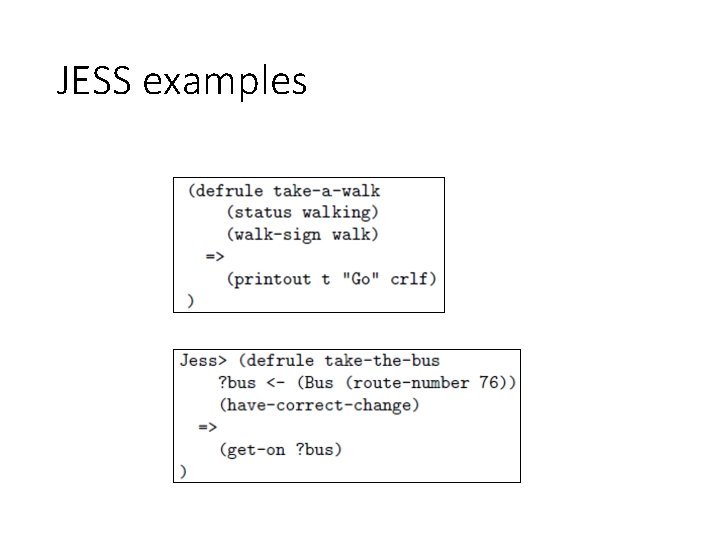
JESS examples

Agent Architectures • Model-based • use local variables to infer and remember unobservable aspects of state of the world

Agent Architectures • Knowledge-based • knowledge base containing logical rules for: • inferring unobservable aspects of state • example: if enemy has fired 6 shots, then they are out of bullets. . . • inferring effects of actions • inferring what is likely to happen • use inference algorithm to decide what to do next, given state and goals • • forward/backward chaining natural deduction resolution prove: Percepts KB Goals |= do(ai) for some action ai
Agent Architectures • Goal-based • search for sequence of action that will transform Sinit into Sgoal • state-space search (forward from Sinit, e. g. using A*) • goal-regression (backward from Sgoal) • reason about effects of actions • SATplan, Graph. Plan, Partial. Order. Plan. . . • note: plans must be maintained on an "agenda" and carried out over time - intentions
Agent Architectures • Utility-based • utility function: maps states to real values, quantifies "goodness" of states • agents select actions to maximize utility • sometimes payoffs are immediate • othertimes payoffs are delayed - Sequential Decisions • maximize long-term discounted reward • Markov Decision Problems (MDPs) • model environment with transition and reward functions • effects of actions can be stochastic (probability distribution over successor states) • can "solve" MDPs to obtain optimal sequence of actions
Agent Architectures • Team-based (multi-agent systems) • competitors vs. collaborators: assume all are selfinterested ("open" agent environment) • team: shared goals, joint intentions • roles, responsibilities • communication is key • BDI - modal logic for representing Beliefs, Desires, and Intentions of other agents • incentives to produce collaborative behavior • consensus algorithms • trust models
- Slides: 13