
INTELLIGENCE To learn about other people is science
INTELLIGENCE �To learn about other people is science, to learn to know yourself is intelligence…. (Chinese Proverb)
IMPORTANCE OF STUDYING INTELLIGENCE �Humans are unique in their intelligence. �Intelligence is arguably the most significant individual difference. �The study of intelligence is historically central to modern psychology. �Much of the excitement among investigators in the field of intelligence derives from their attempts to determine exactly what intelligence is.
WHAT IS INTELLIGENCE �In a 1921 symposium the American psychologists Lewis M. Terman and Edward L. Thorndike differed over the definition of intelligence. �Terman, stressed the ability to think abstractly and Thorndike emphasized learning and the ability to give good responses to questions.
NATURE OF DEFINITION OF INTELLIGENCE �Sternberg (1986) made a distinction between operational and real definitions of Intelligence. �Operational definition defines a concept in terms of the way it is measured. �Boring (1923) carried this view point to its extreme when he defined “intelligence as what the tests or measures”. �Operational definitions of Intelligence however, suffer from two dangerous shortcomings (Sternberg , 1986). 1. They are circular : Intelligence tests were invented to measure intelligence, not to define it. 2. Test designers never intended for their instruments to define intelligence.
NATURE OF DEFINITION OF INTELLIGENCE � Operational definitions block further progress in understanding the nature of Intelligence , because they foreclose discussion on the adequacy of theories of intelligence �They cast doubt upon the common practices of affirming the concurrent validity of new tests by correlating them with old tests. The operational definitions do not allow for the possibility that new tests or conceptions of Intelligence may be superior to the existing ones. �In contrast a real definition is one that seeks to tell us the true nature of the things being defined (Robinson, 1950 Sternberg, , 1986).
EXPERT DEFINITIONS OF INTELLIGENCE �Binet and Simon (1905): The ability to judge well, to understand well. to reason well. �Thurstone (1921): The capacity to inhibit instinctive adjustments, flexibly imagine different responses, and realize modified instinctive adjustments into overt behaviour. �Pintner (1921): The ability of the individual to adapt adequately to relatively new situations in life. �Spearman (1904 , 1923) : A general ability that involves mainly the deduction of relations and correlates.
EXPERT DEFINITIONS OF INTELLIGENCE �Wechsler (1939) : The aggregate or global capacity of the individual to act purposefully, to think rationally, and to deal effectively with the environment. �Stoddard (1941): Intelligence is the ability to undertake activities that are characterized by difficulty, complexity, abstractness, speed, adaptivenss to goal, social value innovativeness and to maintain such activities under conditions that demand a concentration of energy and resistance to emotional forces. �Sternberg (1985): the mental capacity to automatize information processing and to emit contextually appropriate behaviour in response to novelty. Intelligence also includes meta components, performance components and knowledge acquisition components.
EXPERT DEFINITIONS OF INTELLIGENCE � Nickerson et al 1985 give the following list of abilities which the belief represent human intelligence the ability � to classify patterns � to modify behaviour adaptively to learn � to reason deductively � to reason inductively to generalize � to develop and use conceptual models � to understand � Gardner(1986): the ability or skill to solve problems or to Fashion products that are valued within one or more cultural settings. � Ceci(1994): multiple innate ability is that serve as a range of possibilities these abilities developed or fail to develop and later atrophy depending upon motivation and exposure to relevant educational experiences.
EXPERT DEFINITIONS OF INTELLIGENCE � Neisser et al, (1996 ): Intelligence is a general ability, and contains the capacity to reason, plan, solve problems, think abstractly, understand complex ideas, learn fast and learn from experiences. It does not include rote learning, or specific skills learned at school (reading, writing), it does not refer to skilled dealing with intelligence tests. It is a broad and deep capacity that refers to insight in , and understanding of affairs in the everyday life. It helps to decide what has to be done, and is distinguished from creativity, character , personality and other traits � According to Solso (2001 ) as a working definition we should consider human intelligence to be the ability to acquire, recall and use knowledge to understand the concrete and abstract concept and the relationship among object and ideas and to use the knowledge in a meaningful way.
APPROACHES TO UNDERSTAND THE CONCEPT OF INTELLIGENCE: PSYCHOMETRIC & COGNITIVE APPROACHES (EXPLAINED THROUGH THEORIES) �Theories of intelligence have evolved through a succession of paradigms: Ø psychological measurement (often called psychometrics); Ø cognitive psychology, which concerns itself with the mental processes by which the mind functions Ø the merger of cognitive psychology with contextualism (the interaction of the environment and processes of the mind) Ø biologic science, which considers the neural bases of intelligence
�Theories of intelligence or other theories of intelligent behaviour have been based on psychometric, developmental ‘and information processing model respectively(Flanagan and Harrison 2005). �The first two types of theories represent traditional approaches and the third is more recent in origin. �The psychometric approach which has resulted in many tests of Intelligence and a variety of statistical methods for analyzing scores on these tests focuses on individual differences in cognitive abilities and the search for the causes of these differences.
�Among theories or models of cognitive abilities based on the psychometric approach and stemming in particular from the results of factor analyses are: �Spearman's (1927 )two factor theory consisting of a General factor and several Specific factors for each test, �Thurstone's(1938 )multifactor theory of seven primary mental abilities, �Guilford's (1967, 1988) structure of intellect model and � Vernon's (1960) hierarchical model.
PSYCHOMETRIC THEORIES �Psychometric theories have generally sought to understand the structure of intelligence: �What form does it take, and what are its parts, if any? � Such theories have generally been based on and tested by the use of data obtained from paper-and-pencil tests of mental abilities that include analogies, classifications etc. �Underlying the psychometric theories is a psychological model according to which intelligence is a composite of abilities measured by mental tests.
SPEARMAN’S TWO FACTOR THEORY �British psychologist Charles E. Spearman, published his first major article on intelligence in 1904. �Spearman noticed : People who did well on one mental ability test tended to do well on the others, and people who did not do well on one of them also tended not to do well on the others. �Spearman devised a technique for statistical analysis, which he called factor analysis, that examines patterns of individual differences in test scores and is said to provide an analysis of the underlying sources of these individual differences.
�Spearman's factor analyses of test data suggested to him that just two kinds of factors underlie all individual differences in test scores. �The first and more important factor Spearman labeled the "general factor, " or G, which is said to pervade performance on all tasks requiring intelligence. �The second factor is specifically related to each particular test.
G FACTOR AND S FACTOR �He proposed in 1927 that G factor might be something he labeled "mental energy. “ �The performance of any intellectual activity requires some combination of "g" general factor which is available to the same individual for all intellectual acts , and "s" or specific factors which are , specific to that act & which varies in strength from one act to another. �Intelligence comprises both -a single, pervasive reasoning abilities-general factor -that is used on a wide variety of tasks; a number of narrow abilities- specific factorsinvolved in executing particular tasks.
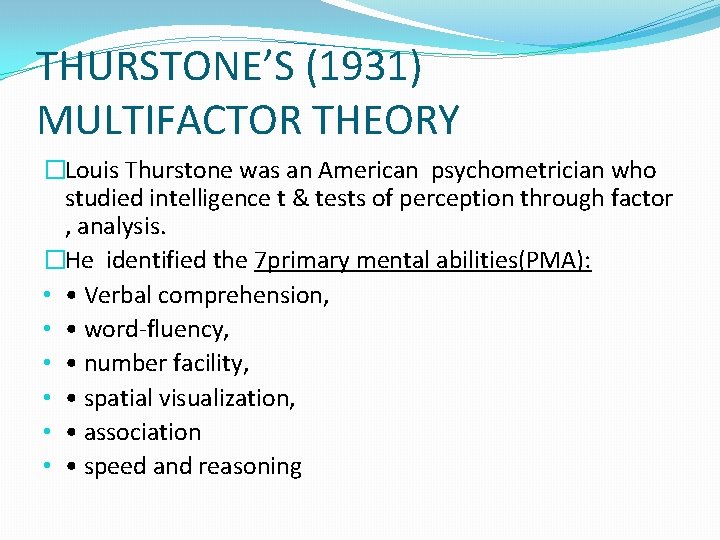
THURSTONE’S (1931) MULTIFACTOR THEORY �Louis Thurstone was an American psychometrician who studied intelligence t & tests of perception through factor , analysis. �He identified the 7 primary mental abilities(PMA): • • Verbal comprehension, • • word-fluency, • • number facility, • • spatial visualization, • • association • • speed and reasoning
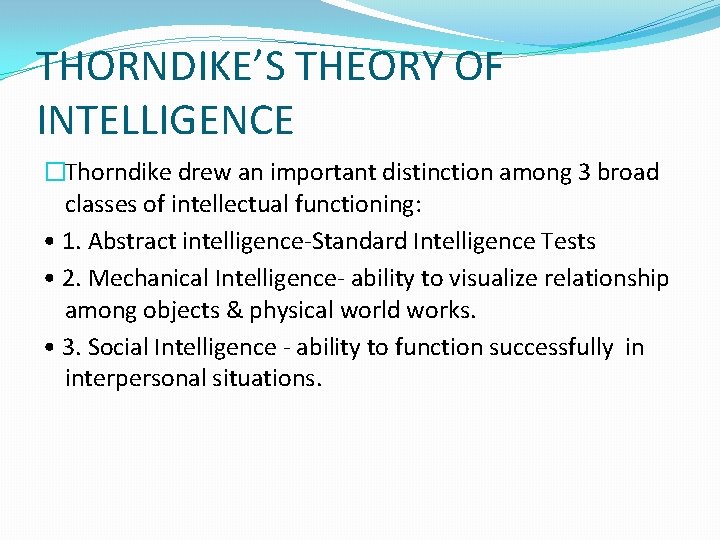
THORNDIKE’S THEORY OF INTELLIGENCE �Thorndike drew an important distinction among 3 broad classes of intellectual functioning: • 1. Abstract intelligence-Standard Intelligence Tests • 2. Mechanical Intelligence- ability to visualize relationship among objects & physical world works. • 3. Social Intelligence - ability to function successfully in interpersonal situations.
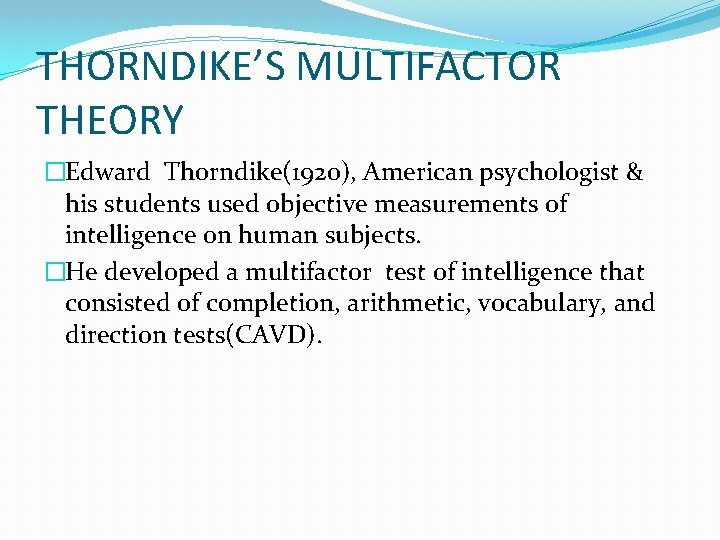
THORNDIKE’S MULTIFACTOR THEORY �Edward Thorndike(1920), American psychologist & his students used objective measurements of intelligence on human subjects. �He developed a multifactor test of intelligence that consisted of completion, arithmetic, vocabulary, and direction tests(CAVD).
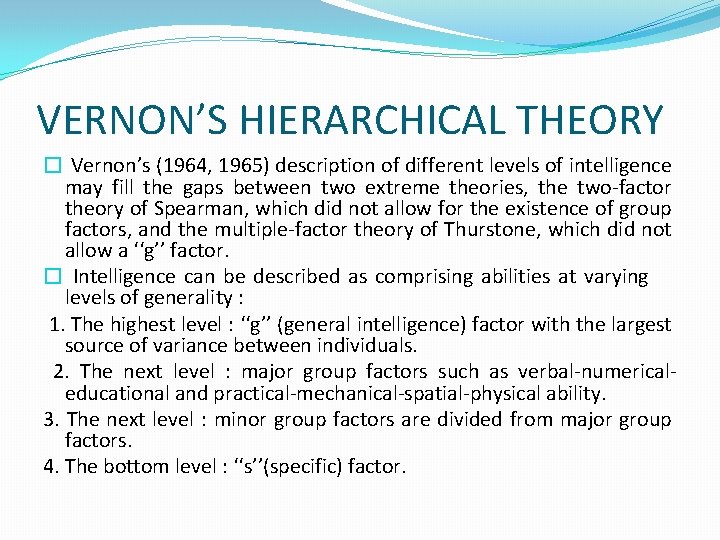
VERNON’S HIERARCHICAL THEORY � Vernon’s (1964, 1965) description of different levels of intelligence may fill the gaps between two extreme theories, the two-factor theory of Spearman, which did not allow for the existence of group factors, and the multiple-factor theory of Thurstone, which did not allow a ‘‘g’’ factor. � Intelligence can be described as comprising abilities at varying levels of generality : 1. The highest level : ‘‘g’’ (general intelligence) factor with the largest source of variance between individuals. 2. The next level : major group factors such as verbal-numericaleducational and practical-mechanical-spatial-physical ability. 3. The next level : minor group factors are divided from major group factors. 4. The bottom level : ‘‘s’’(specific) factor.
�Vernon continued to analyze the effects of genes and the environment on both individual and group difference in intelligence. �He concludes that individual difference in intelligence are approximately 60 percent attributable to genetic factors, and that there is some evidence implicating genes in racial group differences in average levels of mental ability.
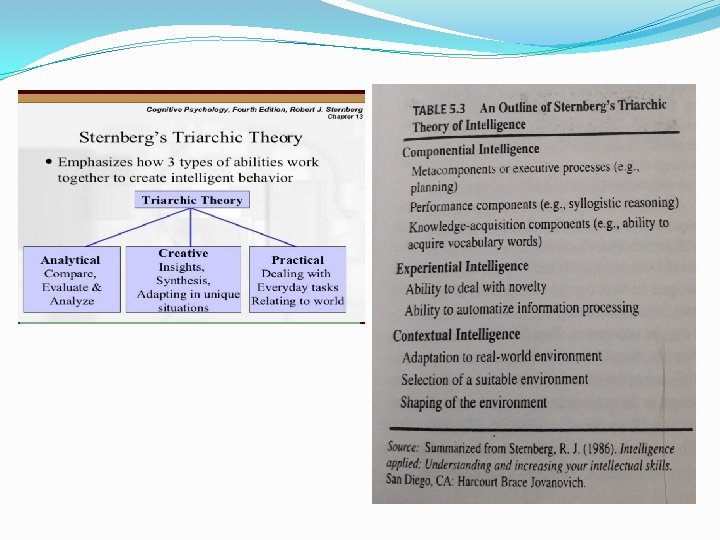
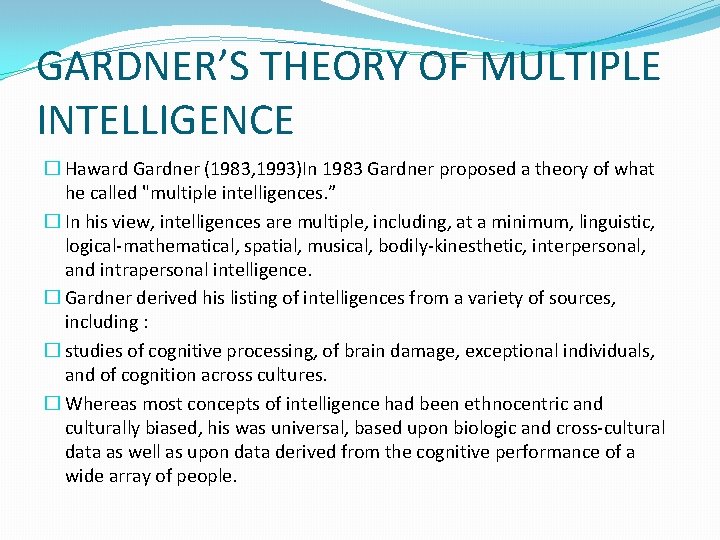
COGNITIVE-CONTEXTUAL THEORIES �Cognitive-contextual theories deal with the way that cognitive processes operate in various environmental contexts. �Two of the major theories of this type are that of the American psychologist Howard Gardner and that of Sternberg.
INFORMATION PROCESSING THEORY OF INTELLIGENCE �This theory was proposed by American Psychologist Robert Sternberg (1984). �The information processing is like a process of solving a problem by an individual in which he proceeds to solve a problem which he comes across, gathers the necessary information and makes use of this information for completing that task.
STEPS OF INFORMATION PROCESSING THEORY �Information processing includes the following steps: �i. Identifying the relevant information (encoding) �ii. Drawing the necessary inferences (inferring) �iii. Establishing relationship between past and present experiences (mapping) �iv. Applying the inferred relationship (application) �v. Justifying the correct solution (justification) �vi. Provide the correct solution (response).
GARDNER’S THEORY OF MULTIPLE INTELLIGENCE � Haward Gardner (1983, 1993)In 1983 Gardner proposed a theory of what he called "multiple intelligences. ” � In his view, intelligences are multiple, including, at a minimum, linguistic, logical-mathematical, spatial, musical, bodily-kinesthetic, interpersonal, and intrapersonal intelligence. � Gardner derived his listing of intelligences from a variety of sources, including : � studies of cognitive processing, of brain damage, exceptional individuals, and of cognition across cultures. � Whereas most concepts of intelligence had been ethnocentric and culturally biased, his was universal, based upon biologic and cross-cultural data as well as upon data derived from the cognitive performance of a wide array of people.
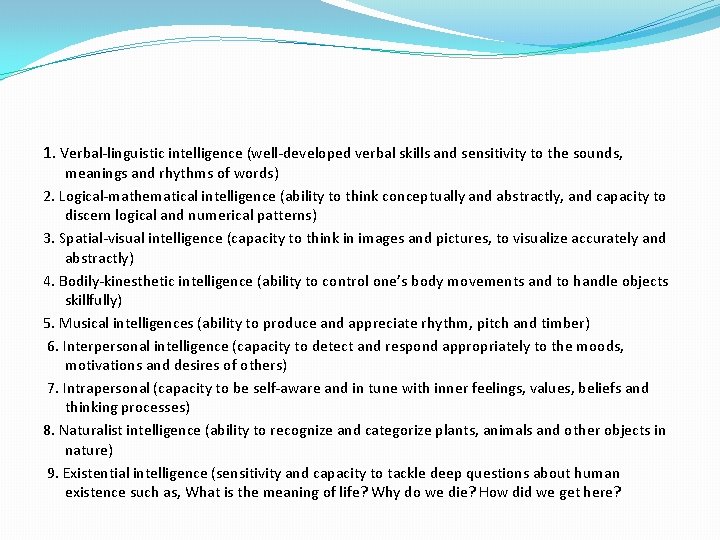
1. Verbal-linguistic intelligence (well-developed verbal skills and sensitivity to the sounds, meanings and rhythms of words) 2. Logical-mathematical intelligence (ability to think conceptually and abstractly, and capacity to discern logical and numerical patterns) 3. Spatial-visual intelligence (capacity to think in images and pictures, to visualize accurately and abstractly) 4. Bodily-kinesthetic intelligence (ability to control one’s body movements and to handle objects skillfully) 5. Musical intelligences (ability to produce and appreciate rhythm, pitch and timber) 6. Interpersonal intelligence (capacity to detect and respond appropriately to the moods, motivations and desires of others) 7. Intrapersonal (capacity to be self-aware and in tune with inner feelings, values, beliefs and thinking processes) 8. Naturalist intelligence (ability to recognize and categorize plants, animals and other objects in nature) 9. Existential intelligence (sensitivity and capacity to tackle deep questions about human existence such as, What is the meaning of life? Why do we die? How did we get here?
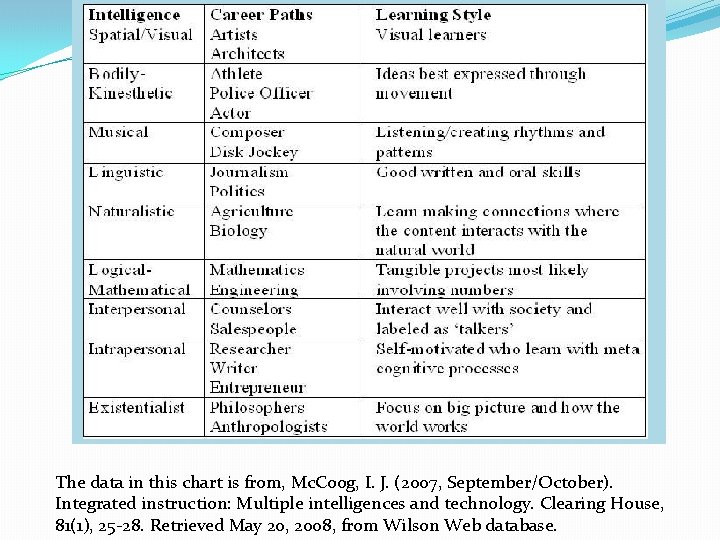
The data in this chart is from, Mc. Coog, I. J. (2007, September/October). Integrated instruction: Multiple intelligences and technology. Clearing House, 81(1), 25 -28. Retrieved May 20, 2008, from Wilson Web database.
GROUP DIFFERENCES IN INTELLIGENCE
GROUP DIFFERENCES ON INTELLIGENCE TEST SCORES �In an attempt to explain some group differences on intelligence test scores Sternberg suggested distinguishing between Intelligence and intelligent behaviour. �Intelligence is a mental process that may or may not result in particular behavioral patterns these patterns of intelligent behaviour may vary from culture to culture �Something considered to be intelligent among members of one culture may not be viewed as such in other cultures
GROUP DIFFERENCE IN INTELLIGENCE �Group difference in intelligence during childhood in verbal behaviour : girls show superiority over boys �During adolescence Witkin (1969) reported girls’ better verbal expression , fluency , perception of details, rapid and accurate manual movement. �Boys are good in spatial tasks, numerical tasks, mechanical tasks.
HEREDITARY INFLUENCES ON INTELLIGENCE �Evidence for hereditary influences on intelligence comes from the following observations: �Family studies show that intelligence tends to run in families. � Twin studies show a higher correlation between identical twins in IQ than between fraternal twins. This holds true even when identical twins reared apart are compared to fraternal twins reared together. �Adoption studies show that adopted children somewhat resemble their biological parents intelligence.
�According to the nativist approach to intelligence human cognitive phenomena are in born they unravel as a result of biological programming and environmental perception requires little active construction by the organism �There is evidence that heredity plays an important role in human intelligence however genetic links for individual differences and similarities do not imply that group differences on the national level for example are also based on genetic factors.
NATURE- NURTURE CONTROVERSY AND INTELLIGENCE �Twin studies: � Monozygotic twins : 100% identical genes �Dizygotic twins : 50% identical genes �Scarr (1981): Substantial difference was found between MZ & DZ twin pairs in about 20 studies
HEREDITY IS CONSTANT BUT ENVIRONMENT IS VARIABLE Monozygotic twins reared in different reared in same environment ‘r' ranges between. 67 to. 78 between IQ of MZ twins reared in different environment
ADOPTION STUDIES �Adoption studies demonstrate that adopted children show some similarity in IQ to their adoptive parents. �Adoption studies also show that siblings reared together are more similar in IQ than siblings reared apart. �This is true even when identical twins reared together are compared to identical twins reared apart.
IQ SIMILARITIES BETWEEN PARENTS AND ADOPTED CHILDREN �Studies reveal that IQ of adopted children correlate strongly with their biological parents than adoptive parents (Scarr, 1981) �Criticism biological parents and biological children shared common environment during pregnancy and at the time of birth
THE KALLIKAK FAMILY: A STUDY IN THE HEREDITY OF FEEBLE-MINDEDNESS � American psychologist Henry Herbert Goddard published the book The Kallikak Family: A Study in the Heredity of Feeble-Mindedness in 1912. �In the early 20 th century as Dr. Henry Goddard, Director of Research at the Vineland Training School for Feeble-Minded Girls and Boys in Vineland, New Jersey, explored the role of the environment versus the role of heredity on the lives of persons with developmental disabilities.
�Dr. Goddard and his research assistant decided to explore the family history of a woman they called Deborah Kallikak ("Kallikak" being a fictitious name taken from the Greek words for "good" and "bad"), who lived in their institution. �One of the things they claimed to have discovered was that Deborah's great grandfather was a revolutionary war soldier named Martin Kallikak. �Apparently, Martin had relations with a "feeble-minded" bar maid. Later, Martin returned to Philadelphia, where he married a woman of the upper class and raised a wholesome family. The bar maid, meanwhile, gave birth to Martin's child and not-so-feeble-mindedly named him Martin Kallikak Jr.
FINDINGS OF THE STUDY �Using this history, Dr. Goddard traced the lineage of Martin Kallikak's family with his wife, finding only successful, outstanding individuals of normal or better intelligence. Of Kallikak's lineage through his offspring with the bar maid, Goddard found criminals, prostitutes, vagabonds: people of below normal intelligence. �Dr. Goddard's conclusion, which he published in a widely-read book entitled The Kallikak Family, was that mental retardation is the root cause of many of our social problems, and that it is hereditary in nature.
IMPORTANT FACTORS THAT LIMIT HERITABILITY ESTIMATES: �Three important factors that limit heritability estimates: � Heritability estimates don't reveal anything about the extent to which genes influence a single person's traits. �Heritability depends on how similar the environment is for a group of people. � Even with high heritability, a trait can still be influenced by environment.
�IQ, declines over time in children raised in deprived environments, such as understaffed orphanages or circumstances of poverty and isolation, Conversely, improves in children who leave deprived environments and enter enriched environment, �Biologically unrelated children raised together in the same home have some similarity in IQ.
RACIAL DIFFERENCE IN INTELLIGENCE �Difference in IQ reported in USA initially white people > black people �Later on this difference vanished when cultural factor and learning opportunities where equated for these two groups �In USA black children adopted by white families enjoy better environment and thereby their intelligence is highly developed. �Environmental factors associated with poverty such as poor nutrition and lack of parental care can have a negative impact on Intelligence
CULTURAL AND ETHNIC DIFFERENCES �Studies have shown a discrepancy in average IQ scores between whites and minority groups in the United States. �Black, Native American, and Hispanic people score lower, on average, than white people on standardized IQ tests. � Controversy exists about whether this difference is due to heredity or environment.
�Some Specialists imply that most intelligence test benefit specific ethnic groups because of the test vocabulary words and items used in the test questions. Tests may contain internal bias because they use words that are familiar to only some groups �As a result member of these groups receive higher score than those who do not belong to these groups
ENVIRONMENTAL CONDITIONS INFLUENCING INTELLIGENCE TEST SCORES Many environmental conditions have been found to influence performance on Intelligence tests �availability of and access to resources � variety of perceptual experiences � predominant type of family climate �Educational opportunities � access to books and travel �presence or absence of cultural magical beliefs �general attitudes and cultural practices
INTELLIGENCE & SOCIO ECONOMIC STATUS �Intelligence scores are in general positively correlated with the social economic status of the individual. � The link between socio-economic conditions and test performance shows at an early age a child’s IQ and the social economic status of the child's parents are also positively correlated. � Affluent and educated family is likely to provide a better material environment for a child and also has more resources to develop the child's intellectual potential than a poor family. �Poverty is responsible for a variety of indirect impact on the intellectual development of children and adults.
�In the United States people with high IQ scores are disproportionately represented among doctors scientists, lawyers and business executives. �Individuals with low intelligence scores are disproportionately represented among people on welfare, prison inmates, single mothers, drug abusers and high school dropouts. �There is difference in the way people across cultures value and construe intelligence.
�For instance the conceptualization of Intelligence as quick and analytic is not shared in all cultures. �cognitive processes have cross cultural similarity but may also develop in different ways according to specific cultural norms and social demands.
EMOTIONAL INTELLIGENCE
EMOTIONAL INTELLIGENCE �According to Salovey and Mayer (1990) emotional intelligence is: “the ability to monitor one’s own and others’ feelings and emotions, to discriminate among them and to use this information to guide one’s thinking and actions. ” �According to Goleman (1995), Emotional Intelligence consists of ‘‘abilities such as being able to motivate oneself and persist in the face of frustrations; to control impulse and delay gratification; to regulate one’s moods and keep distress from swamping the ability to think : to empathize, and to hope’’. �The main areas are : knowing one’s emotions, managing emotions, motivating oneself, recognizing emotions in others, and handling relationships.
What is emotional Intelligence? �Self-awareness & developing a positive sense of selfworth �Problem-solving �Emotional management / Impulse control �Decision-making �Relationship-building / Empathy / Social Skills �Taking responsibility for one’s actions
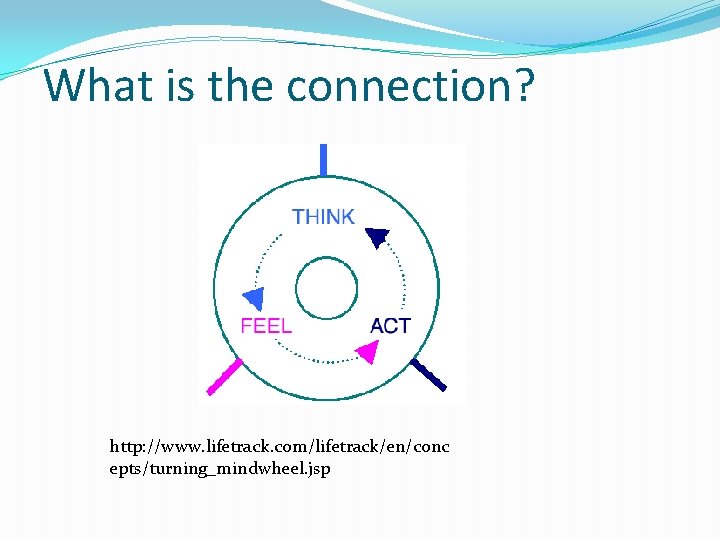
What is the connection? http: //www. lifetrack. com/lifetrack/en/conc epts/turning_mindwheel. jsp
ADVANTAGES OF EMOTIONAL INTELLIGENCE �The advantages emotional intelligence are as below: �improves relationships with human beings; � improves communication with people; �makes better empathy skills; �acting with integrity; � helps you to get respect from others; �to improve career prospects; �managing change more confidently; �enjoy the work wholeheartedly; �feeling confident and positive in attitude; � to reduce stress levels; �to increase creativity; �to learn from mistakes
EMOTIONAL INTELLIGENCE MODELS �In the course of last two decades EI researchers have developed three major models they are � Ability, Mixed, and Trait EI models �John Mayer and Peter Salovey (2000) : An Ability Model of Emotional Intelligence : �Salovey and Mayer‘s (2000) conception of EI strives to define EI within standard criteria for a new intelligence. �Their continuing researches was revised to their initial definition of EI was : �The ability to perceive emotion, integrate emotion to facilitate thought, understand emotions and to regulate emotions to promote personal growth. ‖
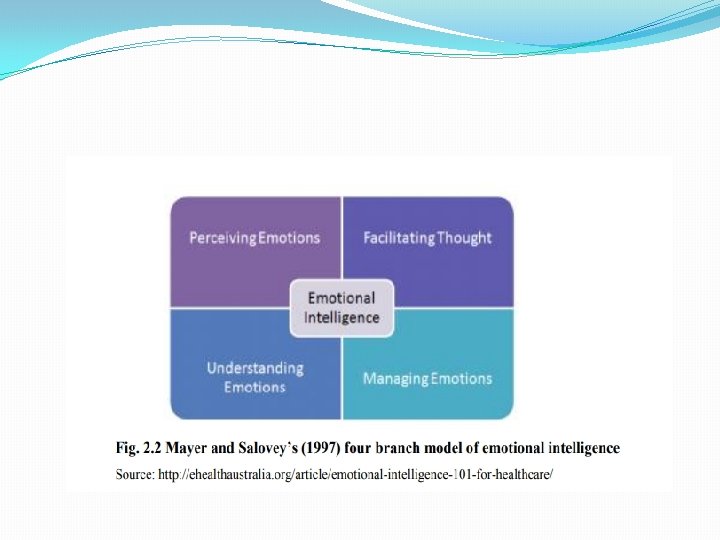
�Goleman (1998)define emotional intelligence as ―the capacity for recognizing our own feelings and those of others, for motivating ourselves, for managing emotions well in ourselves and in our relationships.
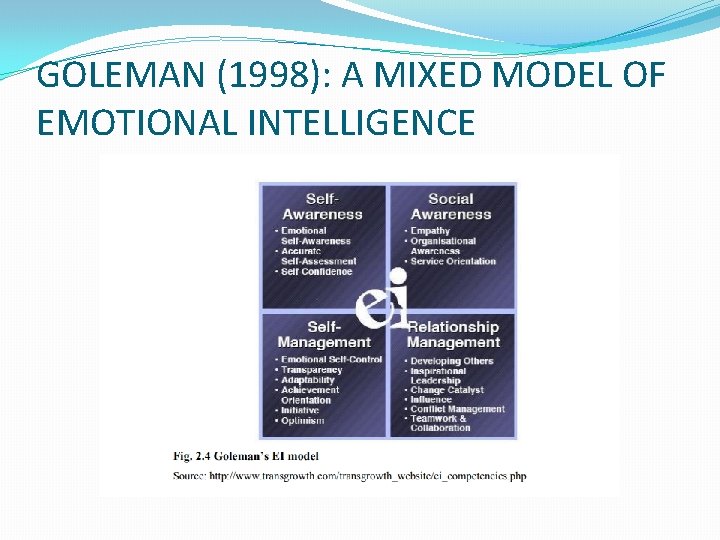
GOLEMAN (1998): A MIXED MODEL OF EMOTIONAL INTELLIGENCE
ASPECTS OF EMOTIONAL INTELLIGENCE 1. intrapersonal management �emotional self awareness �accurate self assessment �self confidence 2. interpersonal management �emotional self control �stress tolerance �Independence �assertiveness �self regard �self actualization � optimism
� 3. interpersonal awareness �awareness about others � empathy � reality testing 4. interpersonal management �managing interpersonal relationships �flexibility �problem solving �conflict management
THE CONCEPT OF EQ & DIFFERENCE BETWEEN IQ AND EQ �IQ represents a relative measure of a once General Intelligence or the fund of intellectual abilities and capacities. �emotional intelligence is known to be associated with non cognitive abilities capacities and competences �the EQ as its relative measure suggests that it is the degree of ones position of such non cognitive potential that is emotional intelligence
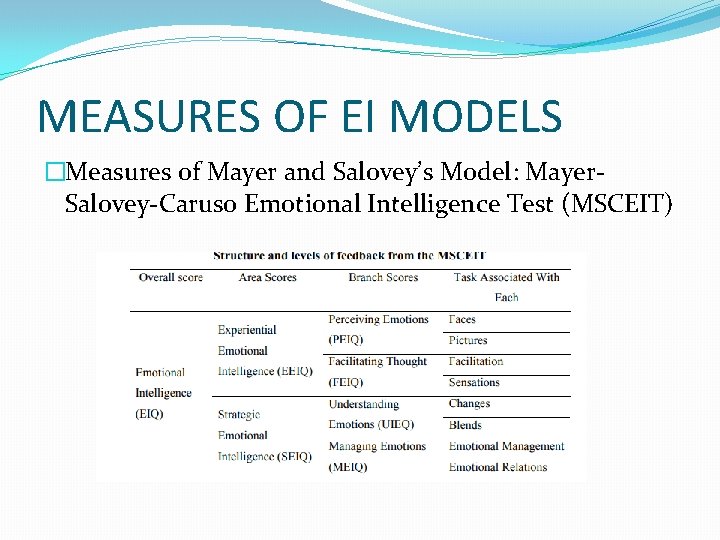
MEASURES OF EI MODELS �Measures of Mayer and Salovey’s Model: Mayer. Salovey-Caruso Emotional Intelligence Test (MSCEIT)
MEASURES OF GOLEMAN’S MODEL �Emotional Competency Inventory (ECI), the Emotional Intelligence Appraisal (EIA), and the Work Profile Questionnaire – Emotional Intelligence Version (WPQei)
EXTREMITIES OF INTELLIGENCE
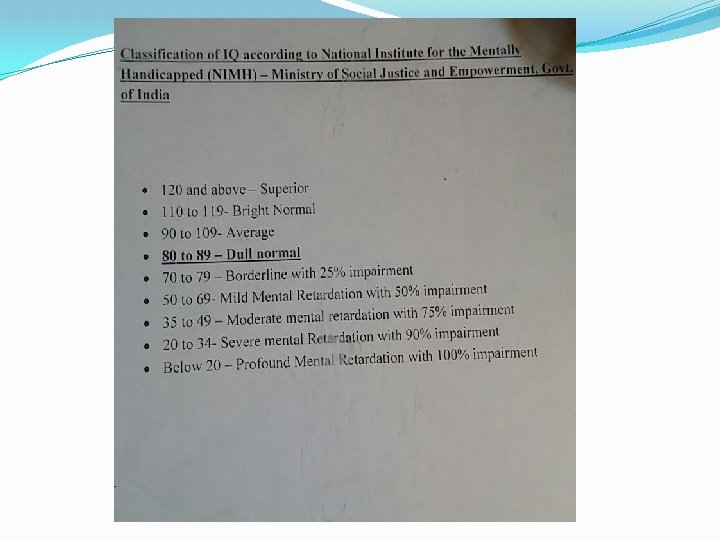
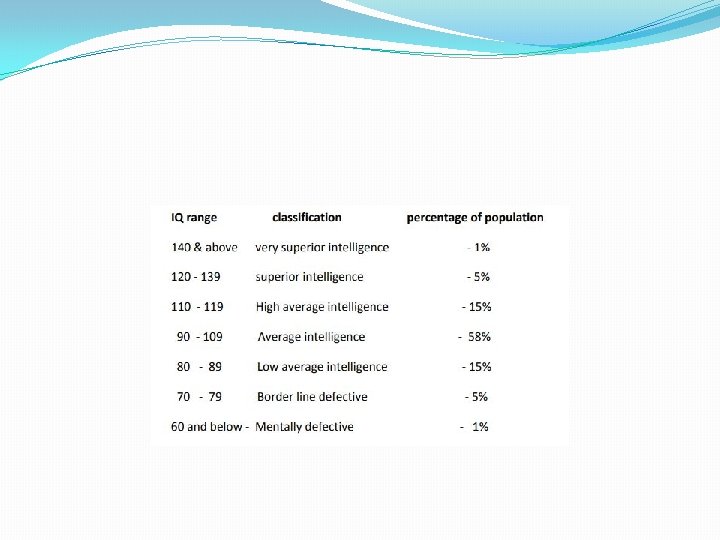
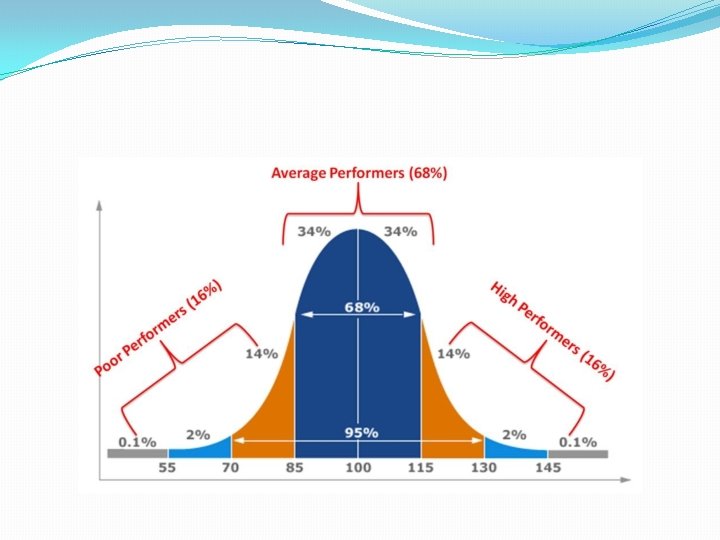
MEANING AND DEFINITION OF MENTALLY RETARDED CHILDREN �American association on mental retardation (1983): mental retardation refers to significantly impaired general intellectual functioning existing concurrently with deficits in adaptive behaviour and manifested during the development al period �Diagnostic and statistical manual of mental disorders 4 th edition DSM 4 : the mental retardation is characterized by significant is sub average intellectual functioning which must be supported by three factors �intellectual impairment �significant difficulty in adaptation functioning and �onset before the age of 18
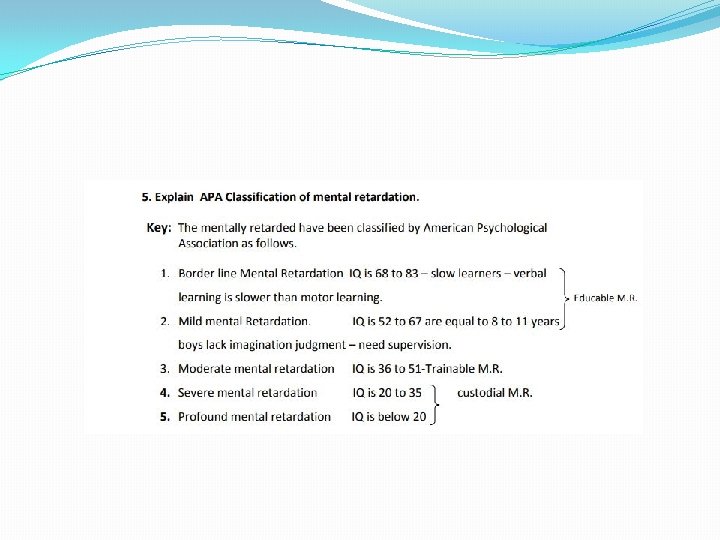
COMMON CLINICAL TYPES OF MENTAL RETARDATION �mongolism, �cretinism �microcephaly �hydrocephalic �phenylketonuria �amaurotic idiocy �x-linked mental retardation of fragile X syndrome �tuberous sclerosis
CHARACTERISTICS OF MENTALLY RETARDED CHILDREN �physical characteristic s �mental or cognitive characteristics �personality and behavioral characteristics
IDENTIFYING OR DETECTING THE MENTALLY RETARDED CHILDREN �identifying or detecting the Mentally retarded children with special emphasis on some names of tests for assessment of intellectual functioning.
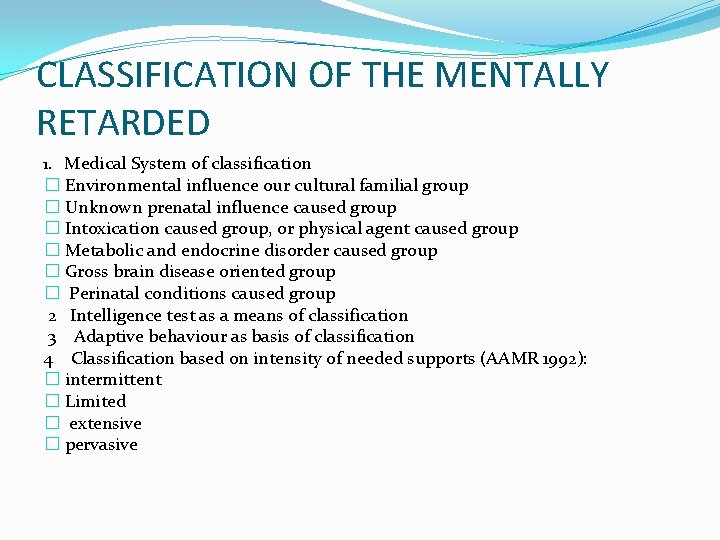
CLASSIFICATION OF THE MENTALLY RETARDED 1. Medical System of classification � Environmental influence our cultural familial group � Unknown prenatal influence caused group � Intoxication caused group, or physical agent caused group � Metabolic and endocrine disorder caused group � Gross brain disease oriented group � Perinatal conditions caused group 2 Intelligence test as a means of classification 3 Adaptive behaviour as basis of classification 4 Classification based on intensity of needed supports (AAMR 1992): � intermittent � Limited � extensive � pervasive
CAUSES AND PREVENTION OF MENTAL RETARDATION Treatment in terms of �providing special education �placement alternatives of regular School �regular school with a provision of resource room �regular school with the provision of Special educator �Special School �residential special school home and Hospital bound facilities � decision about the adaptation of the curriculum �decision about the instructional methodology and strategies
SOME BEHAVIOUR MODIFICATION STRATEGIES FOR MENTALLY RETARDED �strategy of Differential reinforcement �provision of assisting prompting and clueing � use of token system �use of time out for discouraging unacceptable behaviour �use of modeling as a behaviour modification techniques �using applied behaviour analysis as an useful teaching strategy �planning education according to the levels of mental retardation �educational program for the educational mentally retarded �educational program for the trainable mentally retarded �educational program for the custodial Mentally retarded
GIFTED CHILD �A talented or gifted child is one who shows consistently remarkable performance in any worthwhile line of endeavour. does we shall include not only the intellectually gifted but also those who show promise in music the graphic arts creative writing dramatics mechanical skills and social leadership"Education for the gifted fifty seventh th year book of the national Society for the study of education, part II (Chicago University of Chicago press 1958 p. 19) �In defining giftedness there is a current affair to avoid depending too much on IQ but when it comes to identify for selecting gifted children most schools and Research workers rely on a standardized intelligence test partly because there are few other measuring devices
�definition of gifted children characteristics of gifted children �different methods of educating gifted children finding gifted children
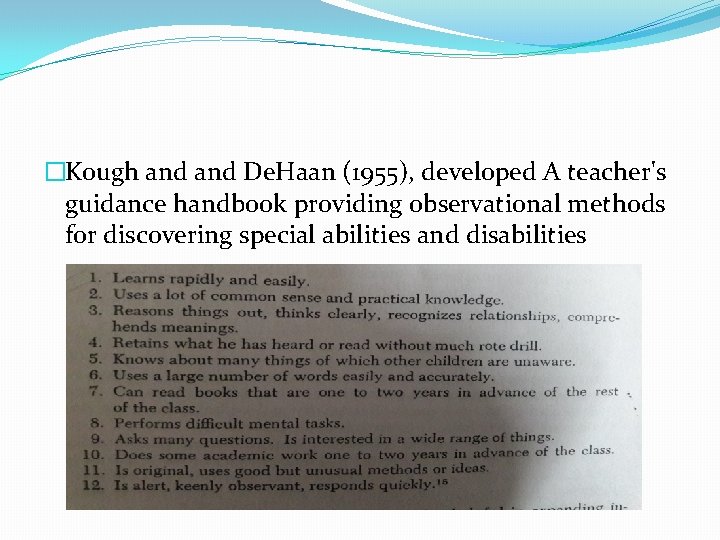
�Kough and De. Haan (1955), developed A teacher's guidance handbook providing observational methods for discovering special abilities and disabilities
THREE APPROACHES TO EDUCATING GIFTED CHILDREN 1. Acceleration �early School admission �skipping grades �telescoping grades �early admission to Secondary Schools or colleges �other method such as passing courses in high school and college by examination.
� 2. Enrichment : �It encouraging teachers in the regular grades to challenge the gifted child with additional reading extra assignment opportunity to participate in extra curricular activities �grouping gifted children in a class so that few gifted children are in a group by themselves and challenging their interest and abilities with problem requiring independent Research � offering additional learning materials employing a special teacher for the gifted children in a school system encouraging teachers to hold high standards of achievement for the gifted children
� 3. special grouping for gifted children special schools and classes adaptation and recommendations at the secondary level �educating special groups of gifted children there can be Three Types of deviated gifted children who will require special attention over and above the provisions which are made for gifted children in general �underachieving gifted child �the highly gifted child and �the gifted child with a handicapped
�Presented by �Dr. Symali Sen (Associate Professor , Bethune College) �Dr. Leena Nair Sengupta (Associate Professor Gokhale Memorial Girls’ College) �Dr. Pooja Chatterjee (Assistant Professor and Head, Department of Psychology, Asutosh College) �Arunima Mitra (Guest Lecturer, Gokhale Memorial Girls’ College)

THANK YOU
- Slides: 83