
Intelligence the test of a firstrate intelligence is
- Slides: 19
Intelligence …the test of a first-rate intelligence is the ability to hold two opposed ideas in the mind at the same time, and still retain the ability to function… F. Scott Fitzgerald
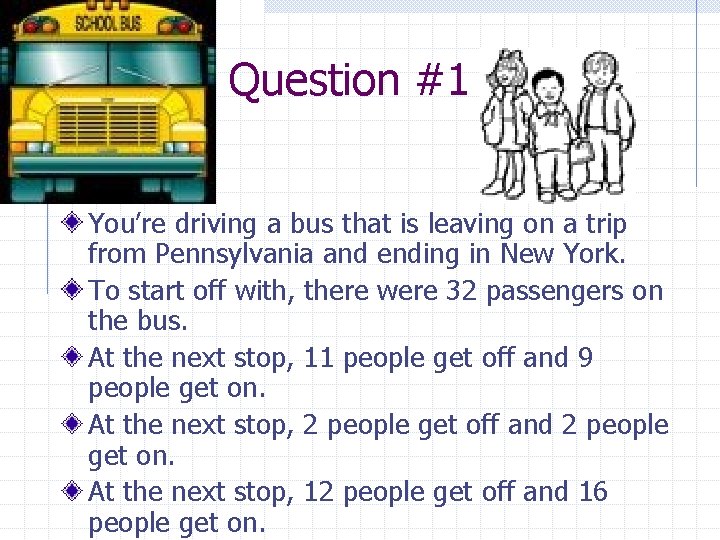
Question #1 You’re driving a bus that is leaving on a trip from Pennsylvania and ending in New York. To start off with, there were 32 passengers on the bus. At the next stop, 11 people get off and 9 people get on. At the next stop, 2 people get off and 2 people get on. At the next stop, 12 people get off and 16 people get on.
What color are the eyes of the bus driver? Blue? Green? Brown? Hazel? Grey? Information not given.
Intelligence What is intelligence? n n The capacity to learn from experience and adapt successfully to one’s environment Reflects how well we function Francis Galton n n Believed that intelligence was inherited Based intelligence on: w Muscular strength w Size of your head w Speed at reacting to signals w Your ability to detect slight differences
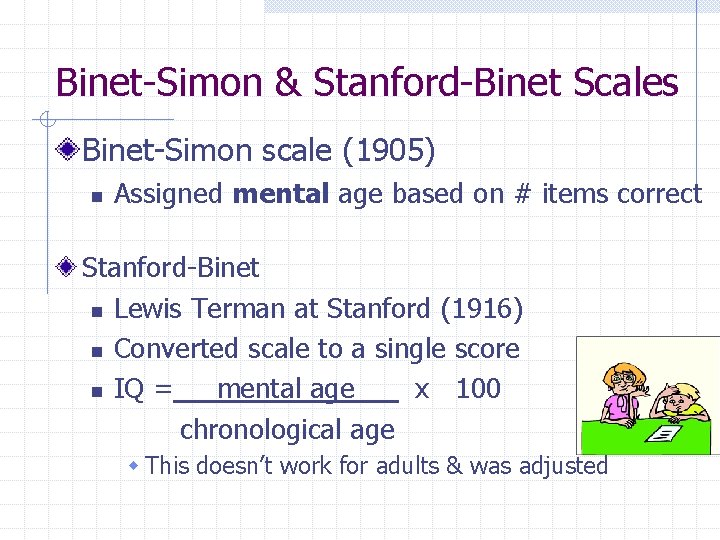
Binet-Simon & Stanford-Binet Scales Binet-Simon scale (1905) n Assigned mental age based on # items correct Stanford-Binet n Lewis Terman at Stanford (1916) n Converted scale to a single score n IQ = mental age x 100 chronological age w This doesn’t work for adults & was adjusted
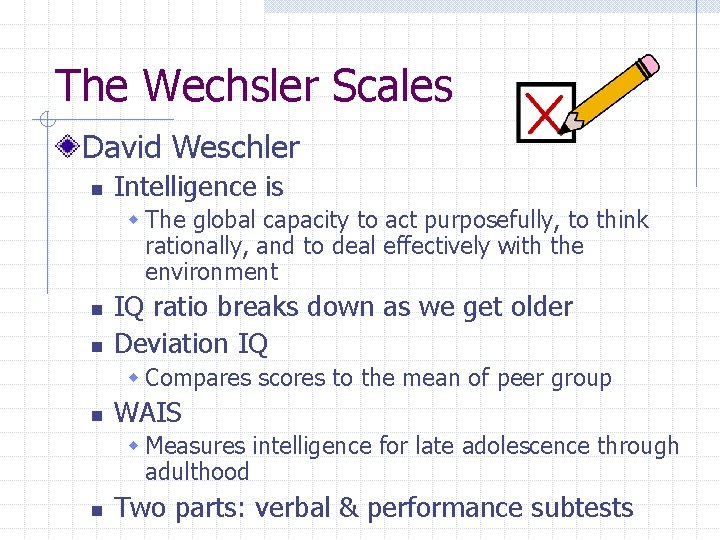
The Wechsler Scales David Weschler n Intelligence is w The global capacity to act purposefully, to think rationally, and to deal effectively with the environment n n IQ ratio breaks down as we get older Deviation IQ w Compares scores to the mean of peer group n WAIS w Measures intelligence for late adolescence through adulthood n Two parts: verbal & performance subtests
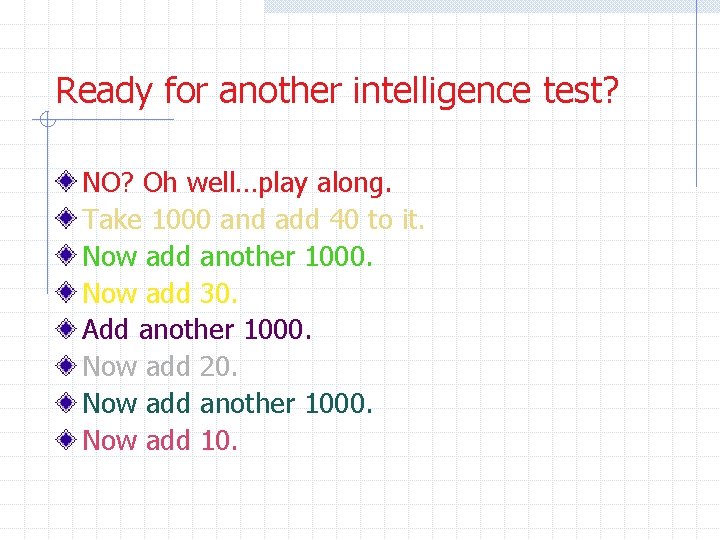
Ready for another intelligence test? NO? Oh well…play along. Take 1000 and add 40 to it. Now add another 1000. Now add 30. Add another 1000. Now add 20. Now add another 1000. Now add 10.
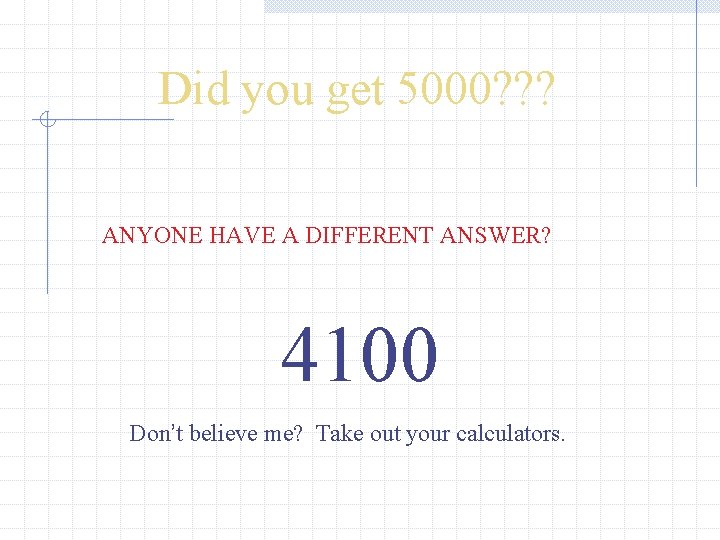
Did you get 5000? ? ? ANYONE HAVE A DIFFERENT ANSWER? 4100 Don’t believe me? Take out your calculators.
Let’s Take an IQ Test! Stevenson’s Mental Inventory – abbreviated version
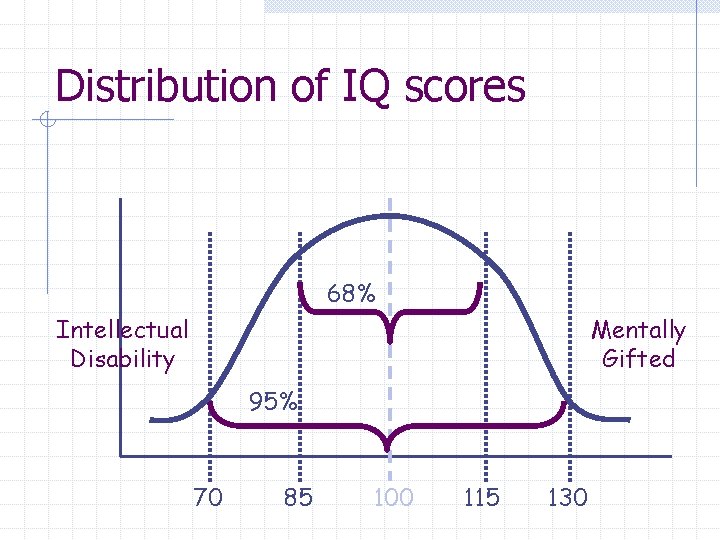
Distribution of IQ scores 68% Intellectual Disability Mentally Gifted 95% 70 85 100 115 130
Issues to Consider in IQ Testing Standardization n The procedure by which existing norms are used to interpret an individual’s test score
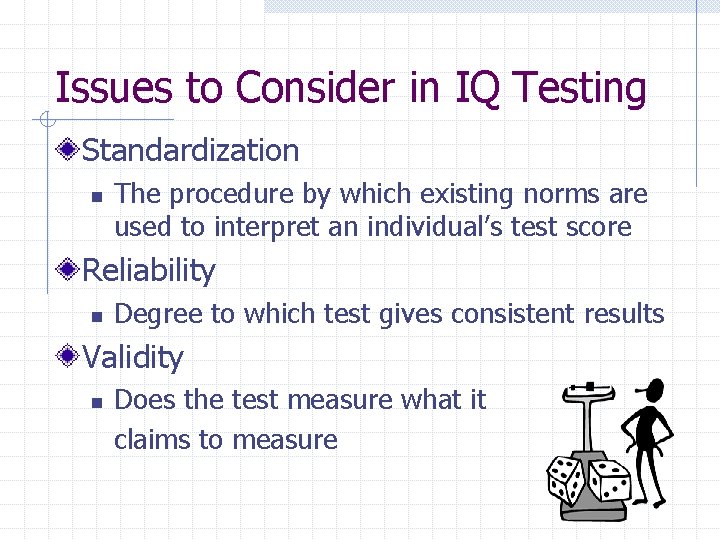
Issues to Consider in IQ Testing Standardization n The procedure by which existing norms are used to interpret an individual’s test score Reliability n Degree to which test gives consistent results Validity n Does the test measure what it claims to measure
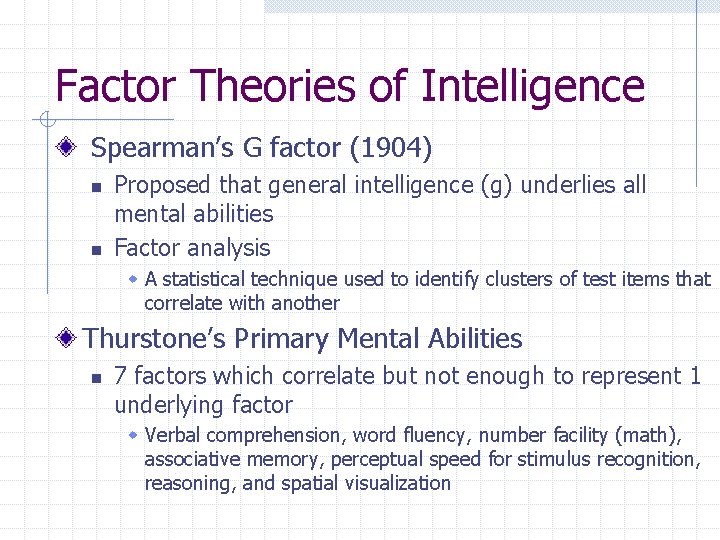
Factor Theories of Intelligence Spearman’s G factor (1904) n n Proposed that general intelligence (g) underlies all mental abilities Factor analysis w A statistical technique used to identify clusters of test items that correlate with another Thurstone’s Primary Mental Abilities n 7 factors which correlate but not enough to represent 1 underlying factor w Verbal comprehension, word fluency, number facility (math), associative memory, perceptual speed for stimulus recognition, reasoning, and spatial visualization
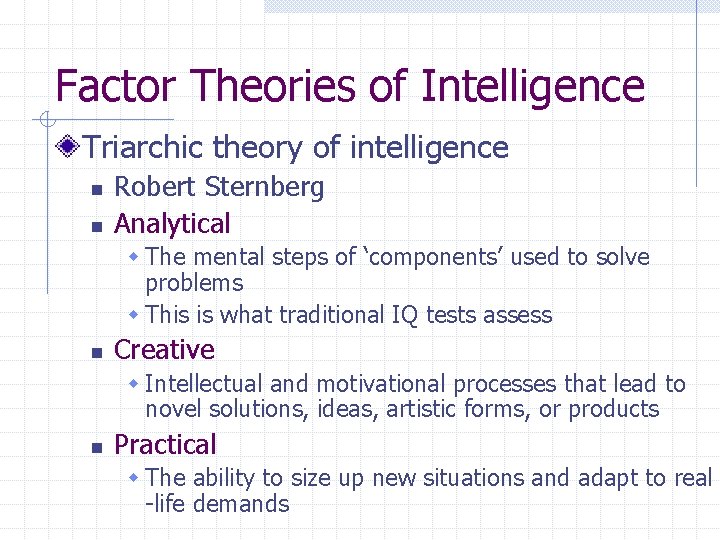
Factor Theories of Intelligence Triarchic theory of intelligence n n Robert Sternberg Analytical w The mental steps of ‘components’ used to solve problems w This is what traditional IQ tests assess n Creative w Intellectual and motivational processes that lead to novel solutions, ideas, artistic forms, or products n Practical w The ability to size up new situations and adapt to real -life demands
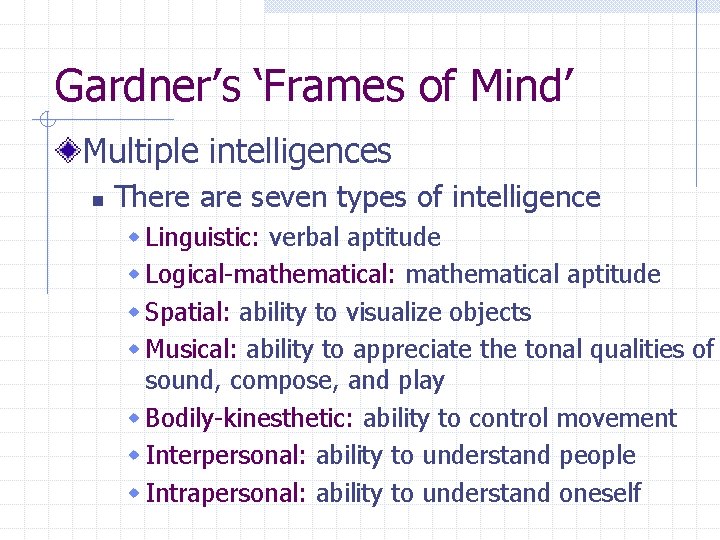
Gardner’s ‘Frames of Mind’ Multiple intelligences n There are seven types of intelligence w Linguistic: verbal aptitude w Logical-mathematical: mathematical aptitude w Spatial: ability to visualize objects w Musical: ability to appreciate the tonal qualities of sound, compose, and play w Bodily-kinesthetic: ability to control movement w Interpersonal: ability to understand people w Intrapersonal: ability to understand oneself
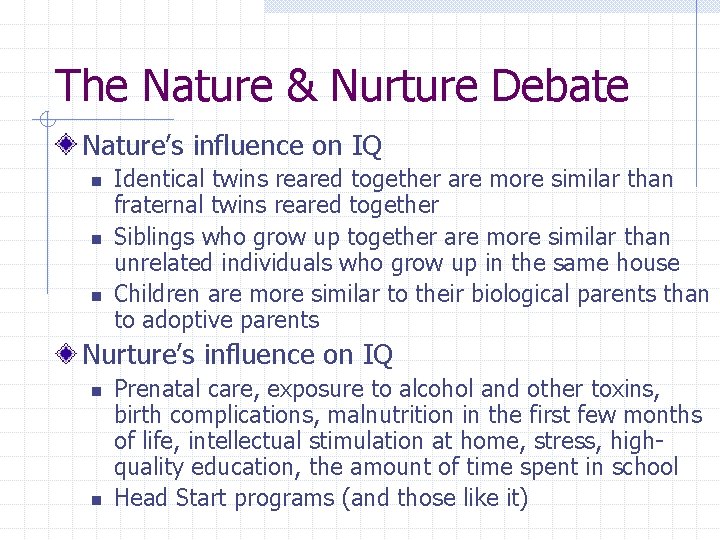
The Nature & Nurture Debate Nature’s influence on IQ n n n Identical twins reared together are more similar than fraternal twins reared together Siblings who grow up together are more similar than unrelated individuals who grow up in the same house Children are more similar to their biological parents than to adoptive parents Nurture’s influence on IQ n n Prenatal care, exposure to alcohol and other toxins, birth complications, malnutrition in the first few months of life, intellectual stimulation at home, stress, highquality education, the amount of time spent in school Head Start programs (and those like it)
Extremes in Intelligence Intellectual Disabilites n n IQ below 70 Difficulties with: w Self-care w School / work w Social relationships n Four categories w Mild, Moderate, Severe, Profound
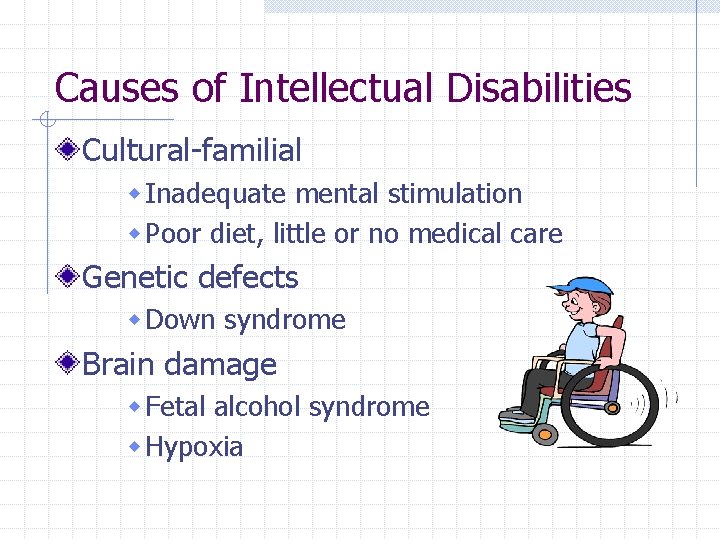
Causes of Intellectual Disabilities Cultural-familial w Inadequate mental stimulation w Poor diet, little or no medical care Genetic defects w Down syndrome Brain damage w Fetal alcohol syndrome w Hypoxia
Mental Giftedness IQ above 130 MENSA n Limits membership to top 2% of population Sidis Fallacy n Contrary to popular belief, geniuses don’t tend to “burn out” at early age