
Intelligence The Dynamics of Intelligence Part six Does
- Slides: 20
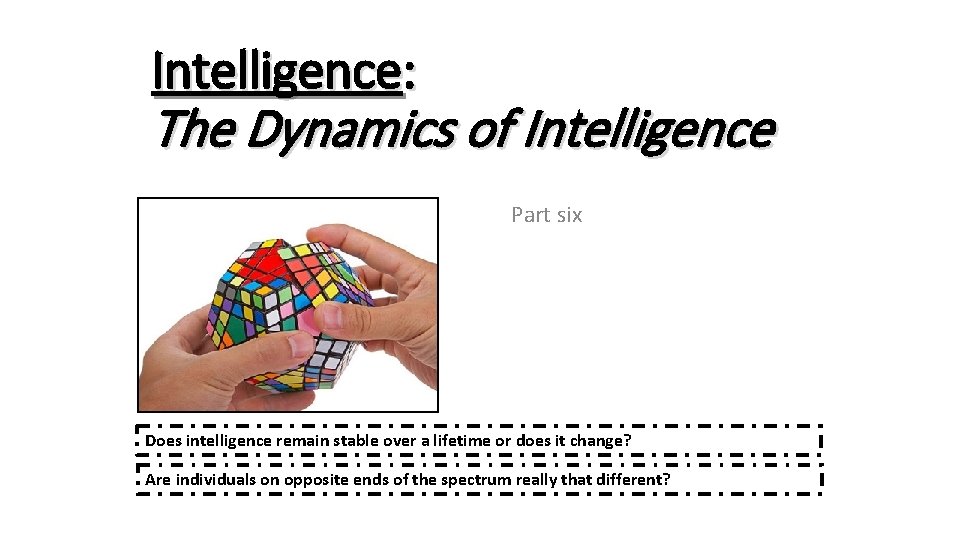
Intelligence: The Dynamics of Intelligence Part six Does intelligence remain stable over a lifetime or does it change? Are individuals on opposite ends of the spectrum really that different?
Intelligence: The Dynamics • By age 4, children’s performance on intelligence tests begins to predict their adolescent & adult scores • High scoring adolescents tend to have been early readers • Intelligence scores become stable after about 7 years of age • In numerous studies, consistency of intelligence scores has been determined to increase with age
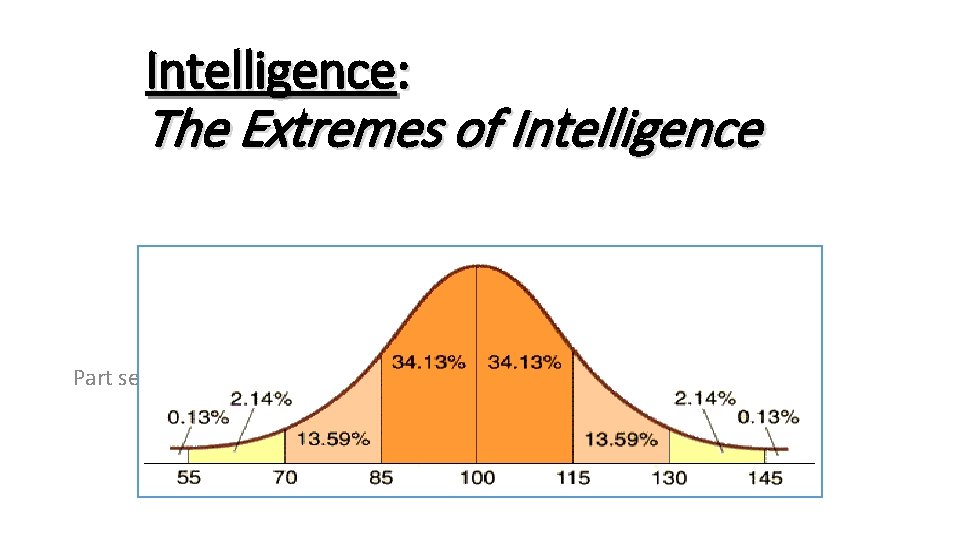
Intelligence: The Extremes of Intelligence Part seven
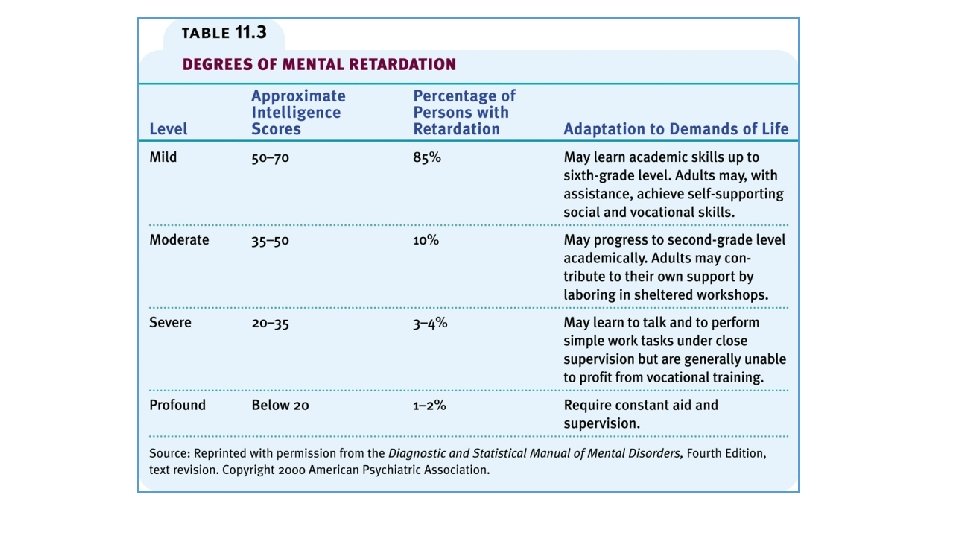
Intelligence: The Extremes (Low) • Intellectual Disability/Developmentally Delayed (Mental Retardation) • A condition characterized by limited mental capacity • Indicated by a low test score (<70) and difficulty adapting to the normal demands of independent living; before the age of 18 • 1 -3% of the population • An estimated 6. 2 to 7. 5 million Americans • Male to female ratio?
Intelligence: The Extremes (Low) • The three most common biological causes… • Down Syndrome • A condition of intellectual disability & associated physical disorders • 47 chromosomes, as opposed to 46 (an extra 21 st) • Fetal Alcohol Syndrome • Fragile X Syndrome • A condition in which a male has a defect in a gene on the X chromosome of the twentythird pair • Leads to a deficiency in a protein needed for brain development
Intelligence: The Extremes (Low) • Other Causes? • Environmental Factors • • Lead poisoning Prenatal exposure to mercury Poor nutrition Lack of mental stimulation • Familial Intellectual Disabilities • A developmental delay related to living in poverty; generally produces relatively intellectual disability.
Intelligence: The Extremes (High) • Definitions of giftedness (>130) vary considerably • 2% of the population is >130 (gifted) • ½% of the population >140 -145 (genius) • Misconceptions about the high extreme • “Early ripe, early rot…” • Socially awkward, physically weak, more likely to suffer from mental illness, etc. • The “mad scientists” or “evil geniuses”
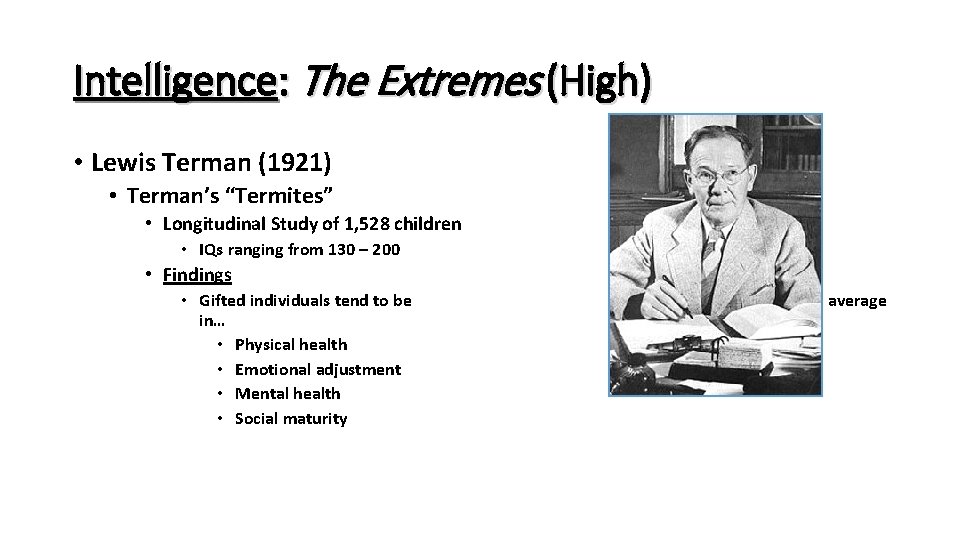
Intelligence: The Extremes (High) • Lewis Terman (1921) • Terman’s “Termites” • Longitudinal Study of 1, 528 children • IQs ranging from 130 – 200 • Findings • Gifted individuals tend to be in… • Physical health • Emotional adjustment • Mental health • Social maturity above average
Intelligence: Part eight Heredity & Environment
Intelligence: Heredity & Environment • Early pioneers of intelligence… • Maintained the nature view of intelligence • Today’s nature theorists… • Assert that a child’s intelligence CANNOT be changed; genetic destiny • Many argue that this downplays the value of special education programs for underprivileged groups
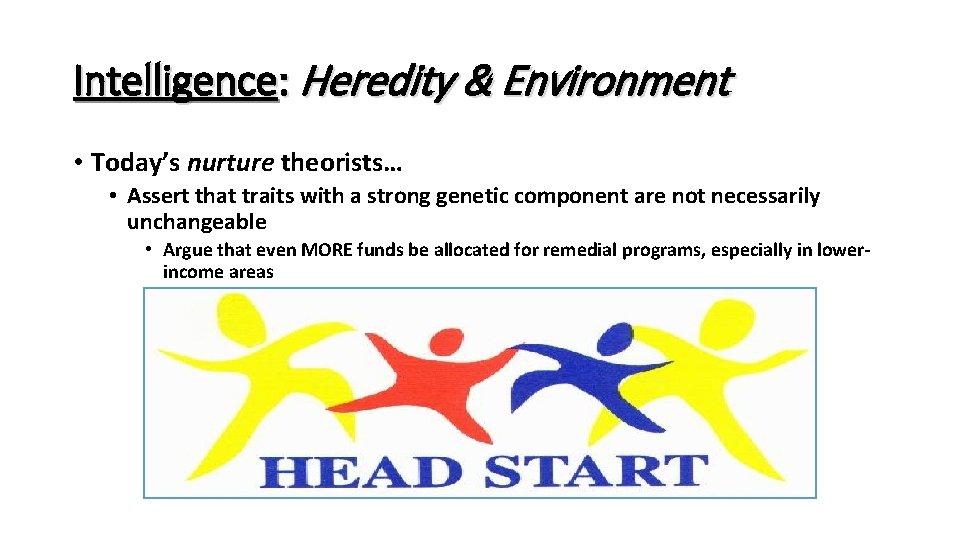
Intelligence: Heredity & Environment • Today’s nurture theorists… • Assert that traits with a strong genetic component are not necessarily unchangeable • Argue that even MORE funds be allocated for remedial programs, especially in lowerincome areas
Evidence for Hereditary Influence
Intelligence: Heredity & Environment • Family Studies • Can determine only whether genetic influence on a trait is plausible • Twin Studies • The average correlation for identical twins is +0. 86 • The average correlation for fraternal twins is +0. 60 • Adoption Studies • Studies indicate that there is more than chance similarity between adopted children and their biological parents
Intelligence: Heredity & Environment • Heritability Ratio • An estimate of the proportion of trait variability in a population that is determined by variations in genetic inheritance • Can be estimated for any trait • 90% for height • 85% for weight • Intelligence?
Intelligence: Heredity & Environment • Heritability estimates for intelligence vary considerably • High Estimate: 80% • 20% of the variation in intelligence is attributable to environmental factors • Low Estimate: 40% • 60% of the variation in intelligence is attributable to environmental factors
Intelligence: Heredity & Environment • Limitations of heritability estimates • Heritability is a group statistic; CANNOT be meaningfully applied to individuals • A trait’s heritability may vary from one group to another • “There really is no single fixed value that represents any true, constant value for the heritability of IQ or anything else…”
Evidence for Environmental Influence
Intelligence: Heredity & Environment • Twin Studies • The average correlation for identical twins raised together is +0. 86 • The average correlation for identical twins raised apart is +0. 72 • Adoption Studies • There is some resemblance between adoptive parents and their children • Siblings reared together are more similar in IQ than siblings reared apart (0. 48, as opposed to 0. 23)
Intelligence: Heredity & Environment • Sandra Scarr (1991) • Reaction-Range Model • Heredity sets certain limits on intelligence and environmental factors determine where individuals fall within these limits • Genetic makeup places an upper limit on a person’s IQ • Cannot be exceeded; even when environment is ideal • Genetic makeup places a lower limit on a person’s IQ except in extreme cases