
Intelligence Testing Intelligence testing A brief history of
Intelligence Testing Intelligence testing
A brief history of intelligence • The concept of 'intelligence' is relatively new, unknown a century ago, though it comes from older Latin roots – inter= between, within + legere =to bring together, gather, pick out, choose, catch up, catch with the eye, read; intellegere = to see into, perceive, understand • Francis Galton revived the term in the late 19 th century, arguing for its innateness Intelligence testing
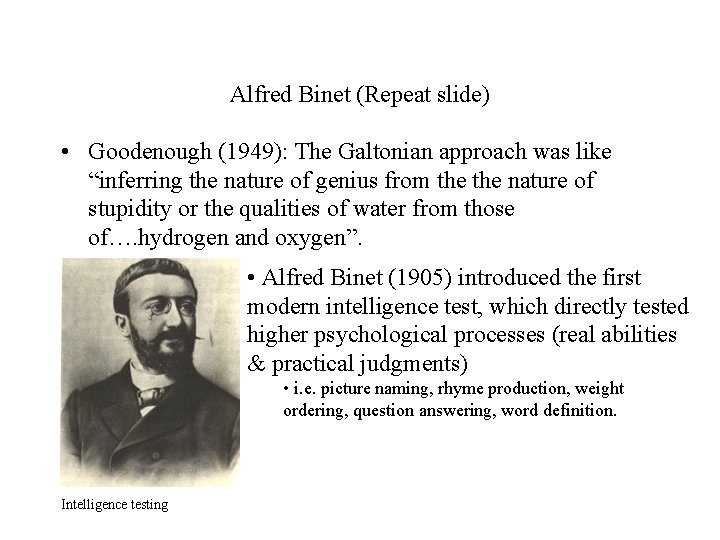
Alfred Binet (Repeat slide) • Goodenough (1949): The Galtonian approach was like “inferring the nature of genius from the nature of stupidity or the qualities of water from those of…. hydrogen and oxygen”. • Alfred Binet (1905) introduced the first modern intelligence test, which directly tested higher psychological processes (real abilities & practical judgments) • i. e. picture naming, rhyme production, weight ordering, question answering, word definition. Intelligence testing
A brief history of intelligence • Some objected to the innateness bias, and suggested the term be replaced with 'general scholastic ability' or 'general educational ability' • However, this did not catch on = most theorists today posit a construct of intelligence that is independent of education Intelligence testing
Defining intelligence • Binet (1916) defined it as the capacity to judge well, to reason well, and to comprehend well • Terman (1916) defined it as the capacity to form concepts and grasp their significance • Pintner (1921) defined it as the ability of an individual to adapt well to new situations in life • Thorndike (1921) defined it as the power of good responses from the point of view of truth or fact • Thurstone (1921) defined it as the capacity to inhibit instinctive response, imagine a different response, and realize the response modification into behavior Intelligence testing
Defining intelligence • Spearman (1923) defined it as a general ability involving mainly the ability to see relations and correlates • Wechlser (1939) defined it as the global capacity of an individual to act purposefully, think rationally, and deal effectively with the environment • Piaget (1972) defined it as referring to the superior forms of organization or equilibrium of cognitive structuring used for adaptation to the physical and social environment • Sternberg (1985) defined it as the mental capacity to automatize information processing and to emit contextually appropriate behavior in response to novelty • Gardner (1986) defined it as the ability to solve problems or fashion products valued within some setting. Intelligence testing
Defining intelligence • You can take your pick of definitions but most agree that intelligence has to do with the related capacities of: i. ) Learning from experience ii. ) Adapting to ones environment • Think of a person lacking either of these, and you pick out people who seem to lack intelligence • Note also that very few formal tests of intelligence really demand subjects to do either of these! Intelligence testing
Defining intelligence • Factor analystic studies (Sternberg, 1981) of informal views of an 'ideally intelligent' person capture these characteristics – They emphasize practical problem solving and social competence (the same thing? ) as signs of intelligence, along with a factor loaded on verbal ability Intelligence testing
A brief history of intelligence testing • As you may recall, Clark Wissler did the first basic validational research, examining the relation between the old Galtonian ‘mental test’ scores and academic achievement – But he neglected to sample the full range of the population • Lewis Terman (1916) created the Stanford-Binet Scale, which incorporated old items from the Binet scale, plus some new items – It was also poorly standardized, on 1000 children and 400 adults who were not selected with care Intelligence testing
A brief history of intelligence testing • The 1937 revision of the scale was improved: – It had wider range (more room on the floor and ceiling) – It had two parallel forms to permit re-testing – It was standardized on a carefully selected population, of 100 children in each six-month interval from 6 to 14 years, and 100 in each year from 15 to 18, with control of sex, selected from 17 different communities • Alas, they were all white and (therefore) above average SES • The test was re-normed in 1960 and 1972, and revised completely in 1986 (SB-IV) Intelligence testing
Item analysis in the Stanford-Binet • To select items from the initial pool, Terman required that: i. ) The item was judged to be a measure of intelligent behavior ii. ) The number of children who passed the item increased with age iii. ) Children who passed the item had significantly higher mean mental age than those that failed it Intelligence testing
Why the Wechsler? • David Wechsler was dis-satisfied with the fact that the Stanford-Binet was designed for children • He designed the Wechsler-Bellevue scale in 1939 to address this limitation – It was revised in 1947, re-standardized and released as the WAIS in 1955, and revised and re-standardized as the WAIS-R in 1981 • The WISC (1949) was last revised (WISC-R) in 1991, for ages 6 -17. • There is also a Wechsler Preschool and Primary Scale of Intelligence, for children aged 3 -7 - the WPPSI-R (1989). Intelligence testing
Standardization Sample for the WAIS-R • The WAIS-R was standardized on 1880 adults in 9 age groups from 16 -74 years of age • The sample was stratified by sex, geographical region, ethnicity, education, and occupation Intelligence testing
Point scale versus age scale formats • The Binet scale (until last revision) used an age scale format = it had groups of items (mixed by content and type) that could be passed by 2/3 - 3/4 of individuals at a particular age, and subjects were tested to a criterion • The WAIS-R uses a point scale format: points are given for each item passed – This allows grouping & analysis of items by content, thereby allowing analysis by individual content areas – You can ask questions like "Is this person strong in area X? " Intelligence testing
Why the sub-scales? • Wechlser had hoped that the scatter on the subscales would be diagnostically useful • Alas, none of his hypotheses about this were confirmed • Later work has been equivocal (or worse) about the validity of pattern analysis • Why might be the problem? i. ) The individual subscales are not very reliable ii. ) Some of the subscales are highly correlated Intelligence testing
Some diagnostic utility of the IQ scales • Differences between verbal and nonverbal IQ are still widely held to be diagnostic of some kinds of organic brain damage (though the jury is still out on this) • The difference may help distinguish intelligence and opportunity, since the verbal IQ is more influenced by educational opportunity that the performance IQ. Intelligence testing
Other intelligence tests • There are myriad of other tests of intelligence including: – British Ability Scale / Differential Ability Scale (DAS) – Peabody Picture Vocabulary Test (PPVT-R) – Columbia Mental Maturity Scale (CMMS) – Ravens Progressive Matrices + many more - Some allow group testing, by using closed-choice formats, allowing for mass screening Intelligence testing
Are all intelligence tests the same? • Ideally IQ scores obtained with different instruments should be identical • In reality, the instrument makes a difference: A Wechsler IQ may not be identical to a Stanford-Binet IQ – It is important to specify the instrument Intelligence testing

Can't we make intelligence tests the same? • Distributional characteristics should make interchanging IQ scores easy – Alas, intelligence is not perfectly normal • there is a hump at the bottom due to many factors which impinge on intelligence in early development • Some have argued that assortative mating has flattened the distribution (= more very low and high scores than normal) Intelligence testing
Does IQ matter? • Terman & Oden (1959) followed high IQ children (IQ > 140) for 40 years – The gifted children were heavier at birth; walked, talked, and matured earlier; their general health was better; they earned more degrees and more money – However, none went on to become super-successful Einstein-types • Some suggested the positive findings might be due to selection bias, since the initial selection was based on teacher ratings • Esquire magazine's "the smartest people in America" • Marilyn Von Savant and the 'Let's Make A Deal' puzzle Intelligence testing
Is IQ innate? • The literature on IQ heritability is huge and controversial • Heritability in IQ has been estimated between 0. 50 and 0. 72 (= 50% - 72% of variability is due to genes) • The best evidence comes from twin studies (ie. Bouchard, 1984) – IQ of identical twins reared apart (even in very different circumstances) correlate almost as high as those of identical twins reared together – Honzik (1957) showed almost no correlation between IQ of adopted children and IQ of their adoptive parents Intelligence testing
Is IQ due to environment? • However, children reared under conditions of little human contact can show huge improvements (30 -50 IQ points) after being placed in normal environments • Jensen (1977) tested the hypothesis of cumulative effects of environmental disadvantage, hypothesizing that older deprived children should do worse on IQ tests than their younger siblings – He found some support for this hypothesis- about 1 point per year for ten years between 5 and 16 years of age, estimated to be higher if earlier years were included – Disadvantaged adoptees into advantaged homes often out-perform their pre-adoptive peers (Scarr & Weinberg, 1983) Intelligence testing
Is IQ due to environment? • A pure innate general intelligence should be stable over generations, but it is not • Standardization samples major IQ tests between 1932 and 1981 tended to be higher than their predecessors – Overall, humankind appears to have picked up nearly 14 IQ points in the last century – Similar observations have been made in other countries using other tests [ However, I note that this does not seem to have stopped humankind from engaging on a large scale this century in some dangerously stupid behaviors…] Intelligence testing
Is IQ due to environment? "…psychologists should stop saying that IQ tests measure intelligence. They should say that IQ tests measure abstract problem-solving ability (APSA), a term that accurately conveys our ignorance. We know that people solve problems on IQ tests; we suspect that those problems are so detached, or so abstracted from reality, that the ability to solve them can diverge over time from the real-world problem solving ability called intelligence; thus far we now little else. " Flynn, J. R. (1987). Massive IQ gains in 14 nations: What IQ tests really measure, Psychological Bulletin, 101, 88, 171 -191. Intelligence testing
How I know that IQ is not everything: A personal account of the smartest man whose IQ I have measured (and maybe of my three most brilliant friends) Intelligence testing
- Slides: 25