
Intelligence Studies National Security UNITI Master 20015 16
- Slides: 31
Intelligence Studies & National Security (UNIT-I) (Master 20015 -16)
Contents �Understating the concept of intelligence and security studies �History of Indian Intelligence �National Security Laws (Secret Act) �Basic role of Intelligence Organisation in securing India
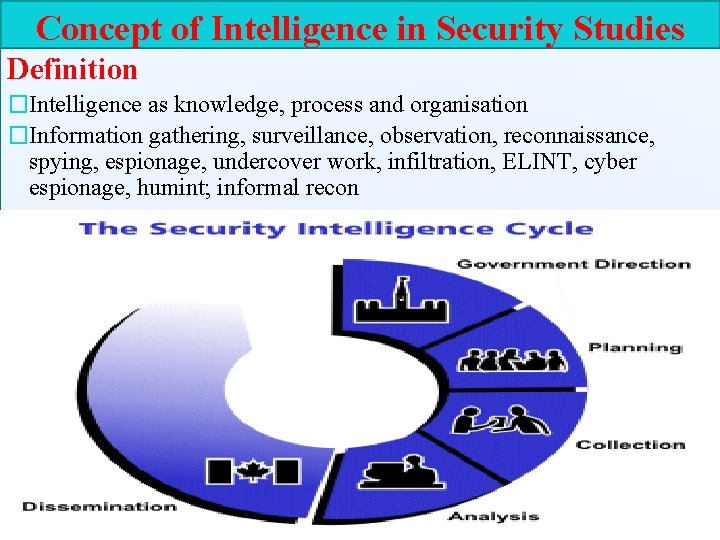
Concept of Intelligence in Security Studies Definition �Intelligence as knowledge, process and organisation �Information gathering, surveillance, observation, reconnaissance, spying, espionage, undercover work, infiltration, ELINT, cyber espionage, humint; informal recon
Concept of Intelligence Background (Intel Studies) �A discipline slow to develop in universities � Secrecy attach to intelligence matters �Academe reluctance to engage with clandestine services �Earlier ignored intel studies in security studies �Student’s late interest on the subject but now burgeoning in developed countries
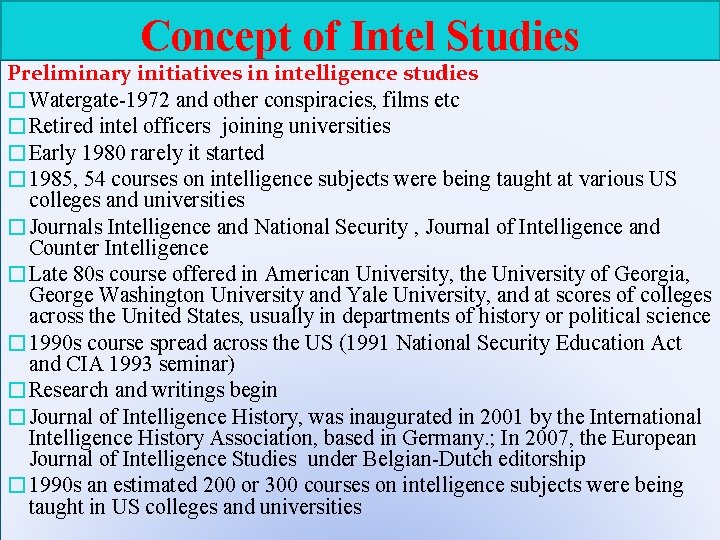
Concept of Intel Studies Preliminary initiatives in intelligence studies �Watergate-1972 and other conspiracies, films etc �Retired intel officers joining universities �Early 1980 rarely it started � 1985, 54 courses on intelligence subjects were being taught at various US colleges and universities �Journals Intelligence and National Security , Journal of Intelligence and Counter Intelligence �Late 80 s course offered in American University, the University of Georgia, George Washington University and Yale University, and at scores of colleges across the United States, usually in departments of history or political science � 1990 s course spread across the US (1991 National Security Education Act and CIA 1993 seminar) �Research and writings begin �Journal of Intelligence History, was inaugurated in 2001 by the International Intelligence History Association, based in Germany. ; In 2007, the European Journal of Intelligence Studies under Belgian-Dutch editorship � 1990 s an estimated 200 or 300 courses on intelligence subjects were being taught in US colleges and universities
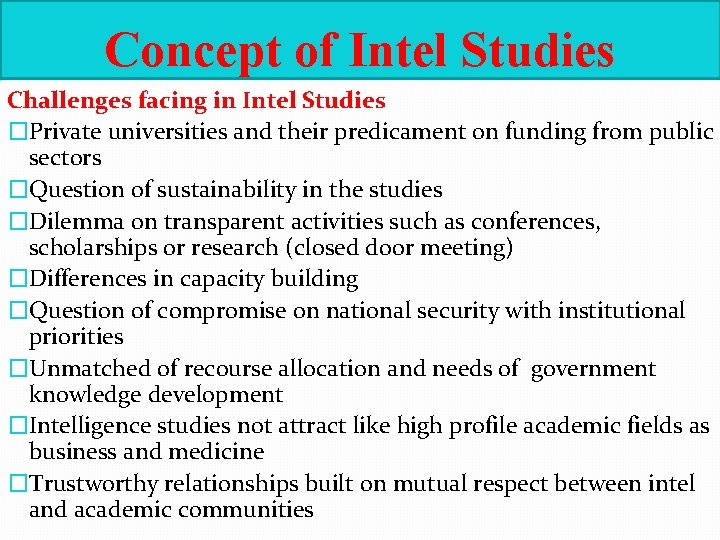
Concept of Intel Studies Challenges facing in Intel Studies �Private universities and their predicament on funding from public sectors �Question of sustainability in the studies �Dilemma on transparent activities such as conferences, scholarships or research (closed door meeting) �Differences in capacity building �Question of compromise on national security with institutional priorities �Unmatched of recourse allocation and needs of government knowledge development �Intelligence studies not attract like high profile academic fields as business and medicine �Trustworthy relationships built on mutual respect between intel and academic communities
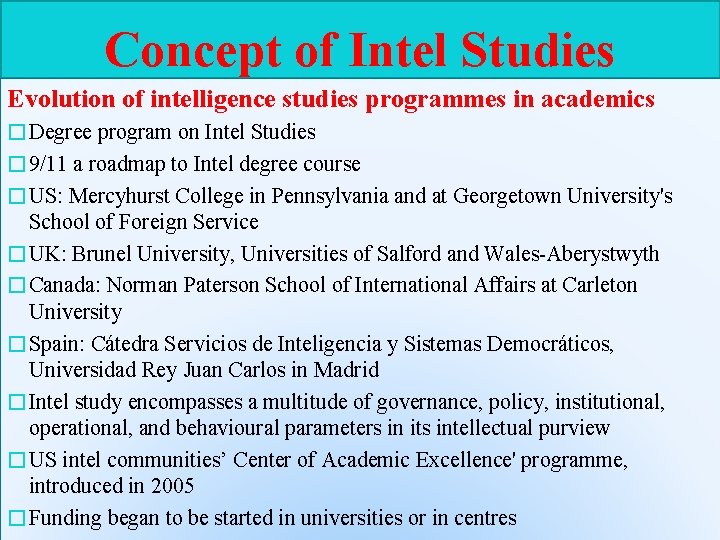
Concept of Intel Studies Evolution of intelligence studies programmes in academics �Degree program on Intel Studies � 9/11 a roadmap to Intel degree course �US: Mercyhurst College in Pennsylvania and at Georgetown University's School of Foreign Service �UK: Brunel University, Universities of Salford and Wales-Aberystwyth �Canada: Norman Paterson School of International Affairs at Carleton University �Spain: Cátedra Servicios de Inteligencia y Sistemas Democráticos, Universidad Rey Juan Carlos in Madrid �Intel study encompasses a multitude of governance, policy, institutional, operational, and behavioural parameters in its intellectual purview �US intel communities’ Center of Academic Excellence' programme, introduced in 2005 �Funding began to be started in universities or in centres
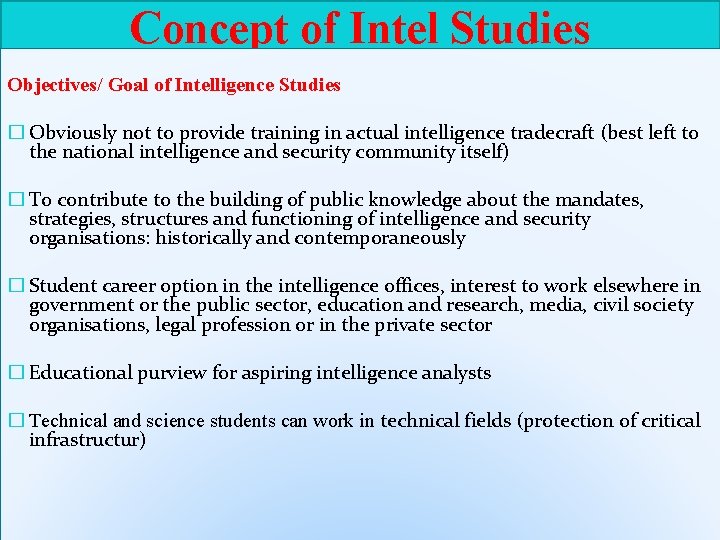
Concept of Intel Studies Objectives/ Goal of Intelligence Studies � Obviously not to provide training in actual intelligence tradecraft (best left to the national intelligence and security community itself) � To contribute to the building of public knowledge about the mandates, strategies, structures and functioning of intelligence and security organisations: historically and contemporaneously � Student career option in the intelligence offices, interest to work elsewhere in government or the public sector, education and research, media, civil society organisations, legal profession or in the private sector � Educational purview for aspiring intelligence analysts � Technical and science students can work in technical fields (protection of critical infrastructur)
Contd. . . � Professional analytical work remains classified in intelligence and security community, however academic research precisely offer an outside perspective based on open sources that allow new insights, comparative assessments, analytical reviews or experiential accounts pertaining to intelligence and security policies, organisations and activities � Contribution of added value to broader governmental and public knowledge � Academic research may, furthermore, prove useful for improving operational capabilities, especially in the domains of intelligence analysis, community outreach, and human resource management � Univ do not themselves have political decision-making power and although they are not major economic powers in their own right, nonetheless they do exert a powerful influence on decision-makers and on students who will become decision-makers
Concept of Intel Studies Teaching intelligence studies �Qualified faculty remains an imposing constraint on the development of intelligence studies programmes almost everywhere �Non availability of doctoral candidates on the subject and less funding �Early-retired practitioners /officials and faculty from cognate fields induced to move to this growth area �Absence of a critical mass of dedicated intelligence studies �Delaying professorial retirements in order to retain faculty strength may be feasible but can be only a short-term solution �Faculty expansion and staffing, libraries and related resources, in order to achieve the warranted critical mass for (post)graduate education �Scholarly conferences, and publications would promote �Role of MHRD, UGC, Defence, MHA, Sc Tech �Scholarship in Intel Studies (UGC/NET)
History of Intel Chanakya (350– 283 ) Arthashastra and Intelligence �Focus more on espionage, operational actives, covert action, collection, organisation however missing analyses, assessment and estimates for strategic planning �But provides methodological and theoretical ideas and concepts for intelligence analysis, assessment, estimates and strategic planning �The secret service or intelligence service is a central and indispensable component of state �Dense network of stationary and mobile secret agents and informants collecting information about treasonous activities, corruption, serious crime and the popular mood � The secret service acts as a ‘secret police’ with executive powers and engages in various forms of ‘active measures’
History of Intel Five Intel Activities �Tracking down suspected treasonable individuals and groups, infiltrating and manipulating them � Tracing corruption, embezzlement and abuse of office in the state apparatus, including ‘sting operations’ �Silent liquidation of enemies of the state, whose extrajudicial killing is disguised as accident, normal crime or natural death �Staging political public relations (PR) operations to influence public opinion �Counter-espionage, including the use of double agents, and operations against foreign subversion and sabotage.
History of Intel Foreign Intel Activities �Information gathering on the political, military and economic situation in order to identify strengths and weaknesses �Diplomatic personnel in foreign countries must collect information, recruit agents of influence and participate in subversive operation �Whenever political tensions and instability are ascertained, the secret service should use local agents of influence to exacerbate tensions and give covert support to treasonous persons and groups as to further weaken and discredit the established governance �If an armed conflict looms, the secret service should weaken the will to fight of the leadership and people as well as the combat power of the armed forces through sabotage operations, ‘psychological warfare’ and covert assassinations of key political and/or military leaders.
History of Intelligence Issues Addressed by Kautilya (Chanakya) � what are the professional requirements for different categories of secret service agents � Which elements/personalities are suitable for secret agents � what are the psychological, social and political dispositions to be exploited for the recruitment of informers and agents of influence � how can the secret service be controlled by organizational segmentation and mutual surveillance within the service � how are secret agents rewarded for special achievements and punished for misconduct � what forms of subversion and covert actions are most suitable for achieving foreign policy objectives
History of Intel British India � In 23 December 1887, the Government created IB in the name of a Central Special Branch, which acted as an embryonic political Police force to coordinate the activities of numerous provincial Special Branches, which handled the vast bulk of data collection � Monitored political organizations and their publications, religious sects and their doctrines, the movements of criminals, the state of public opinion, illegal trade in firearms, the availability of food and water, and inter-regional migration patterns � In 1903, the Central Special Branch was strengthened and renamed as the Department of Criminal Intelligence (DCI); political and criminal surveillance; Secretary of State refused to sanction posts for Hindu or Muslim analysts in the DCI; British officer to headed the Department � Two-tiered intel system, with Indians producing information and Britons evaluating it � Political intelligence on the Congress, and security intelligence on terrorist groups
History of Intel �The failure of Intelligence Bureau (IB), the internal intelligence agency of India, to protect 1962 Sino-India and 1965 Indo. Pakistan wars led to the establishment of the Research and Analyses Wing (R&AW), external intelligence agency in 1968 After 1999 Kargil War �Failure of R&AW lead to establish National Technical Facilities Organisation (NTFO), now known as the National Technical Research Organisation (NTRO) in 2004 �and limited technical skill of the Directorate General of Military Intelligence (DGMI) lead to create Defence Intelligence Agency (DIA) in 2002 Post 9/11 �Multi Agency Centre (MAC), though it already existed since 2000 s was activated only after 26/11
Success and Failure of Inte Famous Global Incidents in Past �United Kingdom (UK) in the 20 th century won counterinsurgency war against Malaya, Kenya and Northern Ireland, but lost on Cyprus due to poor intelligence �With effective intelligence of United States led to win CI war over Philippines, but not on Vietnam � Due to lack of intelligence service, France and Portugal lost CI operations in Algeria and Africa (Angola, Mozambique, Guinea-Bissau, Cape Verde etc) respectively
Official Secrets Act Definition: � An Act to prevent spying and wrongful communication by military/government officials Official Secret Act 1889 � 30 August 1843 -Foreign Dept of Go. I stated officials document not to make public (BEIC rule after Battle of Plasseay from 1757 -1858; Go. I Act 1858 formed and direct control of India by British Crown begins) � 8 July 1875 the Home Department issued a Resolution that an official could become a correspondent for a newspaper only after obtaining permission from his office � 3 June 1885 the Home Department issued another Resolution- stated that the Viceroy had noticed that information of a confidential nature frequently appeared in newspapers � Indian Fortifications Act, 1888 -to prevent unauthorised entry and making of sketches of Military and Naval stations � In September 1889 the Official Secrets Act was passed in Britain � As it was unsuitable to the Indian legal system, the Indian Official Secrets Act (Act XIV) of 1889 was passed by the Viceroy’s Executive Council on 17 October 1889
Official Secrets Act (contd) The Indian Official Secrets (Amendment) Act, 1904 � 1896 arrest of photographer in Bombay Harbour and as 1889 Act was not applicable Army ask for more stringent law but rejected by Lord Curzon � 1901, Parsee photographer and Colaba Fort picture; Curzon reluctantly approved the amending bill in March 1902 as Army persuade; but the Secretary of State in London rejected �January 1904 the Bill was sent to a Select Committee, several members, including GK Gokhale; Pandit Madan Mohan Malaviya wrote a strong letter of protest against the Bill � 1 March 1904, bill was passed incorporating some amendments suggested by Gokhale and Dr Ashutosh Mukherjee
Official Secrets Act (contd) Indian Official Secret Act 1923 � 1911, a new Official Secrets Act was enacted in Britain, repealing the British Act of 1889 �The Act applicable with Indian along with previous 1889/1904 OSA �Karachi incident and Indian Magistrate release as act of espionage was not an offence in Indian Act unless committed by the employee �In July 1914 Army insisted Home Dept for similar British laws and after approval of Viceroy Harding , letter was sent to Secretary of State in London for approval; January 1915 response received from Secretary and not favoured �Again 1916 and 1919 pushed the draft to Viceroy again declined �Again in 1920 a new OSA was enacted in England (by amending the previous Act of 1911); more powerful but not applicable in India
Official Secrets Act (contd) Indian Official Secret Act 1923 (Contd. ) �India OSA 1889 was proposed to amend in 1921 (fourth proposal) �Penalty for spying under Section 3 was maximum 14 and minimum 3 years of sentence; under Section 5, 6, 7, 8 and 9 it was two years; and under Section 10 (harbouring spies) it was one year �The Assembly met on 6 September 1922 to debate the bill; as opposed by many, a committee was formed to study the bill and submitted its report on 30 January 1923; removal of minimal sentence �Another Assembly met on 14 and 24 February 1923 consider the report of Select Committee and debated on it; though it was opposed by few members the Legislative Assemble passed it on 21 March 1923 �The Governor General and Viceroy, Lord Reading, gave his Assent to the Indian Official Secrets Act (Act No XIX of 1923) on 2 April 1923 �Published in the Gazette of India on 14 April 1923 and has remained in force ever since
Official Secrets Act (contd) After Independence �The Bill to amend the Official Secrets Act was introduced in the Rajya Sabha on 23 June 1967; and moved on 24 July 1967 by Shri Vidya Charan Shukla, then Minister of State for Home Affair �Bill finally passed by Lok Sabha on 12 August 1967 �Proviso of not being necessary in proving actions of an accused, which earlier applied only to military was now applicable to all under Section 3 �Over lapping aspect of OSA and Army, Navy and Airforce �In Navy Act, 14 years of sentence for spying and wrongful communication was adopted; in serious nature (communication with traitorous) till death
Official Secrets Act (contd) Salient Points/Sections of OSA 1923 1. This Act may be called the Official Secrets Act, 1923; it extends to the whole of India and applies also to servants of the Government and to citizens of India outside India 2. Definitions- Government place, obtaining or retaining any sketch, plan, model, article, note or document, munitions of war, photograph, prohibited place (omitted Govt of UK and British etc), SP includes police officers of same and above ranks 3. Penalties of spying- punishable with imprisonment for a term which may extend, where the offence is committed in relation to any work of defence, arsenal, naval, military or air force establishment or station, minefield, factory, dockyard, camp, ship or aircraft or otherwise in relation to the naval, military or air force affairs of Government or in relation to any secret official code, to fourteen years 4. Communications with foreign agents to be evidence of commission of certain offences, arrest on the ground of suspicion 5. Wrongful communication etc. , of information-If any person having in his possession or control any secret official code or pass word or any sketch, plan, model, article, note, document or information which relates to or is used in a prohibited place or relates to anything in such a place is considered to be an offence; penalties with death or imprisonment for life, or imprisonment for a term which may extend to ten years and shall, in either case, is liable and to fine
Official Secrets Act (contd) Salient Points of OSA 6. Unauthorised use of uniforms; falsification of reports, forgery, personation, and false documents - fake stamps, signatures etc (two years in jail but can be extended for 14 yrs) 7. Interfering with officers of the police or members of the Armed forces of the Union 8. Duty of giving information as to commission of offences- If any person fails to give any suspected information to police or related authorities, he shall be punishable with imprisonment which may extend to 3 [three years], or with fine, or with both 9. Attempts, incitements, etc- Any person who attempts to commit or abets the commission of an offence under this Act shall be punishable with the same punishment, and be liable to be proceeded against in the same manner as if he had committed such offence 10. Penalty for harbouring spies - punishable with imprisonment for a term which may extend to three years, or with fine, or with both
Official Secrets Act (contd) Salient Points of OSA 11. Search warrants- Magistrate of the first class or Sub-divisional Magistrate to issue warrant orders to police, but in emergency police of higher rank can do it 12. Power to arrest- related to offence punishable under section 3, 5, and 7. . imprisonment for a term which may extend to seven years 13. Restriction on trial of offences- No Court shall take cognizance of any offence under this Act unless upon complaint made by order of, or under authority from appropriate Government 14. Exclusion of public from proceedings-. . . publication of any evidence to be given or of any statement to be made in the course of the proceedings would be prejudicial/harmful to the safety of the State, that all or any portion of the public shall be excluded during any part of the hearing- 15. Offences by companies-"company" means a body corporate and includes a firm or other association of individuals; and "director", in relation to a firm, means a partner in the firm 16. The Indian Official Secret Act, 1889 and the Indian Official Secret (Amendment) Act 1904 are hereby repealed
Role of Intel Orgn. in Securing India � Justification for existence of Intel organisation after the end of Cold War � Today its importance has been increased to retain a strong national security posture in the nation � Similarly, India needs intel organisations to support its national security aspect/activities both in internal and external level � India intelligence has two broad functioning –collection and analyses � Relatively narrow one is covert action � Counter intelligence as an integral process
Role of Intel in Securing India Collection � Intelligence agencies collect information about internel/foreign persons, places, events, and activities that is needed by the Government but cannot be (or is not easily) obtained through publicly available sources or diplomatic contacts � Collection involves complexities, risky, expensive � Political coast (friendly target nation) � Various method of collection- TECHINT, HUMINT, SIGINT, IMINT, OSINT � The collection of publicly available information should be considered a support function rather than a task for intelligence collection � Publicly available but uneasy to access (North Korea, China and Iraq news paper)
Role of Intel in Securing India Analyses: � Analysis contains information obtained by intelligence sources, it is typically classified � Intelligence analysts take information provided by sources and combine it with information from publicly available sources, and produce analysis for the customer � Relevance and irrelevance to be discard by analyst � Demands of consumer if not available, they managed from open sources but still considered as intel report � Accountability of analyst experience and their value addition in inputs
Role of Intel in Securing India Covert Action � Covert actions are used to influence political, military, or economic conditions or situations abroad, where it is intended that the role of the Indian Government will not be apparent or acknowledged publicly � Propaganda activities, support to political or military factions within a particular country; technical and logistical assistance to other governments to deal with the problems within their countries, or actions undertaken to disrupt illicit activities that threaten India interests � Covert actions can be undertaken only in support of an "identifiable" foreign/domestic policy objective � R&AW normally carries out covert actions with support from respective directors, NSA, PM; other agencies or dept. too support � To disrupt the activities of a terrorist group, prevent narcotics traffickers from manufacturing drugs for shipment in India, fake Indian currency
Role of Intel in Securing India Counterintelligence (CI) � Protecting the country, as well as intelligence agencies, from the activities of foreign intelligence services � IB responsible for domestic counter intelligence (R&AW for overseas) � Each of these elements has offensive and defensive missions- � Offensively, they attempt to recruit agents within foreign intelligence services to ascertain what, if any, operations are being undertaken against Indian Govt � monitor the activities of known or suspected agents of foreign intelligence services � Defensively, to investigate cases of suspected espionage and prepare analyses for government and industry concerning the foreign intelligence threat � CI is beyond detecting and monitoring the activities of foreign intelligence services and investigating employees suspected of espionage
Role of Intel in Securing India Why Intelligence/Mission of Intelligence � Support to Indian Diplomacy/Protect Indian interest (e. g. military, economic, and political) � Protecting land sea areas � Monitoring relation between enemy nation and other countries � Following nuclear and military capabilities of enemy nation � Support to Defence Planning (R&D) � Economic Intelligence (info mostly -95% in OSINT); hawala illegal transaction � Counterterrorism; Counternarcotics; Counter proliferation; Countering International Organized Crime (human trafficking, piracy) � Collecting and Analyzing Environmental Information (natural disaster including flood) � Protect from Information Warfare