
Intelligence IQ and Crime o History of mental
- Slides: 9
Intelligence, IQ, and Crime o History of mental testing and IQ o The relationship between IQ and Crime o Issues of fake claims o Direct, or Indirect Effect o Criticisms of the Bell Curve
Alfred Binet o French scientist who began in the field of “craniometry” n Began to doubt the validity of this method n Around 1900, he started “psychological” testing (commissioned by government) n Devised “mental tasks” (counting coins, spatial reasoning http: //www. fibonicci. com/spatialreasoning/test/
Binet’s Ideas Scores are a “rough empirical guide” for identifying retarded children n They should not be used to rank normal children Children identified as retarded should be helped n Low scores should not mark children as “innately incapable”
The Creation of “IQ” o Binet: eventually assigned a “mental age” to each task (normal child x years of age should complete) n Subtract the physical age from the mental age to see how big the gap was (identify those in need) o Later, others argued that the mental age should be divided by the physical age n “Intelligence Quotient” was born
The Americans!!!! o Binet’s methods adopted by scientists in U. S. They managed to break all of the “rules” o H. H. Goddard n coined the term “moron, ” set at a mental age of 12 for an adult n avid in the eugenics movement o Lewis Terman n Created the “Stanford-Binet” IQ exam n Goal = “rational society” where people could be assigned jobs based on intelligence
IQ tests today o No longer “mental age/physical age” o All correlate with the Stanford Binet or other early versions o Calibrated to produce a mean of 100 o The “Flynn effect” o Still multiple tasks covering different cognitive areas
IQ and Crime o Early theorists found large differences between criminals and non-criminals n As testing improved, this difference shrunk n Sutherland (1940 s): it will disappear o Currently: 8 -10 point gap o Why this difference? ? ?
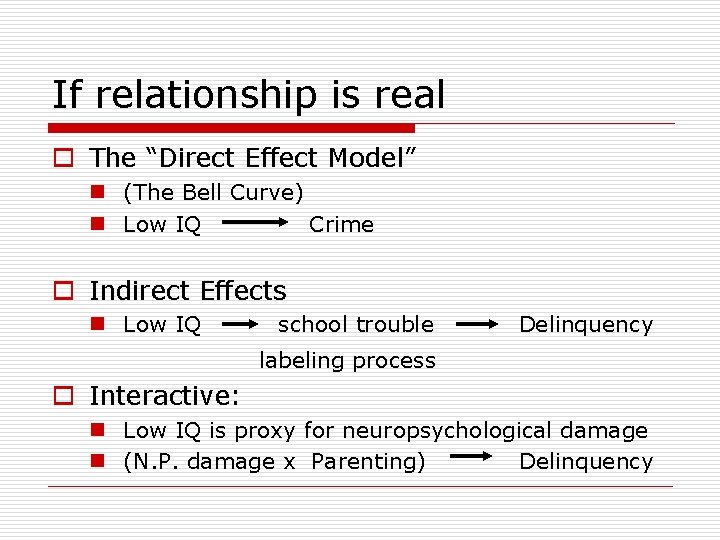
If relationship is real o The “Direct Effect Model” n (The Bell Curve) n Low IQ Crime o Indirect Effects n Low IQ school trouble Delinquency labeling process o Interactive: n Low IQ is proxy for neuropsychological damage n (N. P. damage x Parenting) Delinquency
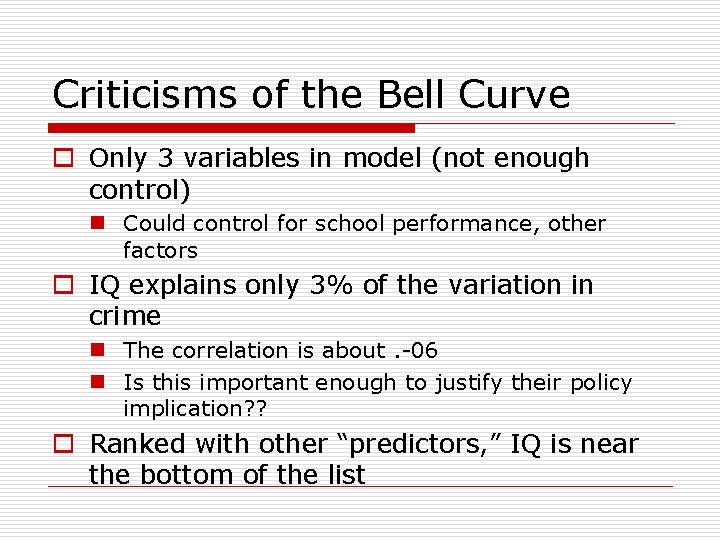
Criticisms of the Bell Curve o Only 3 variables in model (not enough control) n Could control for school performance, other factors o IQ explains only 3% of the variation in crime n The correlation is about. -06 n Is this important enough to justify their policy implication? ? o Ranked with other “predictors, ” IQ is near the bottom of the list