
Intelligence and intelligence assessment Psychology Lecture by Jolanta
Intelligence and intelligence assessment Psychology Lecture by Jolanta Babiak Winter 2017/2018

Intelligence testing • Alfred Binet and Theofile Simon 1905 – first intelligence test • Test of intellectual performance to classify and separate developmentally disabled and normal schoolchildren • To quantify intellectual performance Binet designed age appropriate problems • Average score for normal children at each age was computed • Individual child’s performance was compared with the average of other children of her age • Results expressed in terms of average normal children achieved a particualr score – measure of mental age regardless of chronological age

Beginings of IQ testing • In the USA Lewis Terman, Edward Thorndike, Robert Yerkes developed non-verbal, group administered tests of mental ability and used them around the time of the I World’s War • Public accepted the idea that intelligence tests could differentiate people who could benefit from education and leadership programs in military from those who could not • IQ – intelligence quotient – numerical, standardized measure of intelligence
Stanford-Binet Intelligence Scale (1916) • Lewis Terman’s Stanford Revision of the Binet Tests • IQ=mental age / chronological age x 100 • Clinical psychology, psychiatry, counseling had benefited greatly from this new test • It contains a series of subtests, each for particular mental age • Many revisions, updated norms, extensions of application (very young children to gifted adults)
Wechsler Intelligence Scales • David Wechsler has corrected the dependence of testing on verbal items • Wechsler-Bellevue Intelligence Scale (1939) /Wechsler Adult Intelligence Scale (1955) • WAIS-III, WAIS-IV – 16 subtests span verbal and performance aspects of IQ and fluid intelligence • WAIS-III, ISC-IV, WPPSI-III – family of intelligence test that yield a verbal IQ, a performance IQ, and a full scale IQ at all age levels. • Currently an individual’s scores are added up and compared with the scores of other people her age
Intellectual disabilities • When people younger that 18 obtain valid IQ score lower that 75 they are considered mentally retarded (preferred term intellectually disabled) • Demonstrate limitations skills to challenge every day life tasks • Confusion in the choice of terms: mental handicap, learning disability, learning disorders; now in use - intellectual disabilities [AAIDD American Association on Intellectual and Developmental Disabilities 2011] • ID can be brought about by genetic and environmental factors (especially prenatal environment)
Learning disorders and giftedness • When IQ scores and performance don’t match up, people might be diagnosed with learning disorder if other factors such as low motivation, mediocre teaching or physical problems (e. g. vision) are ruled out • Giftedness: IQ score above 130 • Jospeh Renzulli (2005) proposition: giftedness along the dimensions of ability, creativity, task commitment, but not across academic spectrum • Lewis Terman began a long-term study in 1921 of 1500 boys and girls and followed them to their 80’: good social adjustment, introverted, largely successful in life
Psychometric theories of intelligence • Examine statistical relationships between different measures of ability and then make inferences about the nature of human intelligence • Factor analysis – detects smaller number of dimensions within larger number of independent variables • Psychologists explain and defend interpretations about revealed statistical regularities
Charles Spearman (1927) • Charles Spearman – individual’s performance in each of the variety of intelligence tests is highly intercorrelated • g – factor of general intelligence underlies all intelligent performance • Each individual domain has specific skills called s • e. g. person’s performance on vocabulary or mathematics depends both on general intelligence and domain-specific abilities
Raymond Cattell (1963) • Proposed that general intelligence can be broken down to two relatively independent components • Crystallized intelligence • A knowledge a person has acquired • Ability to access that knowledge • Measured by tests of vocabulary, arithmetic and general information • CI helps to cope with life’s recurring concrete challenges • Fluid intelligence • Ability to recognize complex relationships • Ability to solve problems • Measure by test of block designs and spatial visualization • FI allows to solve novel, abstract issues
Joy Paul Guilford (1961) • Structure of intellect model – three features of intelligence-related tasks 1. Content – type of information 2. Product – form in which information is represented 3. Operation – type of mental activity performed 1. Content – visual, auditory, symbolic, semantic, behavioral 2. Products – units, classes, relations, systems, transformations, implications 3. Operations – evaluation, convergent production, divergent production, memory and cognition • Each task can be identified according to content, product and operation
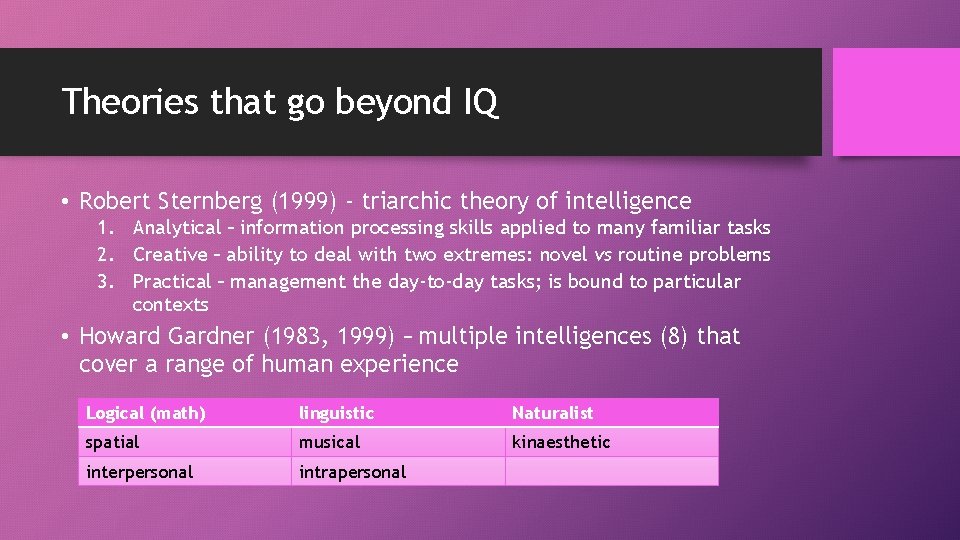
Theories that go beyond IQ • Robert Sternberg (1999) - triarchic theory of intelligence 1. Analytical – information processing skills applied to many familiar tasks 2. Creative – ability to deal with two extremes: novel vs routine problems 3. Practical – management the day-to-day tasks; is bound to particular contexts • Howard Gardner (1983, 1999) – multiple intelligences (8) that cover a range of human experience Logical (math) linguistic Naturalist spatial musical kinaesthetic interpersonal intrapersonal

Emotional Intelligence Peter Salovey & John D. Mayer (1990) • The Ability to perceive, appraise and express emotions accurately and appropriately • The ability to access feelings and use emotions to facilitate thinking • The ability to understand analyze emotions and to use emotional knowledge effectively • The ability to regulate emotions to promote emotional development
Heritability estimate of IQ • Heritability estimate of a trait (intelligence, personality, motivation) is based on the proportion of the variability of test scores on that trait that can be accounted for by genetic factors • Researchers conclude that about 50% of variance in IQ scores is due to genetic make-up • Counterintuitive finding: heritability increases across lifespan!!! • Explanation: it is possible that our genetics make us chose particular environments thereby emphasize our natural tendencies to behave in a particular way
Environmental estimate of IQ • Genetic inheritance is not the only factor responsible for IQ • Environments are made up of many components in dynamic relationship • Environments change over time • Researchers have focused on more global factor: the socioeconomic status of the family
Usefulness of IQ score • IQ scores are valid predictors of • Academic performance from elementary school through college • Occupational status • Many types of jobs • Intelligence, as measured by IQ, directly predicts success • IQ tests are valid for mainstream uses
Is creativity linked to intelligence? • Creativity – • ability to generate ideas or products that are novel and compatible with the circumstances in which they were generated • Divergent thinking – ability to generate a variety of unusual solutions to a problem e. g. name all things you can think of that are square; what can brick be used for • Dimensions: fluency , uniqueness, unusualness • Correlation of divergent thinking with IQ is weak to moderate up to 120 IQ level; over IQ 120 - creativity decreases • Extremes of creativity • Pattern of risk taking, preparation and intrinsic motivation
Bibliography • Gerrig R. J. (2012). Psychology and Life, London, Pearson Education, Ltd. – chapter 9
- Slides: 18