
Intellectual Property Michelle Chitambar Ph D Technology Manager
Intellectual Property Michelle Chitambar, Ph. D Technology Manager 10 September 2019 1002 ECEB
Intellectual Property (IP) Intangible “creations of the mind”: inventions, written works, art, designs, etc. IP protection is a tool to help extract this value § Patents § Trademark § Trade Secret § Copyright § Mask Works § Know-How
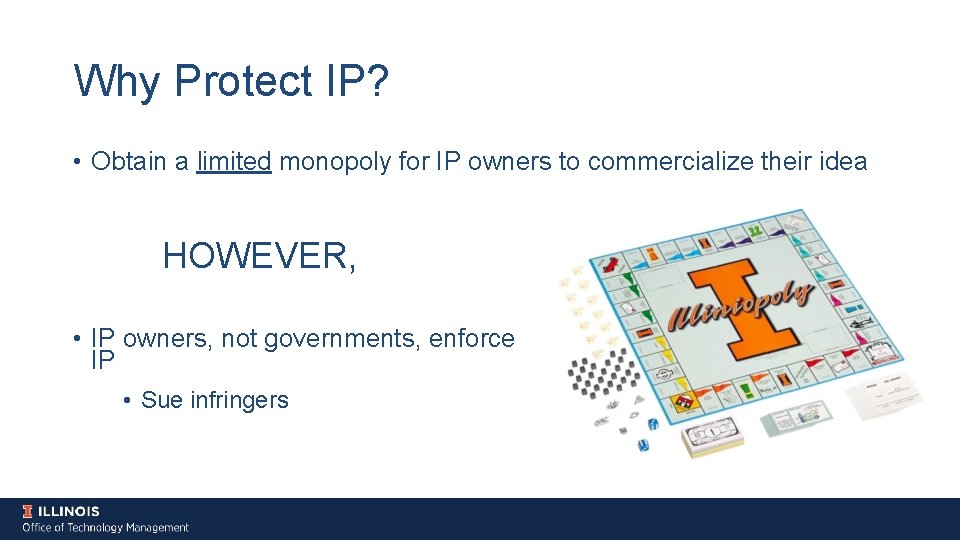
Why Protect IP? • Obtain a limited monopoly for IP owners to commercialize their idea HOWEVER, • IP owners, not governments, enforce IP • Sue infringers
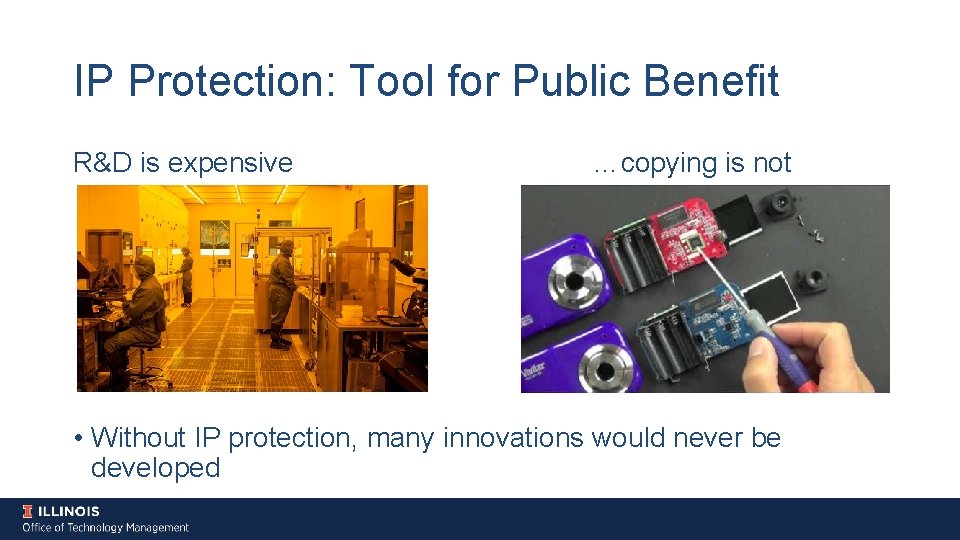
IP Protection: Tool for Public Benefit R&D is expensive …copying is not • Without IP protection, many innovations would never be developed
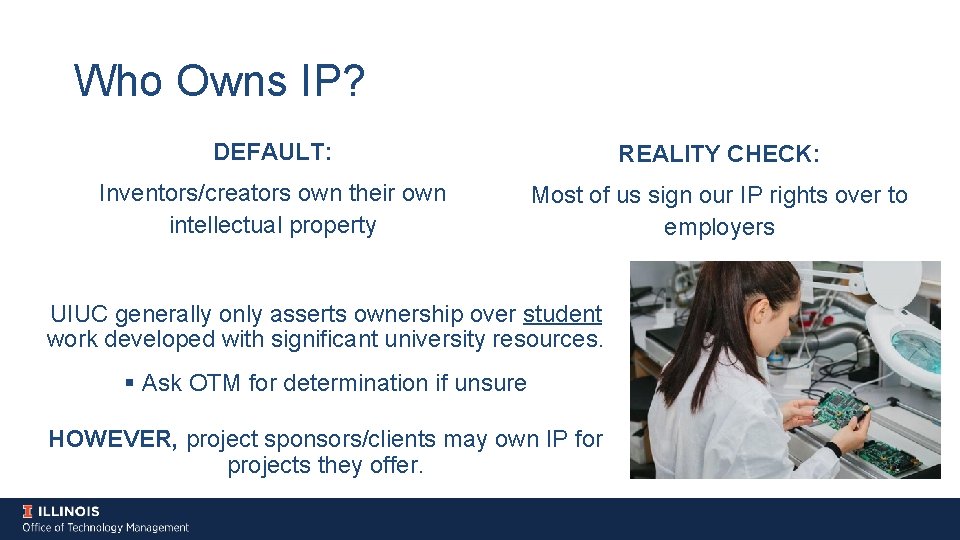
Who Owns IP? DEFAULT: REALITY CHECK: Inventors/creators own their own intellectual property Most of us sign our IP rights over to employers UIUC generally only asserts ownership over student work developed with significant university resources. § Ask OTM for determination if unsure HOWEVER, project sponsors/clients may own IP for projects they offer.
Types of IP: Copyright • Copyright attaches automatically and instantaneously to “expressed form” • Words, photos, artwork, software code, music, video… • Good practice to include copyright mark to avoid damage limitations • Copyright 2018 Board of Trustees of the University of Illinois • © 2018 Michelle Chitambar • Generally expires 70 years after author’s death • Fair use exceptions
Types of IP: Trade Secrets & Know-How • Keep information out of public domain • Lasts until is disclosed, reverse-engineered or independently discovered
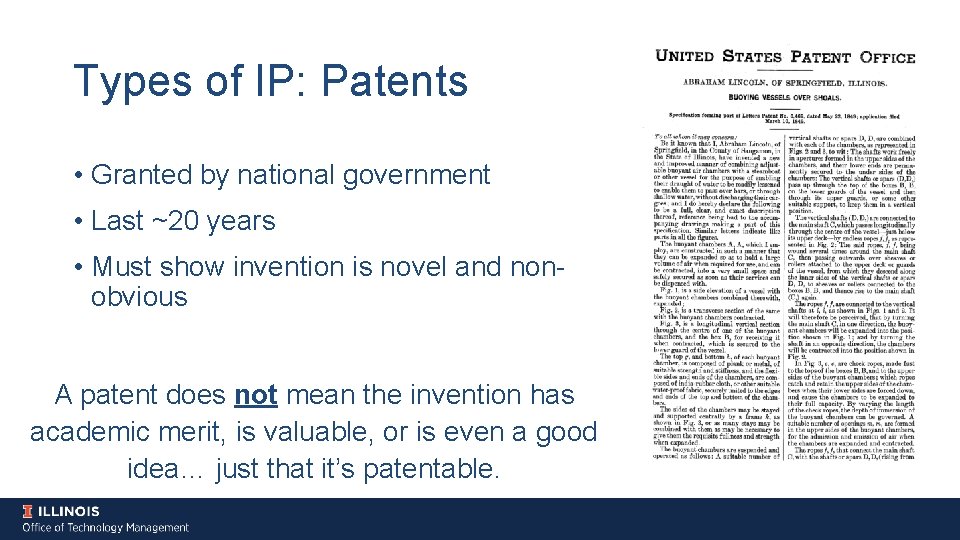
Types of IP: Patents • Granted by national government • Last ~20 years • Must show invention is novel and nonobvious A patent does not mean the invention has academic merit, is valuable, or is even a good idea… just that it’s patentable.
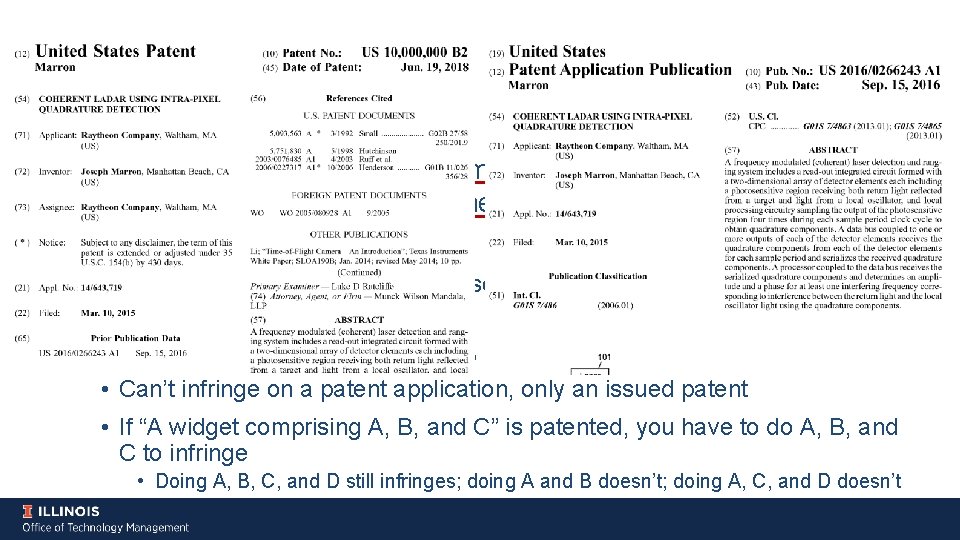
Patent Infringement • To infringe, must meet every limitation of issued claim in patent territory and be using for commercial purposes • If you aren’t selling, offering as a service, using for commercial purpose, you likely aren’t infringing* • To infringe on a Country X patent, must make, use, sell, etc. in Country X • Can’t infringe on a patent application, only an issued patent • If “A widget comprising A, B, and C” is patented, you have to do A, B, and C to infringe • Doing A, B, C, and D still infringes; doing A and B doesn’t; doing A, C, and D doesn’t
Questions? Michelle Chitambar, Ph. D Technology Manager mchitamb@Illinois. edu otm. Illinois. edu
Must-Know Patenting Facts for Inventors • Patents go to first inventor to file • Everything known to public before filing date is “prior art” • Can only protect what you disclose… and can’t add new matter • All patents not made equal—quality matters • Invest in a good patent agent/attorney • Patents can be overturned in whole or part • Provisional filings can be a cheap one-year placeholder
Software – Special Considerations • Frequently patented before 2010 • Alice decision 2010
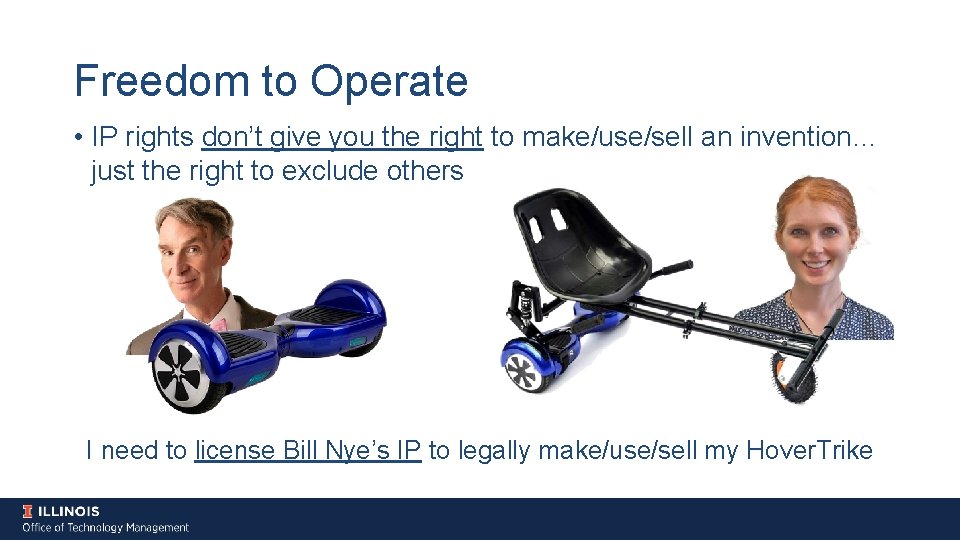
Freedom to Operate • IP rights don’t give you the right to make/use/sell an invention… just the right to exclude others I need to license Bill Nye’s IP to legally make/use/sell my Hover. Trike
When Should You Patent? • It depends • • • Is the technology marketable? How would this enhance current portfolio? Do we have the resources to patent? How strong/defensible will our claims be? How likely are competitors to copy and compete? How long are technology/market cycles?
- Slides: 14