
Intellectual Property IP Strategies to Achieve Sustainable Competitive
Intellectual Property (IP) Strategies to Achieve Sustainable Competitive Advantage Stephen Brown M. I. T. Technology Licensing Office
Patents • A contract between society and inventors • Encourage disclosure of powerful ideas • Encourage reduction to practice for society’s benefit • Provide incentives for the inventors • Protect the rights of the various innovators Stephen Brown, MIT TLO

Why is IP protection important • Adds market value particularly for startups and small companies, sometimes >50% of value • Source of income through licensing (IBM ~ 1/9) • Permits blocking or hindering competitors from practicing your IP • IP attracts funders, strategic partners, customers, and employees Stephen Brown, MIT TLO
Why is IP important (cont. ) • Maintain product or service advantage • Reduces the risk of innovating • Enhance branding, market effectiveness “Skills and knowledge have become the only source of sustainable long-term competitive advantage” Lester Thurow Stephen Brown, MIT TLO
Goals for today Discuss: • The TYPES of IP and their characteristics • The TOOLS used to control and exploit IP • CHOOSING the right TYPES and TOOLS • Avoiding MISTAKES made by IP owners So you can develop a sustainable competitive IP strategy Stephen Brown, MIT TLO
Questions for You • How many can define what a patent is? • How many have run a business dependent on patents? • How many have applied for a patent? Stephen Brown, MIT TLO
Ever frustrated with disposing of Pizza boxes? • An opportunity to patent? • Probably not. . extensive prior art • See for example US 5, 305, 949, and US 5, 110, 038 • Does this mean every good idea is already patented? …no • But how come we don’t see lots of serrated pizza boxes? Stephen Brown, MIT TLO
What about this idea? • “Products that are easy to hold” • Very profitable for David…. See US 5, 205, 473 • Wait a moment…. what about the idea of corrugated? • Does David need a license to the corrugated patent? ………. No…. patent has expired Stephen Brown, MIT TLO
David’s broadest patent claim • 1. A recyclable, insulating beverage container holder, comprising a corrugated tubular member comprising cellulosic material and at least a first opening therein for receiving and retaining a beverage container, said corrugated tubular member comprising fluting means for containing insulating air; said fluting means comprising fluting adhesively attached to a liner with a recyclable adhesive. Stephen Brown, MIT TLO
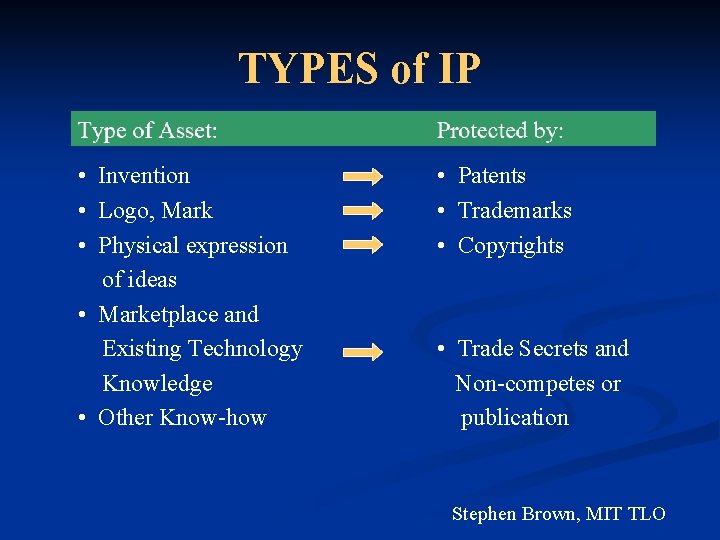
TYPES of IP • Invention • Logo, Mark • Physical expression of ideas • Marketplace and Existing Technology Knowledge • Other Know-how • Patents • Trademarks • Copyrights • Trade Secrets and Non-competes or publication Stephen Brown, MIT TLO
Patents • A patent is a government-issued document that provides its owner with the right to prevent competitors from profiting from the invention defined by the claims. • A patent does not give its owner an affirmative right to make, use, or sell the invention defined by the patent claims. THIS IS VERY IMPORTANT Stephen Brown, MIT TLO
Components of a patent • • • Describe “prior art” Describe the invention List advantages vs existing Give examples of use Specify the “best mode” List “claims” – What is… what isn’t… the invention Stephen Brown, MIT TLO
Criteria for granting a patent • • Useful Novel, i. e. , different from existing Not previously sold or publicly described Not obvious “to one of ordinary skill in the art” – Commercial success can validate nonobviousness – Prior art “teaches against” Stephen Brown, MIT TLO
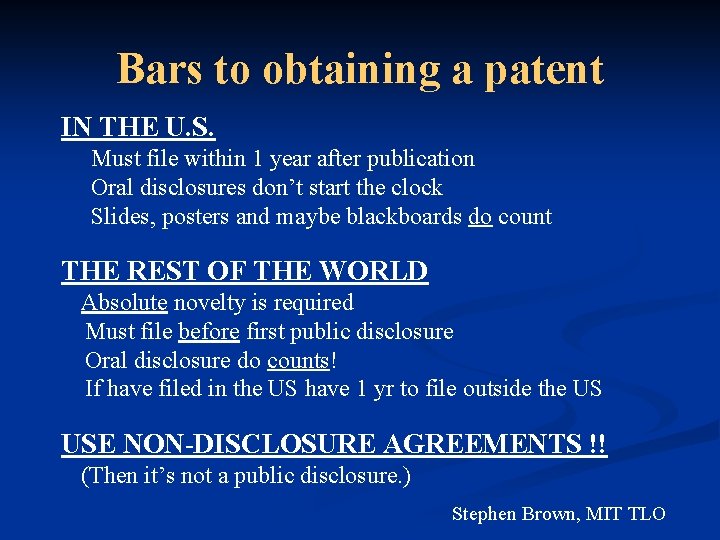
Bars to obtaining a patent IN THE U. S. Must file within 1 year after publication Oral disclosures don’t start the clock Slides, posters and maybe blackboards do count THE REST OF THE WORLD Absolute novelty is required Must file before first public disclosure Oral disclosure do counts! If have filed in the US have 1 yr to file outside the US USE NON-DISCLOSURE AGREEMENTS !! (Then it’s not a public disclosure. ) Stephen Brown, MIT TLO
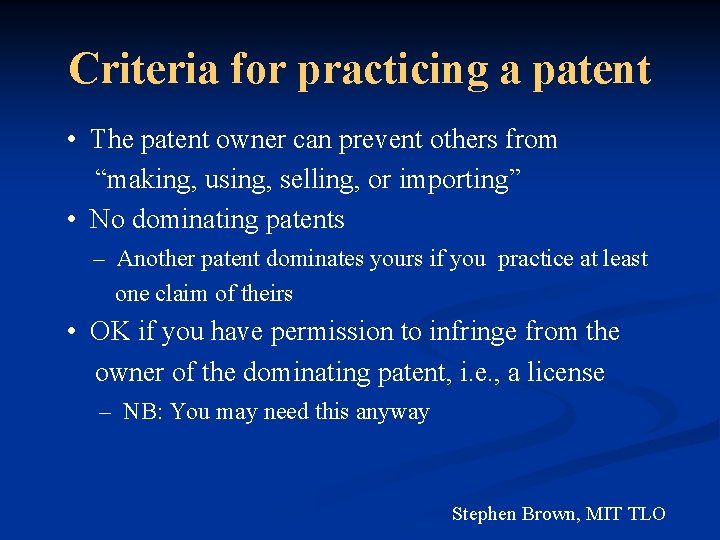
Criteria for practicing a patent • The patent owner can prevent others from “making, using, selling, or importing” • No dominating patents – Another patent dominates yours if you practice at least one claim of theirs • OK if you have permission to infringe from the owner of the dominating patent, i. e. , a license – NB: You may need this anyway Stephen Brown, MIT TLO
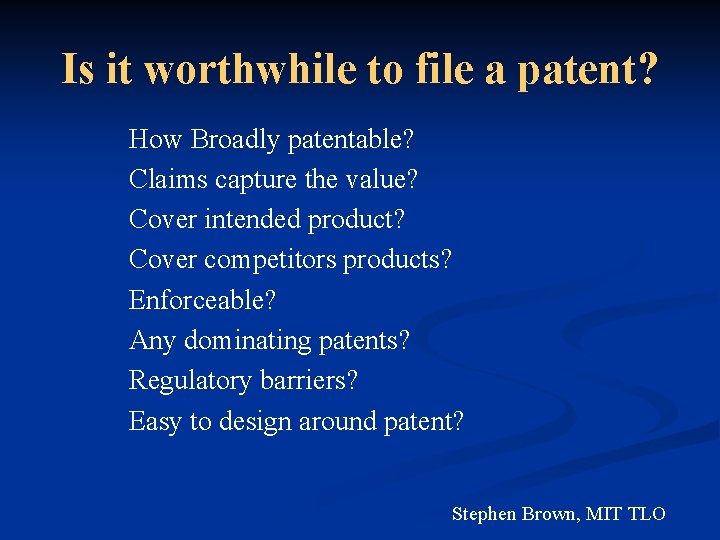
Is it worthwhile to file a patent? How Broadly patentable? Claims capture the value? Cover intended product? Cover competitors products? Enforceable? Any dominating patents? Regulatory barriers? Easy to design around patent? Stephen Brown, MIT TLO
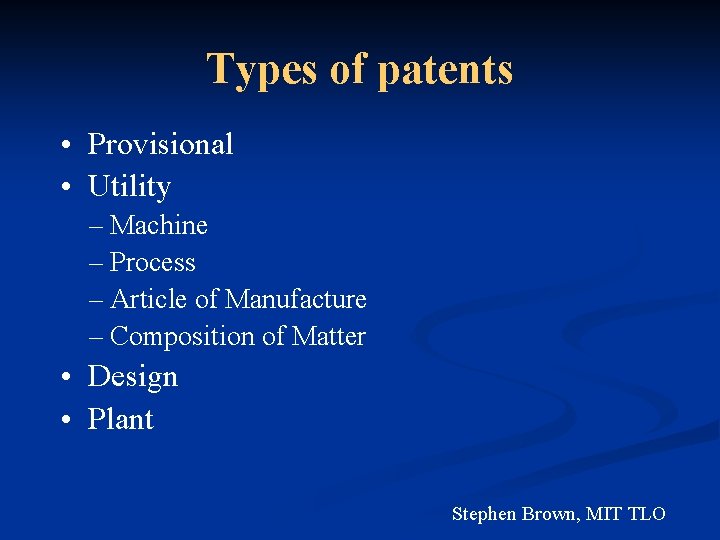
Types of patents • Provisional • Utility – Machine – Process – Article of Manufacture – Composition of Matter • Design • Plant Stephen Brown, MIT TLO
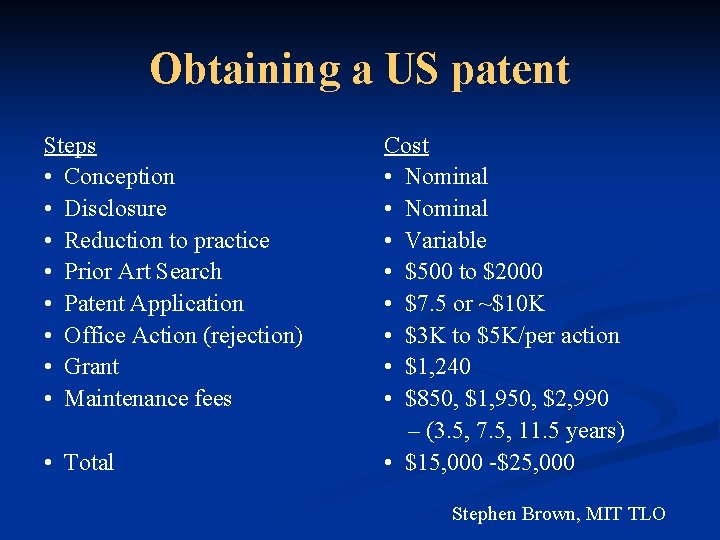
Obtaining a US patent Steps • Conception • Disclosure • Reduction to practice • Prior Art Search • Patent Application • Office Action (rejection) • Grant • Maintenance fees • Total Cost • Nominal • Variable • $500 to $2000 • $7. 5 or ~$10 K • $3 K to $5 K/per action • $1, 240 • $850, $1, 950, $2, 990 – (3. 5, 7. 5, 11. 5 years) • $15, 000 -$25, 000 Stephen Brown, MIT TLO
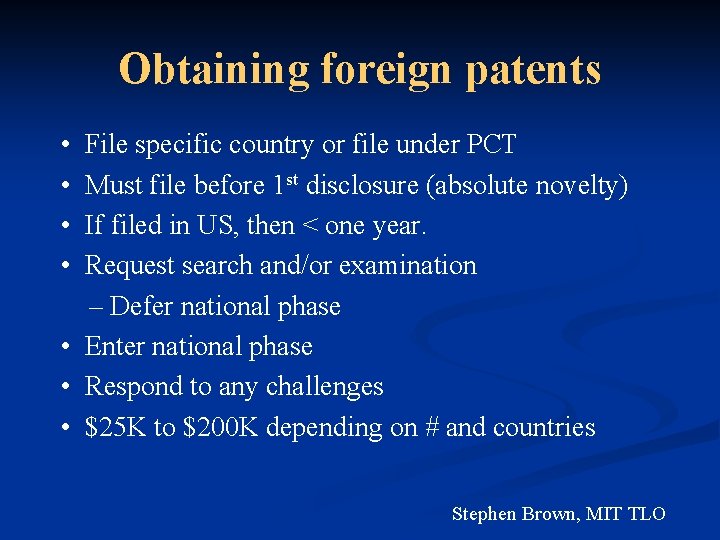
Obtaining foreign patents • • File specific country or file under PCT Must file before 1 st disclosure (absolute novelty) If filed in US, then < one year. Request search and/or examination – Defer national phase • Enter national phase • Respond to any challenges • $25 K to $200 K depending on # and countries Stephen Brown, MIT TLO
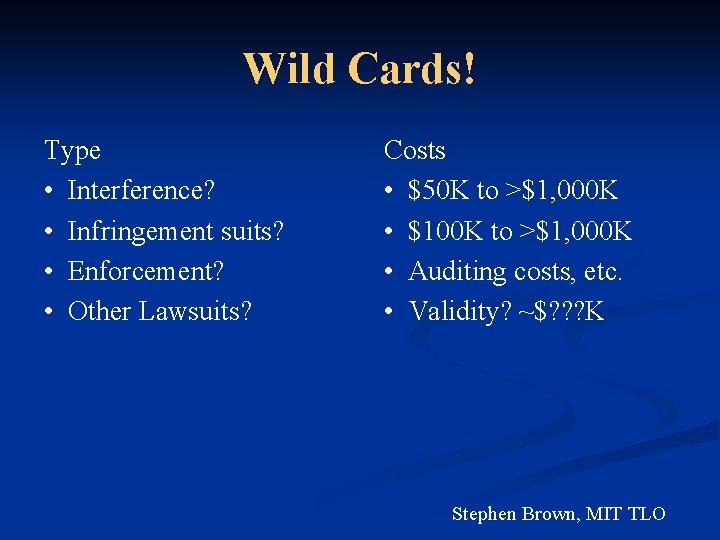
Wild Cards! Type • Interference? • Infringement suits? • Enforcement? • Other Lawsuits? Costs • $50 K to >$1, 000 K • $100 K to >$1, 000 K • Auditing costs, etc. • Validity? ~$? ? ? K Stephen Brown, MIT TLO
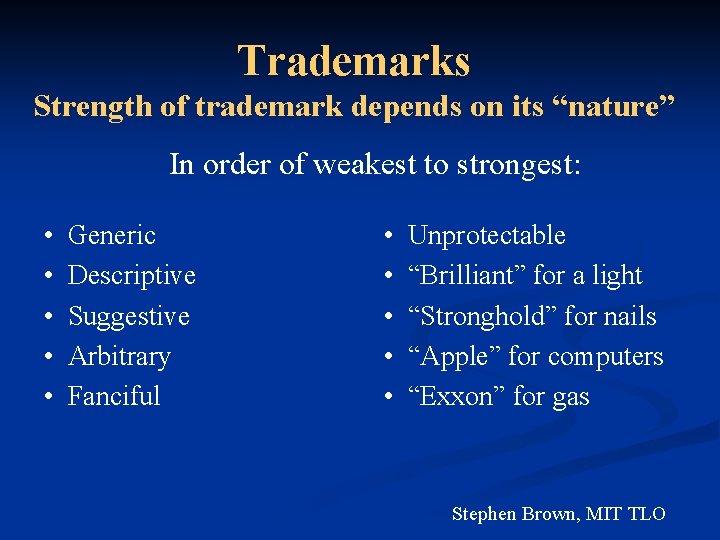
Trademarks Strength of trademark depends on its “nature” In order of weakest to strongest: • • • Generic Descriptive Suggestive Arbitrary Fanciful • • • Unprotectable “Brilliant” for a light “Stronghold” for nails “Apple” for computers “Exxon” for gas Stephen Brown, MIT TLO
Trademarks (cont. ) • BMW may have purchased Rover primarily for their Marks – Land Rover – Triumph – Austin – Range Rover Stephen Brown, MIT TLO
Copyrights • • • Exclusive right to reproduce an original work If… fixed in a tangible medium of expression Right to prepare derivative works Right to perform or display the work Does not protect: – idea, procedure, process, system, method of operation – concept, principle, or discovery – regardless of the form in which it is described, explained, or embodied Stephen Brown, MIT TLO
Life of IP • Patents • Copyrights • Trademarks • Trade Secrets • 20 yrs from filing • ~ 50 -150 yrs • Indefinitely with active use • Indefinitely with active protection Stephen Brown, MIT TLO
Strategic TOOLS for IP Stephen Brown, MIT TLO
Publishing • Cheapest way to prevent competitor from gaining an improvement patent that could block you • Provided you already have protection • Or if you expect to make future inventions Stephen Brown, MIT TLO
Assignment • Required of all employees prior to hiring • Agree to assign ownership of future inventions to company • Need to insure inventor is free to sign • Required at M. I. T. if “significant use” and/or use of M. I. T. administered funds Stephen Brown, MIT TLO
Non Compete (NC) • Employee prevented from joining competitors for 6 months to 3 years • Employee prevented from disclosing sensitive information to future employers • Other terms Stephen Brown, MIT TLO
Material Transfer Agreements (MTA) • Control how, where, and for what purpose proprietary materials can be used • Can provide for sole or joint ownership of future inventions made with material Stephen Brown, MIT TLO
Non Disclosure Agreements (NDA) • Prohibits disclosure that could bar patentability • Restricts use to specific purpose • Prohibits commercial use of information • Provides for knowledge from 3 rd party Stephen Brown, MIT TLO
Joint Invention Agreements (JIA) • • How to share expenses, income Who prosecutes which patents Who takes the lead in licensing If no JIA exists then – In the US, each party can operate independently – Outside the US each must obtain the other’s approval for licensing (few exceptions) Stephen Brown, MIT TLO
Options • • • Generally 6 months to 1 year Assumption of ongoing patent costs Modest up front signing fee Exclusive or Non-exclusive Protects right to take a license Allows for time to evaluate technology and market Stephen Brown, MIT TLO
License CHOICES TOOLS • Field of Use • Exclusive or Non-Ex • Licensed Product • Diligence • Sublicensing • Warrantees • Grant backs CHOICES • Focus on strengths • Exploit vs Seed • Royalty based on ? • $, dates, goals • Mandatory? • No dominating patents • Share know-how, IP Stephen Brown, MIT TLO
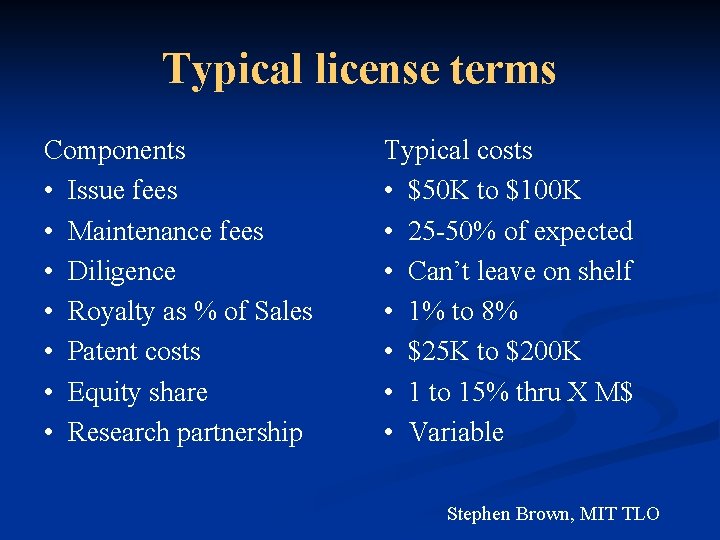
Typical license terms Components • Issue fees • Maintenance fees • Diligence • Royalty as % of Sales • Patent costs • Equity share • Research partnership Typical costs • $50 K to $100 K • 25 -50% of expected • Can’t leave on shelf • 1% to 8% • $25 K to $200 K • 1 to 15% thru X M$ • Variable Stephen Brown, MIT TLO
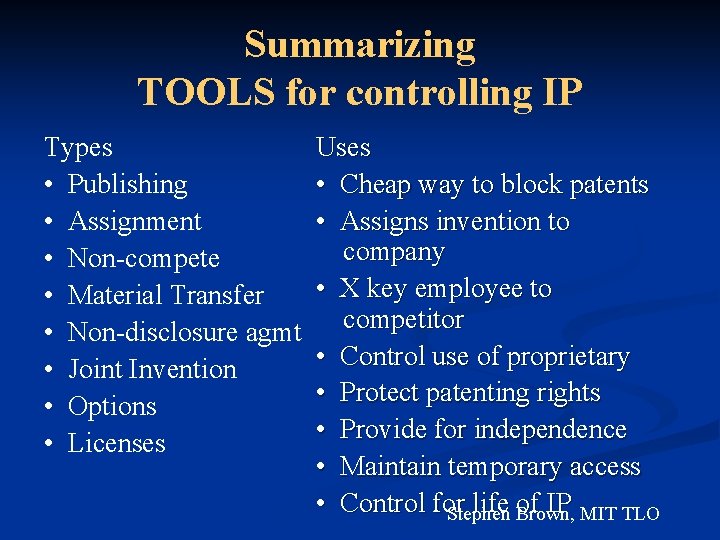
Summarizing TOOLS for controlling IP Types • Publishing • Assignment • Non-compete • Material Transfer • Non-disclosure agmt • Joint Invention • Options • Licenses Uses • Cheap way to block patents • Assigns invention to company • X key employee to competitor • Control use of proprietary • Protect patenting rights • Provide for independence • Maintain temporary access • Control for life Brown, of IP MIT TLO Stephen
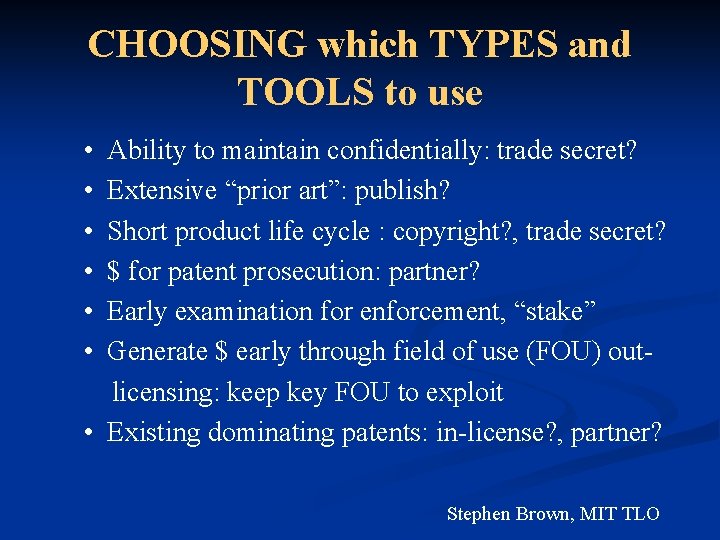
CHOOSING which TYPES and TOOLS to use • • • Ability to maintain confidentially: trade secret? Extensive “prior art”: publish? Short product life cycle : copyright? , trade secret? $ for patent prosecution: partner? Early examination for enforcement, “stake” Generate $ early through field of use (FOU) outlicensing: keep key FOU to exploit • Existing dominating patents: in-license? , partner? Stephen Brown, MIT TLO
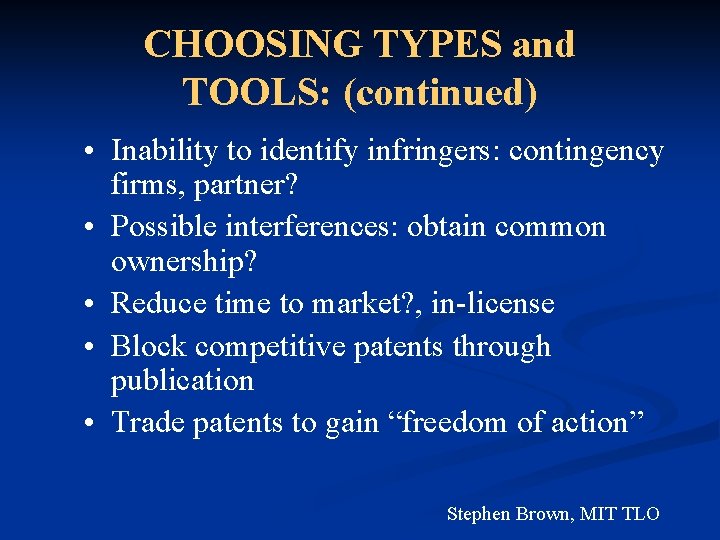
CHOOSING TYPES and TOOLS: (continued) • Inability to identify infringers: contingency firms, partner? • Possible interferences: obtain common ownership? • Reduce time to market? , in-license • Block competitive patents through publication • Trade patents to gain “freedom of action” Stephen Brown, MIT TLO
Common MISTAKES • The first words out of our mouths! – Inventions, licensing, etc. – A sound business plan is paramount • Poor search to identify dominating patents, prior art • Not writing claims to cover how others might circumvent your patent • Not rewarding key inventors Stephen Brown, MIT TLO
Common MISTAKES (continued) • • Filing on each invention made Filing in more countries than needed Assuming US laws are same as ROW Assuming all developed countries have same respect for IP • Forgetting that application will be published – 18 months after filing Stephen Brown, MIT TLO
Common MISTAKES (continued) • Invalidating your patents by – Making a public disclosure prior to filing – Not documenting invention and date – Not getting documentation witnessed – Not citing all known prior art – Not describing best mode – Including erroneous or excluding valid inventors Stephen Brown, MIT TLO
Resources • • www. wipo. org/pct www. uspto. gov web. mit. edu/tlo/www www. delphion. com www. les. org www. autm. net Patent attorneys Licensing agents Stephen Brown, MIT TLO
Conclusion Decide: • • • If: and which IP TOOLS to use Which: ideas to protect. . conception. . application? When: delay costs or quick enforcement How: broadly to pursue coverage With: self, partner, or sublicensee To: seed, share, or exploit Stephen Brown, MIT TLO
Postlude • Look around M. I. T. before you leave • Since M. I. T. was founded in 1861 • Graduates and Faculty have: – Started 4000 companies – That Employ > 1, 000 – With Sales of > $230 Billion/yr – If a nation = 24 thlargest country in the world – Bank of Boston Study -1997 Stephen Brown, MIT TLO
Acknowledgements • Material on Copyright and Trademarks • WHAT IS INTELLECTUAL PROPERTY By Laurence R. Hefter and Robert D. Litowitz • http: //usinfo. state. gov/products/pubs/intelprp/ Stephen Brown, MIT TLO
M. I. T. IP Policy • If sponsored or if made significant use of M. I. T. funds or facilities, then M. I. T. owns it. Textbooks are an exception. • TLO will take on inventor owned technology, but only under Standard royalty sharing policy • Don’t delay publication • Don’t promise future inventions • Conflict of interest - Educational responsibility to students - Requires too much time of inventor - If inventor has equity: M. I. T. won’t accept research funding if • inventions will be dominated by licensed patent • research will be done in the inventor’s lab • inventor’s students will participate in the research April 18, 2002 Stephen Brown, MIT TLO
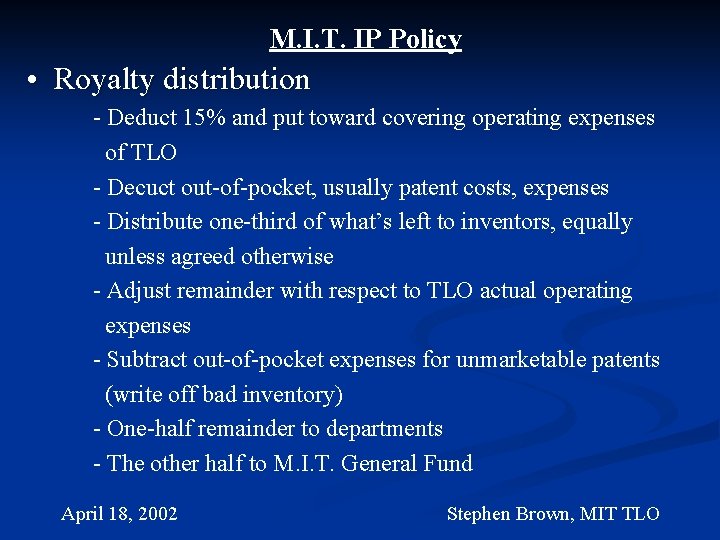
M. I. T. IP Policy • Royalty distribution - Deduct 15% and put toward covering operating expenses of TLO - Decuct out-of-pocket, usually patent costs, expenses - Distribute one-third of what’s left to inventors, equally unless agreed otherwise - Adjust remainder with respect to TLO actual operating expenses - Subtract out-of-pocket expenses for unmarketable patents (write off bad inventory) - One-half remainder to departments - The other half to M. I. T. General Fund April 18, 2002 Stephen Brown, MIT TLO
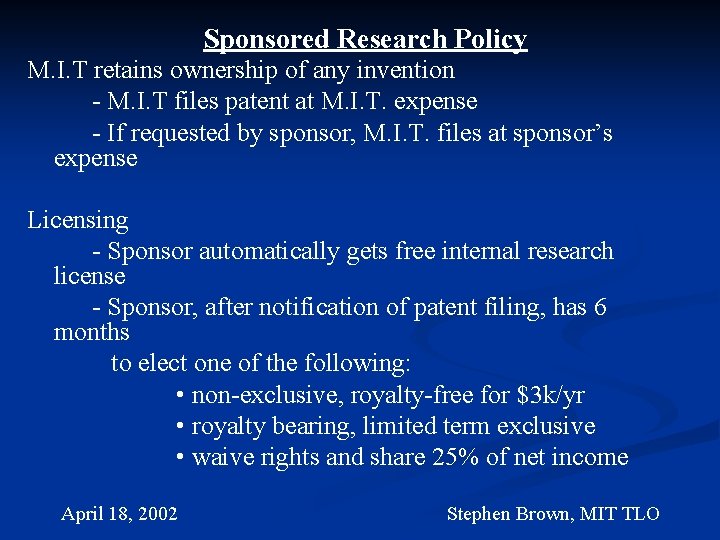
Sponsored Research Policy M. I. T retains ownership of any invention - M. I. T files patent at M. I. T. expense - If requested by sponsor, M. I. T. files at sponsor’s expense Licensing - Sponsor automatically gets free internal research license - Sponsor, after notification of patent filing, has 6 months to elect one of the following: • non-exclusive, royalty-free for $3 k/yr • royalty bearing, limited term exclusive • waive rights and share 25% of net income April 18, 2002 Stephen Brown, MIT TLO
- Slides: 47