
Intellectual Integrity I mean by intellectual integrity the
Intellectual Integrity I mean by intellectual integrity the habit of deciding vexed questions in accordance with the evidence, or of leaving them undecided where the evidence is inconclusive. Bertrand Russell
The essence of the liberal outlook lies not in what opinions are held but in how they are held:
instead of being held dogmatically, they are held tentatively, and with a consciousness that new evidence may at any moment lead to their abandonment.
This is the way opinions are held in science, as opposed to the way in which they are held in theology (and politics - HK).
…This virtue, though it is underestimated by almost all adherents of any system of dogma, is to my mind of the very greatest social importance and far more likely to benefit the world than any other system of organized beliefs. Bertrand Russell

It is now quite lawful for a Catholic woman to avoid pregnancy by a resort to mathematics, though she is still forbidden to resort to physics or chemistry.

Intellectual Integrity …This virtue, though it is underestimated by almost all adherents of any system of dogma, is to my mind of the very greatest social importance and far more likely to benefit the world than Christianity or any other system of organized beliefs. Bertrand Russell
-- Bertrand Russell, "What Is an Agnostic? " What makes a free thinker is not his beliefs, but the way in which he holds them. If he holds them because his elders told him they were true when he was young, or if he holds them because if he did not he would be unhappy, his thought is not free; but if he holds them because, after careful thought, he finds a balance in their favor, then his thought is free, however odd his conclusions may seem.
The essence of the liberal outlook lies not in what opinions are held but in how they are held: instead of being held dogmatically, they are held tentatively, and with a consciousness that new evidence may at any moment lead to their abandonment. This is the way opinions are held in science, as opposed to the way in which they are held in theology.
It is no credit to the orthodox that they do not now believe all the absurdities that were believed 150 years ago. The gradual emasculation of the Christian doctrine has been effected in spite of the most vigorous resistance, and solely as the result of the onslaughts of freethinkers.
Man is a credulous animal, and must believe something; in the absence of good grounds for belief, he will be satisfied with bad ones.
There is something feeble and a little contemptible about a man who cannot face the perils of life without the help of comfortable myths. Almost inevitably some part of him is aware that they are myths and that he believes them only because they are comforting. But he dares not face this thought! Moreover, since he is aware, however dimly, that his opinions are not rational, he becomes furious when they are disputed.
Many orthodox people speak as though it were the business of sceptics to disprove received dogmas rather than of dogmatists to prove them
It has been said that man is a rational animal. All my life I have been searching for evidence which could support this.
So far as I can remember, there is not one word in the Gospels in praise of intelligence; and in this respect ministers of religion follow gospel authority more closely than in some others.
What makes a free thinker is not his beliefs, but the way in which he holds them. If he holds them because his elders told him they were true when he was young, or if he holds them because if he did not he would be unhappy, his thought is not free; but if he holds them because, after careful thought, he finds a balance in their favor, then his thought is free, however odd his conclusions may seem.

Many orthodox people speak as though it were the business of sceptics to disprove received dogmas rather than of dogmatists to prove them -- Bertrand Russell, "What Is an Agnostic? " What makes a free thinker is not his beliefs, but the way in which he holds them. If he holds them because his elders told him they were true when he was young, or if he holds them because if he did not he would be unhappy, his thought is not free; but if he holds them because, after careful thought, he finds a balance in their favor, then his thought is free, however odd his conclusions may seem. -- Bertrand Russell, "The Value of Free Thought" There is something feeble and a little contemptible about a man who cannot face the perils of life without the help of comfortable myths. Almost inevitably some part of him is aware that they are myths and that he believes them only because they are comforting. But he dares not face this thought! Moreover, since he is aware, however dimly, that his opinions are not rational, he becomes furious when they are disputed. -- Bertrand Russell, Human Society in Ethics and Politics (1954), quoted from James A Haught, "Breaking the Last Taboo" (1996) It is no credit to the orthodox that they do not now believe all the absurdities that were believed 150 years ago. The gradual emasculation of the Christian doctrine has been effected in spite of the most vigorous resistance, and solely as the result of the onslaughts of freethinkers.
It has been said that man is a rational animal. All my life I have been searching for evidence which could support this. Man is a credulous animal, and must believe something; in the absence of good grounds for belief, he will be satisfied with bad ones. So far as I can remember, there is not one word in the Gospels in praise of intelligence; and in this respect ministers of religion follow gospel authority more closely than in some others. The essence of the liberal outlook lies not in what opinions are held but in how they are held: instead of being held dogmatically, they are held tentatively, and
Bertrand Arthur William Russell [Third Earl Russell] (1872 -1970) British philosopher, mathematician, social critic, writer It is clear that thought is not free if the profession of certain opinions make it impossible to earn a living. -- Bertrand Russell, Skeptical Essays (1928) My conclusion is that there is no reason to believe any of the dogmas of traditional theology and, further, that there is no reason to wish that they were true. Man, in so far as he is not subject to natural forces, is free to work out his own destiny. The responsibility is his, and so is the opportunity. -- Bertrand Russell, "Is There a God? " commissioned by, but never published in, Illustrated Magazine (1952: repr. The Collected Papers of Bertrand Russell, Volume 11: Last Philosophical Testament, 1943 -68, ed. John G Slater and Peter Köllner (London: Routledge, 1997), pp. 543 -48, quoted from S T Joshi, Atheism: A Reader I mean by intellectual integrity the habit of deciding vexed questions in accordance with the evidence, or of leaving them undecided where the evidence is inconclusive. This virtue, though it is underestimated by almost all adherents of any system of dogma, is to my mind of the very greatest social importance and far more likely to benefit the world than Christianity or any other system of organized beliefs.

Bertrand Russell I mean by intellectual integrity the habit of deciding vexed questions in accordance with the evidence, or of leaving them undecided where the evidence is inconclusive. This virtue, though it is underestimated by almost all adherents of any system of dogma, is to my mind of the very greatest social importance and far more likely to benefit the world than Christianity or any other system of organized beliefs. Bertrand Arthur William Russell [Third Earl Russell] (1872 -1970)
Positive Atheism's Big List of Bertrand Russell Quotations • No-Frames Quotes Index • Load This File With Frames Index • Index: Historical Writings (Russell) • Home to Positive Atheism Bertrand Arthur William Russell [Third Earl Russell] (1872 -1970) British philosopher, mathematician, social critic, writer It is clear that thought is not free if the profession of certain opinions make it impossible to earn a living. -- Bertrand Russell, Skeptical Essays (1928) My conclusion is that there is no reason to believe any of the dogmas of traditional theology and, further, that there is no reason to wish that they were true. Man, in so far as he is not subject to natural forces, is free to work out his own destiny. The responsibility is his, and so is the opportunity. -- Bertrand Russell, "Is There a God? " commissioned by, but never published in, Illustrated Magazine (1952: repr. The Collected Papers of Bertrand Russell, Volume 11: Last Philosophical Testament, 1943 -68, ed. John G Slater and Peter Köllner (London: Routledge, 1997), pp. 543 -48, quoted from S T Joshi, Atheism: A Reader I mean by intellectual integrity the habit of deciding vexed questions in accordance with the evidence, or of leaving them undecided where the evidence is inconclusive. This virtue, though it is underestimated by almost all adherents of any system of dogma, is to my mind of the very greatest social importance and far more likely to benefit the world than Christianity or any other system of organized beliefs. -- Bertrand Russell, "Can Religion Cure Our Troubles? " (1954) It has been said that man is a rational animal. All my life I have been searching for evidence which could support this. -- Bertrand Russell, from "An Outline of Intellectual Rubbish" in the collection, Unpopular Essays Man is a credulous animal, and must believe something; in the absence of good grounds for belief, he will be satisfied with bad ones. -- Bertrand Russell, Unpopular Essays, "An Outline of Intellectual Rubbish" (1950), p. 149, quoted from James A Haught, ed, 2000 Years of Disbelief So far as I can remember, there is not one word in the Gospels in praise of intelligence; and in this respect ministers of religion follow gospel authority more closely than in some others. -- Bertrand Russell, quoted, in part, from Jonathon Green, The Cassell Dictionary of Cynical Quotations [Kant] was like many people: in intellectual matters he was skeptical, but in moral matters he believed imjplicitly in the maximx that he had imbibed at his mother's knee. -- Bertrand Russell, "Why I Am Not A Christian, " One is often told that it is a very wrong thing to attack religion, because religion makes men virtuous. So I am told; I have noticed it. -- Bertrand Russell, "Why I Am Not A Christian, " Little Blue Book No. 1372 edited by E Haldeman-Julius. The essence of the liberal outlook lies not in what opinions are held but in how they are held: instead of being held dogmatically, they are held tentatively, and with a consciousness that new evidence may at any moment lead to their abandonment. This is the way opinions are held in science, as opposed to the way in which they are held in theology. -- Bertrand Russell, Unpopular Essays, "Philosophy and Politics" (1950), p. 149, quoted from James A Haught, ed, 2000 Years of Disbelief The fundamental cause of trouble in the world today is that the stupid are cocksure while the intelligent are full of doubt. -- Bertrand Russell, "Christian Ethics" from Marriage and Morals (1950), quoted from James A Haught, ed, 2000 Years of Disbelief Dogma demands authority, rather than intelligent thought, as the source of opinion; it requires persecution of heretics and hostility to unbelievers; it asks of its disciples that they should inhibit natural kindness in favor of systematic hatred. -- Bertrand Russell, thanks to Laird Wilcox, ed, "The Degeneration of Belief" Most of the greatest evils that man has inflicted upon man have come through people feeling quite certain about something which, in fact, was false. -- Bertrand Russell, Unpopular Essays, "Ideas That Have Harmed Mankind" (1950), p. 149, quoted from James A Haught, ed, 2000 Years of Disbelief The degree of one's emotion varies inversely with one's knowledge of the facts -- the less you know the hotter you get. -- Bertrand Russell (attributed: source unknown) [Regarding] the convention that clergymen are more virtuous than other men. Any average selection of mankind, set apart and told that it excels the rest in virtue, must tend to sink below the average. -- Bertrand Russell, "Religion and the Churches" (1916), quoted from Annie Laurie Gaylor, Betrayal of Trust: Clergy Abuse of Children (1988) Religion is something left over from the infancy of our intelligence, it will fade away as we adopt reason and science as our guidelines. -- Bertrand Russell (attributed: source unknown) The most savage controversies are those about matters as to which there is no good evidence either way. Persecution is used in theology, not in arithmetic. -- Bertrand Russell, Unpopular Essays, "An Outline of Intellectual Rubbish" (1950), quoted from James A Haught, ed, 2000 Years of Disbelief Heretical views arise when the truth is uncertain, and it is only when the truth is uncertain that censorship is invoked. -- Bertrand Russell, "The Value Of Free Thought, " thanks to Laird Wilcox, ed, "The Degeneration of Belief" The opinions that are held with passion are always those for which no good ground exists; indeed, the passion is the measure of the holder's lack of rational conviction. -- Bertrand Russell, Unpopular Essays "On the Value of Skepticism" (1950), quoted from James A Haught, ed, 2000 Years of Disbelief It is permissible with certain precautions to speak in print of coitus, but it is not permissible to employ the monosyllabic synonym for this word.
Positive Atheism's Big List of Bertrand Russell Quotations • No-Frames Quotes Index • Load This File With Frames Index • Index: Historical Writings (Russell) • Home to Positive Atheism Bertrand Arthur William Russell [Third Earl Russell] (1872 -1970) British philosopher, mathematician, social critic, writer It is clear that thought is not free if the profession of certain opinions make it impossible to earn a living. -- Bertrand Russell, Skeptical Essays (1928) My conclusion is that there is no reason to believe any of the dogmas of traditional theology and, further, that there is no reason to wish that they were true. Man, in so far as he is not subject to natural forces, is free to work out his own destiny. The responsibility is his, and so is the opportunity. -- Bertrand Russell, "Is There a God? " commissioned by, but never published in, Illustrated Magazine (1952: repr. The Collected Papers of Bertrand Russell, Volume 11: Last Philosophical Testament, 1943 -68, ed. John G Slater and Peter Köllner (London: Routledge, 1997), pp. 543 -48, quoted from S T Joshi, Atheism: A Reader I mean by intellectual integrity the habit of deciding vexed questions in accordance with the evidence, or of leaving them undecided where the evidence is inconclusive. This virtue, though it is underestimated by almost all adherents of any system of dogma, is to my mind of the very greatest social importance and far more likely to benefit the world than Christianity or any other system of organized beliefs. -- Bertrand Russell, "Can Religion Cure Our Troubles? " (1954) It has been said that man is a rational animal. All my life I have been searching for evidence which could support this. -- Bertrand Russell, from "An Outline of Intellectual Rubbish" in the collection, Unpopular Essays Man is a credulous animal, and must believe something; in the absence of good grounds for belief, he will be satisfied with bad ones. -- Bertrand Russell, Unpopular Essays, "An Outline of Intellectual Rubbish" (1950), p. 149, quoted from James A Haught, ed, 2000 Years of Disbelief So far as I can remember, there is not one word in the Gospels in praise of intelligence; and in this respect ministers of religion follow gospel authority more closely than in some others. -- Bertrand Russell, quoted, in part, from Jonathon Green, The Cassell Dictionary of Cynical Quotations [Kant] was like many people: in intellectual matters he was skeptical, but in moral matters he believed imjplicitly in the maximx that he had imbibed at his mother's knee. -- Bertrand Russell, "Why I Am Not A Christian, " One is often told that it is a very wrong thing to attack religion, because religion makes men virtuous. So I am told; I have noticed it. -- Bertrand Russell, "Why I Am Not A Christian, " Little Blue Book No. 1372 edited by E Haldeman-Julius. The essence of the liberal outlook lies not in what opinions are held but in how they are held: instead of being held dogmatically, they are held tentatively, and with a consciousness that new evidence may at any moment lead to their abandonment. This is the way opinions are held in science, as opposed to the way in which they are held in theology. -- Bertrand Russell, Unpopular Essays, "Philosophy and Politics" (1950), p. 149, quoted from James A Haught, ed, 2000 Years of Disbelief The fundamental cause of trouble in the world today is that the stupid are cocksure while the intelligent are full of doubt. -- Bertrand Russell, "Christian Ethics" from Marriage and Morals (1950), quoted from James A Haught, ed, 2000 Years of Disbelief Dogma demands authority, rather than intelligent thought, as the source of opinion; it requires persecution of heretics and hostility to unbelievers; it asks of its disciples that they should inhibit natural kindness in favor of systematic hatred. -- Bertrand Russell, thanks to Laird Wilcox, ed, "The Degeneration of Belief" Most of the greatest evils that man has inflicted upon man have come through people feeling quite certain about something which, in fact, was false. -- Bertrand Russell, Unpopular Essays, "Ideas That Have Harmed Mankind" (1950), p. 149, quoted from James A Haught, ed, 2000 Years of Disbelief The degree of one's emotion varies inversely with one's knowledge of the facts -- the less you know the hotter you get. -- Bertrand Russell (attributed: source unknown) [Regarding] the convention that clergymen are more virtuous than other men. Any average selection of mankind, set apart and told that it excels the rest in virtue, must tend to sink below the average. -- Bertrand Russell, "Religion and the Churches" (1916), quoted from Annie Laurie Gaylor, Betrayal of Trust: Clergy Abuse of Children (1988) Religion is something left over from the infancy of our intelligence, it will fade away as we adopt reason and science as our guidelines. -- Bertrand Russell (attributed: source unknown) The most savage controversies are those about matters as to which there is no good evidence either way. Persecution is used in theology, not in arithmetic. -- Bertrand Russell, Unpopular Essays, "An Outline of Intellectual Rubbish" (1950), quoted from James A Haught, ed, 2000 Years of Disbelief Heretical views arise when the truth is uncertain, and it is only when the truth is uncertain that censorship is invoked. -- Bertrand Russell, "The Value Of Free Thought, " thanks to Laird Wilcox, ed, "The Degeneration of Belief" The opinions that are held with passion are always those for which no good ground exists; indeed, the passion is the measure of the holder's lack of rational conviction. -- Bertrand Russell, Unpopular Essays "On the Value of Skepticism" (1950), quoted from James A Haught, ed, 2000 Years of Disbelief It is permissible with certain precautions to speak in print of coitus, but it is not permissible to employ the monosyllabic synonym for this word.
Positive Atheism's Big List of Bertrand Russell Quotations • No-Frames Quotes Index • Load This File With Frames Index • Index: Historical Writings (Russell) • Home to Positive Atheism Bertrand Arthur William Russell [Third Earl Russell] (1872 -1970) British philosopher, mathematician, social critic, writer It is clear that thought is not free if the profession of certain opinions make it impossible to earn a living. -- Bertrand Russell, Skeptical Essays (1928) My conclusion is that there is no reason to believe any of the dogmas of traditional theology and, further, that there is no reason to wish that they were true. Man, in so far as he is not subject to natural forces, is free to work out his own destiny. The responsibility is his, and so is the opportunity. -- Bertrand Russell, "Is There a God? " commissioned by, but never published in, Illustrated Magazine (1952: repr. The Collected Papers of Bertrand Russell, Volume 11: Last Philosophical Testament, 1943 -68, ed. John G Slater and Peter Köllner (London: Routledge, 1997), pp. 543 -48, quoted from S T Joshi, Atheism: A Reader I mean by intellectual integrity the habit of deciding vexed questions in accordance with the evidence, or of leaving them undecided where the evidence is inconclusive. This virtue, though it is underestimated by almost all adherents of any system of dogma, is to my mind of the very greatest social importance and far more likely to benefit the world than Christianity or any other system of organized beliefs. -- Bertrand Russell, "Can Religion Cure Our Troubles? " (1954) It has been said that man is a rational animal. All my life I have been searching for evidence which could support this. -- Bertrand Russell, from "An Outline of Intellectual Rubbish" in the collection, Unpopular Essays Man is a credulous animal, and must believe something; in the absence of good grounds for belief, he will be satisfied with bad ones. -- Bertrand Russell, Unpopular Essays, "An Outline of Intellectual Rubbish" (1950), p. 149, quoted from James A Haught, ed, 2000 Years of Disbelief So far as I can remember, there is not one word in the Gospels in praise of intelligence; and in this respect ministers of religion follow gospel authority more closely than in some others. -- Bertrand Russell, quoted, in part, from Jonathon Green, The Cassell Dictionary of Cynical Quotations [Kant] was like many people: in intellectual matters he was skeptical, but in moral matters he believed imjplicitly in the maximx that he had imbibed at his mother's knee. -- Bertrand Russell, "Why I Am Not A Christian, " One is often told that it is a very wrong thing to attack religion, because religion makes men virtuous. So I am told; I have not
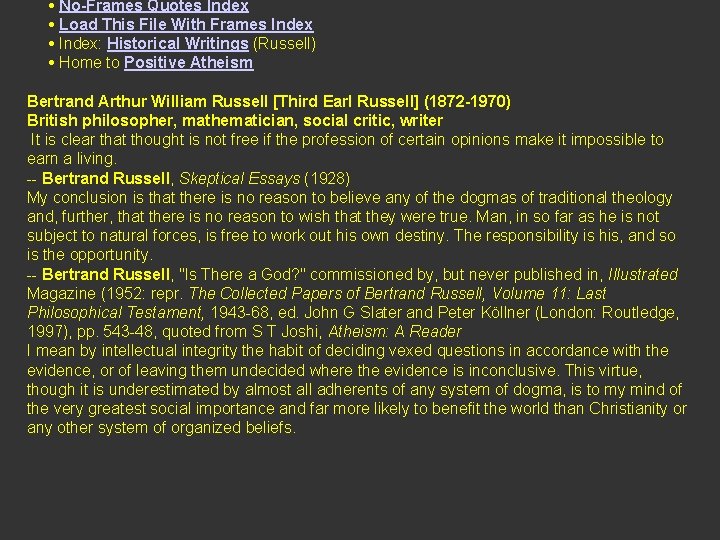
• No-Frames Quotes Index • Load This File With Frames Index • Index: Historical Writings (Russell) • Home to Positive Atheism Bertrand Arthur William Russell [Third Earl Russell] (1872 -1970) British philosopher, mathematician, social critic, writer It is clear that thought is not free if the profession of certain opinions make it impossible to earn a living. -- Bertrand Russell, Skeptical Essays (1928) My conclusion is that there is no reason to believe any of the dogmas of traditional theology and, further, that there is no reason to wish that they were true. Man, in so far as he is not subject to natural forces, is free to work out his own destiny. The responsibility is his, and so is the opportunity. -- Bertrand Russell, "Is There a God? " commissioned by, but never published in, Illustrated Magazine (1952: repr. The Collected Papers of Bertrand Russell, Volume 11: Last Philosophical Testament, 1943 -68, ed. John G Slater and Peter Köllner (London: Routledge, 1997), pp. 543 -48, quoted from S T Joshi, Atheism: A Reader I mean by intellectual integrity the habit of deciding vexed questions in accordance with the evidence, or of leaving them undecided where the evidence is inconclusive. This virtue, though it is underestimated by almost all adherents of any system of dogma, is to my mind of the very greatest social importance and far more likely to benefit the world than Christianity or any other system of organized beliefs.
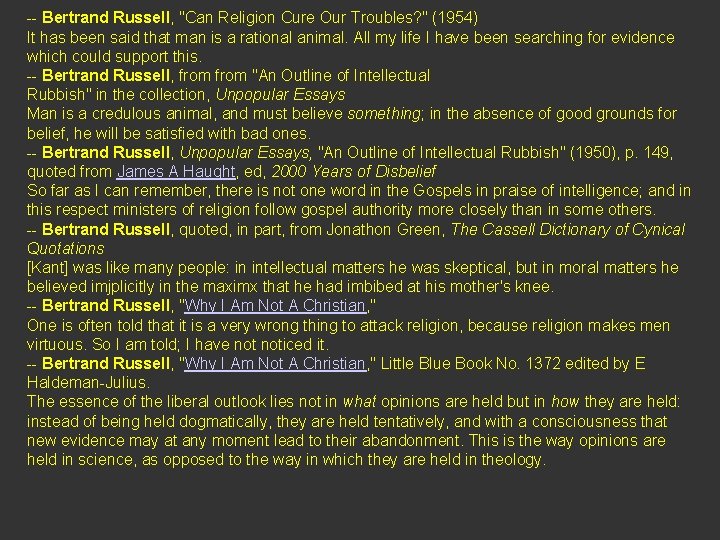
-- Bertrand Russell, "Can Religion Cure Our Troubles? " (1954) It has been said that man is a rational animal. All my life I have been searching for evidence which could support this. -- Bertrand Russell, from "An Outline of Intellectual Rubbish" in the collection, Unpopular Essays Man is a credulous animal, and must believe something; in the absence of good grounds for belief, he will be satisfied with bad ones. -- Bertrand Russell, Unpopular Essays, "An Outline of Intellectual Rubbish" (1950), p. 149, quoted from James A Haught, ed, 2000 Years of Disbelief So far as I can remember, there is not one word in the Gospels in praise of intelligence; and in this respect ministers of religion follow gospel authority more closely than in some others. -- Bertrand Russell, quoted, in part, from Jonathon Green, The Cassell Dictionary of Cynical Quotations [Kant] was like many people: in intellectual matters he was skeptical, but in moral matters he believed imjplicitly in the maximx that he had imbibed at his mother's knee. -- Bertrand Russell, "Why I Am Not A Christian, " One is often told that it is a very wrong thing to attack religion, because religion makes men virtuous. So I am told; I have noticed it. -- Bertrand Russell, "Why I Am Not A Christian, " Little Blue Book No. 1372 edited by E Haldeman-Julius. The essence of the liberal outlook lies not in what opinions are held but in how they are held: instead of being held dogmatically, they are held tentatively, and with a consciousness that new evidence may at any moment lead to their abandonment. This is the way opinions are held in science, as opposed to the way in which they are held in theology.
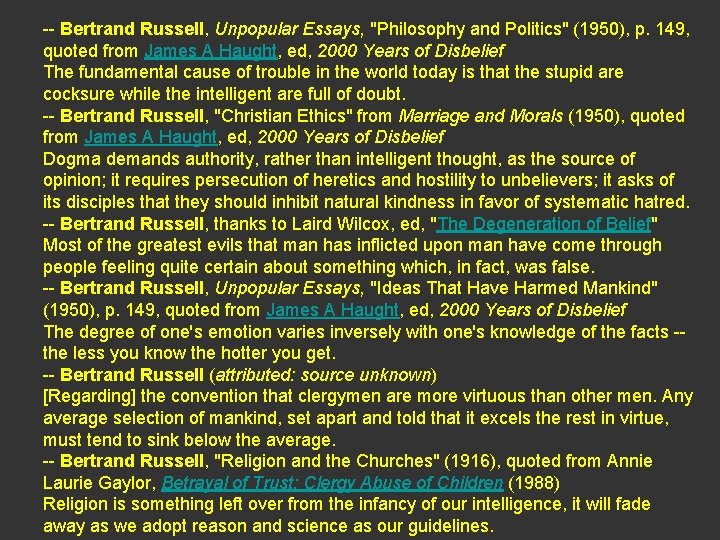
-- Bertrand Russell, Unpopular Essays, "Philosophy and Politics" (1950), p. 149, quoted from James A Haught, ed, 2000 Years of Disbelief The fundamental cause of trouble in the world today is that the stupid are cocksure while the intelligent are full of doubt. -- Bertrand Russell, "Christian Ethics" from Marriage and Morals (1950), quoted from James A Haught, ed, 2000 Years of Disbelief Dogma demands authority, rather than intelligent thought, as the source of opinion; it requires persecution of heretics and hostility to unbelievers; it asks of its disciples that they should inhibit natural kindness in favor of systematic hatred. -- Bertrand Russell, thanks to Laird Wilcox, ed, "The Degeneration of Belief" Most of the greatest evils that man has inflicted upon man have come through people feeling quite certain about something which, in fact, was false. -- Bertrand Russell, Unpopular Essays, "Ideas That Have Harmed Mankind" (1950), p. 149, quoted from James A Haught, ed, 2000 Years of Disbelief The degree of one's emotion varies inversely with one's knowledge of the facts -- the less you know the hotter you get. -- Bertrand Russell (attributed: source unknown) [Regarding] the convention that clergymen are more virtuous than other men. Any average selection of mankind, set apart and told that it excels the rest in virtue, must tend to sink below the average. -- Bertrand Russell, "Religion and the Churches" (1916), quoted from Annie Laurie Gaylor, Betrayal of Trust: Clergy Abuse of Children (1988) Religion is something left over from the infancy of our intelligence, it will fade away as we adopt reason and science as our guidelines.
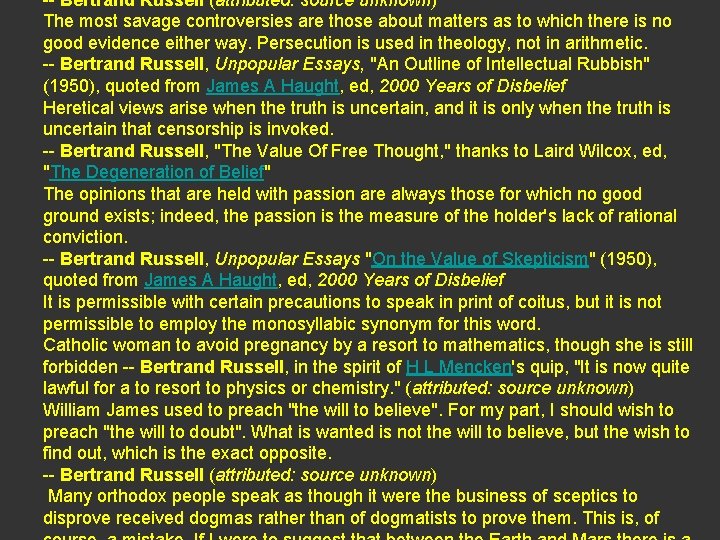
-- Bertrand Russell (attributed: source unknown) The most savage controversies are those about matters as to which there is no good evidence either way. Persecution is used in theology, not in arithmetic. -- Bertrand Russell, Unpopular Essays, "An Outline of Intellectual Rubbish" (1950), quoted from James A Haught, ed, 2000 Years of Disbelief Heretical views arise when the truth is uncertain, and it is only when the truth is uncertain that censorship is invoked. -- Bertrand Russell, "The Value Of Free Thought, " thanks to Laird Wilcox, ed, "The Degeneration of Belief" The opinions that are held with passion are always those for which no good ground exists; indeed, the passion is the measure of the holder's lack of rational conviction. -- Bertrand Russell, Unpopular Essays "On the Value of Skepticism" (1950), quoted from James A Haught, ed, 2000 Years of Disbelief It is permissible with certain precautions to speak in print of coitus, but it is not permissible to employ the monosyllabic synonym for this word. Catholic woman to avoid pregnancy by a resort to mathematics, though she is still forbidden -- Bertrand Russell, in the spirit of H L Mencken's quip, "It is now quite lawful for a to resort to physics or chemistry. " (attributed: source unknown) William James used to preach "the will to believe". For my part, I should wish to preach "the will to doubt". What is wanted is not the will to believe, but the wish to find out, which is the exact opposite. -- Bertrand Russell (attributed: source unknown) Many orthodox people speak as though it were the business of sceptics to disprove received dogmas rather than of dogmatists to prove them. This is, of
- Slides: 32