
Intellectual Functioning in Adulthood Growth Maintenance Decline and




- Slides: 32
Intellectual Functioning in Adulthood: Growth, Maintenance, Decline, and Modifiability K. Warner Schaie Sherry L. Willis The Pennsylvania State University
Work on the Seattle Longitudinal Study, data from which are reported here, has been supported by grants from:
Scientific Collaborators Paul Baltes Ann Gruber-Baldini Ann O’Hanlon Thomas Barrett Christopher Hertzog Iris Parham Ute Bayen Robert Intrieri Robert Plomin Julie Boron Gina Jay Samuel Popkin Hayden Bothworth Alfred Kaszniak Margaret Quayhagen Barbara Buech Iseli Krauss Andrew Revell Grace Caskie Eric Labouvie Amy Roth Heather Chipuer Gisela Labouvie-Vief Lindsay Ryan Theresa Cooney Thomas Ledermann Jane Saczinski Ranjana Dutta Heiner Maier John Schulenberg Cindy de Frias Scott Maitland Charles Strother Michael Gilewski Ann Nardi Vicki Stone Judith Gonda John Nesselroade Linda Teri Kathy Gribbin Ha Nguyen Faika Zanjani Elizabeth Zelinski
Intellectual Functioning in Adulthood § Some Methodological Issues § Growth, Maintenance and Decline § Development Influences that Affect the Life Course of Intellectual Functioning § Early Detection of Risk of Late Life Dementia § Modifiability Through Cognitive Training
Some Methodological Issues § Normal vs Pathological Aging § Cross-Sectional vs Longitudinal Data § Cohort and Generational Differences in Level and Rate of Change § Population vs Family Studies
Normal vs Pathological Aging § Aging as Decline § Neuropathology, Disuse & Obsolescence § Aging as Development § Successful & Unsuccessful Aging § Experience & Wisdom
Cross-Sectional vs Longitudinal Data § Age Differences § Inter-Individual Variation Across Groups § Age Changes § Intra-Individual Changes Over Time Within Groups
Cohort and Generational Differences in Level and Rate of Change § In Population Studies § In Biologically Related Individuals
The Seattle Longitudinal Study (SLS) § Age Changes and Age Differences § Antecedents of Individual Differences in Aging § Interventions to Slow Cognitive Aging § Generational Differences § Family Studies § Early Detection of Dementia
Conceptual Model of the SLS
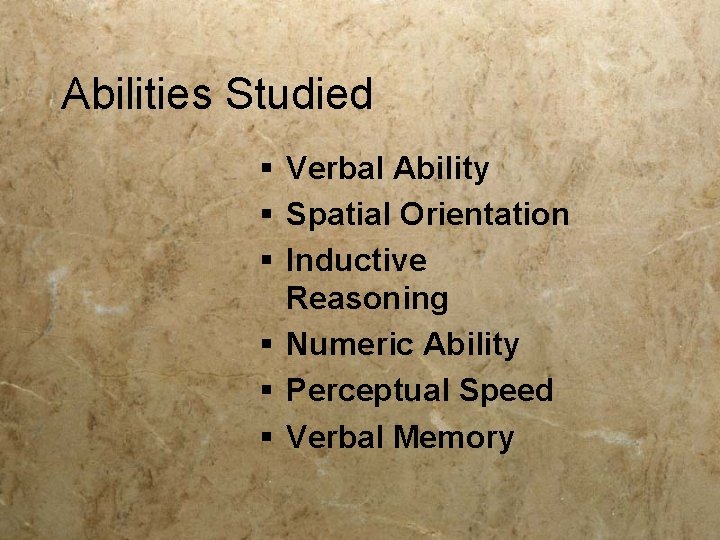
Abilities Studied § Verbal Ability § Spatial Orientation § Inductive Reasoning § Numeric Ability § Perceptual Speed § Verbal Memory
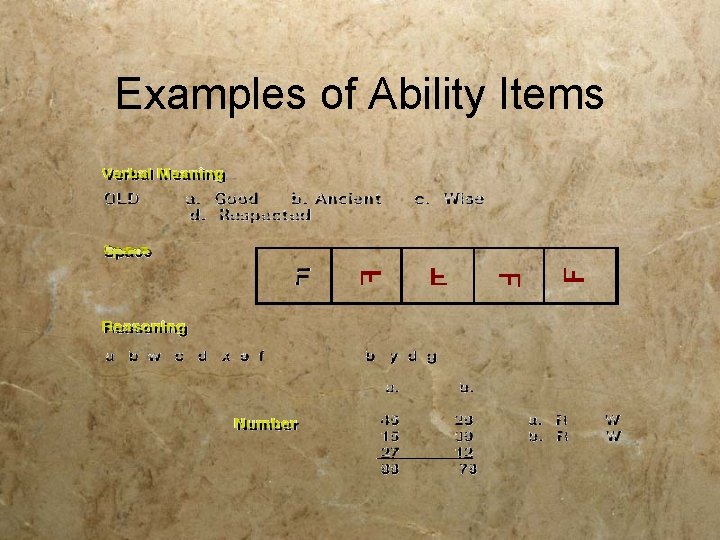
Examples of Ability Items
Cross-Sectional Age Differences
Longitudinal Age Changes
Individual Changes Over Time on Verbal Ability
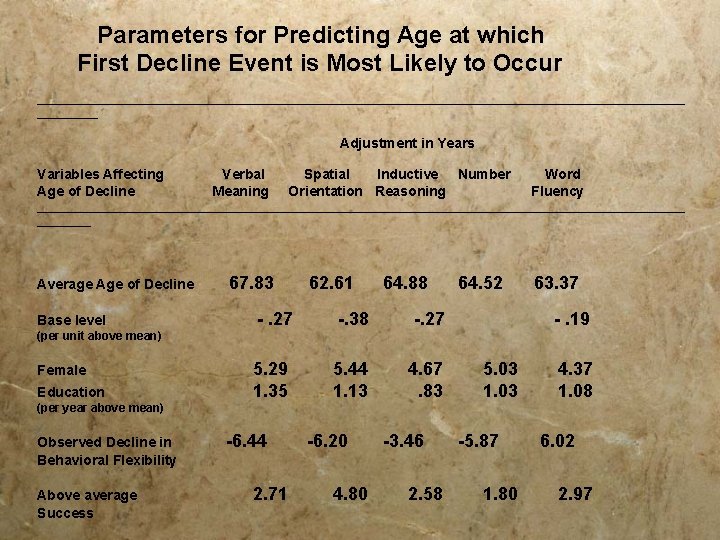
Parameters for Predicting Age at which First Decline Event is Most Likely to Occur _________________________________________________ Adjustment in Years Variables Affecting Age of Decline Verbal Meaning Spatial Inductive Number Orientation Reasoning Word Fluency _________________________________________________ Average Age of Decline Base level 67. 83 62. 61 64. 88 -. 27 -. 38 -. 27 5. 29 1. 35 5. 44 1. 13 4. 67. 83 64. 52 63. 37 -. 19 (per unit above mean) Female Education 5. 03 1. 03 4. 37 1. 08 (per year above mean) Observed Decline in Behavioral Flexibility Above average Success -6. 44 2. 71 -6. 20 4. 80 -3. 46 2. 58 -5. 87 1. 80 6. 02 2. 97
Longitudinal Changes in Cognitive Styles
Separating GENERATIONAL Differences from AGE Changes
Cohort Studies
Cohort Effects in Cognitive Styles
The Family Study § Family Similarity in Intellectual Competence § Family Similarity in Cognitive Style § Similarity in Perception of Family Environment
Generational Difference in Abilities
Rate of Cognitive Change
Rate of Cognitive Change in Biologically Related Individuals
Change over 14 Years
Early Detection of Risk of Dementia § Neuropsychological Studies in Community Dwelling Persons § Genetic Studies: The Apo. E Gene
Population Screened
Apoprotein E Allele Distribution 22 32 33 42 43 44 4 91 397 20 149 17 (0. 6%) (13. 4%) (58. 6%) (3. 0%) (22. 0%) (2. 5%)
7 -Year Cognitive Change by Allele Type
Correlating Autopsy Findings with Cognitive Change