
Intellectual Disability Stella Day IDEA Legal Definition Significantly
Intellectual Disability Stella Day
IDEA Legal Definition Significantly sub average general intellectual functioning, existing concurrently with deficits in adaptive behavior and manifested during the developmental period, that adversely affects a child’s educational performance. There are two key components within this definition: intellectual functioning (intelligence) and capability to function independently, (adaptive behavior). Intellectual Disability” is a new term in IDEA. Until October 2010, the law used the term “mental retardation. ”
Adaptive Behavior Adaptive behavior is the collection of conceptual, social, and practical skills that are learned and performed by people in their everyday lives. Conceptual skills—language and literacy; money, time, and number concepts; and self-direction. Social skills—interpersonal skills, social responsibility, self-esteem, gullibility, naïveté (i. e. , wariness), social problem solving, and the ability to follow rules/obey laws and to avoid being victimized. Practical skills—activities of daily living (personal care), occupational skills, healthcare, travel/transportation, schedules/routines, safety, use of money, use of the telephone.
Common Characteristics Intelligent quotient (or I. Q. ) is between 70 -75 or below (average is 100 for general population) Difficulty with choice making, problem solving, goal setting Difficulty comprehending accepted social behaviors and understanding consequences of actions Difficulty with abstract ideas Poor reading and language skills Difficulty with memory recall and learning strategies Underdeveloped motor skills Students tend may tend toward low motivation and learned helplessness Lack of general knowledge about the world
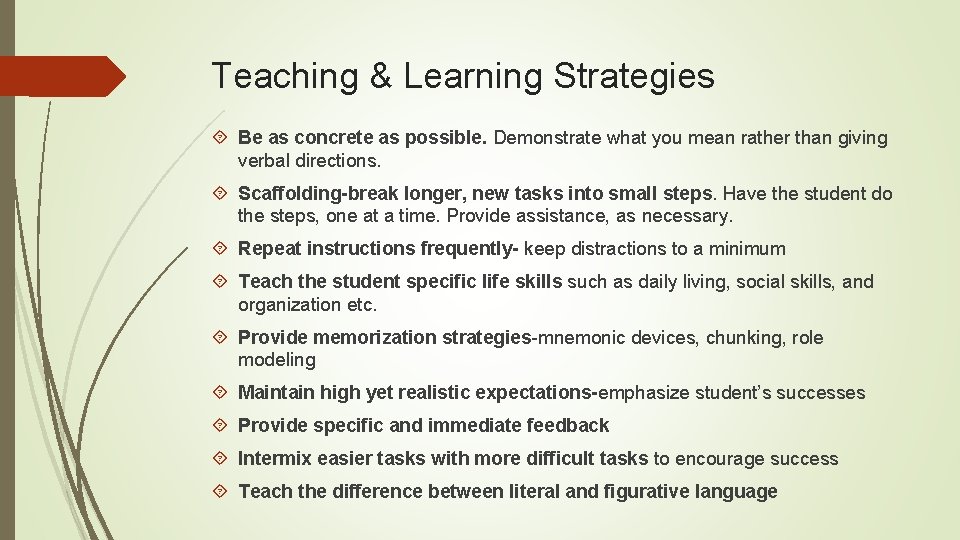
Teaching & Learning Strategies Be as concrete as possible. Demonstrate what you mean rather than giving verbal directions. Scaffolding-break longer, new tasks into small steps. Have the student do the steps, one at a time. Provide assistance, as necessary. Repeat instructions frequently- keep distractions to a minimum Teach the student specific life skills such as daily living, social skills, and organization etc. Provide memorization strategies-mnemonic devices, chunking, role modeling Maintain high yet realistic expectations-emphasize student’s successes Provide specific and immediate feedback Intermix easier tasks with more difficult tasks to encourage success Teach the difference between literal and figurative language
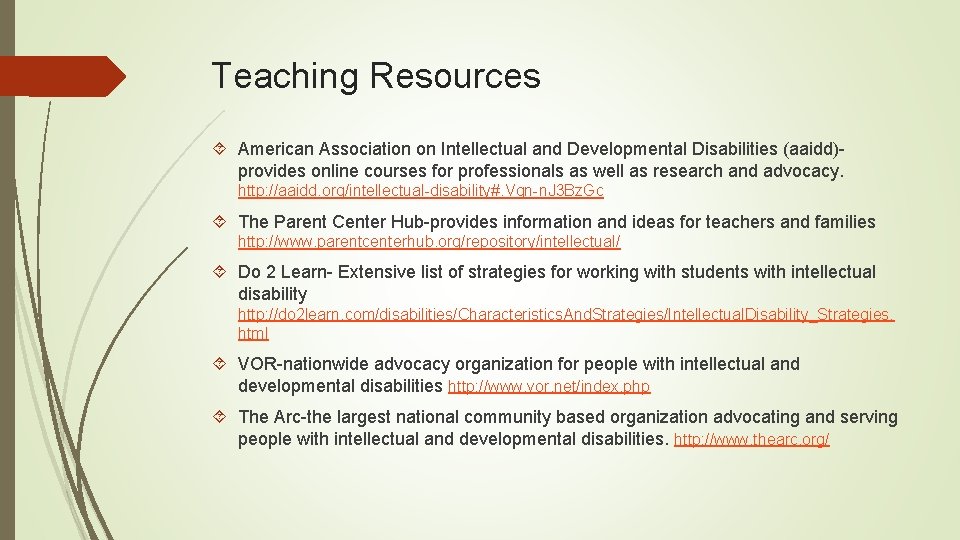
Teaching Resources American Association on Intellectual and Developmental Disabilities (aaidd)provides online courses for professionals as well as research and advocacy. http: //aaidd. org/intellectual-disability#. Vgn-n. J 3 Bz. Gc The Parent Center Hub-provides information and ideas for teachers and families http: //www. parentcenterhub. org/repository/intellectual/ Do 2 Learn- Extensive list of strategies for working with students with intellectual disability http: //do 2 learn. com/disabilities/Characteristics. And. Strategies/Intellectual. Disability_Strategies. html VOR-nationwide advocacy organization for people with intellectual and developmental disabilities http: //www. vor. net/index. php The Arc-the largest national community based organization advocating and serving people with intellectual and developmental disabilities. http: //www. thearc. org/
- Slides: 6