
Intellectual Development of Preschoolers Preoperational Thinking Jean Piaget
- Slides: 20
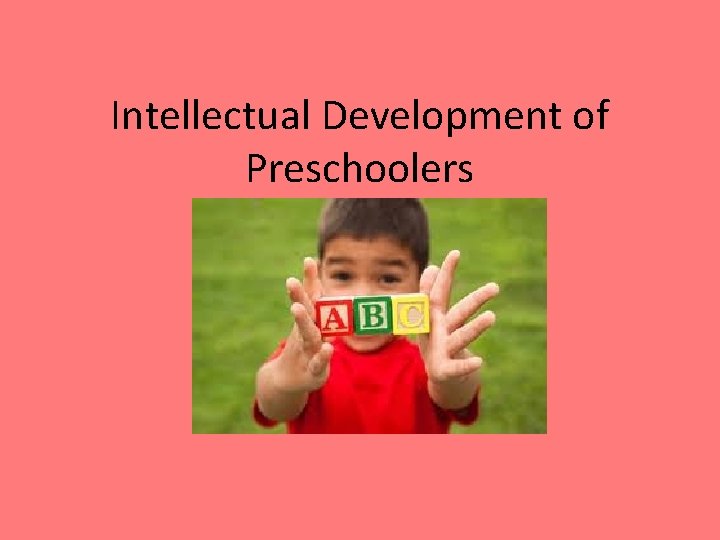
Intellectual Development of Preschoolers
Preoperational Thinking • Jean Piaget identified the time between 2 and 7 as the preoperational period. • Children think in terms of their own activities and what they perceive at the moment. • Use of symbols – children learn that objects and words can also be symbols. A stop sign means stop. • Make-believe play – children learn through play and dramatic play where they imitate real life situations, such as playing house and school. • Egocentric viewpoint – They view the world in terms of their own thoughts and feelings. When a child’s mother was sick he gave his stuffed animal to his mom. • Limited focus – Children find it difficult to focus on more than one feature at a time.
What is Intelligence? • Formal intelligence tests are used to determine thinking skills of children. • Test results can help teachers, principals and learning specialists understand meet students' educational needs. • First intelligence tests was developed by French psychologist, Alfred Binet in 1905. • In 1916 Lewis M. Terman made a revision of the Binet test and it is now referred to the Stanford-Binet. • The test has a can be used to give a child’s intelligence quotient, or IQ. The average child to any age has an IQ between 90 and 110.
Problems with Intelligence Tests • No one test gives an accurate measure of a child’s mental ability. • Factors that have nothing to do with intelligence can influence test results. For instance, a child’s physical or mental state when taking the test can affect the score. • The test doesn’t tell much about specific abilities. Two people with the same IQ may have very different strengths and weaknesses. • The NAEYC – National Association for the Education of Young Children warns that no decision about a child’s placement in school should be made on the basis of one test alone. • If a child falls outside the norms of development for his/her age then an in-depth assessment of skills can be done.
Multiple Intelligences • Psychologist Howard Gardner has advanced a new way of looking at intelligence. He says that humans have multiple intelligences – many different ways of using the mind and body to experience the world.
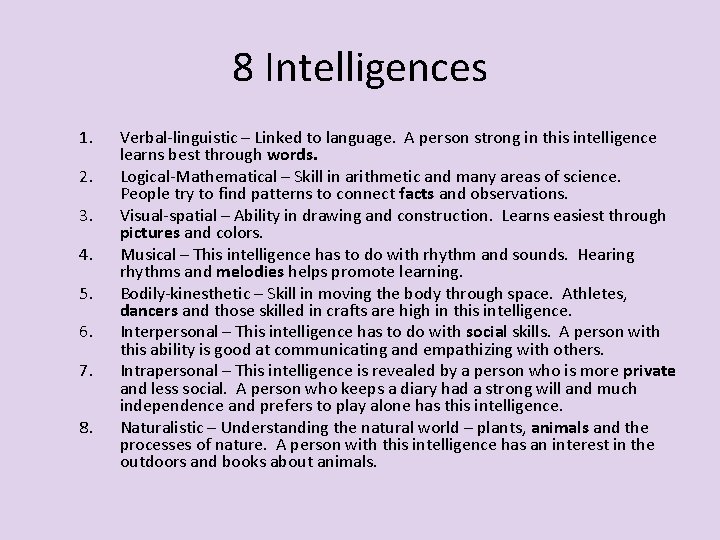
8 Intelligences 1. 2. 3. 4. 5. 6. 7. 8. Verbal-linguistic – Linked to language. A person strong in this intelligence learns best through words. Logical-Mathematical – Skill in arithmetic and many areas of science. People try to find patterns to connect facts and observations. Visual-spatial – Ability in drawing and construction. Learns easiest through pictures and colors. Musical – This intelligence has to do with rhythm and sounds. Hearing rhythms and melodies helps promote learning. Bodily-kinesthetic – Skill in moving the body through space. Athletes, dancers and those skilled in crafts are high in this intelligence. Interpersonal – This intelligence has to do with social skills. A person with this ability is good at communicating and empathizing with others. Intrapersonal – This intelligence is revealed by a person who is more private and less social. A person who keeps a diary had a strong will and much independence and prefers to play alone has this intelligence. Naturalistic – Understanding the natural world – plants, animals and the processes of nature. A person with this intelligence has an interest in the outdoors and books about animals.
Various Intelligences • Children have various intelligences and caregivers shouldn’t label a child as being one particular way and try to enhance that intelligence. • Recognizing the child’s strength can provide them with opportunities to challenge and interest their learning.
Helping Children Learn • • • Four, Five and Six year olds learn from everyday life experiences Talking to the child Giving encouragement Ask them questions Explain things to them in simple terms Asking for a child’s advice Taking trips and doing activities Taking a train, bus or plan can be an adventure Nature walks looking at the birds, flowers and trees Helping around the house Sharing tasks can develop responsibility, maturity and independence
Appreciating Reading • Developing an interest in reading is important • Books provide an opportunity to learn about the world and people • Child who enjoy reading with find it easier and more fun. • An important factor in learning to read is the ability to hear phonemes– the individual sounds in words. – Rhyming words helps develop this awareness – Develop awareness through alliteration – words that begin with the same sound. – Bilingual (ability to speak 2 languages) may make reading easier because they understand that printed words convey a particular meaning sooner than do children who speak one language.
Choosing Books • Young children love books and stories. Encouraging reading when they are young they will most likely enjoy reading as they grow older. • When choosing a book for children, use these questions to guide you: – – – – Are the pictures colorful, interesting and easy to understand? Will the story appeal to the child’s interests? Does the story include action that will hold the child’s interest? Will the child understand most of the words? Does the book use descriptive language that brings the story alive? Is the story short enough to read in one sitting? If you are considering buying the book is it made well to stand up under hard use? • Children enjoy stories about experiences that are different from their own, books with humor, funny rhymes and unusual situations.
Introducing Art and Music • Art helps children express their feelings, learn to control their body and show creativity. • Play dough, crayons, paper, paste, paint and scissors. Even dried macaroni can be strung into a necklace or pasted onto a sheet of construction paper to make a design. • Encourage children to experiment with art materials. Don’t criticize their work. • Asks the child to explain their picture rather than trying to guess what it is. • 3 to 6 year olds enjoy rhythm games and singing simple, repetitive songs. Children are often introduced to singing by finger plays, songs or chants with accompanying hand motions. “The Itsy-Bitsy Spider” is a finger play. • The opportunity to play simple instruments helps develop children’s interest in music.
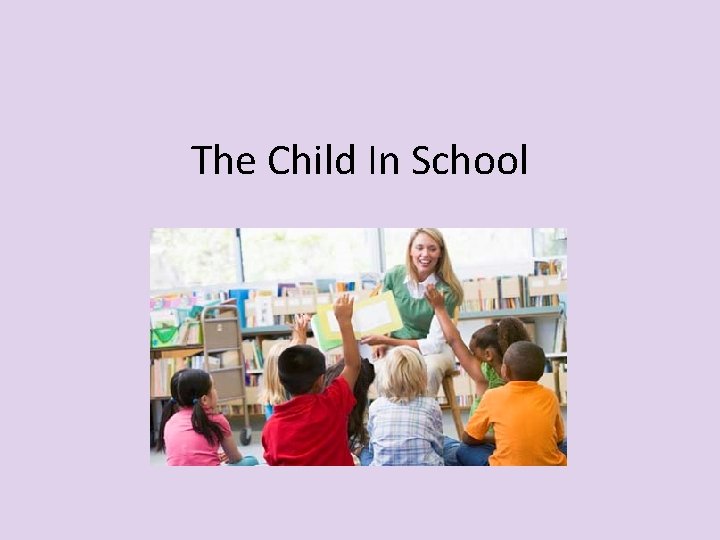
The Child In School
The Preschool Experience • Developing a positive attitude about school from the start is important • Preschool is intended for young children to become used to a school setting • Children learn skills such as paying attention, interacting with others and following directions • Parents need to show that children are healthy and have had all their immunizations to start preschool
Kindergarten • Most kindergarten programs used to be half day but are now full day in order to better prepare children for elementary school • Children make many adjustments when entering kindergarten such as riding a bus, no longer taking an afternoon nap and being in a building with older children
Preparing for Kindergarten • Before entering Kindergarten, children should: – Know their name, address and phone number – Know what to expect at school – Get plenty of rest at night for several weeks before school starts – Be allowed to choose a lunch box, back pack and outfit for the first day – Have a positive attitude about this new experience
Speech Development • A six year old should be able to understand use about 2, 500 words • A six year old should be able to articulate (pronounce clearly and distinctly) about 90% of the words they know correctly • Some sounds like j, ch, st, pl and sl require the coordination of the lips, tongue and throat muscles and may not be mastered until age 6 or later
Children with Special Needs • A learning disability is a problem in a person’s mental processes that prevents him or her from learning in a “normal” way • A common learning disability is Attention Deficit Hyperactivity Disorder or ADHD • A child with ADHD is not able to control his or her activity level or concentrate for an appropriate length of time
Children with Special Needs • Children with dyslexia often cannot understand printed symbols in a “normal” way. These children are usually of average intelligence but their brains don’t process some visual information normally. • 3%-10% of children in the US are gifted which means they have an unusually high level of intelligence or a special talent. These children can benefit from more challenging activities.
Imaginative Play • Make-believe play is when children act out situations using their imagination – Children can choose what they want to play and create a situation over which they have full control – In this pretend world they can be successful, feel important and gain confidence – They can make up their own rules and try new activities without fear of failure or ridicule – Children are able to try out different roles which helps them understand express their feelings
Imaginative Play • Dramatic play is when children act out what they see adults doing • Fantasy play includes activities like being a pirate or traveling to another planet • All types of pretend play should be encouraged and props such as kitchen equipment, a chalk board and dress up clothes can enhance the experience