
Intel Software Guard Extensions Intel SGX Dror Caspi





- Slides: 32
Intel® Software Guard Extensions (Intel® SGX) Dror Caspi Intel April 21, 2015 Copyright © 2015 Intel Corporation. All rights reserved. * Based on a presentation by Frank Mc. Keen, Intel Labs
Legal Disclaimers • The comments and statements are mine and not necessarily Intel’s • Intel technologies’ features and benefits depend on system configuration and may require enabled hardware, software or service activation. Learn more at intel. com, or from the OEM or retailer. • No computer system can be absolutely secure. 2
Outline • Problem Statement • Attack Surface and Overview • Programming environment – System programming view – Day in the life of an enclave • SGX Access Control & Off Chip protections • Attestation and Sealing • Developing with SGX • Summary 3
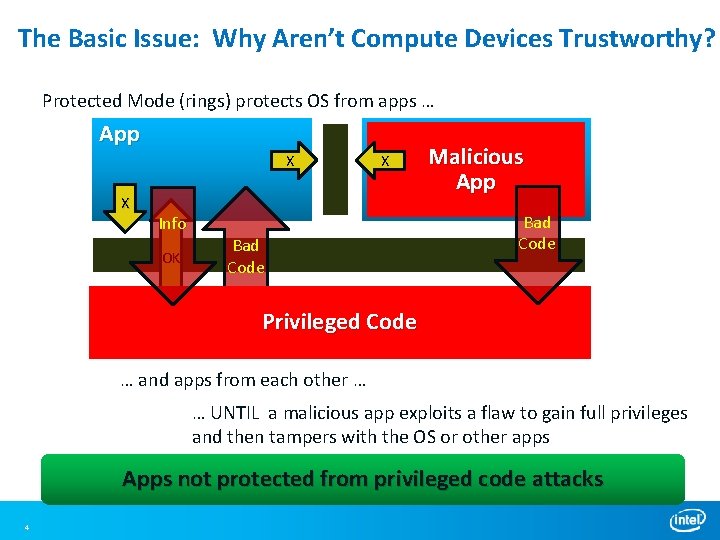
The Basic Issue: Why Aren’t Compute Devices Trustworthy? Protected Mode (rings) protects OS from apps … App X X Info OK X Bad Code Privileged Code Malicious App Bad Code attack … and apps from each other … … UNTIL a malicious app exploits a flaw to gain full privileges and then tampers with the OS or other apps Apps not protected from privileged code attacks 4
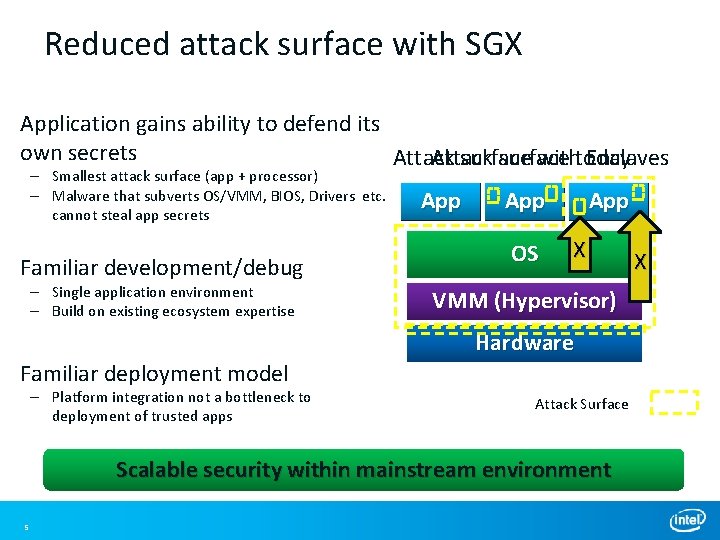
Reduced attack surface with SGX Application gains ability to defend its own secrets Attack surface withtoday Enclaves Attack surface – Smallest attack surface (app + processor) – Malware that subverts OS/VMM, BIOS, Drivers etc. cannot steal app secrets Familiar development/debug – Single application environment – Build on existing ecosystem expertise Proxy App OS Proxy App X VMM (Hypervisor) Hardware Familiar deployment model – Platform integration not a bottleneck to deployment of trusted apps Attack Surface Scalable security within mainstream environment 5 X
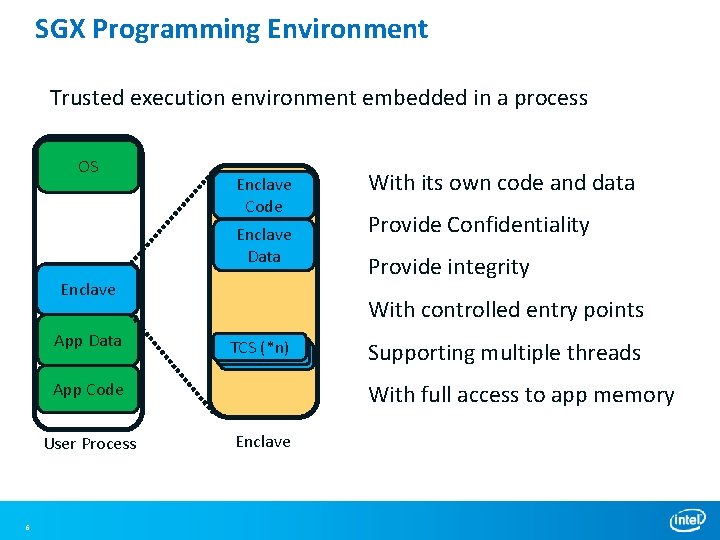
SGX Programming Environment Trusted execution environment embedded in a process OS Enclave Code Enclave Data Enclave App Data 6 Provide Confidentiality Provide integrity With controlled entry points TCS (*n) TCS(*n) App Code User Process With its own code and data Supporting multiple threads With full access to app memory Enclave
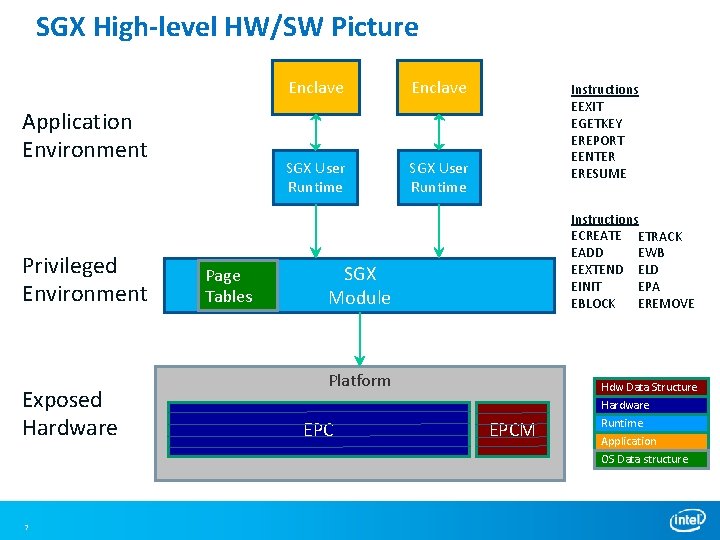
SGX High-level HW/SW Picture Application Environment Privileged Environment Exposed Hardware 7 Page Tables Enclave SGX User Runtime Instructions EEXIT EGETKEY EREPORT EENTER ERESUME Instructions ECREATE ETRACK EADD EWB EEXTEND ELD EINIT EPA EBLOCK EREMOVE SGX Module Platform EPCM Hdw Data Structure Hardware Runtime Application OS Data structure
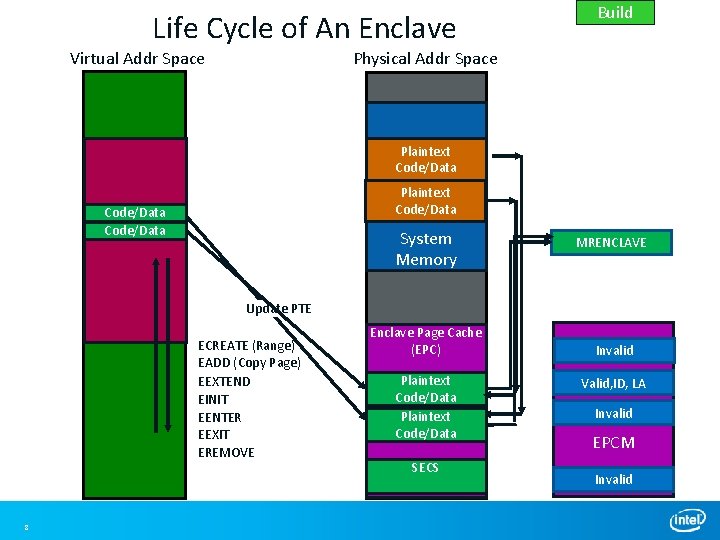
Life Cycle of An Enclave Virtual Addr Space Build Physical Addr Space Load Code/Data Plaintext Code/Data System Memory MRENCLAVE Update PTE ECREATE (Range) EADD (Copy Page) EEXTEND EINIT EENTER EEXIT EREMOVE 8 Enclave Page Cache (EPC) Plaintext Code/Data SECS Invalid Valid, ID, Invalid. LA EPCM Valid, SECS Invalid
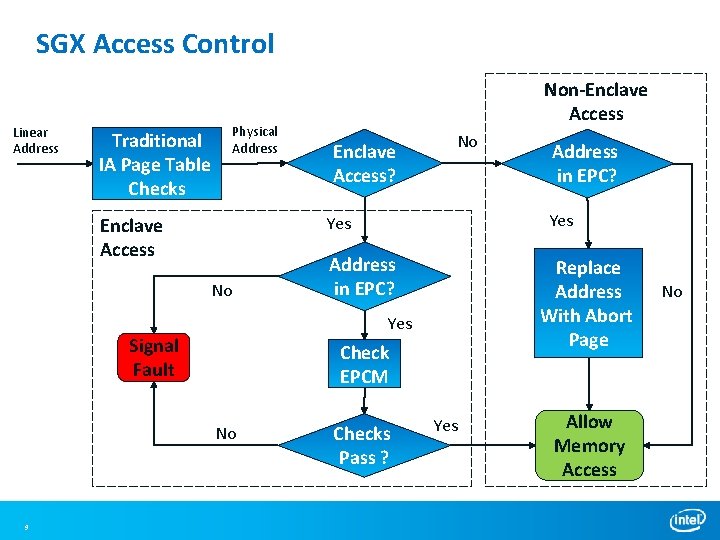
SGX Access Control Linear Address Traditional IA Page Table Checks Physical Address Enclave Access? No No Address in EPC? Replace Address With Abort Page Yes Signal Fault Check EPCM No Address in EPC? Yes Enclave Access 9 Non-Enclave Access Checks Pass ? Yes Allow Memory Access No
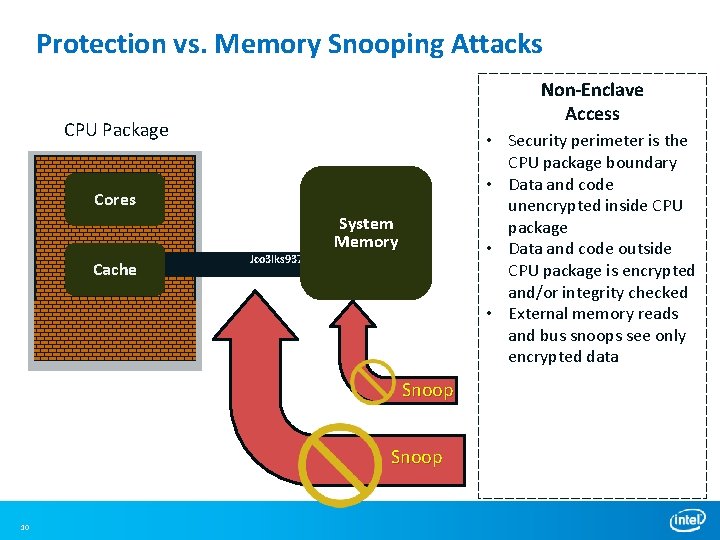
Protection vs. Memory Snooping Attacks Non-Enclave Access CPU Package Cores System Memory Cache Jco 3 lks 937 weu 0 cwejpoi 9987 v 80 we AMEX: 3234134584 -26864 Snoop 10 • Security perimeter is the CPU package boundary • Data and code unencrypted inside CPU package • Data and code outside CPU package is encrypted and/or integrity checked • External memory reads and bus snoops see only encrypted data
Outline • Problem Statement • Attack Surface and Overview • Programming environment – System programming view – Day in the life of an enclave • SGX Access Control & Off Chip protections • Attestation and Sealing • Developing with SGX • Summary 11
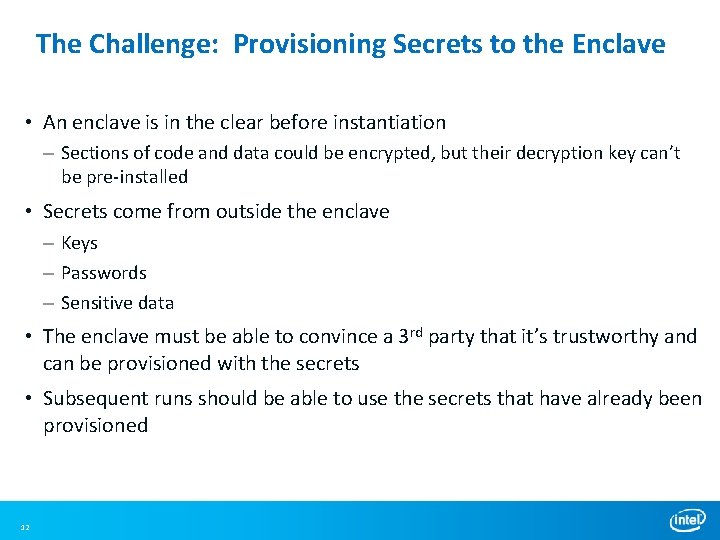
The Challenge: Provisioning Secrets to the Enclave • An enclave is in the clear before instantiation – Sections of code and data could be encrypted, but their decryption key can’t be pre-installed • Secrets come from outside the enclave – Keys – Passwords – Sensitive data • The enclave must be able to convince a 3 rd party that it’s trustworthy and can be provisioned with the secrets • Subsequent runs should be able to use the secrets that have already been provisioned 12
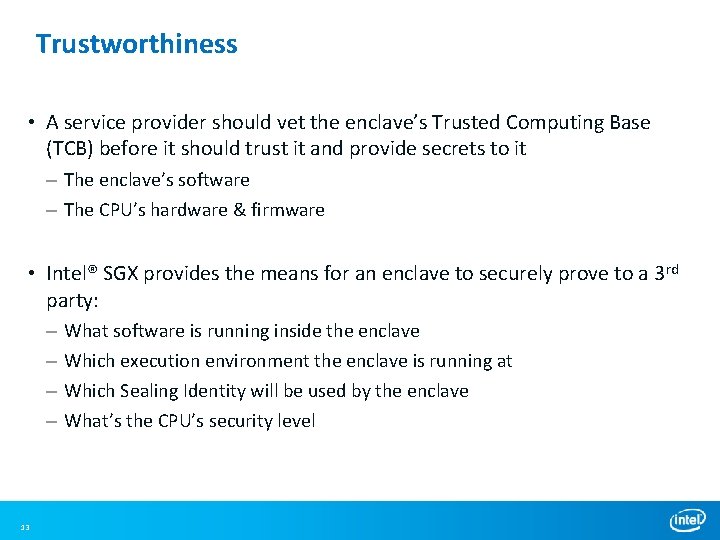
Trustworthiness • A service provider should vet the enclave’s Trusted Computing Base (TCB) before it should trust it and provide secrets to it – The enclave’s software – The CPU’s hardware & firmware • Intel® SGX provides the means for an enclave to securely prove to a 3 rd party: – – 13 What software is running inside the enclave Which execution environment the enclave is running at Which Sealing Identity will be used by the enclave What’s the CPU’s security level
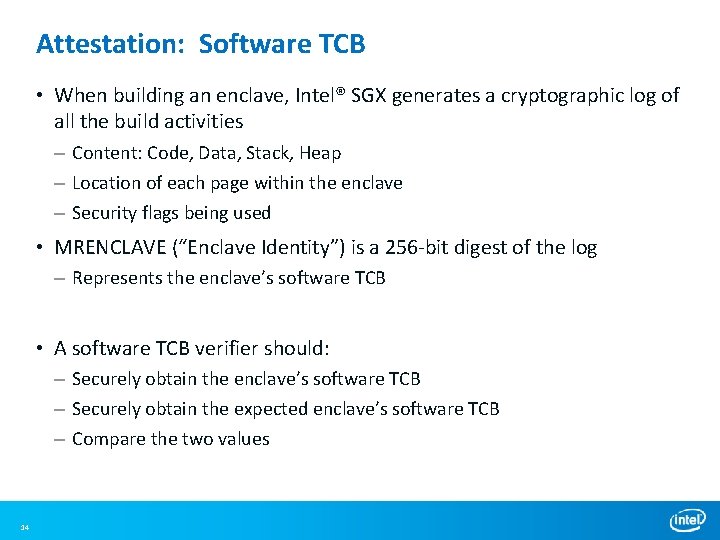
Attestation: Software TCB • When building an enclave, Intel® SGX generates a cryptographic log of all the build activities – Content: Code, Data, Stack, Heap – Location of each page within the enclave – Security flags being used • MRENCLAVE (“Enclave Identity”) is a 256 -bit digest of the log – Represents the enclave’s software TCB • A software TCB verifier should: – Securely obtain the enclave’s software TCB – Securely obtain the expected enclave’s software TCB – Compare the two values 14
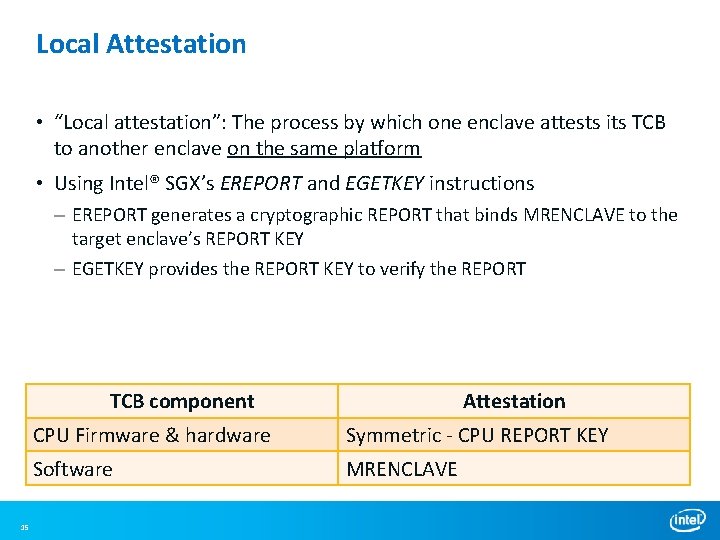
Local Attestation • “Local attestation”: The process by which one enclave attests its TCB to another enclave on the same platform • Using Intel® SGX’s EREPORT and EGETKEY instructions – EREPORT generates a cryptographic REPORT that binds MRENCLAVE to the target enclave’s REPORT KEY – EGETKEY provides the REPORT KEY to verify the REPORT TCB component 15 Attestation CPU Firmware & hardware Symmetric - CPU REPORT KEY Software MRENCLAVE
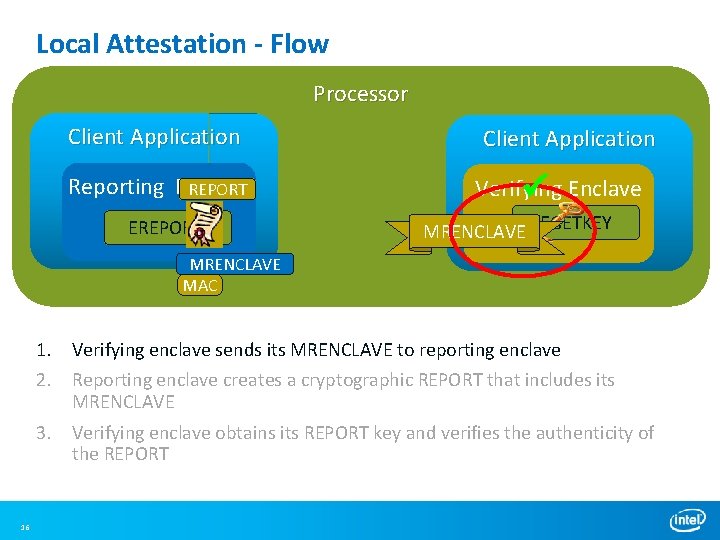
Local Attestation - Flow Processor Client Application Reporting Enclave REPORT EREPORT Client Application Verifying Enclave MRENCLAVE EGETKEY MRENCLAVE MAC 1. Verifying enclave sends its MRENCLAVE to reporting enclave 2. Reporting enclave creates a cryptographic REPORT that includes its MRENCLAVE 3. Verifying enclave obtains its REPORT key and verifies the authenticity of the REPORT 16
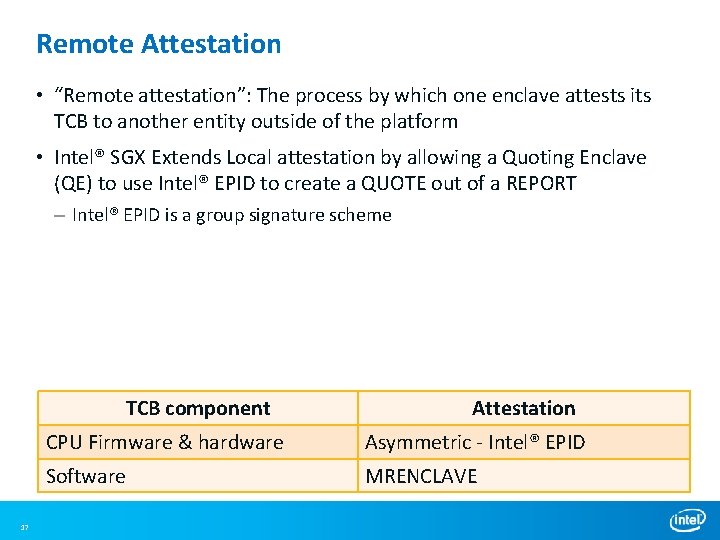
Remote Attestation • “Remote attestation”: The process by which one enclave attests its TCB to another entity outside of the platform • Intel® SGX Extends Local attestation by allowing a Quoting Enclave (QE) to use Intel® EPID to create a QUOTE out of a REPORT – Intel® EPID is a group signature scheme TCB component 17 Attestation CPU Firmware & hardware Asymmetric - Intel® EPID Software MRENCLAVE
Remote Attestation - Flow Enclave Platform Remote Platform QUOTE REPORT Quoting Enclave Verifying Application MRENCLAVE MAC EPID 1. Verifying enclave becomes the Quoting Enclave (QE). 2. After verifying the REPORT the, QE signs the REPORT with the EPID private key and converts it into a QUOTE 3. Remote platform verifies the QUOTE with the EPID public key and verifies MRENCLAVE against the expected value 18
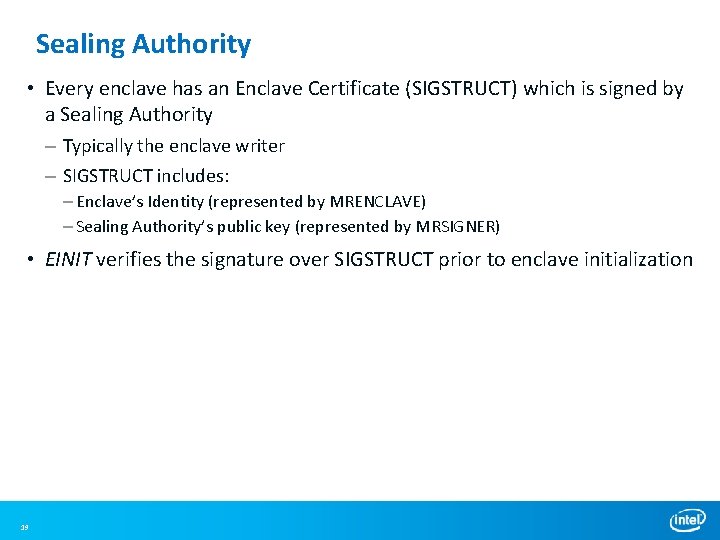
Sealing Authority • Every enclave has an Enclave Certificate (SIGSTRUCT) which is signed by a Sealing Authority – Typically the enclave writer – SIGSTRUCT includes: – Enclave’s Identity (represented by MRENCLAVE) – Sealing Authority’s public key (represented by MRSIGNER) • EINIT verifies the signature over SIGSTRUCT prior to enclave initialization 19
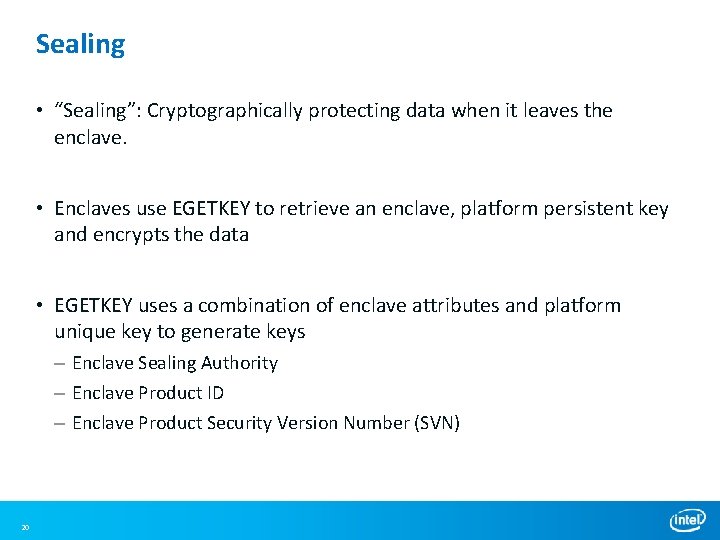
Sealing • “Sealing”: Cryptographically protecting data when it leaves the enclave. • Enclaves use EGETKEY to retrieve an enclave, platform persistent key and encrypts the data • EGETKEY uses a combination of enclave attributes and platform unique key to generate keys – Enclave Sealing Authority – Enclave Product ID – Enclave Product Security Version Number (SVN) 20
Example: Secure Transaction Remote Platform Client Application Enclave 2 1 QE EPID 3 4 1. Enclave built & measured against ISV’s signed certificate 2. Enclave calls EREPORT to obtain a REPORT that includes enclave specific data (ephemeral key) 3. REPORT & user data sent to Quoting Enclave who signs the REPORT with an EPID private key 4. QUOTE sent to server & verified 5. Ephemeral key used to create a trusted channel between enclave and remote server 6. Secret provisioned to enclave 7. Enclave calls EGETKEY to obtain the SEAL KEY 8. Secret is encrypted using SEAL KEY & stored for future use 21
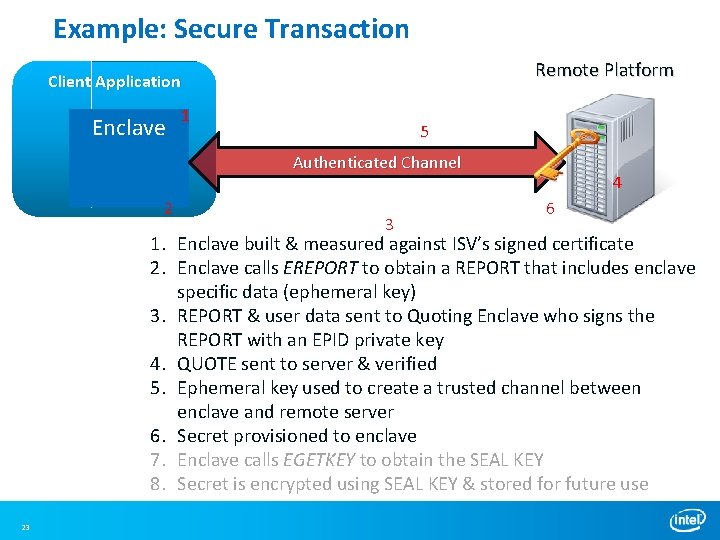
Example: Secure Transaction Remote Platform Client Application Enclave 1 QE 5 Authenticated Channel 2 EPID 3 4 1. Enclave built & measured against ISV’s signed certificate 2. Enclave calls EREPORT to obtain a REPORT that includes enclave specific data (ephemeral key) 3. REPORT & user data sent to Quoting Enclave who signs the REPORT with an EPID private key 4. QUOTE sent to server & verified 5. Ephemeral key used to create a trusted channel between enclave and remote server 6. Secret provisioned to enclave 7. Enclave calls EGETKEY to obtain the SEAL KEY 8. Secret is encrypted using SEAL KEY & stored for future use 22
Example: Secure Transaction Remote Platform Client Application Enclave 2 1 5 5 Authenticated Channel 3 4 6 1. Enclave built & measured against ISV’s signed certificate 2. Enclave calls EREPORT to obtain a REPORT that includes enclave specific data (ephemeral key) 3. REPORT & user data sent to Quoting Enclave who signs the REPORT with an EPID private key 4. QUOTE sent to server & verified 5. Ephemeral key used to create a trusted channel between enclave and remote server 6. Secret provisioned to enclave 7. Enclave calls EGETKEY to obtain the SEAL KEY 8. Secret is encrypted using SEAL KEY & stored for future use 23
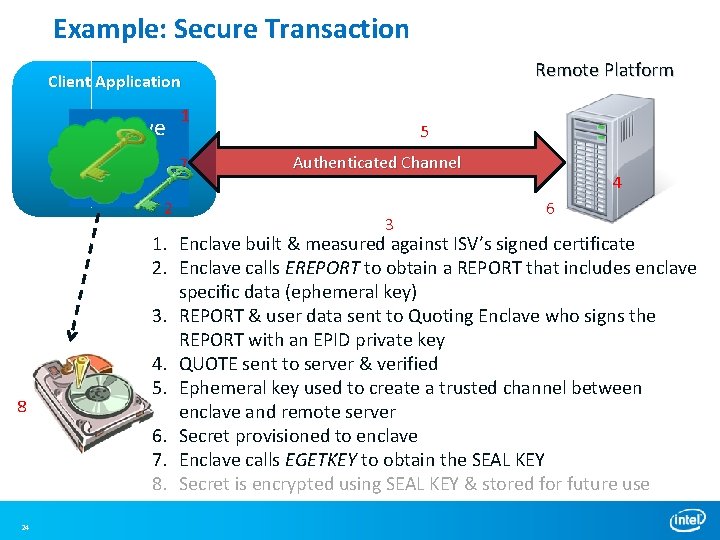
Example: Secure Transaction Remote Platform Client Application Enclave 2 8 24 1 5 7 5 Authenticated Channel 3 4 6 1. Enclave built & measured against ISV’s signed certificate 2. Enclave calls EREPORT to obtain a REPORT that includes enclave specific data (ephemeral key) 3. REPORT & user data sent to Quoting Enclave who signs the REPORT with an EPID private key 4. QUOTE sent to server & verified 5. Ephemeral key used to create a trusted channel between enclave and remote server 6. Secret provisioned to enclave 7. Enclave calls EGETKEY to obtain the SEAL KEY 8. Secret is encrypted using SEAL KEY & stored for future use
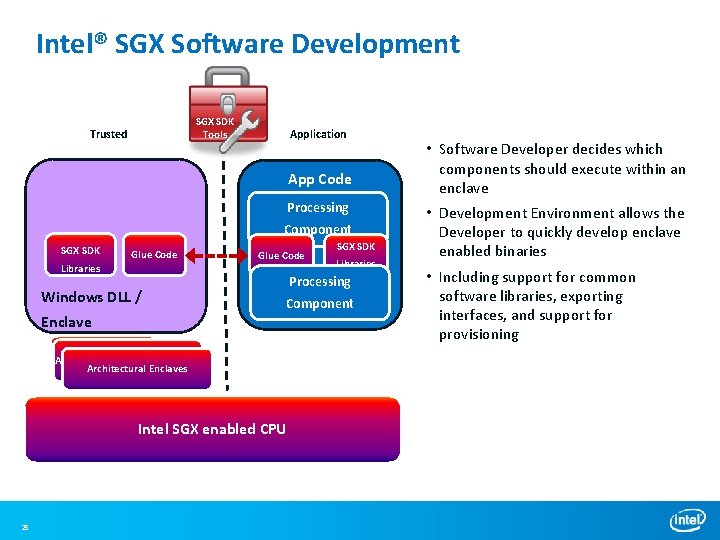
Intel® SGX Software Development SGX SDK Tools Trusted Application App Code Processing Component SGX SDK Glue Code Libraries Windows DLL / Glue Code Libraries Processing Component Enclave Architectural. Enclaves Architectural Enclaves Intel SGX enabled CPU 25 SGX SDK • Software Developer decides which components should execute within an enclave • Development Environment allows the Developer to quickly develop enclave enabled binaries • Including support for common software libraries, exporting interfaces, and support for provisioning
SGX Technical Summary • Provides any application the ability to keep a secret • Provide capability using new processor instructions • Application can support multiple enclaves • Provides integrity and confidentiality • Resists hardware attacks • Prevent software access, including privileged software and SMM • Applications run within OS environment • Low learning curve for application developers • Open to all developers • Resources managed by system software 26
Links • Intel’s SGX Page (Programming Reference, white papers & blogs): https: //software. intel. com/en-us/isa-extensions/intel-sgx • Joint research poster session: http: //sigops. org/sosp 13/ • Public Cloud Paper using SGX 2: https: //www. usenix. org/sites/default/files/osdi 14_full_proceedings. pdf • HASP Workshop: https: //sites. google. com/site/haspworkshop 2013/workshop-program • ISCA 2015 Tutorial: http: //sgxisca. weebly. com/ 27
Thank You 28
Backup 29
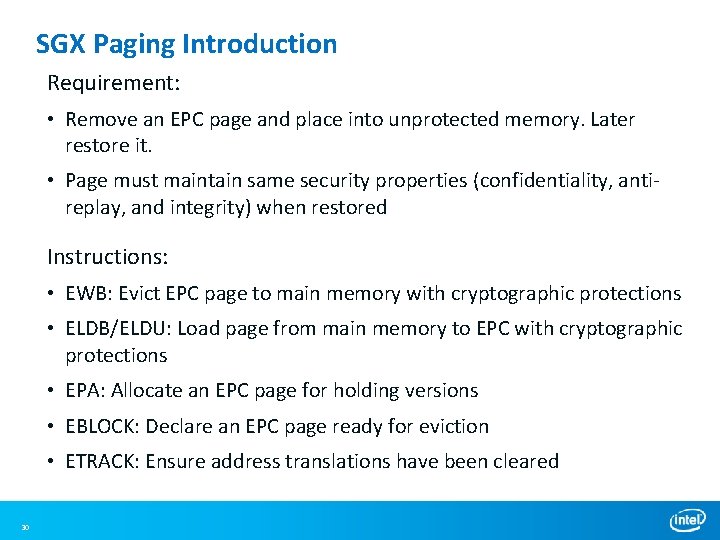
SGX Paging Introduction Requirement: • Remove an EPC page and place into unprotected memory. Later restore it. • Page must maintain same security properties (confidentiality, antireplay, and integrity) when restored Instructions: • EWB: Evict EPC page to main memory with cryptographic protections • ELDB/ELDU: Load page from main memory to EPC with cryptographic protections • EPA: Allocate an EPC page for holding versions • EBLOCK: Declare an EPC page ready for eviction • ETRACK: Ensure address translations have been cleared 30
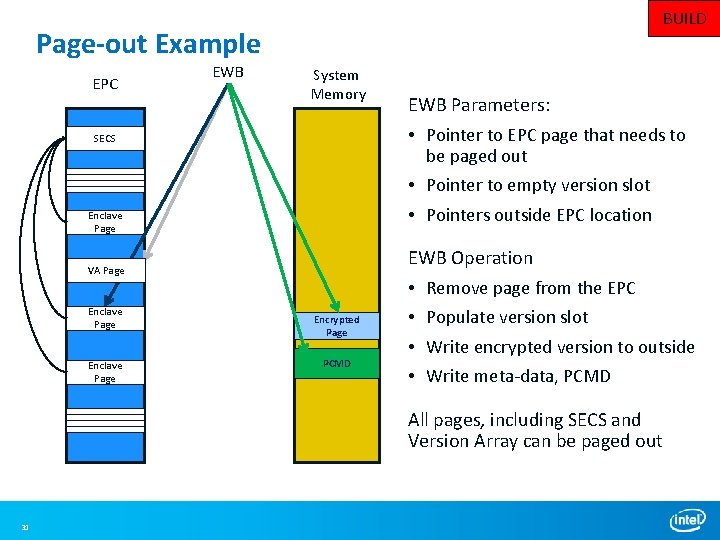
BUILD Page-out Example EPC EWB System Memory SECS EWB Parameters: • Pointer to EPC page that needs to be paged out • Pointer to empty version slot • Pointers outside EPC location Enclave Page VER VA Page Enclave Page Encrypted Page PCMD EWB Operation • Remove page from the EPC • Populate version slot • Write encrypted version to outside • Write meta-data, PCMD All pages, including SECS and Version Array can be paged out 31
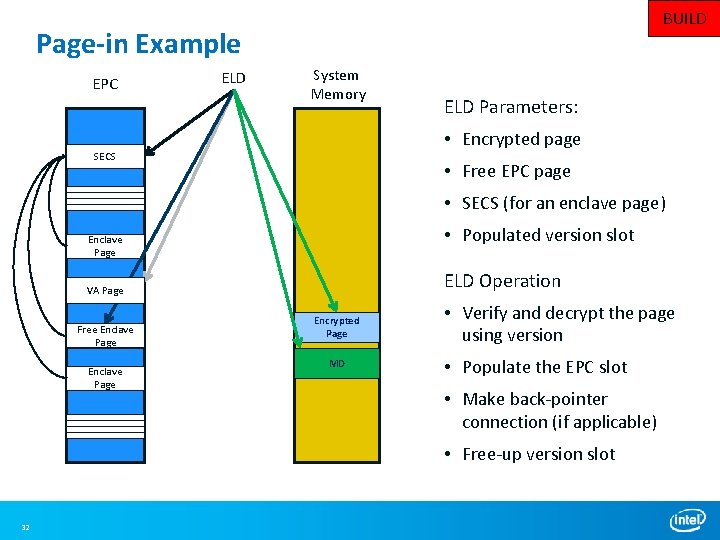
BUILD Page-in Example EPC ELD System Memory ELD Parameters: • Encrypted page SECS • Free EPC page • SECS (for an enclave page) • Populated version slot Enclave Page ELD Operation VER VA Page Free Enclave Page Encrypted Page MD • Verify and decrypt the page using version • Populate the EPC slot • Make back-pointer connection (if applicable) • Free-up version slot 32