
Intel Logistics Siddharth CoelhoPrabhu Arpit Dharia Akshay Kotak
Intel Logistics Siddharth Coelho-Prabhu Arpit Dharia Akshay Kotak Jason Kumar Shyam Mehta Ranjini Ragunathan April 16, 2008 Disclaimer: This document has been created in the framework of a student project and the Georgia Institute of Technology does not sanction its content.
Agenda • Problem Description • Methodology • Single echelon model • Multi-echelon model • Optimal supply rate • Sensitivity and scenario analysis • Deliverables and potential value Disclaimer: This document has been created in the framework of a student project and the Georgia Institute of Technology does not sanction its content. 2
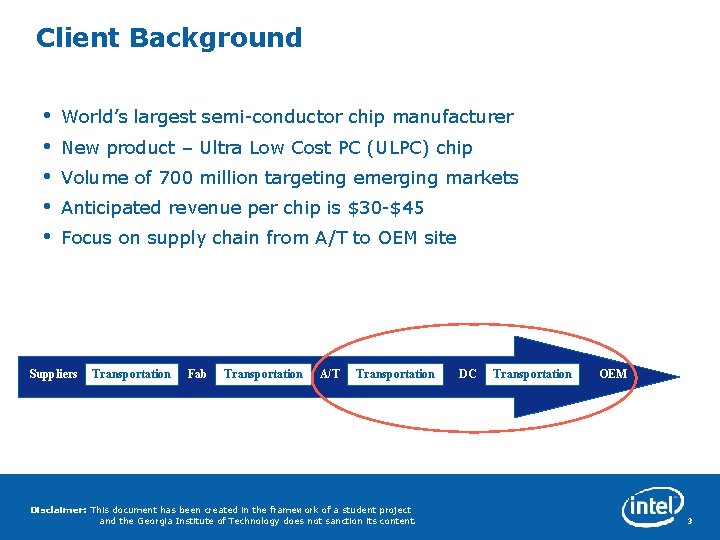
Client Background • • • World’s largest semi-conductor chip manufacturer New product – Ultra Low Cost PC (ULPC) chip Volume of 700 million targeting emerging markets Anticipated revenue per chip is $30 -$45 Focus on supply chain from A/T to OEM site Suppliers Transportation Fab Transportation A/T Transportation Disclaimer: This document has been created in the framework of a student project and the Georgia Institute of Technology does not sanction its content. DC Transportation OEM 3
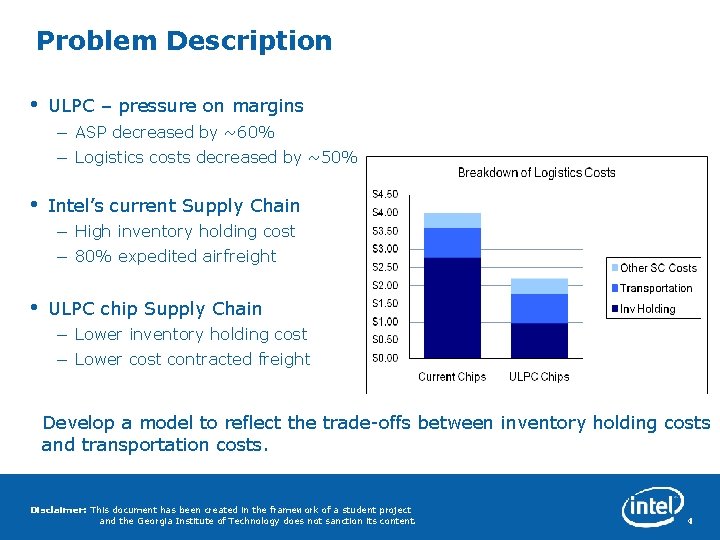
Problem Description • ULPC – pressure on margins – – • Logistics costs decreased by ~50% Intel’s current Supply Chain – – • ASP decreased by ~60% High inventory holding cost 80% expedited airfreight ULPC chip Supply Chain – – Lower inventory holding cost Lower cost contracted freight Develop a model to reflect the trade-offs between inventory holding costs and transportation costs. Disclaimer: This document has been created in the framework of a student project and the Georgia Institute of Technology does not sanction its content. 4
Objective Provide intuition and tools to support strategic decisions involved in designing a supply network with two modes of transportation within a single lane. Key points • Strategic vs. operational focus • Regular and expedited transportation • Single and multi-echelon system Disclaimer: This document has been created in the framework of a student project and the Georgia Institute of Technology does not sanction its content. 5
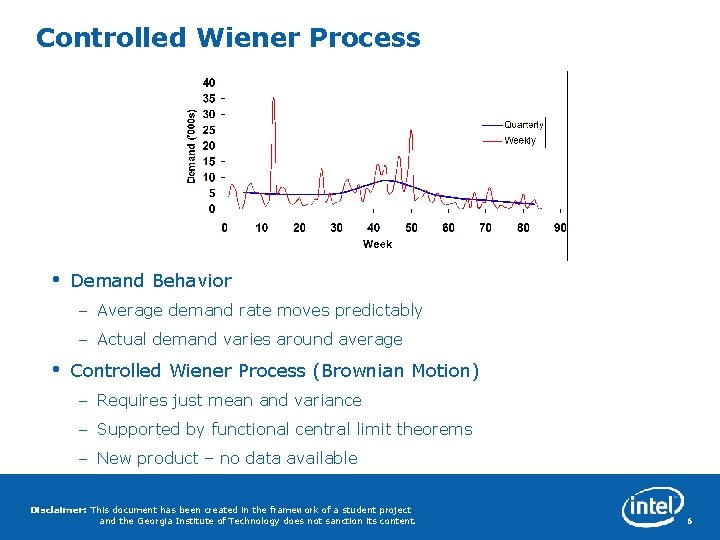
Controlled Wiener Process • Demand Behavior – Average demand rate moves predictably – Actual demand varies around average • Controlled Wiener Process (Brownian Motion) – Requires just mean and variance – Supported by functional central limit theorems – New product – no data available Disclaimer: This document has been created in the framework of a student project and the Georgia Institute of Technology does not sanction its content. 6
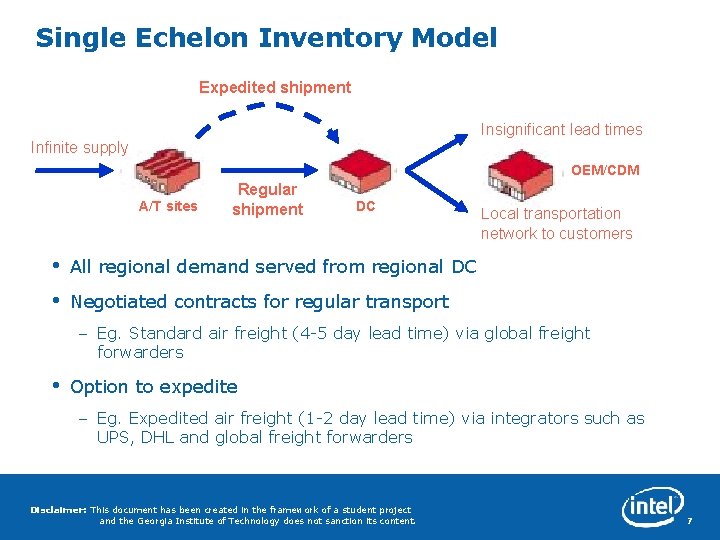
Single Echelon Inventory Model Expedited shipment Insignificant lead times Infinite supply OEM/CDM A/T sites Regular shipment DC • All regional demand served from regional DC • Negotiated contracts for regular transport Local transportation network to customers – Eg. Standard air freight (4 -5 day lead time) via global freight forwarders • Option to expedite – Eg. Expedited air freight (1 -2 day lead time) via integrators such as UPS, DHL and global freight forwarders Disclaimer: This document has been created in the framework of a student project and the Georgia Institute of Technology does not sanction its content. 7
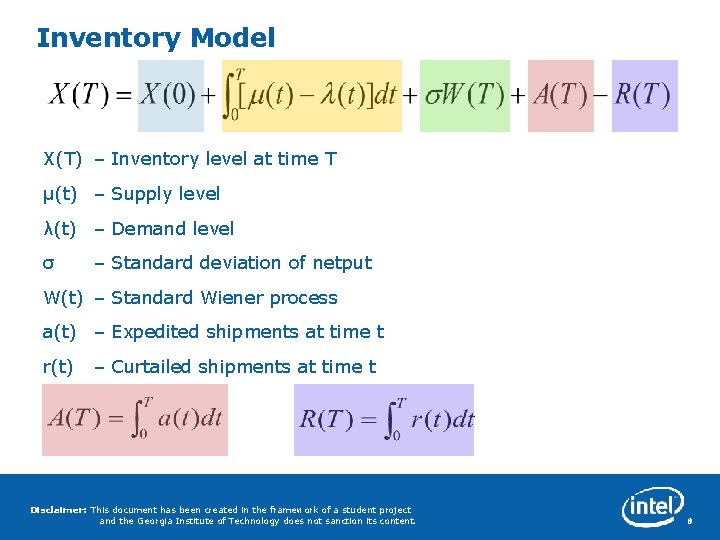
Inventory Model X(T) – Inventory level at time T µ(t) – Supply level λ(t) – Demand level σ – Standard deviation of netput W(t) – Standard Wiener process a(t) – Expedited shipments at time t r(t) – Curtailed shipments at time t Disclaimer: This document has been created in the framework of a student project and the Georgia Institute of Technology does not sanction its content. 8
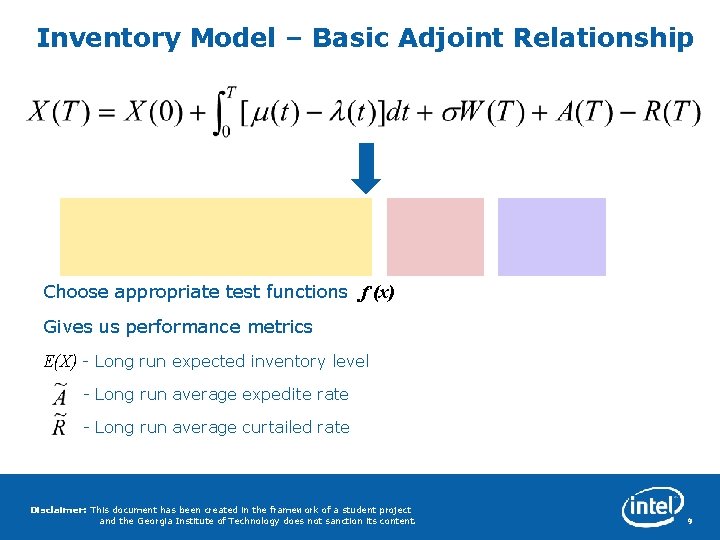
Inventory Model – Basic Adjoint Relationship Choose appropriate test functions f (x) Gives us performance metrics E(X) - Long run expected inventory level - Long run average expedite rate - Long run average curtailed rate Disclaimer: This document has been created in the framework of a student project and the Georgia Institute of Technology does not sanction its content. 9
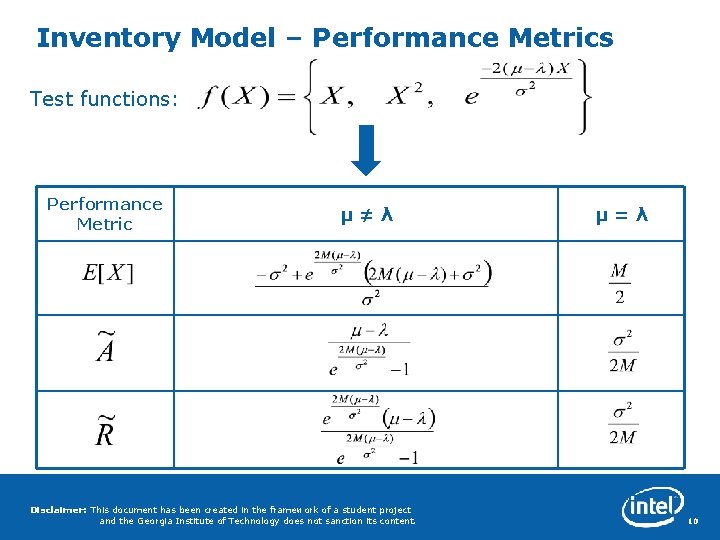
Inventory Model – Performance Metrics Test functions: Performance Metric µ≠λ Disclaimer: This document has been created in the framework of a student project and the Georgia Institute of Technology does not sanction its content. µ=λ 10
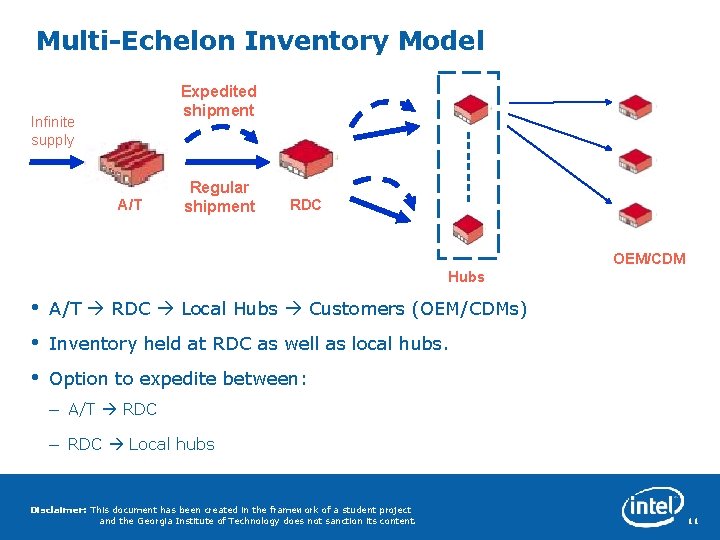
Multi-Echelon Inventory Model Expedited shipment Infinite supply A/T Regular shipment RDC OEM/CDM Hubs • A/T RDC Local Hubs Customers (OEM/CDMs) • Inventory held at RDC as well as local hubs. • Option to expedite between: – A/T RDC – RDC Local hubs Disclaimer: This document has been created in the framework of a student project and the Georgia Institute of Technology does not sanction its content. 11
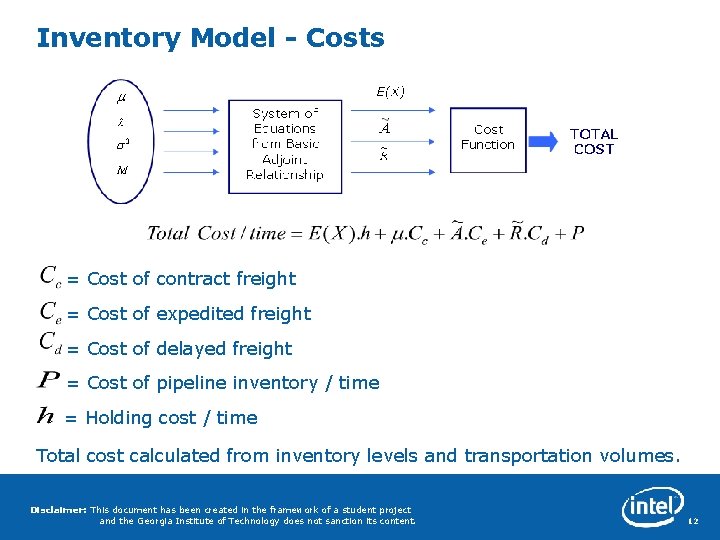
Inventory Model - Costs = Cost of contract freight = Cost of expedited freight = Cost of delayed freight = Cost of pipeline inventory / time = Holding cost / time Total cost calculated from inventory levels and transportation volumes. Disclaimer: This document has been created in the framework of a student project and the Georgia Institute of Technology does not sanction its content. 12
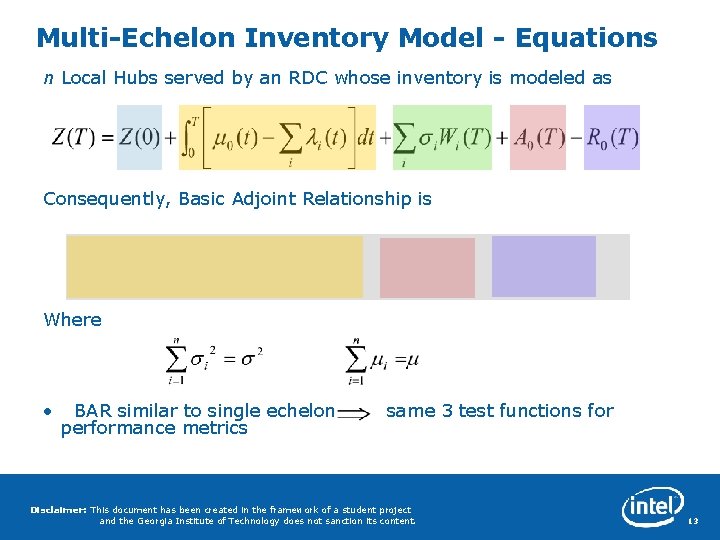
Multi-Echelon Inventory Model - Equations n Local Hubs served by an RDC whose inventory is modeled as Consequently, Basic Adjoint Relationship is Where • BAR similar to single echelon performance metrics same 3 test functions for Disclaimer: This document has been created in the framework of a student project and the Georgia Institute of Technology does not sanction its content. 13
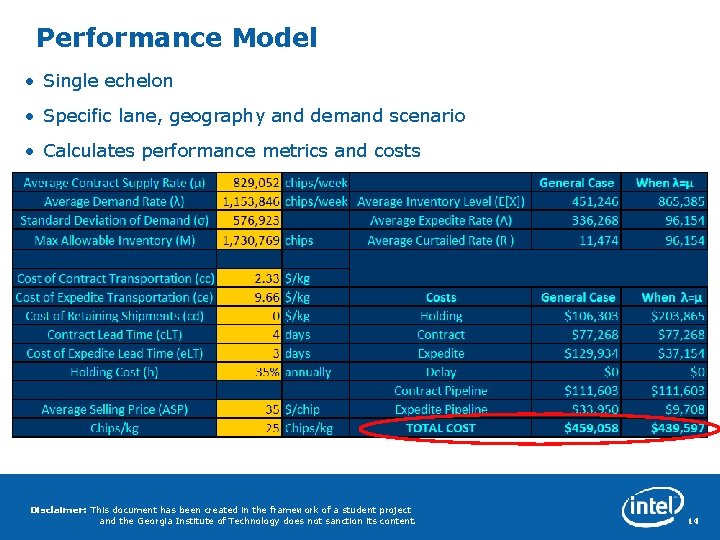
Performance Model • Single echelon • Specific lane, geography and demand scenario • Calculates performance metrics and costs Disclaimer: This document has been created in the framework of a student project and the Georgia Institute of Technology does not sanction its content. 14
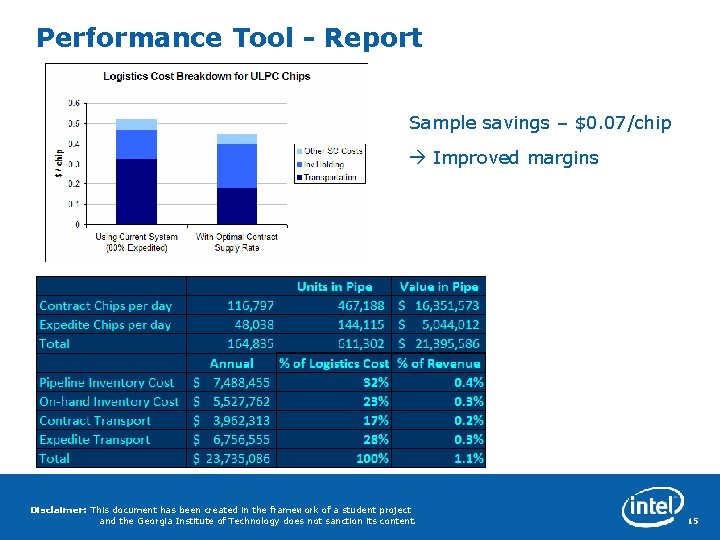
Performance Tool - Report Sample savings – $0. 07/chip Improved margins Disclaimer: This document has been created in the framework of a student project and the Georgia Institute of Technology does not sanction its content. 15
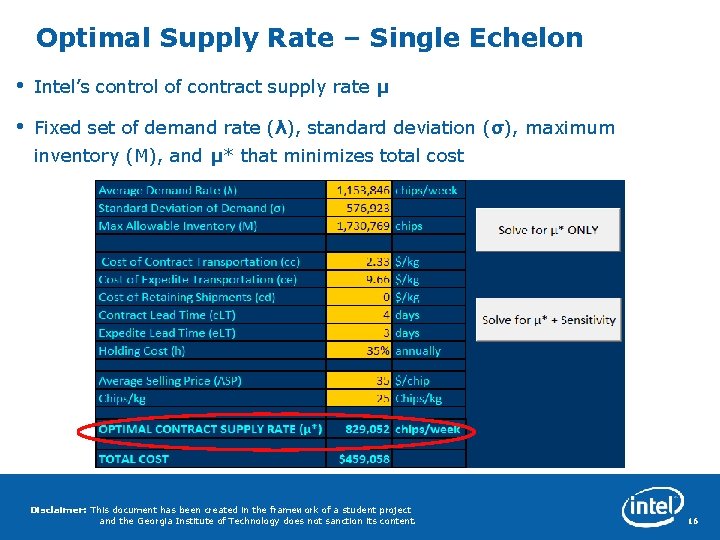
Optimal Supply Rate – Single Echelon • Intel’s control of contract supply rate μ • Fixed set of demand rate (λ), standard deviation (σ), maximum inventory (M), and μ* that minimizes total cost Disclaimer: This document has been created in the framework of a student project and the Georgia Institute of Technology does not sanction its content. 16
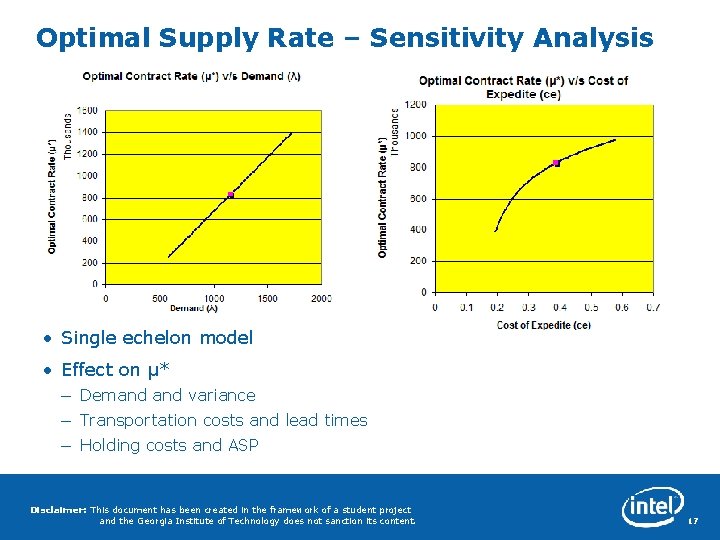
Optimal Supply Rate – Sensitivity Analysis • Single echelon model • Effect on µ* – – – Demand variance Transportation costs and lead times Holding costs and ASP Disclaimer: This document has been created in the framework of a student project and the Georgia Institute of Technology does not sanction its content. 17
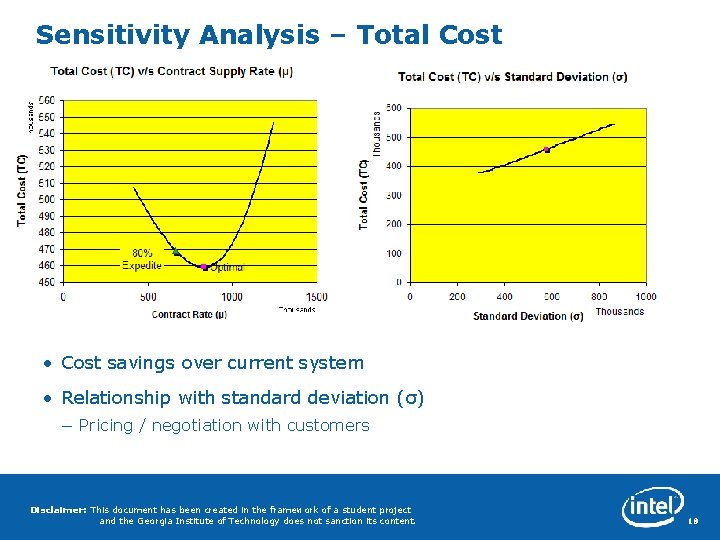
Sensitivity Analysis – Total Cost • Cost savings over current system • Relationship with standard deviation (σ) – Pricing / negotiation with customers Disclaimer: This document has been created in the framework of a student project and the Georgia Institute of Technology does not sanction its content. 18
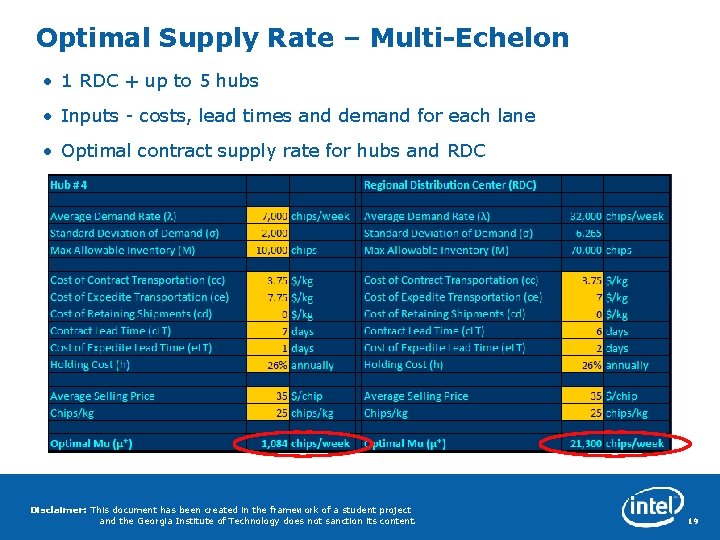
Optimal Supply Rate – Multi-Echelon • 1 RDC + up to 5 hubs • Inputs - costs, lead times and demand for each lane • Optimal contract supply rate for hubs and RDC Disclaimer: This document has been created in the framework of a student project and the Georgia Institute of Technology does not sanction its content. 19
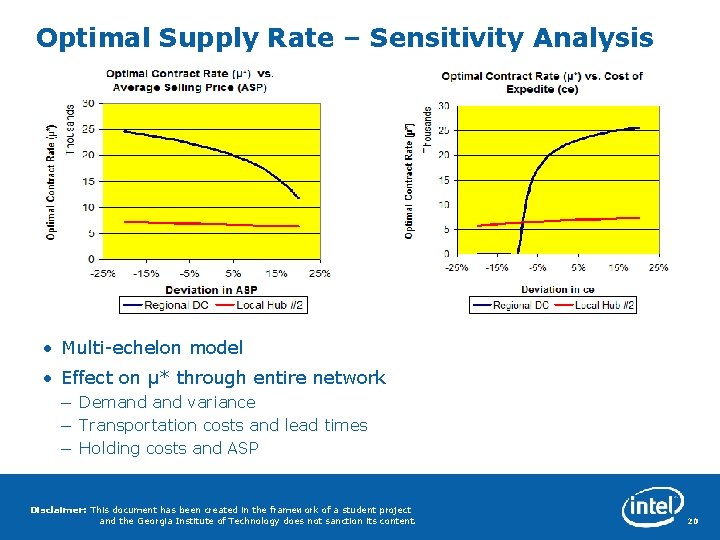
Optimal Supply Rate – Sensitivity Analysis • Multi-echelon model • Effect on µ* through entire network – – – Demand variance Transportation costs and lead times Holding costs and ASP Disclaimer: This document has been created in the framework of a student project and the Georgia Institute of Technology does not sanction its content. 20
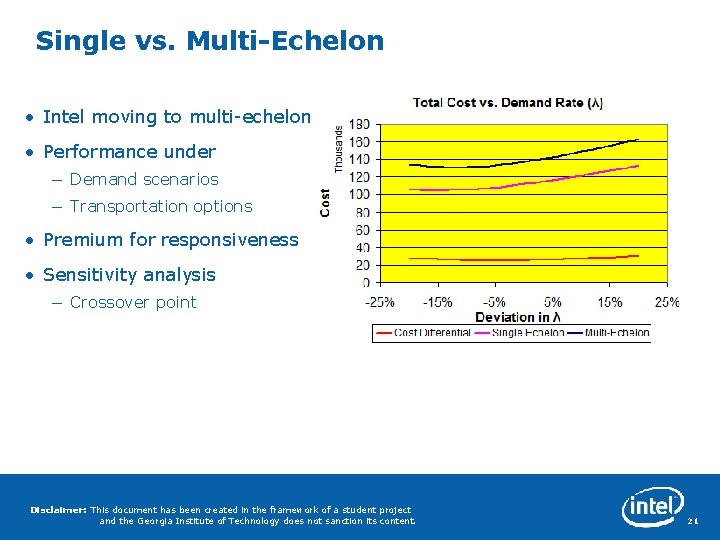
Single vs. Multi-Echelon • Intel moving to multi-echelon • Performance under – – Demand scenarios Transportation options • Premium for responsiveness • Sensitivity analysis – Crossover point Disclaimer: This document has been created in the framework of a student project and the Georgia Institute of Technology does not sanction its content. 21
Simulation Model • Validate assumptions – Enriches theoretical model • Adds stochastic lead times • Finite product life-cycle • Does not assume constant supply rate – Verify real-world applicability • Single and multi-echelon models • Scenario analysis – Lifecycle testing – Specific lanes Disclaimer: This document has been created in the framework of a student project and the Georgia Institute of Technology does not sanction its content. 22
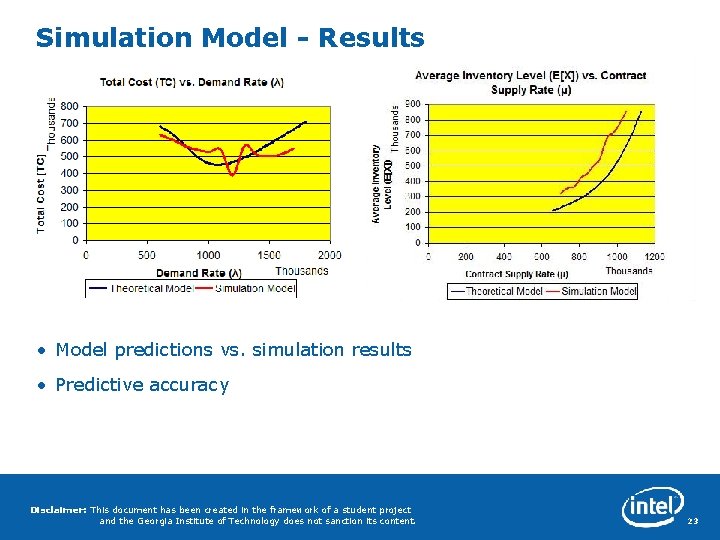
Simulation Model - Results • Model predictions vs. simulation results • Predictive accuracy Disclaimer: This document has been created in the framework of a student project and the Georgia Institute of Technology does not sanction its content. 23
Scenario Analysis • Plan transportation strategy – Optimal contract supply rate • Across product life cycle – – Ramp up, peak, ramp down Changes in demand, variance and holding rate • Specific lanes – – Penang New Delhi Costa Rica Bangkok Manila Singapore Shanghai New Delhi Disclaimer: This document has been created in the framework of a student project and the Georgia Institute of Technology does not sanction its content. 24
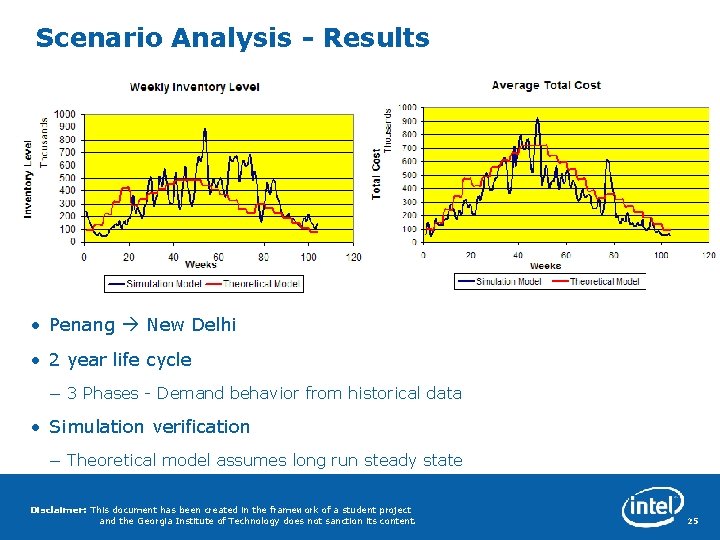
Scenario Analysis - Results • Penang New Delhi • 2 year life cycle – 3 Phases - Demand behavior from historical data • Simulation verification – Theoretical model assumes long run steady state Disclaimer: This document has been created in the framework of a student project and the Georgia Institute of Technology does not sanction its content. 25
Additional Applications • Transportation mode viability – – Multiple transportation options in given geography Infer viability from optimal supply rate • Integration with high ASP supply chain – – ULPC product through current high value network Current high value product through ULPC network Disclaimer: This document has been created in the framework of a student project and the Georgia Institute of Technology does not sanction its content. 26
Deliverables • Tools – Single echelon performance model – Single echelon optimal contract supply rate tool – Multi-echelon optimal contract supply rate tool – Single vs. multi-echelon comparison tool • • • Output interpretation manual Scenario analysis Report - key characteristics of low-cost supply chain Disclaimer: This document has been created in the framework of a student project and the Georgia Institute of Technology does not sanction its content. 27
Potential Value • • Improve margins Flexible model – Within the model itself – Across various configurations • Inform strategic decision making – Configuration of distribution network – Understanding of transportation requirements – Help negotiation with freight forwarders • Trade-offs – Between inventory holding cost and transportation cost – Service levels and supply chain costs Disclaimer: This document has been created in the framework of a student project and the Georgia Institute of Technology does not sanction its content. 28
Summary • Focus - inventory holding vs. transportation costs • Inventory model - controlled Wiener process • Single echelon and multi-echelon models • Performance model • Optimal contract rate models • Sensitivity analysis • Validate through simulation • Single echelon vs. multi-echelon comparison • Potential value Disclaimer: This document has been created in the framework of a student project and the Georgia Institute of Technology does not sanction its content. 29

Questions? Disclaimer: This document has been created in the framework of a student project and the Georgia Institute of Technology does not sanction its content. 30
- Slides: 30