
Integumentary System and Pathologies Chapter 22 Copyright 2020

![Postcentral Gyrus (From Cramer, G. D. , & Darby, S. A. [2014]. Clinical anatomy](https://slidetodoc.com/presentation_image_h2/bf5f71df464deeb73b7019bb0997c87b/image-33.jpg "Postcentral Gyrus (From Cramer, G. D. , & Darby, S. A. [2014]. Clinical anatomy")

- Slides: 43
Integumentary System and Pathologies Chapter 22 Copyright © 2020 by Elsevier Inc. All rights reserved. 1
Learning Objectives Lesson 22. 1: Integumentary System and Pathologies 1. 2. 3. List anatomic structures and physiologic processes related to the integumentary system, and describe the epidermis, and subcutaneous layer. Discuss skin color, hair, nails, skin glands, thermoregulation, and skin receptors. Describe dermatologic pathologies and state their massage modifications. Copyright © 2020 by Elsevier Inc. All rights reserved. 2
Introduction Skin is largest and heaviest organ Ø 7% of body weight Skin is self-repairing and provides a protective barrier Natural openings create passageways to digestive, respiratory, urinary, and reproductive systems Dermatology: study of integumentary system Copyright © 2020 by Elsevier Inc. All rights reserved. 3
Anatomy Skin Hair Nails Skin glands Copyright © 2020 by Elsevier Inc. All rights reserved. 4
Physiology Protection Immunity Absorption Sensation Temperature regulation Excretion Vitamin D synthesis Copyright © 2020 by Elsevier Inc. All rights reserved. 5
Epidermis Outer region Composed of epithelial tissue Relatively avascular Ø Nutrients provided by tissue fluids Derived from ectoderm Ø Embryonic cell layer also forming brain, spinal cord, and special senses Copyright © 2020 by Elsevier Inc. All rights reserved. 6
Epidermal Cells: Melanocytes Produces dark pigment called melanin Ø Ø Sunlight stimulates melanin production, which creates a shield against UV radiation Amount produced influenced by genetics, hormones, and environmental factors, including exposure to sunlight Copyright © 2020 by Elsevier Inc. All rights reserved. 7
Epidermal Cells: Keratinocytes Produced in stratum basale (germinativum) Ø Deepest epidermal layer As keratinocytes are pushed upward, they receive fewer nutrients, stop dividing, and expire Ø Ø Vesicles within keratinocytes begin secreting keratin Keratin mixes with skin oils, forming an epidermal water barrier • This waterproofs skin by reducing water loss Copyright © 2020 by Elsevier Inc. All rights reserved. 8
Epidermal Cells: Desquamation Epidermal cells are completely keratinized when they reach skin’s surface Desquamate: sloughing off keratinized, or dead, skin cells Rate of cell formation and desquamation is same Ø Helps maintain skin thickness Process occurs approximately every 21 to 27 days over a lifetime Copyright © 2020 by Elsevier Inc. All rights reserved. 9
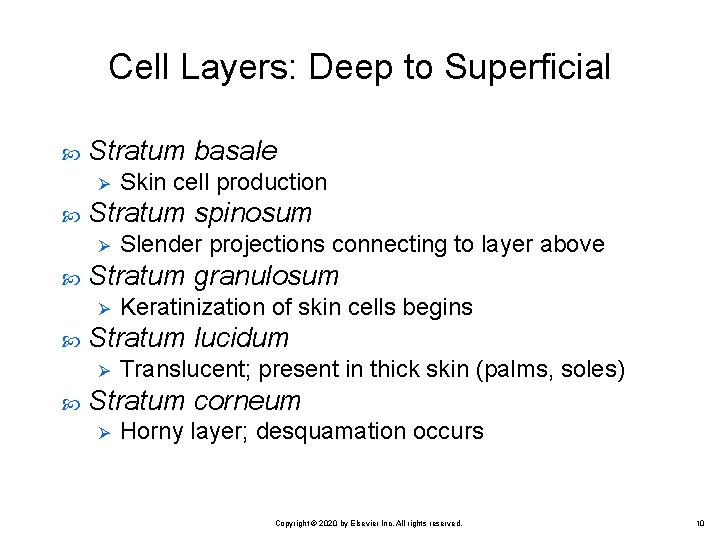
Cell Layers: Deep to Superficial Stratum basale Ø Stratum spinosum Ø Keratinization of skin cells begins Stratum lucidum Ø Slender projections connecting to layer above Stratum granulosum Ø Skin cell production Translucent; present in thick skin (palms, soles) Stratum corneum Ø Horny layer; desquamation occurs Copyright © 2020 by Elsevier Inc. All rights reserved. 10
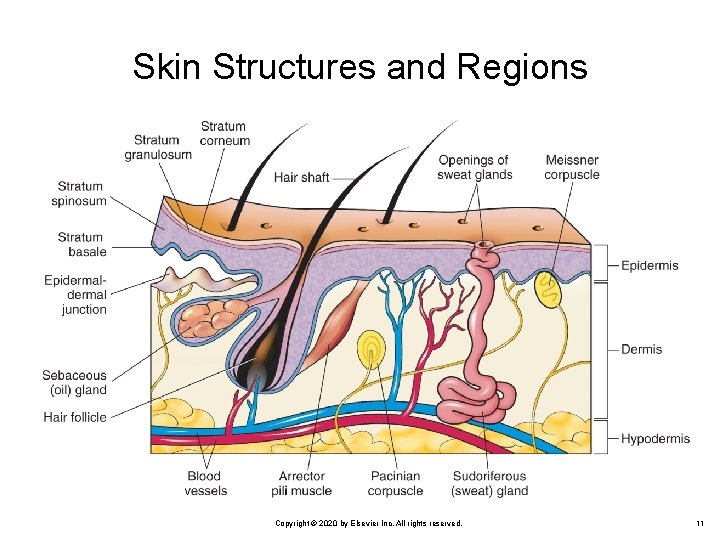
Skin Structures and Regions Copyright © 2020 by Elsevier Inc. All rights reserved. 11
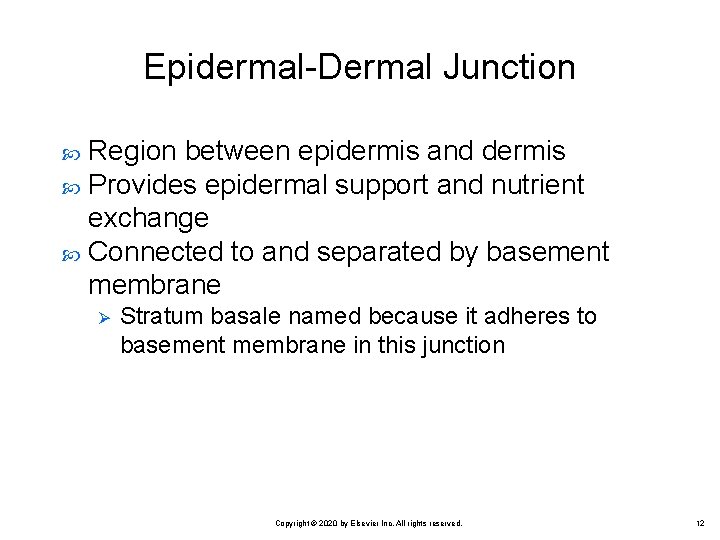
Epidermal-Dermal Junction Region between epidermis and dermis Provides epidermal support and nutrient exchange Connected to and separated by basement membrane Ø Stratum basale named because it adheres to basement membrane in this junction Copyright © 2020 by Elsevier Inc. All rights reserved. 12
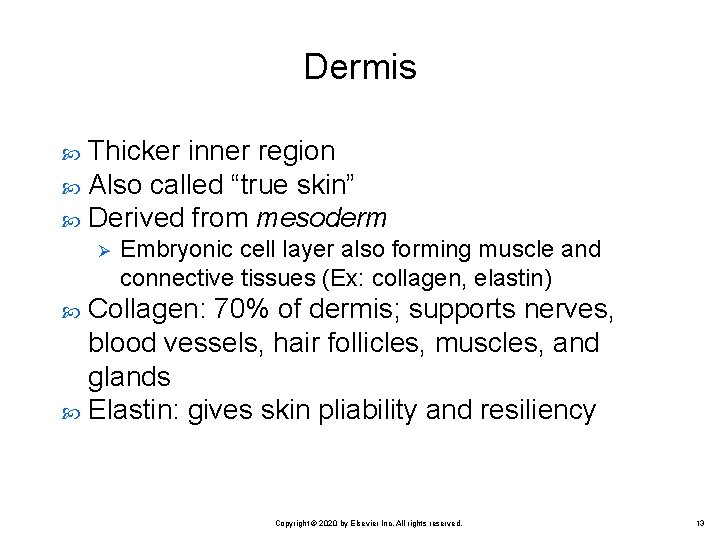
Dermis Thicker inner region Also called “true skin” Derived from mesoderm Ø Embryonic cell layer also forming muscle and connective tissues (Ex: collagen, elastin) Collagen: 70% of dermis; supports nerves, blood vessels, hair follicles, muscles, and glands Elastin: gives skin pliability and resiliency Copyright © 2020 by Elsevier Inc. All rights reserved. 13
Dermal Growth and Repair Does not continually shed and regenerate like cells in epidermis Ø Ø When injured, fibroblasts reproduce and form a scar When overstretched, elastic fibers may tear and from a stretch mark Copyright © 2020 by Elsevier Inc. All rights reserved. 14
Subcutaneous Layer Deep to dermis Ø Also called hypodermis or superficial fascia • When this layer extends inward, it is called deep fascia Anchors skin to underlying structures Consists of: Ø Ø Loose connective tissue Adipose tissue Nerves Blood vessels Copyright © 2020 by Elsevier Inc. All rights reserved. 15
Skin Color (Slide 1 of 4) Ranges from almost black to nearly colorless Determined by: Ø Ø Ø Genetics Physiology Emotions Disease processes Diet Copyright © 2020 by Elsevier Inc. All rights reserved. 16
Skin Color (Slide 2 of 4) Freckles, moles, age spots: melanin concentrated in one or more areas Albinism: inability to produce melanin Vitiligo: partial/total loss of pigmentation Hyperpigmentation from pregnancy hormones Ø Ø Linea nigra: line between navel and pubic area Melasma: darkening of facial skin • Mask of pregnancy Copyright © 2020 by Elsevier Inc. All rights reserved. 17
Skin Color (Slide 3 of 4) Carotene: yellow skin pigment Jaundice: yellow skin from reduced ability to excrete bilirubin Individuals who overeat carotene-rich vegetables (carrots) may cause yellow skin Copyright © 2020 by Elsevier Inc. All rights reserved. 18
Skin Color (Slide 4 of 4) Hyperemia: red skin from vasodilation and increased blood flow Cyanosis: blue or purple-tinted skin Pallor: pale skin Ø Cyanosis/pallor may occur from low oxygen levels in blood, embarrassment, fright, anemia, Raynaud disease, or ischemia (decreased blood flow from vasoconstriction or other causes) Copyright © 2020 by Elsevier Inc. All rights reserved. 19
Hair Keratinized filaments arising from pouchlike hair follicles in dermis Ø Shaft protrudes through a pore in the epidermis Functions: protect skin and body orifices Contains receptors that detect hair movement White/gray hair: no pigment; occurs with age Loss of hair: can result from stress, chemotherapy, radiation therapy, excessive vitamin A, and certain fungal diseases Copyright © 2020 by Elsevier Inc. All rights reserved. 20
Arrector Pili Muscles attached to hair follicles Contract to pull hair shaft upright Ø Ø May occur when cold or experiencing fright or anxiety Skin may dimple, causing goose bumps (flesh) Copyright © 2020 by Elsevier Inc. All rights reserved. 21
Nails Compact keratinized cells forming thin hard plates on distal surfaces of fingers and toes Functions: protects ends of fingers and toes; creates a tool for digging, scratching, manipulating objects Copyright © 2020 by Elsevier Inc. All rights reserved. 22
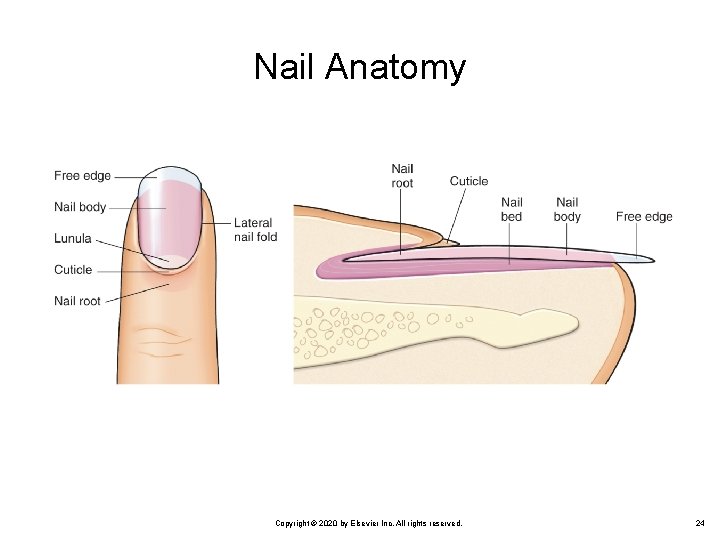
Parts of the Nail Body: largest and most visible part Root: nail production Nailbed: skin beneath nail Lateral nail folds: sides of nail Cuticle: tough ridge growing over nail base Lunula: crescent-shaped white area at nail base Free edge: distal end; trimmed as nail grows Copyright © 2020 by Elsevier Inc. All rights reserved. 23
Nail Anatomy Copyright © 2020 by Elsevier Inc. All rights reserved. 24
Skin Glands Major skin glands Ø Ø Ø Sebaceous Sudoriferous Ceruminous Produce and secrete substances onto skin’s surface via ducts Copyright © 2020 by Elsevier Inc. All rights reserved. 25
Sebaceous (Oil) Glands Connected to a hair follicle Produces sebum Ø Ø Mildly antibacterial and antifungal Lubricates hair and epidermis Copyright © 2020 by Elsevier Inc. All rights reserved. 26
Sudoriferous (Sweat) Glands Produce sweat or perspiration Functions: Ø Ø Regulate body temperature Eliminate wastes Types classified by their secretion, location, and association with nervous system Ø Ø Eccrine Apocrine Copyright © 2020 by Elsevier Inc. All rights reserved. 27
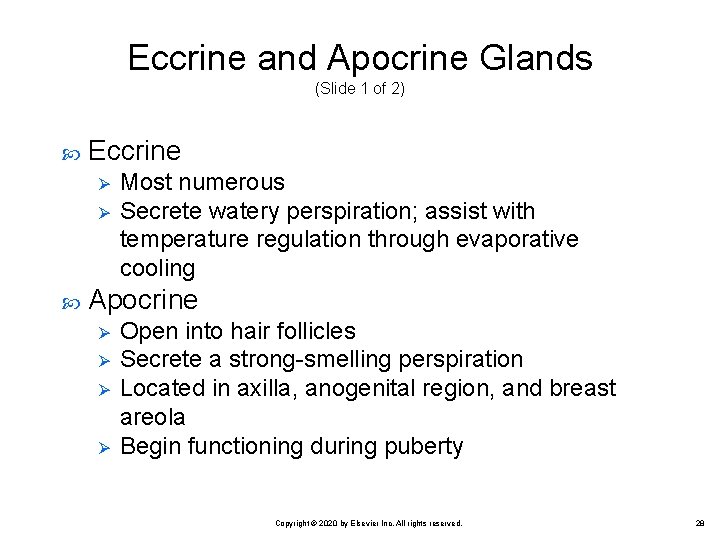
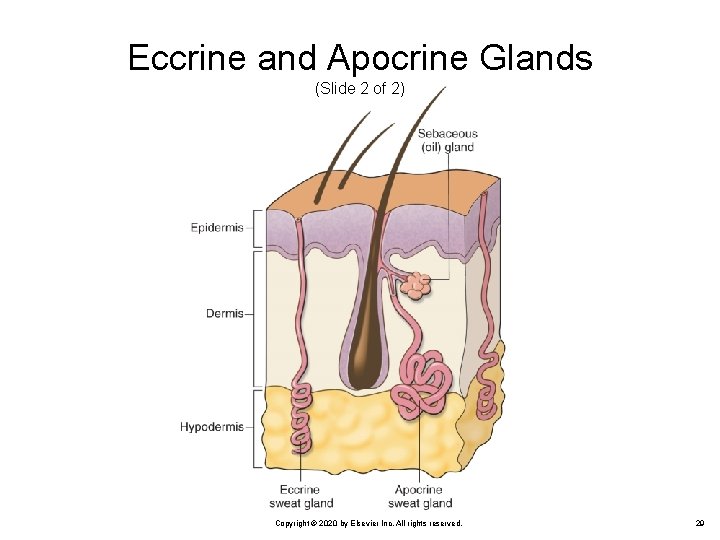
Eccrine and Apocrine Glands (Slide 1 of 2) Eccrine Ø Ø Most numerous Secrete watery perspiration; assist with temperature regulation through evaporative cooling Apocrine Ø Ø Open into hair follicles Secrete a strong-smelling perspiration Located in axilla, anogenital region, and breast areola Begin functioning during puberty Copyright © 2020 by Elsevier Inc. All rights reserved. 28
Eccrine and Apocrine Glands (Slide 2 of 2) Copyright © 2020 by Elsevier Inc. All rights reserved. 29
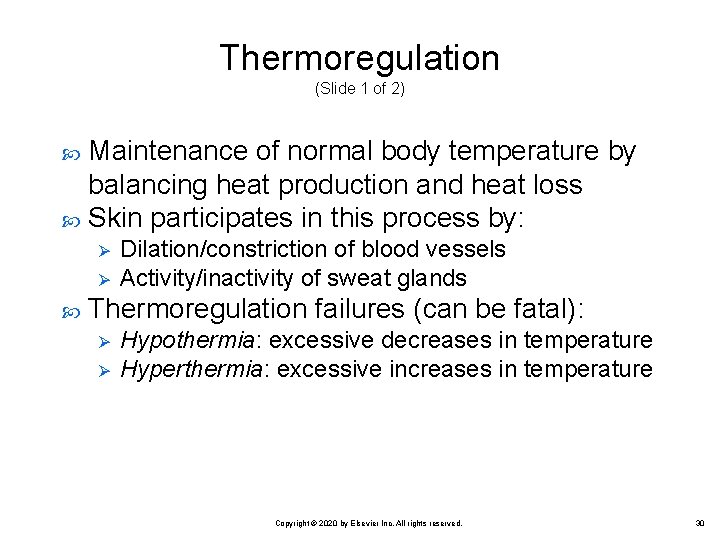
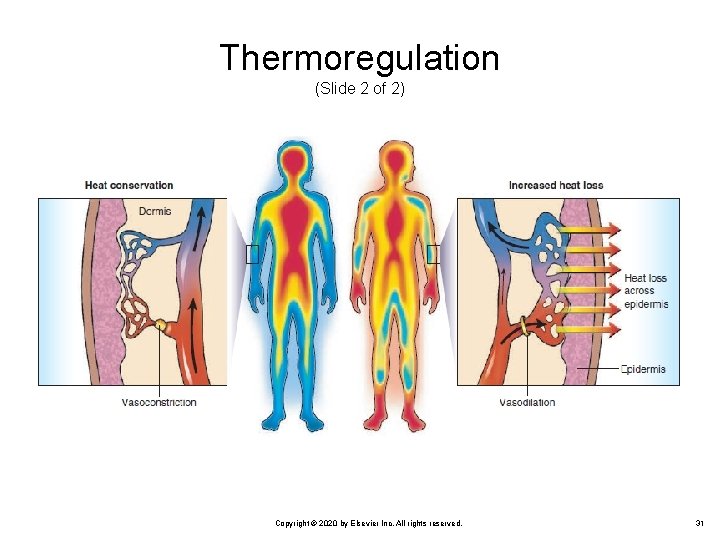
Thermoregulation (Slide 1 of 2) Maintenance of normal body temperature by balancing heat production and heat loss Skin participates in this process by: Ø Ø Dilation/constriction of blood vessels Activity/inactivity of sweat glands Thermoregulation failures (can be fatal): Ø Ø Hypothermia: excessive decreases in temperature Hyperthermia: excessive increases in temperature Copyright © 2020 by Elsevier Inc. All rights reserved. 30
Thermoregulation (Slide 2 of 2) Copyright © 2020 by Elsevier Inc. All rights reserved. 31
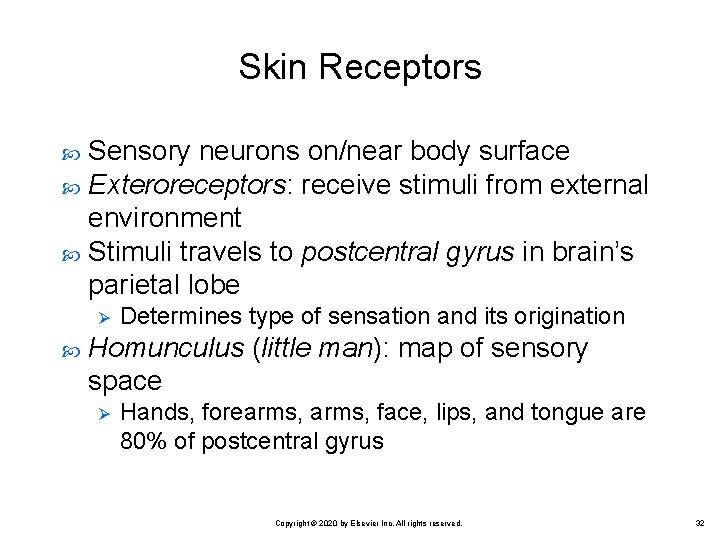
Skin Receptors Sensory neurons on/near body surface Exteroreceptors: receive stimuli from external environment Stimuli travels to postcentral gyrus in brain’s parietal lobe Ø Determines type of sensation and its origination Homunculus (little man): map of sensory space Ø Hands, forearms, face, lips, and tongue are 80% of postcentral gyrus Copyright © 2020 by Elsevier Inc. All rights reserved. 32
Postcentral Gyrus (From Cramer, G. D. , & Darby, S. A. [2014]. Clinical anatomy of the spine, spinal cord, and ANS [3 rd ed. ]. St. Louis, MO: Mosby. ) Copyright © 2020 by Elsevier Inc. All rights reserved. 33
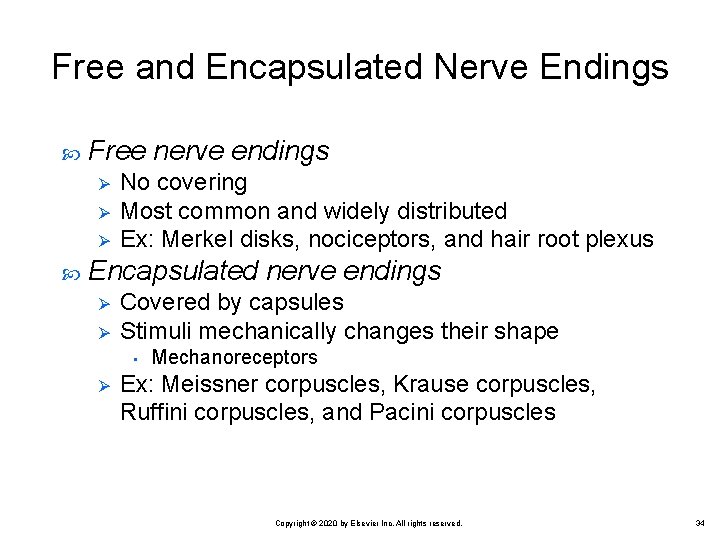
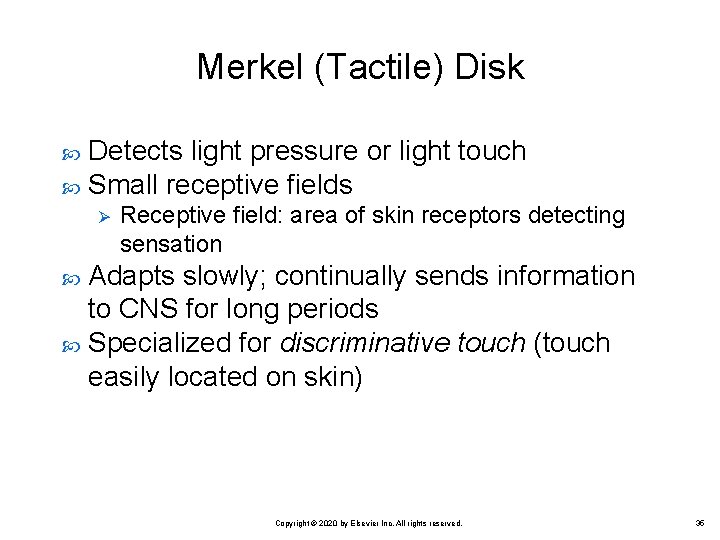
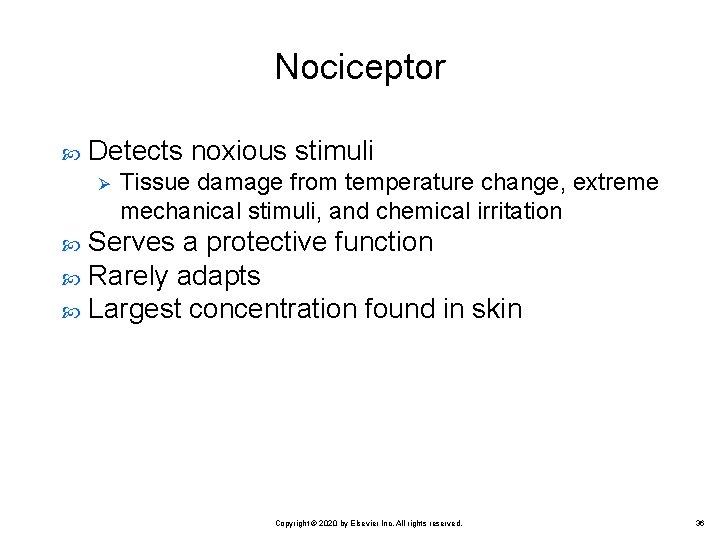
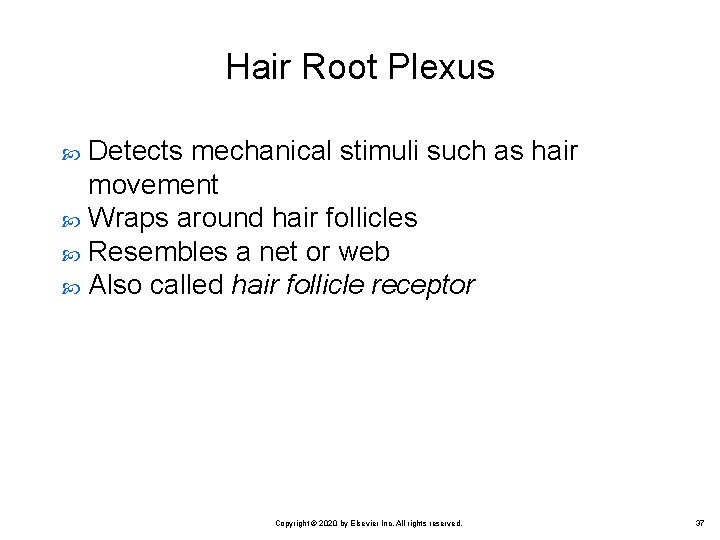
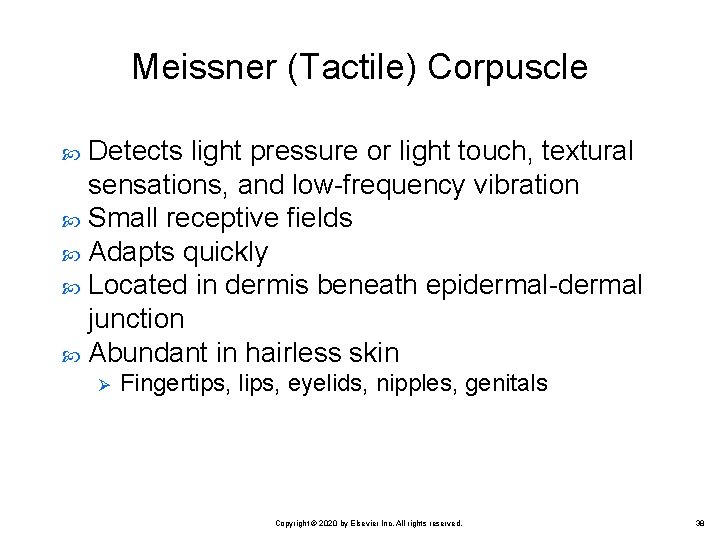
Free and Encapsulated Nerve Endings Free nerve endings Ø Ø Ø No covering Most common and widely distributed Ex: Merkel disks, nociceptors, and hair root plexus Encapsulated nerve endings Ø Ø Covered by capsules Stimuli mechanically changes their shape • Ø Mechanoreceptors Ex: Meissner corpuscles, Krause corpuscles, Ruffini corpuscles, and Pacini corpuscles Copyright © 2020 by Elsevier Inc. All rights reserved. 34
Merkel (Tactile) Disk Detects light pressure or light touch Small receptive fields Ø Receptive field: area of skin receptors detecting sensation Adapts slowly; continually sends information to CNS for long periods Specialized for discriminative touch (touch easily located on skin) Copyright © 2020 by Elsevier Inc. All rights reserved. 35
Nociceptor Detects noxious stimuli Ø Tissue damage from temperature change, extreme mechanical stimuli, and chemical irritation Serves a protective function Rarely adapts Largest concentration found in skin Copyright © 2020 by Elsevier Inc. All rights reserved. 36
Hair Root Plexus Detects mechanical stimuli such as hair movement Wraps around hair follicles Resembles a net or web Also called hair follicle receptor Copyright © 2020 by Elsevier Inc. All rights reserved. 37
Meissner (Tactile) Corpuscle Detects light pressure or light touch, textural sensations, and low-frequency vibration Small receptive fields Adapts quickly Located in dermis beneath epidermal-dermal junction Abundant in hairless skin Ø Fingertips, lips, eyelids, nipples, genitals Copyright © 2020 by Elsevier Inc. All rights reserved. 38
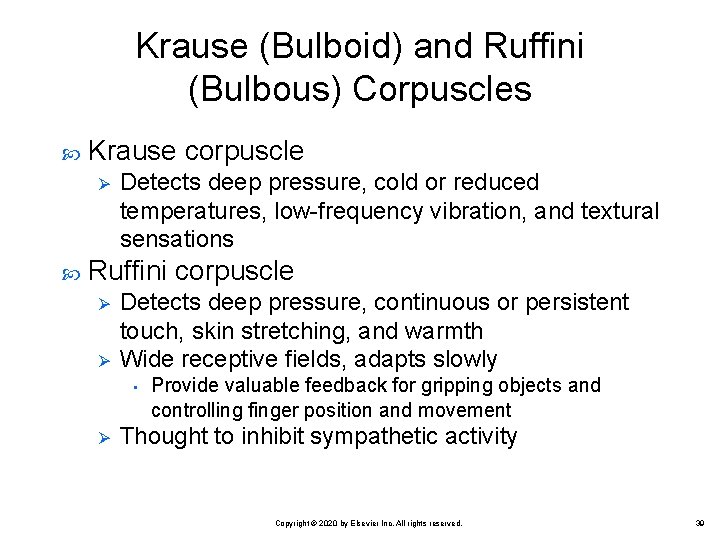
Krause (Bulboid) and Ruffini (Bulbous) Corpuscles Krause corpuscle Ø Detects deep pressure, cold or reduced temperatures, low-frequency vibration, and textural sensations Ruffini corpuscle Ø Ø Detects deep pressure, continuous or persistent touch, skin stretching, and warmth Wide receptive fields, adapts slowly • Ø Provide valuable feedback for gripping objects and controlling finger position and movement Thought to inhibit sympathetic activity Copyright © 2020 by Elsevier Inc. All rights reserved. 39
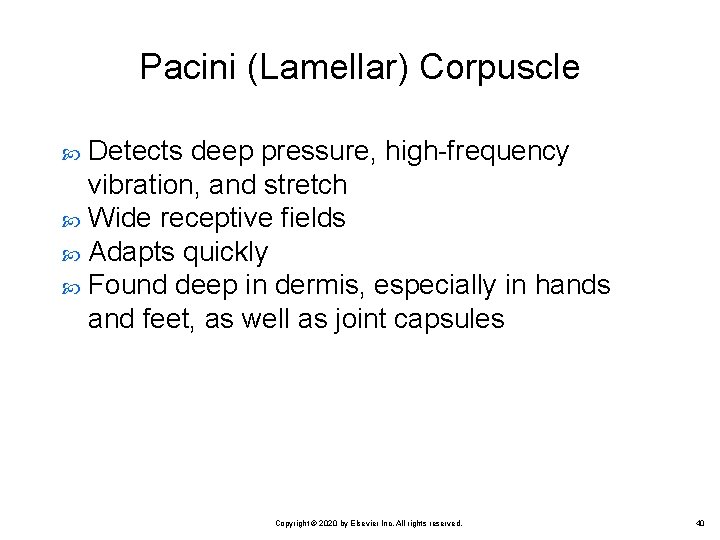
Pacini (Lamellar) Corpuscle Detects deep pressure, high-frequency vibration, and stretch Wide receptive fields Adapts quickly Found deep in dermis, especially in hands and feet, as well as joint capsules Copyright © 2020 by Elsevier Inc. All rights reserved. 40
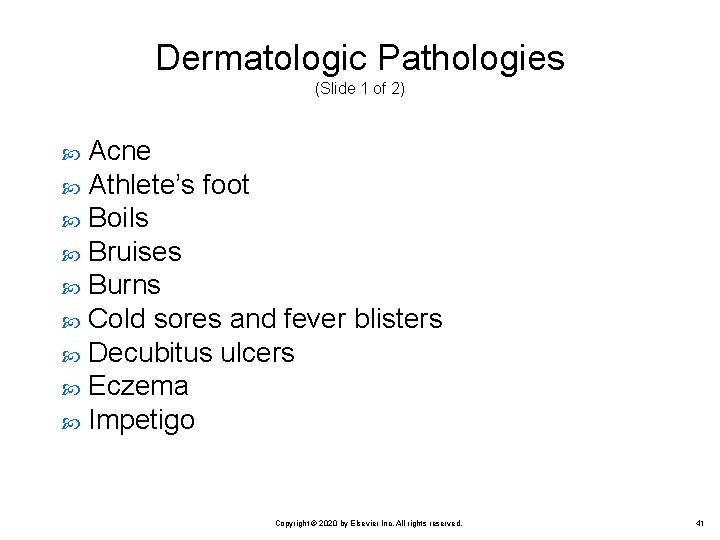
Dermatologic Pathologies (Slide 1 of 2) Acne Athlete’s foot Boils Bruises Burns Cold sores and fever blisters Decubitus ulcers Eczema Impetigo Copyright © 2020 by Elsevier Inc. All rights reserved. 41
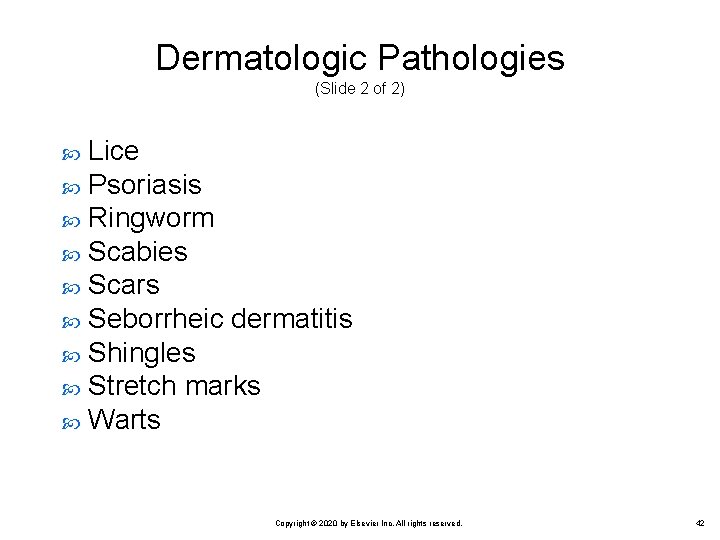
Dermatologic Pathologies (Slide 2 of 2) Lice Psoriasis Ringworm Scabies Scars Seborrheic dermatitis Shingles Stretch marks Warts Copyright © 2020 by Elsevier Inc. All rights reserved. 42
Questions? Copyright © 2020 by Elsevier Inc. All rights reserved. 43