
INTEGRITY Cryptography and Network Security Chapter 11 Fifth
- Slides: 21
INTEGRITY Cryptography and Network Security Chapter 11 Fifth Edition by William Stallings Lecture slides by Lawrie Brown
Scenario • Say that one day an hacker changes a bank account balance • Or, a destination bank account during a transfer • Is there a way to detect and prevent it?
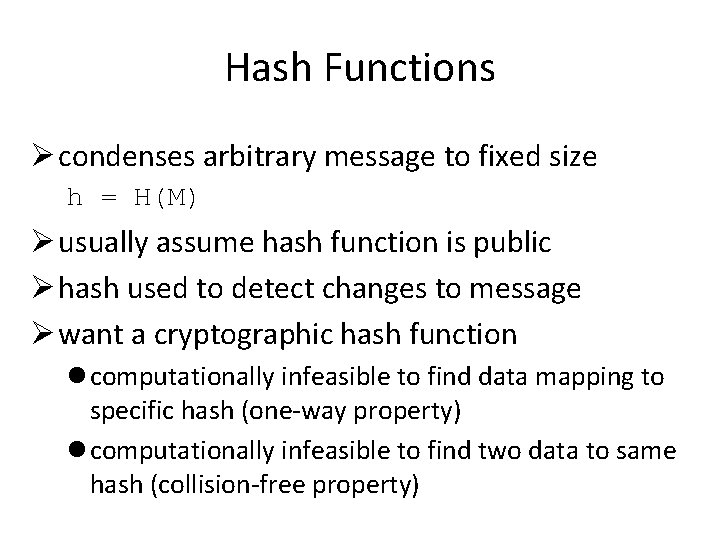
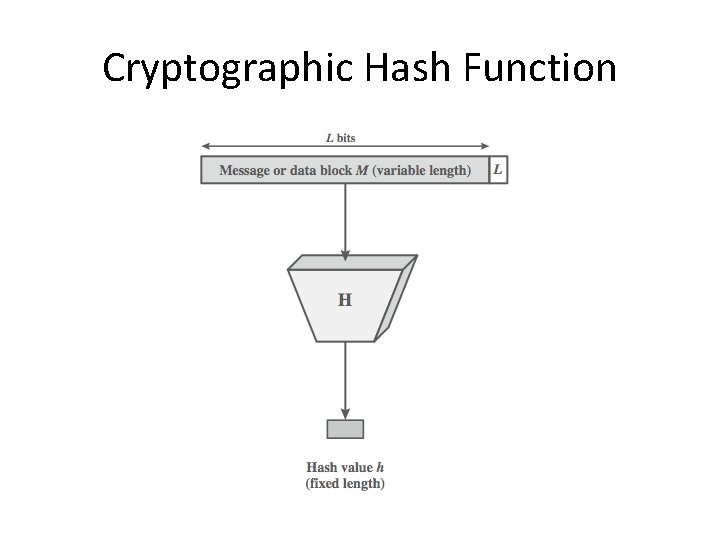
Hash Functions Ø condenses arbitrary message to fixed size h = H(M) Ø usually assume hash function is public Ø hash used to detect changes to message Ø want a cryptographic hash function l computationally infeasible to find data mapping to specific hash (one-way property) l computationally infeasible to find two data to same hash (collision-free property)
Cryptographic Hash Function
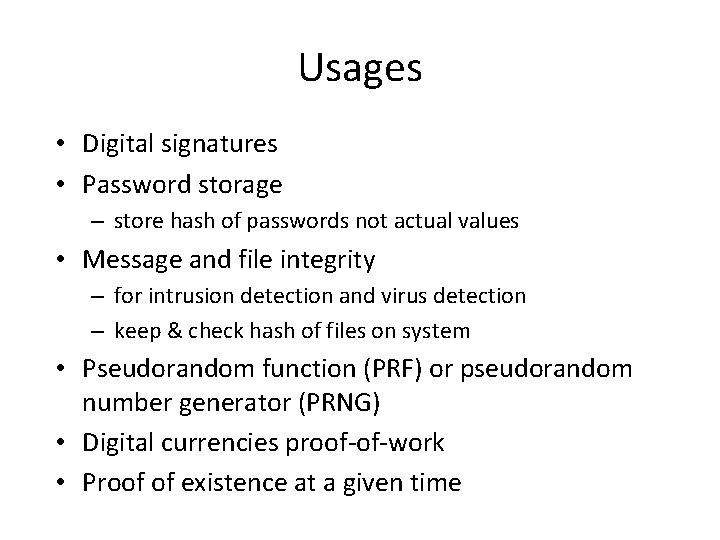
Usages • Digital signatures • Password storage – store hash of passwords not actual values • Message and file integrity – for intrusion detection and virus detection – keep & check hash of files on system • Pseudorandom function (PRF) or pseudorandom number generator (PRNG) • Digital currencies proof-of-work • Proof of existence at a given time
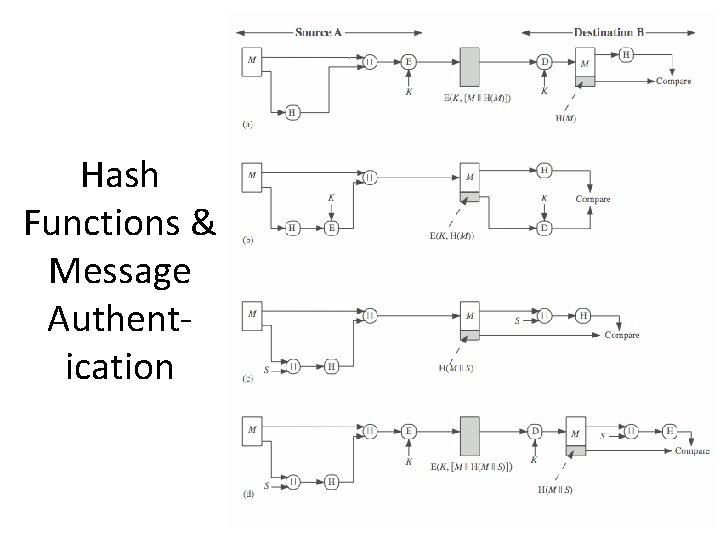
Hash Functions & Message Authentication
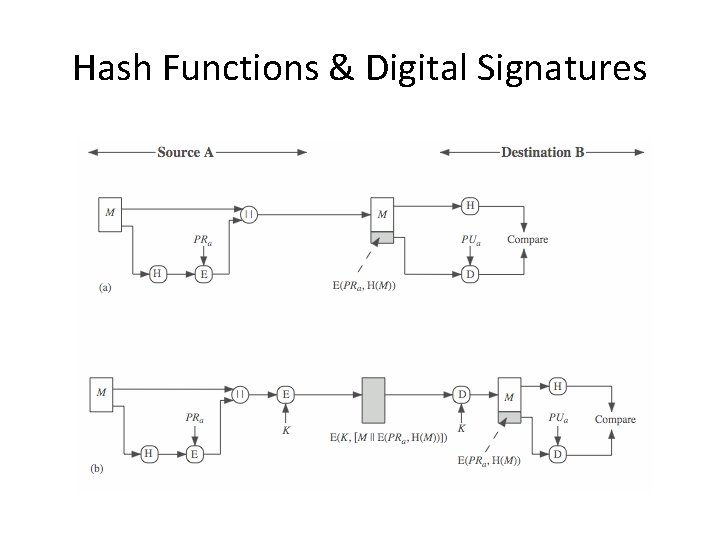
Hash Functions & Digital Signatures
Attack surface of Message integrity checks • Let’s talk about it
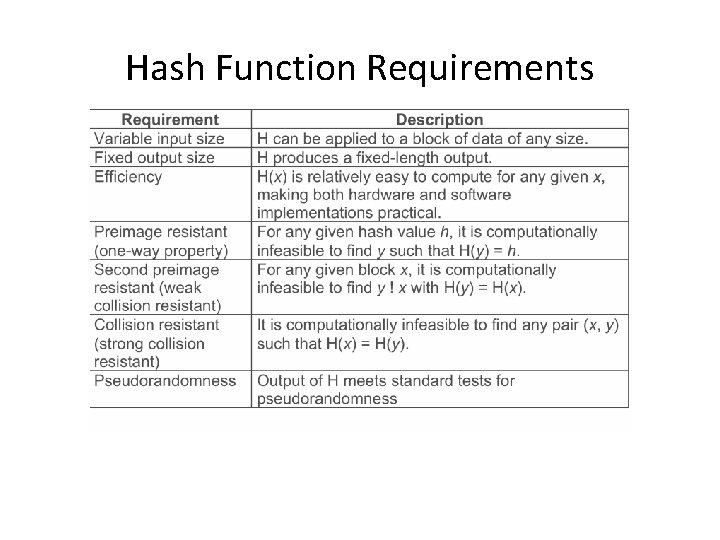
Hash Function Requirements
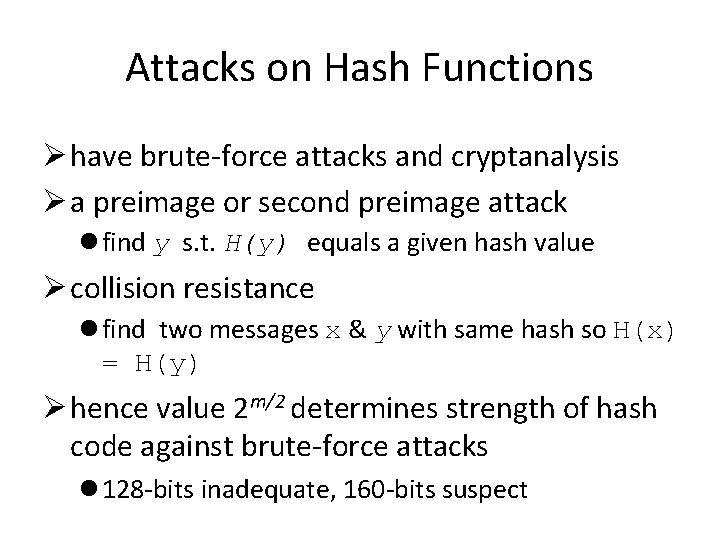
Attacks on Hash Functions Ø have brute-force attacks and cryptanalysis Ø a preimage or second preimage attack l find y s. t. H(y) equals a given hash value Ø collision resistance l find two messages x & y with same hash so H(x) = H(y) Ø hence value 2 m/2 determines strength of hash code against brute-force attacks l 128 -bits inadequate, 160 -bits suspect
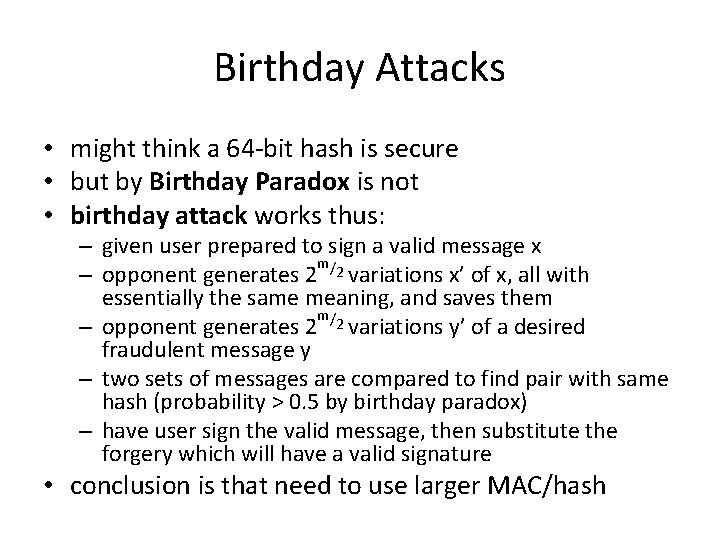
Birthday Attacks • might think a 64 -bit hash is secure • but by Birthday Paradox is not • birthday attack works thus: – given user prepared to sign a valid message x m/ – opponent generates 2 2 variations x’ of x, all with essentially the same meaning, and saves them m/ – opponent generates 2 2 variations y’ of a desired fraudulent message y – two sets of messages are compared to find pair with same hash (probability > 0. 5 by birthday paradox) – have user sign the valid message, then substitute the forgery which will have a valid signature • conclusion is that need to use larger MAC/hash
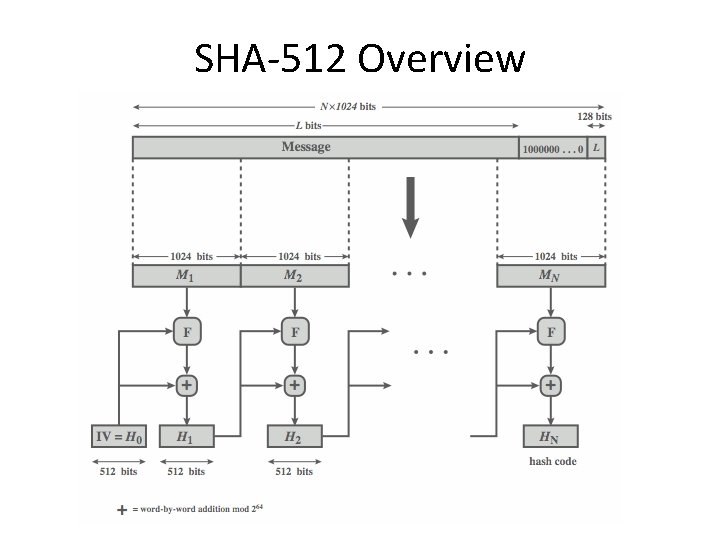
SHA-512 Overview
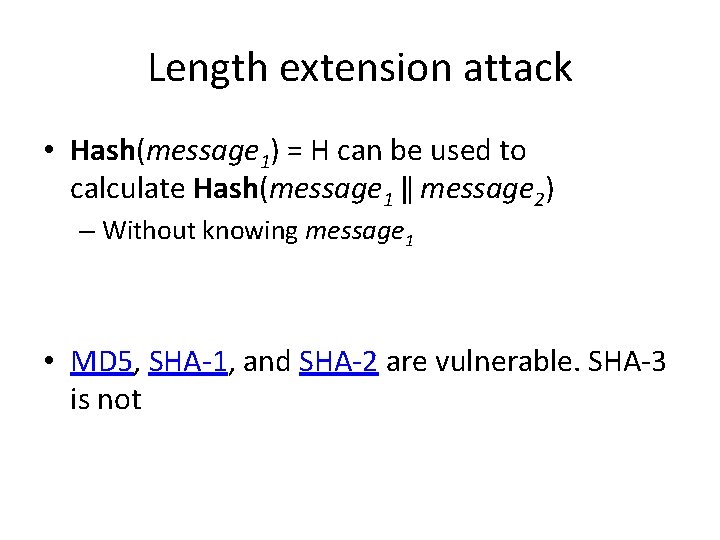
Length extension attack • Hash(message 1) = H can be used to calculate Hash(message 1 ‖ message 2) – Without knowing message 1 • MD 5, SHA-1, and SHA-2 are vulnerable. SHA-3 is not
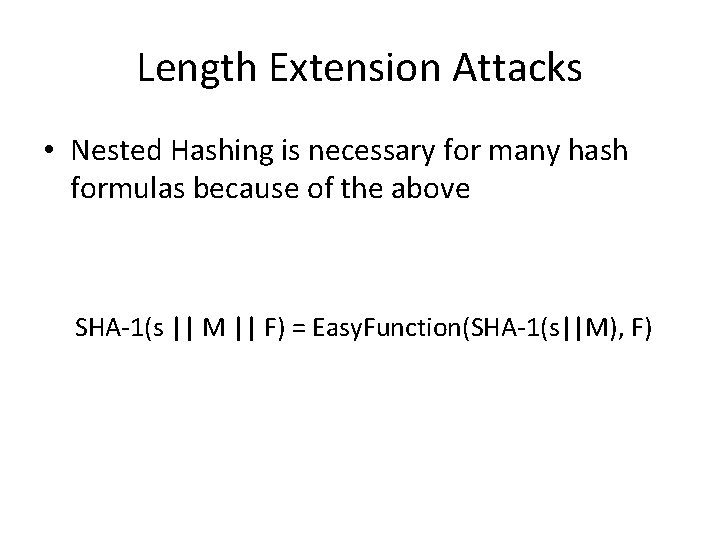
Length Extension Attacks • Nested Hashing is necessary for many hash formulas because of the above SHA-1(s || M || F) = Easy. Function(SHA-1(s||M), F)
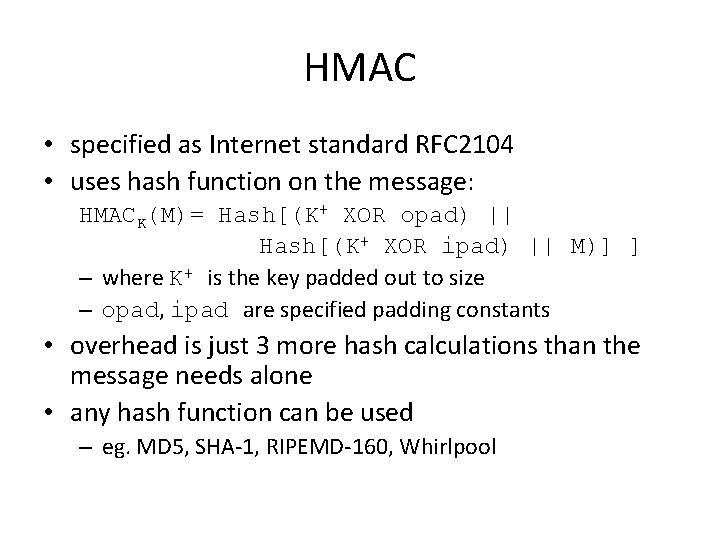
HMAC • specified as Internet standard RFC 2104 • uses hash function on the message: HMACK(M)= Hash[(K+ XOR opad) || Hash[(K+ XOR ipad) || M)] ] – where K+ is the key padded out to size – opad, ipad are specified padding constants • overhead is just 3 more hash calculations than the message needs alone • any hash function can be used – eg. MD 5, SHA-1, RIPEMD-160, Whirlpool
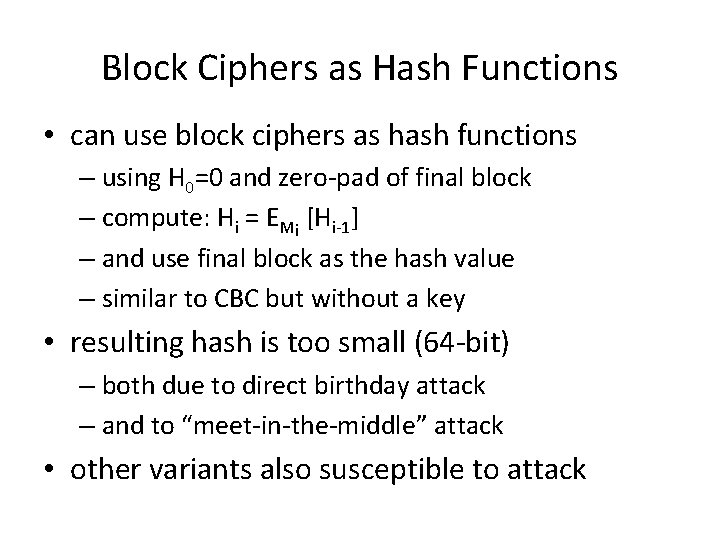
Block Ciphers as Hash Functions • can use block ciphers as hash functions – using H 0=0 and zero-pad of final block – compute: Hi = EMi [Hi-1] – and use final block as the hash value – similar to CBC but without a key • resulting hash is too small (64 -bit) – both due to direct birthday attack – and to “meet-in-the-middle” attack • other variants also susceptible to attack
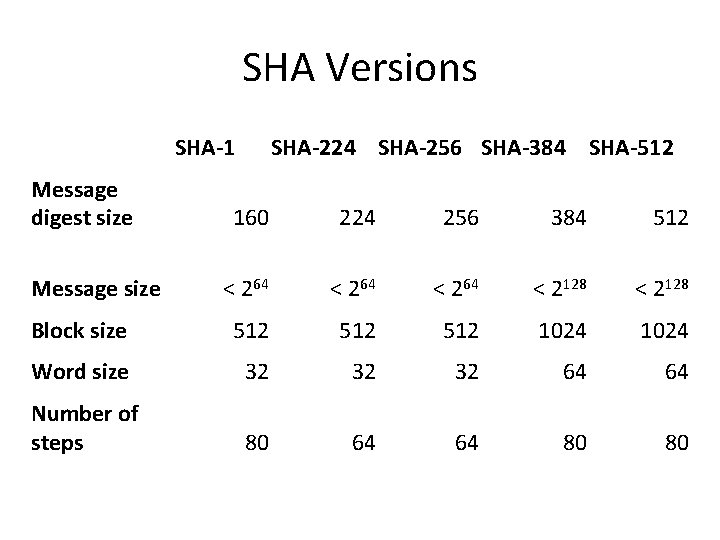
SHA Versions SHA-1 Message digest size SHA-224 SHA-256 SHA-384 SHA-512 160 224 256 384 512 < 264 < 2128 Block size 512 512 1024 Word size 32 32 32 64 64 Number of steps 80 64 64 80 80 Message size
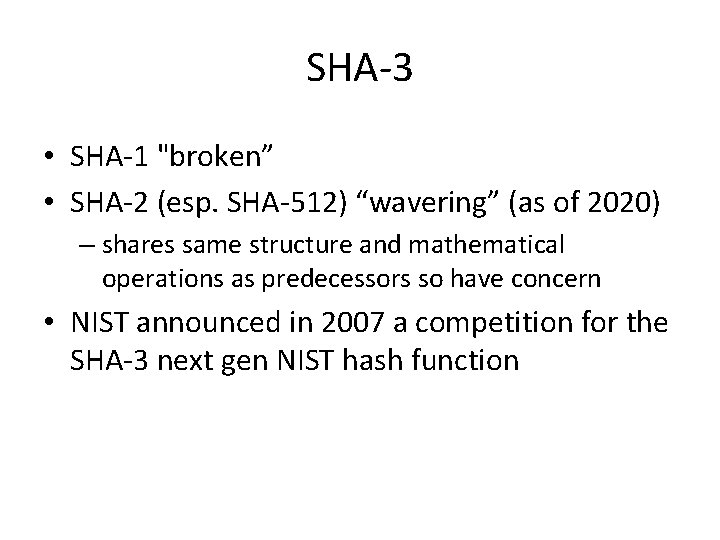
SHA-3 • SHA-1 "broken” • SHA-2 (esp. SHA-512) “wavering” (as of 2020) – shares same structure and mathematical operations as predecessors so have concern • NIST announced in 2007 a competition for the SHA-3 next gen NIST hash function
SHA 1 collisions • https: //alf. nu/SHA 1
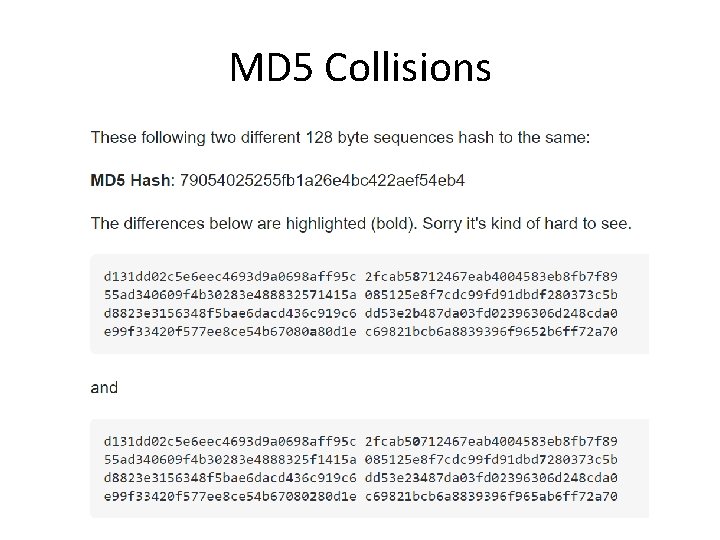
MD 5 Collisions
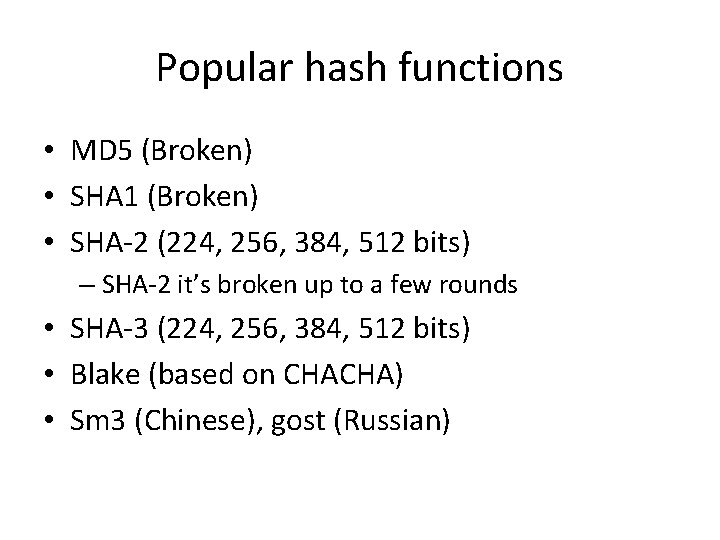
Popular hash functions • MD 5 (Broken) • SHA 1 (Broken) • SHA-2 (224, 256, 384, 512 bits) – SHA-2 it’s broken up to a few rounds • SHA-3 (224, 256, 384, 512 bits) • Blake (based on CHACHA) • Sm 3 (Chinese), gost (Russian)