
Integration testing After different modules of a system
- Slides: 24
Integration testing • After different modules of a system have been coded and unit tested: – modules are integrated in steps according to an integration plan – partially integrated system is tested at each integration step.
System Testing • System testing involves: – validating a fully developed system against its requirements.
Integration Testing • Develop the integration plan by examining the structure chart : – big bang approach – top-down approach – bottom-up approach – mixed approach
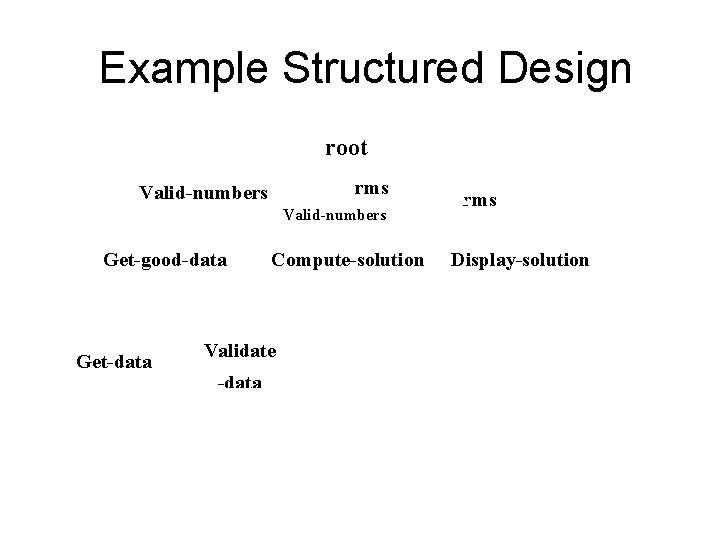
Example Structured Design root rms Valid-numbers Get-good-data Get-data Compute-solution Validate -data rms Display-solution
Big bang Integration Testing • Big bang approach is the simplest integration testing approach: – all the modules are simply put together and tested. – this technique is used only for very small systems.
Big bang Integration Testing • Main problems with this approach: – if an error is found: • it is very difficult to localize the error • the error may potentially belong to any of the modules being integrated. – debugging errors found during big bang integration testing are very expensive to fix.
Bottom-up Integration Testing • Integrate and test the bottom level modules first. • A disadvantage of bottom-up testing: – when the system is made up of a large number of small subsystems. – This extreme case corresponds to the big bang approach.
Top-down integration testing • Top-down integration testing starts with the main routine: – and one or two subordinate routines in the system. • After the top-level 'skeleton’ has been tested: – immediate subordinate modules of the 'skeleton’ are combined with it and tested.
Mixed integration testing • Mixed (or sandwiched) integration testing: – uses both top-down and bottom-up testing approaches. – Most common approach
Integration Testing • In top-down approach: – testing waits till all top-level modules are coded and unit tested. • In bottom-up approach: – testing can start only after bottom level modules are ready.
Phased versus Incremental Integration Testing • Integration can be incremental or phased. • In incremental integration testing, – only one new module is added to the partial system each time.
Phased versus Incremental Integration Testing • In phased integration, – a group of related modules are added to the partially integrated system each time. • Big-bang testing: – a degenerate case of the phased integration testing.
Phased versus Incremental Integration Testing • Phased integration requires less number of integration steps: – compared to the incremental integration approach. • However, when failures are detected, – it is easier to debug if using incremental testing • since errors are very likely to be in the newly integrated module.
System Testing • There are three main kinds of system testing: – Alpha Testing – Beta Testing – Acceptance Testing
Alpha Testing • System testing is carried out by the test team within the developing organization.
Beta Testing • System testing performed by a select group of friendly customers.
Acceptance Testing • System testing performed by the customer himself: – to determine whether the system should be accepted or rejected.
Stress Testing • Stress testing (aka endurance testing): – impose abnormal input to stress the capabilities of the software. – Input data volume, input data rate, processing time, utilization of memory, etc. are tested beyond the designed capacity.
Performance Testing • Addresses non-functional requirements. – May sometimes involve testing hardware and software together. – There are several categories of performance testing.
Stress testing • Evaluates system performance – when stressed for short periods of time. • Stress testing – also known as endurance testing.
Stress testing • Stress tests are black box tests: – designed to impose a range of abnormal and even illegal input conditions – so as to stress the capabilities of the software.
Stress Testing • If the requirements is to handle a specified number of users, or devices: – stress testing evaluates system performance when all users or devices are busy simultaneously.
Stress Testing • If an operating system is supposed to support 15 multiprogrammed jobs, – the system is stressed by attempting to run 15 or more jobs simultaneously. • A real-time system might be tested – to determine the effect of simultaneous arrival of several high-priority interrupts.
Stress Testing • Stress testing usually involves an element of time or size, – such as the number of records transferred per unit time, – the maximum number of users active at any time, input data size, etc. • Therefore stress testing may not be applicable to many types of systems.