
Integration of Workforce Development Activities at all Levels
- Slides: 41
Integration of Workforce Development Activities at all Levels of Government Kirk Lew Senior Policy Advisor Office of Disability Employment Policy 1
Presentation Outline Ø Vision for the System Ø Federal Partners in Transition Ø Vision for the System Ø Key Elements of Integration Ø What’s Working – Examples of Integration Ø Questions Ø Key Elements of Integration Ø What’s Working – Examples of Integration 2
FPT Background • FPT was formed in 2005 to improve interagency policy and service coordination to support all youth, including youth with disabilities, in successfully transitioning from school to adulthood • The partnership is led by Jennifer Sheehy, Acting Assistant Secretary for Office of Disability Employment Policy for Department of Labor, and Sue Swenson, Acting Assistant Secretary for the Office of Special Education and Rehabilitative Services at the Department of Education 3
Participating Departments Include: • Department of Education • Department of Health and Human Services • Department of Labor • Social Security Administration • Department of Transportation • Corporation for National and Community Service 4
What is Collaboration? • Is a process: political • Is empowering: increases capacities • Takes place in different settings • Can be mutually beneficial • Takes time and trust • Helps us reach common goals • Benefits those we aim to help Rogério M. Pinto, Ph. D Columbia University 5
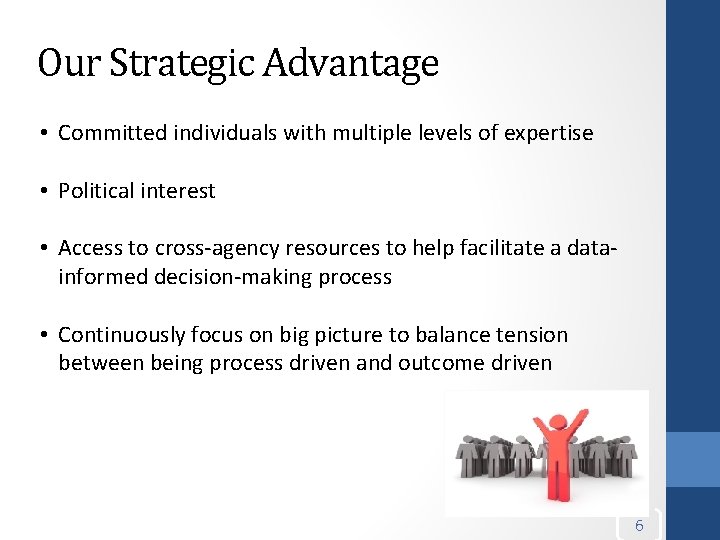
Our Strategic Advantage • Committed individuals with multiple levels of expertise • Political interest • Access to cross-agency resources to help facilitate a datainformed decision-making process • Continuously focus on big picture to balance tension between being process driven and outcome driven 6
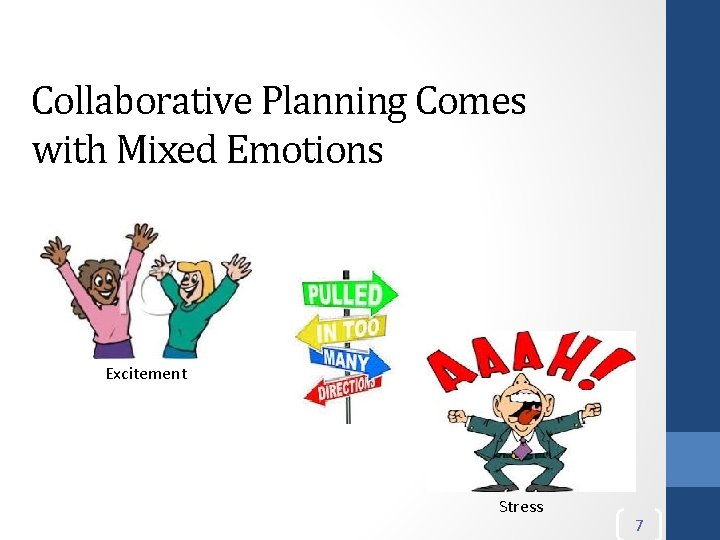
Collaborative Planning Comes with Mixed Emotions Excitement Stress 7
Why FPT Uses an Inclusive Approach to Improve Transition Outcomes for Youth with Disabilities • Sw. D drop out at 2 X rates of peers w/o disabilities. Students with ED have worst outcomes. • special education disability, a majority being learning • Arrest rates are relatively high for Sw. D who drop out. Between 28 percent and 43 percent of detained and incarcerated youthful offenders have an identified special education disability, a majority being learning disabilities. • Data indicates the 55 percent of postsecondary students who were identified by their secondary schools as having a disability did not consider themselves to have a disability by the time they transitioned to postsecondary school (National Longitudinal Transition Study - 2) • Up to 75 percent of youth with disabilities have hidden or nonapparent disabilities, including mental health needs (Tunnels & Cliffs, NCWD/Youth) 8
The Recommendation • The Government Accountability Office recommended that Departments of Education, Health and Human Services, Labor, and Social Security Administration develop a federal interagency transition strategy 9
FPT Vision • All youth programs are based on universal design principles so that youth, regardless of their individual challenges, including disability, are equipped to pursue a self-directed pathway to address their interests, aspirations, and goals across all transition domains including community engagement, education, employment, health, and independent living that will ultimately result in positive, everyday social inclusion 10
Vision Themes Begin with the end user in mind Strength-based research, policies, and practices Universal Design for Learning Set high expectations Options to live successfully in the community Person-centered planning High-quality professional development for youth service professionals • Continuity of service and access to information • • 11
Compatible Outcome Goals Youth with disabilities and all youth will have an equal opportunity to: • Access health care services and integrated work-based experiences in high school • Develop self-determination and engage in self-directed individualized planning • Be connected to programs, services, activities, information, and supports • Develop leadership and advocacy skills • Have involvement from families and other caring adults with high expectations body of text 12
Something to think about How does the Federal Partners in Transition’s Compatible Outcome Goals relate to your work? 13
No Wrong Door to Help Youth & Adults with Disabilities Achieve Their Goals One Great Session in the Integrated Services Track Presented by the U. S. Departments of Labor, Education, Health and Human Services, and Partner Organizations
Session Outline ØVision for the System Ø Key Elements of Integration Ø What’s Working – Examples of Integration Ø Federal Partners in Transition 15
WIOA Vision of Integrated Services “The purposes of this Act are the following: (1)To increase access to, and opportunities for, the employment , education, training, and support services that individuals need to succeed in the labor market, particularly those with barriers to employment. ” - WIOA Sec. 2 This is accomplished by connecting all customers with the full range of services available in their communities. - Vision for the One-stop Delivery System under WIOA 16
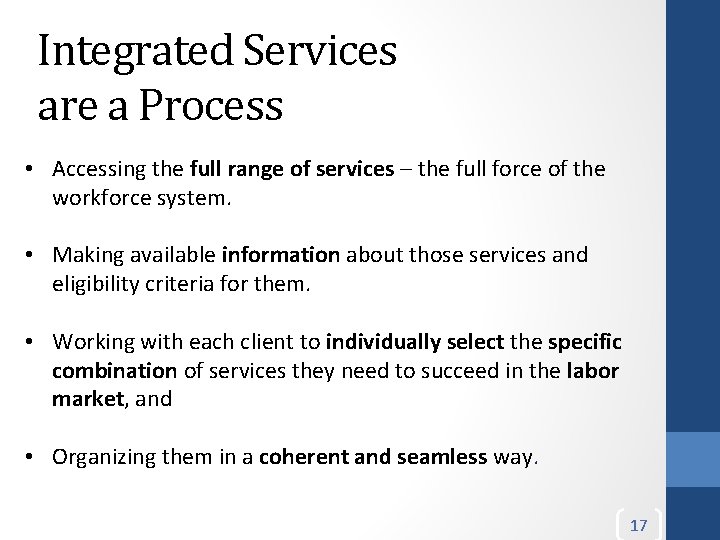
Integrated Services are a Process • Accessing the full range of services – the full force of the workforce system. • Making available information about those services and eligibility criteria for them. • Working with each client to individually select the specific combination of services they need to succeed in the labor market, and • Organizing them in a coherent and seamless way. 17
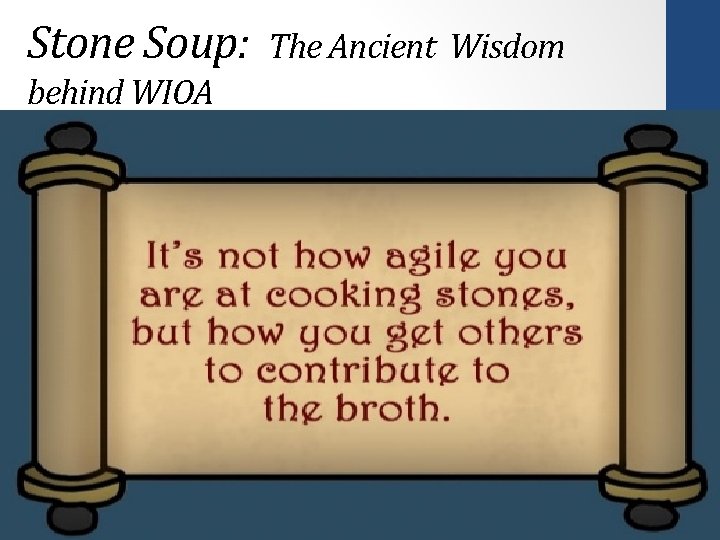
Stone Soup: behind WIOA The Ancient Wisdom
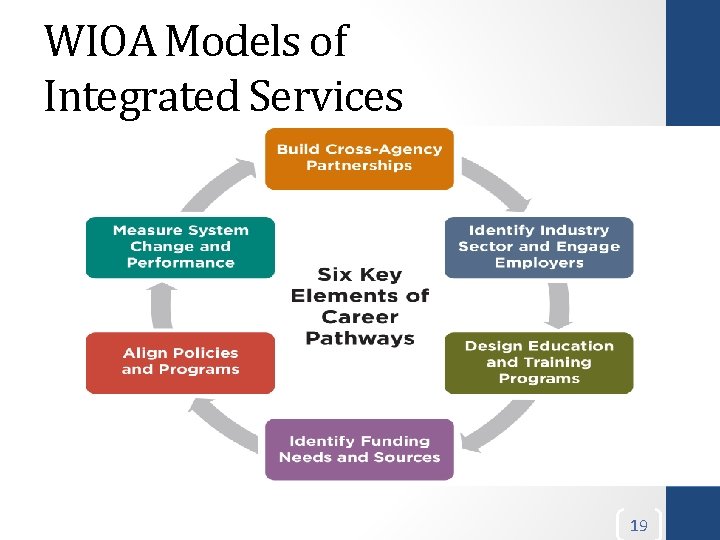
WIOA Models of Integrated Services 19
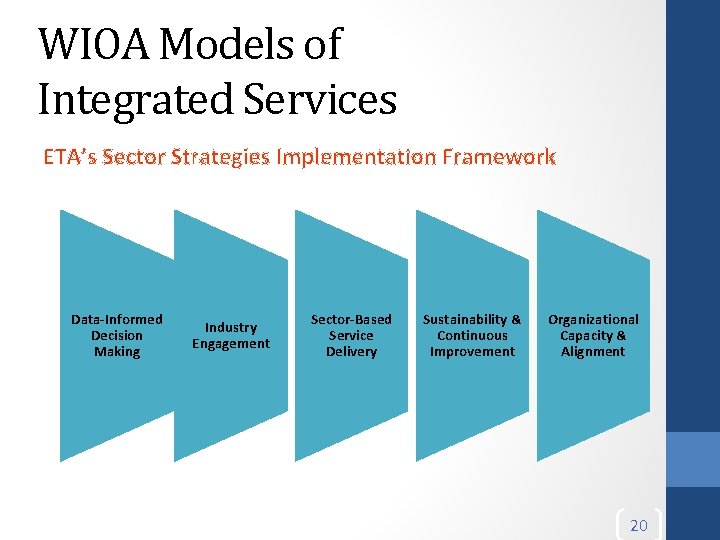
WIOA Models of Integrated Services ETA’s Sector Strategies Implementation Framework Data-Informed Decision Making Industry Engagement Sector-Based Service Delivery Sustainability & Continuous Improvement Organizational Capacity & Alignment 20
Technology to Support Integrated Services ü Share Code ü Get Procurement Advice ü Share Example RFPs ü Collaborate on IT Projects ü Grab IT Tools IT Support Center: www. itsc. org 21
No Wrong Door to Help Youth & Adults with Disabilities Achieve Their Goals Vision: To create a workforce development system in which individuals with disabilities have full and easy access to WIOA-related programs and services. Session Roadmap: • Braided funding and its benefits. • Key elements to integrate disability-related services. • Examples of integration. 22
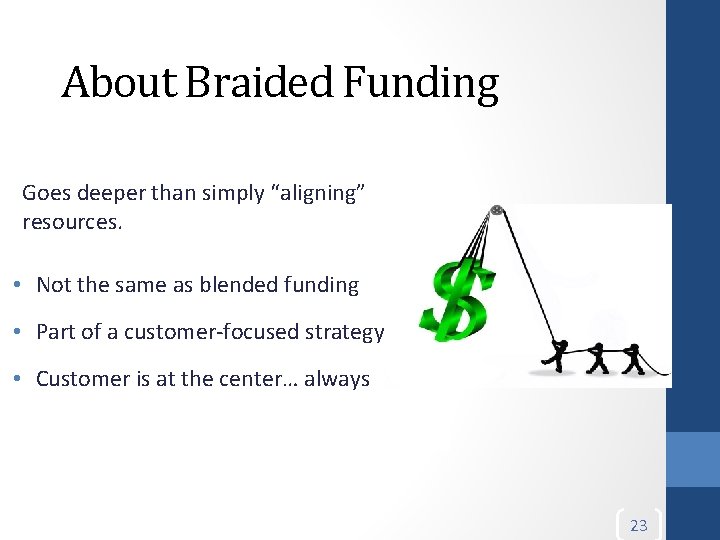
About Braided Funding Goes deeper than simply “aligning” resources. • Not the same as blended funding • Part of a customer-focused strategy • Customer is at the center… always 23
WIOA - How do we start to braid funding? • TITLE I – Workforce Development Activities • TITLE II – Adult Education • TITLE III – Wagner-Peyser/Labor Exchange • TITLE IV – Vocational Rehabilitation 24
Collaborative Success Factors (1) • Partnerships and leadership essential to systems change • Shared goals and strategies • Contribution versus attribution • Co-location helpful, need collaboration 25
Collaborative Success Factors (2) • Service planning and funding investment are essential • Service mapping will capitalize on partners’ strengths • Staff capacity necessary for financial/admin oversight • Data sharing between programs 26
Joint Issuances and Guidance is issued by each of the Federal Agencies, using their unique distribution methods. “Joint Guidance” is the same content coming out from the Federal partner agencies, for consistency. • TEGLs - Training and Employment Letters = ETA • UIPLS - Unemployment Insurance Policy Letters = ETA • PMs – Program Memoranda = Dept. of ED-OCTAE • TACs – Technical Assistance Circulars = Dept. of Ed-RSA • Program Instruction Information Memos and “Dear Colleague Letters” = Dept. of HHS 27
Guidance and TA specific to One-Stop Operations TEGL No. 16 -16 (DOL-ETA) TAC No. 17 -02 (ED-RSA) PM No. 17 -04 (ED-OCTAE) “One Stop Operations for the American Job Center Network” (Issued on 1/18/2017 and available at https: //wdr. doleta. gov/directives/All_WIOA_Related_Advisories. cfm) Ø External Webinar given on “One-Stop Comprehensive, Affiliate, and Co. Location Requirements on March 1, 2017 and archived on ION. Ø National and Regional to State technical assistance since enactment. 28
Example of how can collaboration begin across Titles? Integrated Resource Team Approach One of the key strategic service delivery components of the Disability Employment Initiative, a project U. S. DOL implemented in the workforce development system. 29
Example of Customer Center Design (1) Pennsylvania’s Dept. of Labor and Industry: Bureau of Workforce Development Partnership (Titles I and III), Office of Voc. Rehab. (Title IV), and Dept. of Education (Title II) • Partners participated in DOL's Customer-Centered Design. • Partners’ research with employers found: • Many workforce organizations operate in a local area but few have enough people to provide talent to every employer at every given time. • Employers approach all of the agencies individually and fatigue results. 30
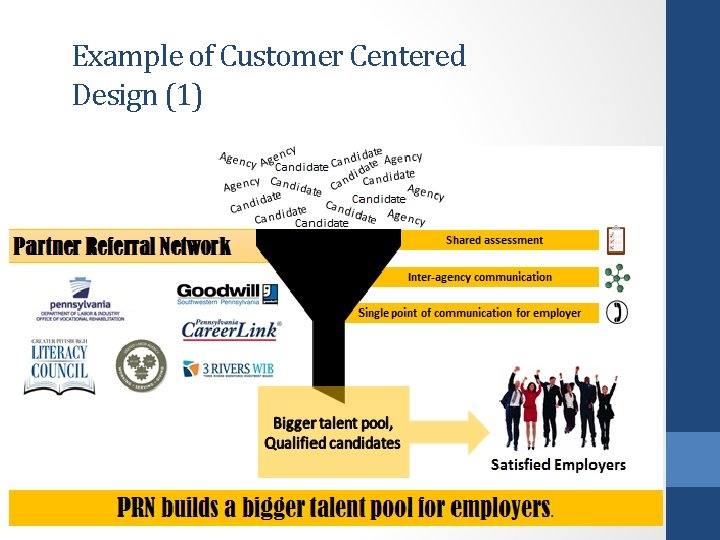
Example of Customer Center Design (1) • Partners quickly recognized that they could address the problem from both the employer side and the talent pool side and came up with the Partner Referral Network (PRN). • PRN allows employers to search customers’ profiles and resumes. • PRN demonstrates integrated service delivery aimed at employers while also meeting the needs of customers. • The PRN allows the partners to: - Refer clients between agencies to make the candidate pool bigger. - Maintain a single point of contact to minimize employer fatigue. 31
Example of Customer Centered Design (1)
Example of Integration through Partnerships Youth Corps New Jersey: Out-of-school youth high school equivalency attainment strategies • Many of the states Youth Corps program also accepts WIOA Title I youth in their programs. • Two Youth Corps programs use local Adult education system to assist with academic remediation for youth participants, prior to attainment of high school equivalency credential. 33
Example of Integration through Partnerships New Brunswick Youth Corps Program: Co-location at New Brunswick Adult Learning Center • New Brunswick WIOA Title II consolidated Adult Basic Skills and Integrated English Literacy and Civics Program. • New Jersey Youth Corps of Middlesex County. • CARES (Creating Alternative Routes to Educational Success) alternate high school program. 34
Example of Integration between WIOA Titles Ohio Department of Higher Education: Adult Basic and Literacy Education Division and Opportunities for Ohioans with Disabilities and Bureau of Services for the Visually Impaired • Partnership assists individuals with visual impairments in gaining basic literacy skills (Braille or print) and obtain a high school equivalence and/or to be ready for post-secondary education, training, or employment. • Initiative is first step in multi-year comprehensive plan to better meet the literacy needs of adults. 35
Example of Integration between WIOA Titles • Partnership fulfills mission of both ABLE and OOD and serves dual purposes in continuum of service delivery • Shared investment that is customer-focused • Mechanics of integrated service delivery are behind the scenes 36
Next Generation Zone The Next Generation Zone provides education, career skills training, and community and employment resources to young adults ages 16 -24. Human Centered Design • Youth One Stop – Designed with youth input • Eliminate barriers – Funding requirements, Food, Outreach and Recruitment. • Diversity – Funds (WIOA, Federal Grants, Private Sector donations, Foundation funds) 37
Resources (1) Office of Disability Employment Policy • www. dol. gov/odep or (866)633 -7365 or (877) 889 -5627 (TTY) National Collaborative on Workforce and Disability for Youth • http: //www. ncwd-youth. info Job Accommodation Network • http: //www. Ask. JAN. org or (800) 526 -7234 or (877) 781 -9403 (TTY) EARN • www. askearn. org 38
Resources (2) Pre-Apprenticeship Guide • https: //www. doleta. gov/oa/preapp/pdf/Pre_Apprenticeship_Guide for. Women. pdf Workforce Connect - Information Technology Support Center • www. itsc. org Workforce GPS - https: //www. workforcegps. org/ • The Playlists: Disability Resources for WIOA Practitioners • Career Pathways Toolkit https: //careerpathways. workforcegps. org 39
Contact Information For questions regarding the information in presentation, send an email to: Lew. Kirk. A@dol. gov Integrated Services Track as the subject line. 40
Thank you! 41