
Integration of sources citations in your academic writing



- Slides: 5
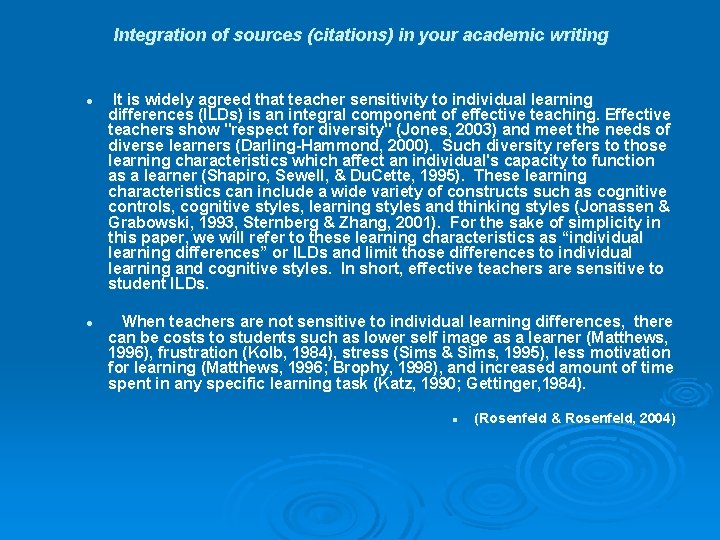
Integration of sources (citations) in your academic writing l l It is widely agreed that teacher sensitivity to individual learning differences (ILDs) is an integral component of effective teaching. Effective teachers show "respect for diversity" (Jones, 2003) and meet the needs of diverse learners (Darling-Hammond, 2000). Such diversity refers to those learning characteristics which affect an individual's capacity to function as a learner (Shapiro, Sewell, & Du. Cette, 1995). These learning characteristics can include a wide variety of constructs such as cognitive controls, cognitive styles, learning styles and thinking styles (Jonassen & Grabowski, 1993, Sternberg & Zhang, 2001). For the sake of simplicity in this paper, we will refer to these learning characteristics as “individual learning differences” or ILDs and limit those differences to individual learning and cognitive styles. In short, effective teachers are sensitive to student ILDs. When teachers are not sensitive to individual learning differences, there can be costs to students such as lower self image as a learner (Matthews, 1996), frustration (Kolb, 1984), stress (Sims & Sims, 1995), less motivation for learning (Matthews, 1996; Brophy, 1998), and increased amount of time spent in any specific learning task (Katz, 1990; Gettinger, 1984). l (Rosenfeld & Rosenfeld, 2004)