
Integration of RFID and ERP Challenges and possibilities
Integration of RFID and ERP Challenges and possibilities Humberto Moran Research Fellow Judge Institute of Management University of Cambridge h. moran@jims. cam. ac. uk June 2004 © Humberto Moran
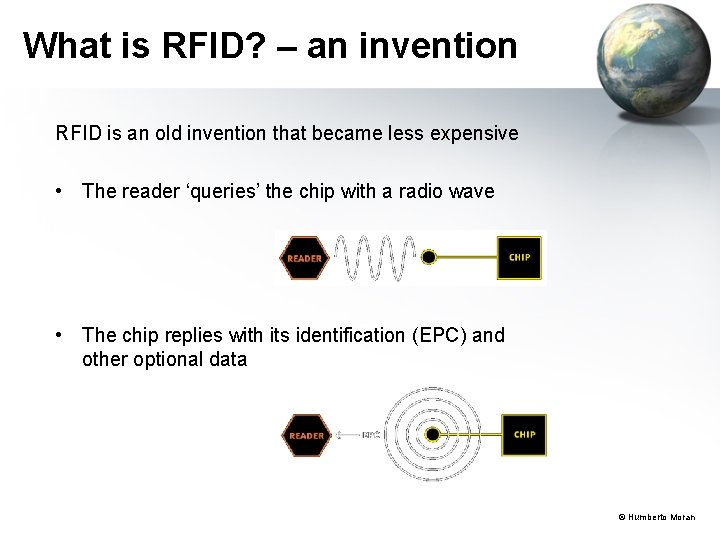
What is RFID? – an invention RFID is an old invention that became less expensive • The reader ‘queries’ the chip with a radio wave • The chip replies with its identification (EPC) and other optional data © Humberto Moran
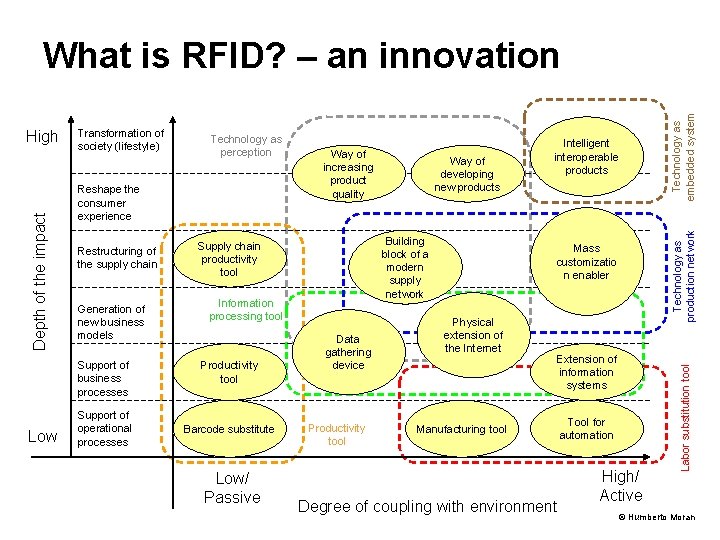
Reshape the consumer experience Restructuring of the supply chain Generation of new business models Support of business processes Low Technology as perception Support of operational processes Way of increasing product quality Building block of a modern supply network Supply chain productivity tool Information processing tool Productivity tool Barcode substitute Low/ Passive Way of developing new products Data gathering device Productivity tool Intelligent interoperable products Technology as production network Transformation of society (lifestyle) Mass customizatio n enabler Physical extension of the Internet Extension of information systems Manufacturing tool Degree of coupling with environment Tool for automation High/ Active Labor substitution tool Depth of the impact High Technology as embedded system What is RFID? – an innovation © Humberto Moran
RFID from a ERP perspective • A set of inter-organisational standards – Identify physical objects – Trace information on products • A powerful tool for automation • Provides computers with new senses, new data (and new possibilities…) • A Revolution in the SW area ? ? © Humberto Moran
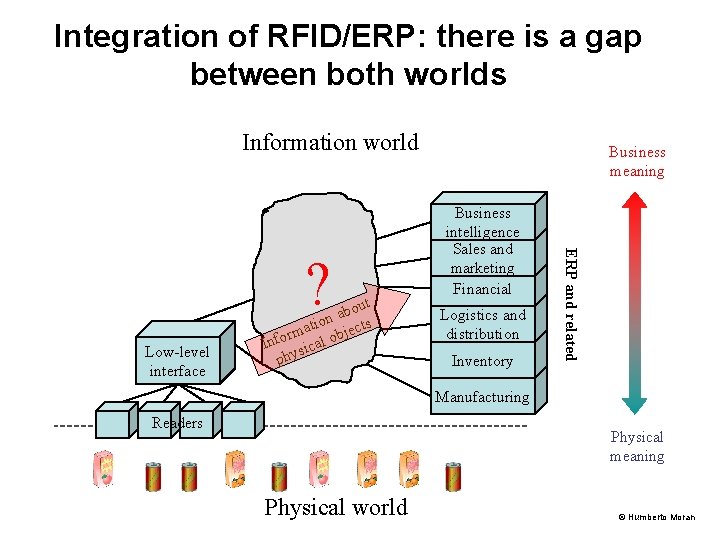
Integration of RFID/ERP: there is a gap between both worlds Information world Low-level interface out b a ion ects t a rm bj Info sical o phy Business intelligence Sales and marketing Financial Logistics and distribution Inventory ERP and related ? Business meaning Manufacturing Readers Physical meaning Physical world © Humberto Moran
Why is it important to integrate both worlds? • Both worlds complement each other creating important complementarities • To allow/ease the adoption of RFID applications • To provide RFID-generated data with useful meaning • To provide ERP systems with accurate, timely and reliable information about physical objects • To make the best possible usage of the new information from a business point of view © Humberto Moran
What are the challenges posed by this integration? 1. RFID-Generated data are dispersed, fragmented, duplicated, inaccurate and lack business meaning 2. Interpretation is context- and informationdependent 3. Interpretation requires sharing inter-organisational information 4. RFID-Generated data might generate business transactions targeting different systems/modules 5. Duplicity of Information and functionality of RFIDenhanced systems and that of existing ERPs 6. Amount of new data is stunning © Humberto Moran
(1) RFID data are dispersed, fragmented, duplicated, inaccurate and lack business meaning • Readers can detect the same objects many times, with random gaps • Some tags can be missed • Reading order is random • Logically related and unrelated objects are read all together • The data consist on identification numbers (EPC) and other optional data, which lack business meaning © Humberto Moran
(2) Interpretation is context- and knowledge-dependent • Business meaning depends on: – – – Location of the object Whether the object is static or moving Direction/speed of movement Detection intervals Aggregation information (e. g. compound products, batches, tools etc. ) – Business transactions (e. g. ASN, warehouse transfers, sales etc. ) – Previous status of the object (e. g. location etc. ) © Humberto Moran
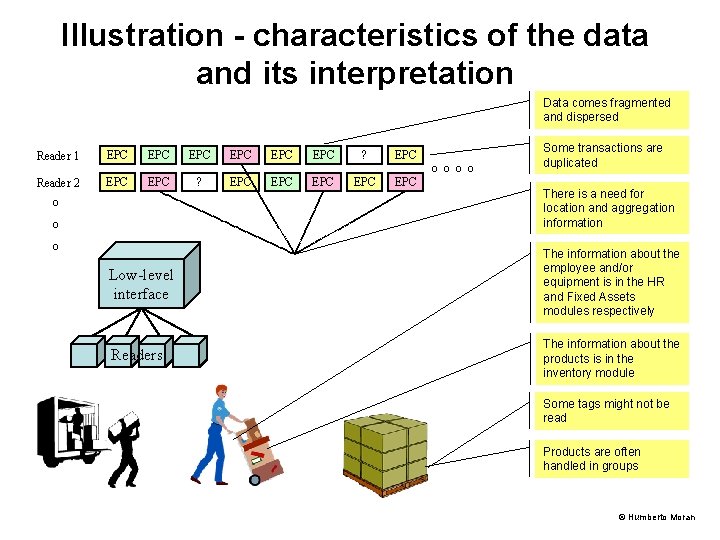
Illustration - characteristics of the data and its interpretation Data comes fragmented and dispersed Reader 1 EPC EPC EPC ? EPC Reader 2 EPC ? EPC EPC EPC o o o o Some transactions are duplicated There is a need for location and aggregation information Low-level interface The information about the employee and/or equipment is in the HR and Fixed Assets modules respectively Readers The information about the products is in the inventory module Some tags might not be read Products are often handled in groups © Humberto Moran
Implications - characteristics of the data and its interpretation • The integration layer must combine data from many different sources – some degree of centralisation is required • Hence, there is a need for interoperability • A GIS must be incorporated or linked to the interface • These data requires sorting - a grammar-like processor is required • Since data may be incomplete or contradictory, the integrator may incorporate “fuzzy” logic or artificial intelligence © Humberto Moran
(3) Interpretation requires sharing inter-organisational information • Most of the value of RFID comes from interorganisational applications – – Information about products Communicating/tracing shipments Vendor managed inventory (VMI) Anti-counterfeit, anti-smuggling etc. • However, these exchanges cannot be easily done at ERP level – Heterogeneity of vendors and versions – Limited funcionality © Humberto Moran
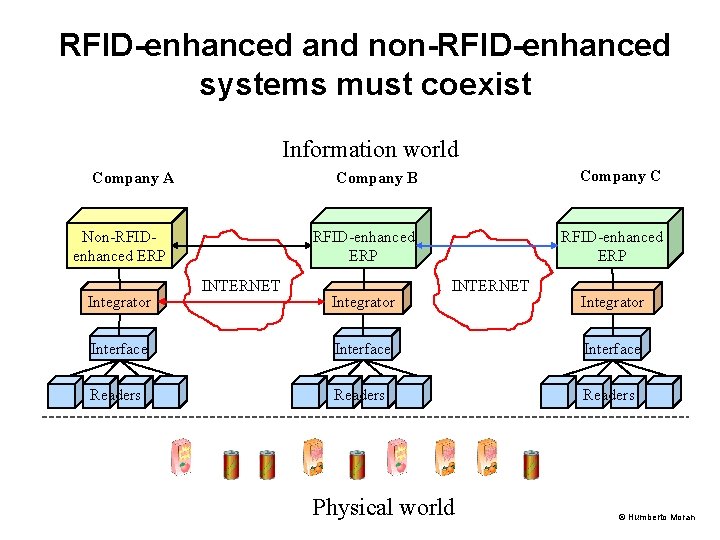
RFID-enhanced and non-RFID-enhanced systems must coexist Information world Company A Non-RFIDenhanced ERP Integrator INTERNET Company B Company C RFID-enhanced ERP Integrator INTERNET Integrator Interface Readers Physical world © Humberto Moran
Implications – sharing of information • There is a need for inter-organisational interoperability at the integration level • As ERPs cannot be replaced overnight, the integration layer must perform the exchange of inter-organisational information • In the future, traditional e-commerce transactions must be expanded to include information about physical objects © Humberto Moran
(4) RFID-Generated business transactions may target many different systems/modules • RFID is very versatile and allows for many business applications, hereby affecting many IS and ERP modules • RFID infrastructure can be shared among applications • A single physical transaction may generate multiple business transactions – even interorganisational ones © Humberto Moran
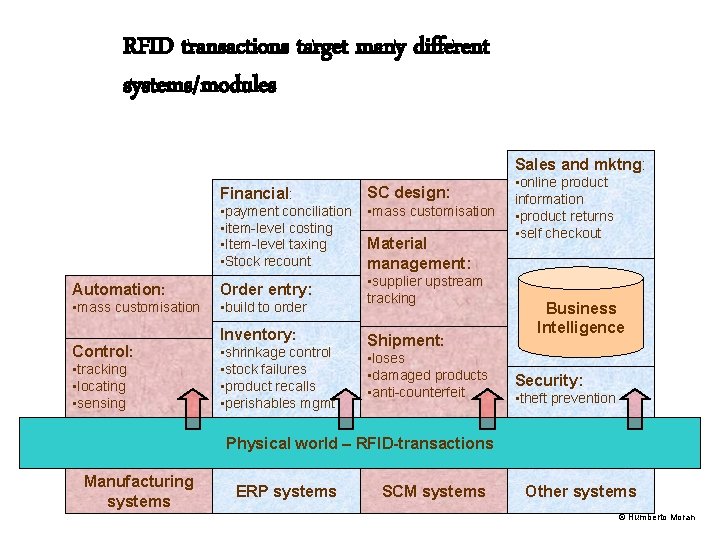
RFID transactions target many different systems/modules Sales and mktng: Financial: SC design: • payment conciliation • item-level costing • Item-level taxing • Stock recount • mass customisation Automation: Order entry: • mass customisation • build to order Control: • tracking • locating • sensing Inventory: • shrinkage control • stock failures • product recalls • perishables mgmt Material management: • supplier upstream tracking Shipment: • loses • damaged products • anti-counterfeit • online product information • product returns • self checkout Business Intelligence Security: • theft prevention Physical world – RFID-transactions Manufacturing systems ERP systems SCM systems Other systems © Humberto Moran
Implications – multiplicity of targets • RFID devices cannot be directly integrated into existing ERPs • The integration RFID/ERP must be multipoint and generate consistent transactions • The inter-organisational layer must convey not only information about products, but also about business transactions • There is a need for interoperability between ERPs from different vendors (again!) © Humberto Moran
(5) Duplicity of Information and functionality of RFID-enhanced systems and that of existing ERPs • Most existing ERP already include information on physical entities – Product description at SKU level – Product location and stock levels – Inter-organisational transactions • Functionality also overlaps – Use of barcodes – Human-fed transactions © Humberto Moran
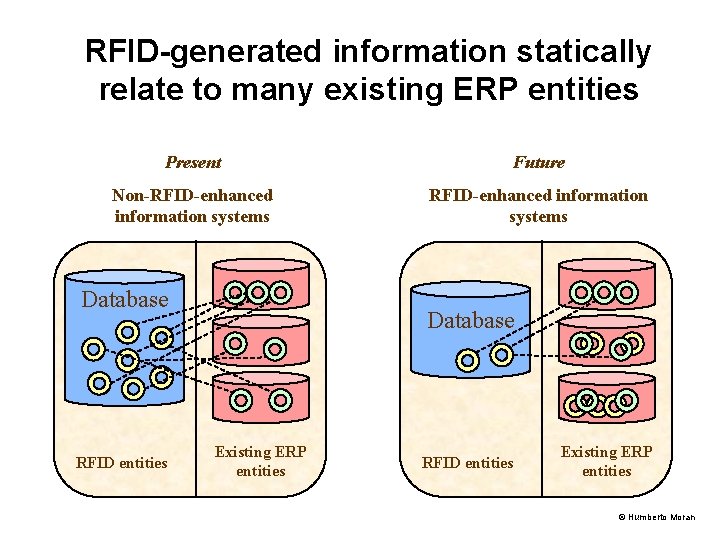
RFID-generated information statically relate to many existing ERP entities Present Future Non-RFID-enhanced information systems Database RFID entities Database Existing ERP entities RFID entities Existing ERP entities © Humberto Moran
Implications – data and functionality overlap • Need for a separate storage for the new physical information • Need for logical links with existing ERP entities • Need for combined functionality • Need for bidirectional transactions to keep both worlds “synchronised” © Humberto Moran
(6) The new amount of data is stunning • Tracking mass-produced goods such as cans of soda will generate millions of transactions every second • Most of these transactions are redundant; others have meaning only to specific modules, whole ERP or other IS; whilst others should be shared beyond the organisation • Transactions will come not only from relevant objects, but also from many other tagged objects scanned by chance © Humberto Moran
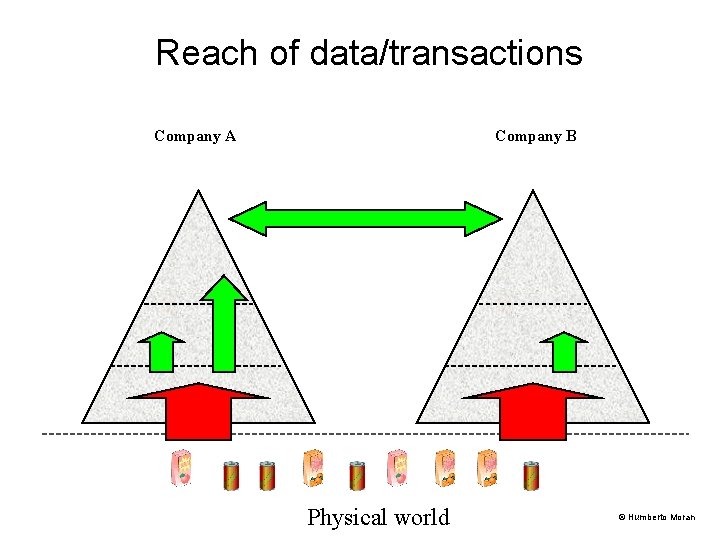
Reach of data/transactions Company A Company B Physical world © Humberto Moran
Implications – amount of data • This requires many filtering and interpretation layers: RFIDGenerated data and their related business transactions should be transmitted to the lowest meaningful possible level only • The integration should be flexible to adapt to different configurations – – All data Exceptions only Expectations (cache) Different levels of trust among SC partners • The integration layer should then allow not only for data transmission, but also for mobile business logic • This requires the creation of a new entity: the “Physical Business Language” (PBL), providing business knowledge with physical cognition and scope © Humberto Moran
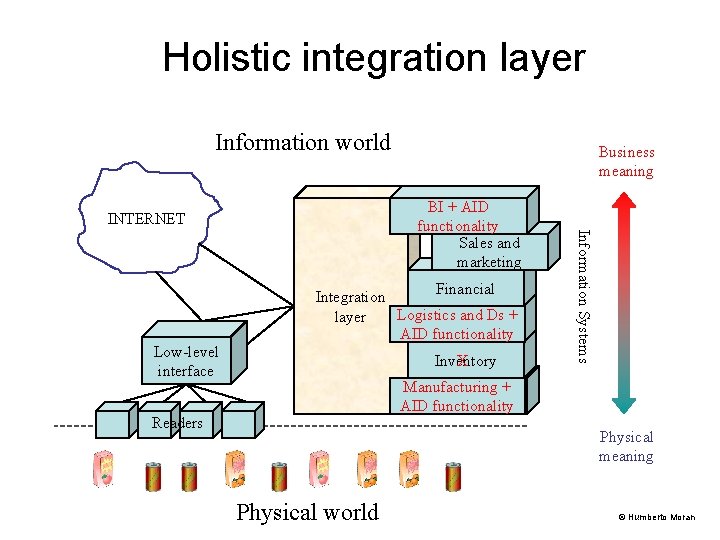
Holistic integration layer Information world Financial Integration Logistics and Ds + layer AIDdistribution functionality Inventory X Information Systems BI + AID functionality Sales and marketing INTERNET Low-level interface Business meaning Manufacturing + AID functionality Readers Physical meaning Physical world © Humberto Moran
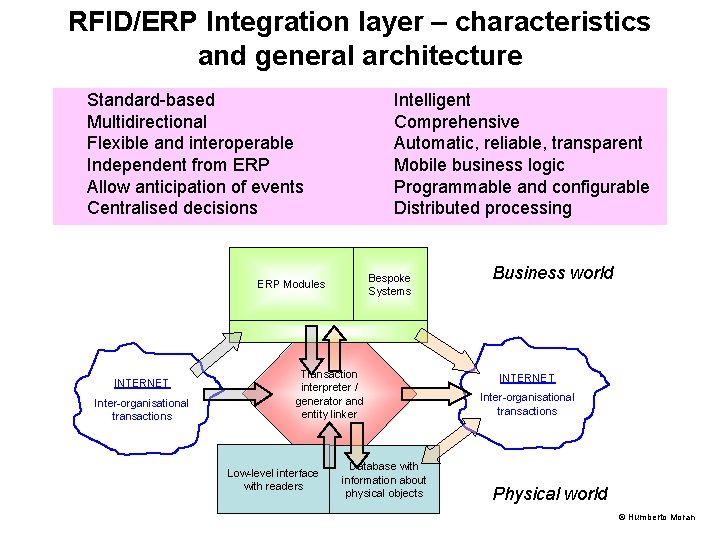
RFID/ERP Integration layer – characteristics and general architecture Standard-based Multidirectional Flexible and interoperable Independent from ERP Allow anticipation of events Centralised decisions Bespoke Systems ERP Modules INTERNET Inter-organisational transactions Intelligent Comprehensive Automatic, reliable, transparent Mobile business logic Programmable and configurable Distributed processing Transaction interpreter / generator and entity linker Low-level interface with readers Database with information about physical objects Business world INTERNET Inter-organisational transactions Physical world © Humberto Moran
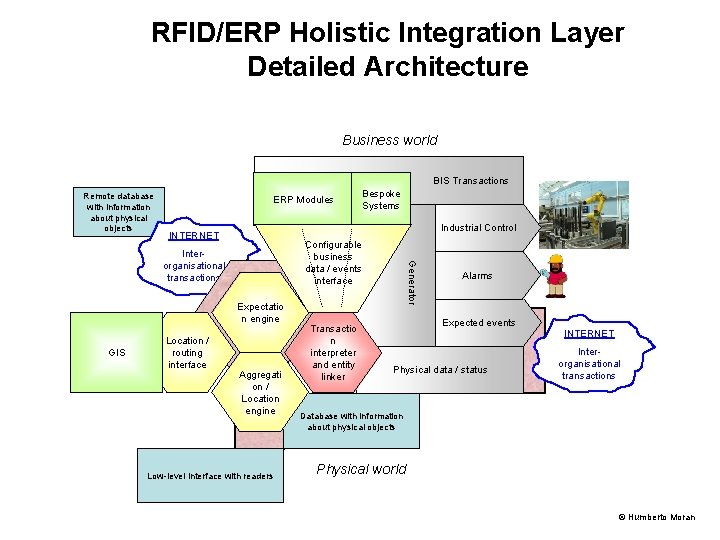
RFID/ERP Holistic Integration Layer Detailed Architecture Business world BIS Transactions Bespoke ERP Modules Systems INTERNET Configurable business data / events interface Interorganisational transactions Expectation n engine GIS Location / routing interface Generator Remote database with information about physical objects Aggregati on / Location engine Low-level interface with readers Transactio n interpreter and entity linker Industrial Control Alarms Expected events Physical data / status INTERNET Interorganisational transactions Database with information about physical objects Physical world © Humberto Moran
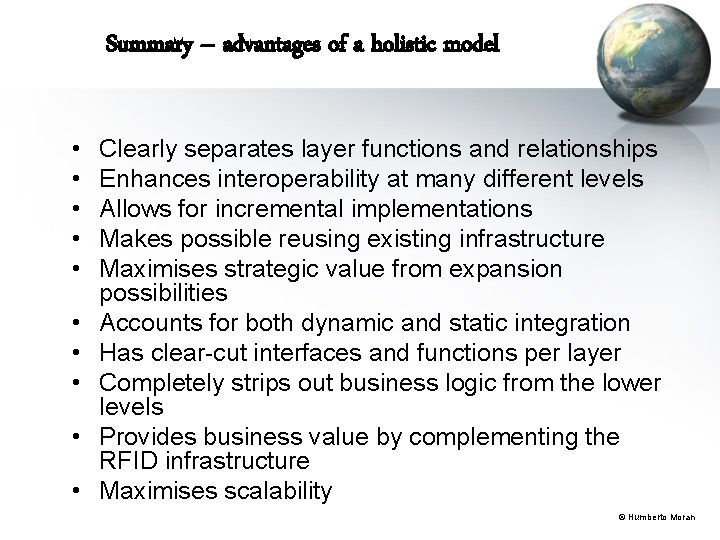
Summary – advantages of a holistic model • • • Clearly separates layer functions and relationships Enhances interoperability at many different levels Allows for incremental implementations Makes possible reusing existing infrastructure Maximises strategic value from expansion possibilities Accounts for both dynamic and static integration Has clear-cut interfaces and functions per layer Completely strips out business logic from the lower levels Provides business value by complementing the RFID infrastructure Maximises scalability © Humberto Moran
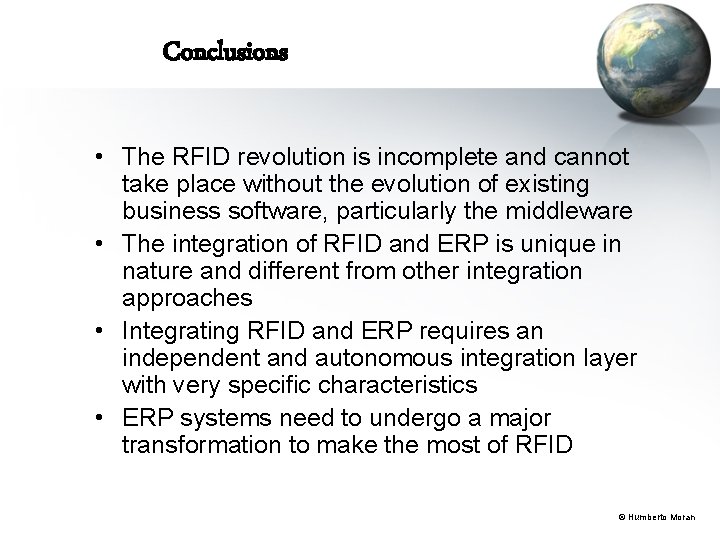
Conclusions • The RFID revolution is incomplete and cannot take place without the evolution of existing business software, particularly the middleware • The integration of RFID and ERP is unique in nature and different from other integration approaches • Integrating RFID and ERP requires an independent and autonomous integration layer with very specific characteristics • ERP systems need to undergo a major transformation to make the most of RFID © Humberto Moran
Integration of RFID and ERP Challenges and possibilities Questions? Humberto Moran Research Fellow Judge Institute of Management University of Cambridge h. moran@jims. cam. ac. uk June 2004 © Humberto Moran
- Slides: 29