
Integration of Medical data Stefan Schulz Institute for


- Slides: 70
Integration of Medical data Stefan Schulz Institute for Medical Informatics, Statistics und Documentation Medical University of Graz stefan. schulz@medunigraz. at
Character of this lecture § Introductory lecture for seminar on clinical data integration § Educational goals: § To understand the rationale for clinical data integration across disciplines, users and institutions § To distinguish between structural and semantic aspects of clinical data § To understand the role of biomedical informatics and international standardization in clinical data integration § To be sensitized regarding ethical aspects of clinical data integration
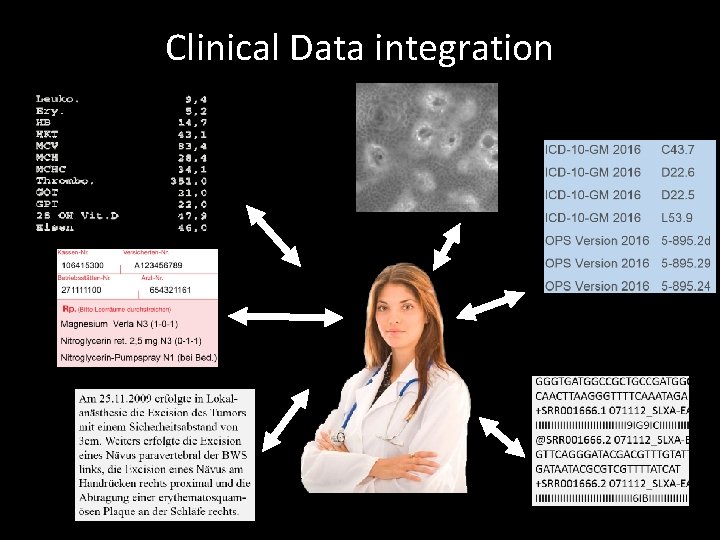
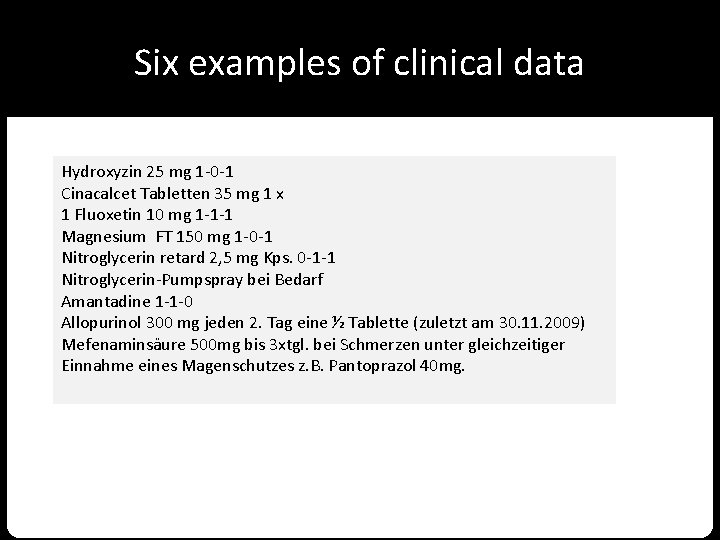
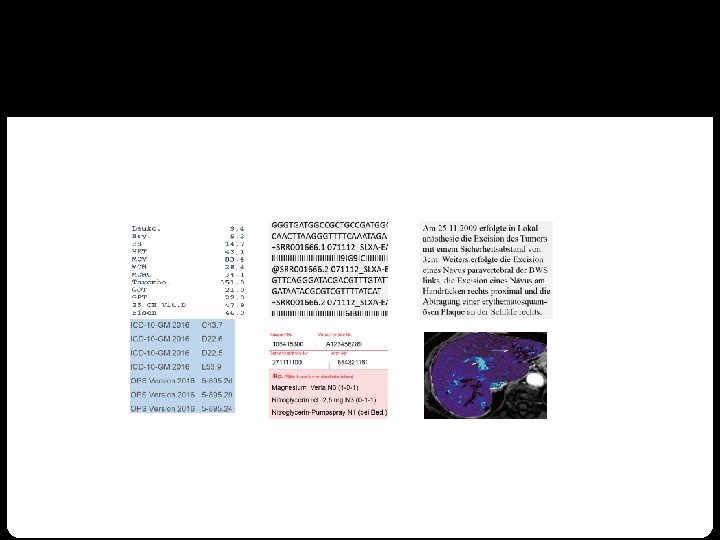
Six examples of clinical data § § § Clinical narrative Drug prescription Lab report Coded disorders and procedures Medical image Extract of gene sequence
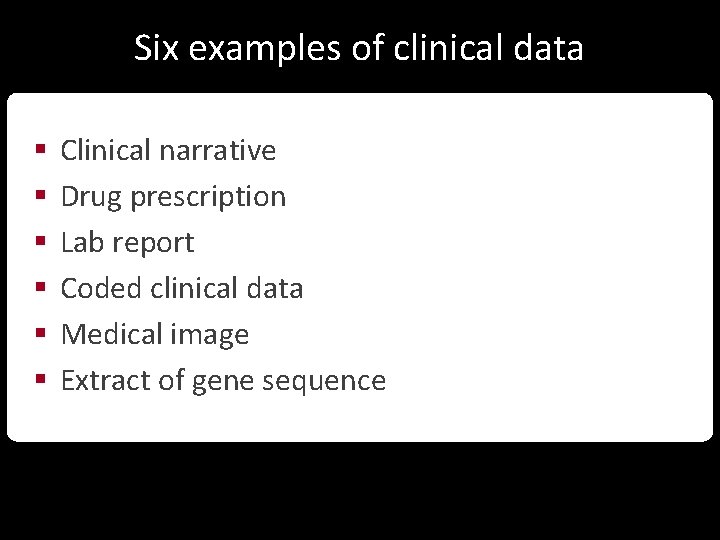
Six examples of clinical data § § § Clinical narrative Drug prescription Lab report Coded clinical data Medical image Extract of gene sequence
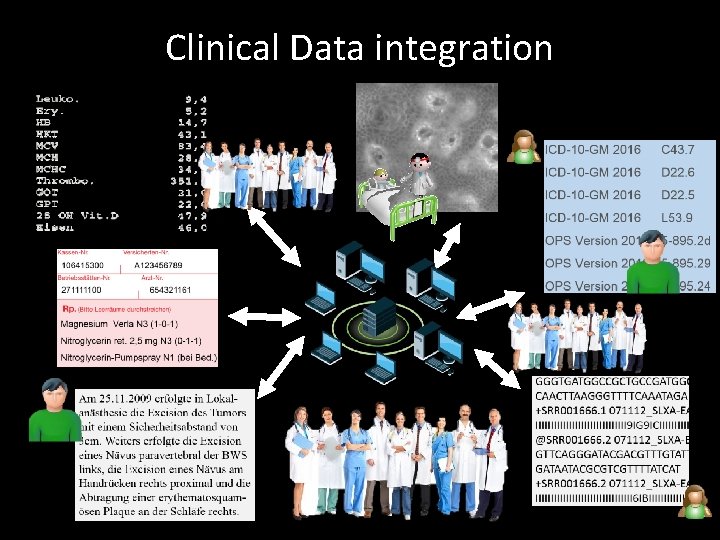
Clinical Data integration
Clinical Data integration
Rationale for clinical data integration
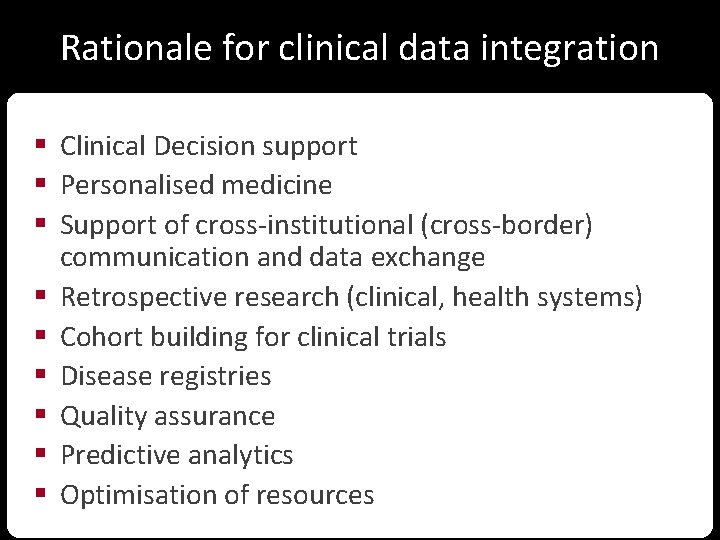
Rationale for clinical data integration § Clinical Decision support § Personalised medicine § Support of cross-institutional (cross-border) communication and data exchange § Retrospective research (clinical, health systems) § Cohort building for clinical trials § Disease registries § Quality assurance § Predictive analytics § Optimisation of resources
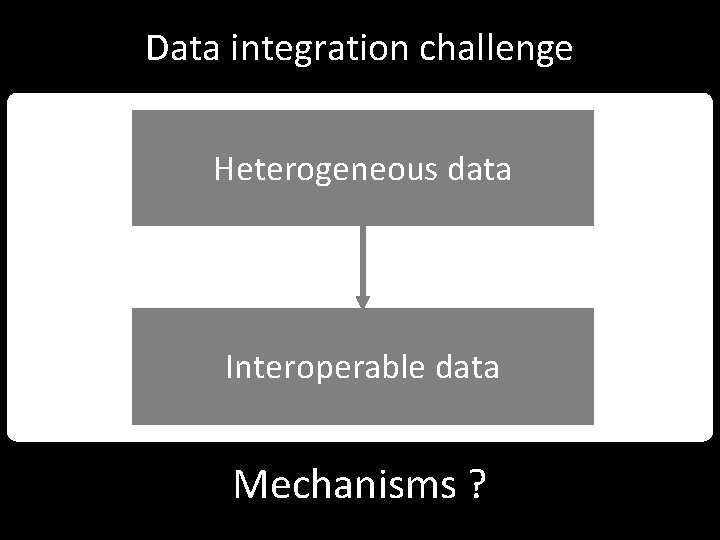
Data integration challenge Heterogeneous data Interoperable data Mechanisms ?
Data structures Data semantics
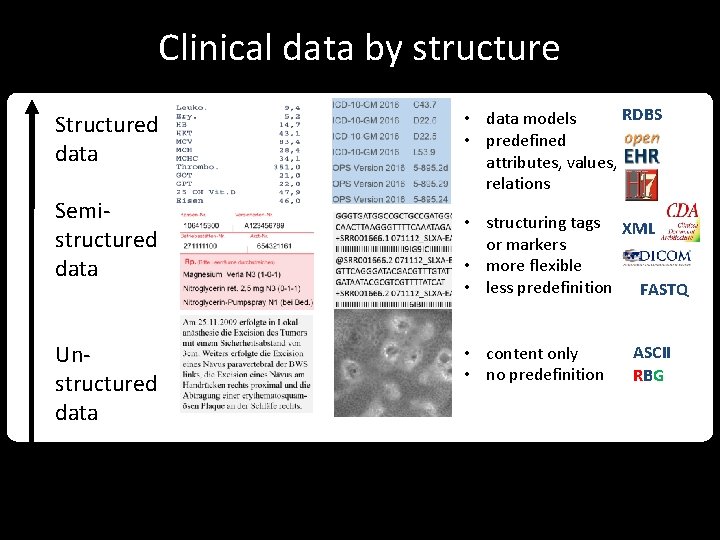
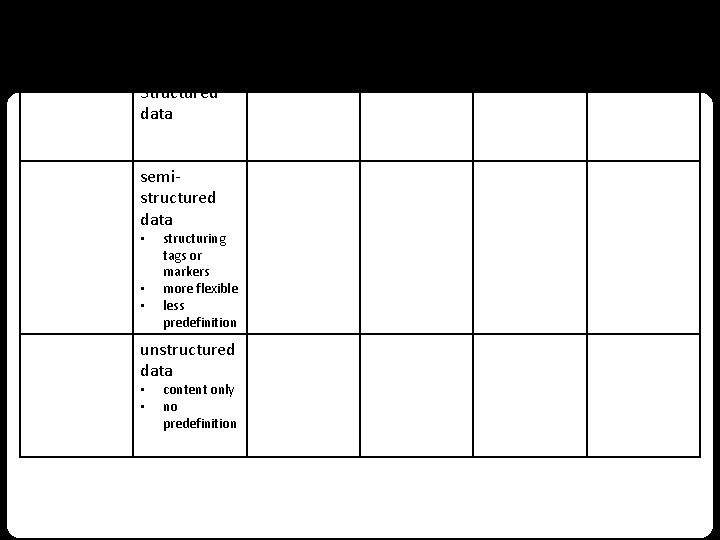
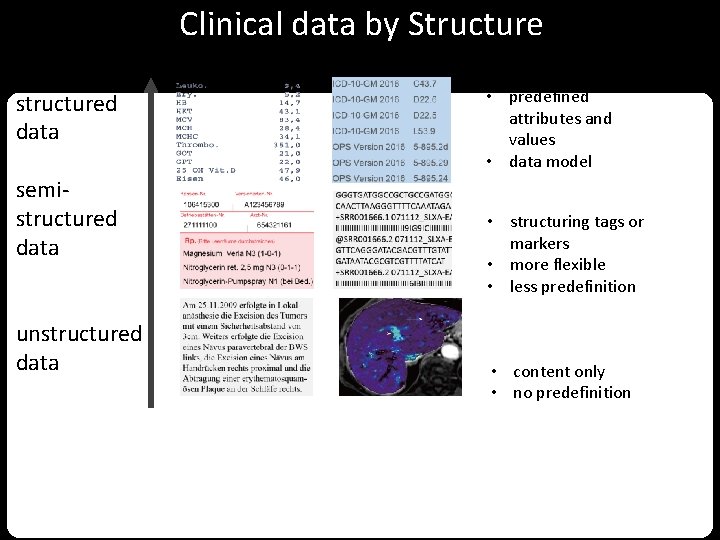
Clinical data by structure Structured data Semistructured data Unstructured data RDBS • data models • predefined attributes, values, relations • structuring tags XML or markers • more flexible • less predefinition FASTQ • content only • no predefinition ASCII RBG
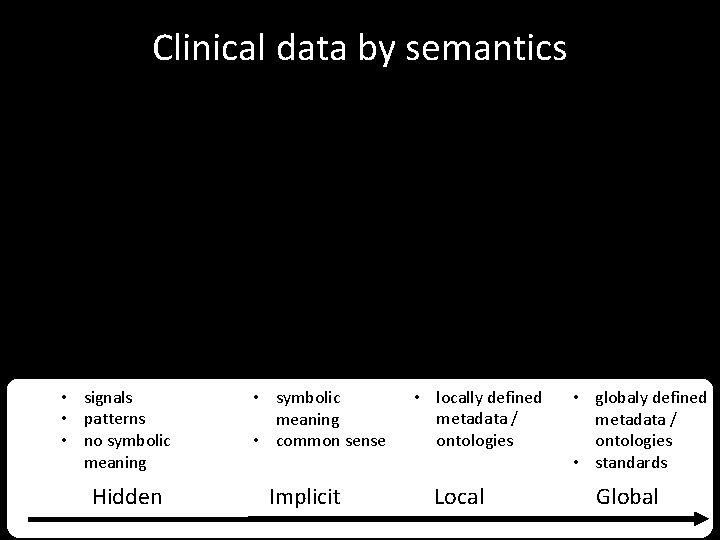
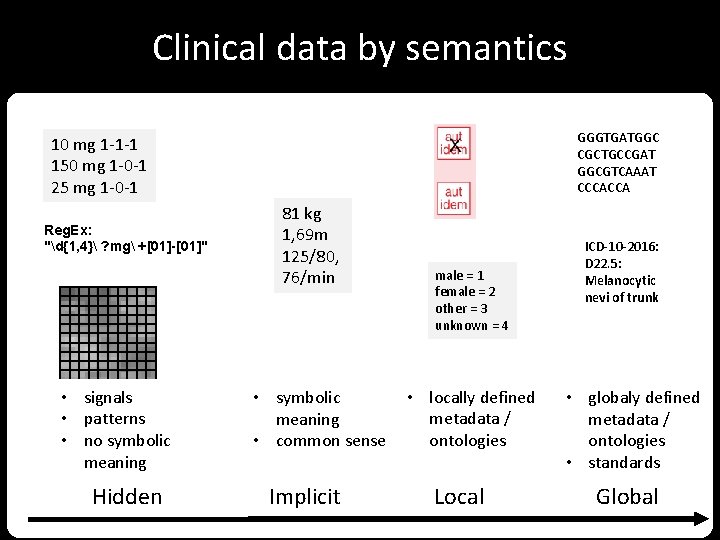
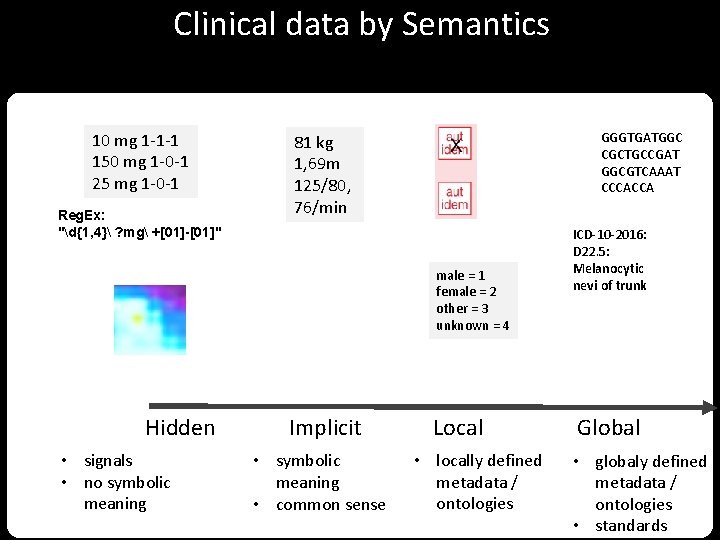
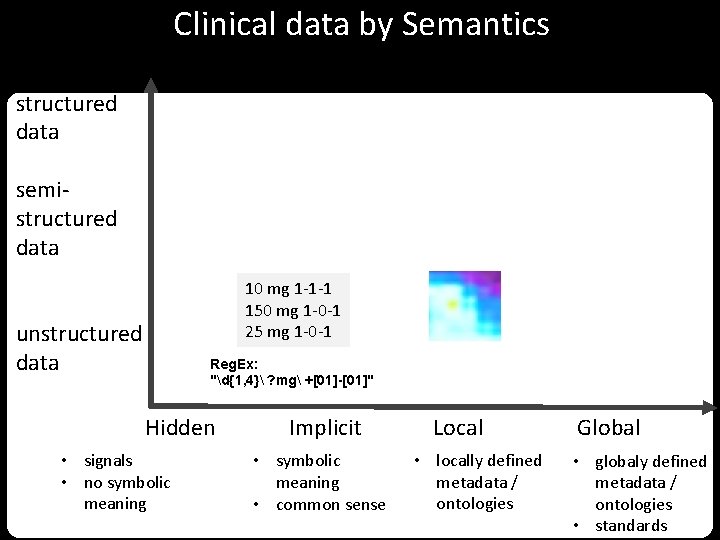
Clinical data by semantics • signals • patterns • no symbolic meaning Hidden • symbolic meaning • common sense Implicit • locally defined metadata / ontologies Local • globaly defined metadata / ontologies • standards Global
Clinical data by semantics GGGTGATGGC CGCTGCCGAT GGCGTCAAAT CCCACCA 10 mg 1 -1 -1 150 mg 1 -0 -1 25 mg 1 -0 -1 Reg. Ex: "d{1, 4} ? mg +[01]-[01]" • signals • patterns • no symbolic meaning Hidden 81 kg 1, 69 m 125/80, 76/min male = 1 female = 2 other = 3 unknown = 4 • symbolic meaning • common sense Implicit • locally defined metadata / ontologies Local ICD-10 -2016: D 22. 5: Melanocytic nevi of trunk • globaly defined metadata / ontologies • standards Global
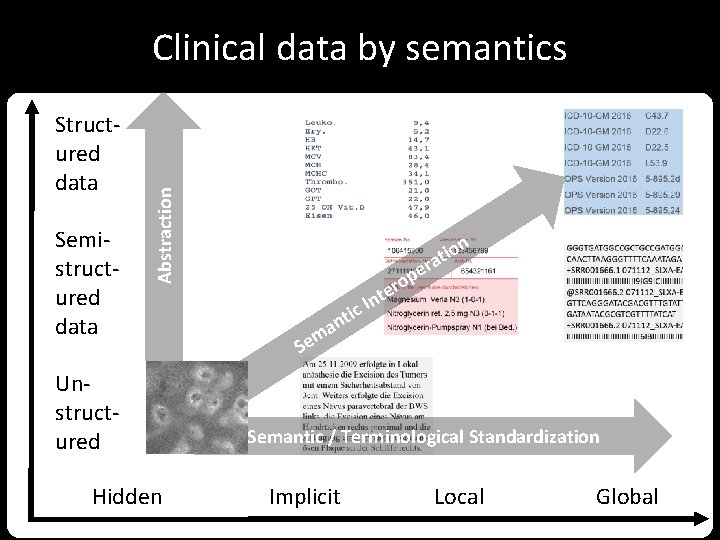
Structured data Semistructured data Abstraction Clinical data by semantics Unstructured Hidden on i t era p ero t n I tic n a m Se Semantic / Terminological Standardization Implicit Local Global
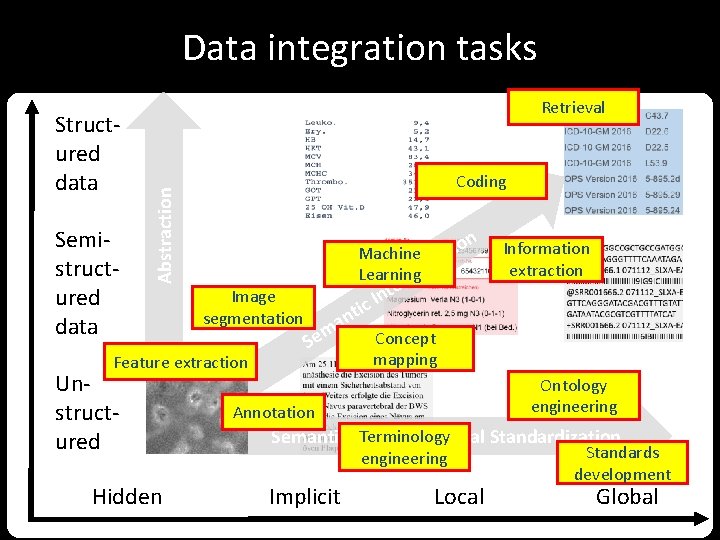
Data integration tasks Semistructured data Coding Abstraction Structured data Retrieval n Image segmentation Feature extraction Unstructured Hidden Machine ratio e Learning rop a m Se te n I c nti Information extraction Concept mapping Ontology engineering Annotation Semantic /Terminology terminological Standardization engineering Implicit Local Standards development Global
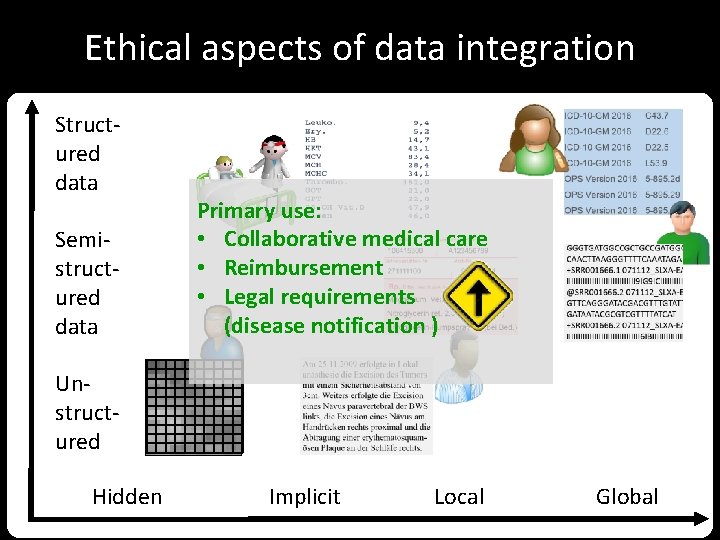
Ethical aspects of data integration Structured data Semistructured data Primary use: • Collaborative medical care • Reimbursement • Legal requirements (disease notification ) Unstructured Hidden Implicit Local Global
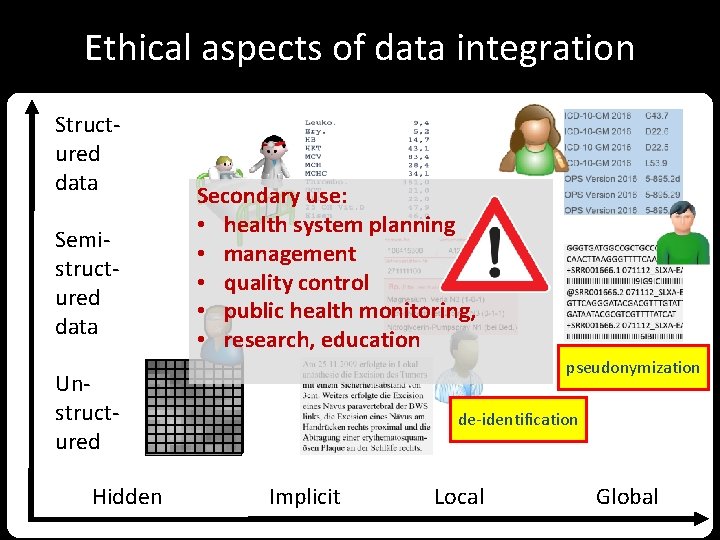
Ethical aspects of data integration Structured data Semistructured data Secondary use: • health system planning • management • quality control • public health monitoring, • research, education pseudonymization Unstructured Hidden de-identification Implicit Local Global
Take home messages § Most clinical data are semi-structured or unstructured § Most clinical data are not semantically standardised § Semantic interoperability: key to many advanced data integration / data reuse scenarios § Data integration requires broad range of medical informatics approaches: § Management of unstructured / semi-structured data § Natural language § Images § Other signals: sensor data, omics data § Standards development: regulatory activities: Terminology / Ontology / Clinical Information models § Ethical / privacy issues in secondary use scenarios
Questions ? Stefan Schulz (Univ. -Prof. Dr. med. ) Institut für Medizinische Informatik, Statistik und Dokumentation Medizinische Universität Graz, Auenbruggerplatz 2/V 8036 Graz (Austria) http: //www. medunigraz. at/imi http: //g. co/maps/aqedt 0043 316 385 16939 0043 316 385 13201 http: //purl. org/steschu mailto: stefan. schulz@medunigraz. at Skype: stschulz
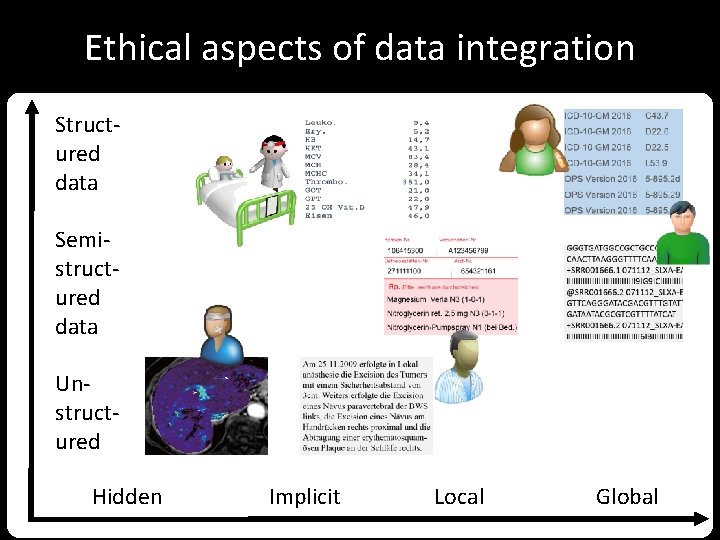
Ethical aspects of data integration Structured data Semistructured data Unstructured Hidden Implicit Local Global
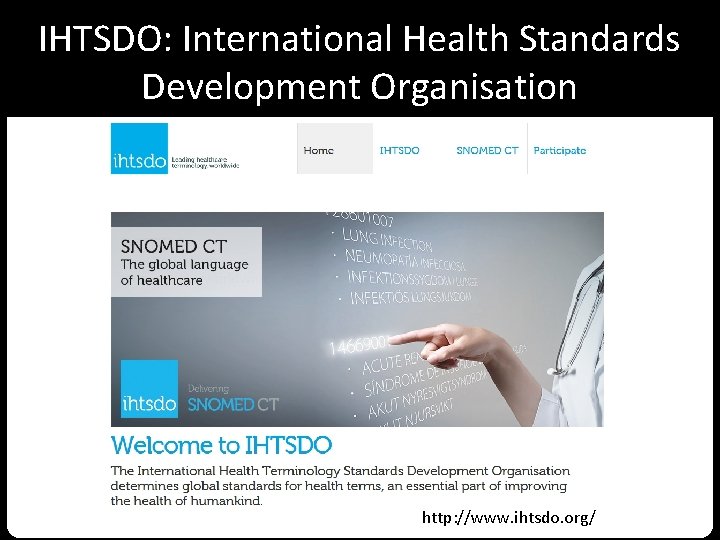
IHTSDO: International Health Standards Development Organisation http: //www. ihtsdo. org/
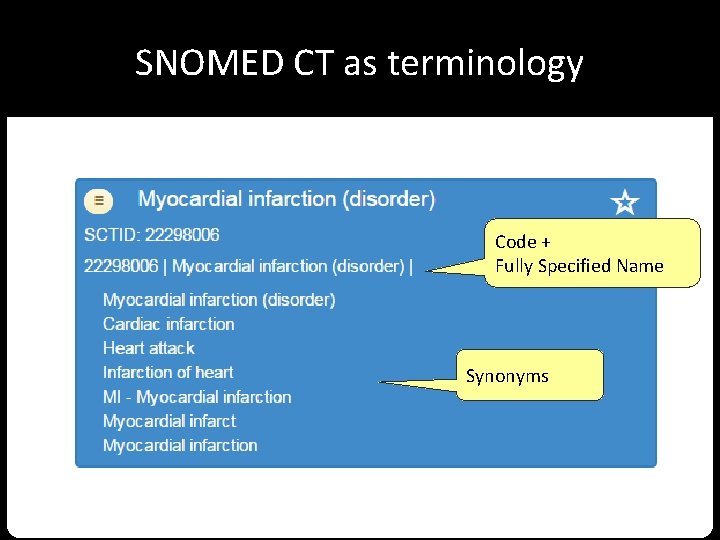
SNOMED CT as terminology Code + Fully Specified Name Synonyms
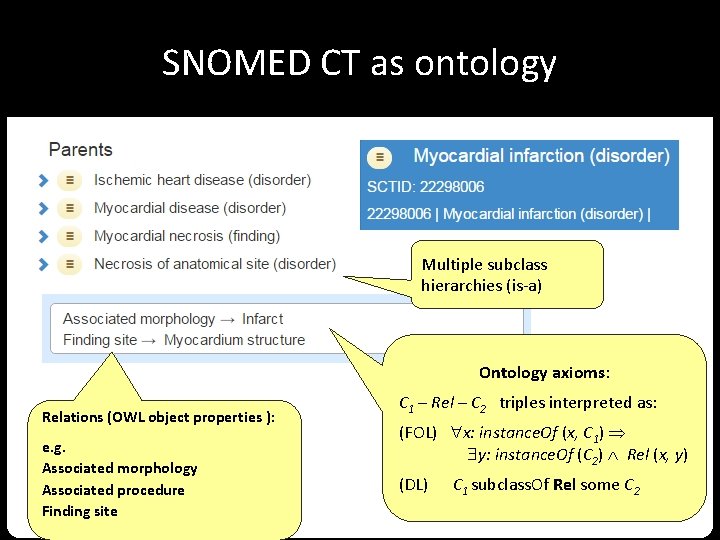
SNOMED CT as ontology Multiple subclass hierarchies (is-a) Ontology axioms: Relations (OWL object properties ): e. g. Associated morphology Associated procedure Finding site C 1 – Rel – C 2 triples interpreted as: (FOL) x: instance. Of (x, C 1) y: instance. Of (C 2) Rel (x, y) (DL) C 1 subclass. Of Rel some C 2
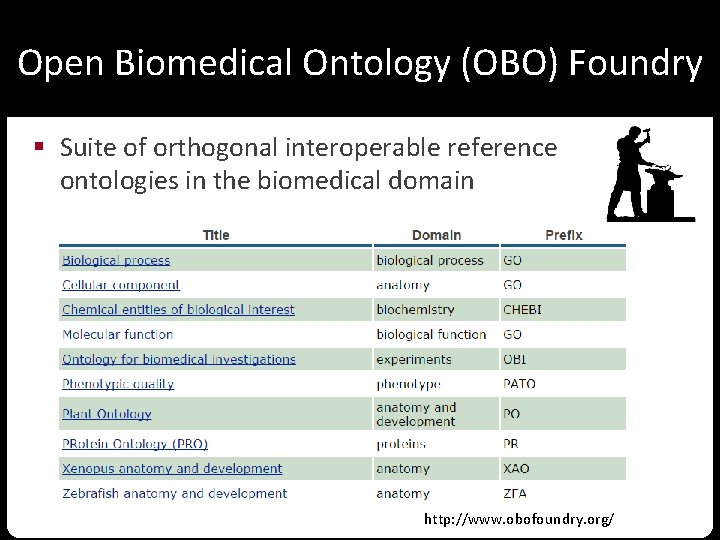
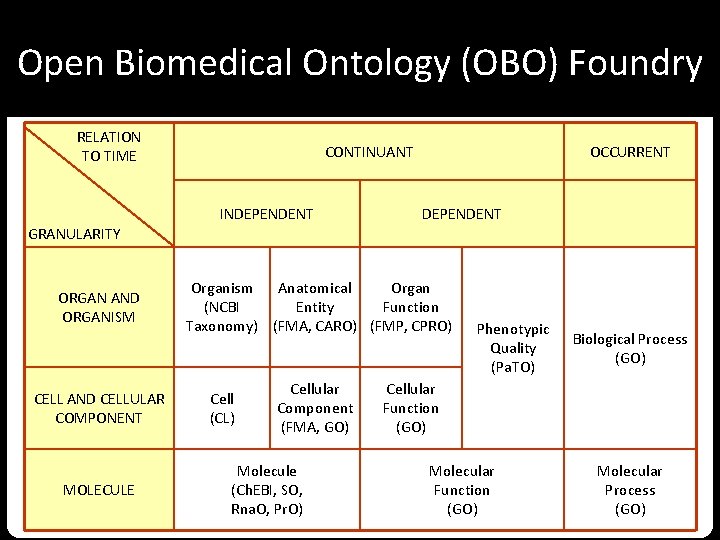
Open Biomedical Ontology (OBO) Foundry § Suite of orthogonal interoperable reference ontologies in the biomedical domain http: //www. obofoundry. org/
Open Biomedical Ontology (OBO) Foundry RELATION CONTINUANT TO TIME INDEPENDENT OCCURRENT DEPENDENT GRANULARITY ORGAN AND ORGANISM CELL AND CELLULAR COMPONENT MOLECULE Organism Anatomical Organ (NCBI Entity Function Taxonomy) (FMA, CARO) (FMP, CPRO) Cell (CL) Cellular Component (FMA, GO) Molecule (Ch. EBI, SO, Rna. O, Pr. O) Phenotypic Quality (Pa. TO) Biological Process (GO) Cellular Function (GO) Molecular Process (GO)
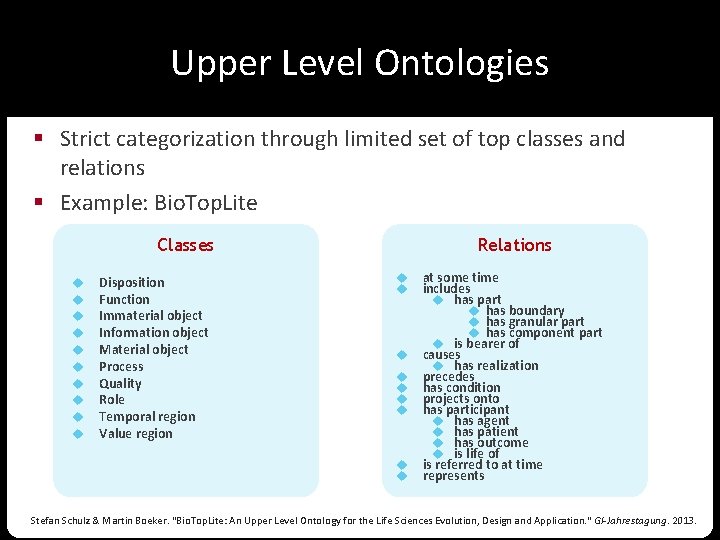
Upper Level Ontologies § Strict categorization through limited set of top classes and relations § Example: Bio. Top. Lite Classes Disposition Function Immaterial object Information object Material object Process Quality Role Temporal region Value region Relations at some time includes has part has boundary has granular part has component part is bearer of causes has realization precedes has condition projects onto has participant has agent has patient has outcome is life of is referred to at time represents Stefan Schulz & Martin Boeker. "Bio. Top. Lite: An Upper Level Ontology for the Life Sciences Evolution, Design and Application. " GI-Jahrestagung. 2013.
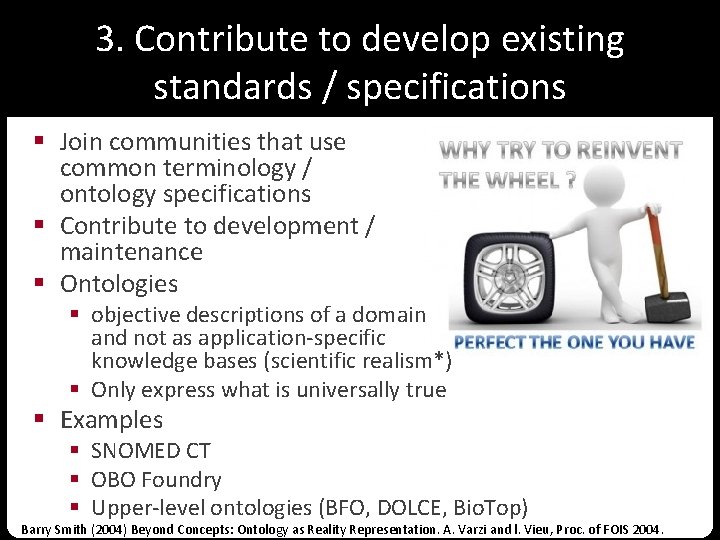
3. Contribute to develop existing standards / specifications § Join communities that use common terminology / ontology specifications § Contribute to development / maintenance § Ontologies § objective descriptions of a domain and not as application-specific knowledge bases (scientific realism*) § Only express what is universally true § Examples § SNOMED CT § OBO Foundry § Upper-level ontologies (BFO, DOLCE, Bio. Top) Barry Smith (2004) Beyond Concepts: Ontology as Reality Representation. A. Varzi and l. Vieu, Proc. of FOIS 2004.
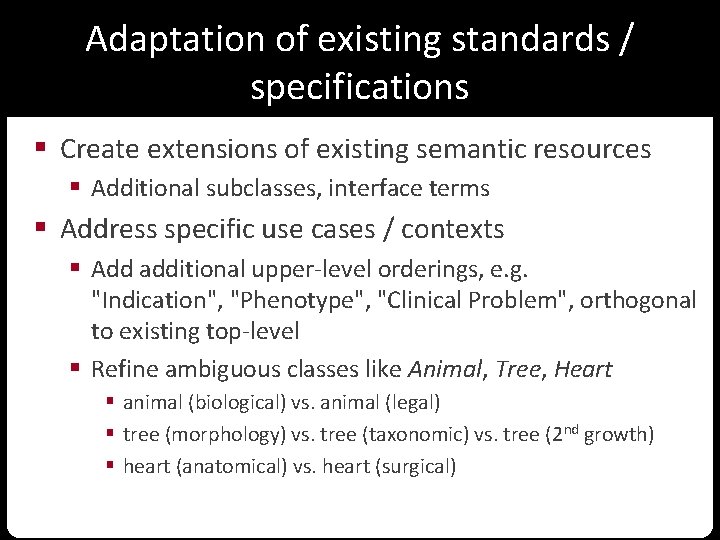
Adaptation of existing standards / specifications § Create extensions of existing semantic resources § Additional subclasses, interface terms § Address specific use cases / contexts § Add additional upper-level orderings, e. g. "Indication", "Phenotype", "Clinical Problem", orthogonal to existing top-level § Refine ambiguous classes like Animal, Tree, Heart § animal (biological) vs. animal (legal) § tree (morphology) vs. tree (taxonomic) vs. tree (2 nd growth) § heart (anatomical) vs. heart (surgical)
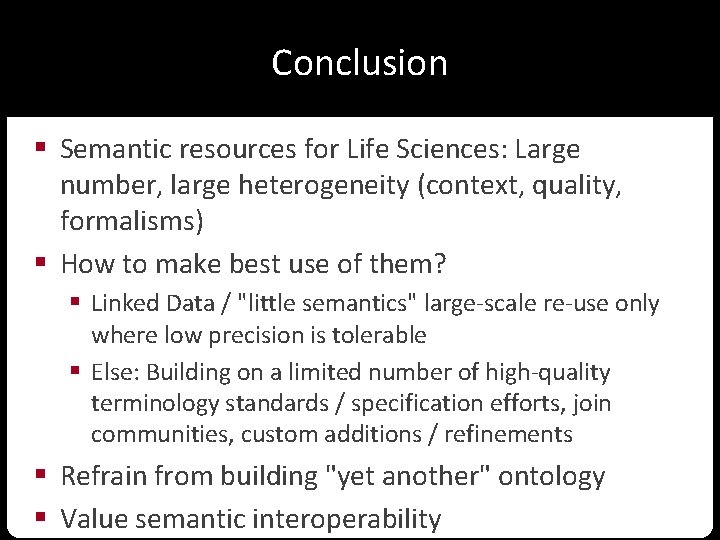
Conclusion § Semantic resources for Life Sciences: Large number, large heterogeneity (context, quality, formalisms) § How to make best use of them? § Linked Data / "little semantics" large-scale re-use only where low precision is tolerable § Else: Building on a limited number of high-quality terminology standards / specification efforts, join communities, custom additions / refinements § Refrain from building "yet another" ontology § Value semantic interoperability
Thank you Stefan Schulz (Univ. -Prof. Dr. med. ) Institut für Medizinische Informatik, Statistik und Dokumentation Medizinische Universität Graz, Auenbruggerplatz 2/V 8036 Graz (Austria) http: //www. medunigraz. at/imi http: //g. co/maps/aqedt 0043 316 385 16939 0043 316 385 13201 http: //purl. org/steschu mailto: stefan. schulz@medunigraz. at Skype: stschulz
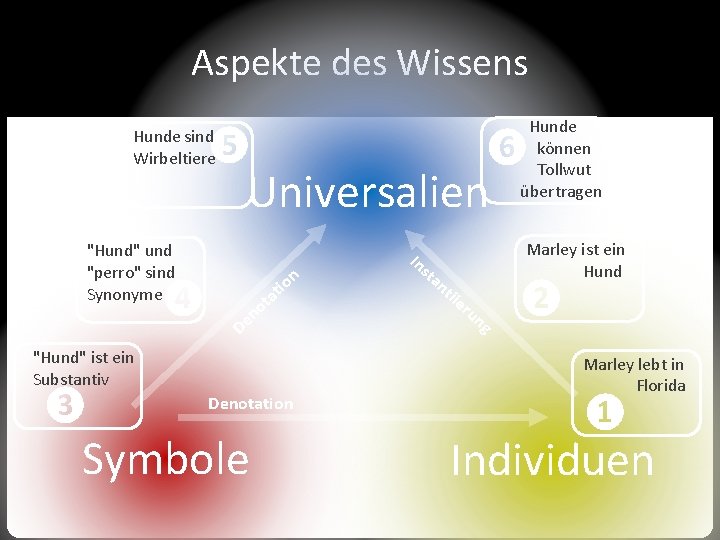
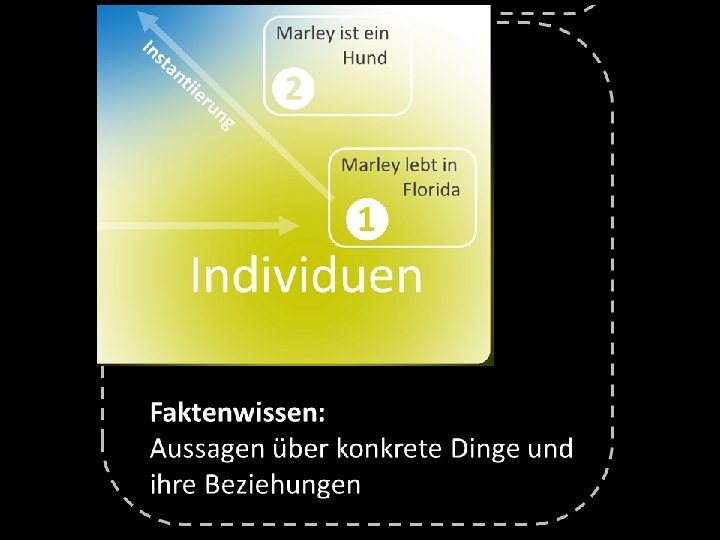
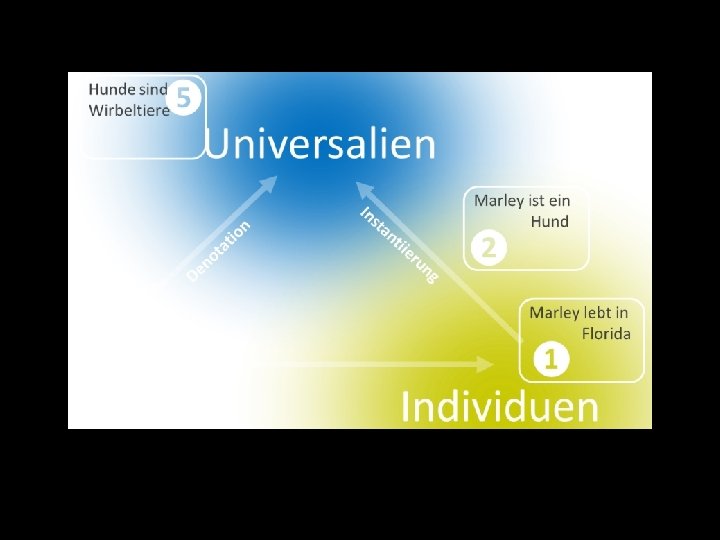
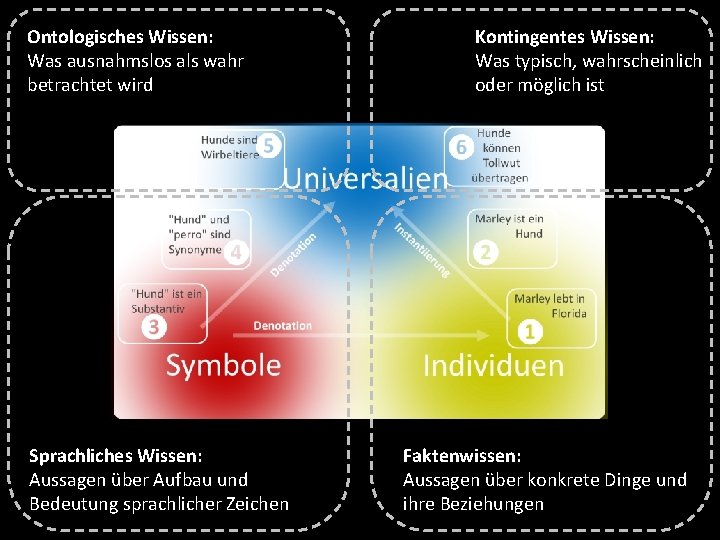
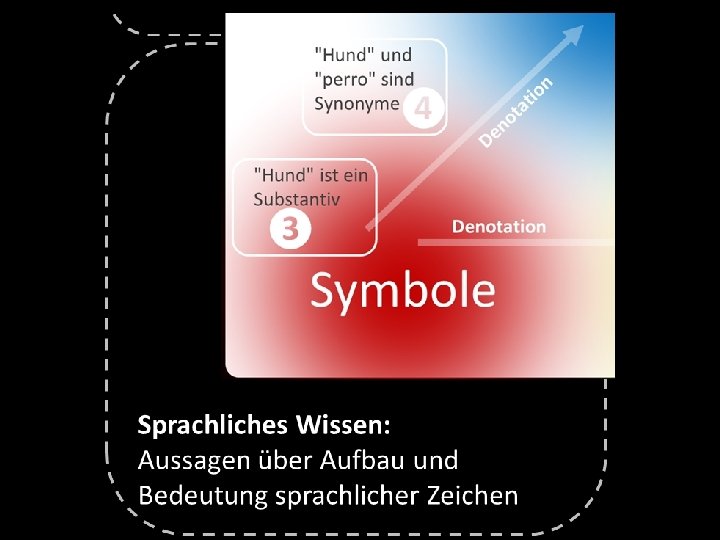
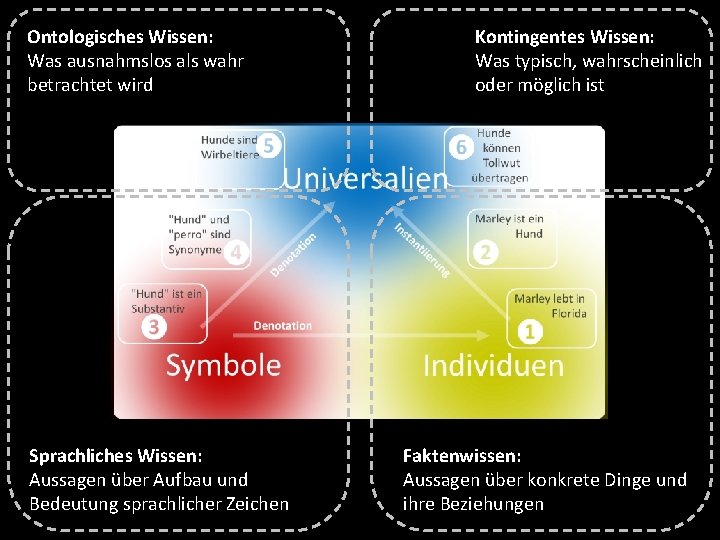
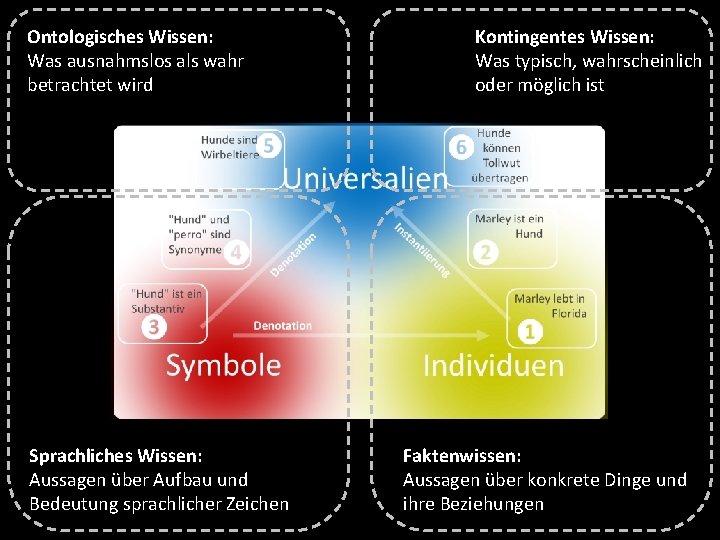
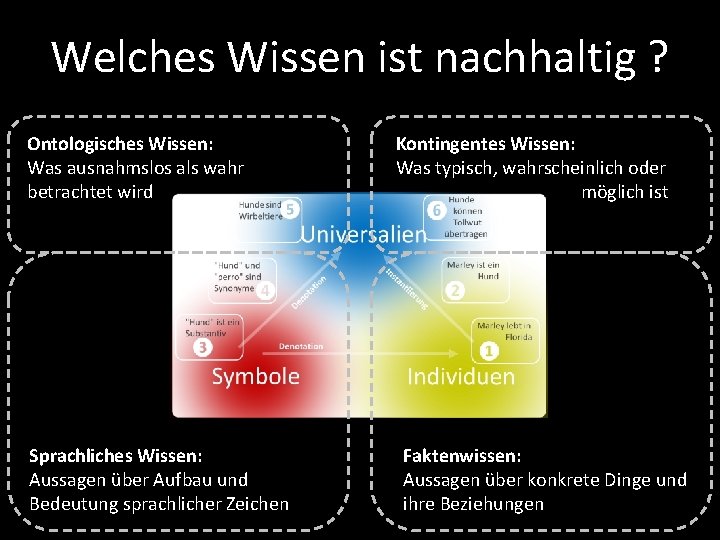
Aspekte des Wissens Hunde sind Wirbeltiere ❺ ❹ ❻ Universalien "Hund" und "perro" sind Synonyme n it o ta o en D "Hund" ist ein Substantiv ❸ Denotation Symbole Hunde können Tollwut übertragen Marley ist ein Hund In s ta nt iie ru ng ❷ Marley lebt in Florida ❶ Individuen
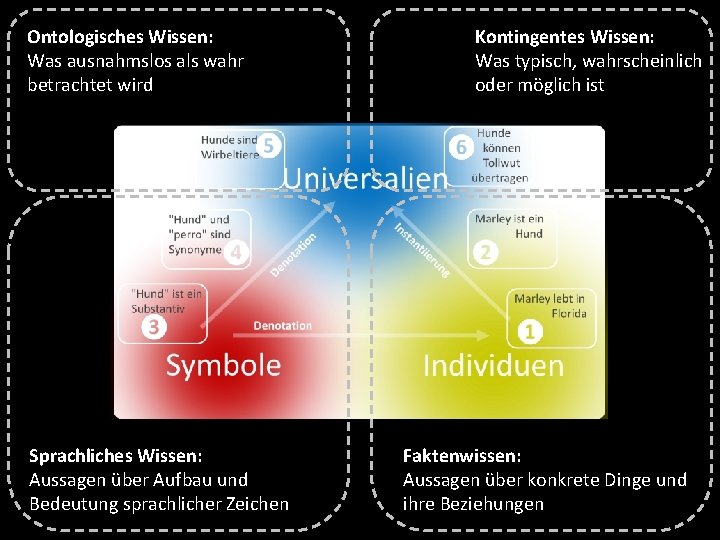
Ontologisches Wissen: Was ausnahmslos als wahr betrachtet wird Sprachliches Wissen: Aussagen über Aufbau und Bedeutung sprachlicher Zeichen Kontingentes Wissen: Was typisch, wahrscheinlich oder möglich ist Faktenwissen: Aussagen über konkrete Dinge und ihre Beziehungen
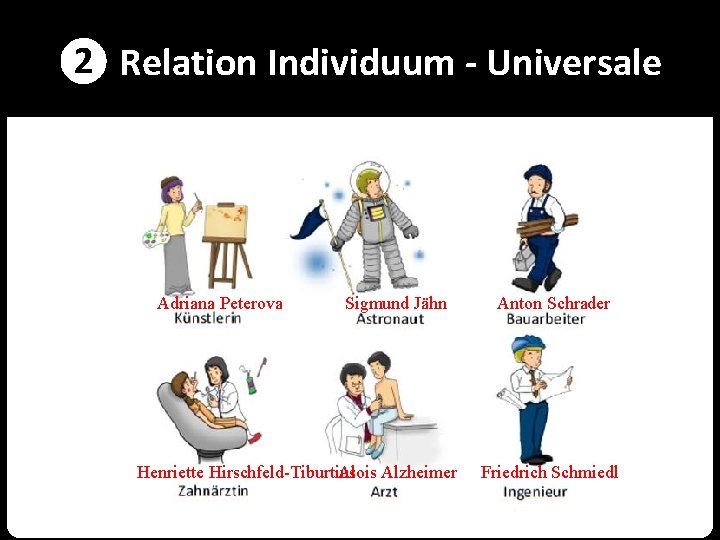
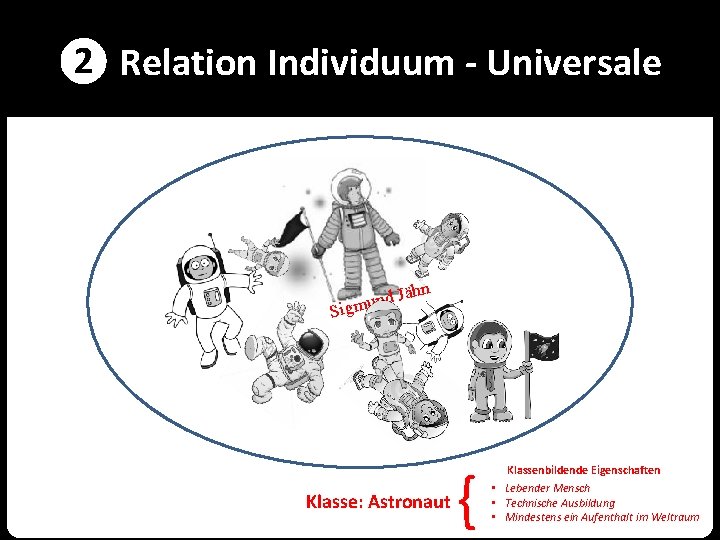
❷ Relation Individuum - Universale Adriana Peterova Sigmund Jähn Henriette Hirschfeld-Tiburtius Alois Alzheimer Anton Schrader Friedrich Schmiedl
❷ Relation Individuum - Universale hn d Jä n u m ig S Klasse: Astronaut { Klassenbildende Eigenschaften • Lebender Mensch • Technische Ausbildung • Mindestens ein Aufenthalt im Weltraum
Ontologisches Wissen: Was ausnahmslos als wahr betrachtet wird Sprachliches Wissen: Aussagen über Aufbau und Bedeutung sprachlicher Zeichen Kontingentes Wissen: Was typisch, wahrscheinlich oder möglich ist Faktenwissen: Aussagen über konkrete Dinge und ihre Beziehungen
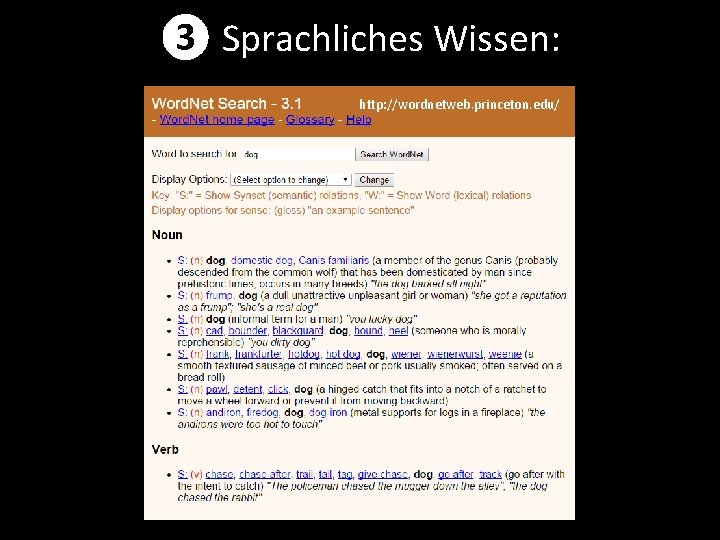
❸ Sprachliches Wissen: http: //wordnetweb. princeton. edu/
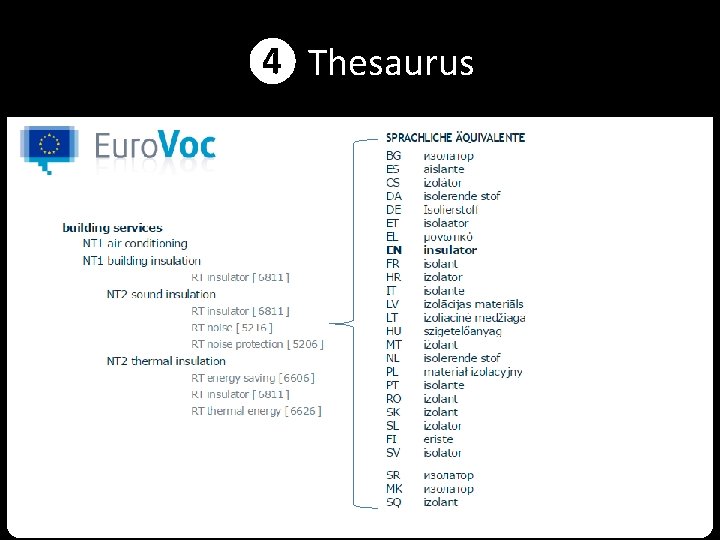
❹ Thesaurus
Ontologisches Wissen: Was ausnahmslos als wahr betrachtet wird Sprachliches Wissen: Aussagen über Aufbau und Bedeutung sprachlicher Zeichen Kontingentes Wissen: Was typisch, wahrscheinlich oder möglich ist Faktenwissen: Aussagen über konkrete Dinge und ihre Beziehungen
Ontologisches Wissen: Was ausnahmslos als wahr betrachtet wird Sprachliches Wissen: Aussagen über Aufbau und Bedeutung sprachlicher Zeichen Kontingentes Wissen: Was typisch, wahrscheinlich oder möglich ist Faktenwissen: Aussagen über konkrete Dinge und ihre Beziehungen
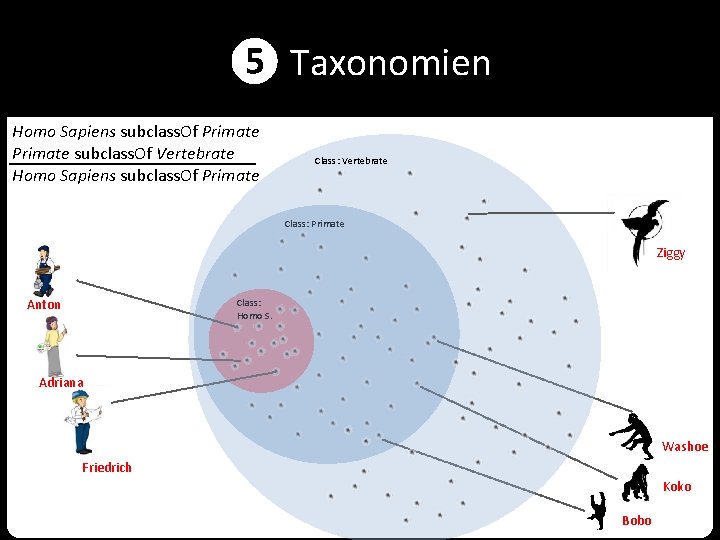
❺ Taxonomien Homo Sapiens subclass. Of Primate subclass. Of Vertebrate Homo Sapiens subclass. Of Primate Class: Vertebrate Class: Primate Ziggy Anton Class: Homo S. Adriana Washoe Friedrich Koko Bobo
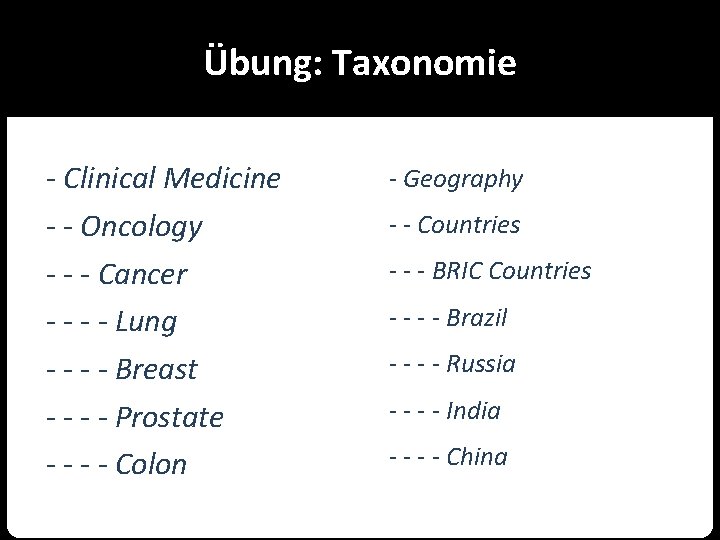
Übung: Taxonomie - Clinical Medicine - - Oncology - - - Cancer - - Lung - - Breast - - Prostate - - Colon - Geography - - Countries - - - BRIC Countries - - Brazil - - Russia - - India - - China
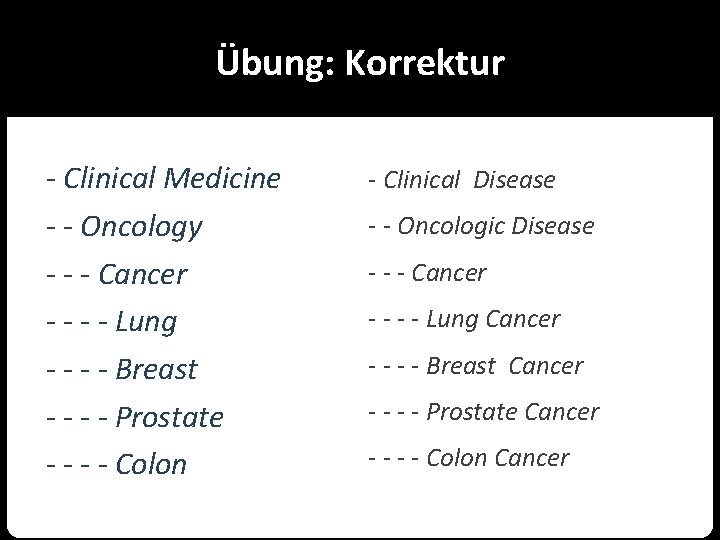
Übung: Korrektur - Clinical Medicine - - Oncology - - - Cancer - - Lung - - Breast - - Prostate - - Colon - Clinical Disease - - Oncologic Disease - - - Cancer - - Lung Cancer - - Breast Cancer - - Prostate Cancer - - Colon Cancer
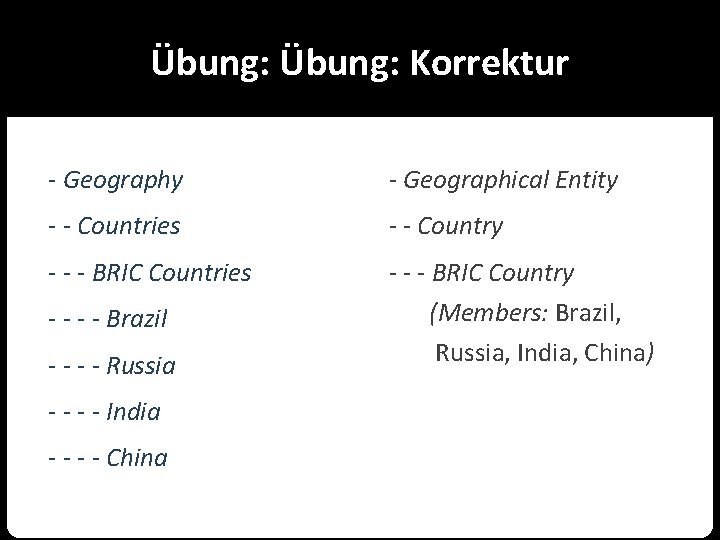
Übung: Korrektur - Geography - Geographical Entity - - Countries - - Country - - - BRIC Countries - - - BRIC Country (Members: Brazil, Russia, India, China) - - Brazil - - Russia - - India - - China
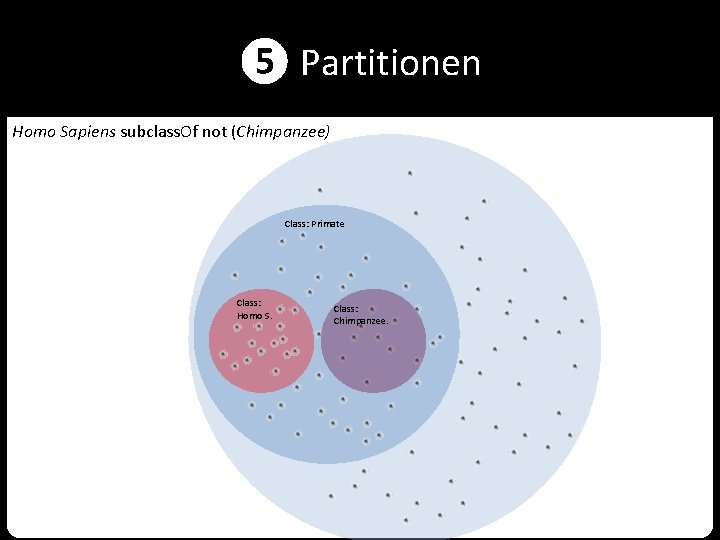
❺ Partitionen Homo Sapiens subclass. Of not (Chimpanzee) Class: Primate Class: Homo S. Class: Chimpanzee.
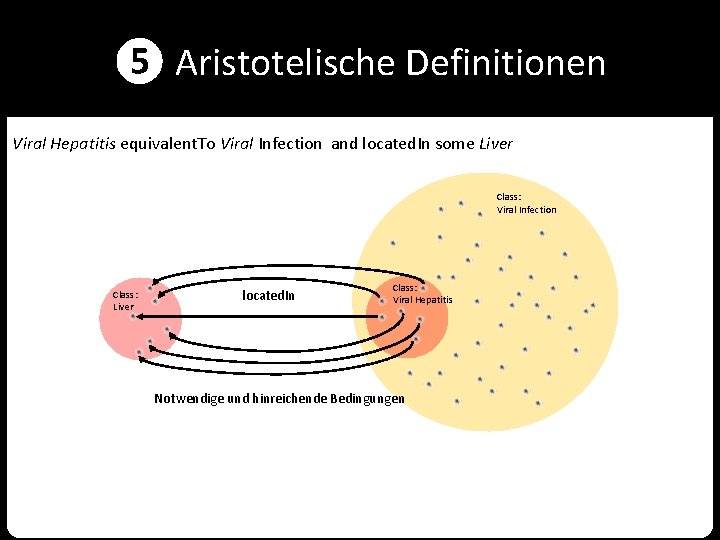
❺ Aristotelische Definitionen Viral Hepatitis equivalent. To Viral Infection and located. In some Liver Class: Viral Infection Class: Liver located. In Class: Viral Hepatitis Notwendige und hinreichende Bedingungen
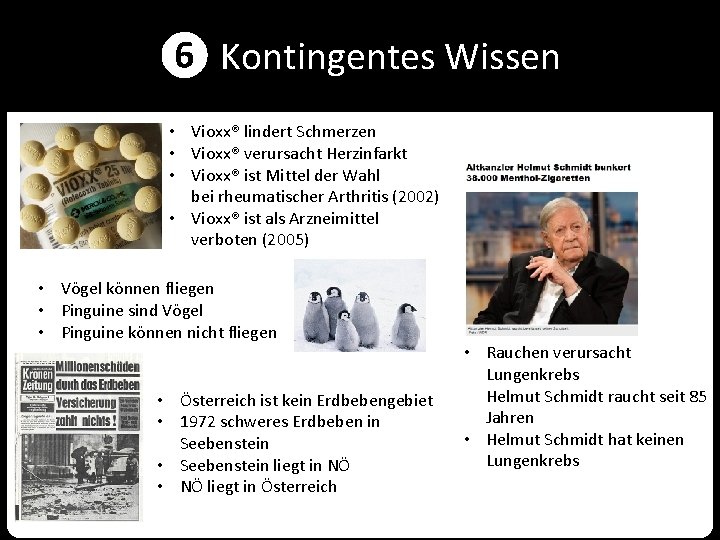
❻ Kontingentes Wissen • Vioxx® lindert Schmerzen • Vioxx® verursacht Herzinfarkt • Vioxx® ist Mittel der Wahl bei rheumatischer Arthritis (2002) • Vioxx® ist als Arzneimittel verboten (2005) • Vögel können fliegen • Pinguine sind Vögel • Pinguine können nicht fliegen • Österreich ist kein Erdbebengebiet • 1972 schweres Erdbeben in Seebenstein • Seebenstein liegt in NÖ • NÖ liegt in Österreich • Rauchen verursacht Lungenkrebs Helmut Schmidt raucht seit 85 Jahren • Helmut Schmidt hat keinen Lungenkrebs
Welches Wissen ist nachhaltig ? Ontologisches Wissen: Was ausnahmslos als wahr betrachtet wird Sprachliches Wissen: Aussagen über Aufbau und Bedeutung sprachlicher Zeichen Kontingentes Wissen: Was typisch, wahrscheinlich oder möglich ist Faktenwissen: Aussagen über konkrete Dinge und ihre Beziehungen
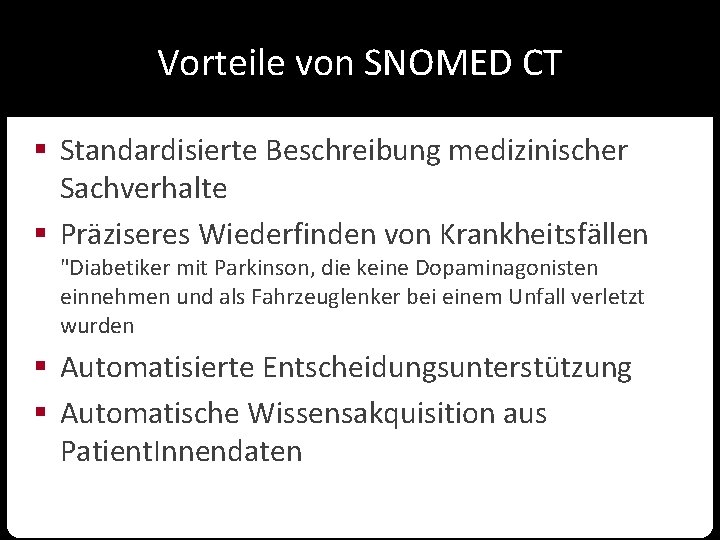
Vorteile von SNOMED CT § Standardisierte Beschreibung medizinischer Sachverhalte § Präziseres Wiederfinden von Krankheitsfällen "Diabetiker mit Parkinson, die keine Dopaminagonisten einnehmen und als Fahrzeuglenker bei einem Unfall verletzt wurden § Automatisierte Entscheidungsunterstützung § Automatische Wissensakquisition aus Patient. Innendaten
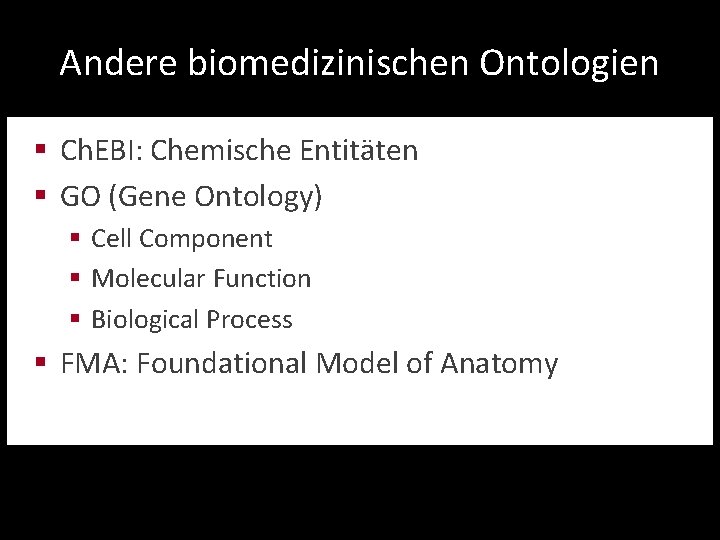
Ontologien in der Wissenschaft Andere biomedizinischen Ontologien § Ch. EBI: Chemische Entitäten § GO (Gene Ontology) § Cell Component § Molecular Function § Biological Process § FMA: Foundational Model of Anatomy
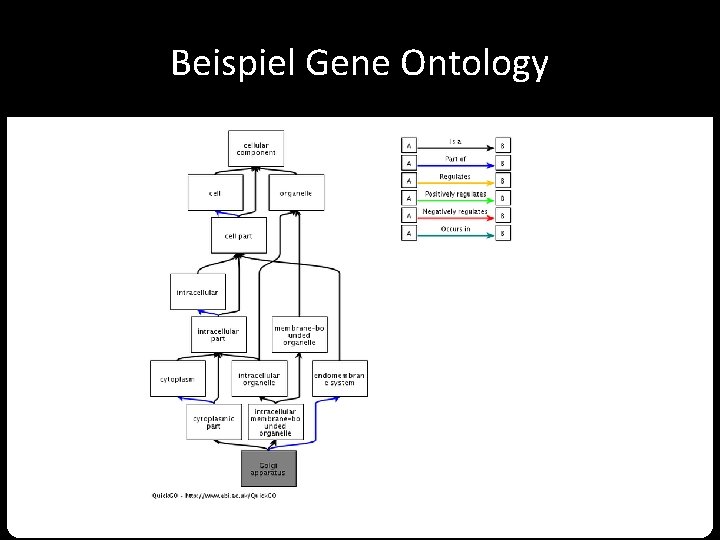
Beispiel Gene Ontology
Gesellschaftliche Aspekte § Nachhaltige Wissensinhalte § Inhalte, die sich nicht verändern, und daher als stabiles Fundament für Wissenskonstruktionen dienen § Wissensquellen, die allgemein zugänglich sind § Wissensinhalte, die durch Partikularinteressen abgeschirmt sind, stehen der nachhaltigen Nutzung im Weg
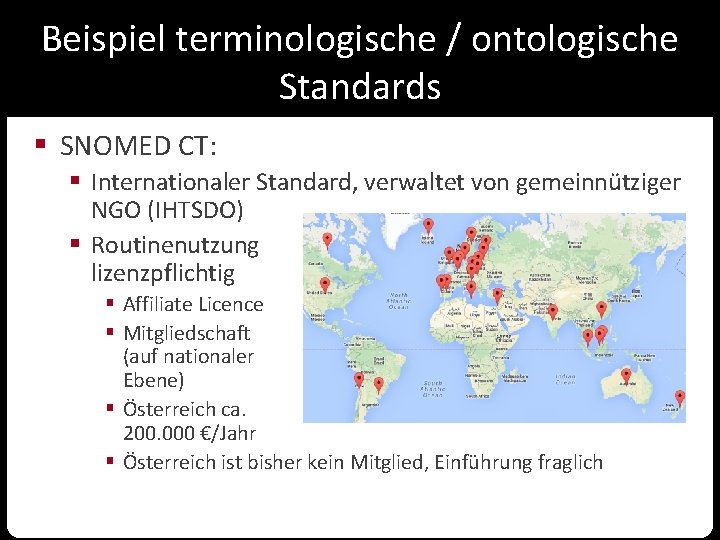
Beispiel terminologische / ontologische Standards § SNOMED CT: § Internationaler Standard, verwaltet von gemeinnütziger NGO (IHTSDO) § Routinenutzung lizenzpflichtig § Affiliate Licence § Mitgliedschaft (auf nationaler Ebene) § Österreich ca. 200. 000 €/Jahr § Österreich ist bisher kein Mitglied, Einführung fraglich
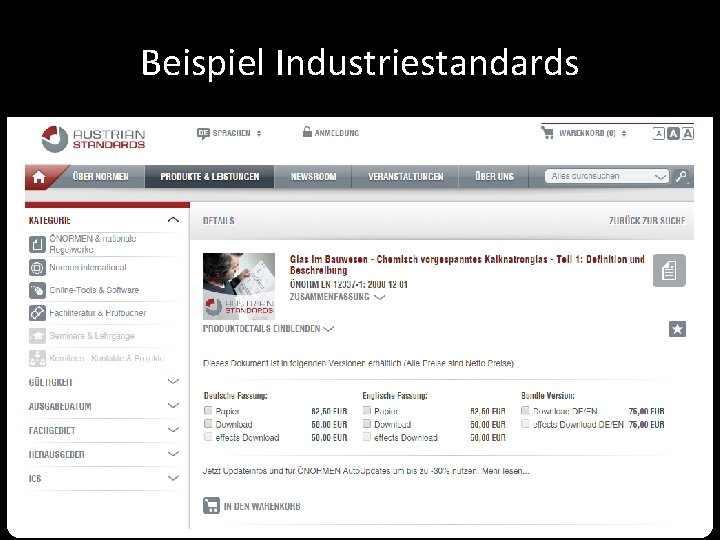
Beispiel Industriestandards
Diskussion § Vorteile genormter Ontologien und Terminologien: § Stabile Benennungen § Logische Begriffsdefinitionen, präziser als sprachliche Definitionen § Genaue Abgrenzung "fließender" Begriffe § "Schokoladenpizza": Kuchen oder Pizza? § 13 -jähriger: Kind oder Jugendlicher § Interoperabilität über Disziplinen und Sprachen hinweg § Widersprüche können maschinell aufgedeckt werden § Plädoyer: Genormte Ontologien und Terminologien als Gemeingut zu behandeln
Six examples of clinical data Hydroxyzin 25 mg 1 -0 -1 Cinacalcet Tabletten 35 mg 1 x 1 Fluoxetin 10 mg 1 -1 -1 Magnesium FT 150 mg 1 -0 -1 Nitroglycerin retard 2, 5 mg Kps. 0 -1 -1 Nitroglycerin-Pumpspray bei Bedarf Amantadine 1 -1 -0 Allopurinol 300 mg jeden 2. Tag eine ½ Tablette (zuletzt am 30. 11. 2009) Mefenaminsäure 500 mg bis 3 xtgl. bei Schmerzen unter gleichzeitiger Einnahme eines Magenschutzes z. B. Pantoprazol 40 mg.
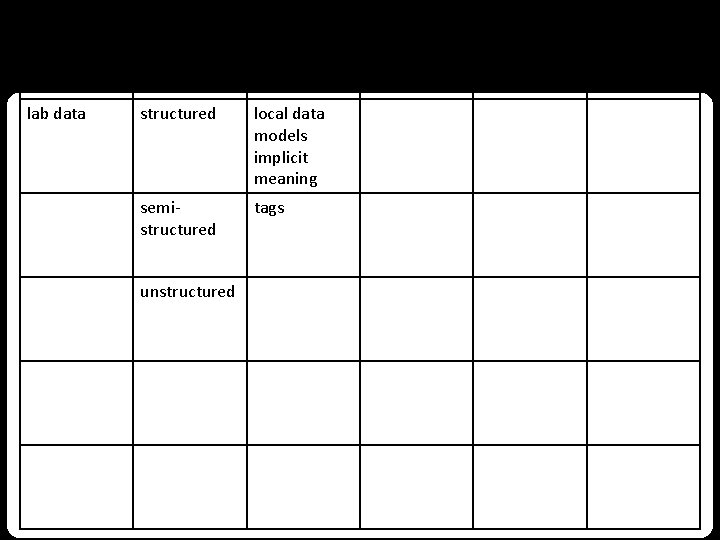
ICD codes structured and coded shared models of meaning lab data structured local data models implicit meaning semistructured tags unstructured
Implicit meaning Structured data semistructured data • • • structuring tags or markers more flexible less predefinition unstructured data • • content only no predefinition Local metadata Global metadata
Clinical data by Structure structured data semistructured data unstructured data • data models • predefined attributes and values • data model • structuring tags or markers • more flexible • less predefinition • content only • no predefinition
Clinical data by Semantics 10 mg 1 -1 -1 150 mg 1 -0 -1 25 mg 1 -0 -1 Reg. Ex: "d{1, 4} ? mg +[01]-[01]" GGGTGATGGC CGCTGCCGAT GGCGTCAAAT CCCACCA 81 kg 1, 69 m 125/80, 76/min male = 1 female = 2 other = 3 unknown = 4 Hidden • signals • no symbolic meaning Implicit • symbolic meaning • common sense Local • locally defined metadata / ontologies ICD-10 -2016: D 22. 5: Melanocytic nevi of trunk Global • globaly defined metadata / ontologies • standards
Clinical data by Semantics structured data semistructured data 10 mg 1 -1 -1 150 mg 1 -0 -1 25 mg 1 -0 -1 unstructured data Reg. Ex: "d{1, 4} ? mg +[01]-[01]" Hidden • signals • no symbolic meaning Implicit • symbolic meaning • common sense Local • locally defined metadata / ontologies Global • globaly defined metadata / ontologies • standards
§ Die Lehrprobe soll grundlegende Arten von medizinisch relevanten Daten (einschließlich klinischer Versorgungsdaten, medizinischer Bilddaten und Omics-Daten) erläutern. Darauf aufbauend soll erläutert werden, wie diese Daten unter Beachtung von regulatorischen und Sicherheitsaspekten semantisch integriert und analysiert werden können. § Die Lehrprobe sollte auf Englisch gehalten werden, da auch die Lehre im Masterstudiengang „Medical Informatics“ in Englisch gehalten wird