
INTEGRATION OF CLIMATE ADAPTATION AND MITIGATION POLICIES IN
- Slides: 17
INTEGRATION OF CLIMATE ADAPTATION AND MITIGATION POLICIES IN THE BRAZILIAN AMAZON Prof. Peter H. May, CPDA/UFRRJ, PPED/IE/UFRJ e INCT/PPED peterhmay@gmail. com and Monica Di Gregorio, University of Leeds School of Earth and Environment
Objectives and challenges • How is policy toward climate change in forest biomes addressed at multiple levels, by both state and non-state actors? • The capacity to address these challenges depends on building actor group coalitions that assume different roles at the interface between science and policy, demanding a central role for the State • The science-policy interface offers a credible contribution to a positive stance on what is to be done to face long-term socioenvironmental crisis (i. e. , climate change is NOT a “farce”). • An integration of mitigation and adaptation is increasingly viewed as necessary to confront the multiple challenges of climate change already apparent in tropical forest environments.
Recent research by INCT-PPED collaborators (in submission) Multi-level Governance in Climate Change Policy Networks: Evidence from Brazil’s and Indonesia’s land use sector Monica Di Gregorio, Leandra Fatorelli, Maria Brockhaus, Dodik Nurrochmat, Peter H. May, Bruno Locatelli School of Earth and Environment SUSTAINABILITY RESEARCH INSTITUTE 3
Rationale • Climate Change policy domain = complex ‘glocal’ governance structure (Gupta et al. 2007) • Policy decisions on climate change mitigation (M) in the land use sector often disconnected from climate change adaptation (A) • BUT M and A display important interactions need for policy integration (Nabuurs et al. 2007, Denton et al. 2014)
Research questions • To what extent do governance levels represent a barrier to information and collaboration exchanges in the climate change domain? Do cross-level interactions differ between mitigation and adaptation? • To what extent do dominant and minority coalitions bridge across levels of governance? • What is the role of brokers in facilitating cross-level interactions?
Multi-level governance ‘The point of departure for … multi-level governance is the existence of overlapping competencies among multiple levels of governments and the interaction of political actors across those levels. … Instead of the two level game assumptions adopted by state centrists, MLG theory posits a set of overarching, multi-level policy networks. ’ Mechanisms that determine which type of cross-level interactions will occur (e. g. dominance or negotiated agreement) include (Young 2006): • level (and limits) of decentralization, authority/power differentials, policy coalitions, cognitive transitions and contrasting discourses
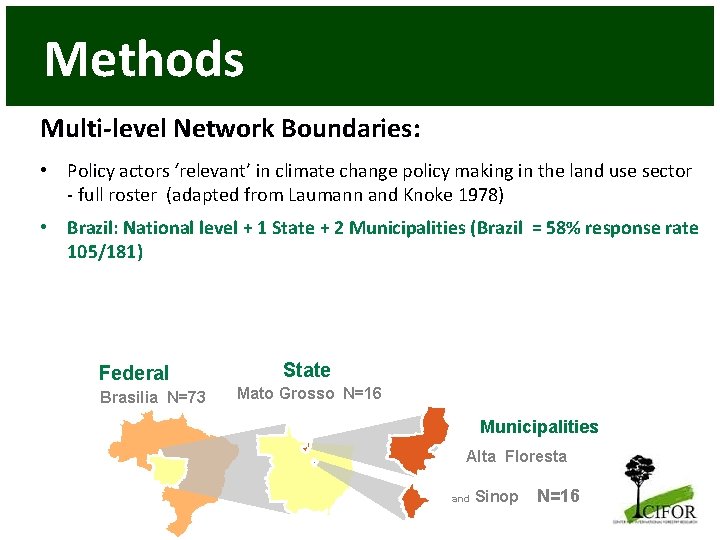
Methods Multi-level Network Boundaries: • Policy actors ‘relevant’ in climate change policy making in the land use sector - full roster (adapted from Laumann and Knoke 1978) • Brazil: National level + 1 State + 2 Municipalities (Brazil = 58% response rate 105/181) Federal Brasilia N=73 State Mato Grosso N=16 Municipalities Alta Floresta and Sinop N=16
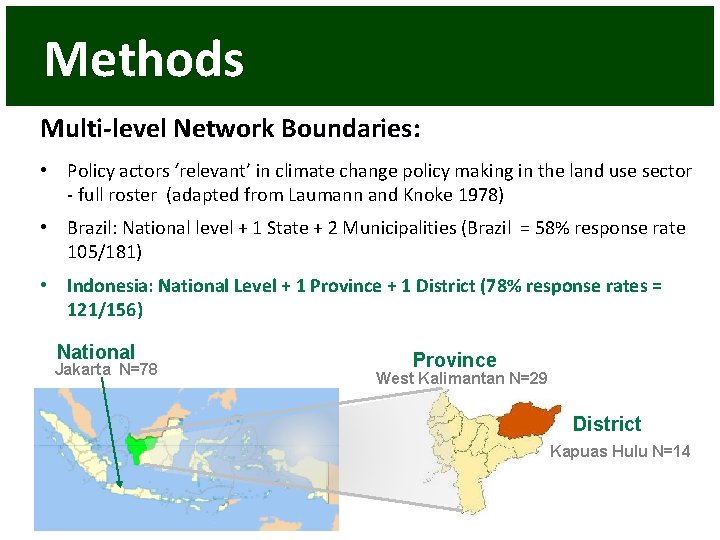
Methods Multi-level Network Boundaries: • Policy actors ‘relevant’ in climate change policy making in the land use sector - full roster (adapted from Laumann and Knoke 1978) • Brazil: National level + 1 State + 2 Municipalities (Brazil = 58% response rate 105/181) • Indonesia: National Level + 1 Province + 1 District (78% response rates = 121/156) National Jakarta N=78 Province West Kalimantan N=29 District Kapuas Hulu N=14
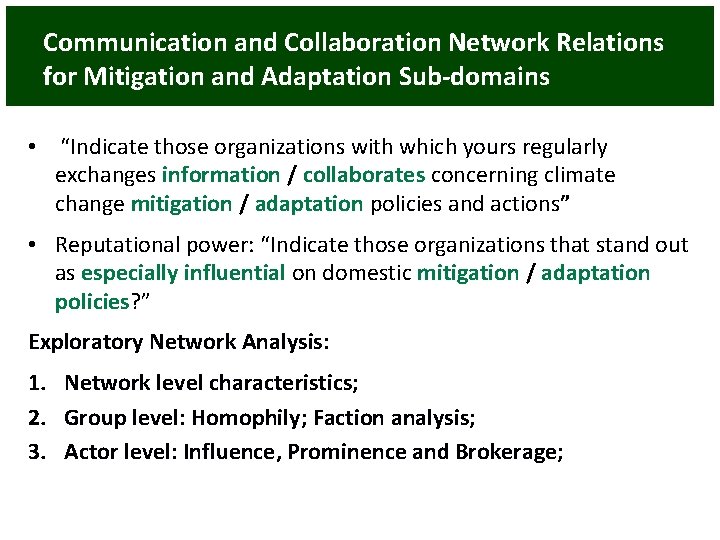
Communication and Collaboration Network Relations for Mitigation and Adaptation Sub-domains • “Indicate those organizations with which yours regularly exchanges information / collaborates concerning climate change mitigation / adaptation policies and actions” • Reputational power: “Indicate those organizations that stand out as especially influential on domestic mitigation / adaptation policies? ” Exploratory Network Analysis: 1. Network level characteristics; 2. Group level: Homophily; Faction analysis; 3. Actor level: Influence, Prominence and Brokerage;
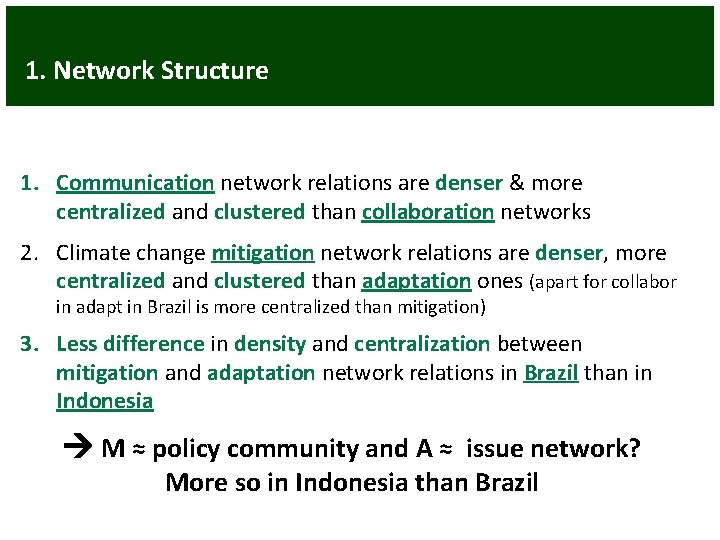
1. Network Structure 1. Communication network relations are denser & more centralized and clustered than collaboration networks 2. Climate change mitigation network relations are denser, more centralized and clustered than adaptation ones (apart for collabor in adapt in Brazil is more centralized than mitigation) 3. Less difference in density and centralization between mitigation and adaptation network relations in Brazil than in Indonesia M ≈ policy community and A ≈ issue network? More so in Indonesia than Brazil
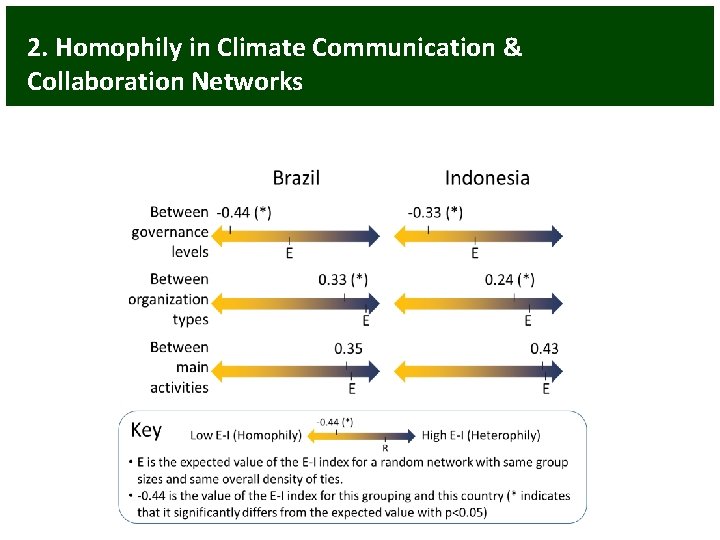
2. Homophily in Climate Communication & Collaboration Networks
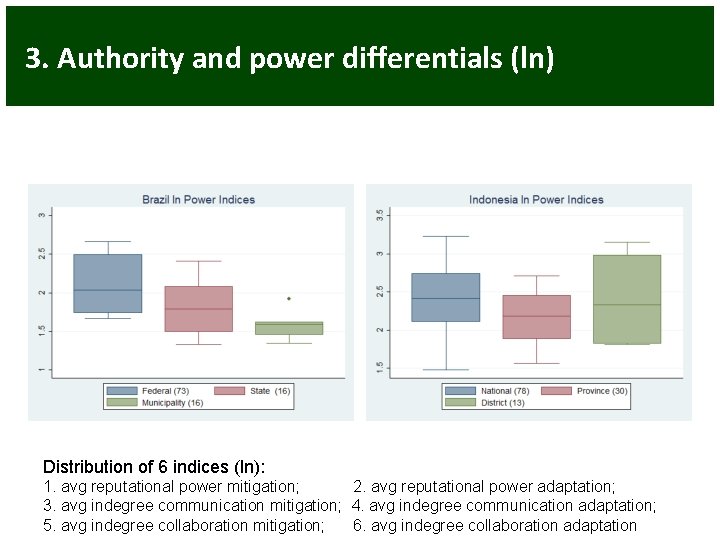
3. Authority and power differentials (ln) Distribution of 6 indices (ln): 1. avg reputational power mitigation; 2. avg reputational power adaptation; 3. avg indegree communication mitigation; 4. avg indegree communication adaptation; 5. avg indegree collaboration mitigation; 6. avg indegree collaboration adaptation
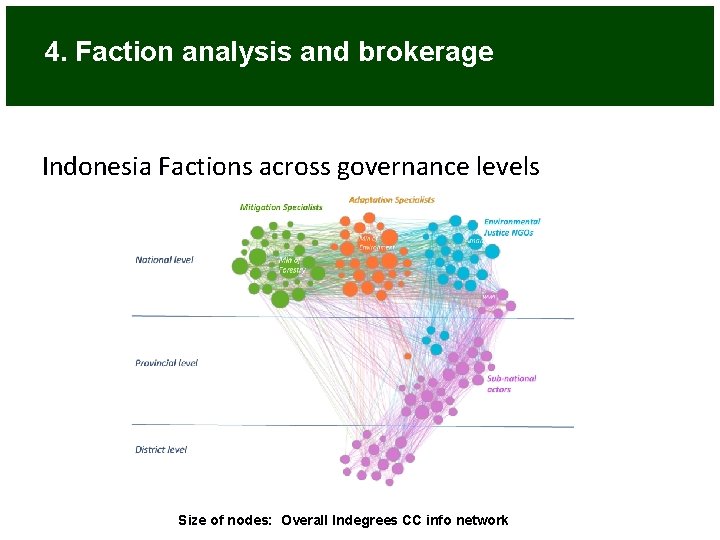
4. Faction analysis and brokerage Indonesia Factions across governance levels Size of nodes: Overall Indegrees CC info network
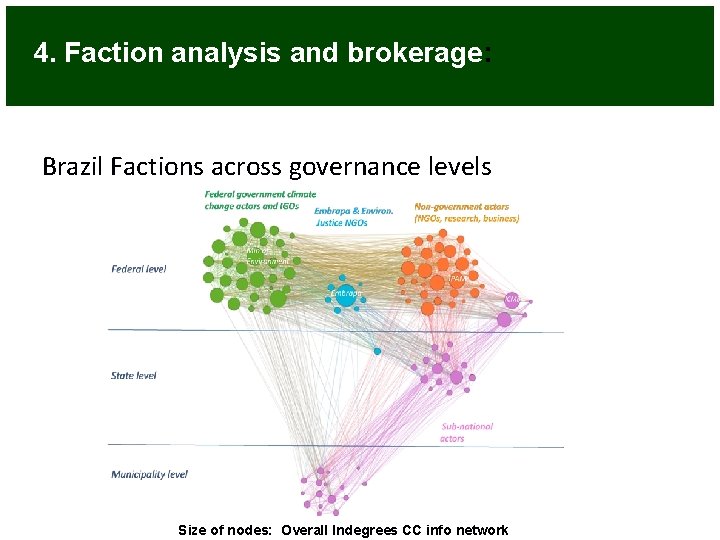
4. Faction analysis and brokerage: Brazil Factions across governance levels Size of nodes: Overall Indegrees CC info network
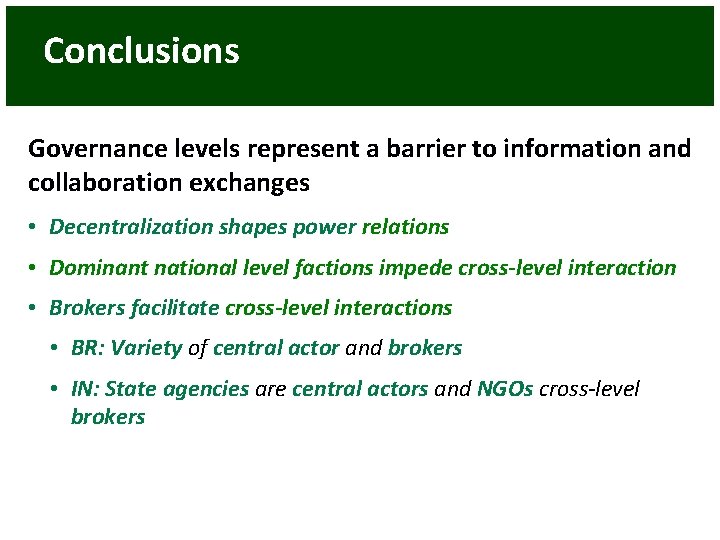
Conclusions Governance levels represent a barrier to information and collaboration exchanges • Decentralization shapes power relations • Dominant national level factions impede cross-level interaction • Brokers facilitate cross-level interactions • BR: Variety of central actor and brokers • IN: State agencies are central actors and NGOs cross-level brokers
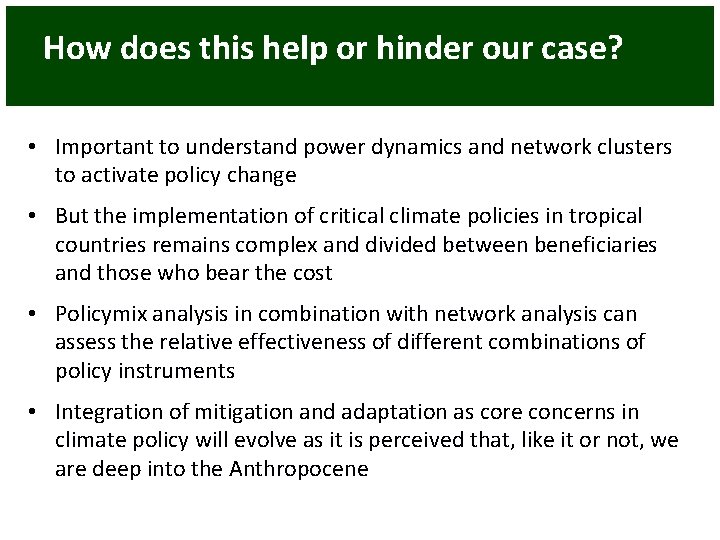
How does this help or hinder our case? • Important to understand power dynamics and network clusters to activate policy change • But the implementation of critical climate policies in tropical countries remains complex and divided between beneficiaries and those who bear the cost • Policymix analysis in combination with network analysis can assess the relative effectiveness of different combinations of policy instruments • Integration of mitigation and adaptation as core concerns in climate policy will evolve as it is perceived that, like it or not, we are deep into the Anthropocene
Thanks! This research is funded by the Economic and Social Research Council of the United Kingdom [grant number ES/K 00879 X/1], by the Brazilian government through the Science Without Borders Program and by: