
Integration of Big Data and Education Towards a
Integration of Big Data and Education: Towards a Cloud-based Open Lab for Data Science Cheng. Xiang (“Cheng”) Zhai Department of Computer Science University of Illinois at Urbana-Champaign USA Microsoft Research Asia Faculty Summit, Nov. 4, 2016, Seoul, Korea 1

Integration of Big Data and Education Intelligent MOOC Platform Improve Scalability & Quality Educate ? Applied to MOOC Log Education Big Data Research & Develop Big Data Technology 2
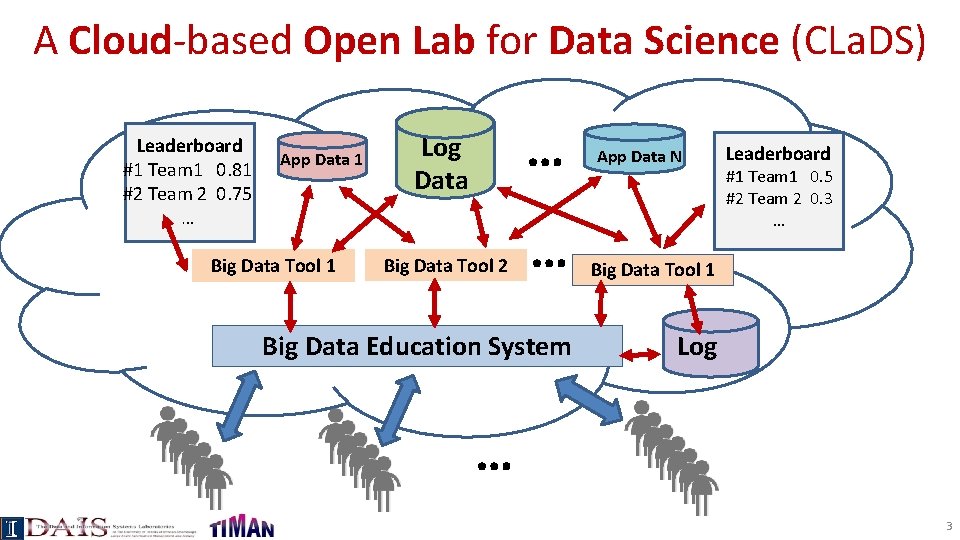
A Cloud-based Open Lab for Data Science (CLa. DS) Leaderboard #1 Team 1 0. 81 #2 Team 2 0. 75 … App Data 1 … Log Data App Data N … Big Data Tool 1 Big Data Education System Log Big Data Tool 1 Big Data Tool 2 Leaderboard #1 Team 1 0. 5 #2 Team 2 0. 3 … … 3
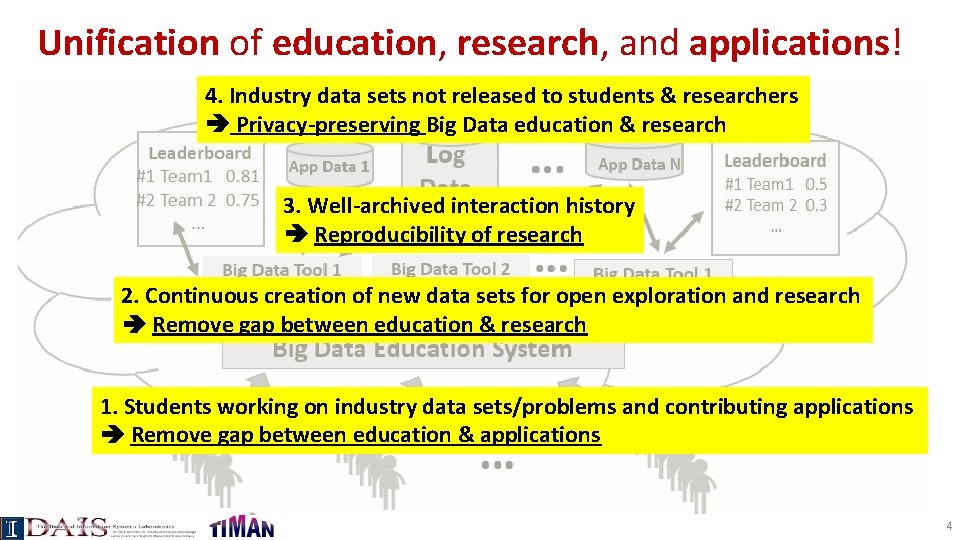
Unification of education, research, and applications! 4. Industry data sets not released to students & researchers Privacy-preserving Big Data education & research 3. Well-archived interaction history Reproducibility of research 2. Continuous creation of new data sets for open exploration and research Remove gap between education & research 1. Students working on industry data sets/problems and contributing applications Remove gap between education & applications 4
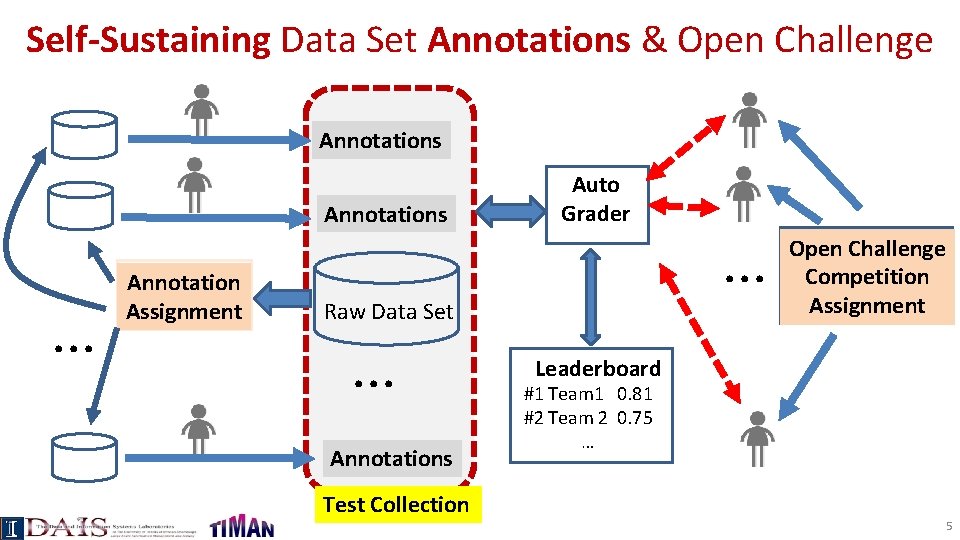
Self-Sustaining Data Set Annotations & Open Challenge Annotations . . . Annotation Assignment Auto Grader Raw Data Set . . . Annotations Test Collection . . . Open Challenge Competition Assignment Leaderboard #1 Team 1 0. 81 #2 Team 2 0. 75 … 5
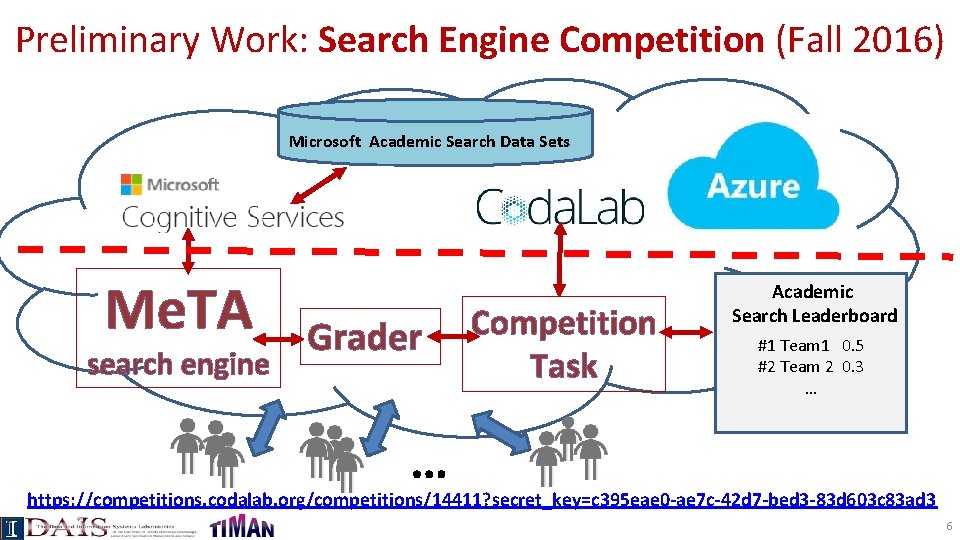
Preliminary Work: Search Engine Competition (Fall 2016) Microsoft Academic Search Data Sets Me. TA search engine Grader Competition Task Academic Search Leaderboard #1 Team 1 0. 5 #2 Team 2 0. 3 … … https: //competitions. codalab. org/competitions/14411? secret_key=c 395 eae 0 -ae 7 c-42 d 7 -bed 3 -83 d 603 c 83 ad 3 6
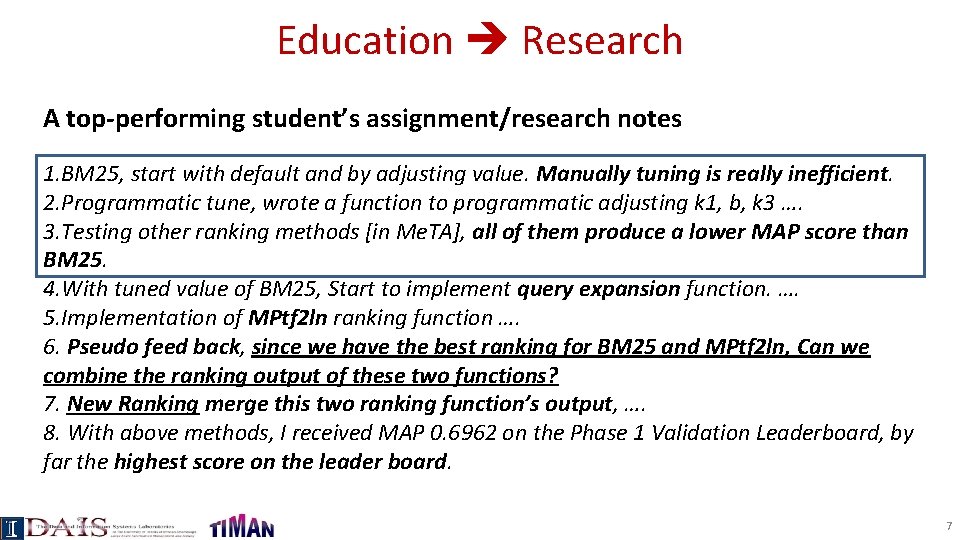
Education Research A top-performing student’s assignment/research notes 1. BM 25, start with default and by adjusting value. Manually tuning is really inefficient. 2. Programmatic tune, wrote a function to programmatic adjusting k 1, b, k 3 …. 3. Testing other ranking methods [in Me. TA], all of them produce a lower MAP score than BM 25. 4. With tuned value of BM 25, Start to implement query expansion function. …. 5. Implementation of MPtf 2 ln ranking function …. 6. Pseudo feed back, since we have the best ranking for BM 25 and MPtf 2 ln, Can we combine the ranking output of these two functions? 7. New Ranking merge this two ranking function’s output, …. 8. With above methods, I received MAP 0. 6962 on the Phase 1 Validation Leaderboard, by far the highest score on the leader board. 7
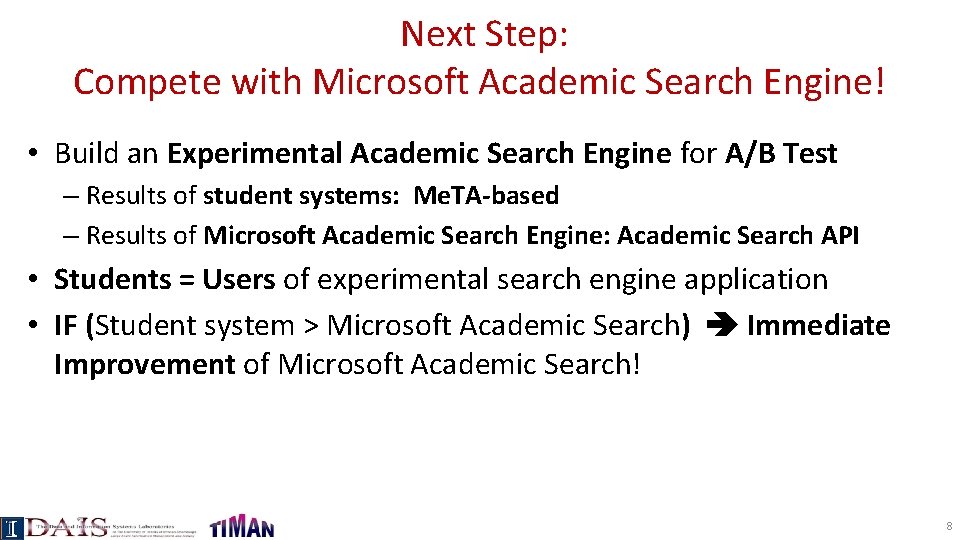
Next Step: Compete with Microsoft Academic Search Engine! • Build an Experimental Academic Search Engine for A/B Test – Results of student systems: Me. TA-based – Results of Microsoft Academic Search Engine: Academic Search API • Students = Users of experimental search engine application • IF (Student system > Microsoft Academic Search) Immediate Improvement of Microsoft Academic Search! 8
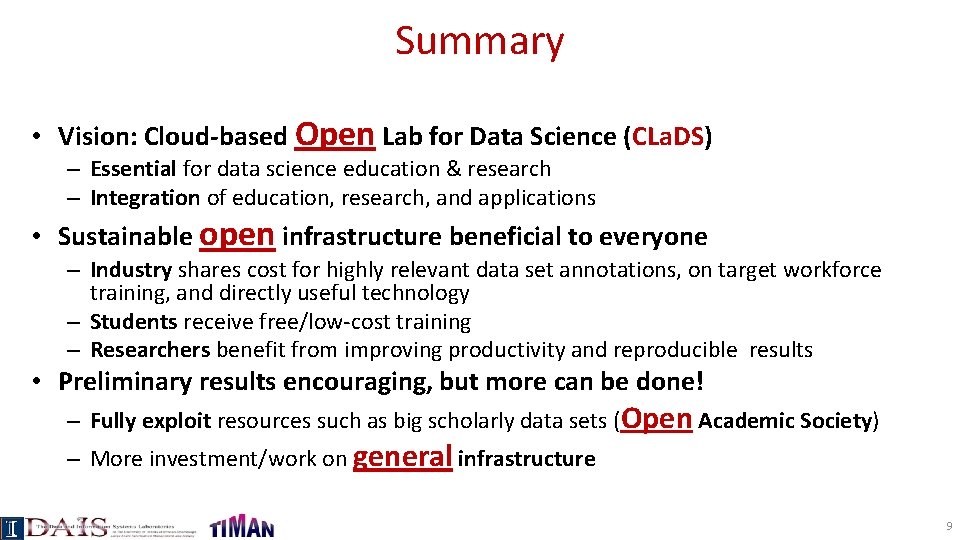
Summary • Vision: Cloud-based Open Lab for Data Science (CLa. DS) – Essential for data science education & research – Integration of education, research, and applications • Sustainable open infrastructure beneficial to everyone – Industry shares cost for highly relevant data set annotations, on target workforce training, and directly useful technology – Students receive free/low-cost training – Researchers benefit from improving productivity and reproducible results • Preliminary results encouraging, but more can be done! – Fully exploit resources such as big scholarly data sets (Open Academic Society) – More investment/work on general infrastructure 9
Education Automation & Revolution? • Big Data and IT enable education automation and revolution toward more affordable high-quality education – IT enables one teacher to teach many more students than before (efficiency) – Big Data technology would enable “automated” TA/instructor (scalability) – Intelligent MOOC would improve quality of education at low cost • Implications: Many traditional boundaries will likely disappear! – No strict distinction between a teacher and a student (everyone learns from each other) – No strict distinction between grade levels or age groups (learn at your own pace) – No inherent boundaries between different courses (due to high modularization) – No boundaries of subject areas (due to high modularization) – No boundaries of institutions (MOOCs unify all institutions!) 10
Acknowledgments • Grants – Intel Big Data Education pilot grant (John Somoza) – Microsoft Azure for Education grant (Randy Guthrie, David Giard) • Infrastructure – Microsoft Azure, Coda. Lab (Evelyne Viegas), and Academic Search API (Kuansan Wang) – UIUC Me. TA toolkit (Chase Geigle, Sean Massung), and CS 410 assignment (Ismini Lourentzou) – Coursera • Collaboration – Univ. of Delaware (Hui Fang) – Chinese Academy of Sciences (Xueqi Cheng) 11
Thank You! Questions/Comments? 12
- Slides: 12