
Integration of a Magnetocaloric Heat Pump in Energy




- Slides: 68
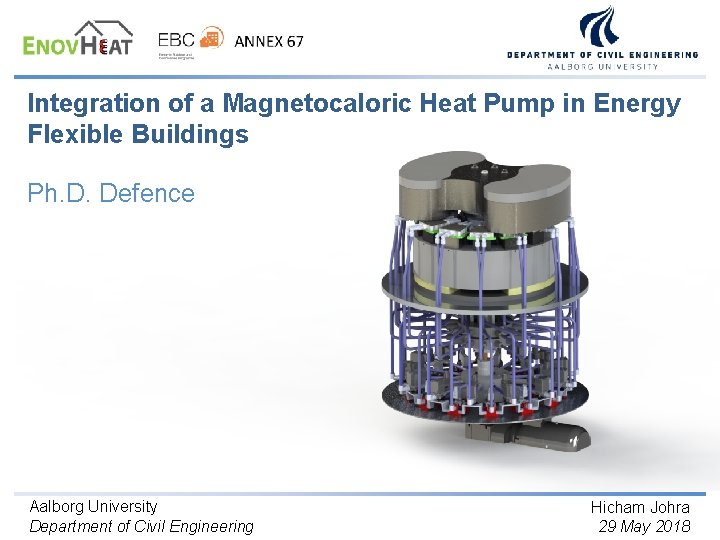
Integration of a Magnetocaloric Heat Pump in Energy Flexible Buildings Ph. D. Defence Aalborg University Department of Civil Engineering Hicham Johra 29 May 2018
Foreword A Ph. D. project is like a long journey… Hicham Johra - Aalborg University – Ph. D. Defence - 29 May 2018 2 / 68
Foreword Finally !!! Hicham Johra - Aalborg University – Ph. D. Defence - 29 May 2018 3 / 68
Integration of a Magnetocaloric Heat Pump in Energy Flexible Buildings Hicham Johra - Aalborg University – Ph. D. Defence - 29 May 2018 4 / 68
Outline of the presentation ■ Introduction ■ Magnetocaloric heat pump ■ Building energy flexibility ■ Scientific challenges ■ Numerical investigations ■ Results ■ Conclusions ■ Recommendations for future work Hicham Johra - Aalborg University – Ph. D. Defence - 29 May 2018 5 / 68
INTRODUCTION Hicham Johra - Aalborg University – Ph. D. Defence - 29 May 2018 6 / 68
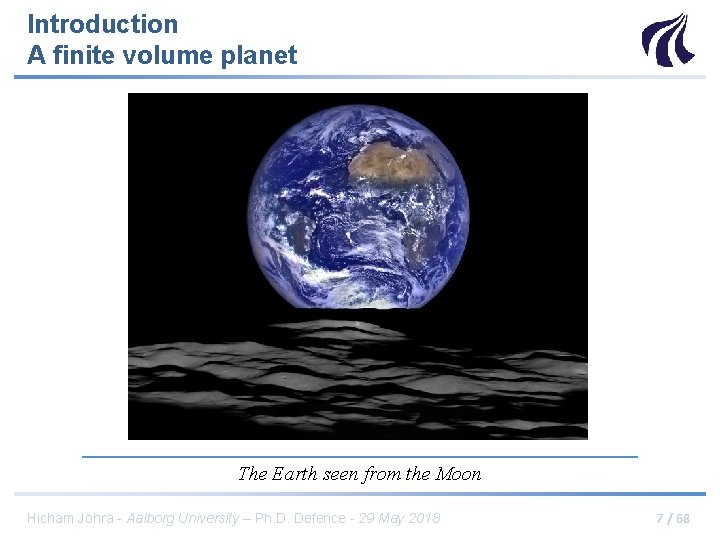
Introduction A finite volume planet The Earth seen from the Moon Hicham Johra - Aalborg University – Ph. D. Defence - 29 May 2018 7 / 68
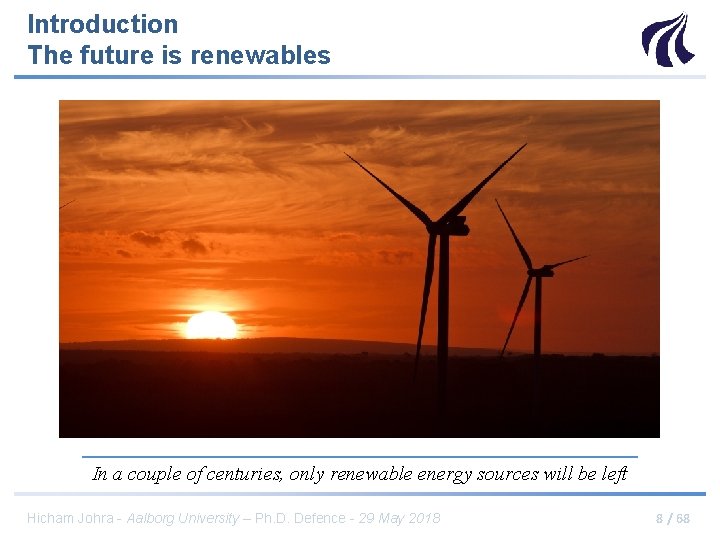
Introduction The future is renewables In a couple of centuries, only renewable energy sources will be left Hicham Johra - Aalborg University – Ph. D. Defence - 29 May 2018 8 / 68
Introduction No planet B There is no planet B, we have to take care of our planet Earth Hicham Johra - Aalborg University – Ph. D. Defence - 29 May 2018 9 / 68
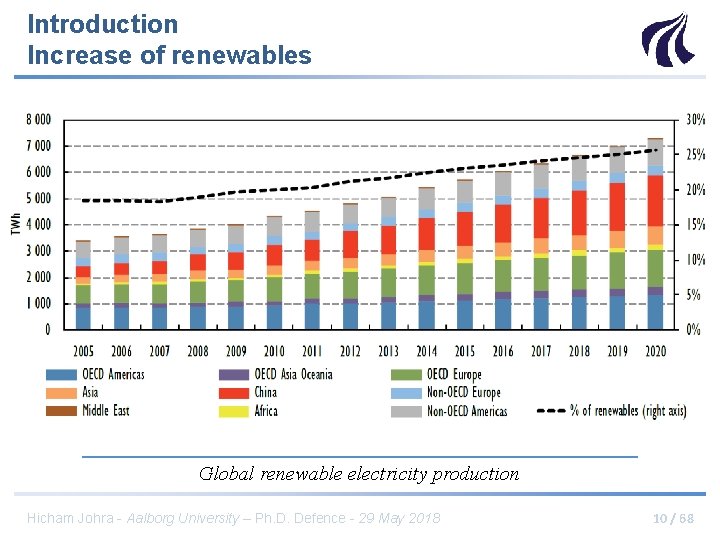
Introduction Increase of renewables Global renewable electricity production Hicham Johra - Aalborg University – Ph. D. Defence - 29 May 2018 10 / 68
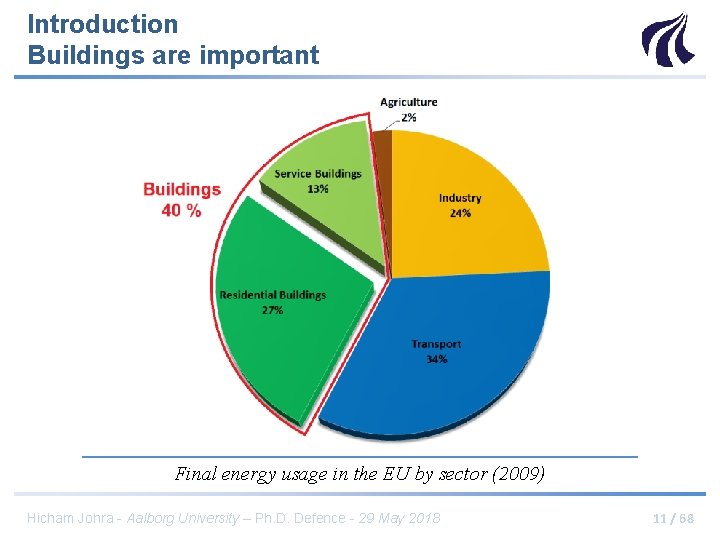
Introduction Buildings are important Final energy usage in the EU by sector (2009) Hicham Johra - Aalborg University – Ph. D. Defence - 29 May 2018 11 / 68
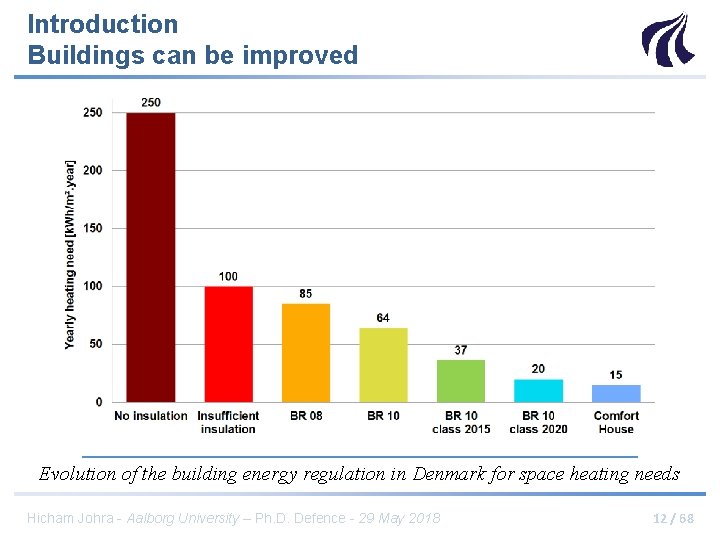
Introduction Buildings can be improved Evolution of the building energy regulation in Denmark for space heating needs Hicham Johra - Aalborg University – Ph. D. Defence - 29 May 2018 12 / 68
Introduction Enov. Heat project The Enov. Heat project Hicham Johra - Aalborg University – Ph. D. Defence - 29 May 2018 13 / 68
MAGNETOCALORIC HEAT PUMP Hicham Johra - Aalborg University – Ph. D. Defence - 29 May 2018 14 / 68
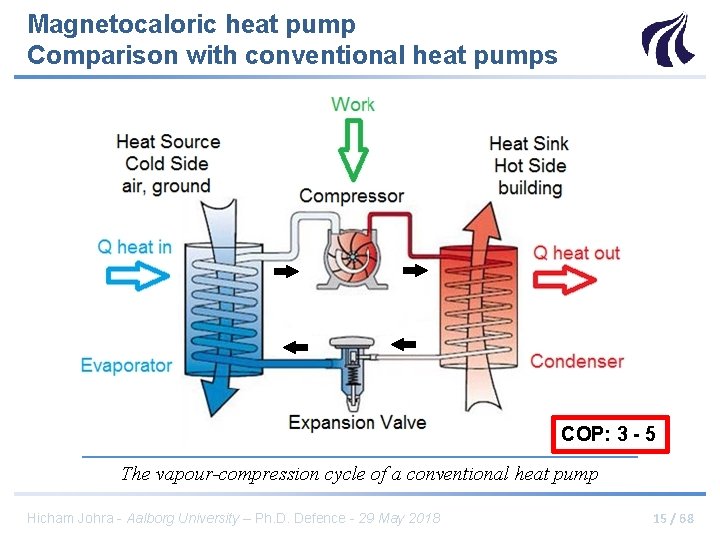
Magnetocaloric heat pump Comparison with conventional heat pumps COP: 3 - 5 The vapour-compression cycle of a conventional heat pump Hicham Johra - Aalborg University – Ph. D. Defence - 29 May 2018 15 / 68
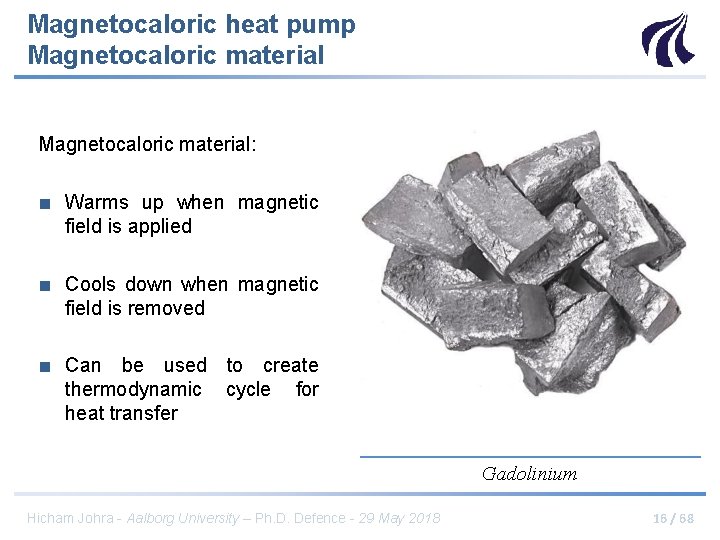
Magnetocaloric heat pump Magnetocaloric material: ■ Warms up when magnetic field is applied ■ Cools down when magnetic field is removed ■ Can be used to create thermodynamic heat transfer cycle for Gadolinium Hicham Johra - Aalborg University – Ph. D. Defence - 29 May 2018 16 / 68
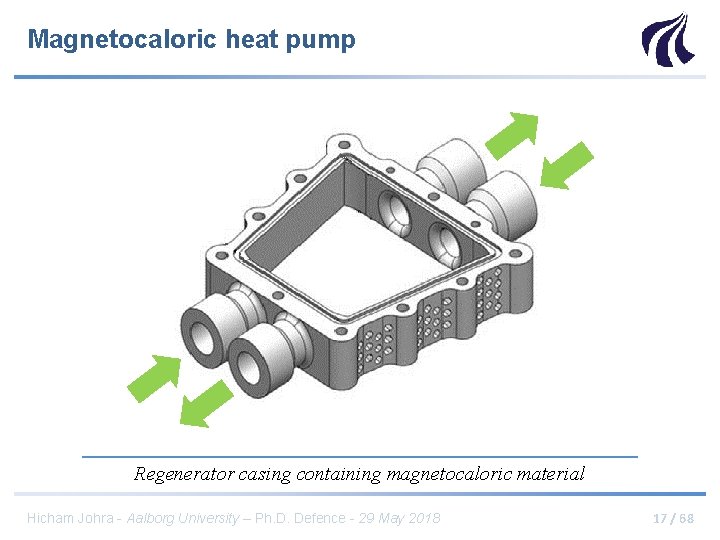
Magnetocaloric heat pump Regenerator casing containing magnetocaloric material Hicham Johra - Aalborg University – Ph. D. Defence - 29 May 2018 17 / 68
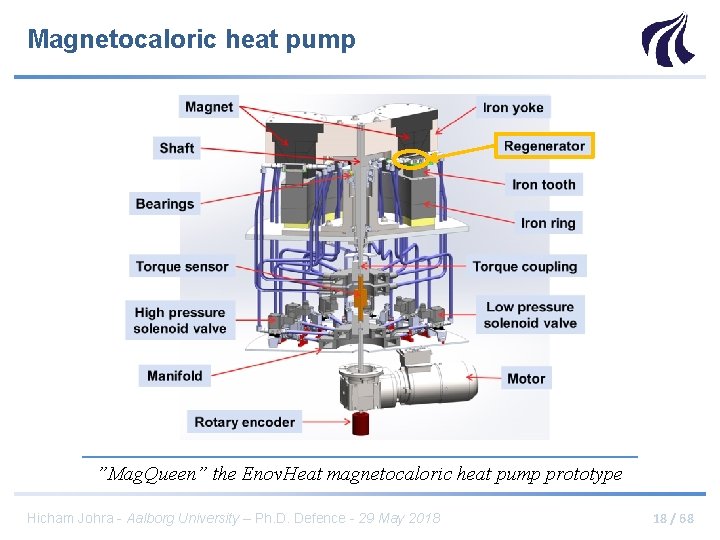
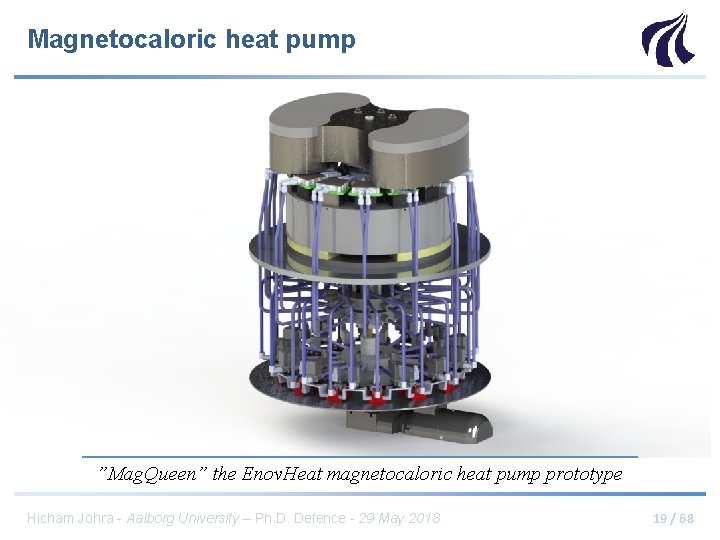
Magnetocaloric heat pump ”Mag. Queen” the Enov. Heat magnetocaloric heat pump prototype Hicham Johra - Aalborg University – Ph. D. Defence - 29 May 2018 18 / 68
Magnetocaloric heat pump ”Mag. Queen” the Enov. Heat magnetocaloric heat pump prototype Hicham Johra - Aalborg University – Ph. D. Defence - 29 May 2018 19 / 68
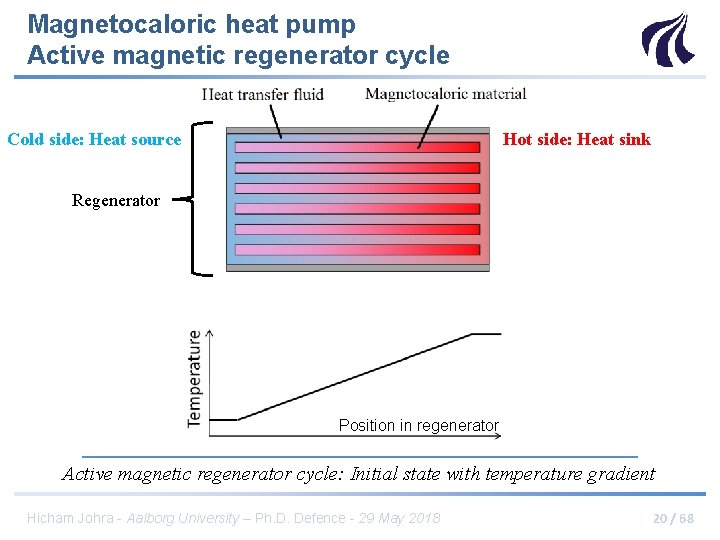
Magnetocaloric heat pump Active magnetic regenerator cycle Cold side: Heat source Hot side: Heat sink Regenerator Position in regenerator Active magnetic regenerator cycle: Initial state with temperature gradient Hicham Johra - Aalborg University – Ph. D. Defence - 29 May 2018 20 / 68
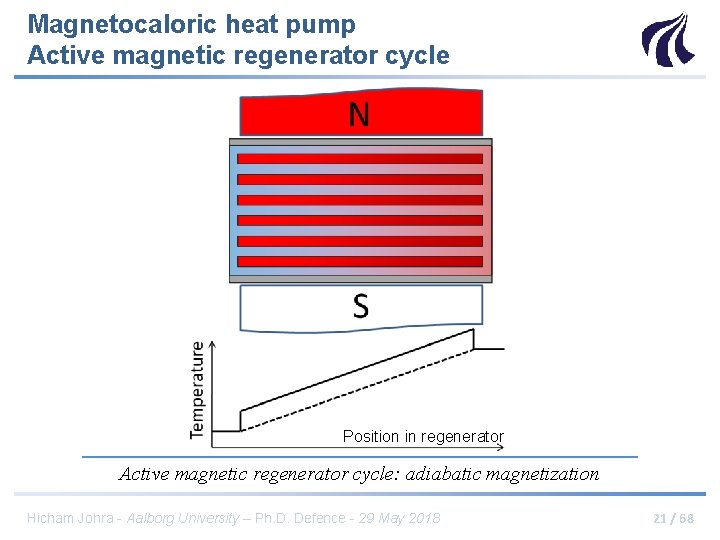
Magnetocaloric heat pump Active magnetic regenerator cycle Position in regenerator Active magnetic regenerator cycle: adiabatic magnetization Hicham Johra - Aalborg University – Ph. D. Defence - 29 May 2018 21 / 68
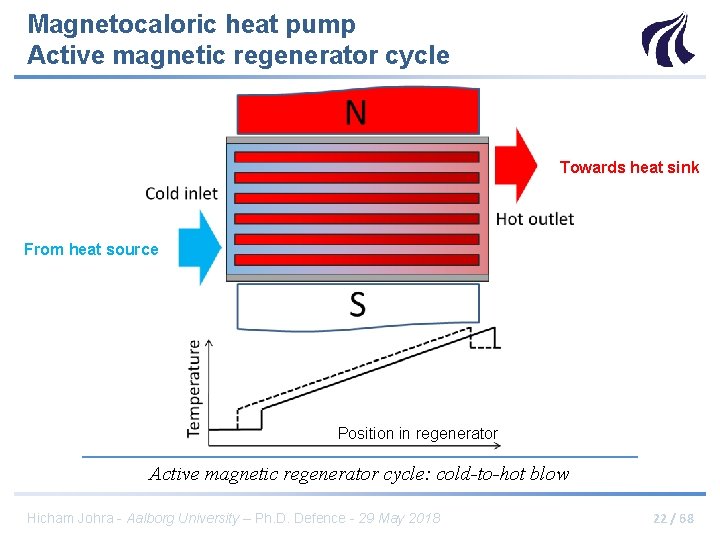
Magnetocaloric heat pump Active magnetic regenerator cycle Towards heat sink From heat source Position in regenerator Active magnetic regenerator cycle: cold-to-hot blow Hicham Johra - Aalborg University – Ph. D. Defence - 29 May 2018 22 / 68
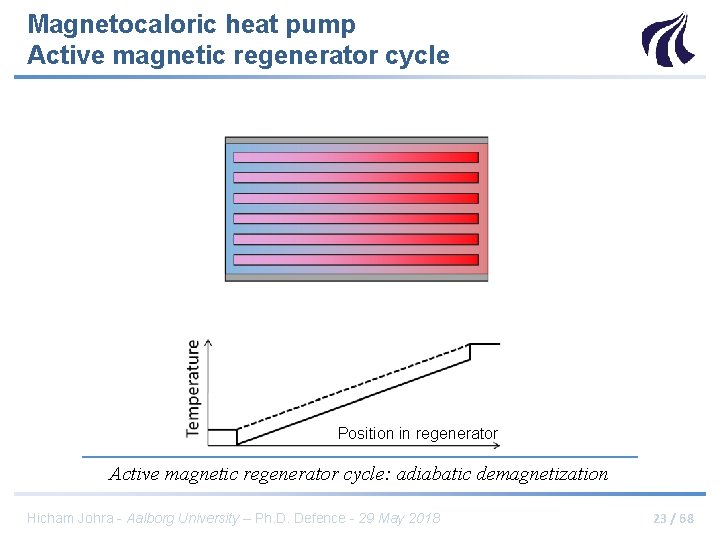
Magnetocaloric heat pump Active magnetic regenerator cycle Position in regenerator Active magnetic regenerator cycle: adiabatic demagnetization Hicham Johra - Aalborg University – Ph. D. Defence - 29 May 2018 23 / 68
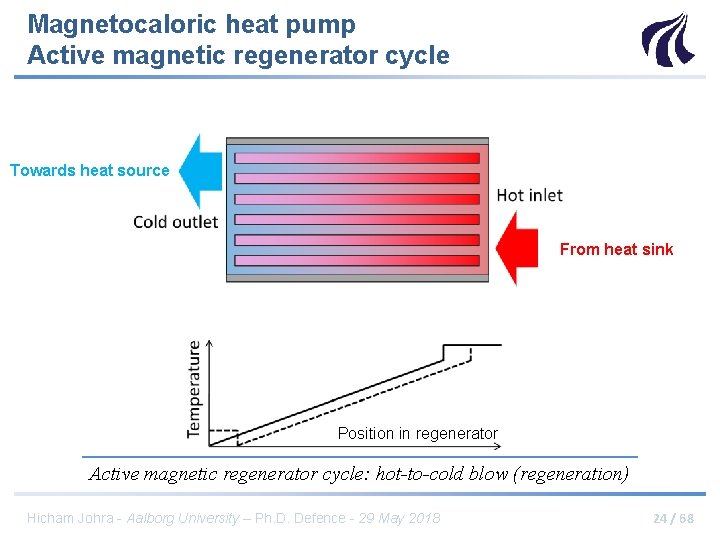
Magnetocaloric heat pump Active magnetic regenerator cycle Towards heat source From heat sink Position in regenerator Active magnetic regenerator cycle: hot-to-cold blow (regeneration) Hicham Johra - Aalborg University – Ph. D. Defence - 29 May 2018 24 / 68
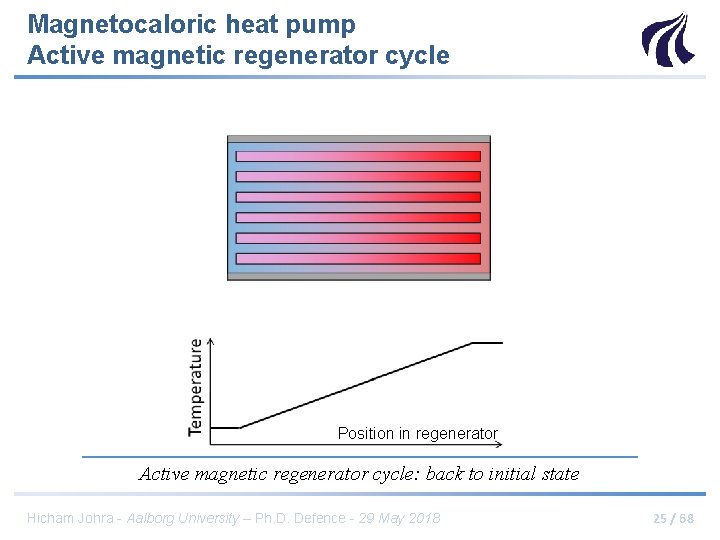
Magnetocaloric heat pump Active magnetic regenerator cycle Position in regenerator Active magnetic regenerator cycle: back to initial state Hicham Johra - Aalborg University – Ph. D. Defence - 29 May 2018 25 / 68
Magnetocaloric heat pump Advantages ■ Efficient magnetocaloric thermodynamic cycle ■ Potential for high coefficient of performance ■ Low operation frequency, low vibration level, silent operation ■ No use of toxic or greenhouse gases Hicham Johra - Aalborg University – Ph. D. Defence - 29 May 2018 26 / 68
BUILDING ENERGY FLEXIBILITY Hicham Johra - Aalborg University – Ph. D. Defence - 29 May 2018 27 / 68
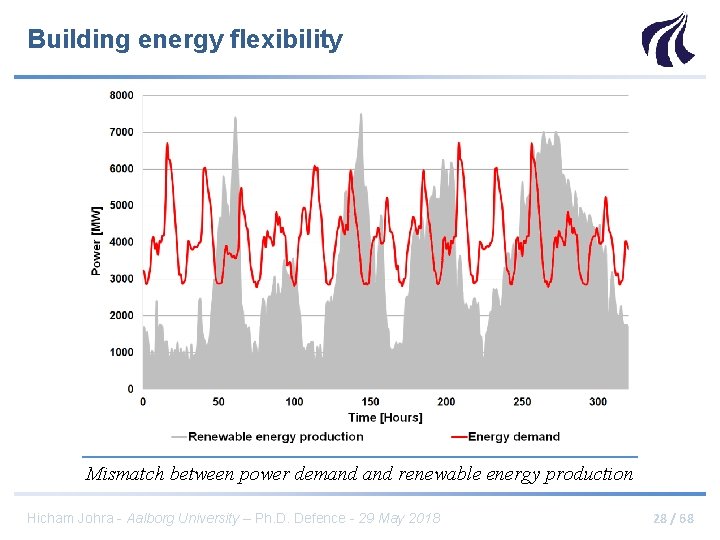
Building energy flexibility Mismatch between power demand renewable energy production Hicham Johra - Aalborg University – Ph. D. Defence - 29 May 2018 28 / 68
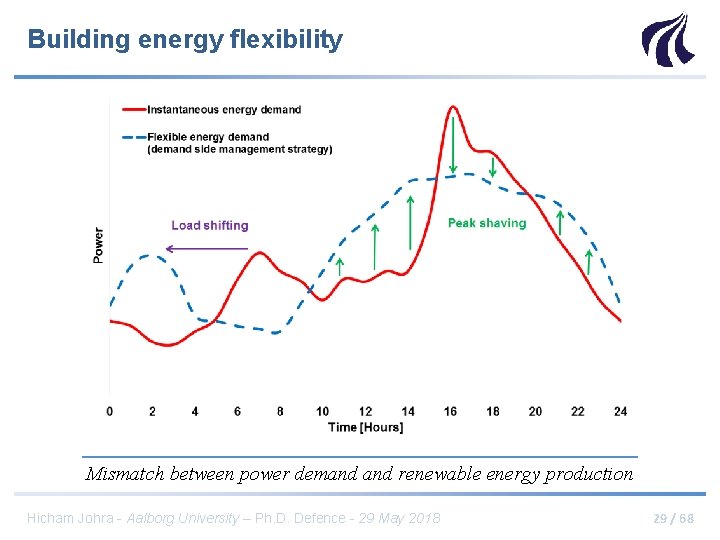
Building energy flexibility Mismatch between power demand renewable energy production Hicham Johra - Aalborg University – Ph. D. Defence - 29 May 2018 29 / 68
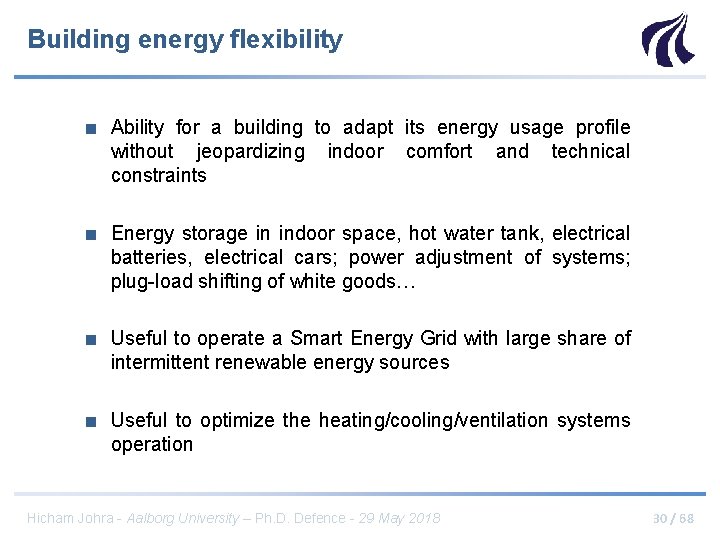
Building energy flexibility ■ Ability for a building to adapt its energy usage profile without jeopardizing constraints indoor comfort and technical ■ Energy storage in indoor space, hot water tank, electrical batteries, electrical cars; power adjustment of systems; plug-load shifting of white goods… ■ Useful to operate a Smart Energy Grid with large share of intermittent renewable energy sources ■ Useful to optimize the heating/cooling/ventilation systems operation Hicham Johra - Aalborg University – Ph. D. Defence - 29 May 2018 30 / 68
SCIENTIFIC CHALLENGES Hicham Johra - Aalborg University – Ph. D. Defence - 29 May 2018 31 / 68
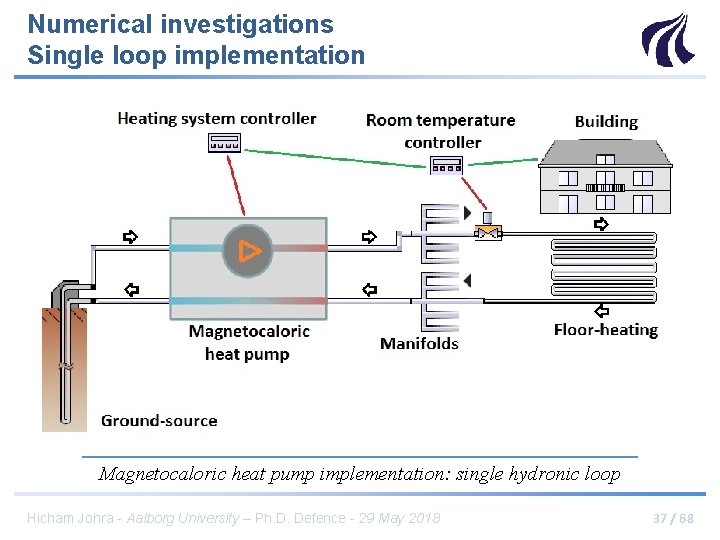
Scientific challenges ■ Integrate magnetocaloric heat pump in building model ■ Integrate the magnetocaloric heat pump with other building systems in a single hydronic loop with limited temperature span between heat source and heat sink ■ Assess magnetocaloric heat pump performance with basic controller ■ Understand the heating energy flexibility potential of residential houses in Denmark ■ Develop control strategy using heating energy flexibility of building to optimize magnetocaloric heat pump operation Hicham Johra - Aalborg University – Ph. D. Defence - 29 May 2018 32 / 68
NUMERICAL INVESTIGATIONS Hicham Johra - Aalborg University – Ph. D. Defence - 29 May 2018 33 / 68
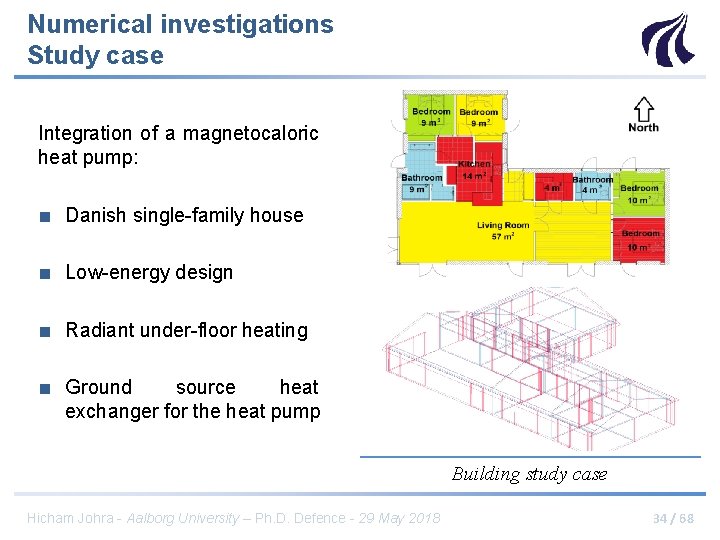
Numerical investigations Study case Integration of a magnetocaloric heat pump: ■ Danish single-family house ■ Low-energy design ■ Radiant under-floor heating ■ Ground source heat exchanger for the heat pump Building study case Hicham Johra - Aalborg University – Ph. D. Defence - 29 May 2018 34 / 68
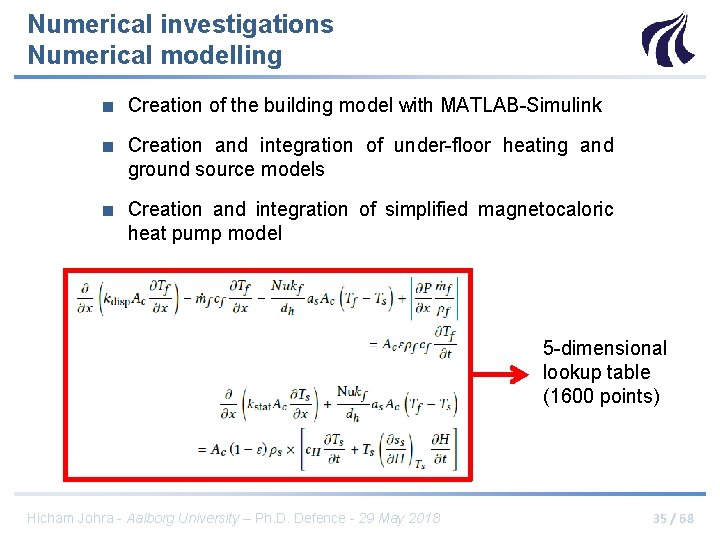
Numerical investigations Numerical modelling ■ Creation of the building model with MATLAB-Simulink ■ Creation and integration of under-floor heating and ground source models ■ Creation and integration of simplified magnetocaloric heat pump model 5 -dimensional lookup table (1600 points) Hicham Johra - Aalborg University – Ph. D. Defence - 29 May 2018 35 / 68
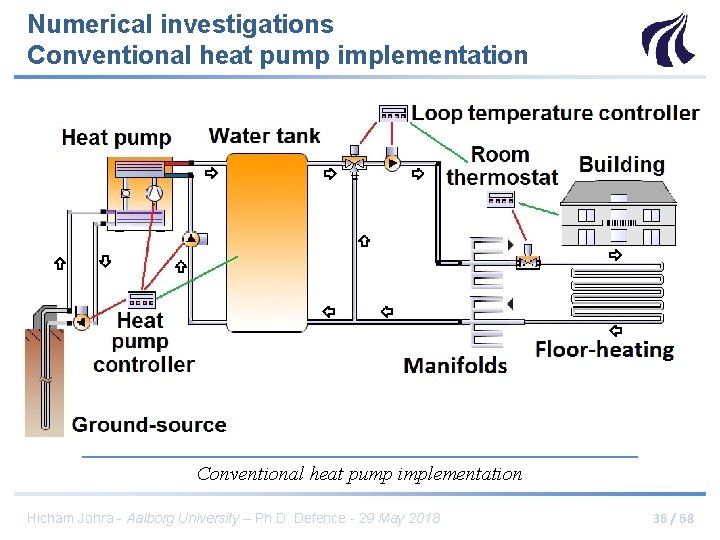
Numerical investigations Conventional heat pump implementation Hicham Johra - Aalborg University – Ph. D. Defence - 29 May 2018 36 / 68
Numerical investigations Single loop implementation Magnetocaloric heat pump implementation: single hydronic loop Hicham Johra - Aalborg University – Ph. D. Defence - 29 May 2018 37 / 68
Numerical investigations Testing magnetocaloric heat pump ■ Demonstrate that magnetocaloric heat pump can sustain good indoor comfort in low-energy house during Danish winter ■ Assess performance of magnetocaloric heat pump when operating with a simple controller ■ Identify the cause of limited operational performance of the magnetic heating system ■ Create and test control strategy optimizing magnetocaloric heat pump performance by means of thermal storage in the indoor environment Hicham Johra - Aalborg University – Ph. D. Defence - 29 May 2018 38 / 68
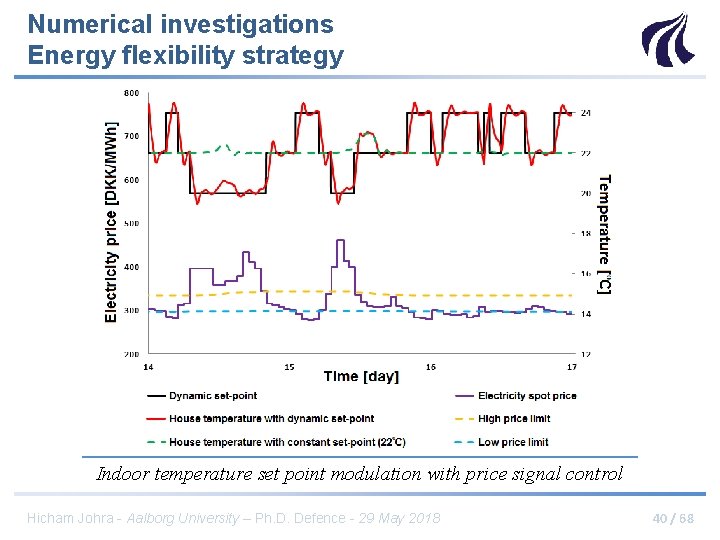
Numerical investigations Testing heating energy flexibility Heating energy flexibility potential of single-family house in Denmark (same study case): ■ Define an energy flexibility index ■ Focus on thermal storage in the built environment by mean of price signal-based indoor temperature set point modulation ■ Study influence of different building parameters on indoor space heating energy flexibility ■ Study impact of additional indoor content thermal mass and phase change materials Hicham Johra - Aalborg University – Ph. D. Defence - 29 May 2018 39 / 68
Numerical investigations Energy flexibility strategy Indoor temperature set point modulation with price signal control Hicham Johra - Aalborg University – Ph. D. Defence - 29 May 2018 40 / 68
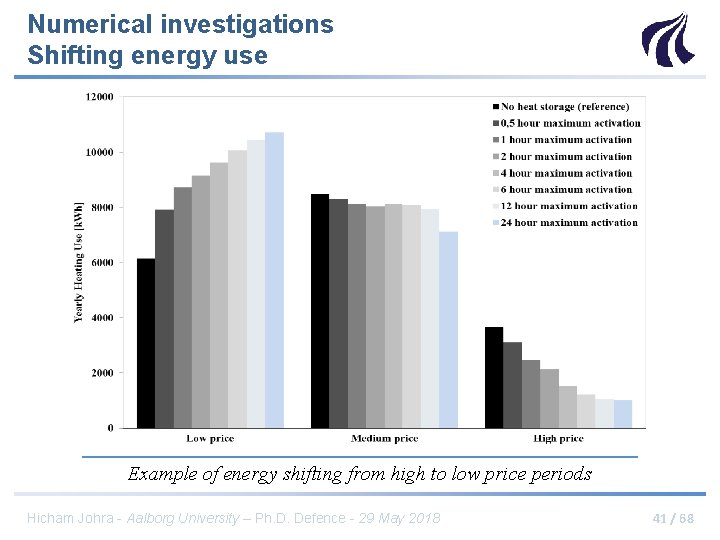
Numerical investigations Shifting energy use Example of energy shifting from high to low price periods Hicham Johra - Aalborg University – Ph. D. Defence - 29 May 2018 41 / 68
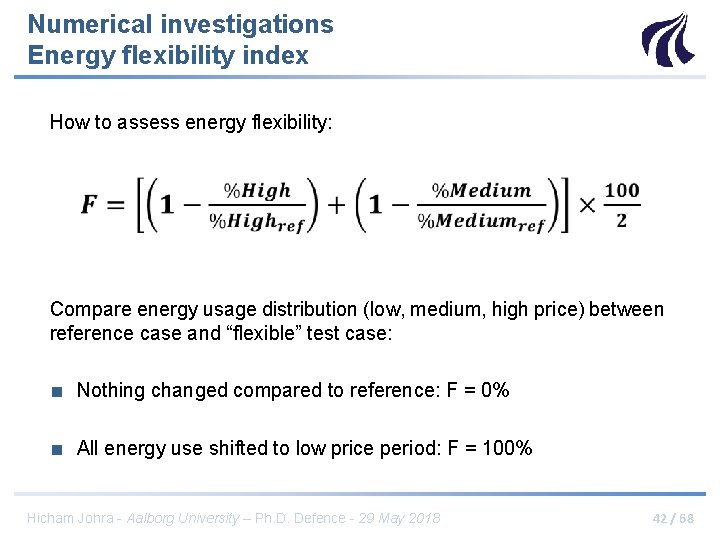
Numerical investigations Energy flexibility index How to assess energy flexibility: Compare energy usage distribution (low, medium, high price) between reference case and “flexible” test case: ■ Nothing changed compared to reference: F = 0% ■ All energy use shifted to low price period: F = 100% Hicham Johra - Aalborg University – Ph. D. Defence - 29 May 2018 42 / 68
Numerical investigations Studying indoor content / furniture Indoor content / furniture thermal mass: ■ Often ignored in energy building simulations (empty building assumption) ■ How to model indoor content and furniture? ■ Does it have an thermodynamics? influence on building ■ Does it have an impact on heating energy flexibility? Hicham Johra - Aalborg University – Ph. D. Defence - 29 May 2018 43 / 68
RESULTS INDOOR CONTENT FURNITURE Hicham Johra - Aalborg University – Ph. D. Defence - 29 May 2018 44 / 68
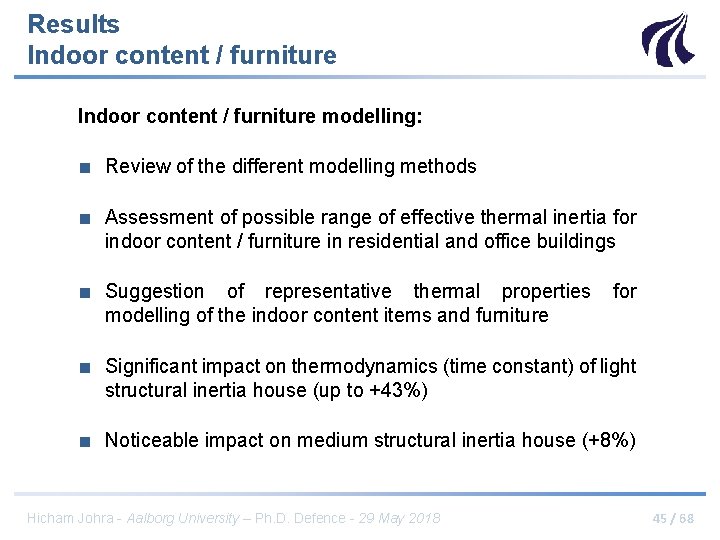
Results Indoor content / furniture modelling: ■ Review of the different modelling methods ■ Assessment of possible range of effective thermal inertia for indoor content / furniture in residential and office buildings ■ Suggestion of representative thermal properties for modelling of the indoor content items and furniture ■ Significant impact on thermodynamics (time constant) of light structural inertia house (up to +43%) ■ Noticeable impact on medium structural inertia house (+8%) Hicham Johra - Aalborg University – Ph. D. Defence - 29 May 2018 45 / 68
RESULTS HEATING ENERGY FLEXIBILITY Hicham Johra - Aalborg University – Ph. D. Defence - 29 May 2018 46 / 68
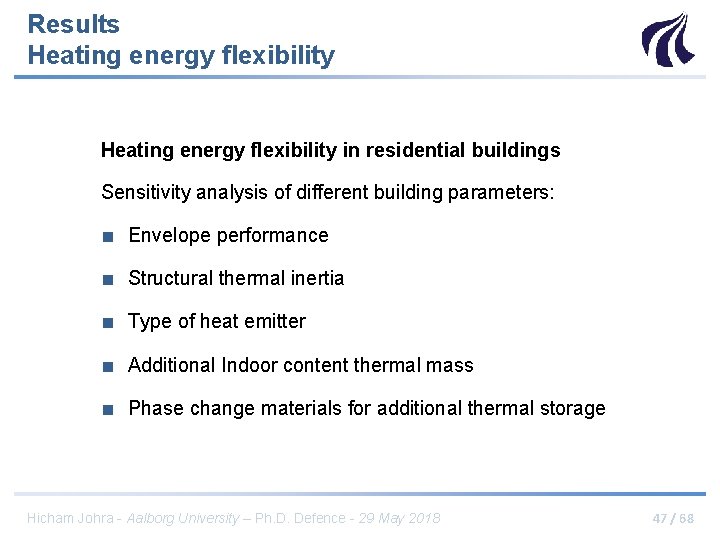
Results Heating energy flexibility in residential buildings Sensitivity analysis of different building parameters: ■ Envelope performance ■ Structural thermal inertia ■ Type of heat emitter ■ Additional Indoor content thermal mass ■ Phase change materials for additional thermal storage Hicham Johra - Aalborg University – Ph. D. Defence - 29 May 2018 47 / 68
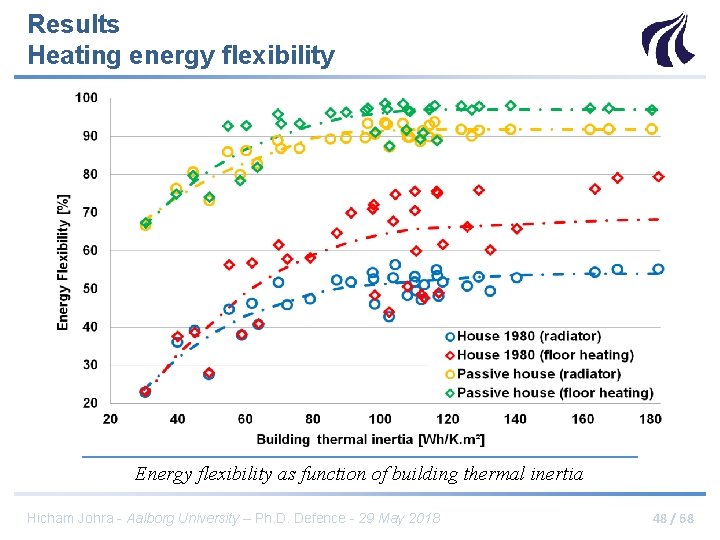
Results Heating energy flexibility Energy flexibility as function of building thermal inertia Hicham Johra - Aalborg University – Ph. D. Defence - 29 May 2018 48 / 68
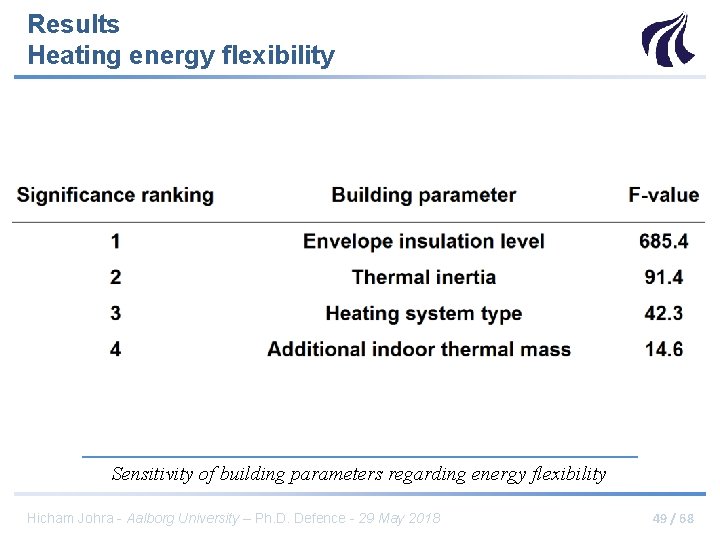
Results Heating energy flexibility Sensitivity of building parameters regarding energy flexibility Hicham Johra - Aalborg University – Ph. D. Defence - 29 May 2018 49 / 68
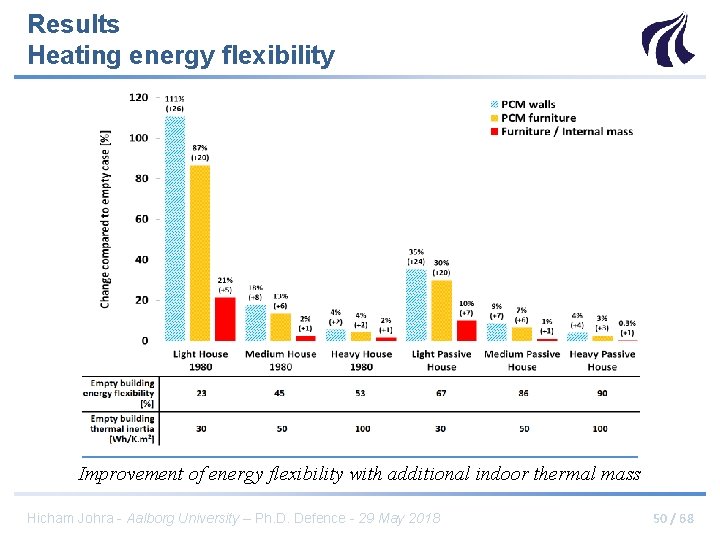
Results Heating energy flexibility Improvement of energy flexibility with additional indoor thermal mass Hicham Johra - Aalborg University – Ph. D. Defence - 29 May 2018 50 / 68
RESULTS MAGNETOCALORIC HEAT PUMP Hicham Johra - Aalborg University – Ph. D. Defence - 29 May 2018 51 / 68
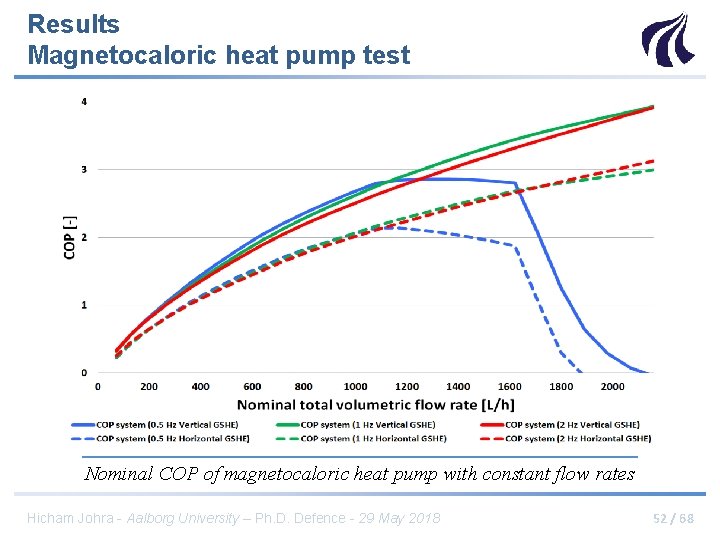
Results Magnetocaloric heat pump test Nominal COP of magnetocaloric heat pump with constant flow rates Hicham Johra - Aalborg University – Ph. D. Defence - 29 May 2018 52 / 68
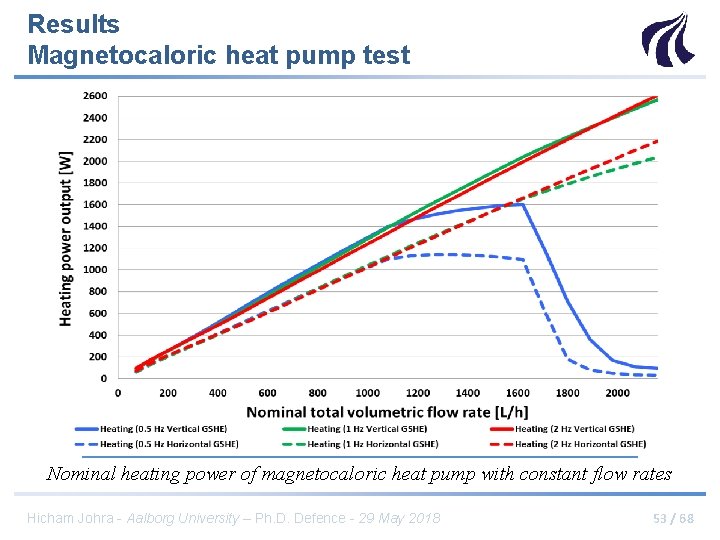
Results Magnetocaloric heat pump test Nominal heating power of magnetocaloric heat pump with constant flow rates Hicham Johra - Aalborg University – Ph. D. Defence - 29 May 2018 53 / 68
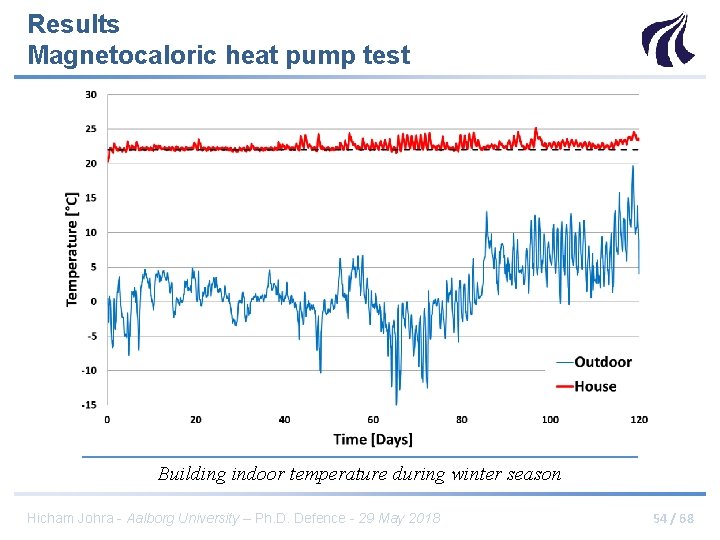
Results Magnetocaloric heat pump test Building indoor temperature during winter season Hicham Johra - Aalborg University – Ph. D. Defence - 29 May 2018 54 / 68
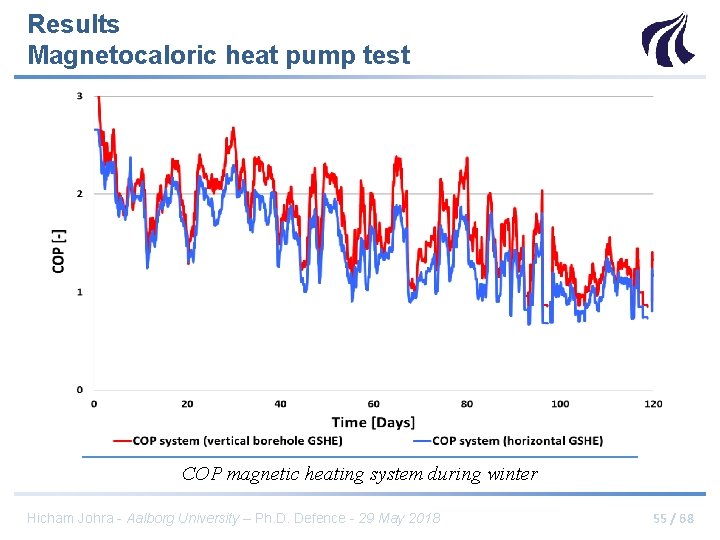
Results Magnetocaloric heat pump test COP magnetic heating system during winter Hicham Johra - Aalborg University – Ph. D. Defence - 29 May 2018 55 / 68
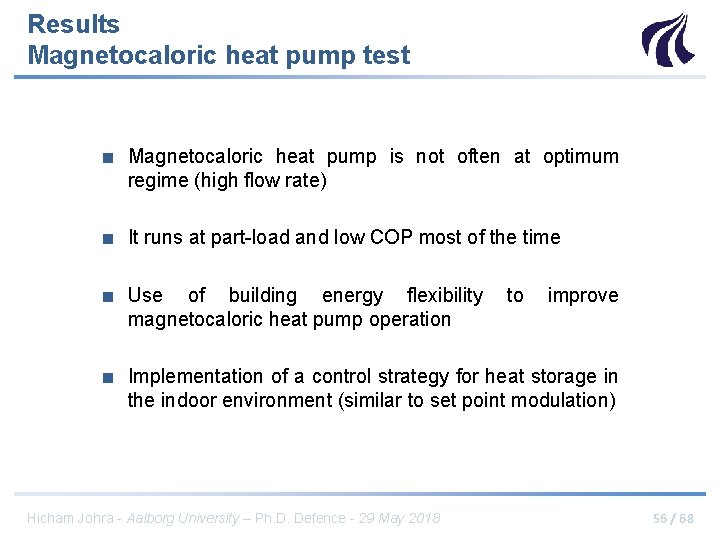
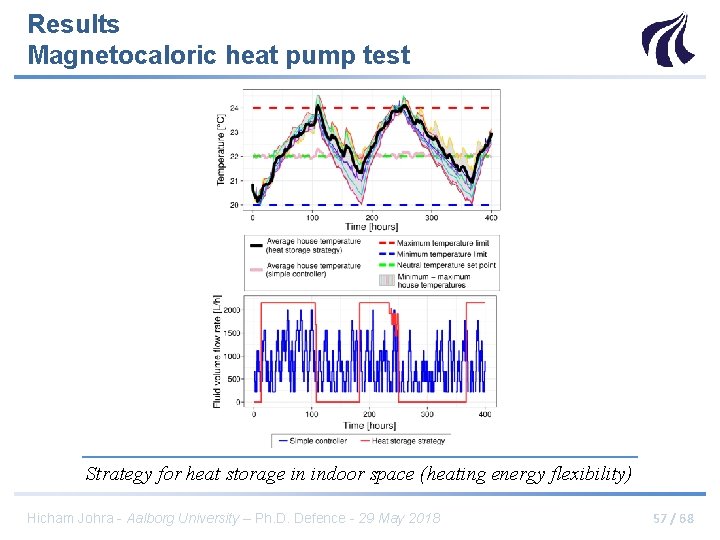
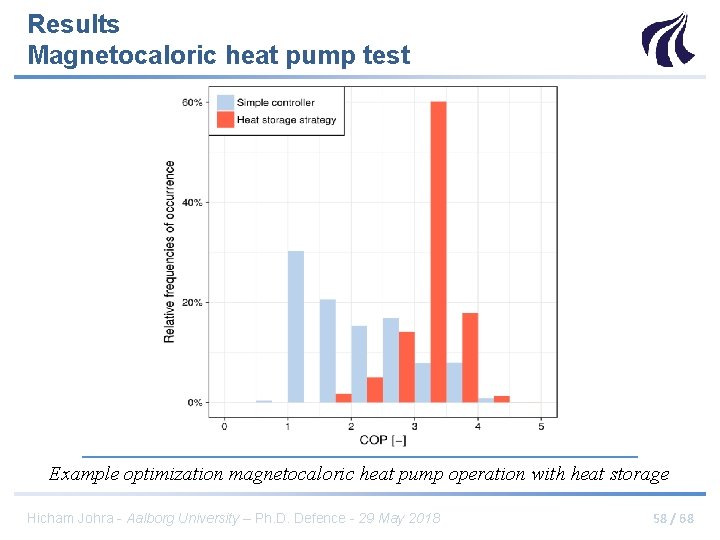
Results Magnetocaloric heat pump test ■ Magnetocaloric heat pump is not often at optimum regime (high flow rate) ■ It runs at part-load and low COP most of the time ■ Use of building energy flexibility magnetocaloric heat pump operation to improve ■ Implementation of a control strategy for heat storage in the indoor environment (similar to set point modulation) Hicham Johra - Aalborg University – Ph. D. Defence - 29 May 2018 56 / 68
Results Magnetocaloric heat pump test Strategy for heat storage in indoor space (heating energy flexibility) Hicham Johra - Aalborg University – Ph. D. Defence - 29 May 2018 57 / 68
Results Magnetocaloric heat pump test Example optimization magnetocaloric heat pump operation with heat storage Hicham Johra - Aalborg University – Ph. D. Defence - 29 May 2018 58 / 68
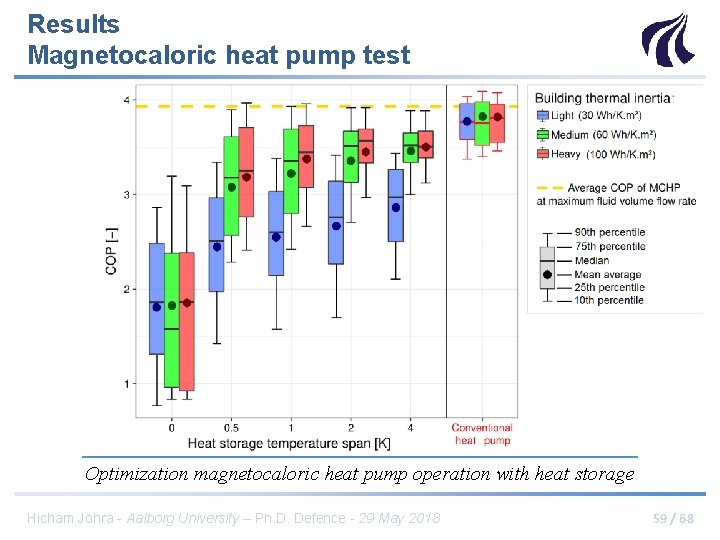
Results Magnetocaloric heat pump test Optimization magnetocaloric heat pump operation with heat storage Hicham Johra - Aalborg University – Ph. D. Defence - 29 May 2018 59 / 68
CONCLUSIONS Hicham Johra - Aalborg University – Ph. D. Defence - 29 May 2018 60 / 68
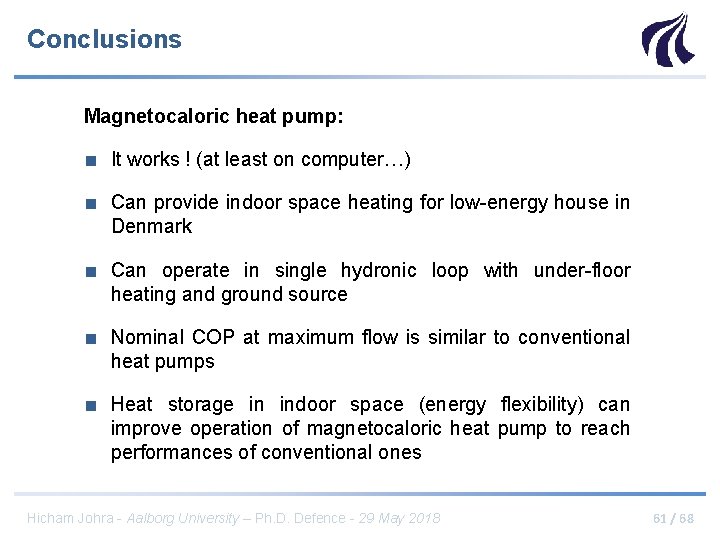
Conclusions Magnetocaloric heat pump: ■ It works ! (at least on computer…) ■ Can provide indoor space heating for low-energy house in Denmark ■ Can operate in single hydronic loop with under-floor heating and ground source ■ Nominal COP at maximum flow is similar to conventional heat pumps ■ Heat storage in indoor space (energy flexibility) can improve operation of magnetocaloric heat pump to reach performances of conventional ones Hicham Johra - Aalborg University – Ph. D. Defence - 29 May 2018 61 / 68
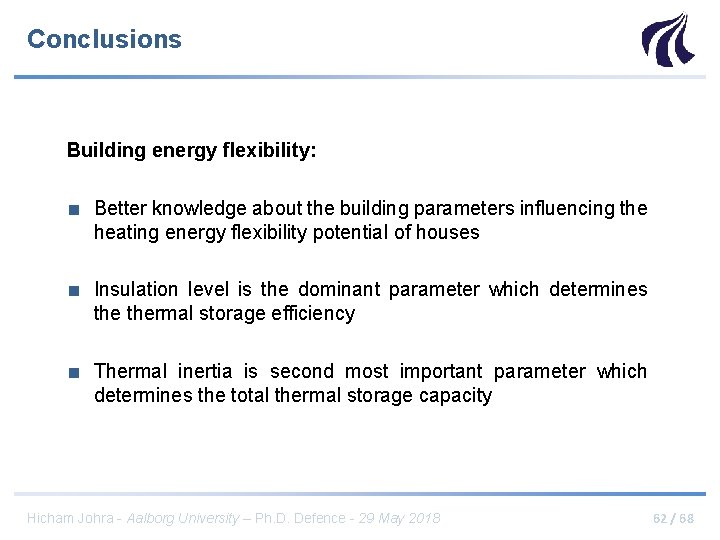
Conclusions Building energy flexibility: ■ Better knowledge about the building parameters influencing the heating energy flexibility potential of houses ■ Insulation level is the dominant parameter which determines thermal storage efficiency ■ Thermal inertia is second most important parameter which determines the total thermal storage capacity Hicham Johra - Aalborg University – Ph. D. Defence - 29 May 2018 62 / 68
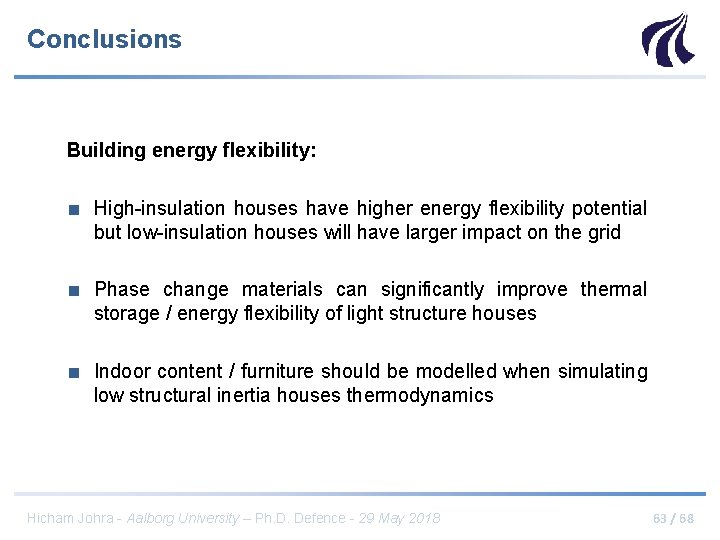
Conclusions Building energy flexibility: ■ High-insulation houses have higher energy flexibility potential but low-insulation houses will have larger impact on the grid ■ Phase change materials can significantly improve thermal storage / energy flexibility of light structure houses ■ Indoor content / furniture should be modelled when simulating low structural inertia houses thermodynamics Hicham Johra - Aalborg University – Ph. D. Defence - 29 May 2018 63 / 68
RECOMMENDATIONS FOR FUTURE WORK Hicham Johra - Aalborg University – Ph. D. Defence - 29 May 2018 64 / 68
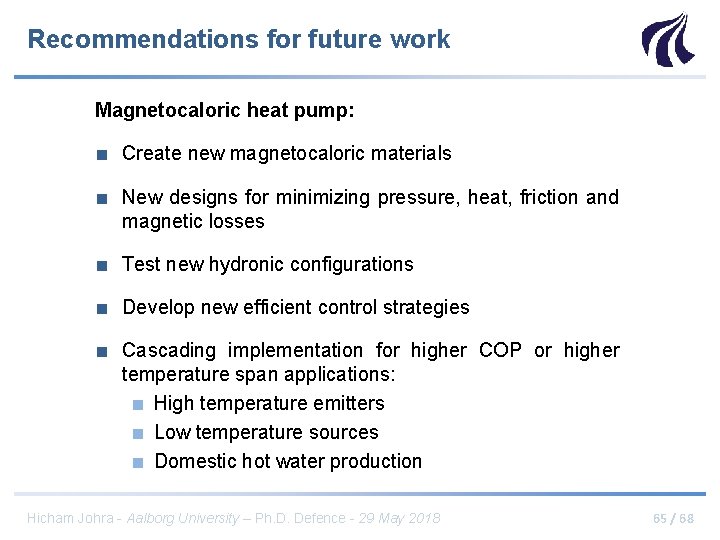
Recommendations for future work Magnetocaloric heat pump: ■ Create new magnetocaloric materials ■ New designs for minimizing pressure, heat, friction and magnetic losses ■ Test new hydronic configurations ■ Develop new efficient control strategies ■ Cascading implementation for higher COP or higher temperature span applications: ■ High temperature emitters ■ Low temperature sources ■ Domestic hot water production Hicham Johra - Aalborg University – Ph. D. Defence - 29 May 2018 65 / 68
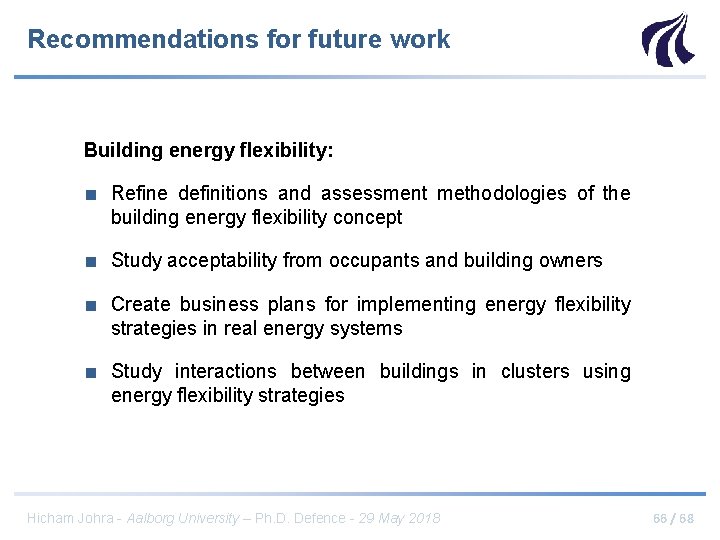
Recommendations for future work Building energy flexibility: ■ Refine definitions and assessment methodologies of the building energy flexibility concept ■ Study acceptability from occupants and building owners ■ Create business plans for implementing energy flexibility strategies in real energy systems ■ Study interactions between buildings in clusters using energy flexibility strategies Hicham Johra - Aalborg University – Ph. D. Defence - 29 May 2018 66 / 68
AND VOILÀ !!! Hicham Johra - Aalborg University – Ph. D. Defence - 29 May 2018 67 / 68
Thank you for your attention ! Contact: Hicham Johra Ph. D Candidate Aalborg University Department of Civil Engineering Division of Architectural Engineering Laboratory of Building Energy and Indoor Environment Further information: www. civil. aau. dk hj@civil. aau. dk (+45) 53 82 88 35 linkedin. com/in/hichamjohra Thomas Manns Vej 23 9220 Aalborg Øst Denmark