
Integration Introduction This is a very big chapter
Integration
Introduction • This is a very big chapter which covers many ways of Integrating more difficult expressions • You are sometimes told which method to use but in addition must be able to identify the most appropriate way • We also cover using Integration to work out volumes as well as areas, as well as setting up and using equations (similar to the chapter on differentiation)

Teachings for Exercise 6 A
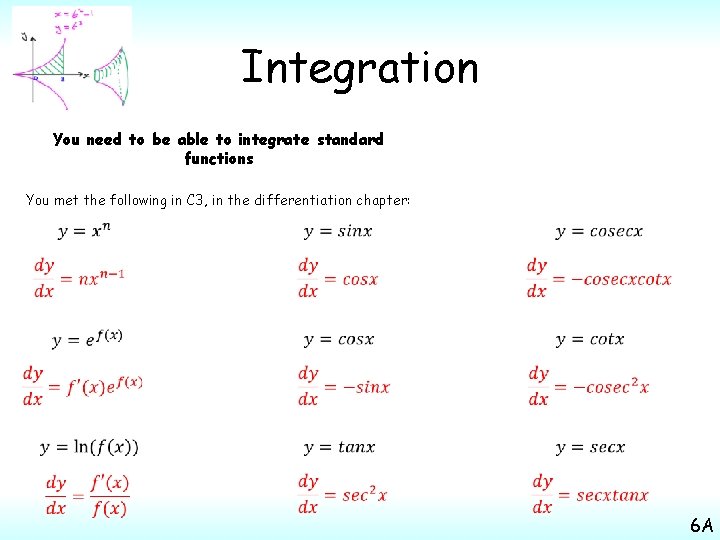
Integration You need to be able to integrate standard functions You met the following in C 3, in the differentiation chapter: 6 A
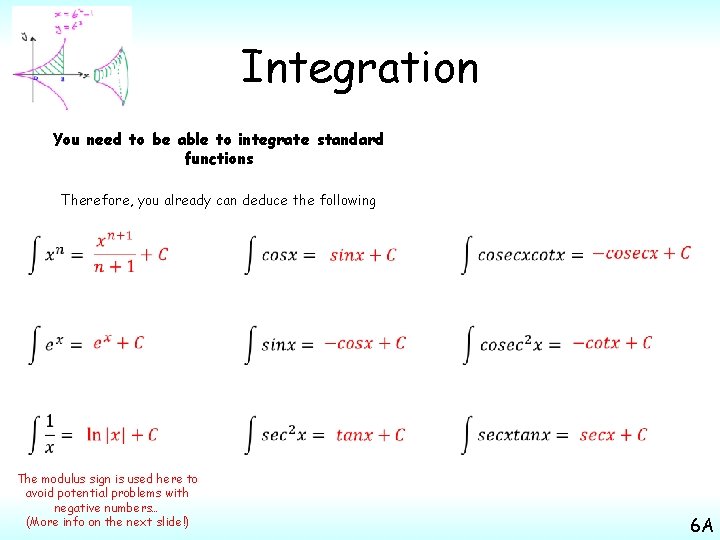
Integration You need to be able to integrate standard functions Therefore, you already can deduce the following The modulus sign is used here to avoid potential problems with negative numbers… (More info on the next slide!) 6 A
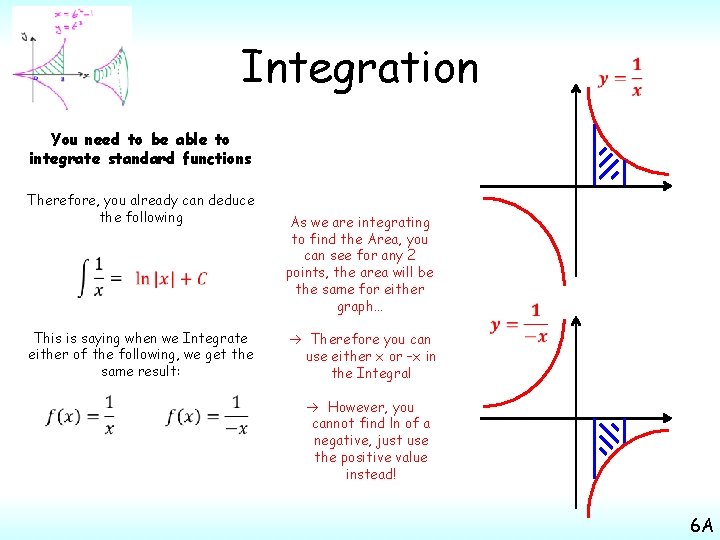
Integration You need to be able to integrate standard functions Therefore, you already can deduce the following This is saying when we Integrate either of the following, we get the same result: As we are integrating to find the Area, you can see for any 2 points, the area will be the same for either graph… Therefore you can use either x or –x in the Integral However, you cannot find ln of a negative, just use the positive value instead! 6 A
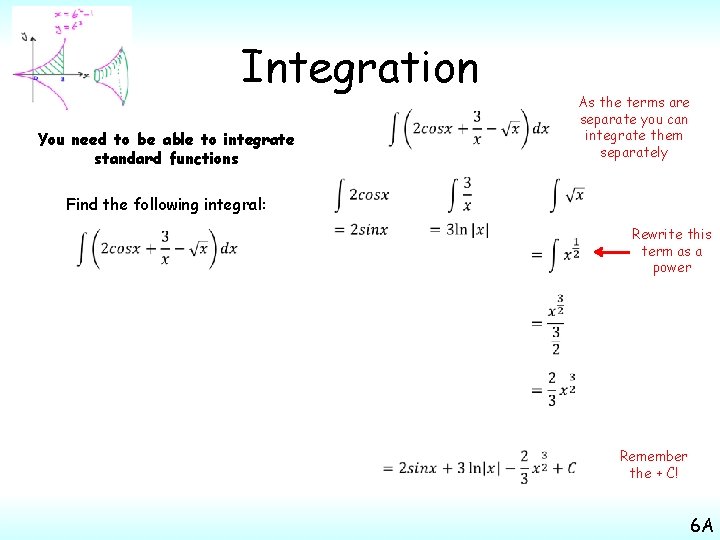
Integration You need to be able to integrate standard functions Find the following integral: As the terms are separate you can integrate them separately Rewrite this term as a power Remember the + C! 6 A
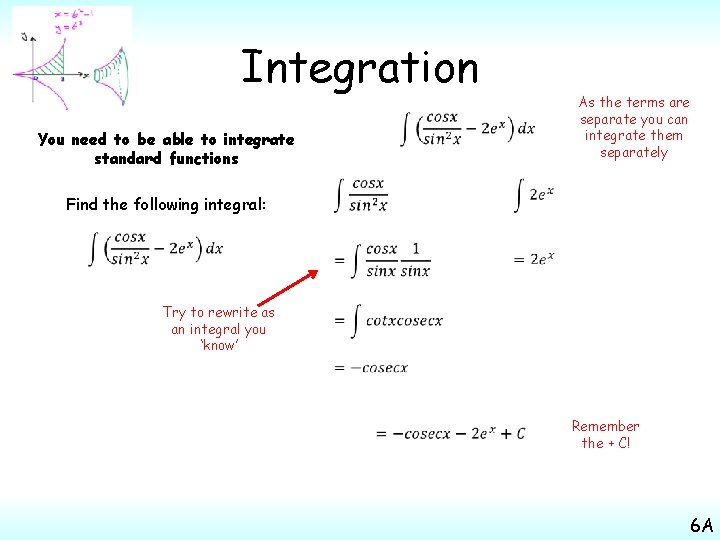
Integration You need to be able to integrate standard functions Find the following integral: Try to rewrite as an integral you ‘know’ As the terms are separate you can integrate them separately Remember the + C! 6 A

Teachings for Exercise 6 B
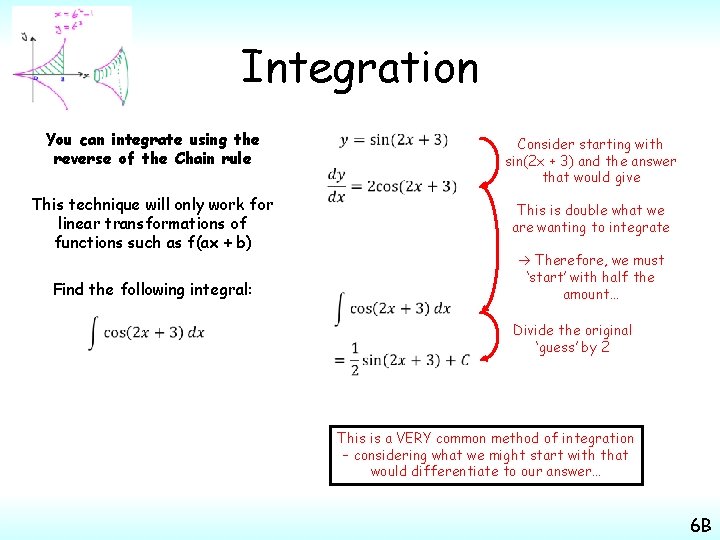
Integration You can integrate using the reverse of the Chain rule This technique will only work for linear transformations of functions such as f(ax + b) Find the following integral: Consider starting with sin(2 x + 3) and the answer that would give This is double what we are wanting to integrate Therefore, we must ‘start’ with half the amount… Divide the original ‘guess’ by 2 This is a VERY common method of integration – considering what we might start with that would differentiate to our answer… 6 B
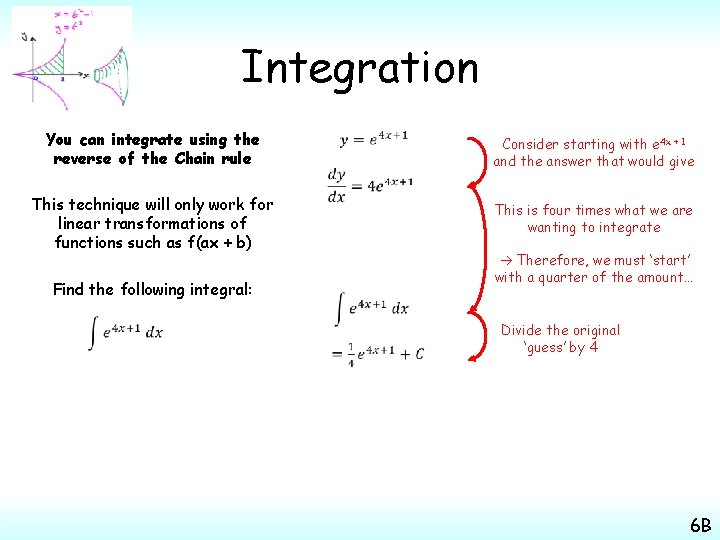
Integration You can integrate using the reverse of the Chain rule This technique will only work for linear transformations of functions such as f(ax + b) Find the following integral: Consider starting with e 4 x + 1 and the answer that would give This is four times what we are wanting to integrate Therefore, we must ‘start’ with a quarter of the amount… Divide the original ‘guess’ by 4 6 B
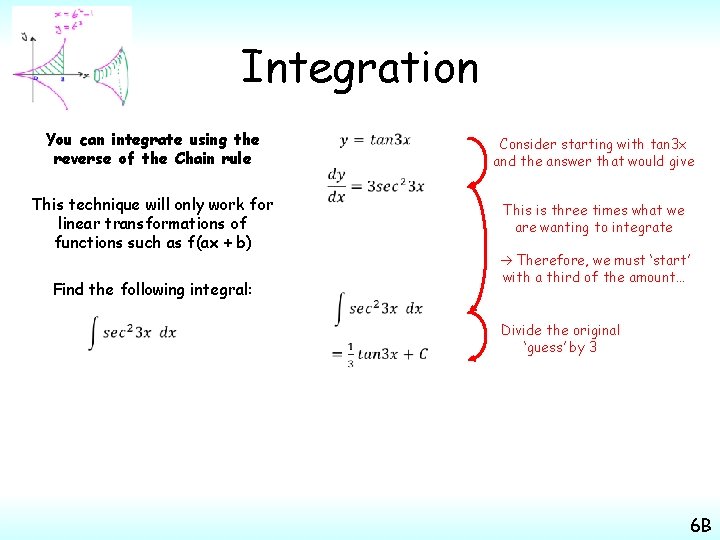
Integration You can integrate using the reverse of the Chain rule This technique will only work for linear transformations of functions such as f(ax + b) Find the following integral: Consider starting with tan 3 x and the answer that would give This is three times what we are wanting to integrate Therefore, we must ‘start’ with a third of the amount… Divide the original ‘guess’ by 3 6 B
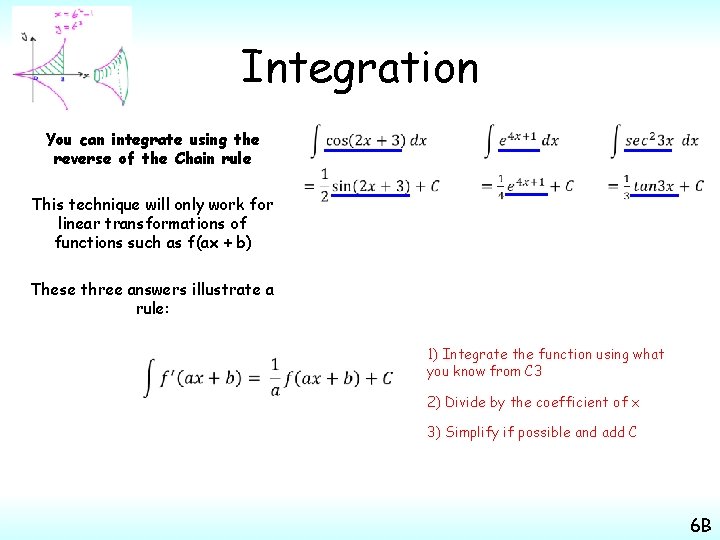
Integration You can integrate using the reverse of the Chain rule This technique will only work for linear transformations of functions such as f(ax + b) These three answers illustrate a rule: 1) Integrate the function using what you know from C 3 2) Divide by the coefficient of x 3) Simplify if possible and add C 6 B
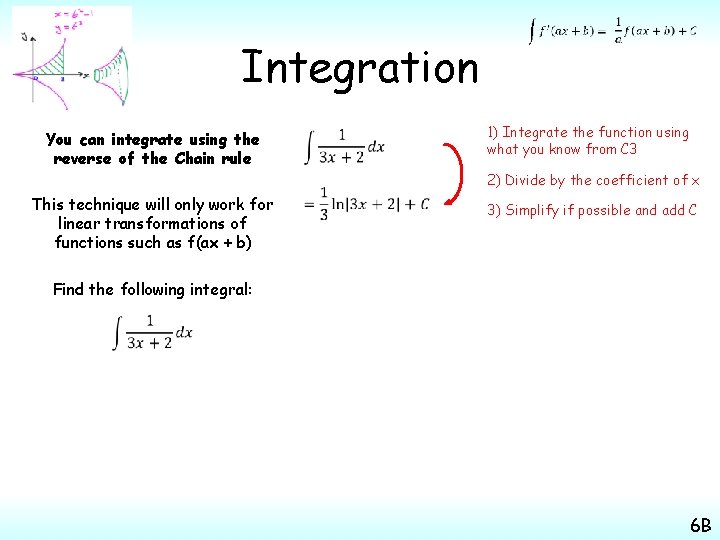
Integration You can integrate using the reverse of the Chain rule This technique will only work for linear transformations of functions such as f(ax + b) 1) Integrate the function using what you know from C 3 2) Divide by the coefficient of x 3) Simplify if possible and add C Find the following integral: 6 B
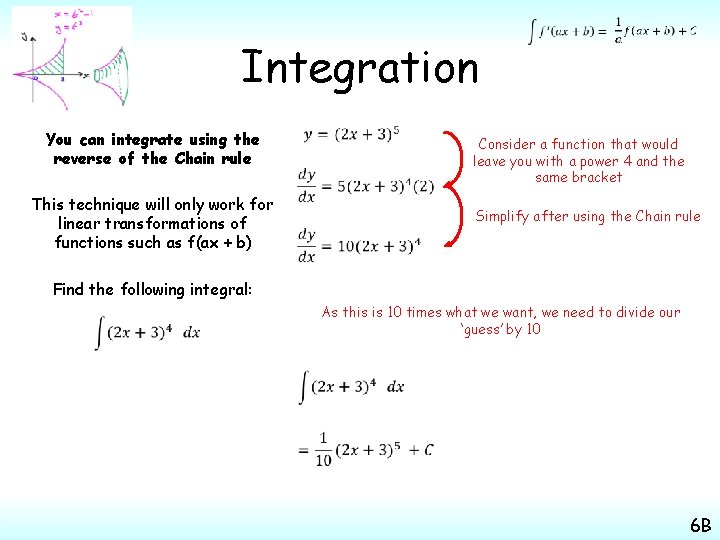
Integration You can integrate using the reverse of the Chain rule This technique will only work for linear transformations of functions such as f(ax + b) Consider a function that would leave you with a power 4 and the same bracket Simplify after using the Chain rule Find the following integral: As this is 10 times what we want, we need to divide our ‘guess’ by 10 6 B

Teachings for Exercise 6 C
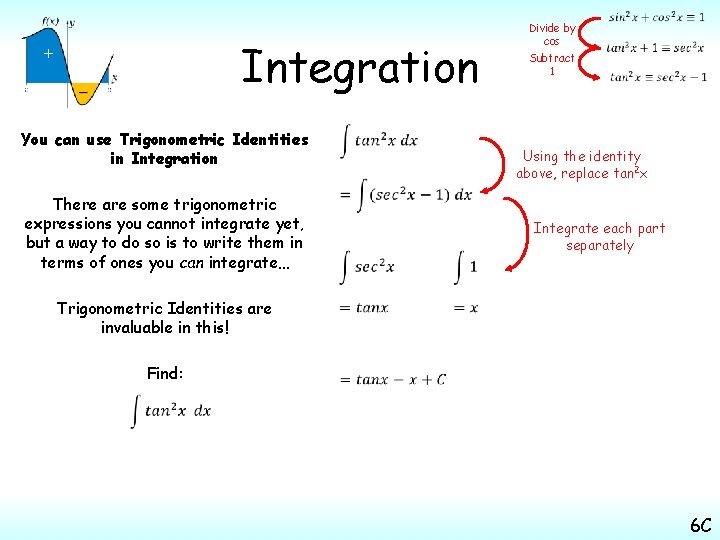
Integration You can use Trigonometric Identities in Integration There are some trigonometric expressions you cannot integrate yet, but a way to do so is to write them in terms of ones you can integrate… Subtract 1 Using the identity above, replace tan 2 x Trigonometric Identities are invaluable in this! Find: Divide by cos Integrate each part separately 6 C
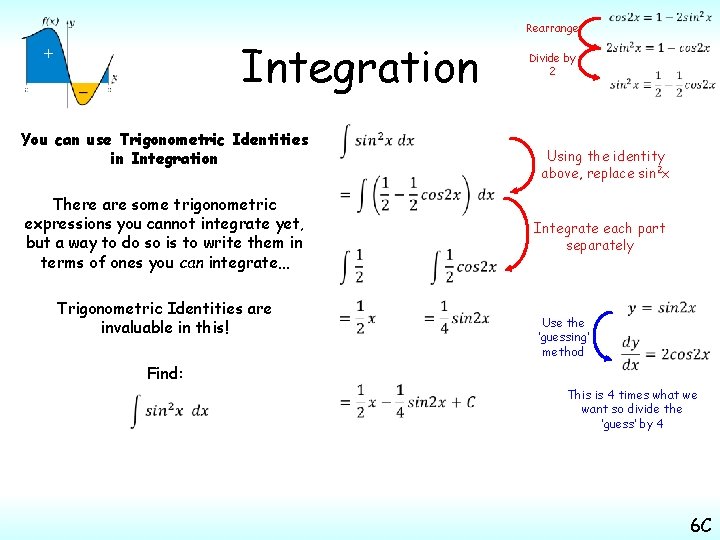
Integration You can use Trigonometric Identities in Integration There are some trigonometric expressions you cannot integrate yet, but a way to do so is to write them in terms of ones you can integrate… Trigonometric Identities are invaluable in this! Find: Rearrange Divide by 2 Using the identity above, replace sin 2 x Integrate each part separately Use the ‘guessing’ method This is 4 times what we want so divide the ‘guess’ by 4 6 C
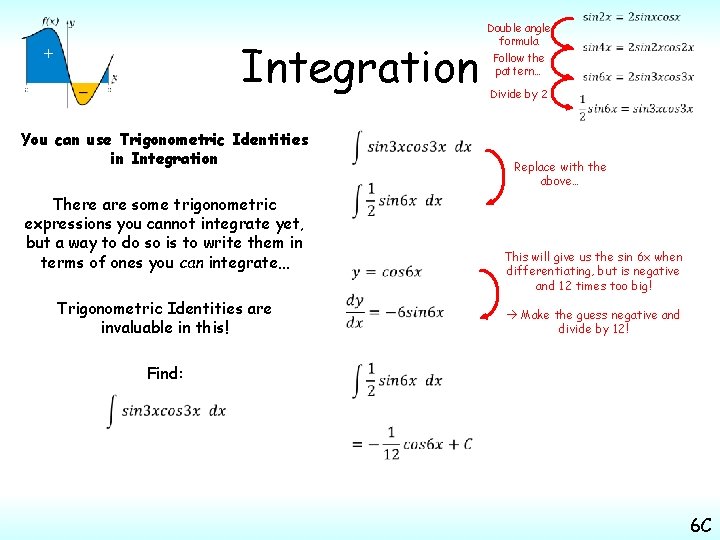
Integration There are some trigonometric expressions you cannot integrate yet, but a way to do so is to write them in terms of ones you can integrate… Find: Follow the pattern… Divide by 2 You can use Trigonometric Identities in Integration Trigonometric Identities are invaluable in this! Double angle formula Replace with the above… This will give us the sin 6 x when differentiating, but is negative and 12 times too big! Make the guess negative and divide by 12! 6 C
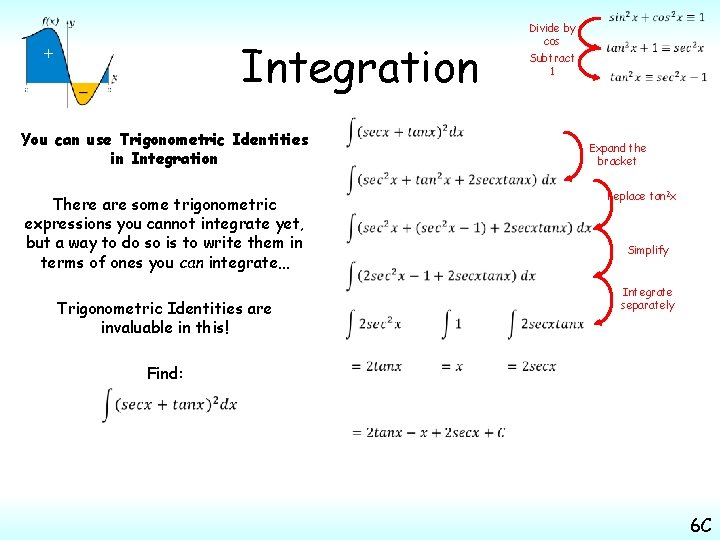
Divide by cos Integration You can use Trigonometric Identities in Integration There are some trigonometric expressions you cannot integrate yet, but a way to do so is to write them in terms of ones you can integrate… Trigonometric Identities are invaluable in this! Find: Subtract 1 Expand the bracket Replace tan 2 x Simplify Integrate separately 6 C

Teachings for Exercise 6 D
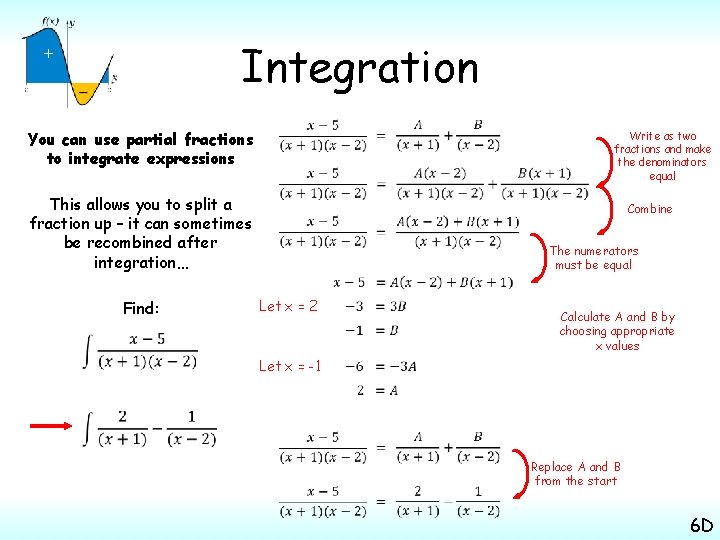
Integration You can use partial fractions to integrate expressions This allows you to split a fraction up – it can sometimes be recombined after integration… Combine The numerators must be equal Find: Write as two fractions and make the denominators equal Let x = 2 Let x = -1 Calculate A and B by choosing appropriate x values Replace A and B from the start 6 D
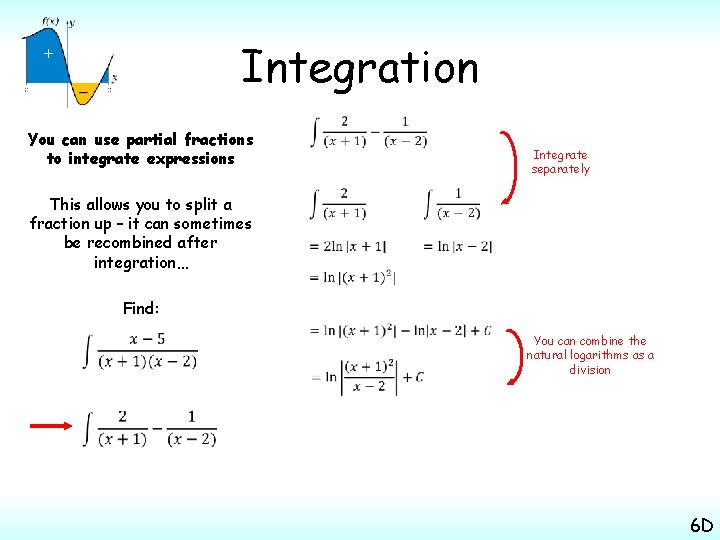
Integration You can use partial fractions to integrate expressions This allows you to split a fraction up – it can sometimes be recombined after integration… Integrate separately Find: You can combine the natural logarithms as a division 6 D
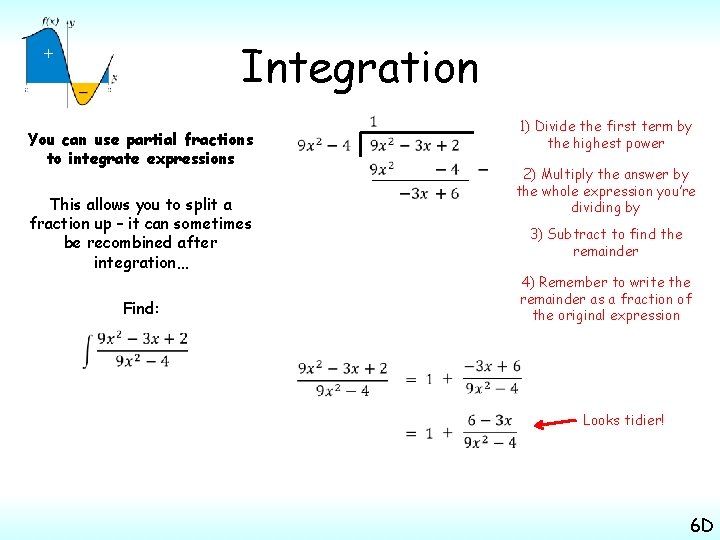
Integration You can use partial fractions to integrate expressions 1) Divide the first term by the highest power This allows you to split a fraction up – it can sometimes be recombined after integration… 2) Multiply the answer by the whole expression you’re dividing by 3) Subtract to find the remainder 4) Remember to write the remainder as a fraction of the original expression Find: Looks tidier! 6 D
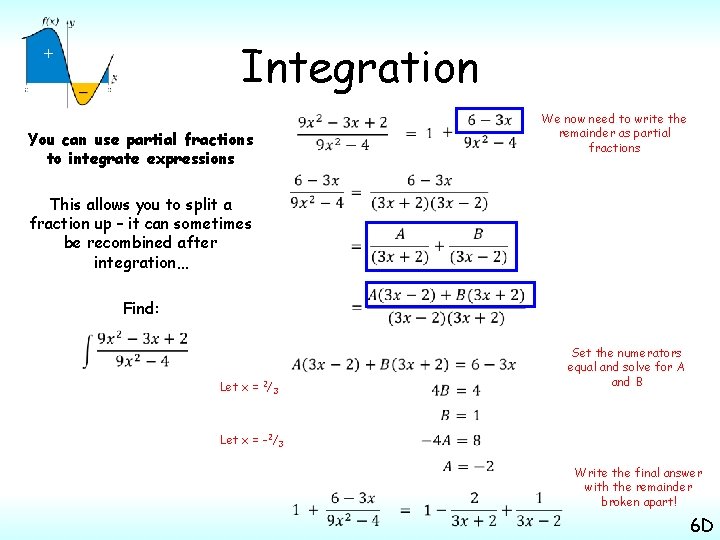
Integration You can use partial fractions to integrate expressions This allows you to split a fraction up – it can sometimes be recombined after integration… We now need to write the remainder as partial fractions Find: Set the numerators equal and solve for A and B Let x = 2/3 Let x = -2/3 Write the final answer with the remainder broken apart! 6 D
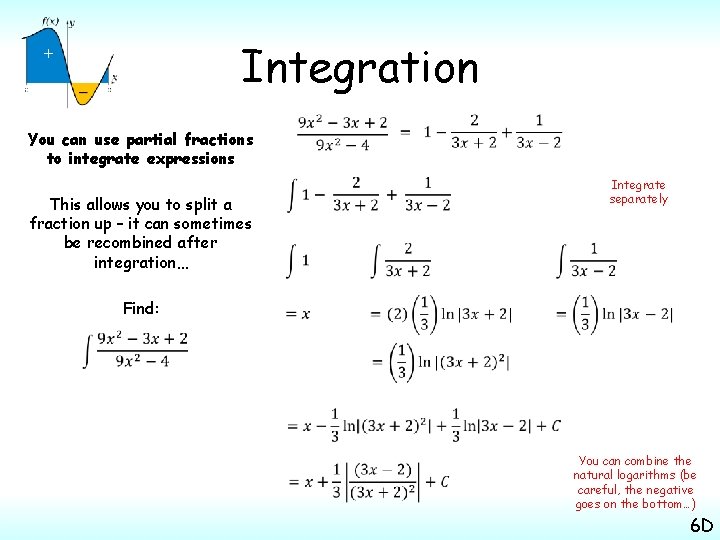
Integration You can use partial fractions to integrate expressions This allows you to split a fraction up – it can sometimes be recombined after integration… Find: Integrate separately You can combine the natural logarithms (be careful, the negative goes on the bottom…) 6 D

Teachings for Exercise 6 E
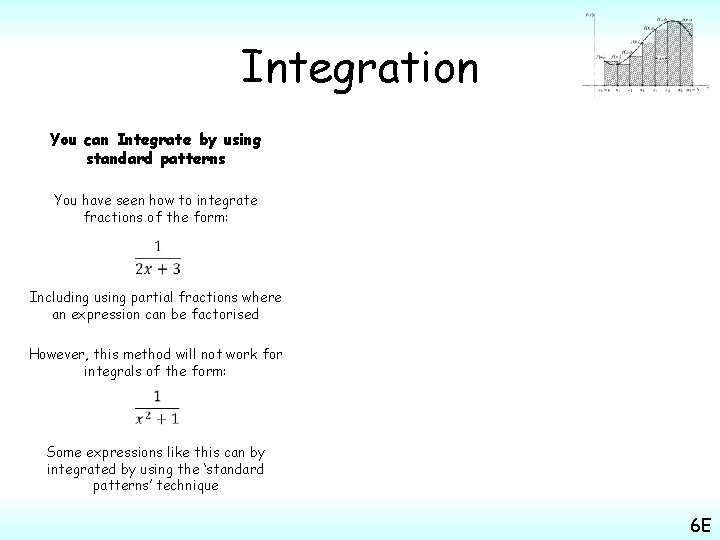
Integration You can Integrate by using standard patterns You have seen how to integrate fractions of the form: Including using partial fractions where an expression can be factorised However, this method will not work for integrals of the form: Some expressions like this can by integrated by using the ‘standard patterns’ technique 6 E
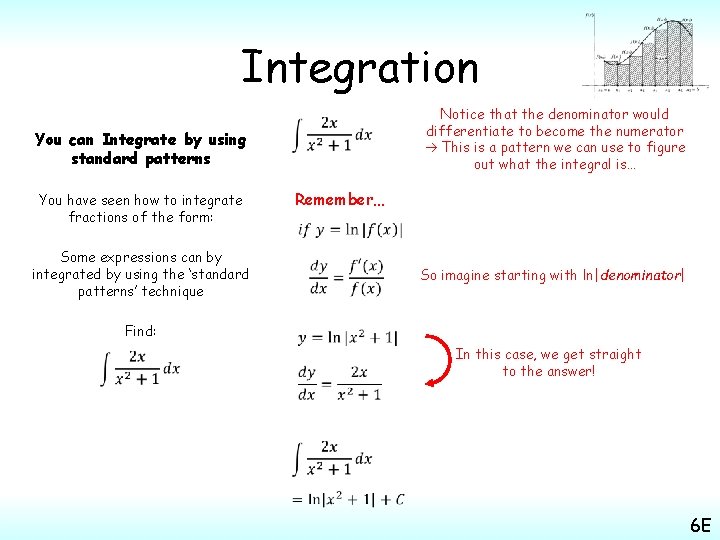
Integration You can Integrate by using standard patterns Notice that the denominator would differentiate to become the numerator This is a pattern we can use to figure out what the integral is… Remember… You have seen how to integrate fractions of the form: Some expressions can by integrated by using the ‘standard patterns’ technique Find: So imagine starting with ln|denominator| In this case, we get straight to the answer! 6 E
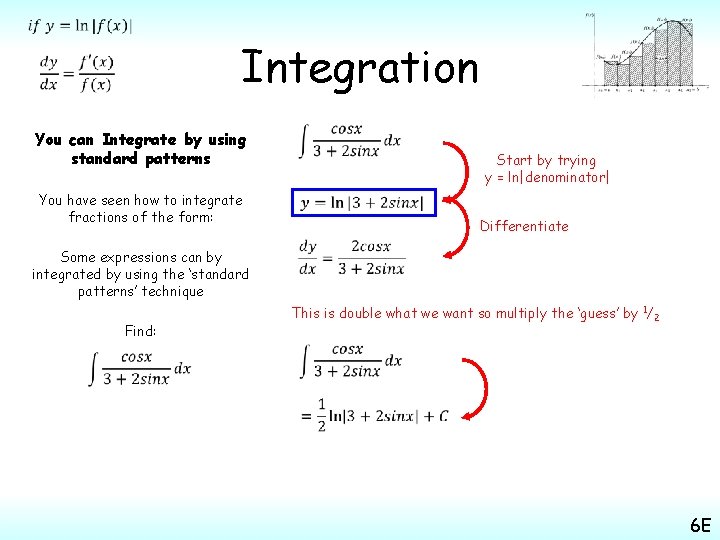
Integration You can Integrate by using standard patterns You have seen how to integrate fractions of the form: Some expressions can by integrated by using the ‘standard patterns’ technique Find: Start by trying y = ln|denominator| Differentiate This is double what we want so multiply the ‘guess’ by 1/2 6 E
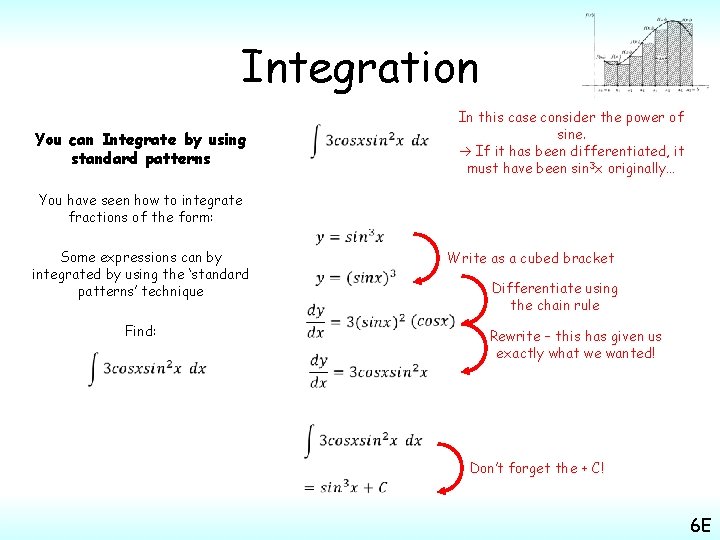
Integration In this case consider the power of sine. If it has been differentiated, it must have been sin 3 x originally… You can Integrate by using standard patterns You have seen how to integrate fractions of the form: Some expressions can by integrated by using the ‘standard patterns’ technique Find: Write as a cubed bracket Differentiate using the chain rule Rewrite – this has given us exactly what we wanted! Don’t forget the + C! 6 E
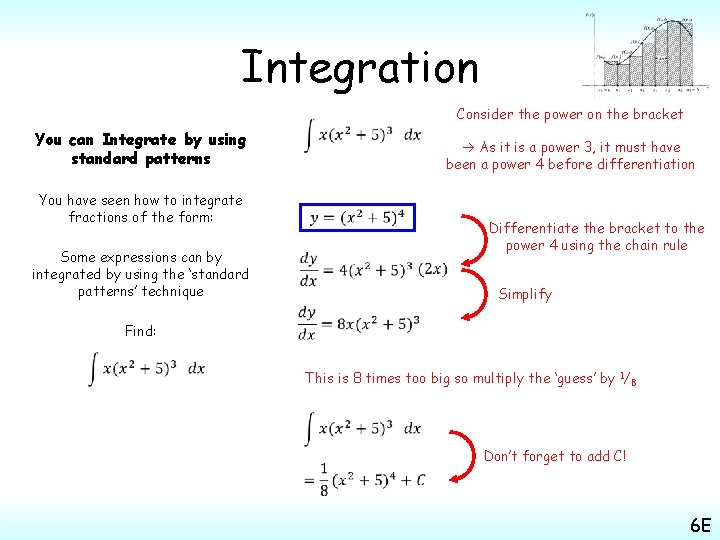
Integration You can Integrate by using standard patterns As it is a power 3, it must have been a power 4 before differentiation You have seen how to integrate fractions of the form: Some expressions can by integrated by using the ‘standard patterns’ technique Find: Consider the power on the bracket Differentiate the bracket to the power 4 using the chain rule Simplify This is 8 times too big so multiply the ‘guess’ by 1/8 Don’t forget to add C! 6 E
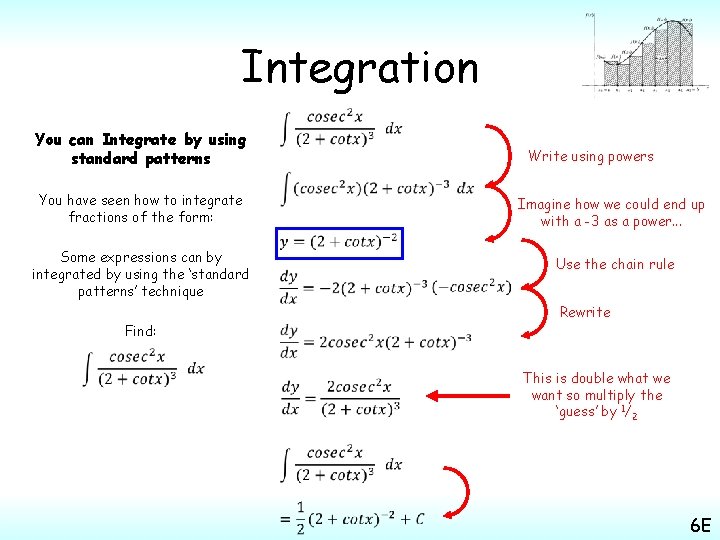
Integration You can Integrate by using standard patterns Write using powers You have seen how to integrate fractions of the form: Some expressions can by integrated by using the ‘standard patterns’ technique Find: Imagine how we could end up with a -3 as a power. . . Use the chain rule Rewrite This is double what we want so multiply the ‘guess’ by 1/2 6 E
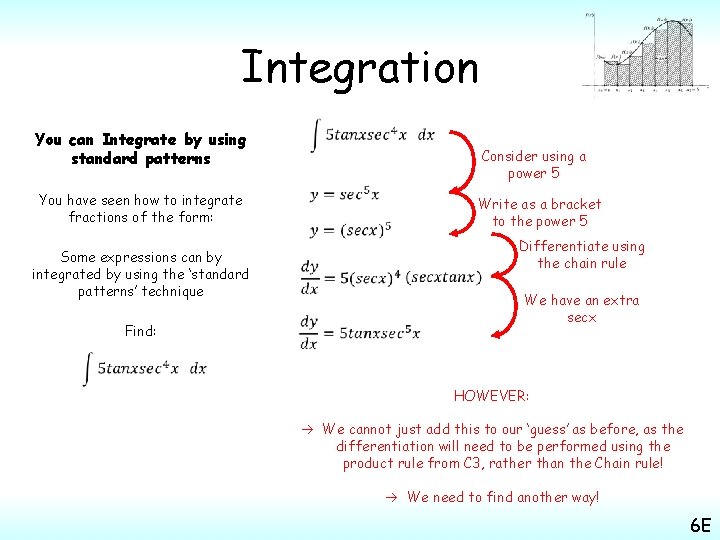
Integration You can Integrate by using standard patterns Consider using a power 5 You have seen how to integrate fractions of the form: Write as a bracket to the power 5 Some expressions can by integrated by using the ‘standard patterns’ technique Find: Differentiate using the chain rule We have an extra secx HOWEVER: We cannot just add this to our ‘guess’ as before, as the differentiation will need to be performed using the product rule from C 3, rather than the Chain rule! We need to find another way! 6 E
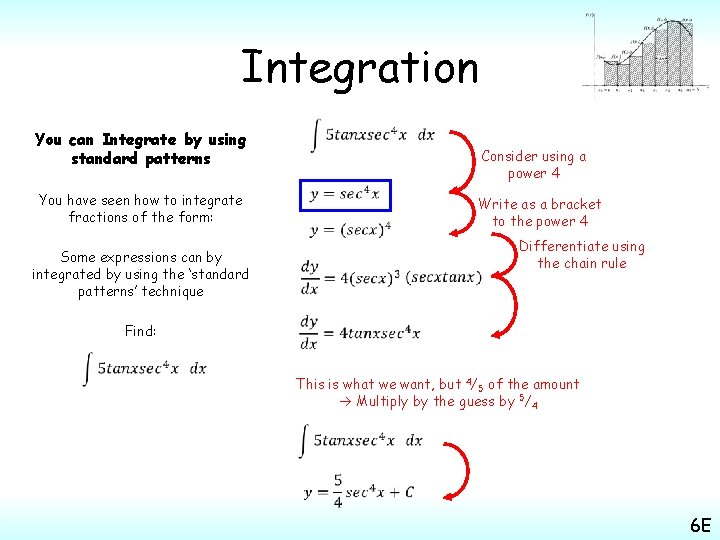
Integration You can Integrate by using standard patterns Consider using a power 4 You have seen how to integrate fractions of the form: Write as a bracket to the power 4 Some expressions can by integrated by using the ‘standard patterns’ technique Find: Differentiate using the chain rule This is what we want, but 4/5 of the amount Multiply by the guess by 5/4 6 E

Teachings for Exercise 6 F
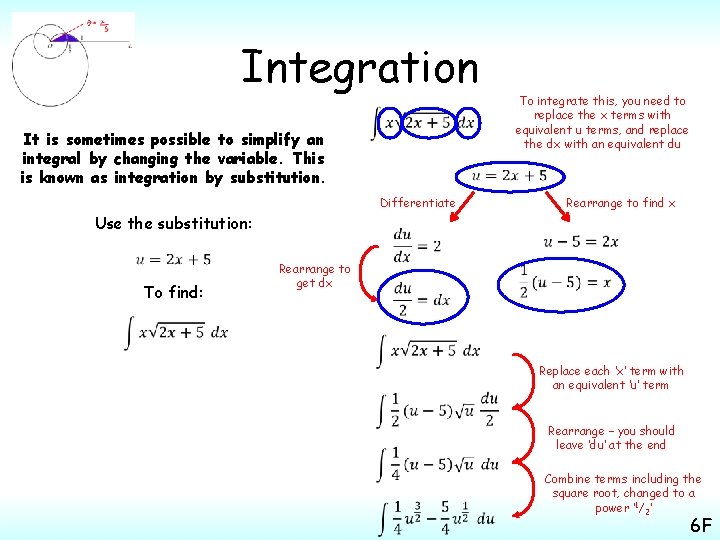
Integration It is sometimes possible to simplify an integral by changing the variable. This is known as integration by substitution. To integrate this, you need to replace the x terms with equivalent u terms, and replace the dx with an equivalent du Differentiate Use the substitution: To find: Rearrange to find x Rearrange to get dx Replace each ‘x’ term with an equivalent ‘u’ term Rearrange – you should leave ‘du’ at the end Combine terms including the square root, changed to a power ‘ 1/2’ 6 F
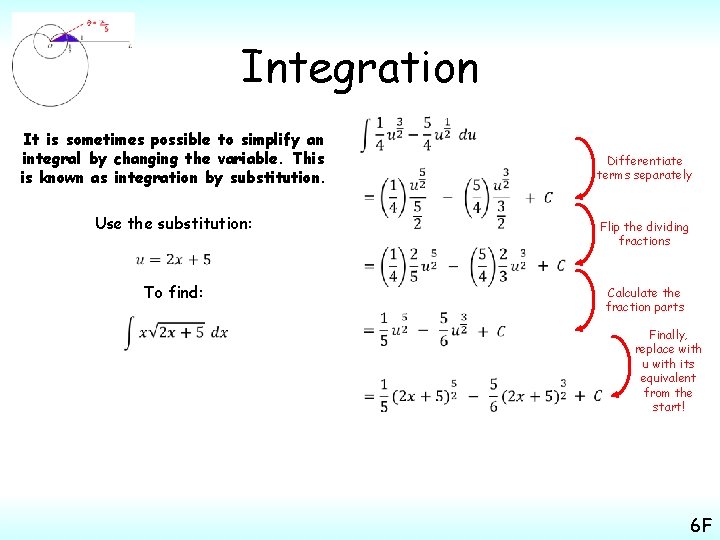
Integration It is sometimes possible to simplify an integral by changing the variable. This is known as integration by substitution. Differentiate terms separately Use the substitution: Flip the dividing fractions To find: Calculate the fraction parts Finally, replace with u with its equivalent from the start! 6 F
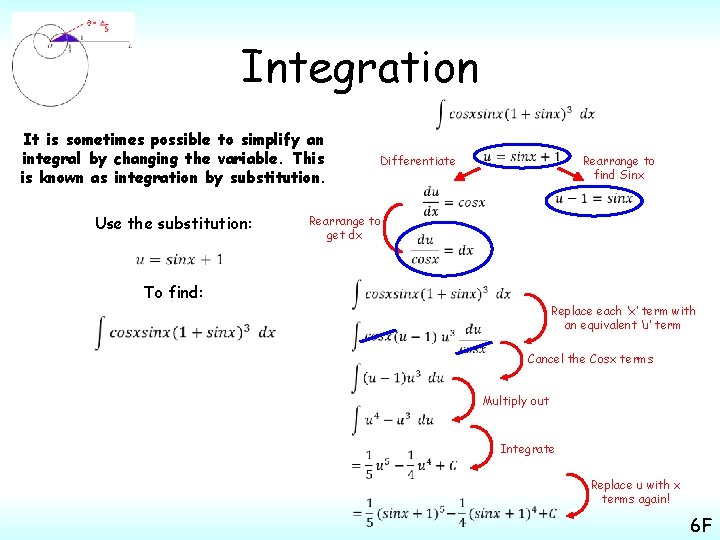
Integration It is sometimes possible to simplify an integral by changing the variable. This is known as integration by substitution. Use the substitution: Differentiate Rearrange to find Sinx Rearrange to get dx To find: Replace each ‘x’ term with an equivalent ‘u’ term Cancel the Cosx terms Multiply out Integrate Replace u with x terms again! 6 F
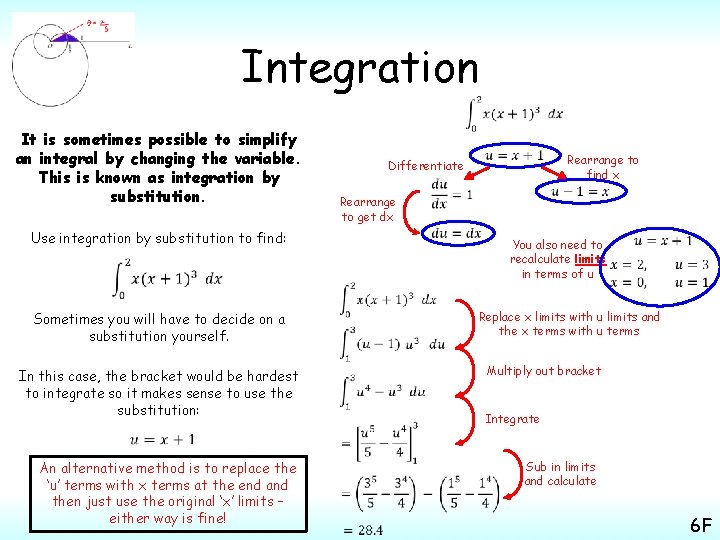
Integration It is sometimes possible to simplify an integral by changing the variable. This is known as integration by substitution. Differentiate In this case, the bracket would be hardest to integrate so it makes sense to use the substitution: An alternative method is to replace the ‘u’ terms with x terms at the end and then just use the original ‘x’ limits – either way is fine! Replace x limits with u limits and the x terms with u terms Integrate You also need to recalculate limits in terms of u Multiply out bracket Rearrange to find x Rearrange to get dx Use integration by substitution to find: Sometimes you will have to decide on a substitution yourself. Sub in limits and calculate 6 F

Teachings for Exercise 6 G
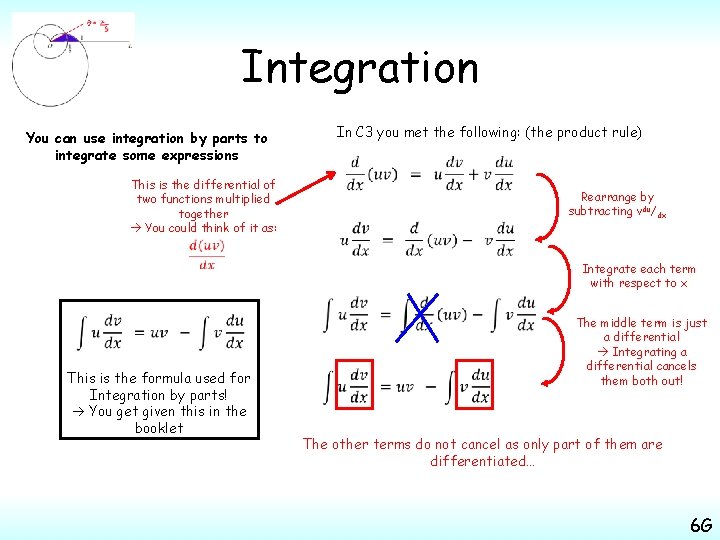
Integration In C 3 you met the following: (the product rule) You can use integration by parts to integrate some expressions This is the differential of two functions multiplied together You could think of it as: Rearrange by subtracting vdu/dx Integrate each term with respect to x This is the formula used for Integration by parts! You get given this in the booklet The middle term is just a differential Integrating a differential cancels them both out! The other terms do not cancel as only part of them are differentiated… 6 G
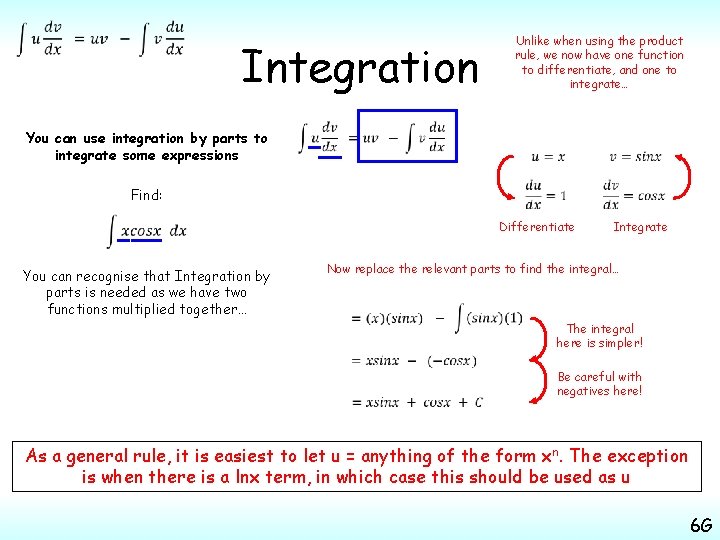
Integration You can use integration by parts to integrate some expressions Find: You can recognise that Integration by parts is needed as we have two functions multiplied together… Unlike when using the product rule, we now have one function to differentiate, and one to integrate… Differentiate Integrate Now replace the relevant parts to find the integral… The integral here is simpler! Be careful with negatives here! As a general rule, it is easiest to let u = anything of the form x n. The exception is when there is a lnx term, in which case this should be used as u 6 G
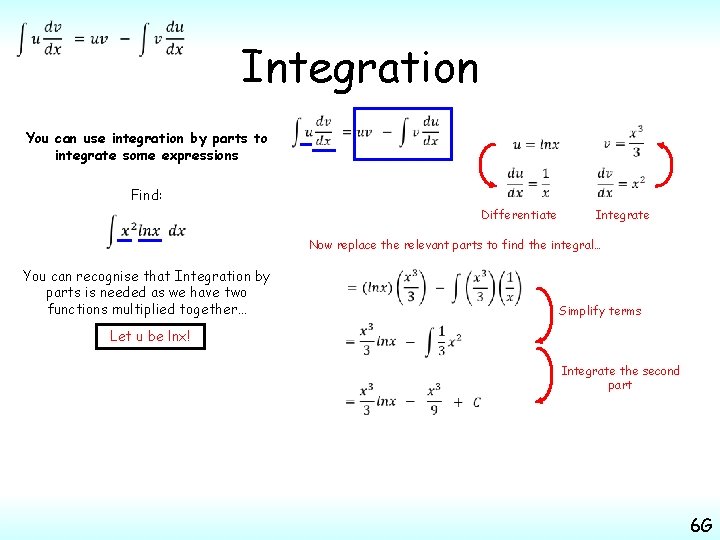
Integration You can use integration by parts to integrate some expressions Find: Differentiate Integrate Now replace the relevant parts to find the integral… You can recognise that Integration by parts is needed as we have two functions multiplied together… Let u be lnx! Simplify terms Integrate the second part 6 G
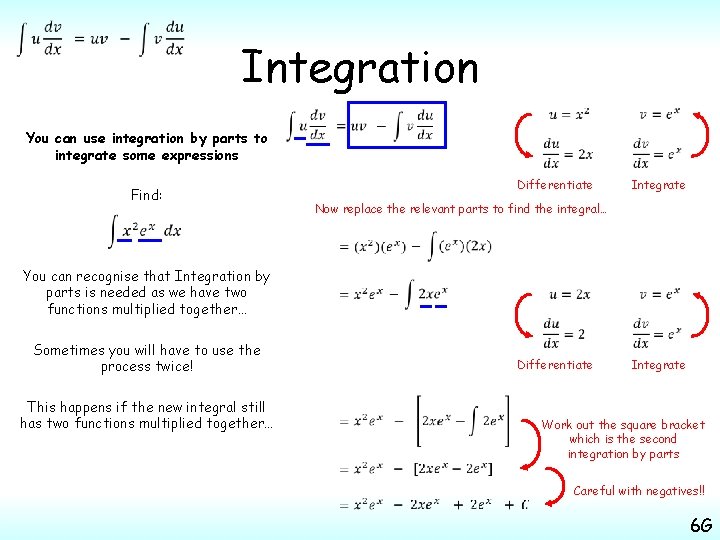
Integration You can use integration by parts to integrate some expressions Find: Integrate Now replace the relevant parts to find the integral… Sometimes you will have to use the process twice! This happens if the new integral still has two functions multiplied together… Differentiate You can recognise that Integration by parts is needed as we have two functions multiplied together… Differentiate Integrate Work out the square bracket which is the second integration by parts Careful with negatives!! 6 G
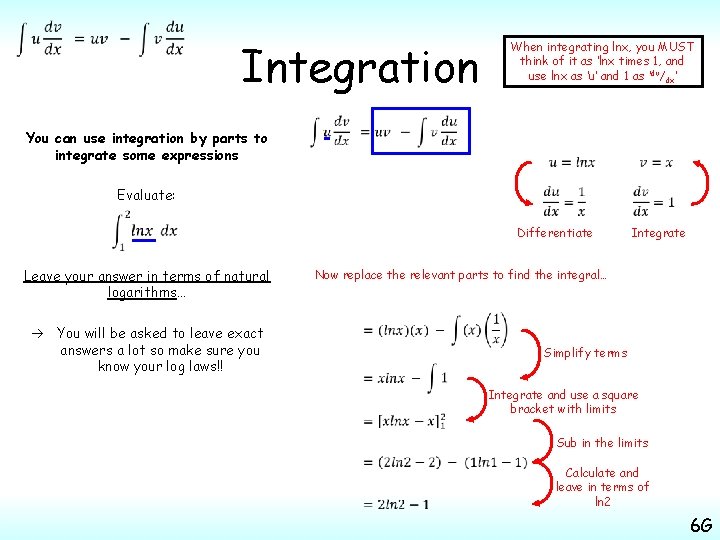
Integration You can use integration by parts to integrate some expressions You will be asked to leave exact answers a lot so make sure you know your log laws!! Evaluate: Leave your answer in terms of natural logarithms… When integrating lnx, you MUST think of it as ‘lnx times 1, and use lnx as ‘u’ and 1 as ‘dv/dx’ Differentiate Integrate Now replace the relevant parts to find the integral… Simplify terms Integrate and use a square bracket with limits Sub in the limits Calculate and leave in terms of ln 2 6 G
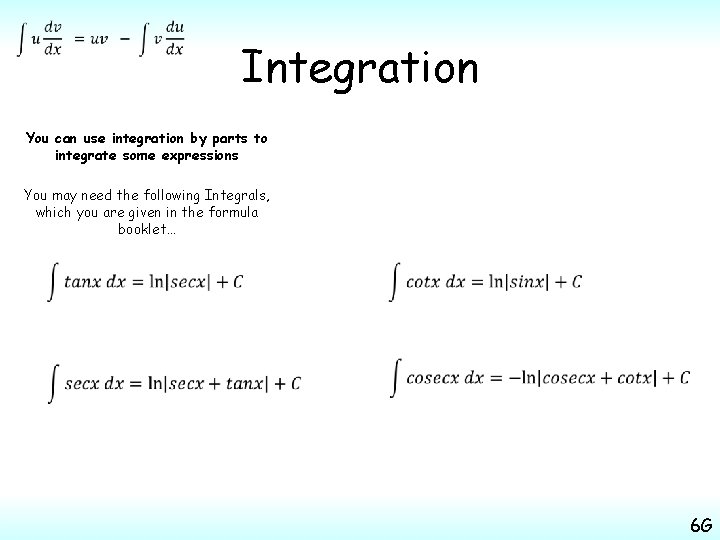
Integration You can use integration by parts to integrate some expressions You may need the following Integrals, which you are given in the formula booklet… 6 G

Teachings for Exercise 6 H
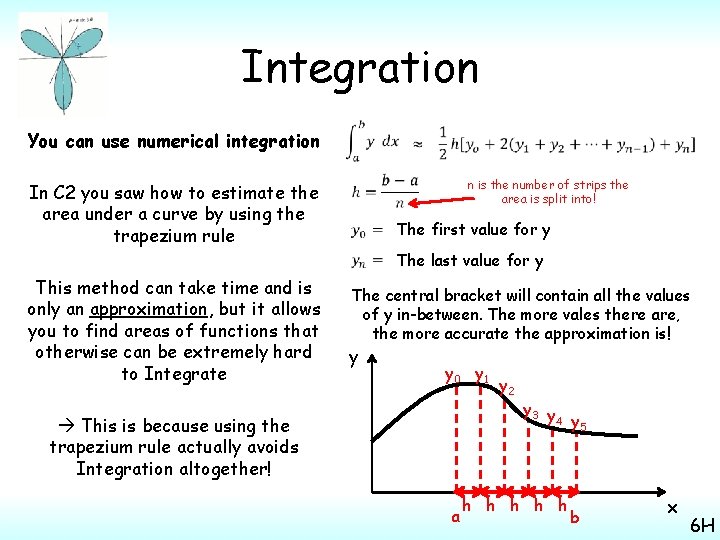
Integration You can use numerical integration In C 2 you saw how to estimate the area under a curve by using the trapezium rule This method can take time and is only an approximation, but it allows you to find areas of functions that otherwise can be extremely hard to Integrate n is the number of strips the area is split into! The first value for y The last value for y The central bracket will contain all the values of y in-between. The more vales there are, the more accurate the approximation is! y y 0 y 1 This is because using the trapezium rule actually avoids Integration altogether! a y 2 y 3 y 4 y 5 h h h b x 6 H
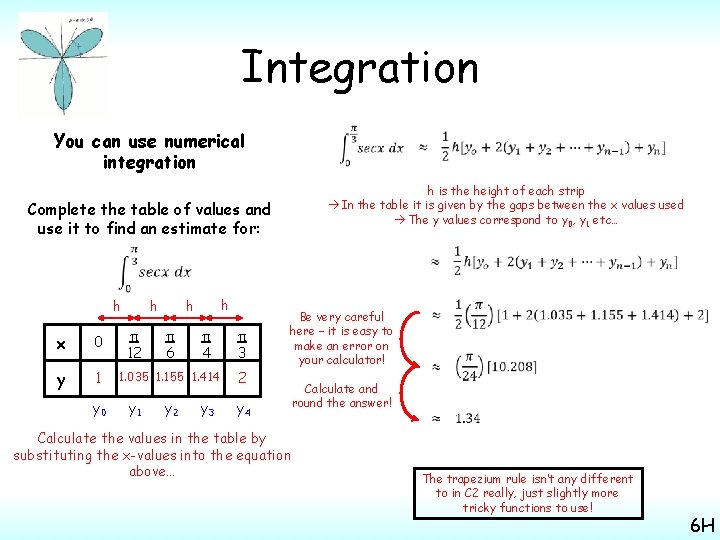
Integration You can use numerical integration h is the height of each strip In the table it is given by the gaps between the x values used The y values correspond to y 0, y 1 etc… Complete the table of values and use it to find an estimate for: h x 0 y 1 y 0 h π 12 h h π 6 π 4 1. 035 1. 155 1. 414 y 1 y 2 y 3 π 3 2 Be very careful here – it is easy to make an error on your calculator! y 4 Calculate the values in the table by substituting the x-values into the equation above… Calculate and round the answer! The trapezium rule isn’t any different to in C 2 really, just slightly more tricky functions to use! 6 H
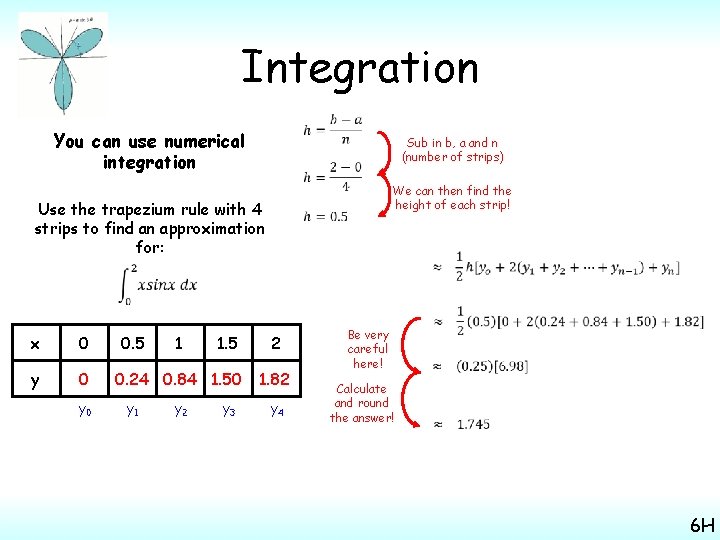
Integration You can use numerical integration Sub in b, a and n (number of strips) Use the trapezium rule with 4 strips to find an approximation for: We can then find the height of each strip! x 0 y 0 0. 5 1 1. 5 0. 24 0. 84 1. 50 y 1 y 2 y 3 2 1. 82 y 4 Be very careful here! Calculate and round the answer! 6 H

Teachings for Exercise 6 I
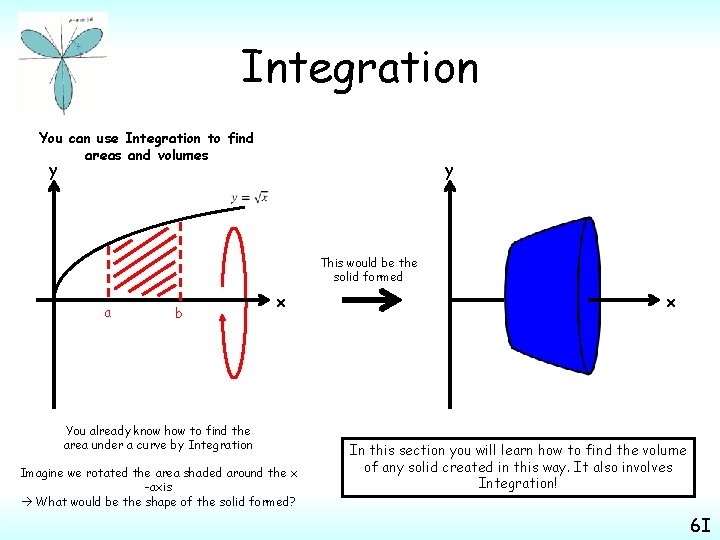
Integration You can use Integration to find areas and volumes y y This would be the solid formed a b x You already know how to find the area under a curve by Integration Imagine we rotated the area shaded around the x -axis What would be the shape of the solid formed? x In this section you will learn how to find the volume of any solid created in this way. It also involves Integration! 6 I
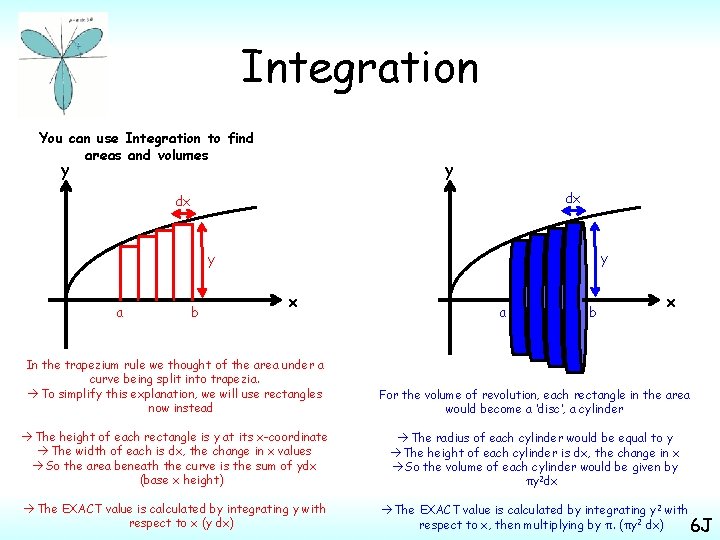
Integration You can use Integration to find areas and volumes y y dx dx y y a b x In the trapezium rule we thought of the area under a curve being split into trapezia. To simplify this explanation, we will use rectangles now instead For the volume of revolution, each rectangle in the area would become a ‘disc’, a cylinder The height of each rectangle is y at its x-coordinate The width of each is dx, the change in x values So the area beneath the curve is the sum of ydx (base x height) The radius of each cylinder would be equal to y The height of each cylinder is dx, the change in x So the volume of each cylinder would be given by πy 2 dx The EXACT value is calculated by integrating y with respect to x (y dx) The EXACT value is calculated by integrating y 2 with respect to x, then multiplying by π. (πy 2 dx) 6 J
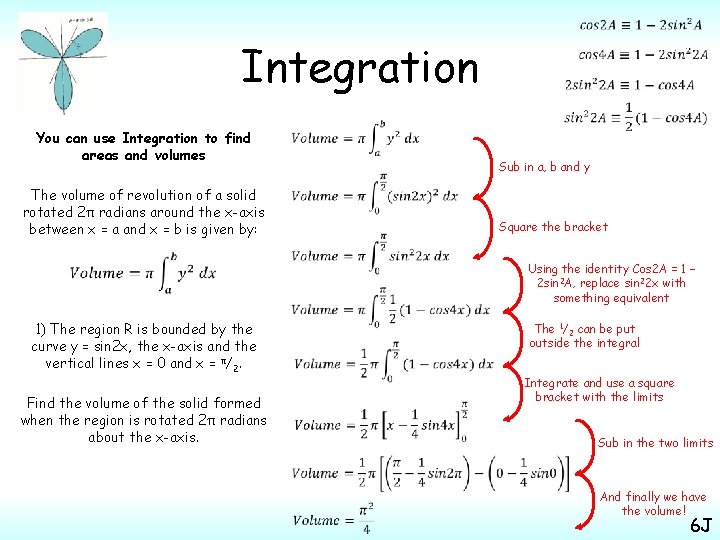
Integration You can use Integration to find areas and volumes The volume of revolution of a solid rotated 2π radians around the x-axis between x = a and x = b is given by: 1) The region R is bounded by the curve y = sin 2 x, the x-axis and the vertical lines x = 0 and x = π/2. Find the volume of the solid formed when the region is rotated 2π radians about the x-axis. Sub in a, b and y Square the bracket Using the identity Cos 2 A = 1 – 2 sin 2 A, replace sin 22 x with something equivalent The 1/2 can be put outside the integral Integrate and use a square bracket with the limits Sub in the two limits And finally we have the volume! 6 J
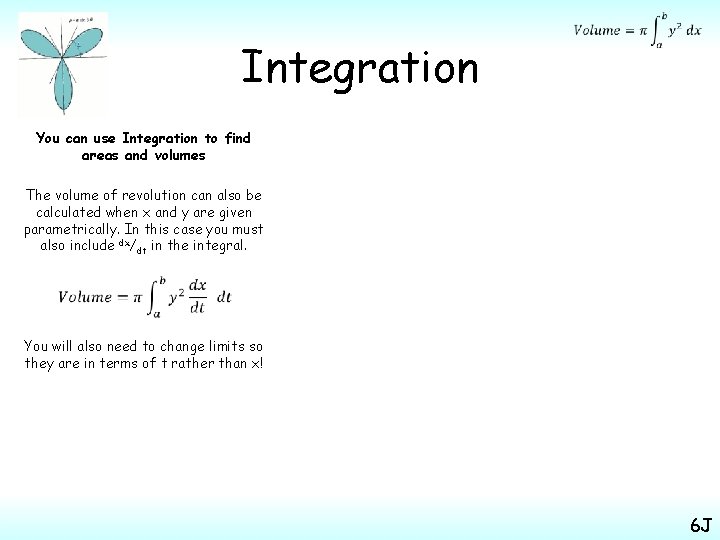
Integration You can use Integration to find areas and volumes The volume of revolution can also be calculated when x and y are given parametrically. In this case you must also include dx/dt in the integral. You will also need to change limits so they are in terms of t rather than x! 6 J
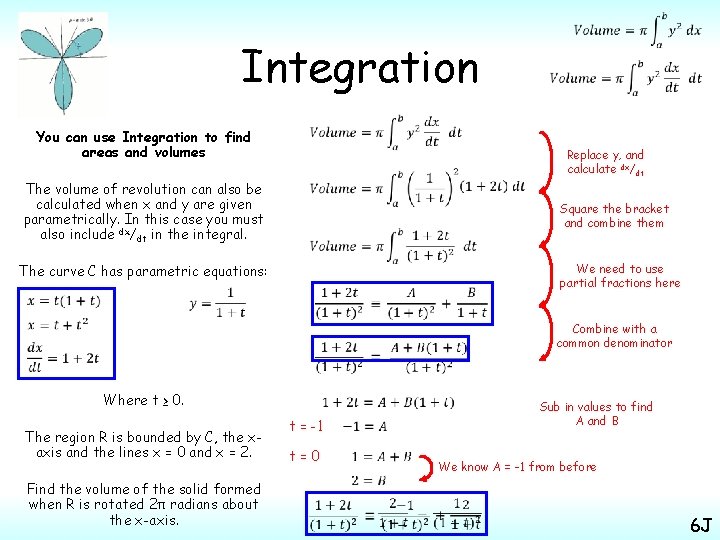
Integration You can use Integration to find areas and volumes The volume of revolution can also be calculated when x and y are given parametrically. In this case you must also include dx/dt in the integral. Where t ≥ 0. The region R is bounded by C, the xaxis and the lines x = 0 and x = 2. Find the volume of the solid formed when R is rotated 2π radians about the x-axis. t = -1 t=0 We need to use partial fractions here Combine with a common denominator Replace y, and calculate dx/dt Square the bracket and combine them The curve C has parametric equations: Sub in values to find A and B We know A = -1 from before 6 J
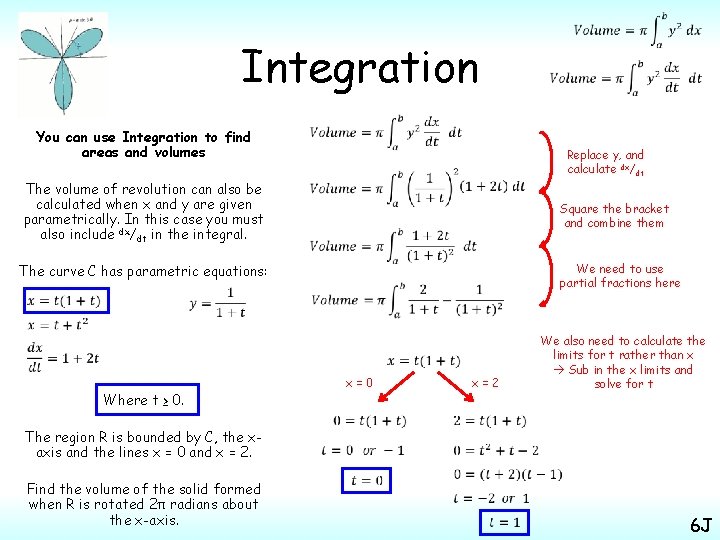
Integration You can use Integration to find areas and volumes The volume of revolution can also be calculated when x and y are given parametrically. In this case you must also include dx/dt in the integral. The curve C has parametric equations: Replace y, and calculate dx/dt Square the bracket and combine them We need to use partial fractions here x=0 Where t ≥ 0. The region R is bounded by C, the xaxis and the lines x = 0 and x = 2. Find the volume of the solid formed when R is rotated 2π radians about the x-axis. x=2 We also need to calculate the limits for t rather than x Sub in the x limits and solve for t 6 J
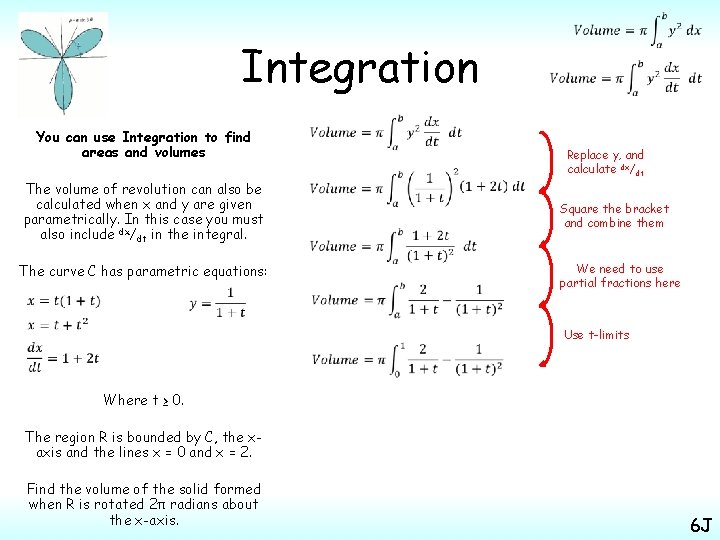
Integration You can use Integration to find areas and volumes The volume of revolution can also be calculated when x and y are given parametrically. In this case you must also include dx/dt in the integral. The curve C has parametric equations: Replace y, and calculate dx/dt Square the bracket and combine them We need to use partial fractions here Use t-limits Where t ≥ 0. The region R is bounded by C, the xaxis and the lines x = 0 and x = 2. Find the volume of the solid formed when R is rotated 2π radians about the x-axis. 6 J
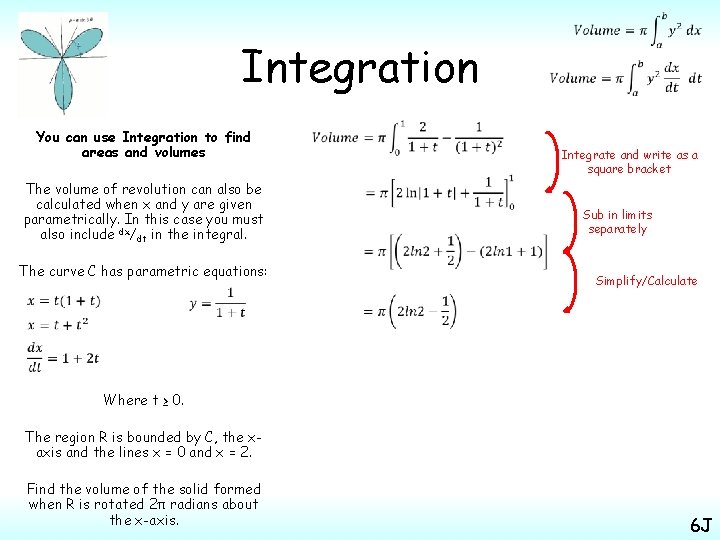
Integration You can use Integration to find areas and volumes The volume of revolution can also be calculated when x and y are given parametrically. In this case you must also include dx/dt in the integral. The curve C has parametric equations: Integrate and write as a square bracket Sub in limits separately Simplify/Calculate Where t ≥ 0. The region R is bounded by C, the xaxis and the lines x = 0 and x = 2. Find the volume of the solid formed when R is rotated 2π radians about the x-axis. 6 J

Teachings for Exercise 6 J
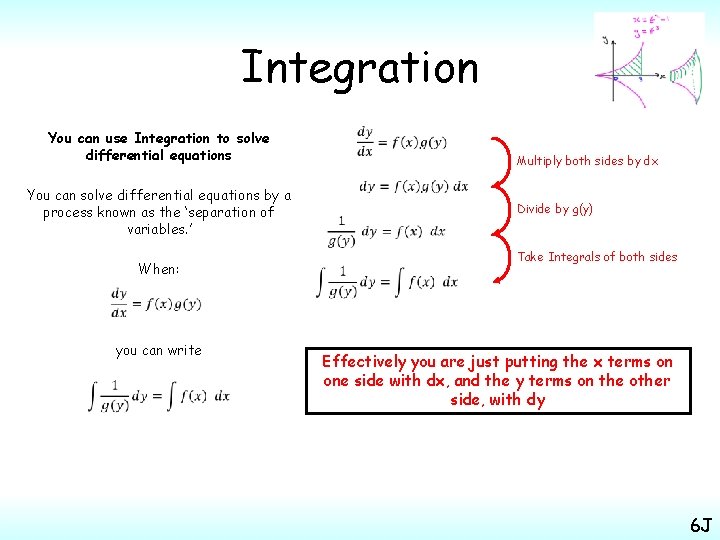
Integration You can use Integration to solve differential equations Multiply both sides by dx You can solve differential equations by a process known as the ‘separation of variables. ’ When: Divide by g(y) Take Integrals of both sides you can write Effectively you are just putting the x terms on one side with dx, and the y terms on the other side, with dy 6 J
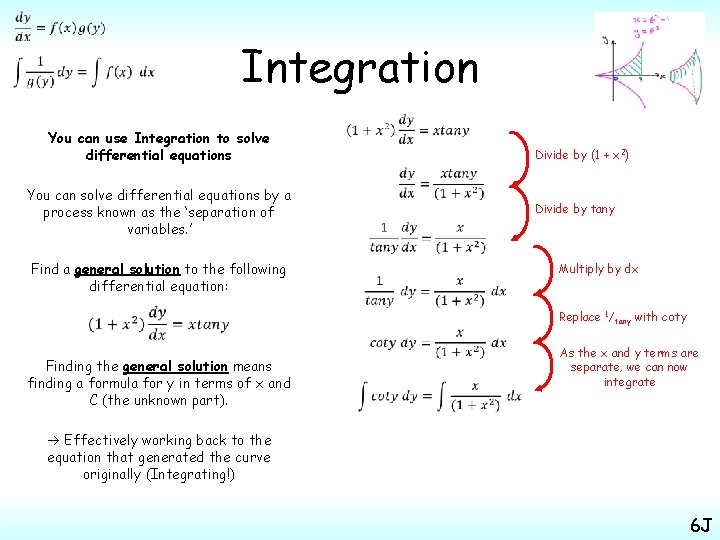
Integration You can use Integration to solve differential equations Divide by (1 + x 2) You can solve differential equations by a process known as the ‘separation of variables. ’ Divide by tany Find a general solution to the following differential equation: Multiply by dx Replace 1/tany with coty Finding the general solution means finding a formula for y in terms of x and C (the unknown part). As the x and y terms are separate, we can now integrate Effectively working back to the equation that generated the curve originally (Integrating!) 6 J
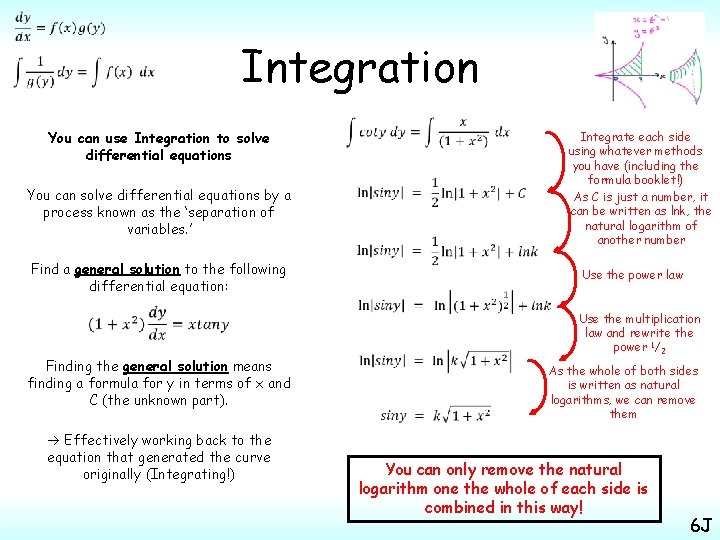
Integration You can use Integration to solve differential equations You can solve differential equations by a process known as the ‘separation of variables. ’ Find a general solution to the following differential equation: Finding the general solution means finding a formula for y in terms of x and C (the unknown part). Effectively working back to the equation that generated the curve originally (Integrating!) Integrate each side using whatever methods you have (including the formula booklet!) As C is just a number, it can be written as lnk, the natural logarithm of another number Use the power law Use the multiplication law and rewrite the power 1/2 As the whole of both sides is written as natural logarithms, we can remove them You can only remove the natural logarithm one the whole of each side is combined in this way! 6 J
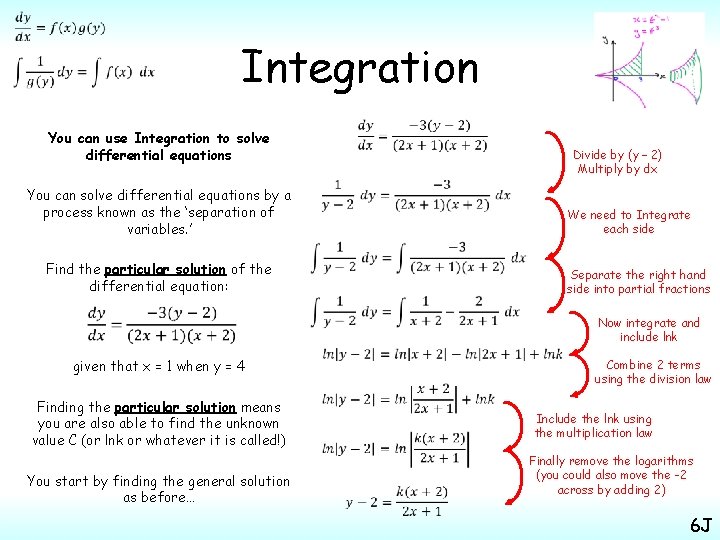
Integration You can use Integration to solve differential equations You can solve differential equations by a process known as the ‘separation of variables. ’ Find the particular solution of the differential equation: given that x = 1 when y = 4 Finding the particular solution means you are also able to find the unknown value C (or lnk or whatever it is called!) You start by finding the general solution as before… Divide by (y – 2) Multiply by dx We need to Integrate each side Separate the right hand side into partial fractions Now integrate and include lnk Combine 2 terms using the division law Include the lnk using the multiplication law Finally remove the logarithms (you could also move the -2 across by adding 2) 6 J
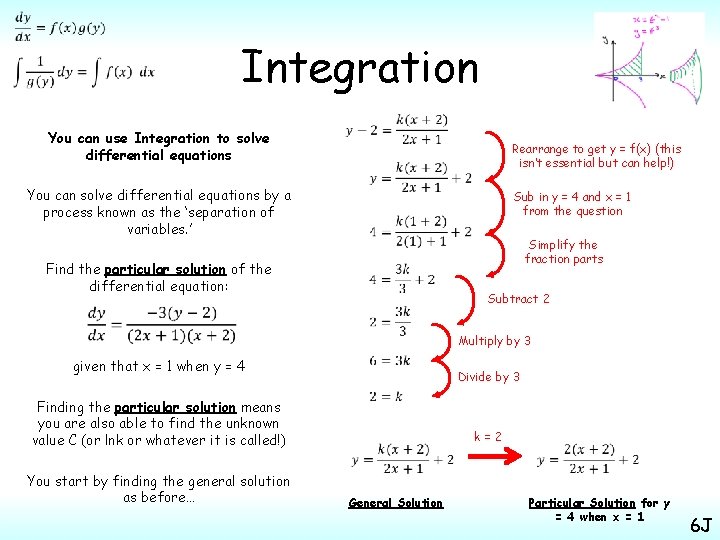
Integration You can use Integration to solve differential equations Rearrange to get y = f(x) (this isn’t essential but can help!) You can solve differential equations by a process known as the ‘separation of variables. ’ Sub in y = 4 and x = 1 from the question Find the particular solution of the differential equation: Simplify the fraction parts Subtract 2 Multiply by 3 given that x = 1 when y = 4 Finding the particular solution means you are also able to find the unknown value C (or lnk or whatever it is called!) You start by finding the general solution as before… Divide by 3 General Solution k=2 Particular Solution for y = 4 when x = 1 6 J

Teachings for Exercise 6 K
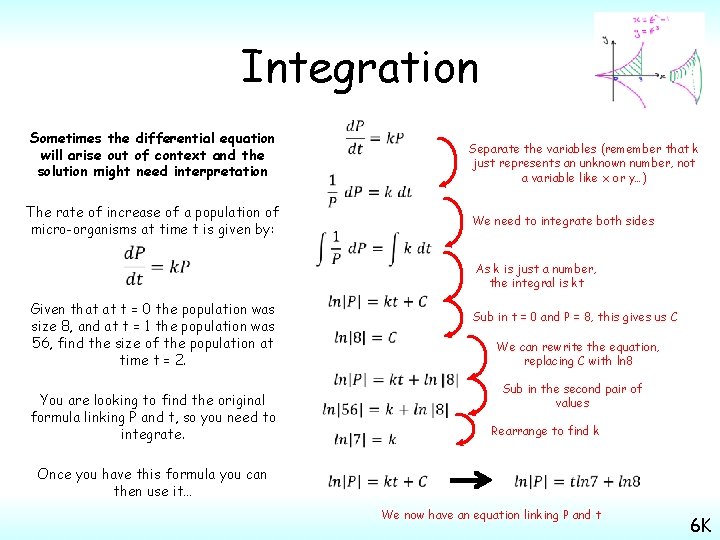
Integration Sometimes the differential equation will arise out of context and the solution might need interpretation The rate of increase of a population of micro-organisms at time t is given by: We need to integrate both sides As k is just a number, the integral is kt Given that at t = 0 the population was size 8, and at t = 1 the population was 56, find the size of the population at time t = 2. You are looking to find the original formula linking P and t, so you need to integrate. Once you have this formula you can then use it… Separate the variables (remember that k just represents an unknown number, not a variable like x or y…) Sub in t = 0 and P = 8, this gives us C We can rewrite the equation, replacing C with ln 8 Sub in the second pair of values Rearrange to find k We now have an equation linking P and t 6 K
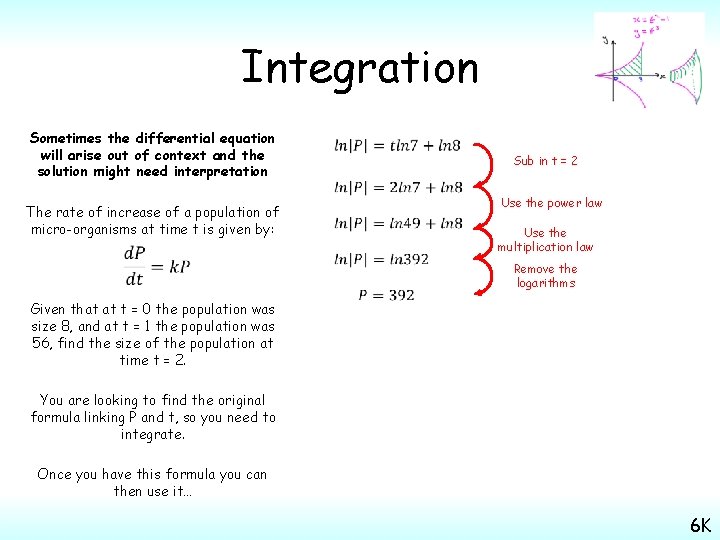
Integration Sometimes the differential equation will arise out of context and the solution might need interpretation The rate of increase of a population of micro-organisms at time t is given by: Given that at t = 0 the population was size 8, and at t = 1 the population was 56, find the size of the population at time t = 2. Sub in t = 2 Use the power law Use the multiplication law Remove the logarithms You are looking to find the original formula linking P and t, so you need to integrate. Once you have this formula you can then use it… 6 K
Summary • We have covered how to Integrate many more functions • We have seen how Integration can be used to calculate volumes • We have also seen how it links in with differential equations
- Slides: 70