
Integrating the Healthcare Enterprise AI Workflow for Imaging


- Slides: 17
Integrating the Healthcare Enterprise AI Workflow for Imaging (AIW-I) IHE Radiology Technical Committee DICOM WG 23 IHE Radiology Technical Committee
AIW-I Profile is intended to address non-interactive use of AI models for Post. Image Acquisition Analysis focusing on the classification models (if presence of a condition) This profile includes Post Acquisition clinical content input required by the AI model and results distribution of the output content The profile specifies transactions for workflow management that are based on the worklist service defined by DICOM® UPS. The profile also specifies content and access models for input to the AI Model performer and storing the outputs from the AI Model performer using DICOMweb ® RESTful Services.
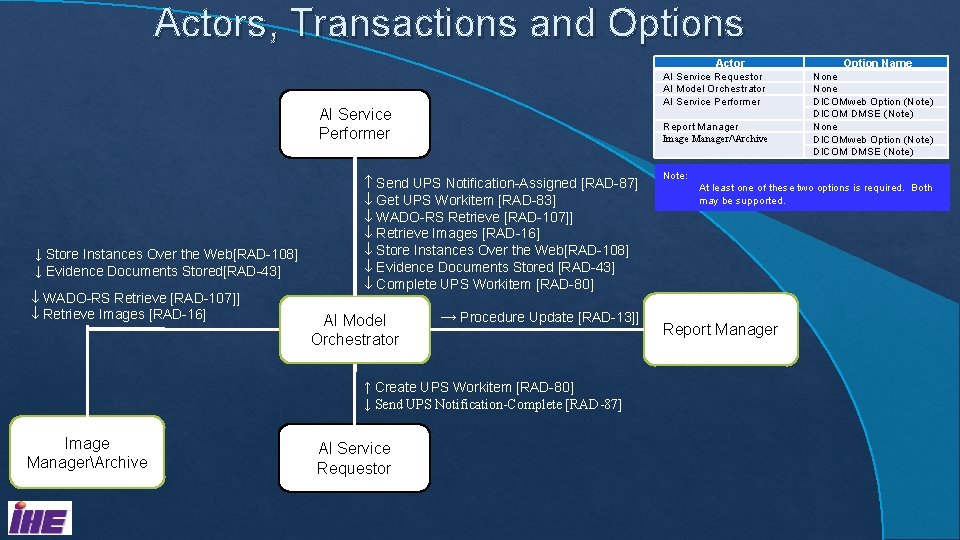
Actors, Transactions and Options Actor AI Service Requestor AI Model Orchestrator AI Service Performer ↓ Store Instances Over the Web[RAD-108] ↓ Evidence Documents Stored[RAD-43] WADO-RS Retrieve [RAD-107]] Retrieve Images [RAD-16] Report Manager Image Manager/Archive Send UPS Notification-Assigned [RAD-87] Get UPS Workitem [RAD-83] WADO-RS Retrieve [RAD-107]] Retrieve Images [RAD-16] Store Instances Over the Web[RAD-108] Evidence Documents Stored [RAD-43] Complete UPS Workitem [RAD-80] AI Model Orchestrator → Procedure Update [RAD-13]] ↑ Create UPS Workitem [RAD-80] ↓ Send UPS Notification-Complete [RAD-87] Image ManagerArchive AI Service Requestor Option Name None DICOMweb Option (Note) DICOM DMSE (Note) Note: At least one of these two options is required. Both may be supported. Report Manager
AI Image Service Requestor initiates the AI Workflow for Imaging. It is responsible for preparing the AI Service Request and sending the request to an orchestrator. There may be multiple AI Model Service Requestors communicating to a single (or multiple) AI Model Orchestrator (M: N relationship) The AI Model Service Requestor provides the endpoint location for where the input images are hosted while the service request is processed. The AI Model Service Requestor provides the endpoint location where the results are posted. The AI Service Requestor can specify any input and output endpoint, providing it can support either DMSE or DICOMweb. This includes self hosting. An example is a workstation or modality hosting the images and capable of receiving the results.
AI Model Service Orchestrator The AI Model Orchestrator manages AI Model Service Performers and distributes AI results. The Orchestrator is responsible for the creation, updating and completion of the UPS workitems. The Orchestrator utilizes DICOM UPS workflow management for all AI Model Service Performers, including hosted applications that do not support DICOM UPS. In such cases, the Orchestrator manages workitems on the application’s behalf and invokes the application via an appropriate alternative method. The AI Model Orchestrator may create a new UPS workitem without a service request. A single AI service Request may initiate multiple UPS workitems. The requestor may not know if multiple workitems were initiated. Only when the requested workitem is complete. The AI Model Orchestrator is responsible for the results distribution. The AI Model Orchestrator may modify the AI Service Request Input and Output endpoints when assigning to an AI Model Performer. This is an expected action when AI results need to be aggregated by the Orchestrator for Results Distribution.
AI Model Service Performer The AI Model Service Performer is a Software Application that provides image analysis using AI techniques. The AI Model Service Performer is managed by the AI Model Orchestrator. An AI Model is identified by: Name ID Version Instance Unique Identifier Instance date When there is an update to the model’s learning data set or software, a new Instance UUID is created. When the AI model is updated, a new version identifier is created. The AI Model Instance Unique Identifier shall be provided with each data element reported by the AI Model.
Report Manager The Report Manager is a system that manages reading worklists. The AI Model may create critical findings which could impact reading scheduling tasks or patient care. When this information is created, it is routed to the Report Manager for action. The Update Procedure [RAD-13] transaction will convey the priority with the data associated with the critical findings. The expected action is to impact the reading worklist priority. The End Point for the HL 7 v 2 message is identified in the AI Service request when Critical Results are expected as part of the AI Results. It is expected that the Report Manager will use this information to prioritize the Reading worklist. It is up to the report manager to determine the action to take.
Image Manager/Archive The Image Manager/Archive is a system that provides access to DICOM SOP Instances for retrieval. Images should be retrievable using at least one of two End point methods: DICOM DIMSE or DICOMweb. The End Points are used in the AI Service Request to identify where the AI Model Orchestrator retrieves the images for the AI Model. This system must be capable to receive DICOM SOP Instances. Images should be received by using at least one of two End point methods: DICOM DIMSE or DICOMweb The End Points are used in the AI Service Request to identify where the AI Model Orchestrator sends the DICOM SOP AI Model.
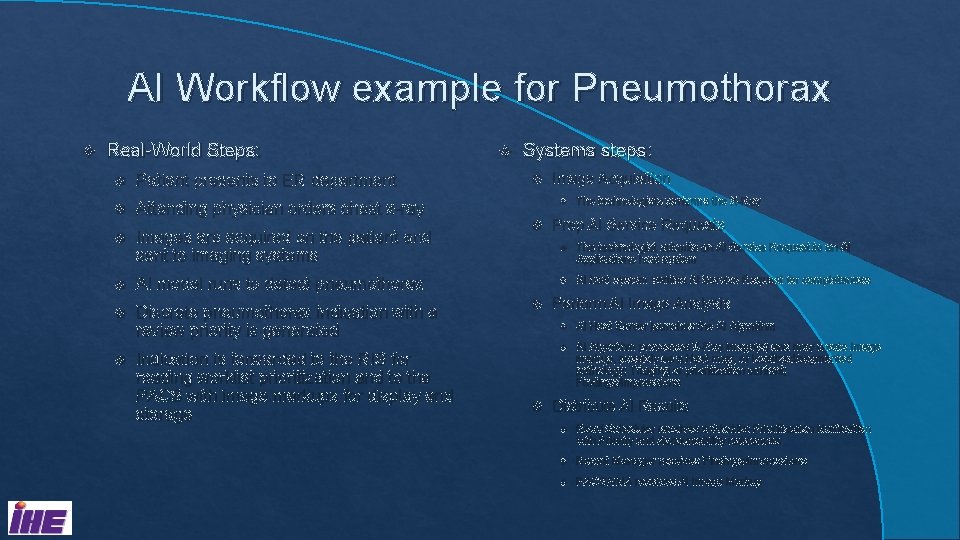
AI Workflow example for Pneumothorax Real-World Steps: Patient presents to ER department Attending physician orders chest x-ray Images are acquired on the patient and sent to imaging systems AI model runs to detect pneumothorax Discrete pneumothorax indication with a review priority is generated Indication is forwarded to the RIS for reading worklist prioritization and to the PACS with image markups for display and storage Systems steps: Image Acquisition The technologists performs the X-Ray Prep AI Service Requests The technologist submits an AI Service Request. to an AI Applications host system AI host system verifies AI Service Request for completeness Perform AI Image Analysis AI Host Server launches the AI Algorithm processes X-Ray image(s) and may create Image markup, possibly as a Heat map, or localized/segmented pathology; Triaging or prioritization content; Findings/Impressions Distribute AI Results Read Scheduler receives a Worklist Prioritization Notification with Priority and Accountability references Report Manager receives Findings/Impressions PACS/VNA receives AI Image Markup
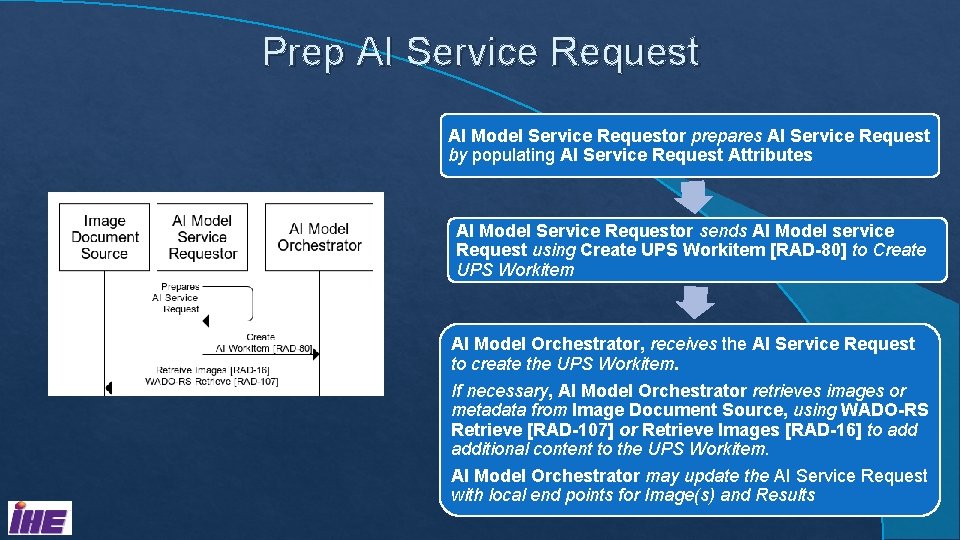
Prep AI Service Request AI Model Service Requestor prepares AI Service Request by populating AI Service Request Attributes AI Model Service Requestor sends AI Model service Request using Create UPS Workitem [RAD-80] to Create UPS Workitem AI Model Orchestrator, receives the AI Service Request to create the UPS Workitem. If necessary, AI Model Orchestrator retrieves images or metadata from Image Document Source, using WADO-RS Retrieve [RAD-107] or Retrieve Images [RAD-16] to additional content to the UPS Workitem. AI Model Orchestrator may update the AI Service Request with local end points for Image(s) and Results
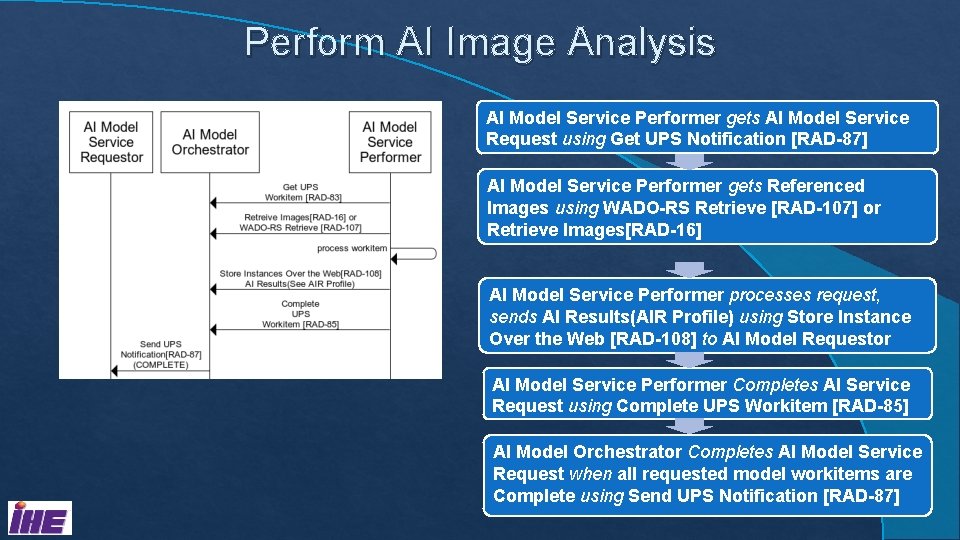
Perform AI Image Analysis AI Model Service Performer gets AI Model Service Request using Get UPS Notification [RAD-87] AI Model Service Performer gets Referenced Images using WADO-RS Retrieve [RAD-107] or Retrieve Images[RAD-16] AI Model Service Performer processes request, sends AI Results(AIR Profile) using Store Instance Over the Web [RAD-108] to AI Model Requestor AI Model Service Performer Completes AI Service Request using Complete UPS Workitem [RAD-85] AI Model Orchestrator Completes AI Model Service Request when all requested model workitems are Complete using Send UPS Notification [RAD-87]
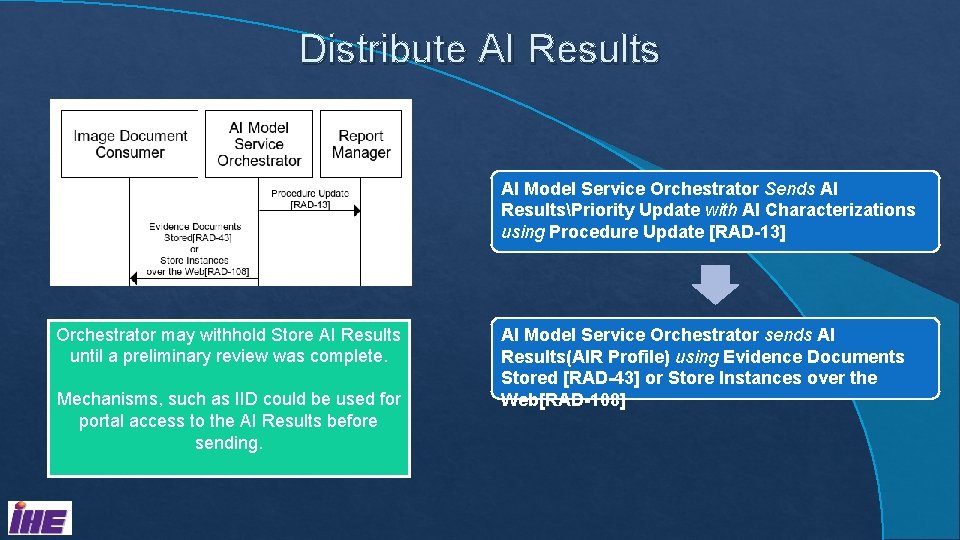
Distribute AI Results AI Model Service Orchestrator Sends AI ResultsPriority Update with AI Characterizations using Procedure Update [RAD-13] Orchestrator may withhold Store AI Results until a preliminary review was complete. Mechanisms, such as IID could be used for portal access to the AI Results before sending. AI Model Service Orchestrator sends AI Results(AIR Profile) using Evidence Documents Stored [RAD-43] or Store Instances over the Web[RAD-108]
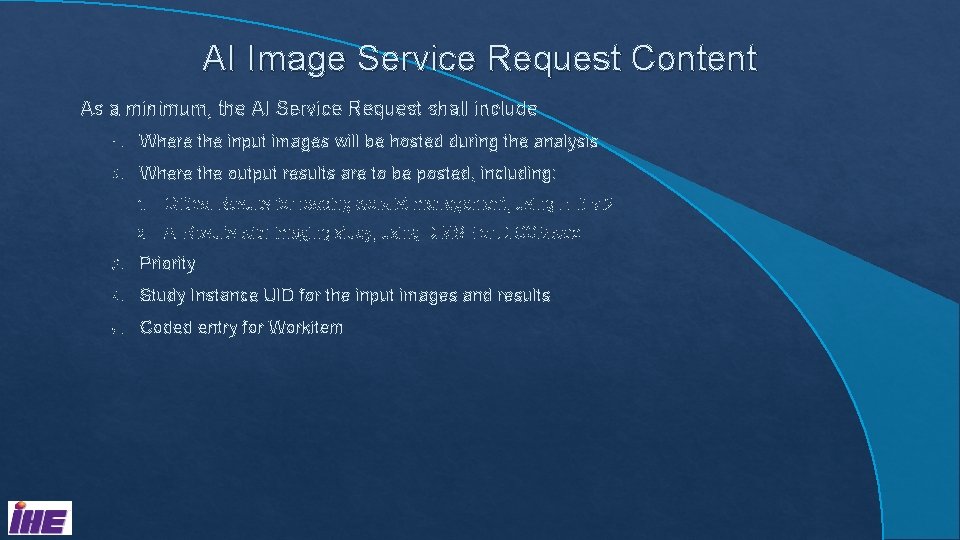
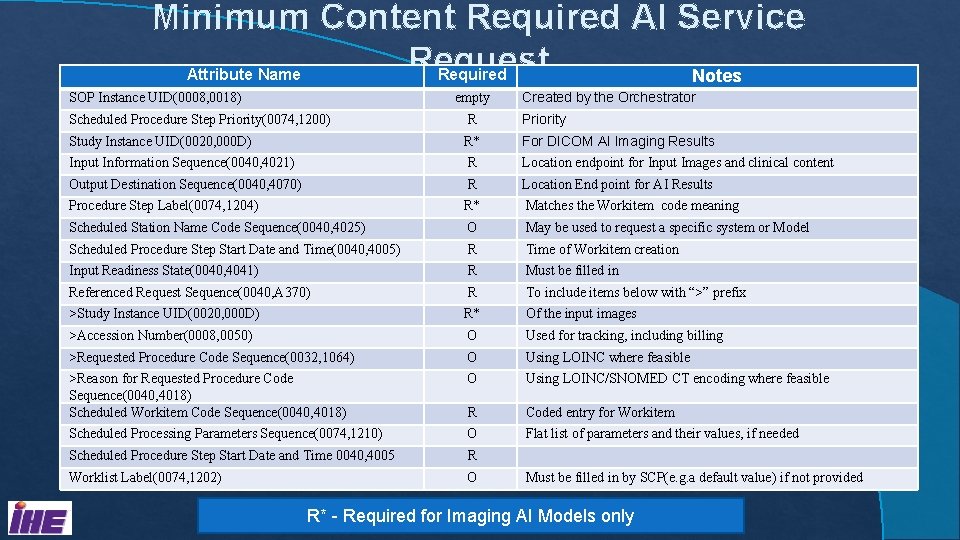
AI Image Service Request Content As a minimum, the AI Service Request shall include 1. Where the input images will be hosted during the analysis 2. Where the output results are to be posted, including: 1. Critical Results for reading worklist management, using HL 7 v. 2 2. AI Results with imaging study, using DIMSE or DICOMweb 3. Priority 4. Study Instance UID for the input images and results 5. Coded entry for Workitem
Minimum Content Required AI Service Request Attribute Name Required Notes SOP Instance UID(0008, 0018) empty Created by the Orchestrator Scheduled Procedure Step Priority(0074, 1200) R Priority Study Instance UID(0020, 000 D) R* For DICOM AI Imaging Results Input Information Sequence(0040, 4021) R Location endpoint for Input Images and clinical content Output Destination Sequence(0040, 4070) R Location End point for AI Results Procedure Step Label(0074, 1204) R* Matches the Workitem code meaning Scheduled Station Name Code Sequence(0040, 4025) O May be used to request a specific system or Model Scheduled Procedure Step Start Date and Time(0040, 4005) R Time of Workitem creation Input Readiness State(0040, 4041) R Must be filled in Referenced Request Sequence(0040, A 370) R To include items below with “>” prefix >Study Instance UID(0020, 000 D) R* Of the input images >Accession Number(0008, 0050) O Used for tracking, including billing >Requested Procedure Code Sequence(0032, 1064) O Using LOINC where feasible >Reason for Requested Procedure Code Sequence(0040, 4018) Scheduled Workitem Code Sequence(0040, 4018) O Using LOINC/SNOMED CT encoding where feasible R Coded entry for Workitem Scheduled Processing Parameters Sequence(0074, 1210) O Flat list of parameters and their values, if needed Scheduled Procedure Step Start Date and Time 0040, 4005 R Worklist Label(0074, 1202) O Must be filled in by SCP(e. g. a default value) if not provided R* - Required for Imaging AI Models only
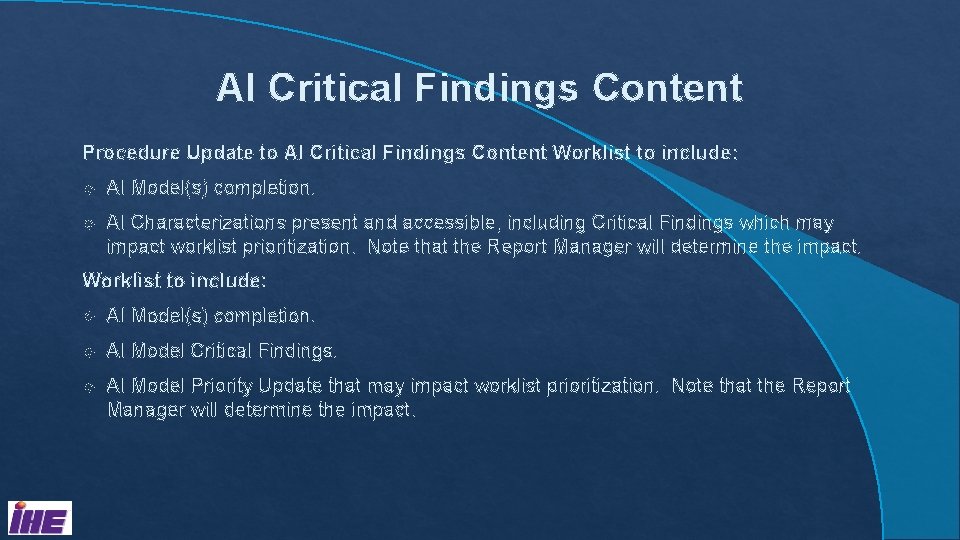
AI Critical Findings Content Procedure Update to AI Critical Findings Content Worklist to include: AI Model(s) completion. AI Characterizations present and accessible, including Critical Findings which may impact worklist prioritization. Note that the Report Manager will determine the impact. Worklist to include: AI Model(s) completion. AI Model Critical Findings. AI Model Priority Update that may impact worklist prioritization. Note that the Report Manager will determine the impact.
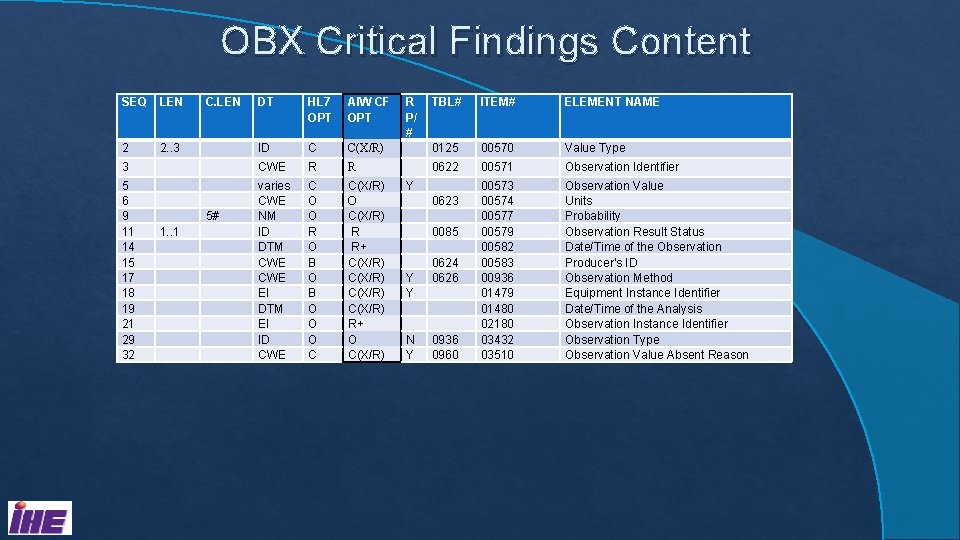
OBX Critical Findings Content SEQ LEN 2 2. . 3 C. LEN DT HL 7 OPT AIW CF OPT ID C 3 CWE 5 6 9 11 14 15 17 18 19 21 29 32 varies CWE NM ID DTM CWE EI DTM EI ID CWE 5# 1. . 1 R P/ # TBL# ITEM# ELEMENT NAME C(X/R) 0125 00570 Value Type R R 0622 00571 Observation Identifier C O O R O B O O O C C(X/R) O C(X/R) R R+ C(X/R) R+ O C(X/R) 00573 00574 00577 00579 00582 00583 00936 01479 01480 02180 03432 03510 Observation Value Units Probability Observation Result Status Date/Time of the Observation Producer's ID Observation Method Equipment Instance Identifier Date/Time of the Analysis Observation Instance Identifier Observation Type Observation Value Absent Reason Y 0623 0085 Y Y N Y 0624 0626 0936 0960
Providers and Vendors Working Together to Deliver Interoperable Health Information Systems In the Enterprise and Across Care Settings WWW. IHE. NET March 17, 17 IHE and medical Standards