
Integrating the CERN LASER Alarm System with the

![Example - LASER Remote Interface: interface Alarm. System. . . { Alarm[] get. Active.](https://slidetodoc.com/presentation_image_h2/4e2a9ee4ee692ef4f7ab783de92d3b1e/image-18.jpg "Example - LASER Remote Interface: interface Alarm. System. . . { Alarm[] get. Active.")
- Slides: 23
Integrating the CERN LASER Alarm System with the ALMA Common Software A. Caproniac, K. Sigerudb, K. Zagard a. ESO, European Organization for Astronomical Research in the Southern Hemisphere c. CERN, European Organization for Nuclear Research b. INAF-OATs, Osservatorio Astronomico di Trieste d. COSYLAB, Control System Laboratory
Atacama Large Millimeter Array ALMA is a collaboration between Europe, Japan and North America to build a radio telescope in the Chajanantor desert in Chile. • up to 64 movable antennas each of which mounts a 12 m wide dish • the configuration varies from 18 km to 150 m • the receivers covers the range from 30 to 950 Ghz • Atacama Compact Array: twelve 7 m telescopes in compact configuration plus four 12 m telescopes
ALMA Common Software (ACS) ACS is a software infrastructure for the development of distributed systems widely used in ALMA from high level application development to the Control Software • based on CORBA • implements its own Component/Container paradigm • widely distributed project: ESO, NRAO, Observatory of Trieste, university of Calgary • IDL, XML, C++, python, java • adopt free software to minimize the programming effort • freely redistributable under LGPL license
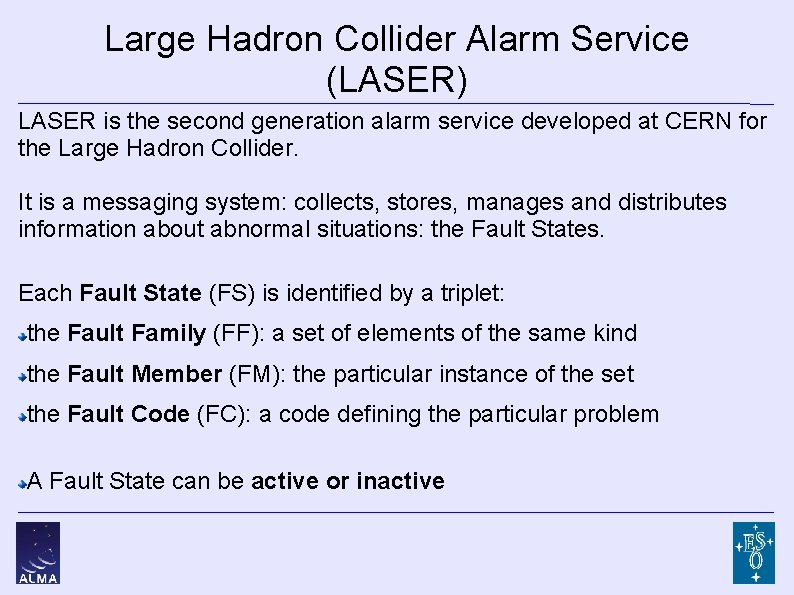
Large Hadron Collider Alarm Service (LASER) LASER is the second generation alarm service developed at CERN for the Large Hadron Collider. It is a messaging system: collects, stores, manages and distributes information about abnormal situations: the Fault States. Each Fault State (FS) is identified by a triplet: the Fault Family (FF): a set of elements of the same kind the Fault Member (FM): the particular instance of the set the Fault Code (FC): a code defining the particular problem A Fault State can be active or inactive
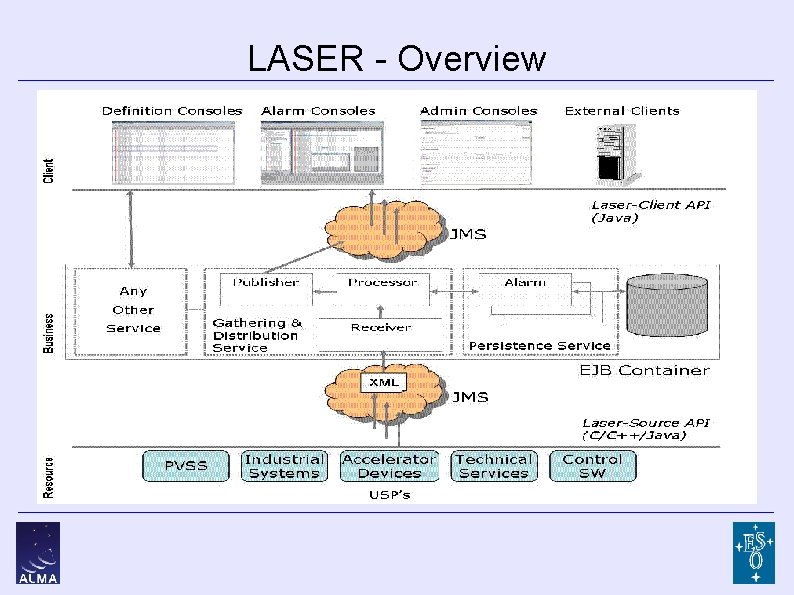
LASER - Overview
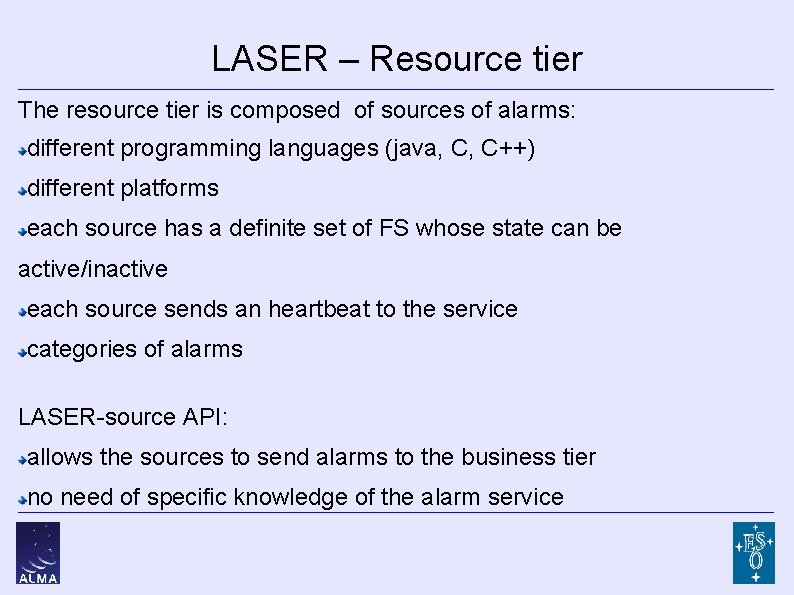
LASER – Resource tier The resource tier is composed of sources of alarms: different programming languages (java, C, C++) different platforms each source has a definite set of FS whose state can be active/inactive each source sends an heartbeat to the service categories of alarms LASER-source API: allows the sources to send alarms to the business tier no need of specific knowledge of the alarm service
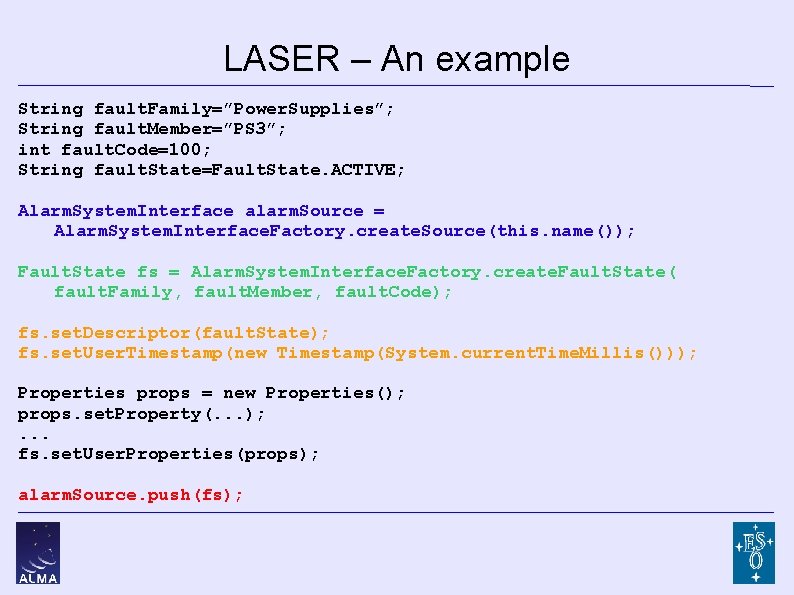
LASER – An example String fault. Family=”Power. Supplies”; String fault. Member=”PS 3”; int fault. Code=100; String fault. State=Fault. State. ACTIVE; Alarm. System. Interface alarm. Source = Alarm. System. Interface. Factory. create. Source(this. name()); Fault. State fs = Alarm. System. Interface. Factory. create. Fault. State( fault. Family, fault. Member, fault. Code); fs. set. Descriptor(fault. State); fs. set. User. Timestamp(new Timestamp(System. current. Time. Millis())); Properties props = new Properties(); props. set. Property(. . . ); . . . fs. set. User. Properties(props); alarm. Source. push(fs);
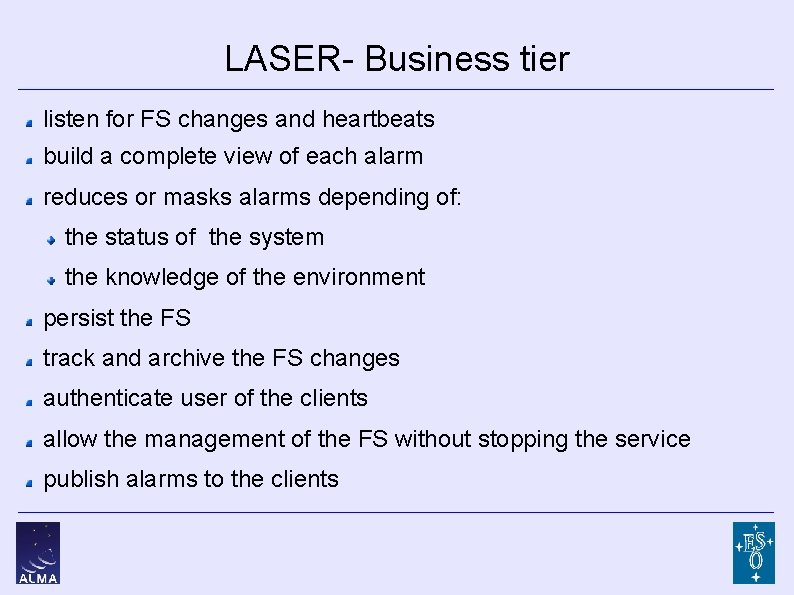
LASER- Business tier listen for FS changes and heartbeats build a complete view of each alarm reduces or masks alarms depending of: the status of the system the knowledge of the environment persist the FS track and archive the FS changes authenticate user of the clients allow the management of the FS without stopping the service publish alarms to the clients
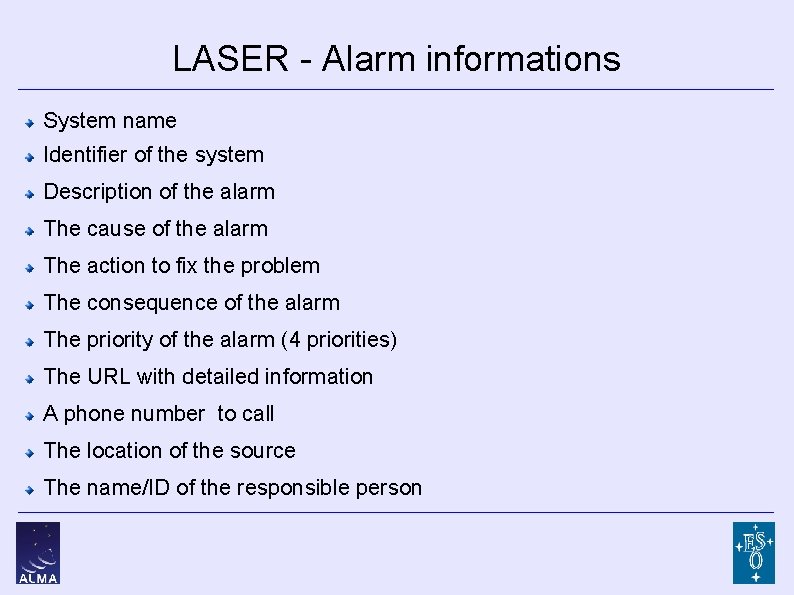
LASER - Alarm informations System name Identifier of the system Description of the alarm The cause of the alarm The action to fix the problem The consequence of the alarm The priority of the alarm (4 priorities) The URL with detailed information A phone number to call The location of the source The name/ID of the responsible person
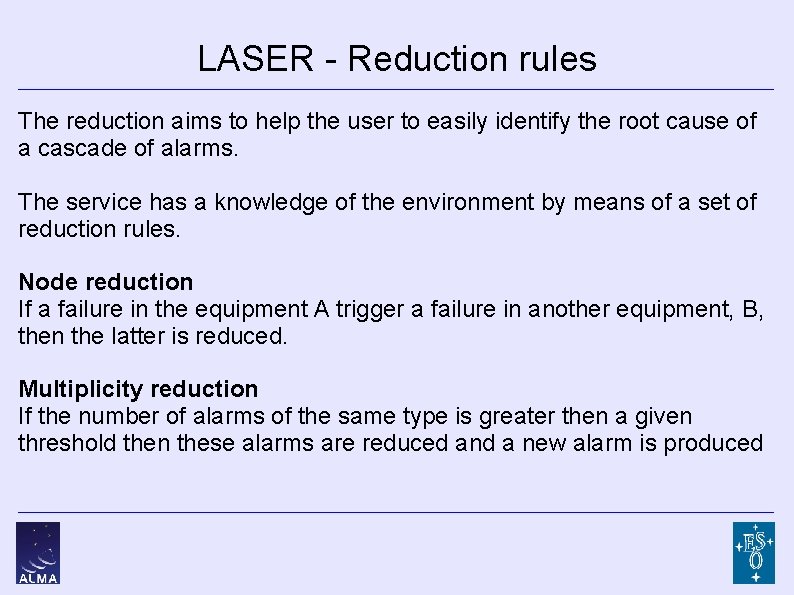
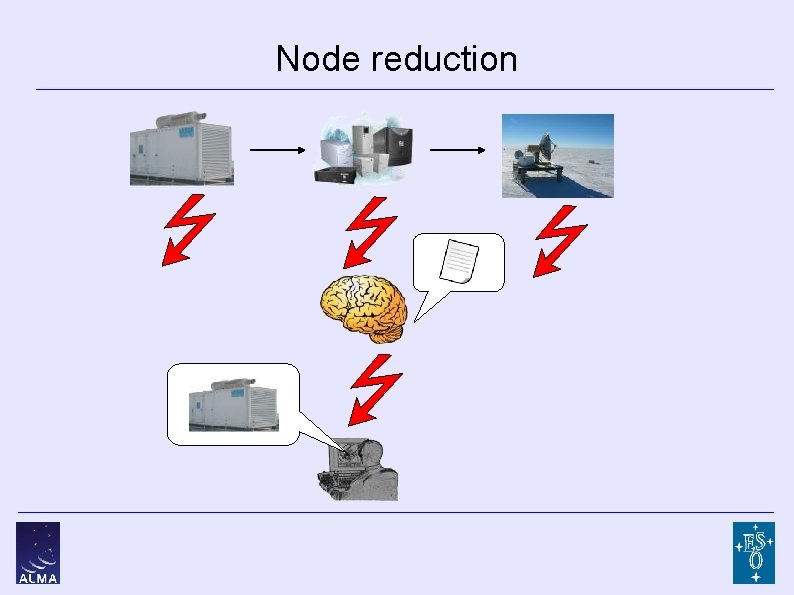
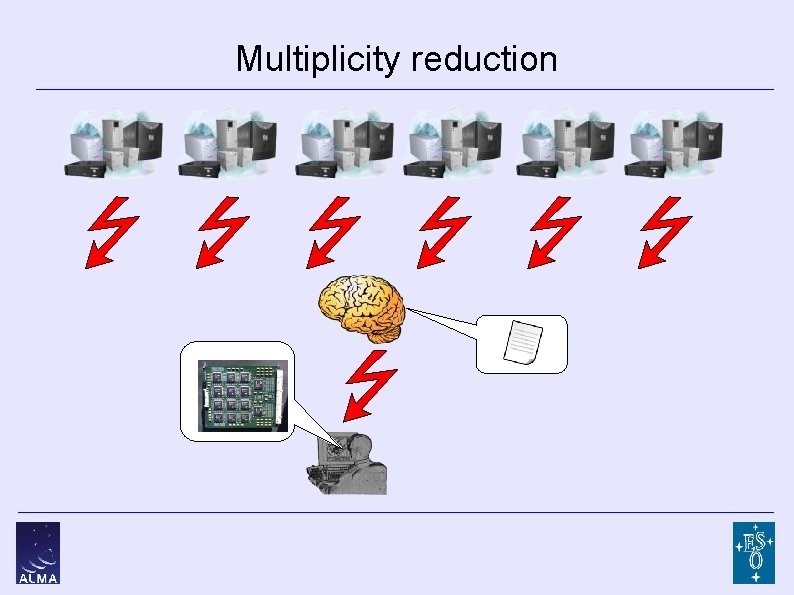
LASER - Reduction rules The reduction aims to help the user to easily identify the root cause of a cascade of alarms. The service has a knowledge of the environment by means of a set of reduction rules. Node reduction If a failure in the equipment A trigger a failure in another equipment, B, then the latter is reduced. Multiplicity reduction If the number of alarms of the same type is greater then a given threshold then these alarms are reduced and a new alarm is produced
Node reduction
Multiplicity reduction
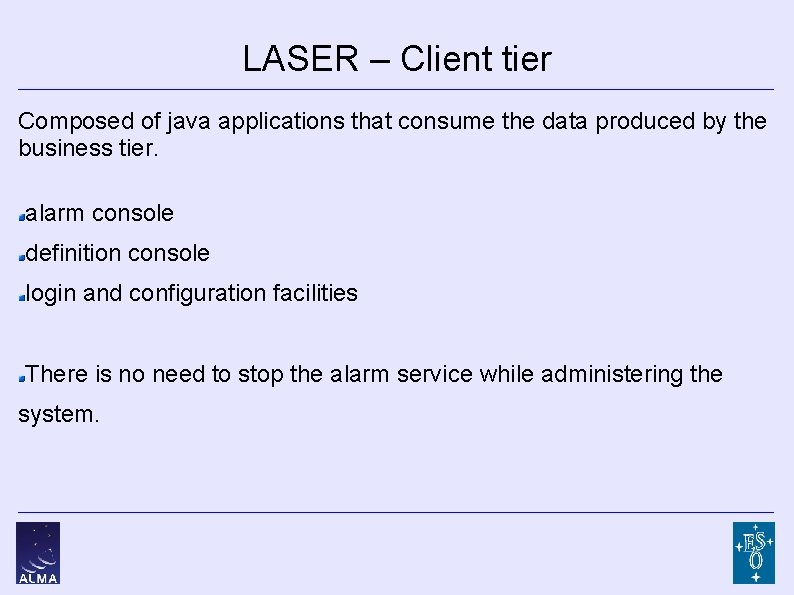
LASER – Client tier Composed of java applications that consume the data produced by the business tier. alarm console definition console login and configuration facilities There is no need to stop the alarm service while administering the system.
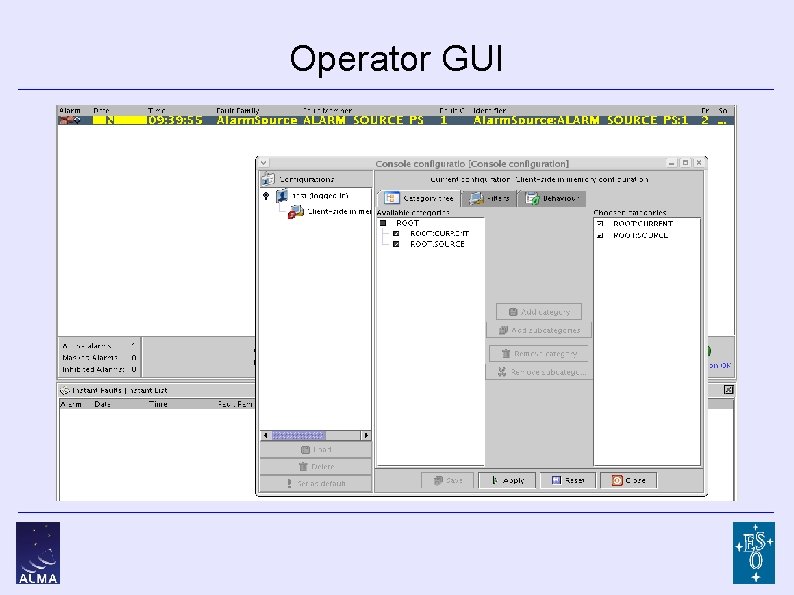
Operator GUI
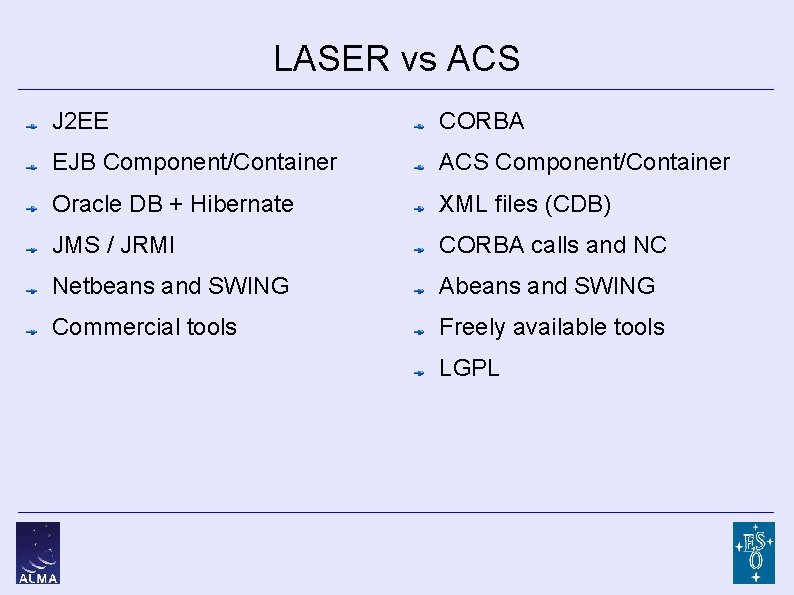
LASER vs ACS J 2 EE CORBA EJB Component/Container ACS Component/Container Oracle DB + Hibernate XML files (CDB) JMS / JRMI CORBA calls and NC Netbeans and SWING Abeans and SWING Commercial tools Freely available tools LGPL
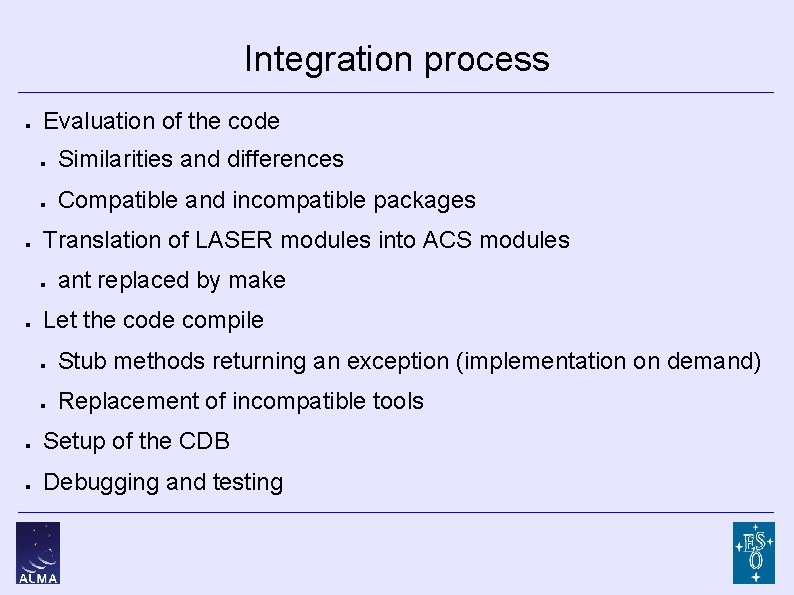
Integration process Evaluation of the code Similarities and differences Compatible and incompatible packages Translation of LASER modules into ACS modules ant replaced by make Let the code compile Stub methods returning an exception (implementation on demand) Replacement of incompatible tools Setup of the CDB Debugging and testing
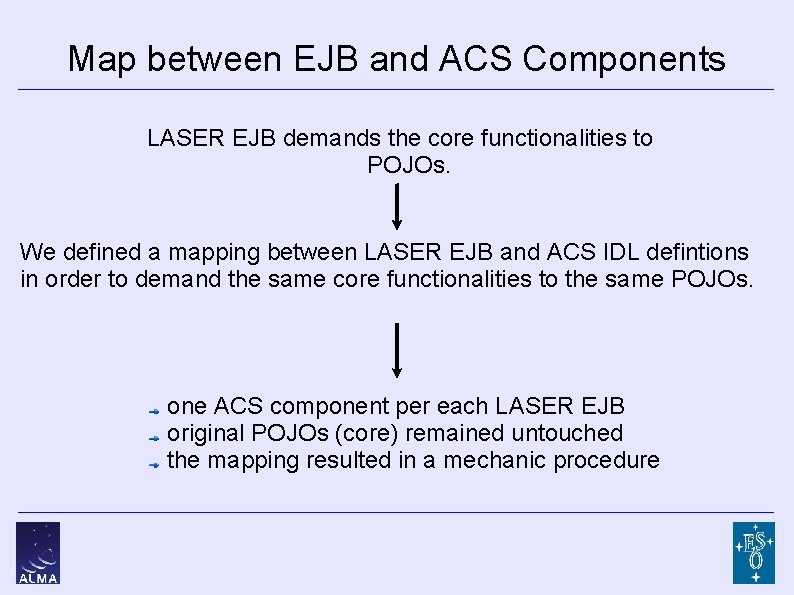
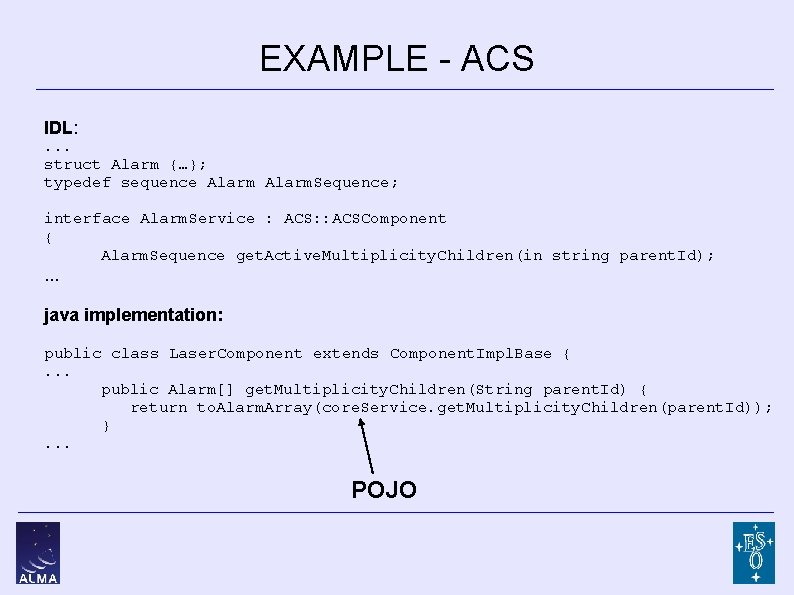
Map between EJB and ACS Components LASER EJB demands the core functionalities to POJOs. We defined a mapping between LASER EJB and ACS IDL defintions in order to demand the same core functionalities to the same POJOs. one ACS component per each LASER EJB original POJOs (core) remained untouched the mapping resulted in a mechanic procedure
Example - LASER Remote Interface: interface Alarm. System. . . { Alarm[] get. Active. Multiplicity. Children(String parent. Id). . . } Home Interface (EJB life cycle methods) Business logic: { } public Alarm[] get. Active. Multiplicity. Children(String parent. Id) { return (Alarm[])core. Service. get. Active. Multiplicity. Children(parent. Id); }. . . POJO
EXAMPLE - ACS IDL: . . . struct Alarm {…}; typedef sequence Alarm. Sequence; interface Alarm. Service : ACS: : ACSComponent { Alarm. Sequence get. Active. Multiplicity. Children(in string parent. Id); . . . java implementation: public class Laser. Component extends Component. Impl. Base {. . . public Alarm[] get. Multiplicity. Children(String parent. Id) { return to. Alarm. Array(core. Service. get. Multiplicity. Children(parent. Id)); }. . . POJO
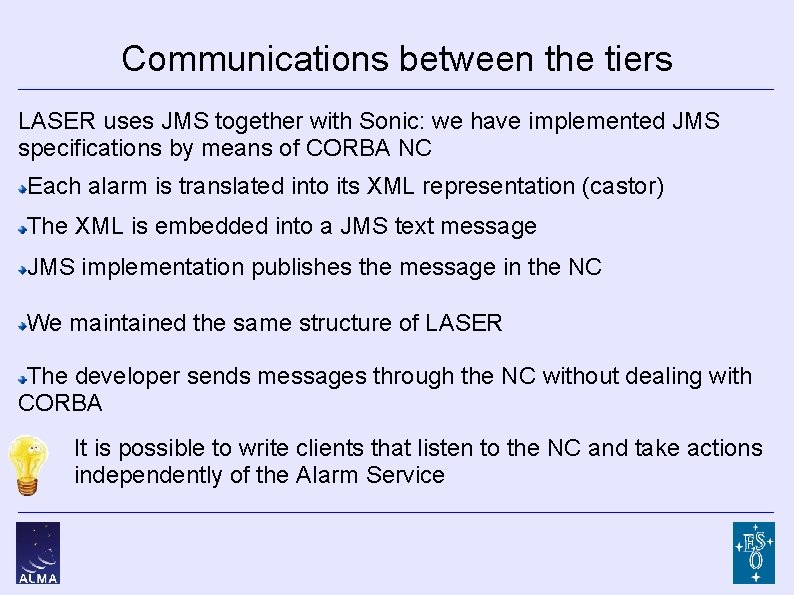
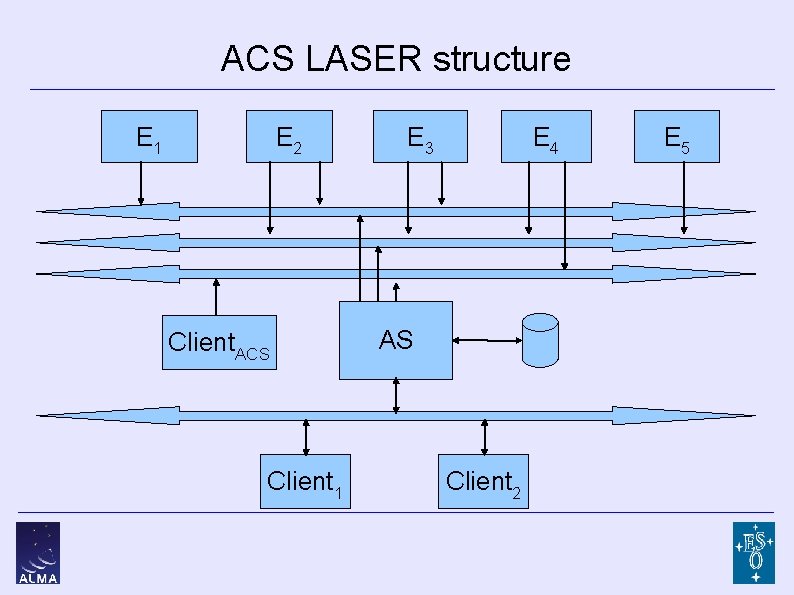
Communications between the tiers LASER uses JMS together with Sonic: we have implemented JMS specifications by means of CORBA NC Each alarm is translated into its XML representation (castor) The XML is embedded into a JMS text message JMS implementation publishes the message in the NC We maintained the same structure of LASER The developer sends messages through the NC without dealing with CORBA It is possible to write clients that listen to the NC and take actions independently of the Alarm Service
ACS LASER structure E 1 E 2 Client. ACS Client 1 E 3 E 4 AS Client 2 E 5
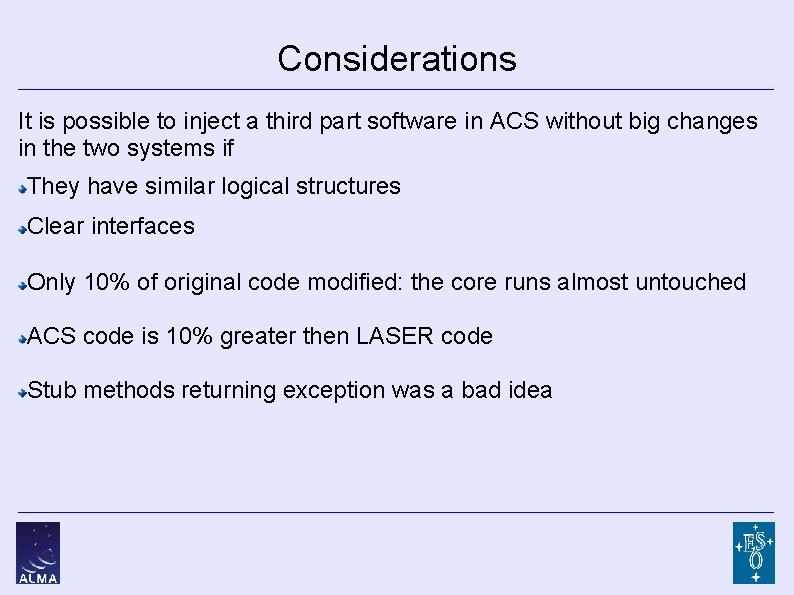
Considerations It is possible to inject a third part software in ACS without big changes in the two systems if They have similar logical structures Clear interfaces Only 10% of original code modified: the core runs almost untouched ACS code is 10% greater then LASER code Stub methods returning exception was a bad idea
The future A stable collaboration between ESO/ACS and CERN is established: ACS/LASER will be distributed as LGPL in a future release of ACS. To make this collaboration effective we need to decouple ACS and LASER: • • definition of interfaces refactoring of the LASER code definition of CVS policies definition of the release procedure