
Integrating the Apache Stack with HPC for Big
Integrating the Apache Stack with HPC for Big Data AGU Session: Leveraging Enabling Technologies and Architectures to Enable Data Intensive Science II Moscone Convention Center, San Francisco December 16 2014 Geoffrey Fox, Judy Qiu, Shantenu Jha gcf@indiana. edu http: //www. infomall. org School of Informatics and Computing Digital Science Center Indiana University Bloomington 1
NIST Big Data Initiative Led by Chaitin Baru, Bob Marcus, Wo Chang 2
NBD-PWG (NIST Big Data Public Working Group) Subgroups & Co-Chairs • There were 5 Subgroups - Note mainly industry • Requirements and Use Cases Sub Group – Geoffrey Fox, Indiana U. ; Joe Paiva, VA; Tsegereda Beyene, Cisco • Definitions and Taxonomies SG – Nancy Grady, SAIC; Natasha Balac, SDSC; Eugene Luster, R 2 AD • Reference Architecture Sub Group – Orit Levin, Microsoft; James Ketner, AT&T; Don Krapohl, Augmented Intelligence • Security and Privacy Sub Group – Arnab Roy, CSA/Fujitsu Nancy Landreville, U. MD Akhil Manchanda, GE • Technology Roadmap Sub Group – Carl Buffington, Vistronix; Dan Mc. Clary, Oracle; David Boyd, Data Tactics • See http: //bigdatawg. nist. gov/usecases. php • and http: //bigdatawg. nist. gov/V 1_output_docs. php 3
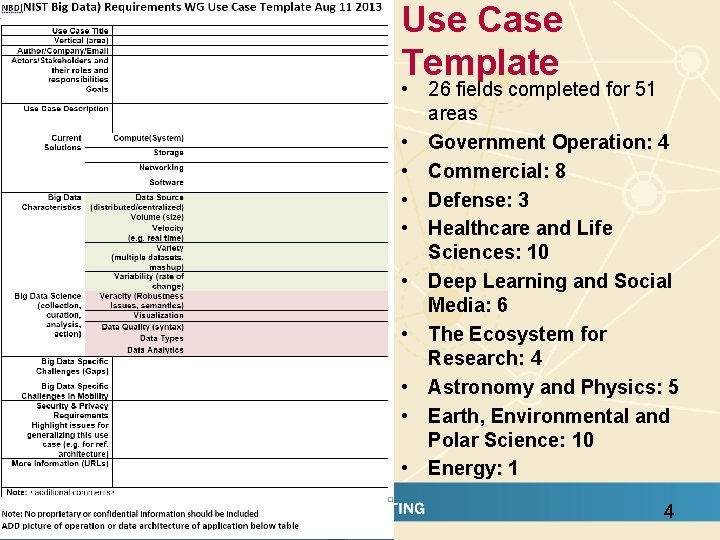
Use Case Template • 26 fields completed for 51 areas • Government Operation: 4 • Commercial: 8 • Defense: 3 • Healthcare and Life Sciences: 10 • Deep Learning and Social Media: 6 • The Ecosystem for Research: 4 • Astronomy and Physics: 5 • Earth, Environmental and Polar Science: 10 • Energy: 1 4
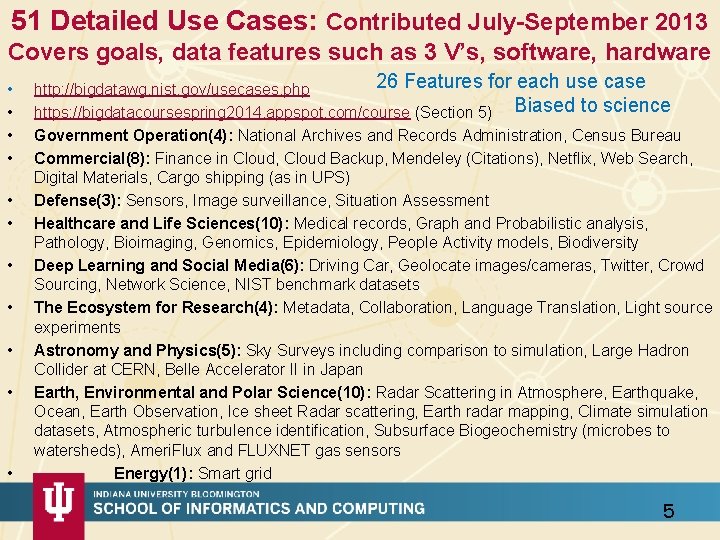
51 Detailed Use Cases: Contributed July-September 2013 Covers goals, data features such as 3 V’s, software, hardware • • • 26 Features for each use case http: //bigdatawg. nist. gov/usecases. php https: //bigdatacoursespring 2014. appspot. com/course (Section 5) Biased to science Government Operation(4): National Archives and Records Administration, Census Bureau Commercial(8): Finance in Cloud, Cloud Backup, Mendeley (Citations), Netflix, Web Search, Digital Materials, Cargo shipping (as in UPS) Defense(3): Sensors, Image surveillance, Situation Assessment Healthcare and Life Sciences(10): Medical records, Graph and Probabilistic analysis, Pathology, Bioimaging, Genomics, Epidemiology, People Activity models, Biodiversity Deep Learning and Social Media(6): Driving Car, Geolocate images/cameras, Twitter, Crowd Sourcing, Network Science, NIST benchmark datasets The Ecosystem for Research(4): Metadata, Collaboration, Language Translation, Light source experiments Astronomy and Physics(5): Sky Surveys including comparison to simulation, Large Hadron Collider at CERN, Belle Accelerator II in Japan Earth, Environmental and Polar Science(10): Radar Scattering in Atmosphere, Earthquake, Ocean, Earth Observation, Ice sheet Radar scattering, Earth radar mapping, Climate simulation datasets, Atmospheric turbulence identification, Subsurface Biogeochemistry (microbes to watersheds), Ameri. Flux and FLUXNET gas sensors Energy(1): Smart grid 5
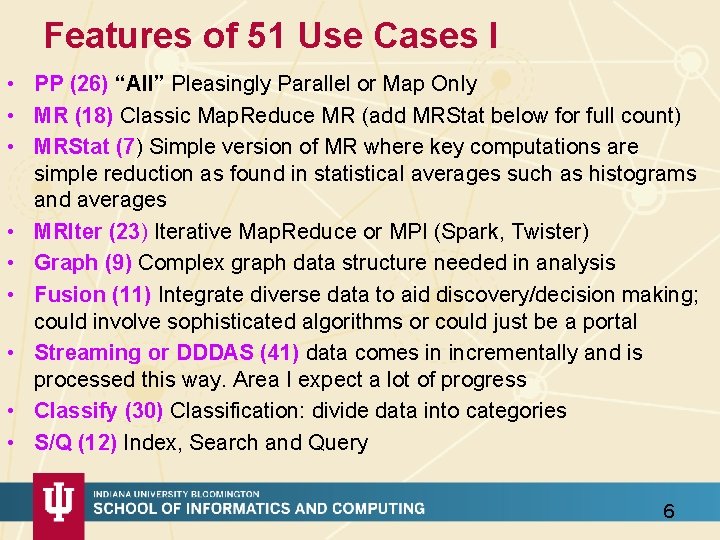
Features of 51 Use Cases I • PP (26) “All” Pleasingly Parallel or Map Only • MR (18) Classic Map. Reduce MR (add MRStat below for full count) • MRStat (7) Simple version of MR where key computations are simple reduction as found in statistical averages such as histograms and averages • MRIter (23) Iterative Map. Reduce or MPI (Spark, Twister) • Graph (9) Complex graph data structure needed in analysis • Fusion (11) Integrate diverse data to aid discovery/decision making; could involve sophisticated algorithms or could just be a portal • Streaming or DDDAS (41) data comes in incrementally and is processed this way. Area I expect a lot of progress • Classify (30) Classification: divide data into categories • S/Q (12) Index, Search and Query 6
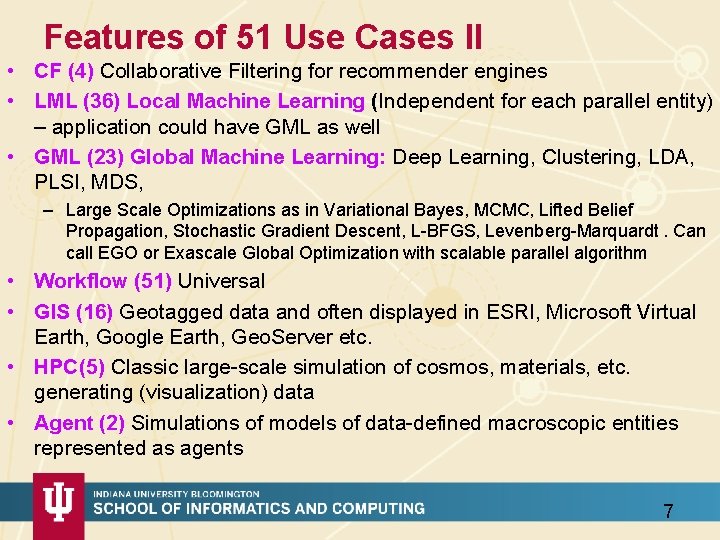
Features of 51 Use Cases II • CF (4) Collaborative Filtering for recommender engines • LML (36) Local Machine Learning (Independent for each parallel entity) – application could have GML as well • GML (23) Global Machine Learning: Deep Learning, Clustering, LDA, PLSI, MDS, – Large Scale Optimizations as in Variational Bayes, MCMC, Lifted Belief Propagation, Stochastic Gradient Descent, L-BFGS, Levenberg-Marquardt. Can call EGO or Exascale Global Optimization with scalable parallel algorithm • Workflow (51) Universal • GIS (16) Geotagged data and often displayed in ESRI, Microsoft Virtual Earth, Google Earth, Geo. Server etc. • HPC(5) Classic large-scale simulation of cosmos, materials, etc. generating (visualization) data • Agent (2) Simulations of models of data-defined macroscopic entities represented as agents 7
Big Data Patterns – the Ogres 8
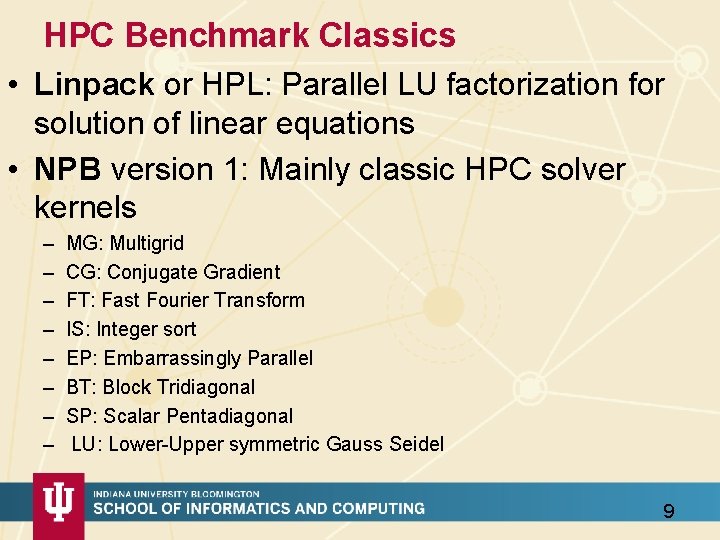
HPC Benchmark Classics • Linpack or HPL: Parallel LU factorization for solution of linear equations • NPB version 1: Mainly classic HPC solver kernels – – – – MG: Multigrid CG: Conjugate Gradient FT: Fast Fourier Transform IS: Integer sort EP: Embarrassingly Parallel BT: Block Tridiagonal SP: Scalar Pentadiagonal LU: Lower-Upper symmetric Gauss Seidel 9
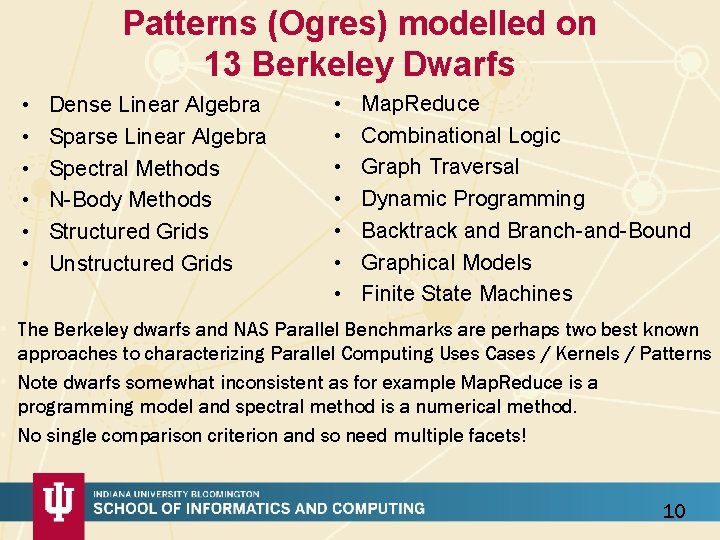
Patterns (Ogres) modelled on 13 Berkeley Dwarfs • • • Dense Linear Algebra Sparse Linear Algebra Spectral Methods N-Body Methods Structured Grids Unstructured Grids • • Map. Reduce Combinational Logic Graph Traversal Dynamic Programming Backtrack and Branch-and-Bound Graphical Models Finite State Machines • The Berkeley dwarfs and NAS Parallel Benchmarks are perhaps two best known approaches to characterizing Parallel Computing Uses Cases / Kernels / Patterns • Note dwarfs somewhat inconsistent as for example Map. Reduce is a programming model and spectral method is a numerical method. • No single comparison criterion and so need multiple facets! 10
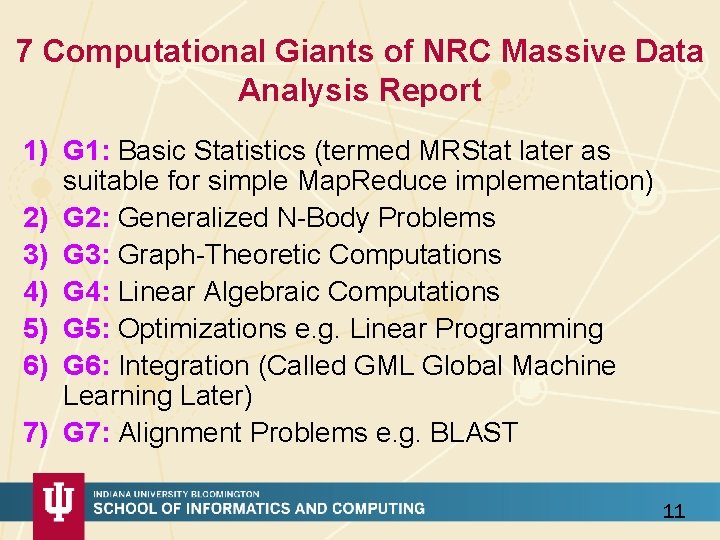
7 Computational Giants of NRC Massive Data Analysis Report 1) G 1: Basic Statistics (termed MRStat later as suitable for simple Map. Reduce implementation) 2) G 2: Generalized N-Body Problems 3) G 3: Graph-Theoretic Computations 4) G 4: Linear Algebraic Computations 5) G 5: Optimizations e. g. Linear Programming 6) G 6: Integration (Called GML Global Machine Learning Later) 7) G 7: Alignment Problems e. g. BLAST 11
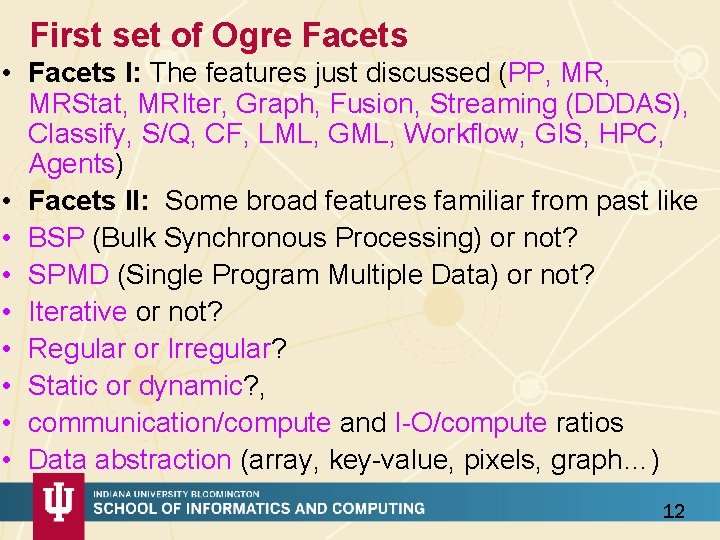
First set of Ogre Facets • Facets I: The features just discussed (PP, MRStat, MRIter, Graph, Fusion, Streaming (DDDAS), Classify, S/Q, CF, LML, GML, Workflow, GIS, HPC, Agents) • Facets II: Some broad features familiar from past like • BSP (Bulk Synchronous Processing) or not? • SPMD (Single Program Multiple Data) or not? • Iterative or not? • Regular or Irregular? • Static or dynamic? , • communication/compute and I-O/compute ratios • Data abstraction (array, key-value, pixels, graph…) 12
Core Analytics Facet I • Map-Only • Pleasingly parallel - Local Machine Learning • Map. Reduce: Search/Query/Index • Summarizing statistics as in LHC Data analysis (histograms) (G 1) • Recommender Systems (Collaborative Filtering) • Linear Classifiers (Bayes, Random Forests) • Alignment and Streaming (G 7) • Genomic Alignment, Incremental Classifiers • Global Analytics: Nonlinear Solvers (structure depends on objective function) (G 5, G 6) – Stochastic Gradient Descent SGD and approximations to Newton’s Method – Levenberg-Marquardt solver 13
Core Analytics Facet II • Global Analytics: Map-Collective (See Mahout, MLlib) (G 2, G 4, G 6) • Often use matrix-matrix, -vector operations, solvers (conjugate gradient) • Clustering (many methods), Mixture Models, LDA (Latent Dirichlet Allocation), PLSI (Probabilistic Latent Semantic Indexing) • SVM and Logistic Regression • Outlier Detection (several approaches) • Page. Rank, (find leading eigenvector of sparse matrix) • SVD (Singular Value Decomposition) • MDS (Multidimensional Scaling) • Learning Neural Networks (Deep Learning) • Hidden Markov Models • Graph Analytics (G 3) • Structure and Simulation (Communities, subgraphs/motifs, diameter, maximal cliques, connected components, Betweenness centrality, shortest path) • Linear/Quadratic Programming, Combinatorial Optimization, Branch and Bound (G 5) 14
HPC-ABDS Integrating High Performance Computing with Apache Big Data Stack Shantenu Jha, Judy Qiu, Andre Luckow 15
There a lot of Big Data and HPC Software systems Challenge! Manage environment offering these different components 16
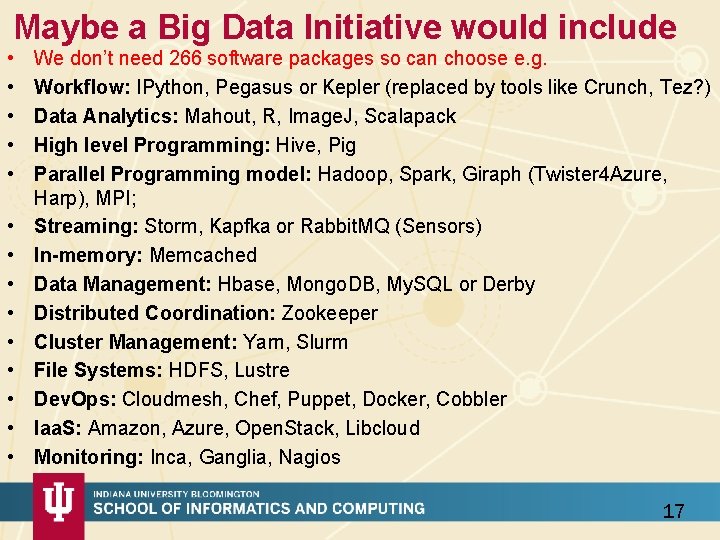
Maybe a Big Data Initiative would include • • • • We don’t need 266 software packages so can choose e. g. Workflow: IPython, Pegasus or Kepler (replaced by tools like Crunch, Tez? ) Data Analytics: Mahout, R, Image. J, Scalapack High level Programming: Hive, Pig Parallel Programming model: Hadoop, Spark, Giraph (Twister 4 Azure, Harp), MPI; Streaming: Storm, Kapfka or Rabbit. MQ (Sensors) In-memory: Memcached Data Management: Hbase, Mongo. DB, My. SQL or Derby Distributed Coordination: Zookeeper Cluster Management: Yarn, Slurm File Systems: HDFS, Lustre Dev. Ops: Cloudmesh, Chef, Puppet, Docker, Cobbler Iaa. S: Amazon, Azure, Open. Stack, Libcloud Monitoring: Inca, Ganglia, Nagios 17
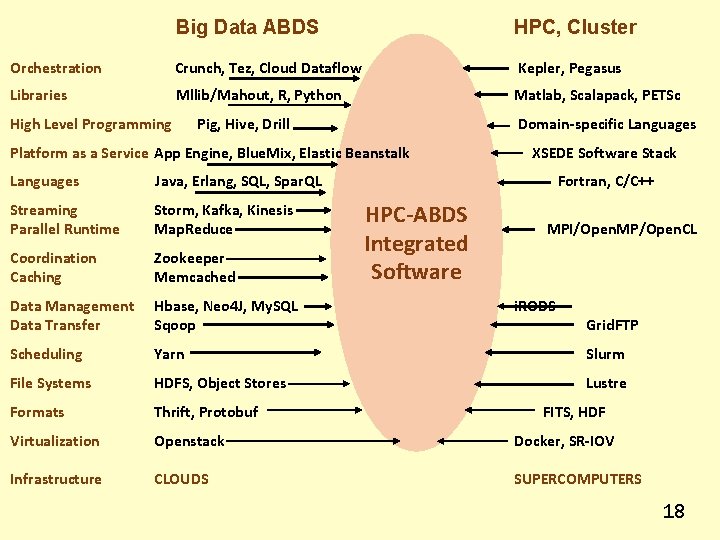
Big Data ABDS HPC, Cluster Orchestration Crunch, Tez, Cloud Dataflow Kepler, Pegasus Libraries Mllib/Mahout, R, Python Matlab, Scalapack, PETSc High Level Programming Pig, Hive, Drill Domain-specific Languages Platform as a Service App Engine, Blue. Mix, Elastic Beanstalk XSEDE Software Stack Languages Java, Erlang, SQL, Spar. QL Fortran, C/C++ Streaming Parallel Runtime Storm, Kafka, Kinesis Map. Reduce Coordination Caching Zookeeper Memcached Data Management Data Transfer Hbase, Neo 4 J, My. SQL Sqoop Scheduling Yarn Slurm File Systems HDFS, Object Stores Lustre Formats Thrift, Protobuf Virtualization Openstack Docker, SR-IOV Infrastructure CLOUDS SUPERCOMPUTERS HPC-ABDS Integrated Software MPI/Open. MP/Open. CL i. RODS Grid. FTP FITS, HDF 18
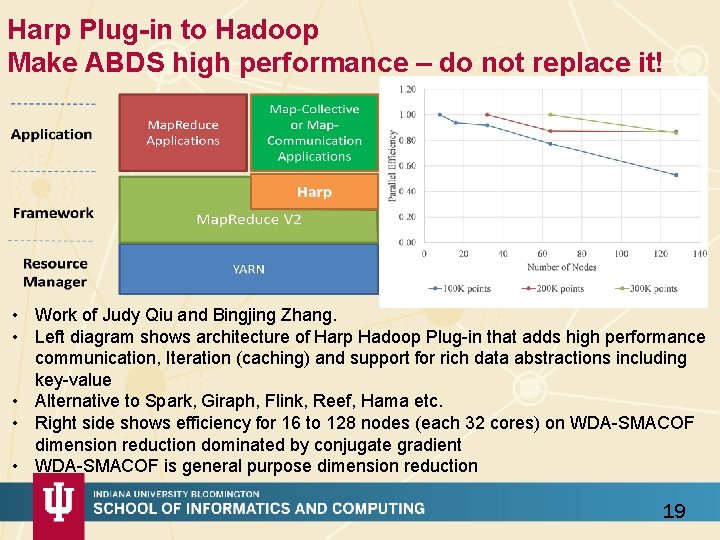
Harp Plug-in to Hadoop Make ABDS high performance – do not replace it! • Work of Judy Qiu and Bingjing Zhang. • Left diagram shows architecture of Harp Hadoop Plug-in that adds high performance communication, Iteration (caching) and support for rich data abstractions including key-value • Alternative to Spark, Giraph, Flink, Reef, Hama etc. • Right side shows efficiency for 16 to 128 nodes (each 32 cores) on WDA-SMACOF dimension reduction dominated by conjugate gradient • WDA-SMACOF is general purpose dimension reduction 19
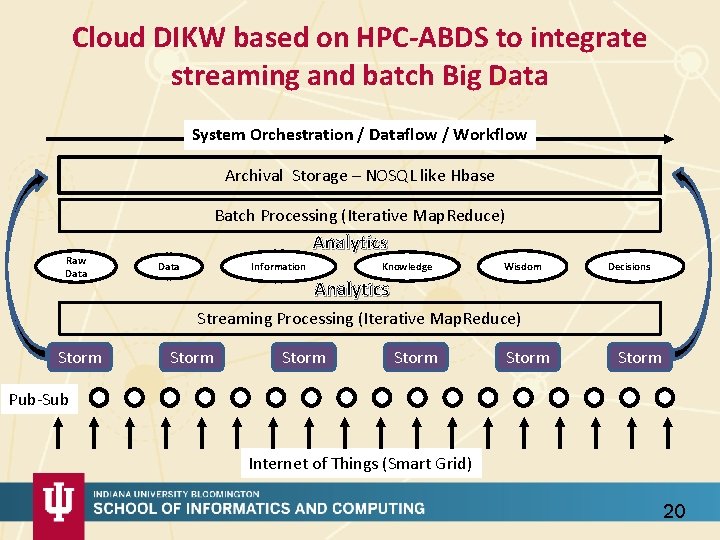
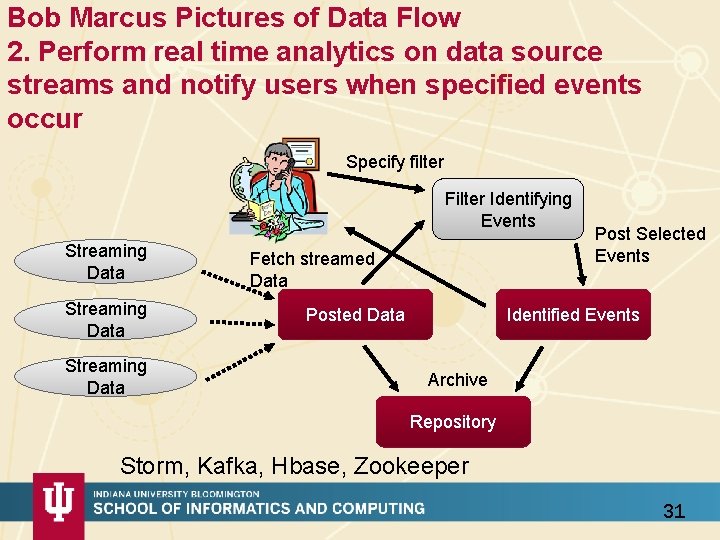
Cloud DIKW based on HPC-ABDS to integrate streaming and batch Big Data System Orchestration / Dataflow / Workflow Archival Storage – NOSQL like Hbase Batch Processing (Iterative Map. Reduce) Raw Data Analytics Data Knowledge Information Wisdom Decisions Analytics Streaming Processing (Iterative Map. Reduce) Storm Storm Pub-Sub Internet of Things (Smart Grid) 20
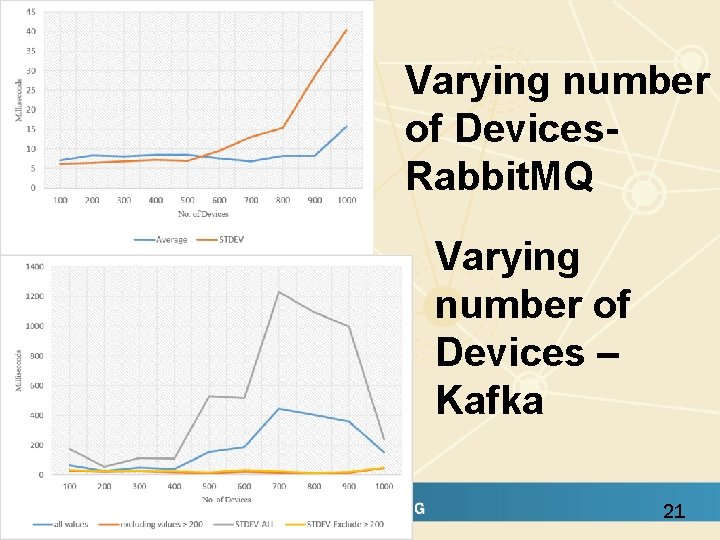
Varying number of Devices. Rabbit. MQ Varying number of Devices – Kafka 21
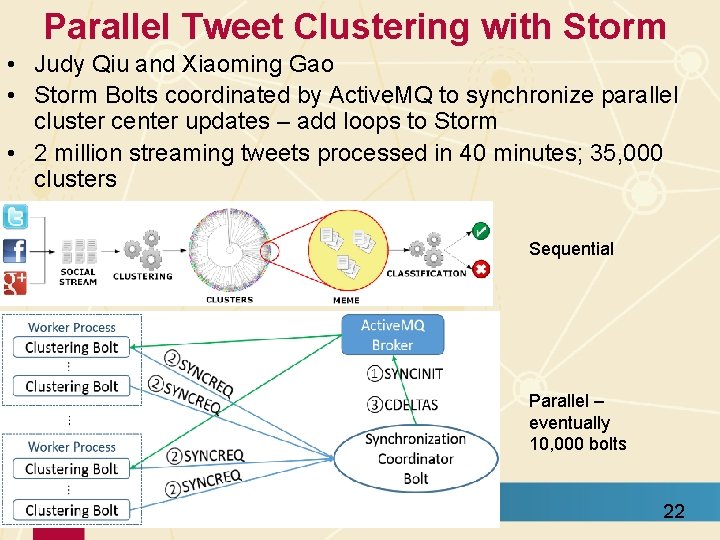
Parallel Tweet Clustering with Storm • Judy Qiu and Xiaoming Gao • Storm Bolts coordinated by Active. MQ to synchronize parallel cluster center updates – add loops to Storm • 2 million streaming tweets processed in 40 minutes; 35, 000 clusters Sequential Parallel – eventually 10, 000 bolts 22

Data Science at Indiana University 23
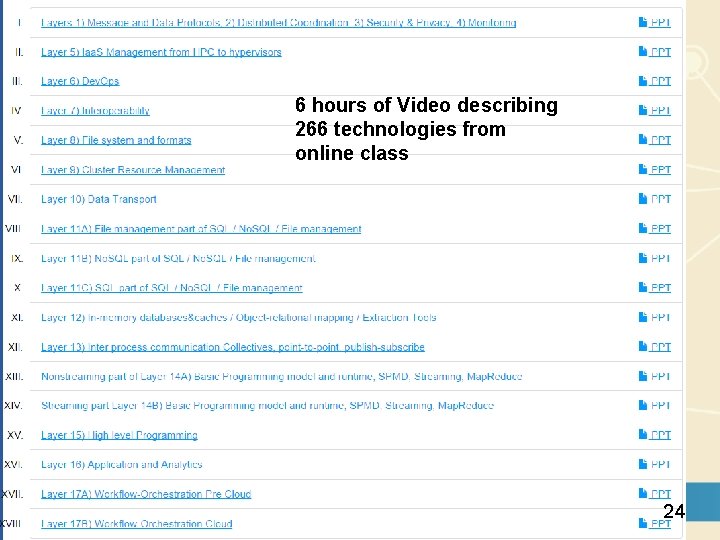
6 hours of Video describing 266 technologies from online class 24
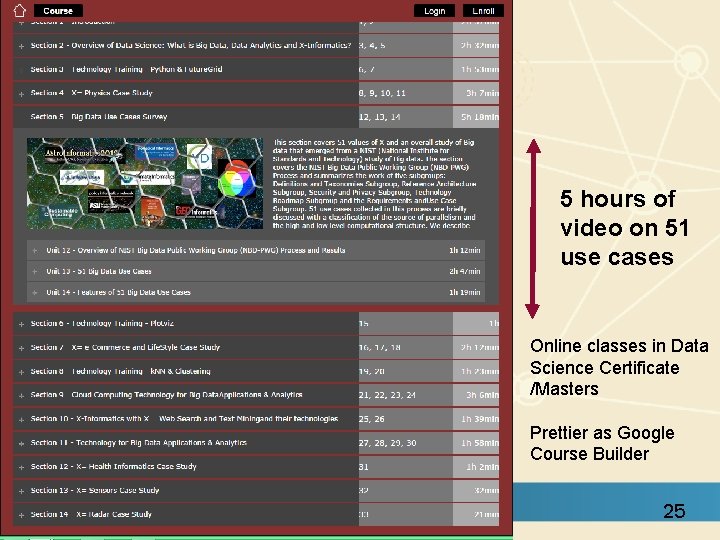
5 hours of video on 51 use cases Online classes in Data Science Certificate /Masters Prettier as Google Course Builder 25
IU Data Science Masters Features • Fully approved by University and State October 14 2014 • Blended online and residential • Department of Information and Library Science, Division of Informatics and Division of Computer Science in the Department of Informatics and Computer Science, School of Informatics and Computing and the Department of Statistics, College of Arts and Science, IUB • 30 credits (10 conventional courses) • Basic (general) Masters degree plus tracks – Currently only track is “Computational and Analytic Data Science ” – Other tracks expected • A purely online 4 -course Certificate in Data Science has been running since January 2014 (Technical and Decision Maker paths) • A Ph. D. Minor in Data Science has been proposed. 26
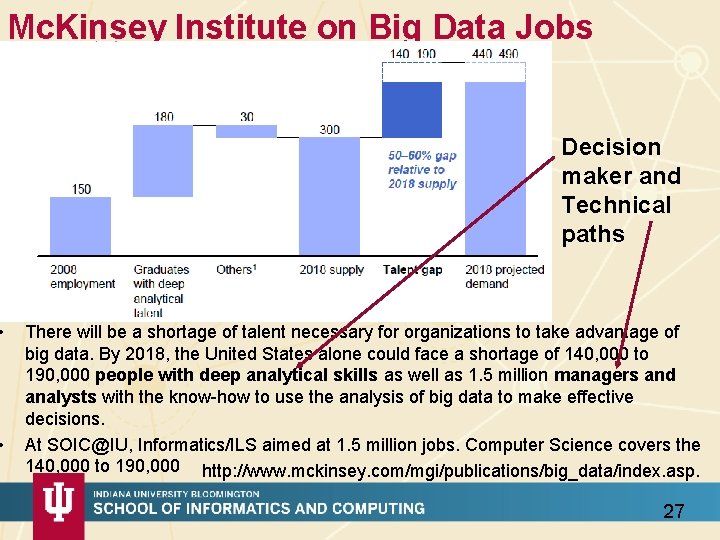
• • Mc. Kinsey Institute on Big Data Jobs Decision maker and Technical paths There will be a shortage of talent necessary for organizations to take advantage of big data. By 2018, the United States alone could face a shortage of 140, 000 to 190, 000 people with deep analytical skills as well as 1. 5 million managers and analysts with the know-how to use the analysis of big data to make effective decisions. At SOIC@IU, Informatics/ILS aimed at 1. 5 million jobs. Computer Science covers the 140, 000 to 190, 000 http: //www. mckinsey. com/mgi/publications/big_data/index. asp. 27
Lessons / Insights • Proposed classification of Big Data applications with features and kernels for analytics • Data intensive algorithms do not have the well developed high performance libraries familiar from HPC • Global Machine Learning or (Exascale Global Optimization) particularly challenging • Develop SPIDAL (Scalable Parallel Interoperable Data Analytics Library) – New algorithms and new high performance parallel implementations • Integrate (don’t compete) HPC with “Commodity Big data” (Google to Amazon to Enterprise Data Analytics) – i. e. improve Mahout; don’t compete with it – Use Hadoop plug-ins rather than replacing Hadoop • Enhanced Apache Big Data Stack HPC-ABDS has >266 members with HPC opportunities at Resource management, Storage/Data, Streaming, Programming, monitoring, workflow layers. 28
EXTRAS 29
Integrating the Apache Stack with HPC for Big Data • • • There is perhaps a broad consensus as to important issues in practical parallel computing as applied to large scale simulations; this is reflected in supercomputer architectures, algorithms, libraries, languages, compilers and best practice for application development. However, the same is not so true for data intensive computing, even though commercially clouds devote much more resources to data analytics than supercomputers devote to simulations. We look at a sample of over 50 big data applications to identify characteristics of data intensive applications and to deduce needed runtime and architectures. We suggest a big data version of the famous Berkeley dwarfs and NAS parallel benchmarks and use these to identify a few key classes of hardware/software architectures. Our analysis builds on combining HPC and ABDS the Apache big data software stack that is well used in modern cloud computing. Initial results on clouds and HPC systems are encouraging. We propose the development of SPIDAL - Scalable Parallel Interoperable Data Analytics Library -- built on system aand data abstractions suggested by the HPC-ABDS architecture. We discuss how it can be used in several application areas including Polar Science. 30
Bob Marcus Pictures of Data Flow 2. Perform real time analytics on data source streams and notify users when specified events occur Specify filter Filter Identifying Events Streaming Data Fetch streamed Data Post Selected Events Identified Events Archive Repository Storm, Kafka, Hbase, Zookeeper 31
Data Processing Facet: Illustrated by Typical Science Case 32

System Architecture 33
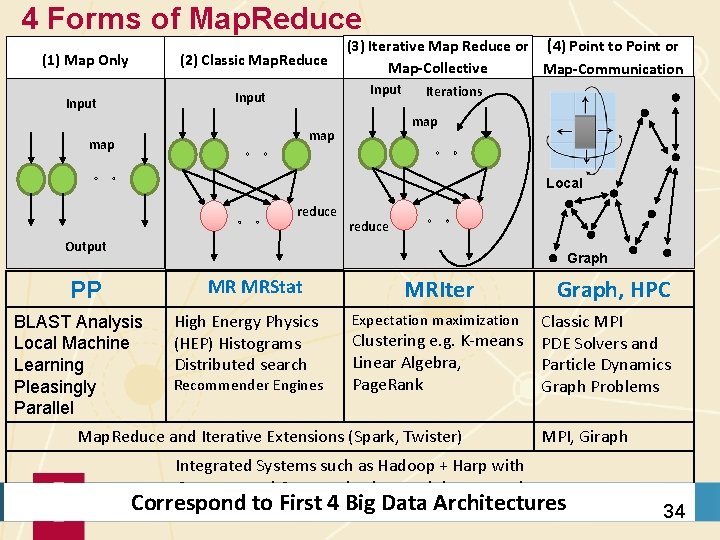
4 Forms of Map. Reduce (1) Map Only (2) Classic Map. Reduce Input (3) Iterative Map Reduce or (4) Point to Point or Map-Collective Map-Communication map map Iterations Local reduce Output Graph MR MRStat PP BLAST Analysis Local Machine Learning Pleasingly Parallel High Energy Physics (HEP) Histograms Distributed search Recommender Engines MRIter Expectation maximization Clustering e. g. K-means Linear Algebra, Page. Rank Map. Reduce and Iterative Extensions (Spark, Twister) Graph, HPC Classic MPI PDE Solvers and Particle Dynamics Graph Problems MPI, Giraph Integrated Systems such as Hadoop + Harp with Compute and Communication model separated Correspond to First 4 Big Data Architectures 34
Useful Set of Analytics Architectures • Pleasingly Parallel: including local machine learning as in parallel over images and apply image processing to each image - Hadoop could be used but many other HTC, Many task tools • Classic Map. Reduce including search, collaborative filtering and motif finding implemented using Hadoop etc. • Map-Collective or Iterative Map. Reduce using Collective Communication (clustering) – Hadoop with Harp, Spark …. . • Map-Communication or Iterative Giraph: (Map. Reduce) with pointto-point communication (most graph algorithms such as maximum clique, connected component, finding diameter, community detection) – Vary in difficulty of finding partitioning (classic parallel load balancing) • Large and Shared memory: thread-based (event driven) graph algorithms (shortest path, Betweenness centrality) and Large memory applications 35
Parallel Data Analytics Issues 36
• Remarks on Parallelism I Most use parallelism over items in data set – Entities to cluster or map to Euclidean space • Except deep learning (for image data sets)which has parallelism over pixel plane in neurons not over items in training set – as need to look at small numbers of data items at a time in Stochastic Gradient Descent SGD – Need experiments to really test SGD – as no easy to use parallel implementations tests at scale NOT done – Maybe got where they are as most work sequential • • • Maximum Likelihood or 2 both lead to structure like Minimize sum items=1 N (Positive nonlinear function of unknown parameters for item i) All solved iteratively with (clever) first or second order approximation to shift in objective function – – • Sometimes steepest descent direction; sometimes Newton 11 billion deep learning parameters; Newton impossible Have classic Expectation Maximization structure Steepest descent shift is sum over shift calculated from each point SGD – take randomly a few hundred of items in data set and calculate shifts over these and move a tiny distance – Classic method – take all (millions) of items in data set and move full distance 37
Remarks on Parallelism II • Need to cover non vector semimetric and vector spaces for clustering and dimension reduction (N points in space) • MDS Minimizes Stress (X) = i<j=1 N weight(i, j) ( (i, j) - d(Xi , Xj))2 • Semimetric spaces just have pairwise distances defined between points in space (i, j) • Vector spaces have Euclidean distance and scalar products – Algorithms can be O(N) and these are best for clustering but for MDS O(N) methods may not be best as obvious objective function O(N 2) – Important new algorithms needed to define O(N) versions of current O(N 2) – “must” work intuitively and shown in principle • Note matrix solvers all use conjugate gradient – converges in 5 -100 iterations – a big gain for matrix with a million rows. This removes factor of N in time complexity • Ratio of #clusters to #points important; new ideas if ratio >~ 0. 1 38
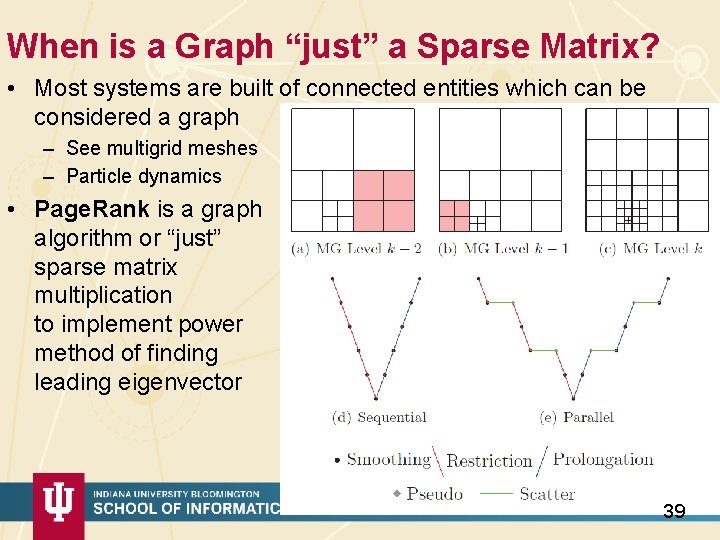
When is a Graph “just” a Sparse Matrix? • Most systems are built of connected entities which can be considered a graph – See multigrid meshes – Particle dynamics • Page. Rank is a graph algorithm or “just” sparse matrix multiplication to implement power method of finding leading eigenvector 39
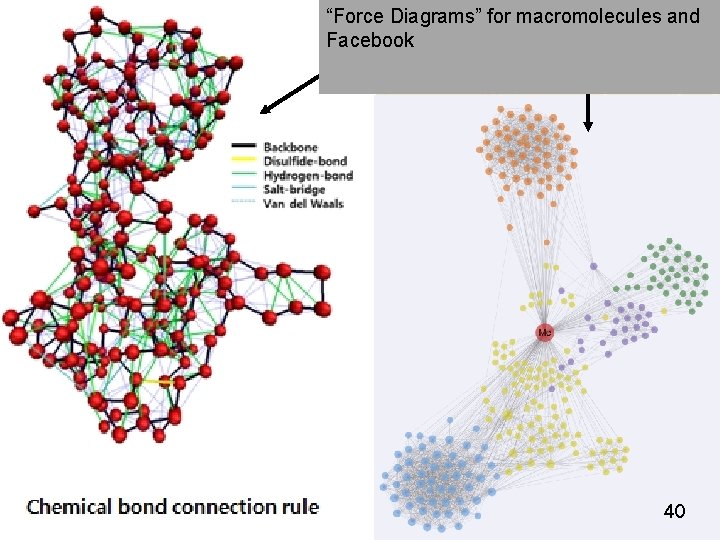
“Force Diagrams” for macromolecules and Facebook 40
Algorithm Challenges • • • See NRC Massive Data Analysis report O(N) algorithms for O(N 2) problems Parallelizing Stochastic Gradient Descent Streaming data algorithms – balance and interplay between batch methods (most time consuming) and interpolative streaming methods Graph algorithms Machine Learning Community uses parameter servers; Parallel Computing (MPI) would not recommend this? – Is classic distributed model for “parameter service” better? Apply best of parallel computing – communication and load balancing – to Giraph/Hadoop/Spark Are data analytics sparse? ; many cases are full matrices BTW Need Java Grande – Some C++ but Java most popular in ABDS, with Python, Erlang, Go, Scala (compiles to JVM) …. . 41
Benchmark Suite in spirit of NAS Parallel Benchmarks or Berkeley Dwarfs 42
Benchmarks across Facets • Classic Database: TPC benchmarks • No. SQL Data systems: store, index, query (e. g. on Tweets) • Hard core commercial: Web Search, Collaborative Filtering (different structure and defer to Google!) • Streaming: Gather in Pub-Sub(Kafka) + Process (Apache Storm) solution (e. g. gather tweets, Internet of Things) • Pleasingly parallel (Local Analytics): as in initial steps of LHC, Astronomy, Pathology, Bioimaging (differ in type of data analysis) • “Global” Analytics: Deep Learning, SVM, Clustering, Multidimensional Scaling, Graph Community finding (~Clustering) to Shortest Path (? Shared memory) • Workflow linking above 43
- Slides: 43