
Integrating Sustainability into business courses Mary Panko Contents
Integrating Sustainability into business courses Mary Panko
Contents 1. 2. 3. 4. 5. What does sustainability mean? Why should any educator want to do this - and business educators in particular? Having decided it is important – what principles underpin the concept? How to go about integrating sustainability into a business programme? Instead of Greenwash – does this just add Green. Ed?
What does Sustainability mean to you? Keeping your business running in a healthy manner? Appealing to your stakeholders? Aspects of the Triple (or Quadruple) Bottom Line? Being a “greenie”? Or …
Quadruple Bottom Line? The three pillars plus … People (including culture) Planet (environment) Profit PLUS Governance The RMIT model
Descriptions of Sustainable Development "Sustainable development is development that meets the needs of the present without compromising the ability of future generations to meet their own needs. ” Brundtland Report (1987)
Sustainable businesses: Principles? Replace nationally and internationally produced items with products created locally and regionally. Take responsibility for the effects they have on the natural world. Do not require exotic sources of capital in order to develop and grow.
And more principles Engage in production processes that are human, worthy, dignified, and intrinsically satisfying. Create objects of durability and utility whose ultimate use or disposition will not be harmful to future generations. Change consumers to customers through education.
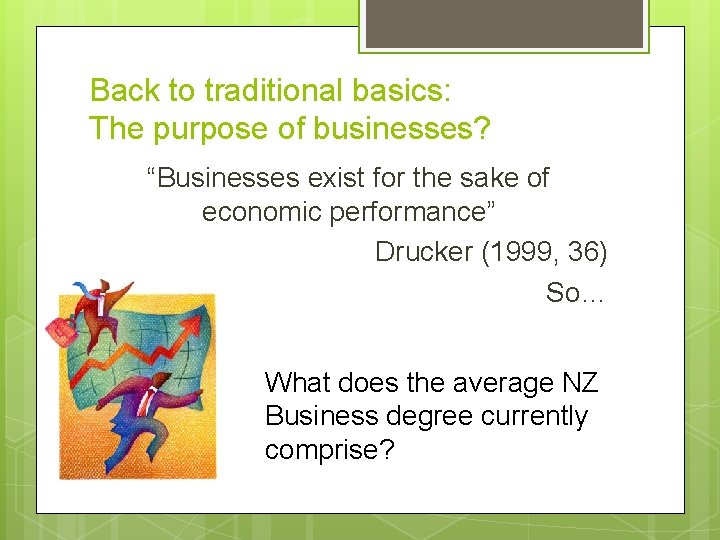
Back to traditional basics: The purpose of businesses? “Businesses exist for the sake of economic performance” Drucker (1999, 36) So… What does the average NZ Business degree currently comprise?
With notable exceptions –current business programmes focus on: Example 1 BBus Enterprise mgt. Entrepreneurship + innovation IT HR Finance Research methods Example 2 BBus (Finance) Accounting Commercial law Economics Finance IT Marketing Management Business statistics
One more example Financial accounting Auditing Taxation Business finance Management HR Operations management Marketing Advertising practice
Sustainability is missing! Why?
Sustainability is missing! Why? N. B. it has been established (see refs) that: Businesses that have adopted sustainable business practices have reported a number of benefits:
Benefits: Reduction in operating costs. Improved identification and management of risks. Created value through enhanced and positive customer response. Increased ability to attract and retain employees. Increased learning and innovation. Reduced Government intervention.
Why is sustainability significant in tertiary education? If tertiary graduates do not have a core understanding of sustainability, then the pathway to a sustainable future will remain a side road for longer than necessary. (PEC, 2004, 135). Environmental Issues involve: Climate change, Reduction of gas emissions, Biodiversity, Energy efficiency, Development of clean technologies, Conservation of natural resources, Waste management, Pollution, Sustainable transport.
Ways to integrate Sustainability into the existing BSC business education models 1. 2. Integrate Environmental and Social aspects across the existing four business perspectives (Finance/Customers/Internal/Innovation). Add an additional perspective onto the 4 original ones with specific environmental and/or social measurements.
3. Develop a dedicated Business Sustainability programme? 4. Develop a final year case-study working with an external organisation to examine real-world sustainable processes.
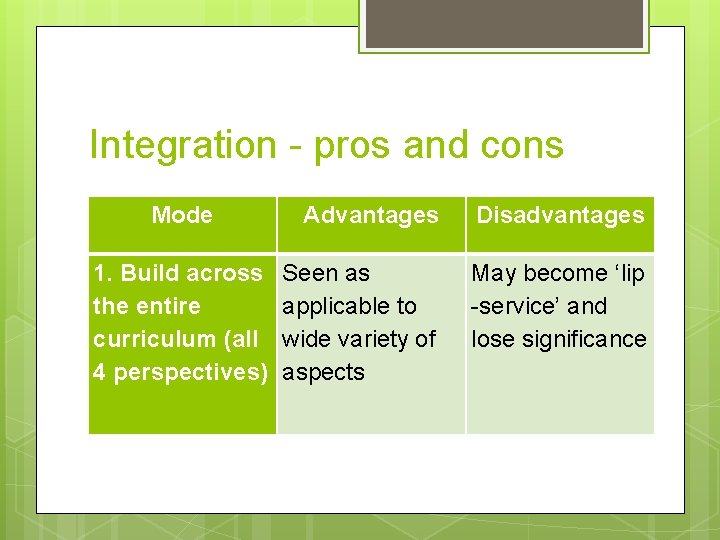
Integration - pros and cons Mode 1. Build across the entire curriculum (all 4 perspectives) Advantages Disadvantages Seen as applicable to wide variety of aspects May become ‘lip -service’ and lose significance
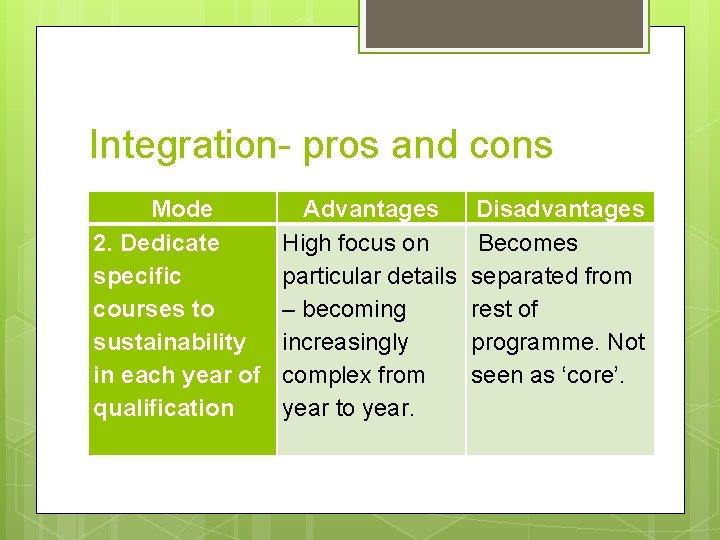
Integration- pros and cons Mode 2. Dedicate specific courses to sustainability in each year of qualification Advantages High focus on particular details – becoming increasingly complex from year to year. Disadvantages Becomes separated from rest of programme. Not seen as ‘core’.
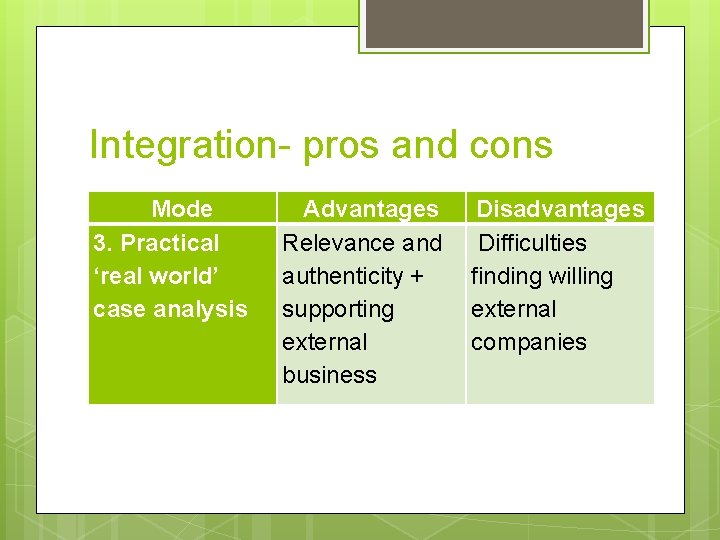
Integration- pros and cons Mode 3. Practical ‘real world’ case analysis Advantages Relevance and authenticity + supporting external business Disadvantages Difficulties finding willing external companies
BUT: • In New Zealand, architects, economists, engineers and policy analysts commonly graduate without any knowledge of, or concern for, sustainability issues (Parliamentary Commissioner for the Environment, 2004, PEC). • Research shows that the graduate employability is closely linked to the employer’s sustainability agenda (Neirop, 2008). • Tertiary trained graduates will be leaders of next generation – essential for future of planet that everyone develops understanding of Sustainability – particularly in business.
Greenwash/Green. Ed- Is it real or just lip service? Is Sustainability still seen as valuable or is it no longer ‘trendy’? In business (and in education) Greenwash can be any combination of the following:
Sins of Greenwashing Fluffy language Outright lying Green products/dirty Imaginary friends company Green images Irrelevant claims Gobbledygook Best (of a bad lot) (and awards) No proof Outright lies Hidden trade-offs
Now for the Team challenge How many words or phrases can your team suggest that products claiming Sustainability might use in their marketing?
But – is all Greenwash bad? Pavan Sukhdev “Corporation 2020” Redefining Economic success to include valuing social and natural capital Aspirational as it can lead to auditing
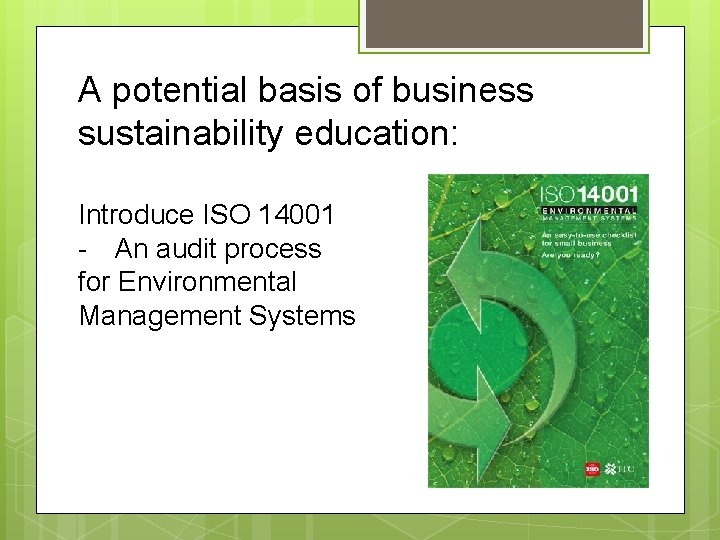
A potential basis of business sustainability education: Introduce ISO 14001 - An audit process for Environmental Management Systems
Environmental management system (EMS) refers to the management of an organization's environmental programs in a comprehensive, systematic, planned and documented manner. Sets out procedures and processes for training of personnel, monitoring, summarizing, and reporting of specialized environmental performance information to internal and external stakeholders of a firm
Aims of EMS - ISO 14001: A family of voluntary standards and guidance documents to help organizations address environmental issues. 2 aspects: a) increase compliance (including training)and, b) reduce waste (from design phase, through pollution prevention and waste minimization. At the end of the life cycle, waste is reduced by recycling.
Discussion of issues raised
References Drucker, P. F. (1999). Innovation ad Entrepreneurship. Harper. Collins. Paul Hawken. The Ecology of Commerce. (New York, New York: Harper Business, 1993), p 144. Neirop, J. van (2008). Inventory of sustainable practices in education for sustainable development. DG Education and Culture. Parliamentary Commissioner for the Environment, (2004) PEC. Pearse, G. (2012). Greenwash. Sukhdev, P. (2012). Corporation 2020. United Nations (1998). Brundtland Report
- Slides: 29