
INTEGRATING SELFDETERMINATION AND SELFEFFICACY IN GAME DESIGN Hossein
![REFERENCES [1] R. Ryan and E. Deci, “Self-determination theory and the facilitation of intrinsic](https://slidetodoc.com/presentation_image_h2/e30969cd0f48dc69e5d942a6e0d0d3c0/image-22.jpg "REFERENCES [1] R. Ryan and E. Deci, “Self-determination theory and the facilitation of intrinsic")
- Slides: 24
INTEGRATING SELF-DETERMINATION AND SELF-EFFICACY IN GAME DESIGN Hossein JAMSHIDIFARSANI Paul TAMAYO-SERRANO Samir GARBAYA Theodore LIM Pierre BLAZEVIC Games and Learning Alliance Conference 2018. Palermo, Italy. December 5 -7 2018
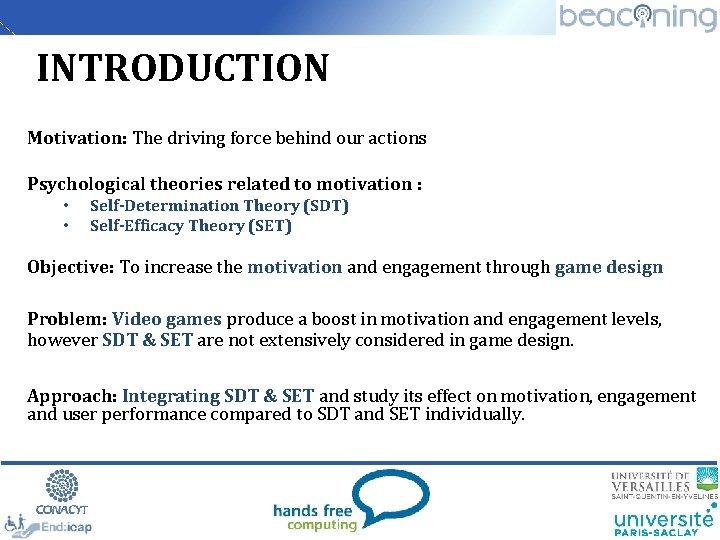
INTRODUCTION Motivation: The driving force behind our actions Psychological theories related to motivation : • • Self-Determination Theory (SDT) Self-Efficacy Theory (SET) Objective: To increase the motivation and engagement through game design Problem: Video games produce a boost in motivation and engagement levels, however SDT & SET are not extensively considered in game design. Approach: Integrating SDT & SET and study its effect on motivation, engagement and user performance compared to SDT and SET individually.
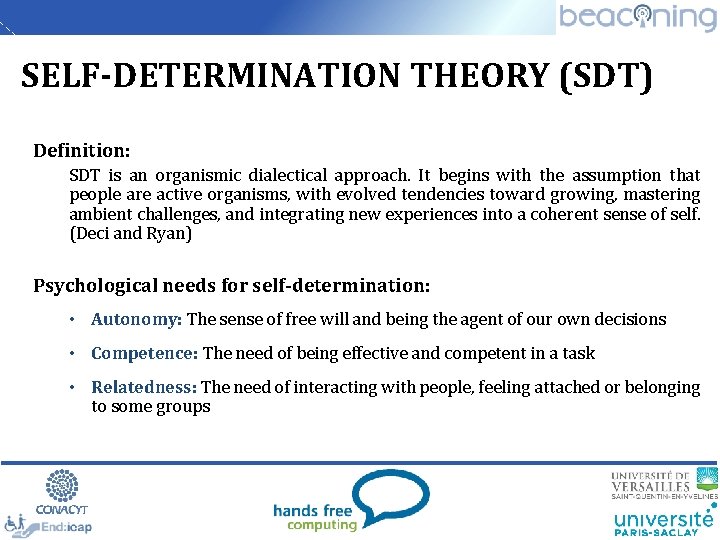
SELF-DETERMINATION THEORY (SDT) Definition: SDT is an organismic dialectical approach. It begins with the assumption that people are active organisms, with evolved tendencies toward growing, mastering ambient challenges, and integrating new experiences into a coherent sense of self. (Deci and Ryan) Psychological needs for self-determination: • Autonomy: The sense of free will and being the agent of our own decisions • Competence: The need of being effective and competent in a task • Relatedness: The need of interacting with people, feeling attached or belonging to some groups
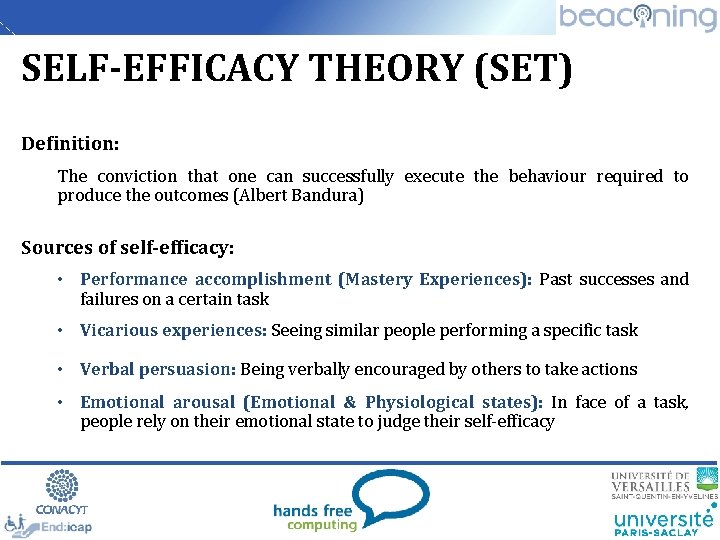
SELF-EFFICACY THEORY (SET) Definition: The conviction that one can successfully execute the behaviour required to produce the outcomes (Albert Bandura) Sources of self-efficacy: • Performance accomplishment (Mastery Experiences): Past successes and failures on a certain task • Vicarious experiences: Seeing similar people performing a specific task • Verbal persuasion: Being verbally encouraged by others to take actions • Emotional arousal (Emotional & Physiological states): In face of a task, people rely on their emotional state to judge their self-efficacy
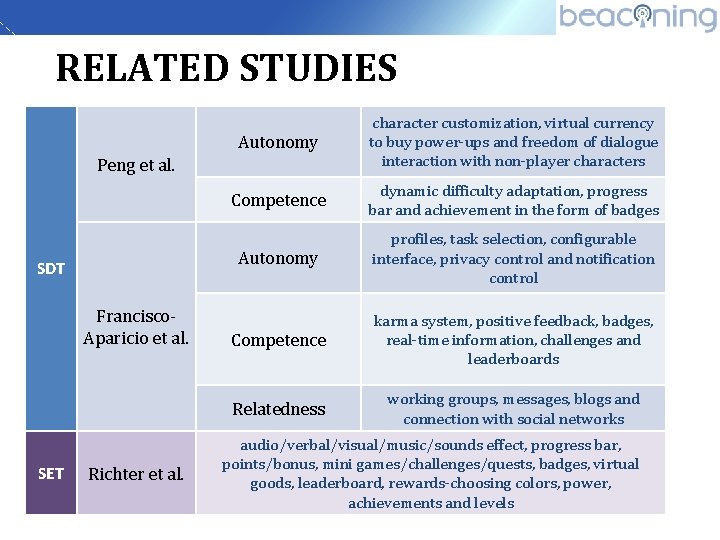
RELATED STUDIES Autonomy character customization, virtual currency to buy power-ups and freedom of dialogue interaction with non-player characters Competence dynamic difficulty adaptation, progress bar and achievement in the form of badges Autonomy profiles, task selection, configurable interface, privacy control and notification control Competence karma system, positive feedback, badges, real-time information, challenges and leaderboards Relatedness working groups, messages, blogs and connection with social networks Peng et al. SDT Francisco. Aparicio et al. SET Richter et al. audio/verbal/visual/music/sounds effect, progress bar, points/bonus, mini games/challenges/quests, badges, virtual goods, leaderboard, rewards-choosing colors, power, achievements and levels
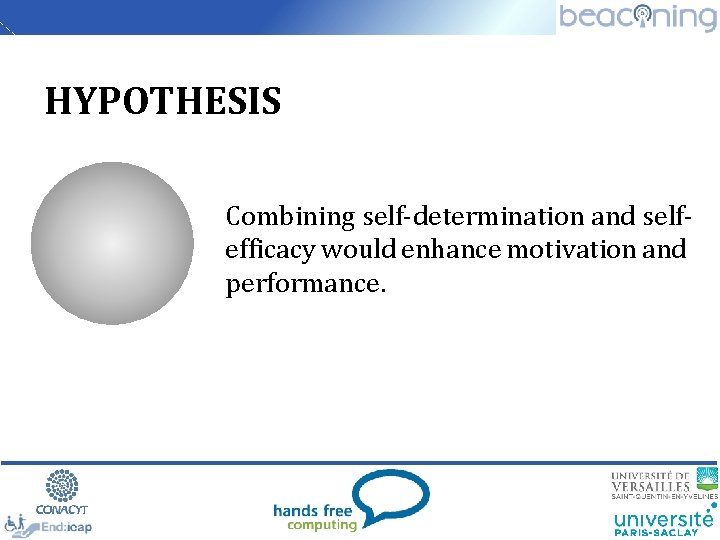
HYPOTHESIS Combining self-determination and selfefficacy would enhance motivation and performance.
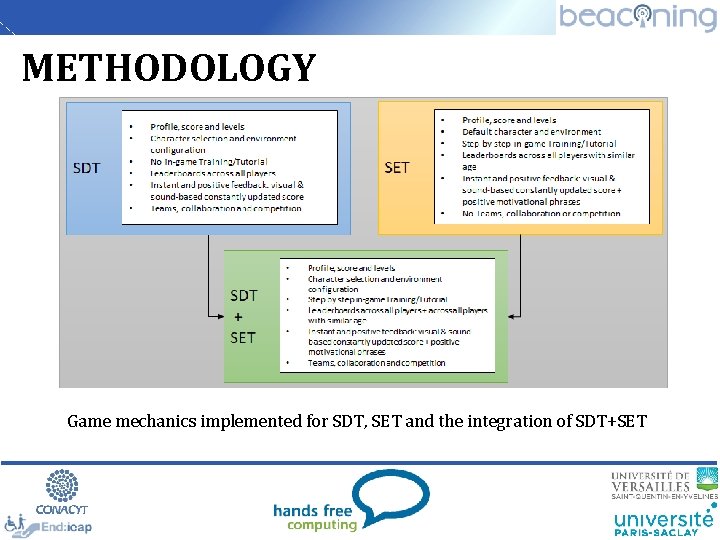
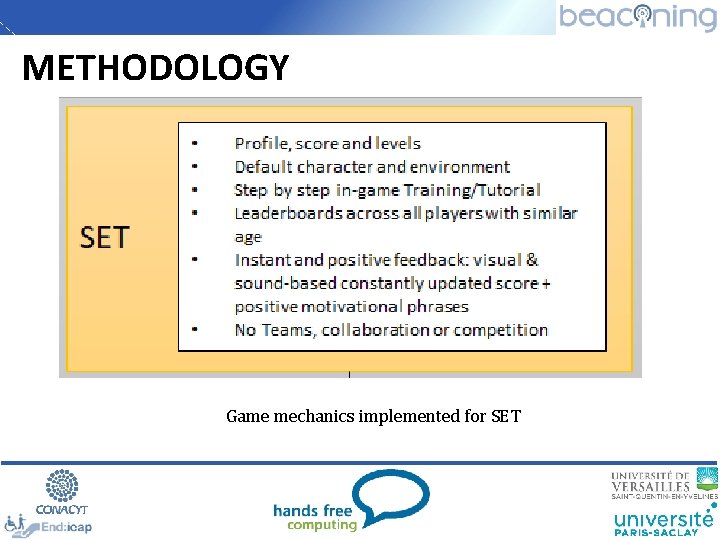
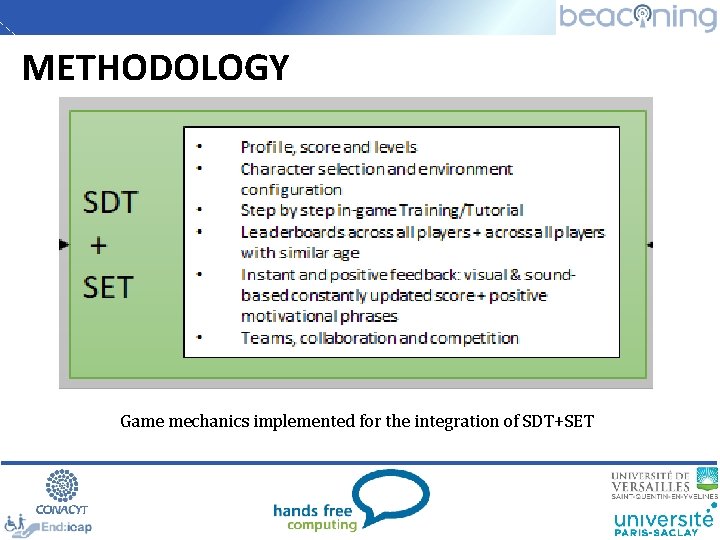
METHODOLOGY Game mechanics implemented for SDT, SET and the integration of SDT+SET
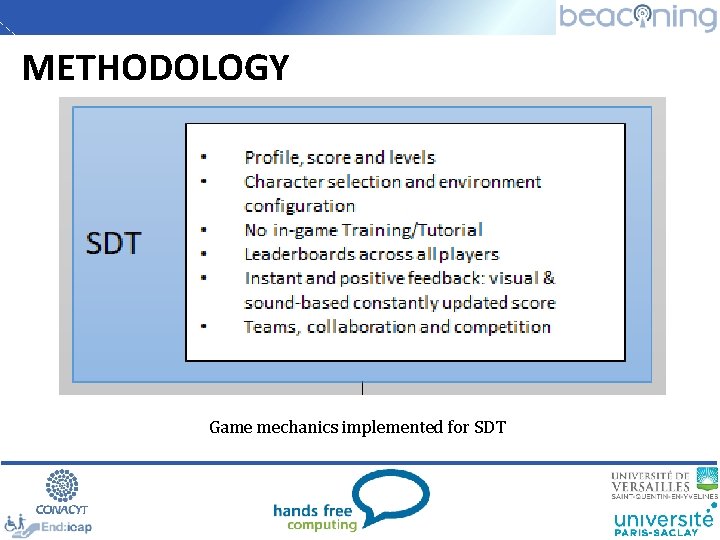
METHODOLOGY Game mechanics implemented for SDT
METHODOLOGY Game mechanics implemented for SET
METHODOLOGY Game mechanics implemented for the integration of SDT+SET
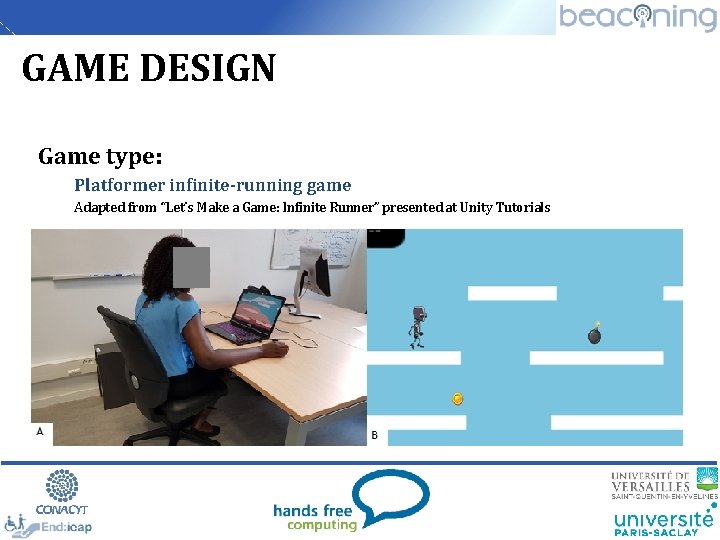
GAME DESIGN Game type: Platformer infinite-running game Adapted from “Let’s Make a Game: Infinite Runner” presented at Unity Tutorials
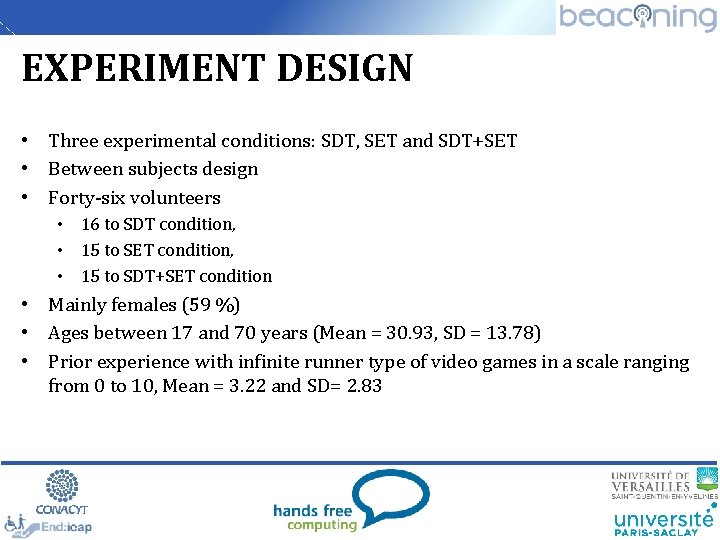
EXPERIMENT DESIGN • Three experimental conditions: SDT, SET and SDT+SET • Between subjects design • Forty-six volunteers • 16 to SDT condition, • 15 to SET condition, • 15 to SDT+SET condition • Mainly females (59 %) • Ages between 17 and 70 years (Mean = 30. 93, SD = 13. 78) • Prior experience with infinite runner type of video games in a scale ranging from 0 to 10, Mean = 3. 22 and SD= 2. 83
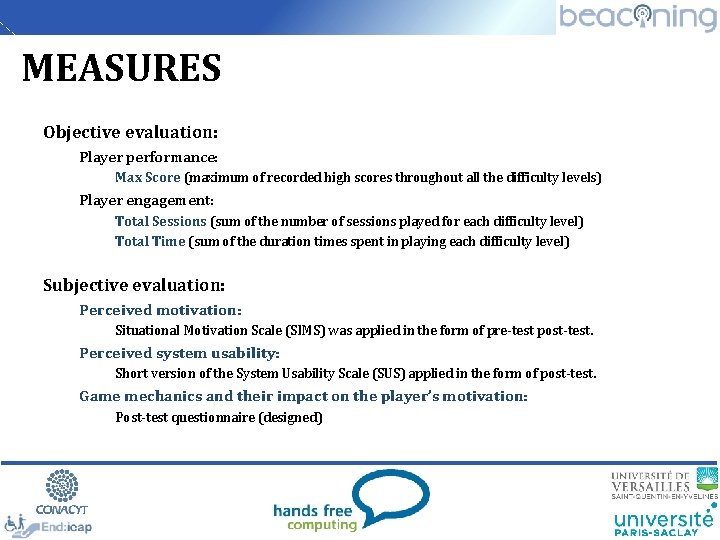
MEASURES Objective evaluation: Player performance: Max Score (maximum of recorded high scores throughout all the difficulty levels) Player engagement: Total Sessions (sum of the number of sessions played for each difficulty level) Total Time (sum of the duration times spent in playing each difficulty level) Subjective evaluation: Perceived motivation: Situational Motivation Scale (SIMS) was applied in the form of pre-test post-test. Perceived system usability: Short version of the System Usability Scale (SUS) applied in the form of post-test. Game mechanics and their impact on the player’s motivation: Post-test questionnaire (designed)
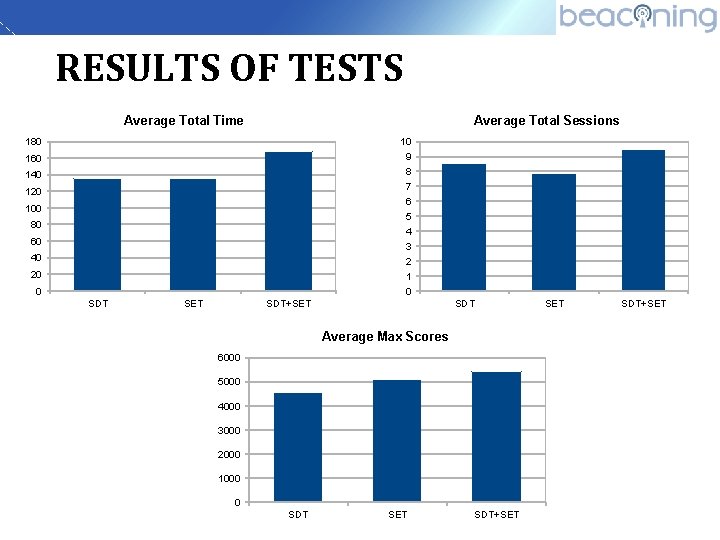
RESULTS OF TESTS Average Total Time Average Total Sessions 180 10 9 8 7 6 5 4 3 2 1 0 160 140 120 100 80 60 40 20 0 SDT SET SDT+SET SDT Average Max Scores 6000 5000 4000 3000 2000 1000 0 SDT SET SDT+SET
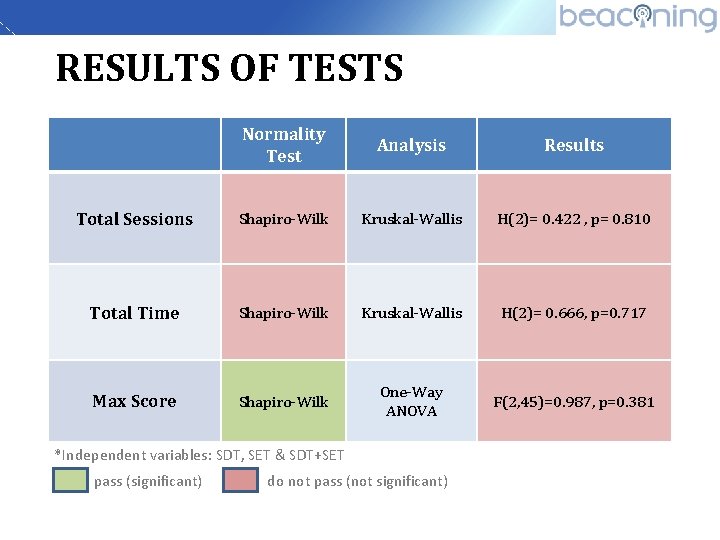
RESULTS OF TESTS Normality Test Analysis Results Total Sessions Shapiro-Wilk Kruskal-Wallis H(2)= 0. 422 , p= 0. 810 Total Time Shapiro-Wilk Kruskal-Wallis H(2)= 0. 666, p=0. 717 Max Score Shapiro-Wilk One-Way ANOVA F(2, 45)=0. 987, p=0. 381 *Independent variables: SDT, SET & SDT+SET pass (significant) do not pass (not significant)
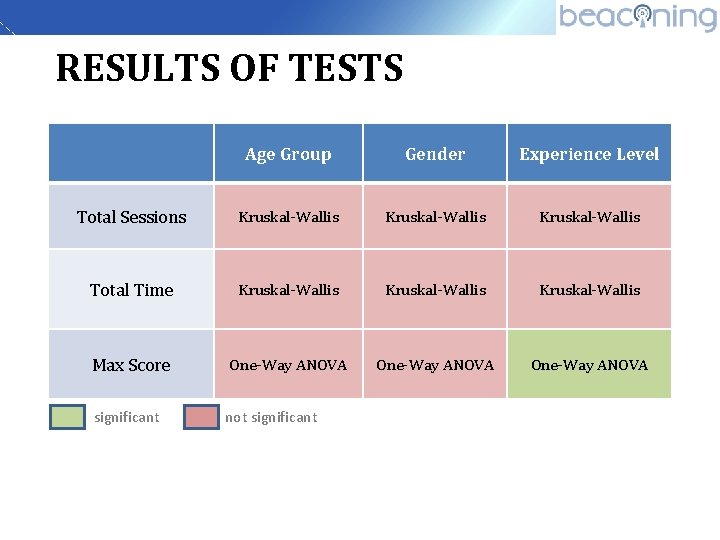
RESULTS OF TESTS Age Group Gender Experience Level Total Sessions Kruskal-Wallis Total Time Kruskal-Wallis Max Score One-Way ANOVA significant not significant
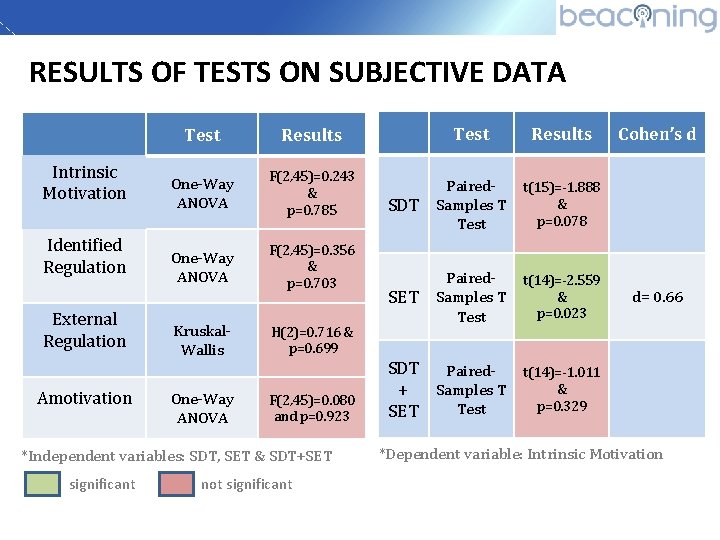
RESULTS OF TESTS ON SUBJECTIVE DATA Intrinsic Motivation Identified Regulation External Regulation Amotivation Test Results One-Way ANOVA F(2, 45)=0. 243 & p=0. 785 One-Way ANOVA F(2, 45)=0. 356 & p=0. 703 Kruskal. Wallis One-Way ANOVA H(2)=0. 716 & p=0. 699 F(2, 45)=0. 080 and p=0. 923 *Independent variables: SDT, SET & SDT+SET significant not significant Test Results SDT Paired. Samples T Test t(15)=-1. 888 & p=0. 078 SET Paired. Samples T Test t(14)=-2. 559 & p=0. 023 SDT Paired. Samples T + Test SET t(14)=-1. 011 & p=0. 329 Cohen’s d d= 0. 66 *Dependent variable: Intrinsic Motivation
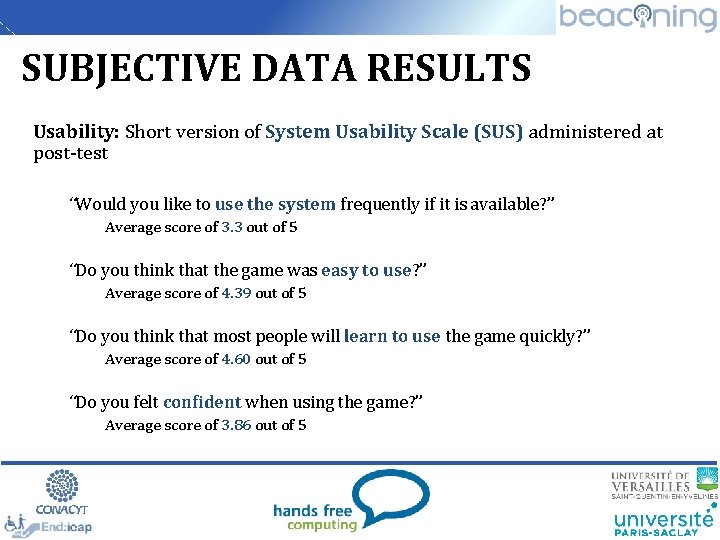
SUBJECTIVE DATA RESULTS Usability: Short version of System Usability Scale (SUS) administered at post-test “Would you like to use the system frequently if it is available? ” Average score of 3. 3 out of 5 “Do you think that the game was easy to use? ” Average score of 4. 39 out of 5 “Do you think that most people will learn to use the game quickly? ” Average score of 4. 60 out of 5 “Do you felt confident when using the game? ” Average score of 3. 86 out of 5
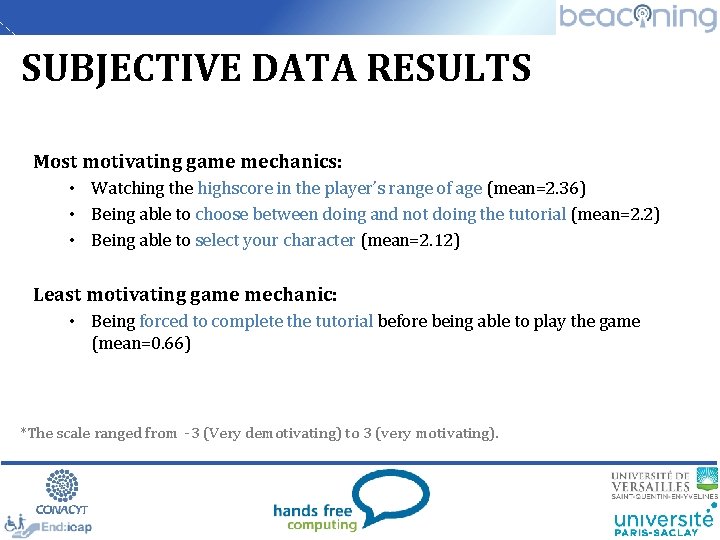
SUBJECTIVE DATA RESULTS Most motivating game mechanics: • Watching the highscore in the player’s range of age (mean=2. 36) • Being able to choose between doing and not doing the tutorial (mean=2. 2) • Being able to select your character (mean=2. 12) Least motivating game mechanic: • Being forced to complete the tutorial before being able to play the game (mean=0. 66) *The scale ranged from -3 (Very demotivating) to 3 (very motivating).
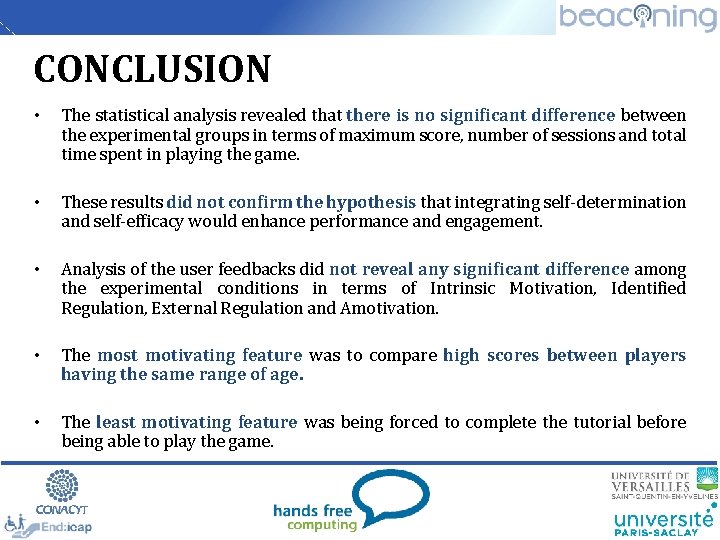
CONCLUSION • The statistical analysis revealed that there is no significant difference between the experimental groups in terms of maximum score, number of sessions and total time spent in playing the game. • These results did not confirm the hypothesis that integrating self-determination and self-efficacy would enhance performance and engagement. • Analysis of the user feedbacks did not reveal any significant difference among the experimental conditions in terms of Intrinsic Motivation, Identified Regulation, External Regulation and Amotivation. • The most motivating feature was to compare high scores between players having the same range of age. • The least motivating feature was being forced to complete the tutorial before being able to play the game.
RESEARCH PERSPECTIVES • Bigger sample size of subjects should be involved. • Multiple games could be included for allowing the participants to choose among them, in order to increase their sense of autonomy. • Additional indicators, such as emotion recognition should be included to evaluate the effect of the emotional state of the user during the gameplay.
REFERENCES [1] R. Ryan and E. Deci, “Self-determination theory and the facilitation of intrinsic motivation, social development, and well-being. , ” Am. Psychol. , vol. 55, no. 1, pp. 68– 78, (2000). [2] R. Ryan and E. Deci, “Self-determination theory: An organismic dialectical perspective, ” Handb. Self-Determination Res. , pp. 3– 33, (2002). [3] E. L. Deci and R. M. Ryan, “Self-determination theory-A macrotheory of human motivation, development and health, ” Can. Psychol. , vol. 49, no. 3, pp. 182– 185, (2008). [4] A. Bandura, “Self-efficacy: Toward a unifying theory of behavioral change, ” Psychol. Rev. , vol. 84, no. 2, pp. 191– 215, (1977). [5] W. Peng, J. H. Lin, K. A. Pfeiffer, and B. Winn, “Need Satisfaction Supportive Game Features as Motivational Determinants: An Experimental Study of a Self-Determination Theory Guided Exergame, ” Media Psychol. , vol. 15, no. 2, pp. 175– 196, (2012). [6] A. Francisco-Aparicio, F. L. Gutiérrez-Vela, J. L. Isla-Montes, and J. L. G. Sanchez, “Gamification: Analysis and Application”, pp. 113– 126, (2013). [7] G. Richter, D. R. Raban, and S. Rafaeli, “Studying Gamification: The Effect of Rewards and Incentives on Motivation, ” in Gamification in Education and Business, Cham: Springer International Publishing, pp. 21– 46, (2015).
THANK YOU! Contact: hossein. jamshidifarsani@uvsq. fr paul. tamayo-serrano@uvsq. fr