
Integrating Radiation Monitoring System for the ATLAS Detector
- Slides: 18
Integrating Radiation Monitoring System for the ATLAS Detector at the Large Hadron Collider Igor Mandić1, Vladimir Cindro 1, Gregor Kramberger 1 and Marko Mikuž 1, 2 1 Jožef Stefan Institute, Ljubljana, Slovenia 2 Faculty of Mathematics and Physics, University of Ljubljana, Slovenia I. Mandić, RADECS 06, Athens, Greece 1
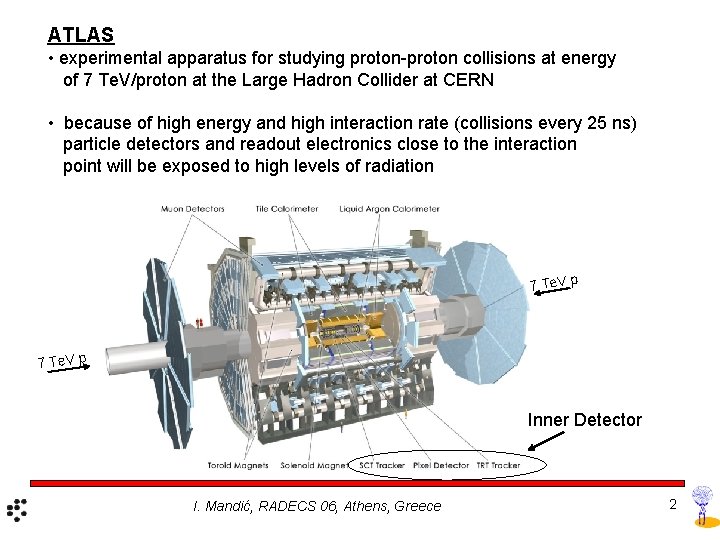
ATLAS • experimental apparatus for studying proton-proton collisions at energy of 7 Te. V/proton at the Large Hadron Collider at CERN • because of high energy and high interaction rate (collisions every 25 ns) particle detectors and readout electronics close to the interaction point will be exposed to high levels of radiation 7 Te. V p Inner Detector I. Mandić, RADECS 06, Athens, Greece 2
Radiation levels in the Inner Detector • detectors and electronics will be exposed to radiation arising from primary vertex (mostly pions) and to neutrons arising from interactions of hadrons with detector material • in 10 years of operation parts of inner detector will be exposed to ionization dose of more than 100 k. Gy and to fluence of hadrons causing bulk damage in silicon equivalent to more than 1015 /cm 2 of 1 Me. V neutrons • fluence of thermal neutrons of same magnitude as the fluence of fast neutrons radiation damage will degrade performance of detectors and readout electronics monitoring of radiation levels needed to understand detector performance cross check of simulations of radiation levels to correctly predict damage I. Mandić, RADECS 06, Athens, Greece 3
Radiation Monitor for the Inner Detector Ø online radiation monitoring system Ø measure ionization dose and bulk damage at 14 locations in the inner detector Ø range up to 100 k. Gy and 1015 n/cm 2 Ø sufficient sensitivity for initial low luminosity years of LHC operation (~ 1. 4 % of planned integrated luminosity per low-luminosity year) during low luminosity years at least exposed monitoring location in the ID doses per day will be ~ 1 Gy and ~ 1010 n/cm 2 required sensitivity I. Mandić, RADECS 06, Athens, Greece 4
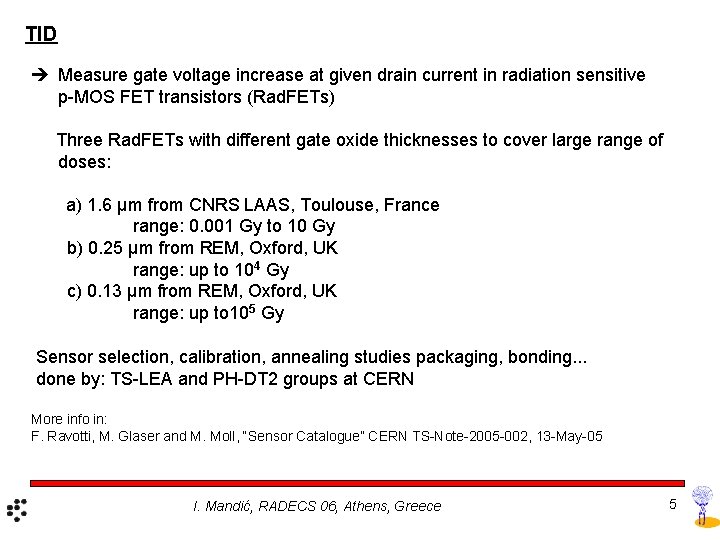
TID Measure gate voltage increase at given drain current in radiation sensitive p-MOS FET transistors (Rad. FETs) Three Rad. FETs with different gate oxide thicknesses to cover large range of doses: a) 1. 6 µm from CNRS LAAS, Toulouse, France range: 0. 001 Gy to 10 Gy b) 0. 25 µm from REM, Oxford, UK range: up to 104 Gy c) 0. 13 µm from REM, Oxford, UK range: up to 105 Gy Sensor selection, calibration, annealing studies packaging, bonding. . . done by: TS-LEA and PH-DT 2 groups at CERN More info in: F. Ravotti, M. Glaser and M. Moll, “Sensor Catalogue” CERN TS-Note-2005 -002, 13 -May-05 I. Mandić, RADECS 06, Athens, Greece 5
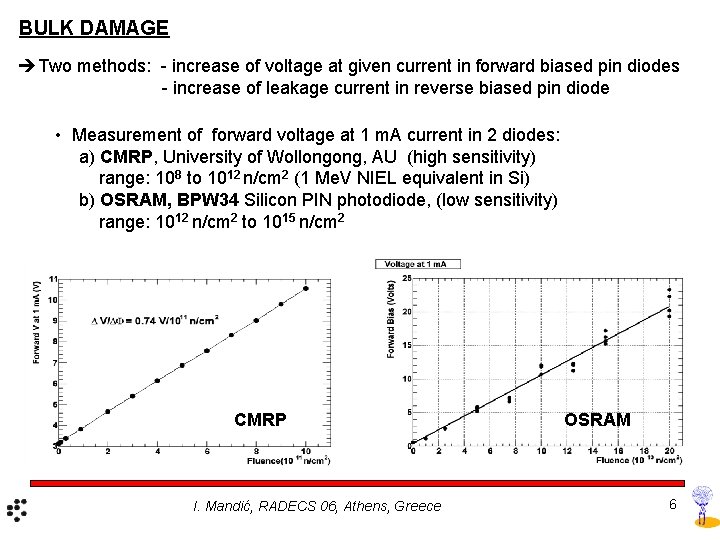
BULK DAMAGE Two methods: - increase of voltage at given current in forward biased pin diodes - increase of leakage current in reverse biased pin diode • Measurement of forward voltage at 1 m. A current in 2 diodes: a) CMRP, University of Wollongong, AU (high sensitivity) range: 108 to 1012 n/cm 2 (1 Me. V NIEL equivalent in Si) b) OSRAM, BPW 34 Silicon PIN photodiode, (low sensitivity) range: 1012 n/cm 2 to 1015 n/cm 2 CMRP I. Mandić, RADECS 06, Athens, Greece OSRAM 6
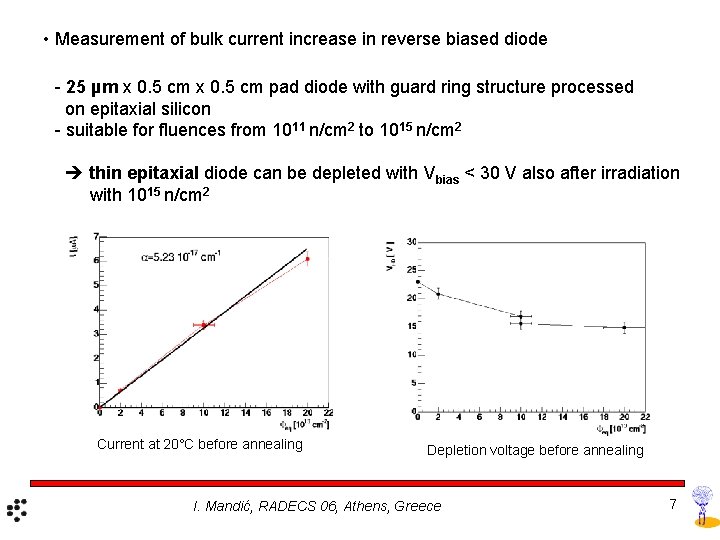
• Measurement of bulk current increase in reverse biased diode - 25 µm x 0. 5 cm pad diode with guard ring structure processed on epitaxial silicon - suitable for fluences from 1011 n/cm 2 to 1015 n/cm 2 thin epitaxial diode can be depleted with Vbias < 30 V also after irradiation with 1015 n/cm 2 Current at 20°C before annealing Depletion voltage before annealing I. Mandić, RADECS 06, Athens, Greece 7
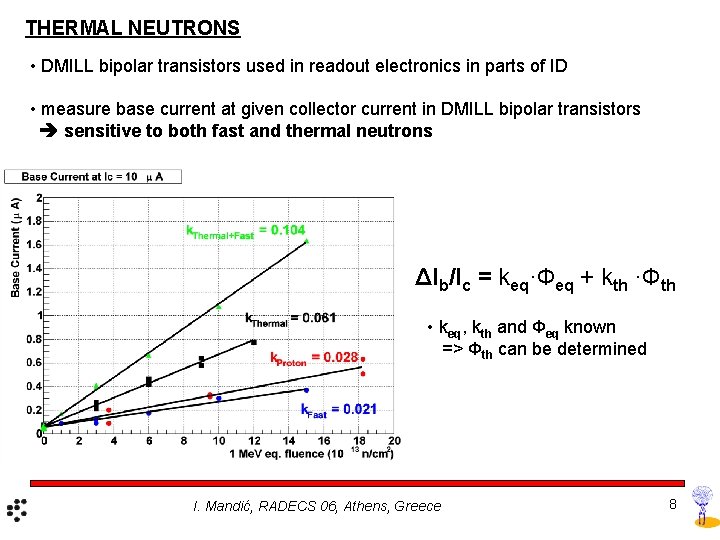
THERMAL NEUTRONS • DMILL bipolar transistors used in readout electronics in parts of ID • measure base current at given collector current in DMILL bipolar transistors sensitive to both fast and thermal neutrons ΔIb/Ic = keq·Фeq + kth ·Фth • keq, kth and Фeq known => Фth can be determined I. Mandić, RADECS 06, Athens, Greece 8
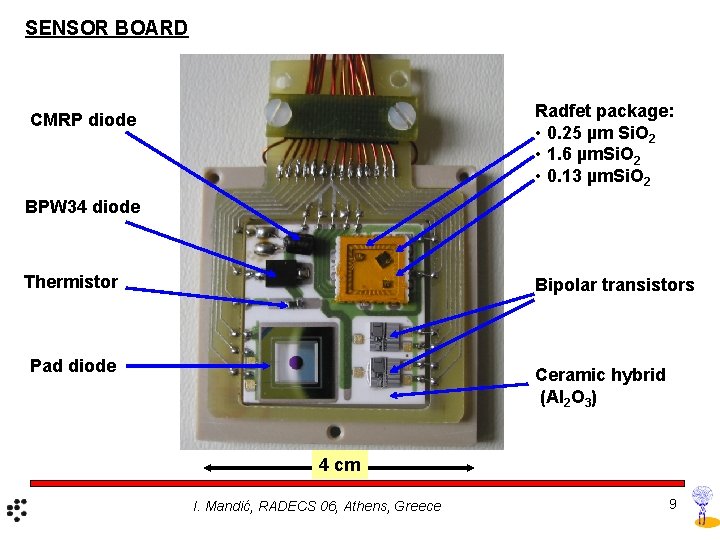
SENSOR BOARD Radfet package: • 0. 25 µm Si. O 2 • 1. 6 µm. Si. O 2 • 0. 13 µm. Si. O 2 CMRP diode BPW 34 diode Thermistor Bipolar transistors Pad diode Ceramic hybrid (Al 2 O 3) 4 cm I. Mandić, RADECS 06, Athens, Greece 9
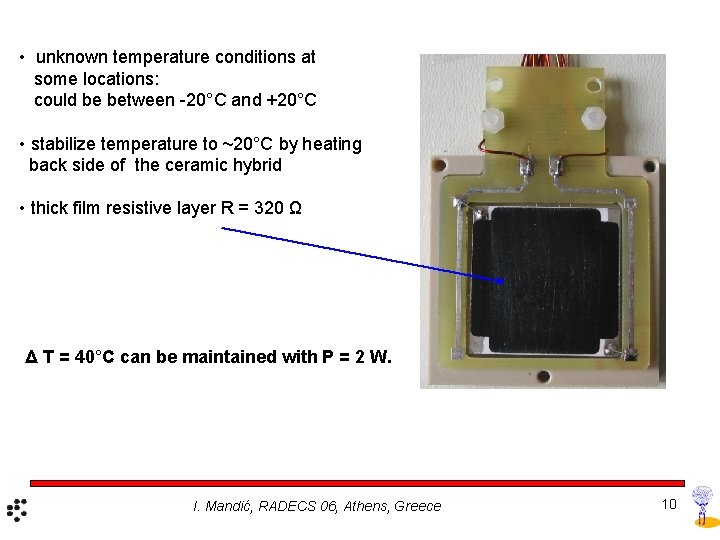
• unknown temperature conditions at some locations: could be between -20°C and +20°C • stabilize temperature to ~20°C by heating back side of the ceramic hybrid • thick film resistive layer R = 320 Ω Δ T = 40°C can be maintained with P = 2 W. I. Mandić, RADECS 06, Athens, Greece 10
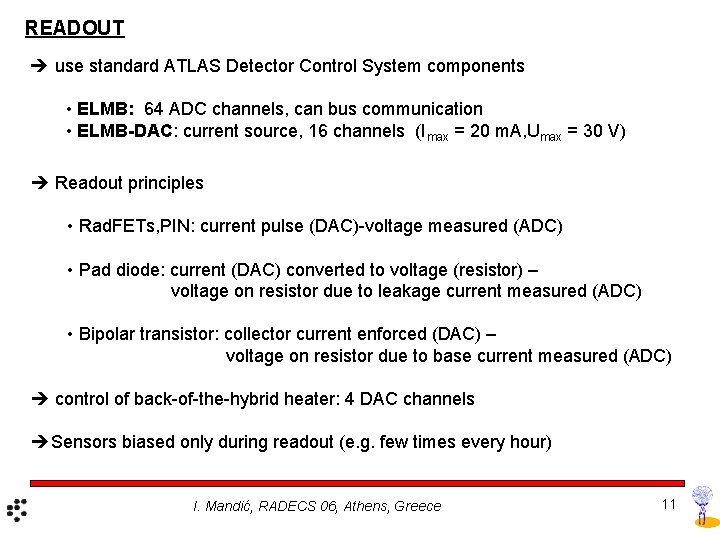
READOUT use standard ATLAS Detector Control System components • ELMB: 64 ADC channels, can bus communication • ELMB-DAC: current source, 16 channels (Imax = 20 m. A, Umax = 30 V) Readout principles • Rad. FETs, PIN: current pulse (DAC)-voltage measured (ADC) • Pad diode: current (DAC) converted to voltage (resistor) – voltage on resistor due to leakage current measured (ADC) • Bipolar transistor: collector current enforced (DAC) – voltage on resistor due to base current measured (ADC) control of back-of-the-hybrid heater: 4 DAC channels Sensors biased only during readout (e. g. few times every hour) I. Mandić, RADECS 06, Athens, Greece 11
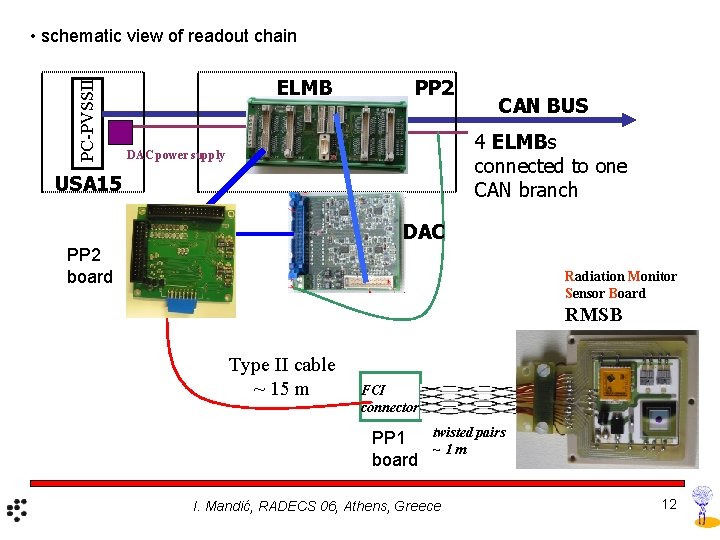
PC-PVSSII • schematic view of readout chain ELMB PP 2 CAN BUS 4 ELMBs connected to one CAN branch DAC power supply USA 15 DAC PP 2 board Radiation Monitor Sensor Board RMSB Type II cable ~ 15 m FCI connector PP 1 board twisted pairs ~1 m I. Mandić, RADECS 06, Athens, Greece 12
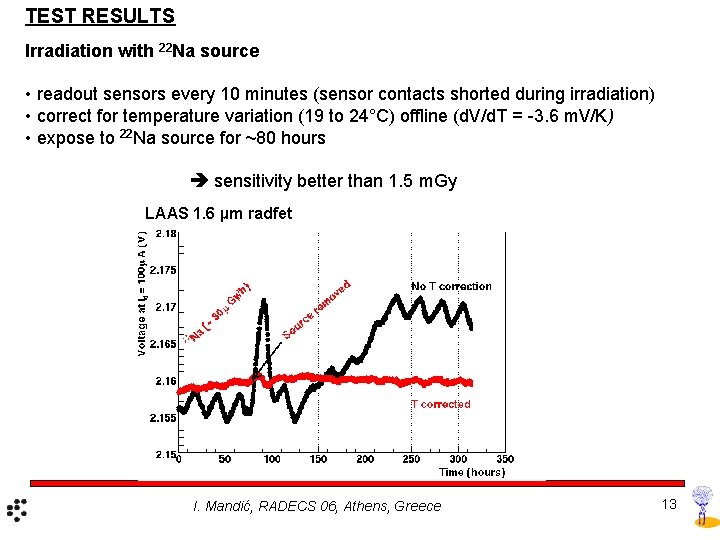
TEST RESULTS Irradiation with 22 Na source • readout sensors every 10 minutes (sensor contacts shorted during irradiation) • correct for temperature variation (19 to 24°C) offline (d. V/d. T = -3. 6 m. V/K) • expose to 22 Na source for ~80 hours sensitivity better than 1. 5 m. Gy LAAS 1. 6 µm radfet I. Mandić, RADECS 06, Athens, Greece 13
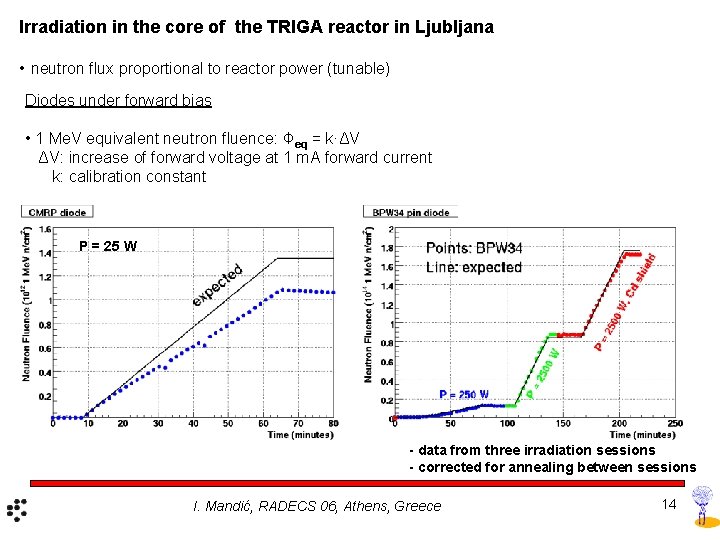
Irradiation in the core of the TRIGA reactor in Ljubljana • neutron flux proportional to reactor power (tunable) Diodes under forward bias • 1 Me. V equivalent neutron fluence: Фeq = k·ΔV ΔV: increase of forward voltage at 1 m. A forward current k: calibration constant P = 25 W - data from three irradiation sessions - corrected for annealing between sessions I. Mandić, RADECS 06, Athens, Greece 14
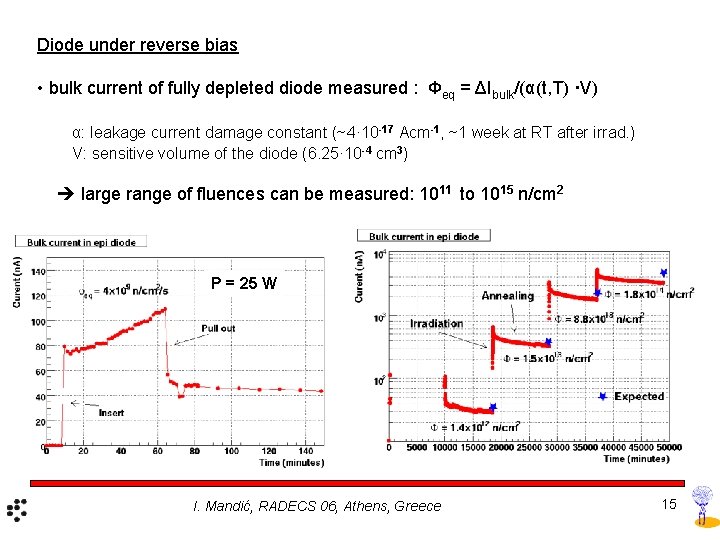
Diode under reverse bias • bulk current of fully depleted diode measured : Фeq = ΔIbulk/(α(t, T) ·V) α: leakage current damage constant (~4· 10 -17 Acm-1, ~1 week at RT after irrad. ) V: sensitive volume of the diode (6. 25· 10 -4 cm 3) large range of fluences can be measured: 1011 to 1015 n/cm 2 P = 25 W I. Mandić, RADECS 06, Athens, Greece 15
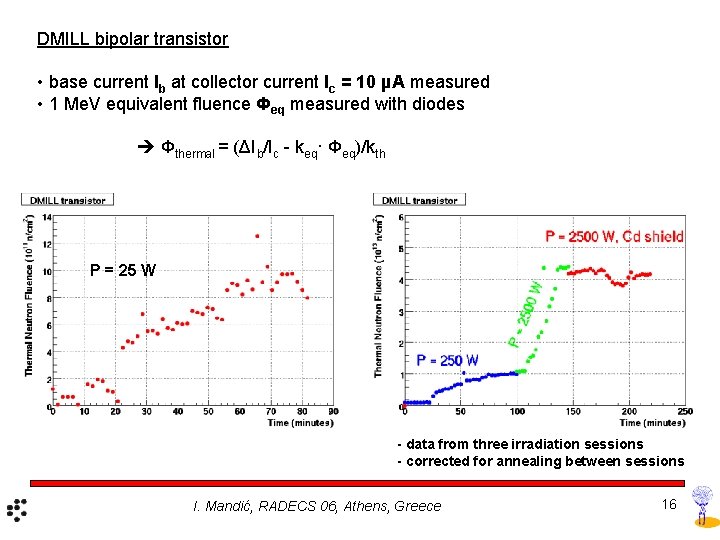
DMILL bipolar transistor • base current Ib at collector current Ic = 10 µA measured • 1 Me. V equivalent fluence Фeq measured with diodes Фthermal = (ΔIb/Ic - keq· Фeq)/kth P = 25 W - data from three irradiation sessions - corrected for annealing between sessions I. Mandić, RADECS 06, Athens, Greece 16
Summary • system for online radiation monitoring in ATLAS Inner Detector: Ø total ionization dose in Si 02, Ø bulk damage in silicon in terms of 1 Me. V equivalent neutron fluence, Ø fluence of thermal neutrons Ø readout compatible with ATLAS Detector Control System Ø sufficient sensitivity for low luminosity years of ATLAS • locations outside of the Inner Detector (lower doses): Ø use simpler system with one LAAS radfet and CMRP diode per location • to improve accuracy: Ø irradiations in mixed field environment at low dose rates Ø annealing studies help of TS-LEA and PH-DT 2 groups at CERN, see contributions by F. Ravotti et al. , (papers PH-2, PH-3) I. Mandić, RADECS 06, Athens, Greece 17
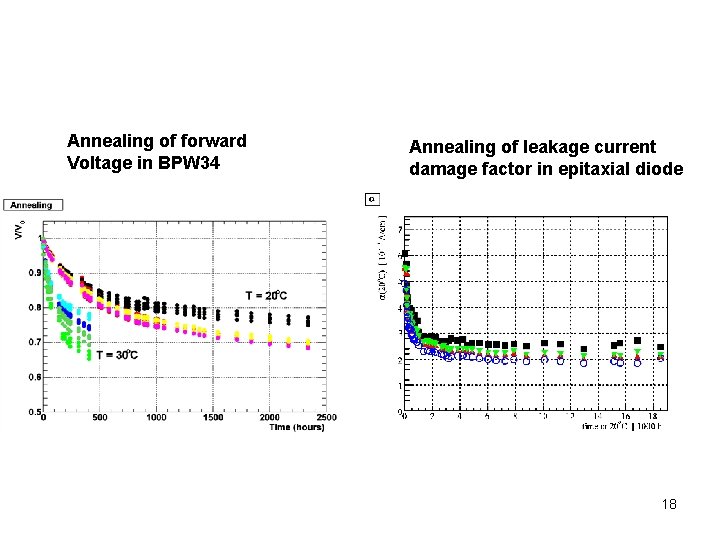
Annealing of forward Voltage in BPW 34 Annealing of leakage current damage factor in epitaxial diode 18