
INTEGRATING QUOTATIONS APA INTEXT CITATIONS The info you


- Slides: 15
INTEGRATING QUOTATIONS (APA)
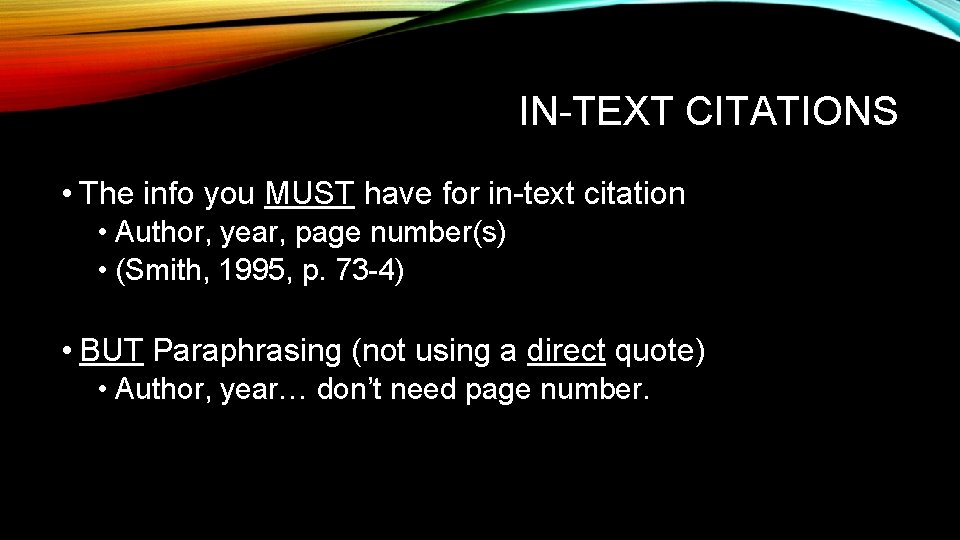
IN-TEXT CITATIONS • The info you MUST have for in-text citation • Author, year, page number(s) • (Smith, 1995, p. 73 -4) • BUT Paraphrasing (not using a direct quote) • Author, year… don’t need page number.
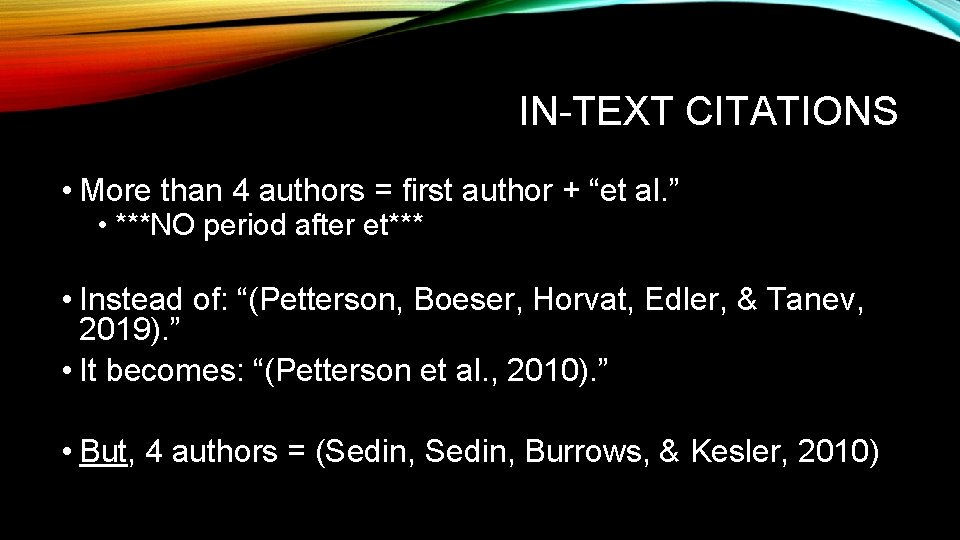
IN-TEXT CITATIONS • More than 4 authors = first author + “et al. ” • ***NO period after et*** • Instead of: “(Petterson, Boeser, Horvat, Edler, & Tanev, 2019). ” • It becomes: “(Petterson et al. , 2010). ” • But, 4 authors = (Sedin, Burrows, & Kesler, 2010)
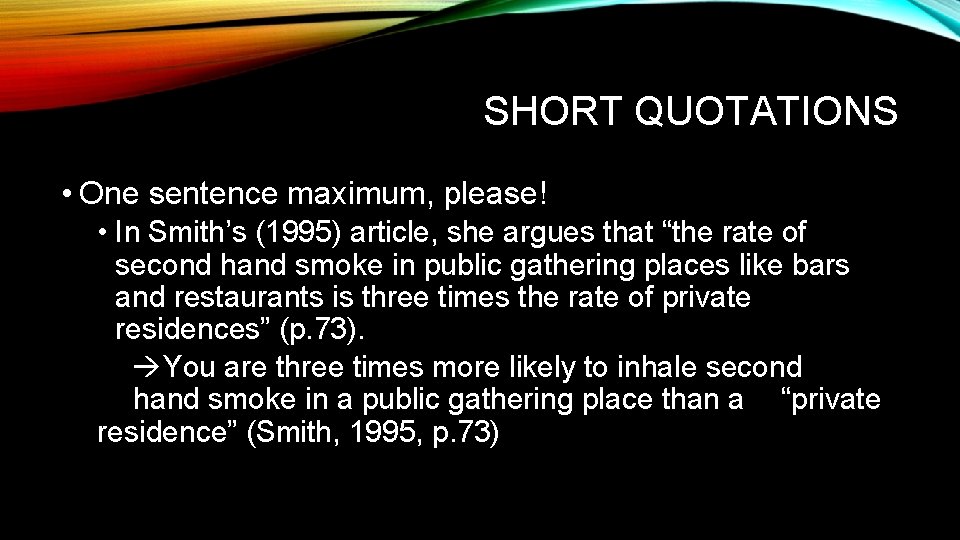
SHORT QUOTATIONS • One sentence maximum, please! • In Smith’s (1995) article, she argues that “the rate of second hand smoke in public gathering places like bars and restaurants is three times the rate of private residences” (p. 73). You are three times more likely to inhale second hand smoke in a public gathering place than a “private residence” (Smith, 1995, p. 73)
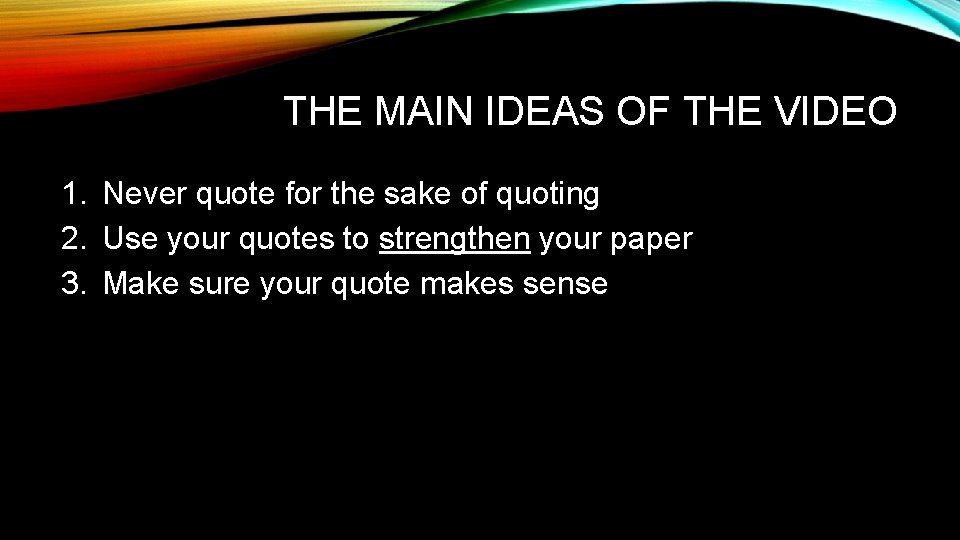
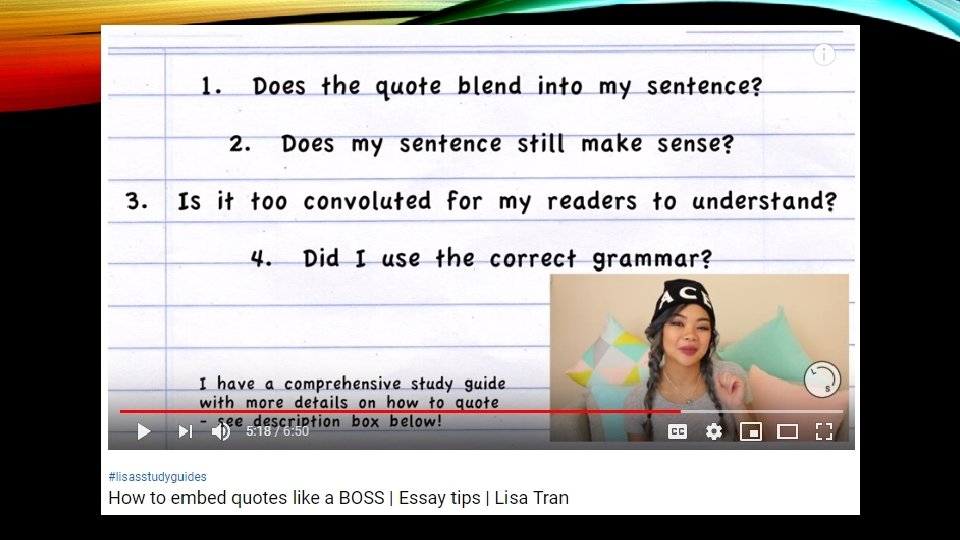
THE MAIN IDEAS OF THE VIDEO 1. Never quote for the sake of quoting 2. Use your quotes to strengthen your paper 3. Make sure your quote makes sense
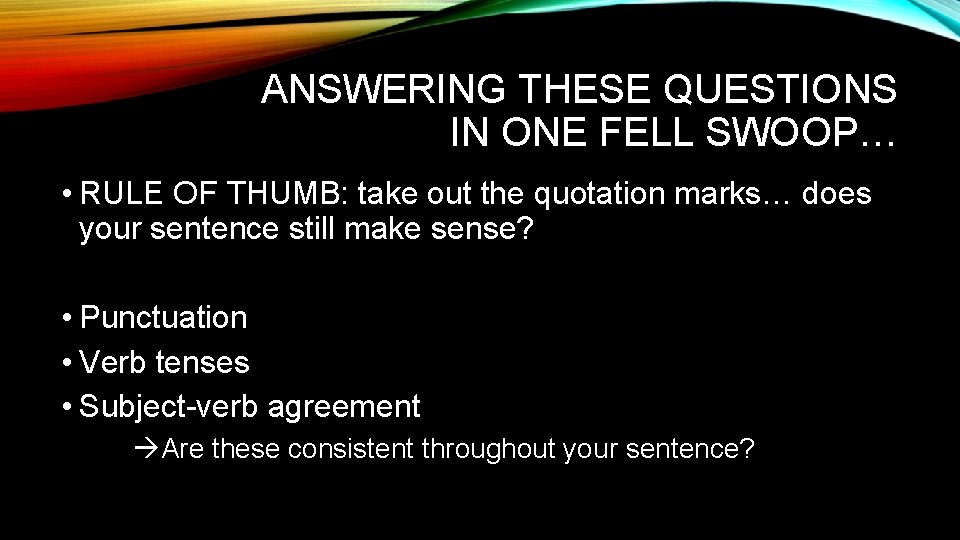
ANSWERING THESE QUESTIONS IN ONE FELL SWOOP… • RULE OF THUMB: take out the quotation marks… does your sentence still make sense? • Punctuation • Verb tenses • Subject-verb agreement Are these consistent throughout your sentence?
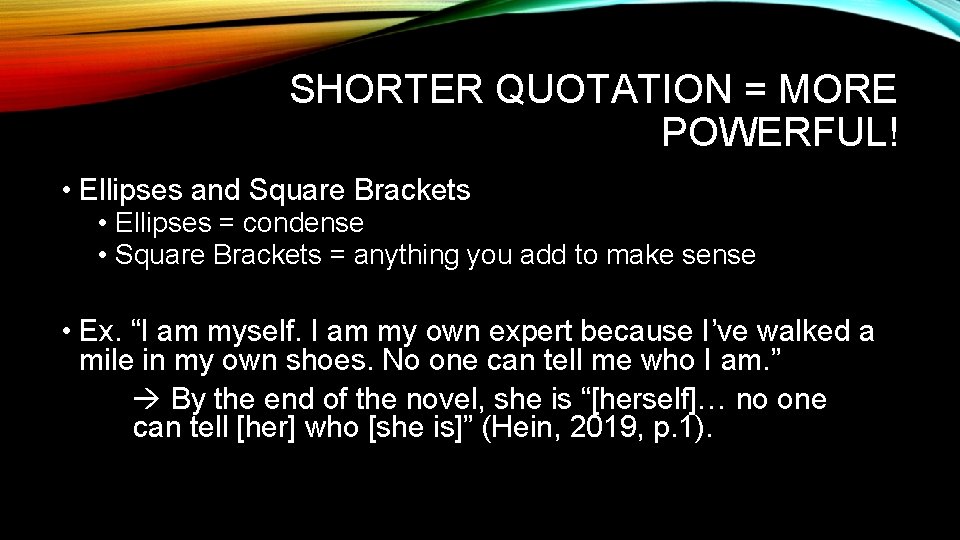
SHORTER QUOTATION = MORE POWERFUL! • Ellipses and Square Brackets • Ellipses = condense • Square Brackets = anything you add to make sense • Ex. “I am myself. I am my own expert because I’ve walked a mile in my own shoes. No one can tell me who I am. ” By the end of the novel, she is “[herself]… no one can tell [her] who [she is]” (Hein, 2019, p. 1).
QUALITY OF QUOTES, NOT QUANTITY OF QUOTES • “Never quote for the sake of quoting, ” because your teacher isn’t looking for “ 4 quotes per paragraph” (Tran, 2016). • Use a quote only when… 1. The writer’s words are more memorable and interesting 2. The writer’s language can better convey an idea than you can 3. You want to add authority to your paper
PARAPHRASING = NO DIRECT QUOTATION • “The rate of second hand smoke in public gathering places like bars and restaurants is three times the rate of private residences” (Smith, 1995, p. 73). Can become… According to Smith (1995), second hand smoke is three times stronger in public gathering places than in private residences.
THREE TYPES OF QUOTE INTEGRATION 1. Begin with quote (not strong) • “She always felt the center of her heart go hard” demonstrates how Mrs. Wilmot appears a loving mother to the rest of the world, while inwardly feeling little for her children (120). 2. Begin with explanation (stronger) • Even though Mrs. Wilmot appears to love her children to the rest of the world, “when her children were present, she always felt the center of her heart go hard” (120). 3. Quote inserted in the middle (strongest) • Mrs. Wilmot “always felt the center of heart go hard” when her children were present, but to the rest of the world, she appears to be a loving mother.
2 MINUTE STRETCH • On one condition: • Come back, phones away, notes out
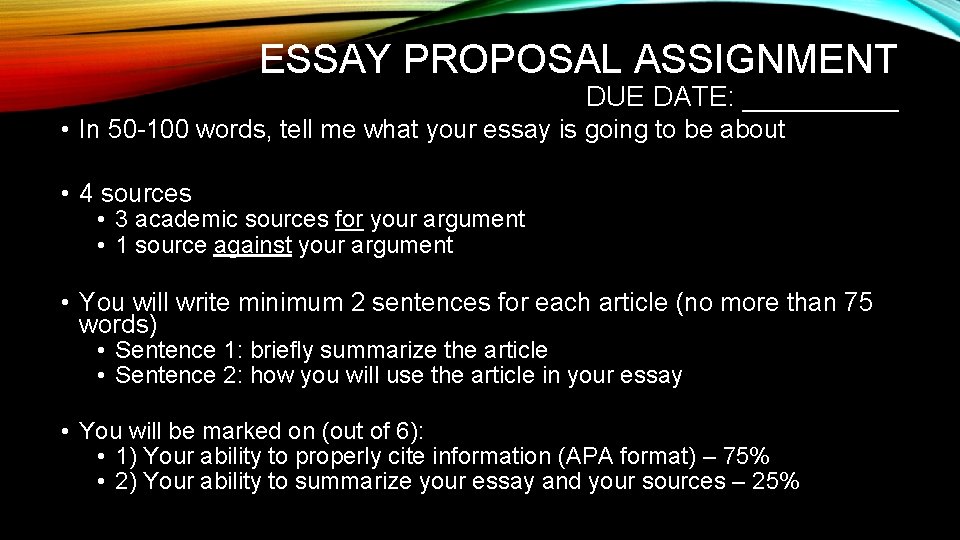
ESSAY PROPOSAL ASSIGNMENT DUE DATE: _____ • In 50 -100 words, tell me what your essay is going to be about • 4 sources • 3 academic sources for your argument • 1 source against your argument • You will write minimum 2 sentences for each article (no more than 75 words) • Sentence 1: briefly summarize the article • Sentence 2: how you will use the article in your essay • You will be marked on (out of 6): • 1) Your ability to properly cite information (APA format) – 75% • 2) Your ability to summarize your essay and your sources – 25%
• My first essay proposal, English 135 @ UVic