
Integrating New Findings into the Complementary Learning Systems




- Slides: 49
Integrating New Findings into the Complementary Learning Systems Theory of Memory Jay Mc. Clelland, Stanford University
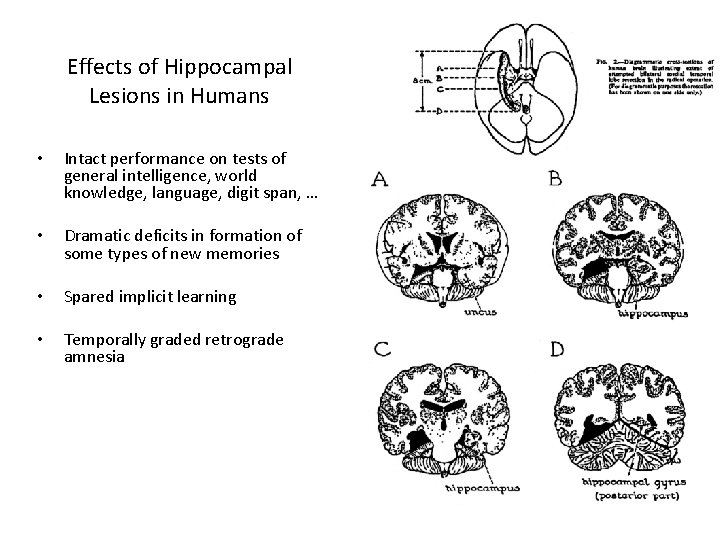
Effects of Hippocampal Lesions in Humans • Intact performance on tests of general intelligence, world knowledge, language, digit span, … • Dramatic deficits in formation of some types of new memories • Spared implicit learning • Temporally graded retrograde amnesia • l
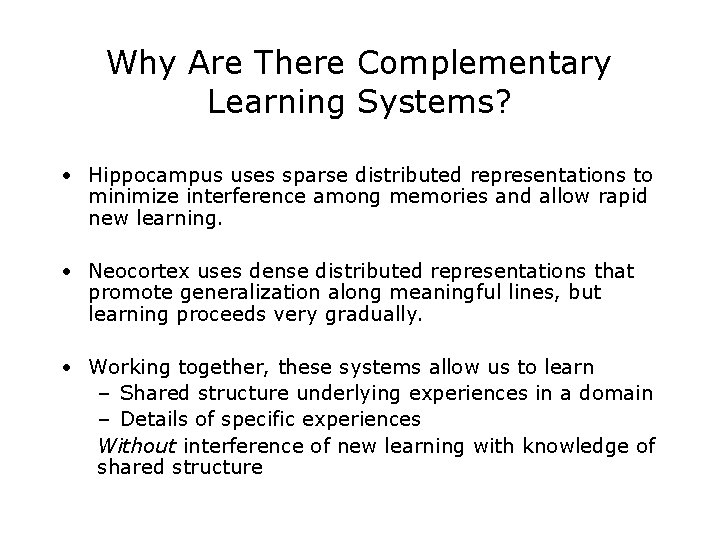
Why Are There Complementary Learning Systems? • Hippocampus uses sparse distributed representations to minimize interference among memories and allow rapid new learning. • Neocortex uses dense distributed representations that promote generalization along meaningful lines, but learning proceeds very gradually. • Working together, these systems allow us to learn – Shared structure underlying experiences in a domain – Details of specific experiences Without interference of new learning with knowledge of shared structure
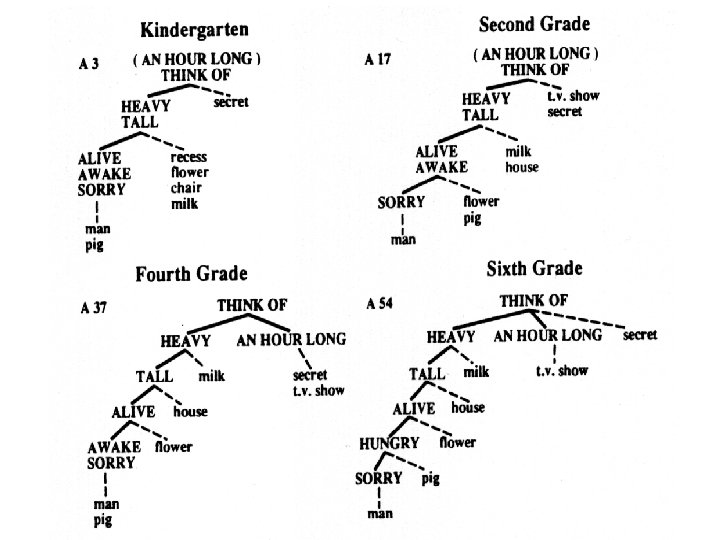
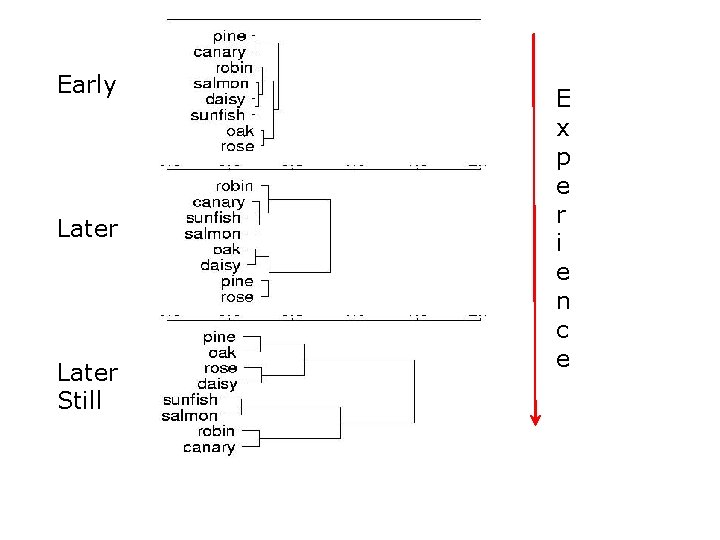
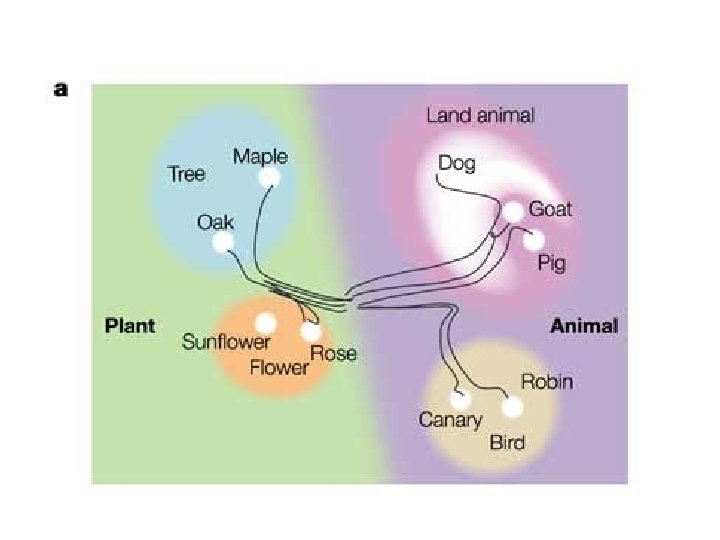
A model of neocortical learning (Rumelhart, 1990; Mc. C et al. 1995) • Relies on distributed representations capturing aspects of meaning that emerge through a very gradual learning process • The progression of learning and the representations formed capture many aspects of cognitive development – Differentiation of concept representations – Generalization of learning to new concepts – llusory correlations and overgeneralization – Domain-specific variation in importance of feature dimensions – Reorganization of conceptual knowledge
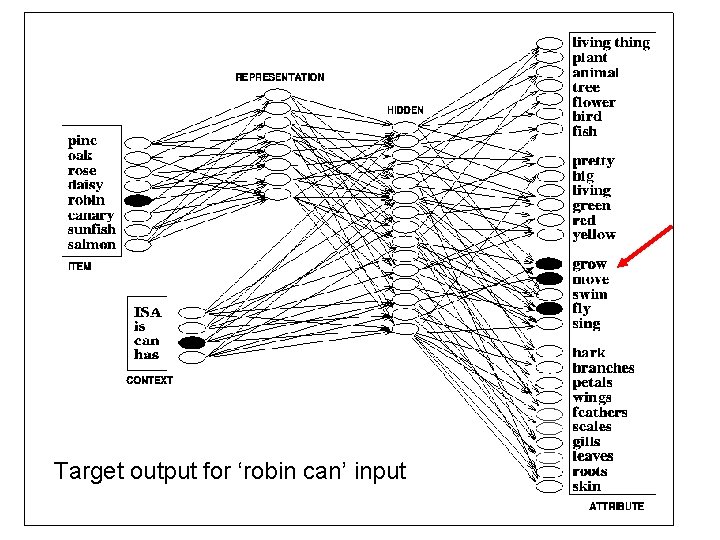
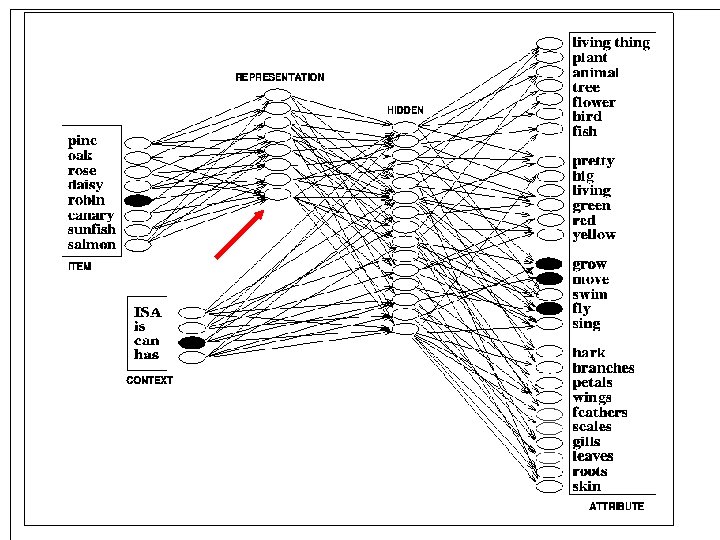
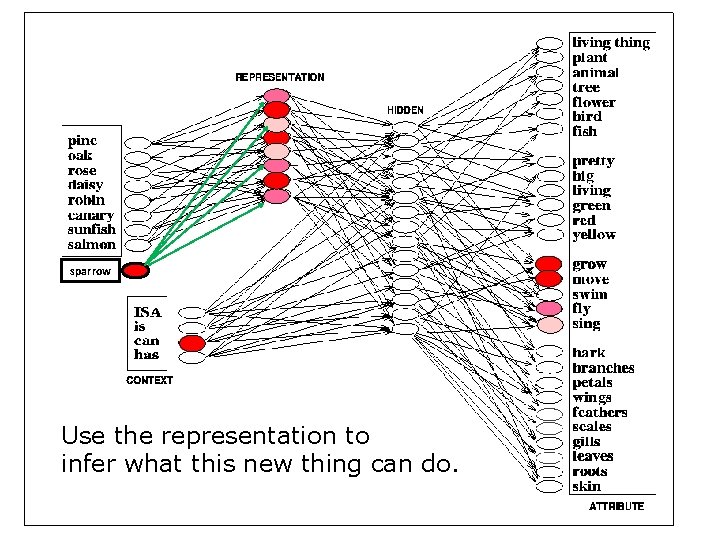
The Rumelhart Model
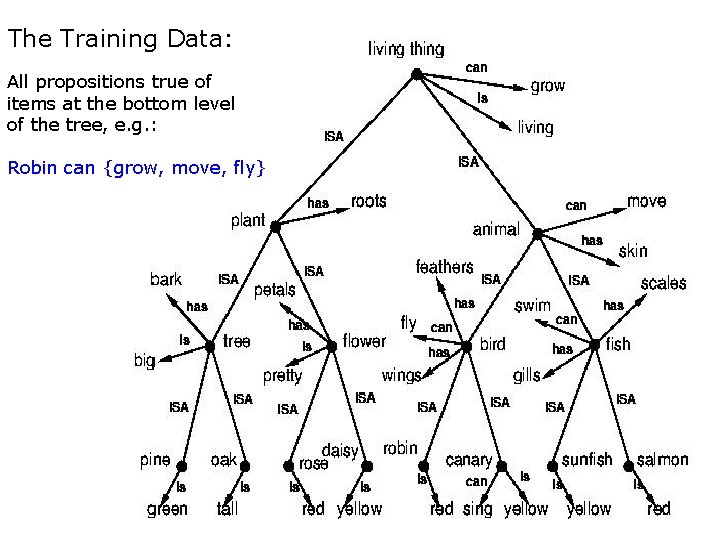
The Training Data: All propositions true of items at the bottom level of the tree, e. g. : Robin can {grow, move, fly}
Target output for ‘robin can’ input
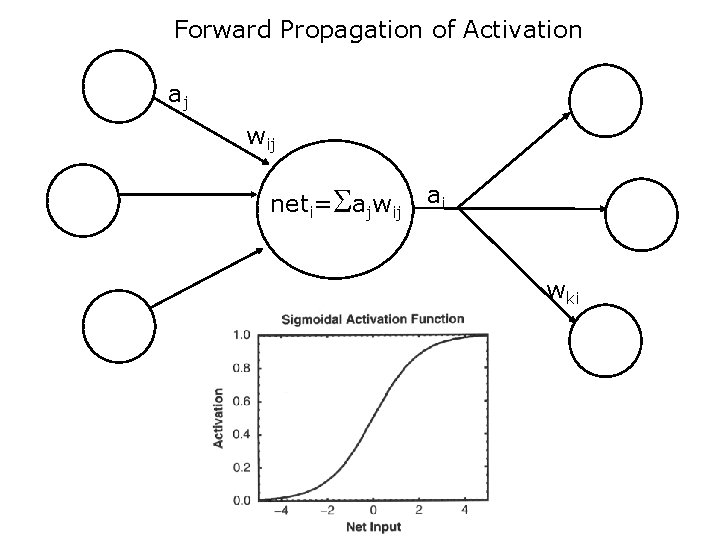
Forward Propagation of Activation aj wij neti=Sajwij ai wki
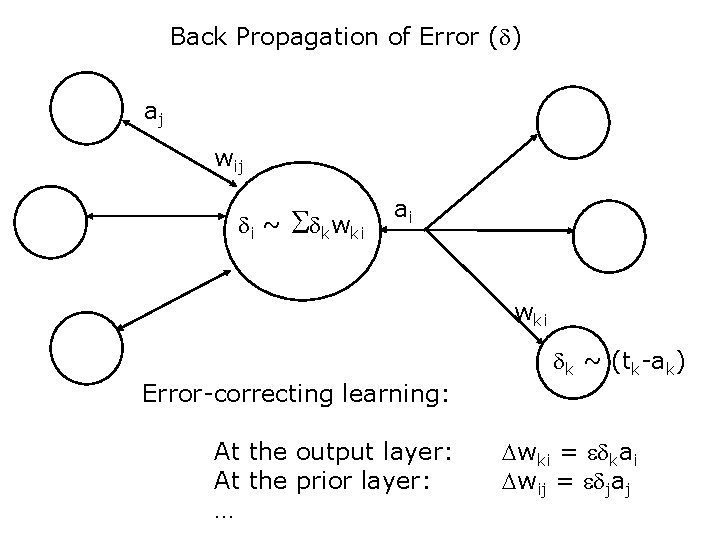
Back Propagation of Error (d) aj wij di ~ Sdkwki ai wki Error-correcting learning: At the output layer: At the prior layer: … dk ~ (tk-ak) Dwki = edkai Dwij = edjaj
Early Later Still E x p e r i e n c e
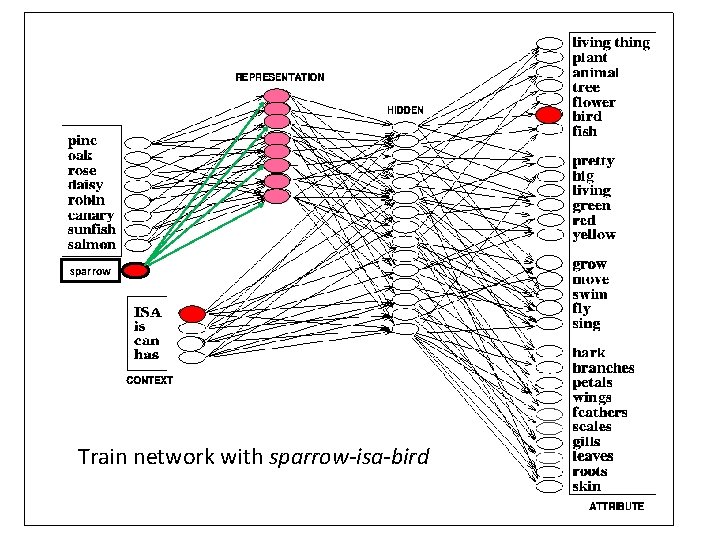
sparrow Train network with sparrow-isa-bird
sparrow It learns a representation similar to other birds…
sparrow Use the representation to infer what this new thing can do.
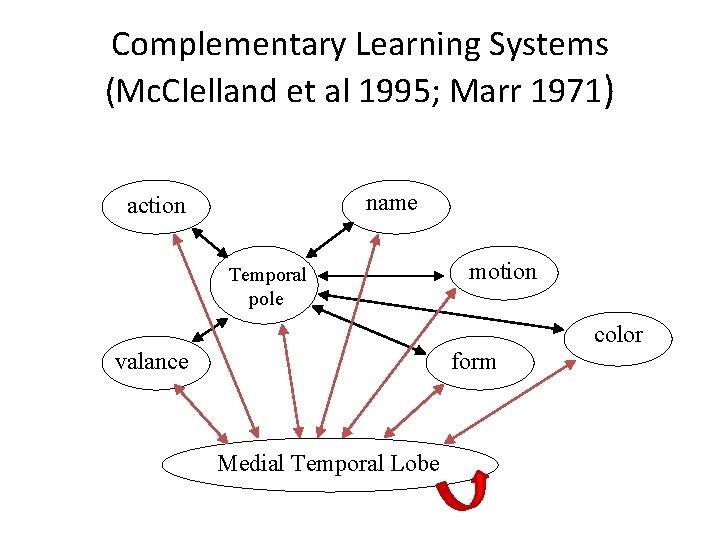
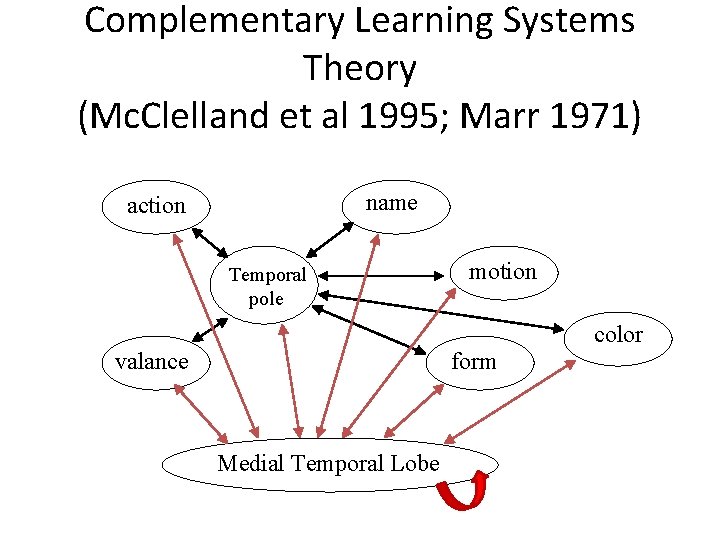
Complementary Learning Systems (Mc. Clelland et al 1995; Marr 1971) name action Temporal pole motion color valance form Medial Temporal Lobe
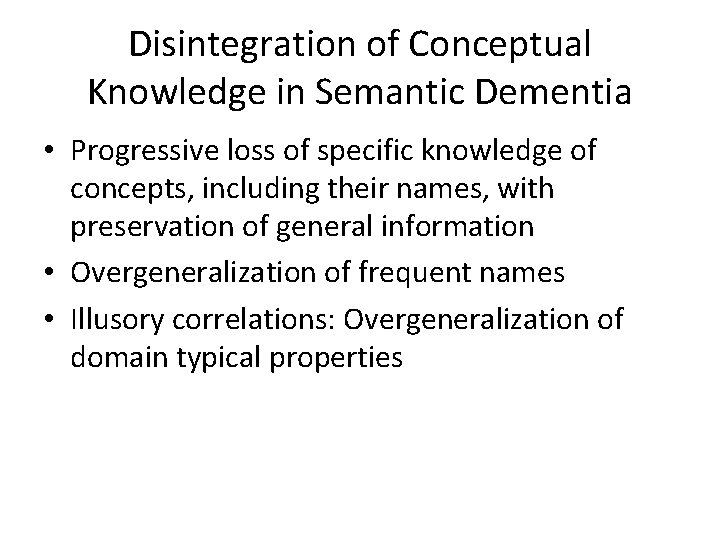
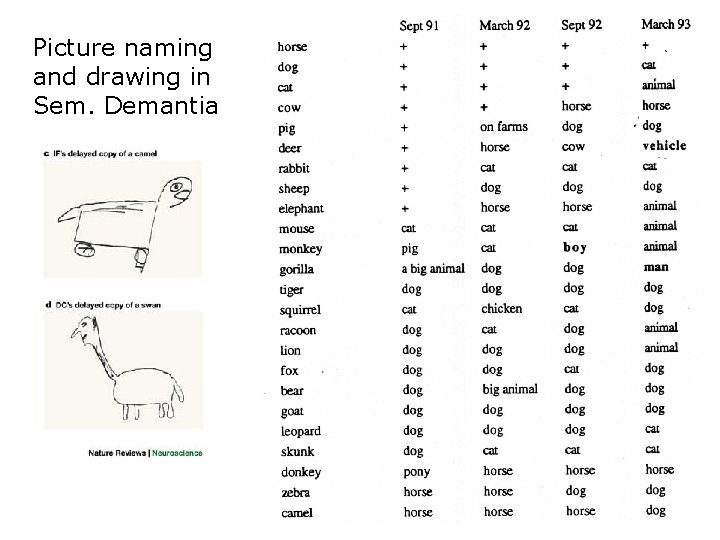
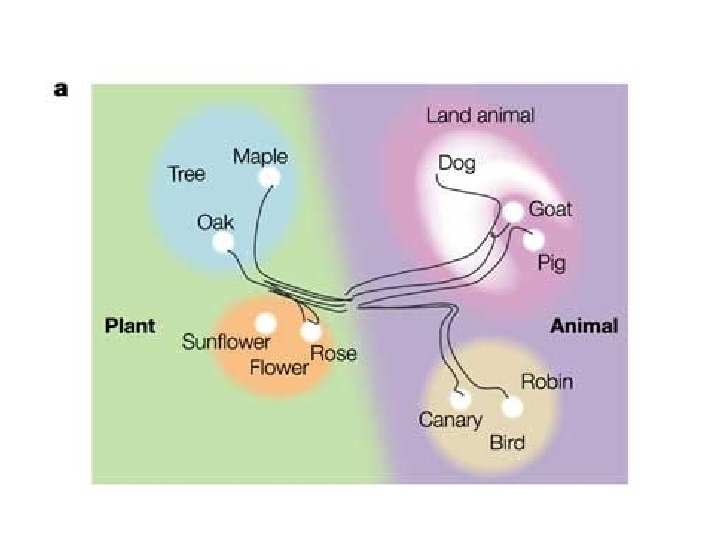
Disintegration of Conceptual Knowledge in Semantic Dementia • Progressive loss of specific knowledge of concepts, including their names, with preservation of general information • Overgeneralization of frequent names • Illusory correlations: Overgeneralization of domain typical properties
Picture naming and drawing in Sem. Demantia
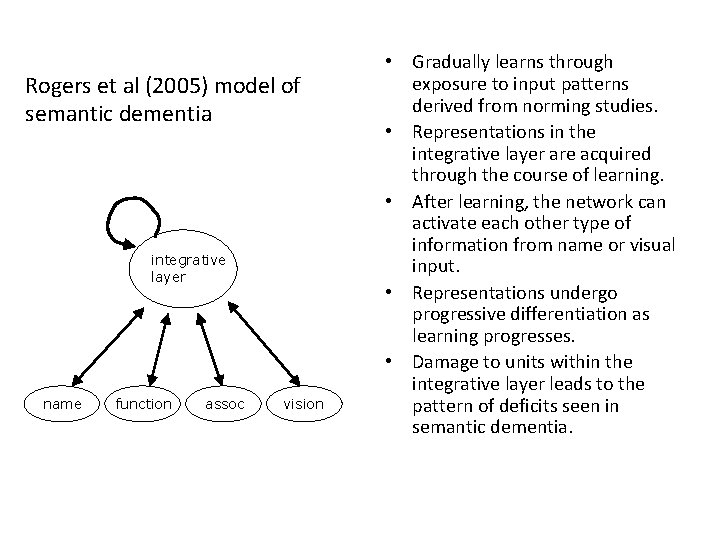
Rogers et al (2005) model of semantic dementia integrative layer name function assoc vision • Gradually learns through exposure to input patterns derived from norming studies. • Representations in the integrative layer are acquired through the course of learning. • After learning, the network can activate each other type of information from name or visual input. • Representations undergo progressive differentiation as learning progresses. • Damage to units within the integrative layer leads to the pattern of deficits seen in semantic dementia.
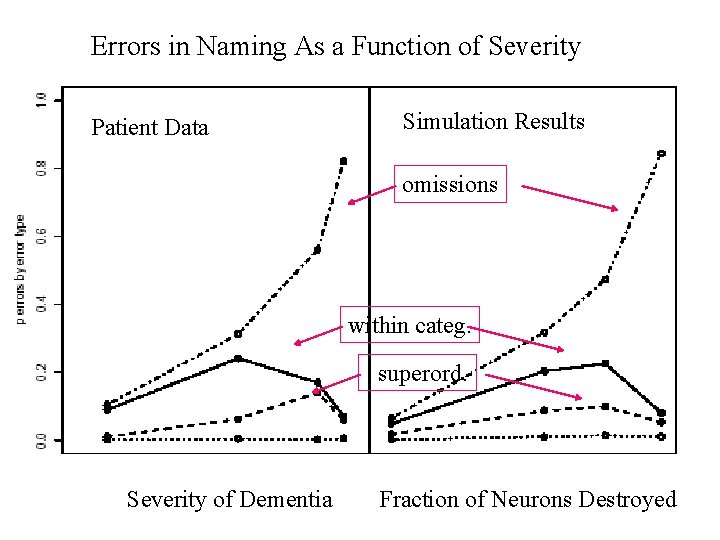
Errors in Naming As a Function of Severity Patient Data Simulation Results omissions within categ. superord. Severity of Dementia Fraction of Neurons Destroyed
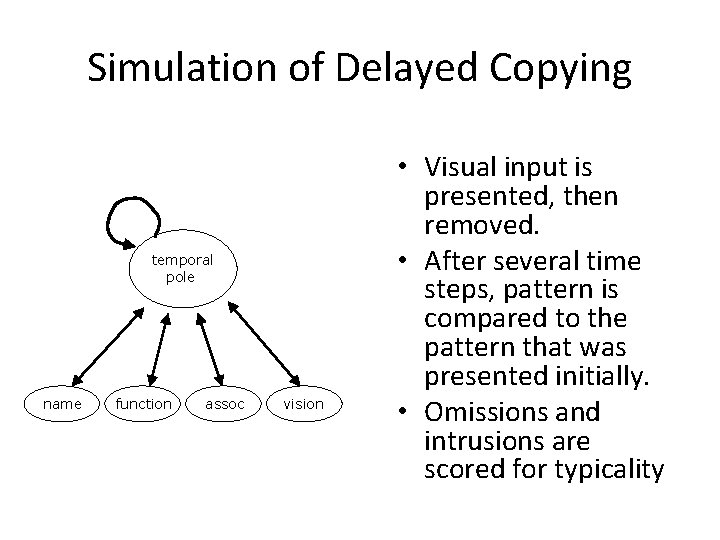
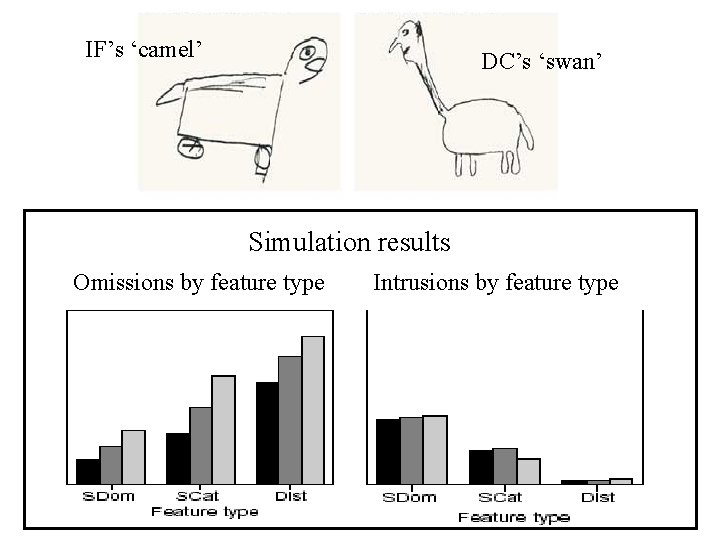
Simulation of Delayed Copying temporal pole name function assoc vision • Visual input is presented, then removed. • After several time steps, pattern is compared to the pattern that was presented initially. • Omissions and intrusions are scored for typicality
IF’s ‘camel’ DC’s ‘swan’ Simulation results Omissions by feature type Intrusions by feature type
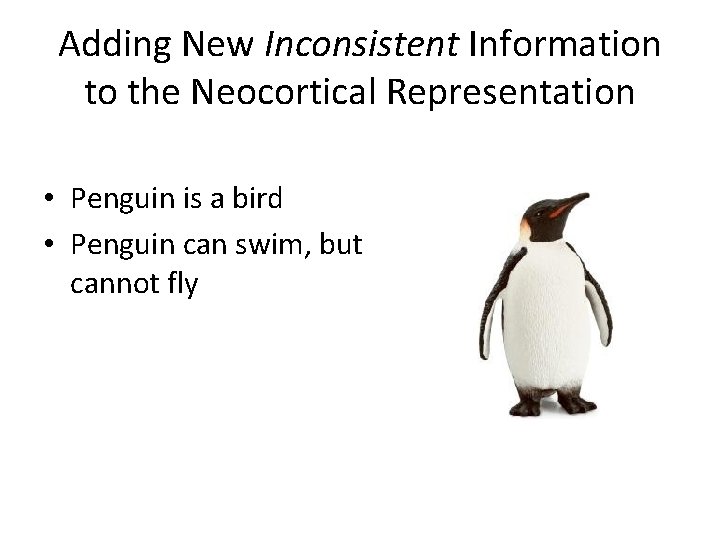
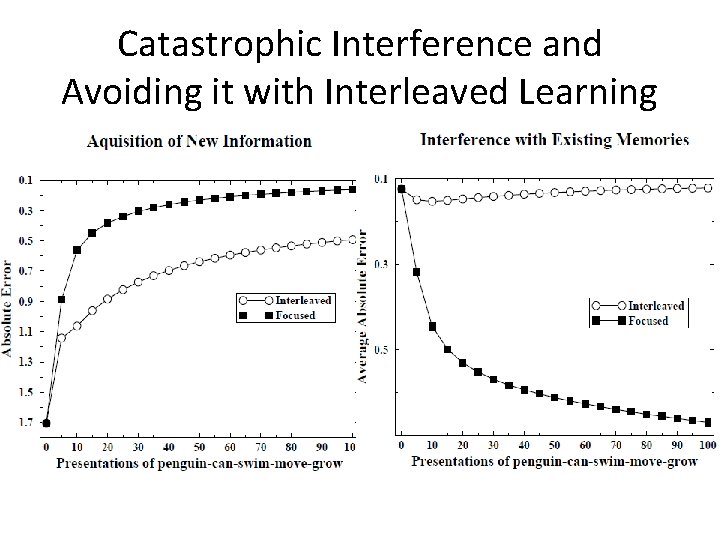
Adding New Inconsistent Information to the Neocortical Representation • Penguin is a bird • Penguin can swim, but cannot fly
Catastrophic Interference and Avoiding it with Interleaved Learning
Complementary Learning Systems Theory (Mc. Clelland et al 1995; Marr 1971) name action Temporal pole motion color valance form Medial Temporal Lobe
Challenges for CLS • If extraction of generalizations depends on gradual learning, how do we form generalizations and inferences shortly after initial learning? • Why do some studies find evidence consistent with the view that an intact MTL facilitates certain types of generalization in memory? • How can we explain new findings showing that new information can sometimes be consolidated into neocortical representations quickly?
Challenges for CLS Ø If extraction of generalizations depends on gradual learning, how do we form generalizations and inferences shortly after initial learning? Ø Why do some studies find evidence consistent with the view that an intact MTL facilitates certain types of generalization in memory? • How can we explain new findings showing that new information can sometimes be consolidated into neocortical representations quickly?
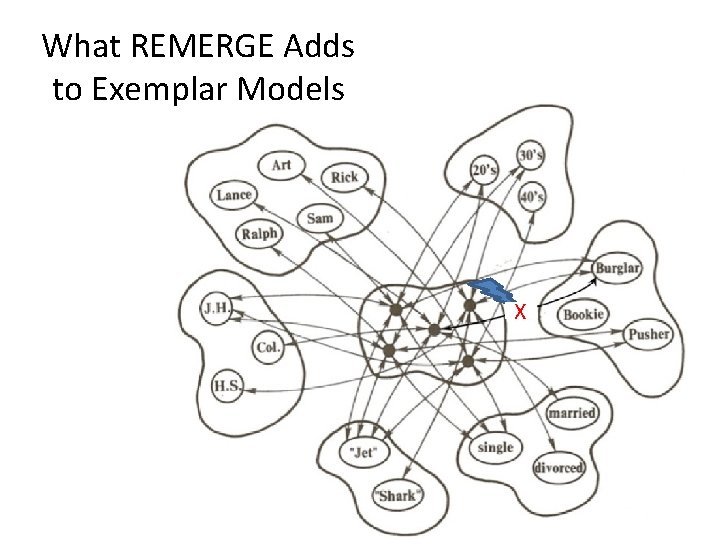
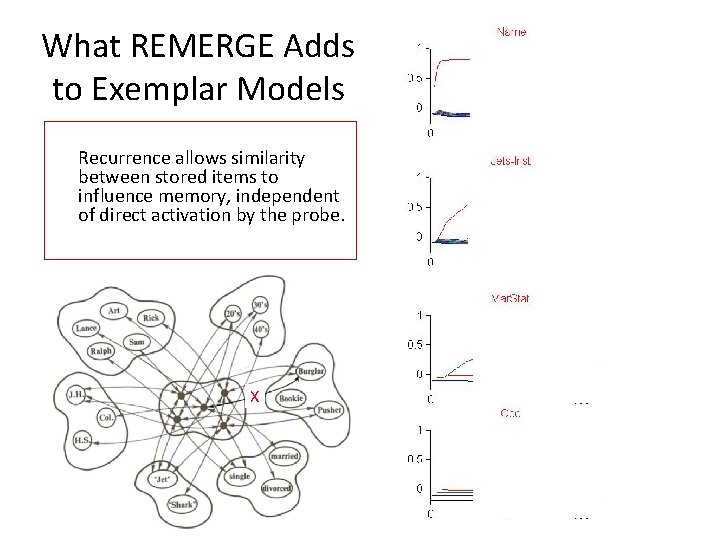
REMERGE: Recurrence and Episodic Memory Result in Generalization (Kumaran & Mc. Clelland, 2012) • Holds that several MTL based item representations may work together through recurrent activation to produce generalization and inference • Draws on classic exemplar models (Medin & Shaffer, 1978; Nosofsky, 1984) • Extends these models by allowing similarity between stored items to influence performance, independent of direct activation by the probe (Mc. Clelland, 1981) • Demonstrates the strong dependence of some forms of generalization and inference on the strength of learning for trained items
What REMERGE Adds to Exemplar Models X
What REMERGE Adds to Exemplar Models Recurrence allows similarity between stored items to influence memory, independent of direct activation by the probe. X c
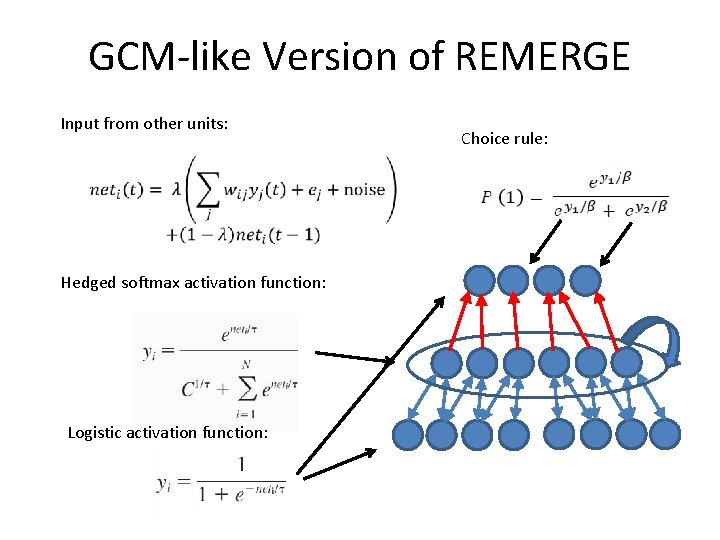
Neural Network Model, Exemplar Model, or Probabilistic Model? • REMERGE was initially built on the IAC model, a neural network/connectionist model • But the same principles can be captured in an exemplar model formulation, which in turn is closely related to an explicitly Bayesian formulation • In fact there are now two versions of the model (IAC, GCM) and a probabilistic version is on its way
GCM-like Version of REMERGE Input from other units: Hedged softmax activation function: Logistic activation function: Choice rule:
“Learning” in REMERGE • Connection weights in REMERGE are specified by the modeler, not learned by a connection adjustment rule. • Stronger weights lead to better performance • Weight strength can vary as a function of amount of exposure, individual differences, and brain injury
Phenomena Considered • Benchmark Simulations – Categorization – Recognition memory • Acquired Equivalence • Associative Chaining – In paired associate learning – In hippocampal reactivation after spatial learning • Transitive Inference – Effects of increasing study – Effects of sleep • Spared Category Learning in Amnesia
Phenomena Considered • Benchmark Simulations – Categorization – Recognition memory • Acquired Equivalence • Associative Chaining – In paired associate learning – In hippocampal reactivation after spatial learning • Transitive Inference – Effects of increasing study – Effects of sleep • Spared Category Learning in Amnesia
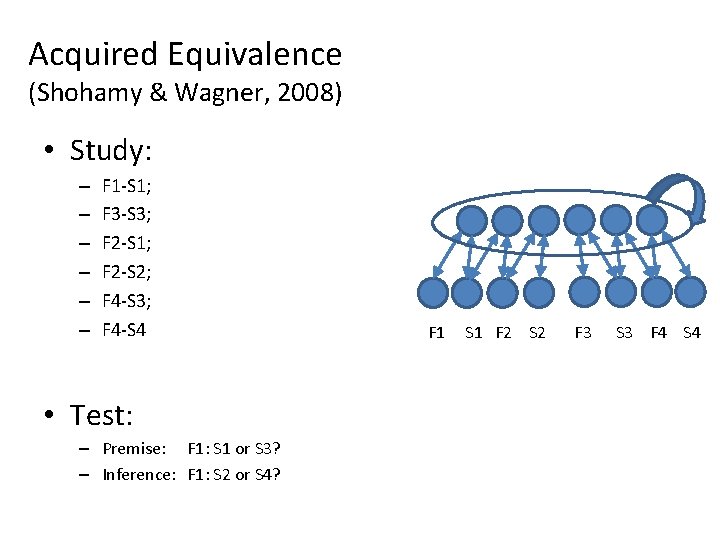
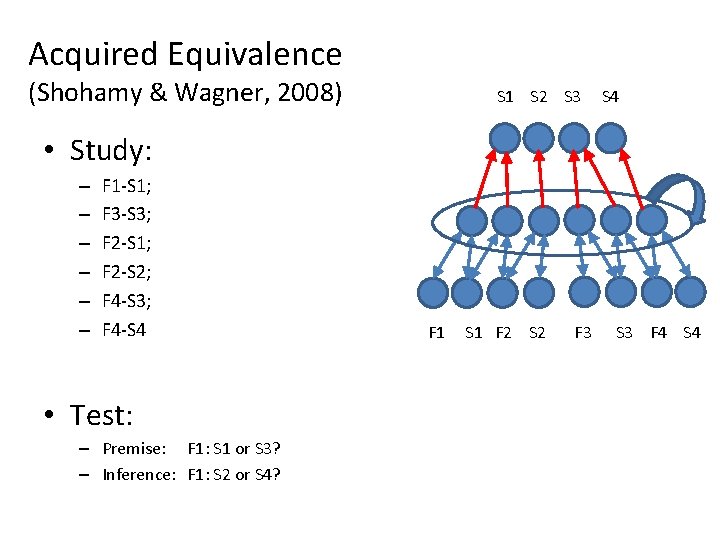
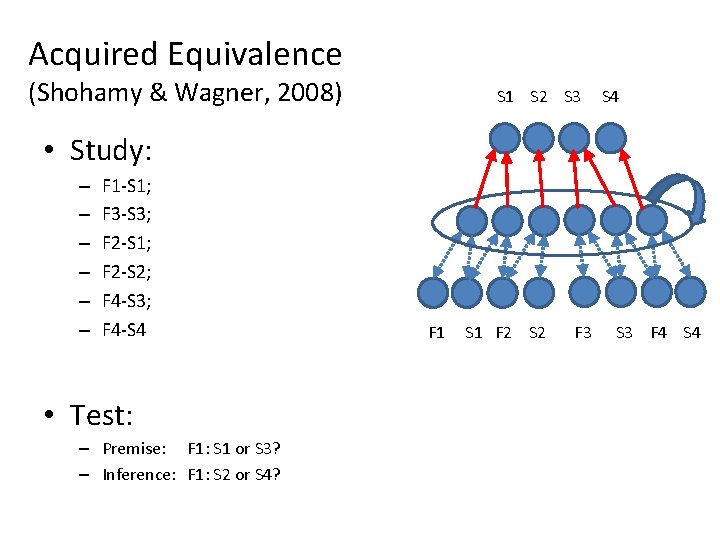
Acquired Equivalence (Shohamy & Wagner, 2008) • Study: – – – F 1 -S 1; F 3 -S 3; F 2 -S 1; F 2 -S 2; F 4 -S 3; F 4 -S 4 • Test: – Premise: F 1: S 1 or S 3? – Inference: F 1: S 2 or S 4?
Acquired Equivalence (Shohamy & Wagner, 2008) • Study: – – – F 1 -S 1; F 3 -S 3; F 2 -S 1; F 2 -S 2; F 4 -S 3; F 4 -S 4 • Test: – Premise: F 1: S 1 or S 3? – Inference: F 1: S 2 or S 4? F 1 S 1 F 2 S 2 F 3 S 3 F 4 S 4
Acquired Equivalence (Shohamy & Wagner, 2008) S 1 S 2 S 3 S 4 • Study: – – – F 1 -S 1; F 3 -S 3; F 2 -S 1; F 2 -S 2; F 4 -S 3; F 4 -S 4 • Test: – Premise: F 1: S 1 or S 3? – Inference: F 1: S 2 or S 4? F 1 S 1 F 2 S 2 F 3 S 3 F 4 S 4
Acquired Equivalence (Shohamy & Wagner, 2008) S 1 S 2 S 3 S 4 • Study: – – – F 1 -S 1; F 3 -S 3; F 2 -S 1; F 2 -S 2; F 4 -S 3; F 4 -S 4 • Test: – Premise: F 1: S 1 or S 3? – Inference: F 1: S 2 or S 4? F 1 S 1 F 2 S 2 F 3 S 3 F 4 S 4
Roles of Neocortical Learning • Gradually learns the ‘features’ (dimensions of the neocortical distributed representations) that serve as the basis for exemplar learning in the MTL • Provides efficient, structured distributed representations that capture structure in experience • But what about those findings showing that new ‘schema consistent’ knowledge can be integrated into neocortical networks quickly?
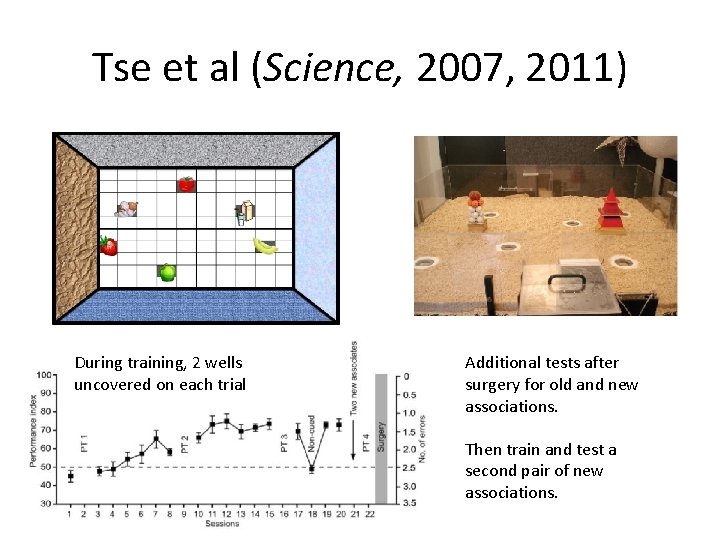
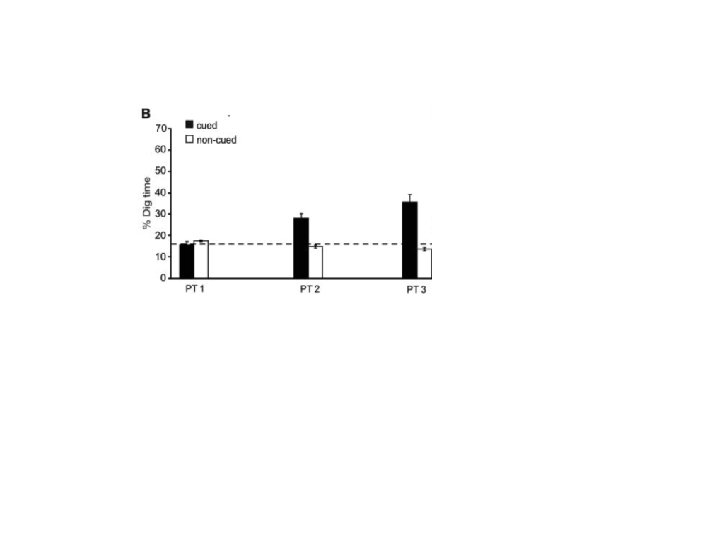
Tse et al (Science, 2007, 2011) During training, 2 wells uncovered on each trial Additional tests after surgery for old and new associations. Then train and test a second pair of new associations.
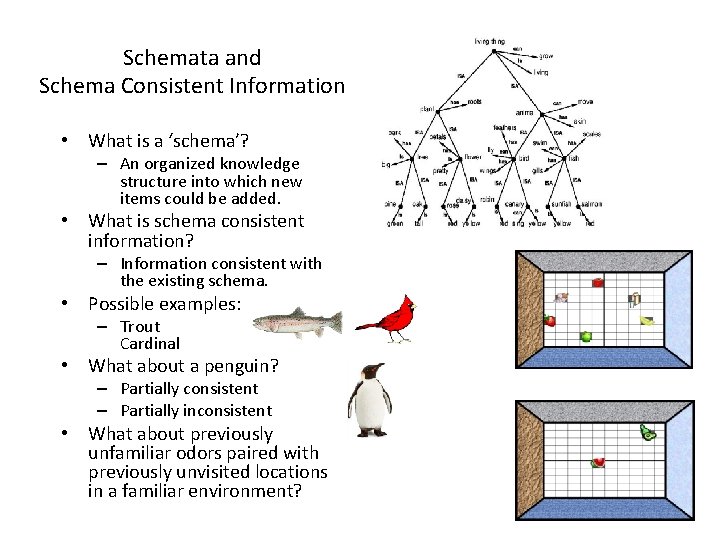
Schemata and Schema Consistent Information • What is a ‘schema’? – An organized knowledge structure into which new items could be added. • What is schema consistent information? – Information consistent with the existing schema. • Possible examples: – Trout Cardinal • What about a penguin? – Partially consistent – Partially inconsistent • What about previously unfamiliar odors paired with previously unvisited locations in a familiar environment?
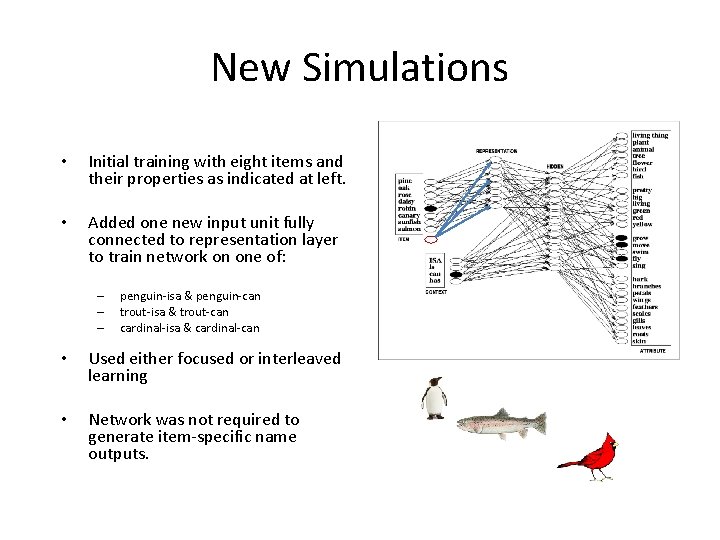
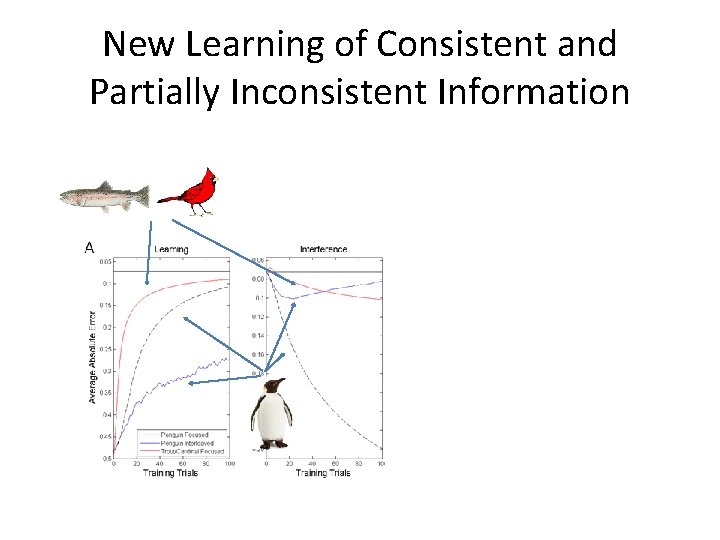
New Simulations • Initial training with eight items and their properties as indicated at left. • Added one new input unit fully connected to representation layer to train network on one of: – – – penguin-isa & penguin-can trout-isa & trout-can cardinal-isa & cardinal-can • Used either focused or interleaved learning • Network was not required to generate item-specific name outputs.
New Learning of Consistent and Partially Inconsistent Information
Overall Discussion • The work described here (with a new hippocampal model, and an old neocortical model) addresses both types of challenge to the CLS theory • But many questions remain – What is an item and how is it represented in the hippocampus and the neocortex? – What new information is sufficiently ‘schema consistent’ to be learned rapidly in amnesia? – Even if the models capture important features of hippocampal and neocortical learning, how are these processes actually implemented in real nervous systems?