
Integrating Multiple Branch Office Applications Within Your Organization
Integrating Multiple Branch Office Applications Within Your Organization Sarat Khilnani (skhilnan@cisco. com) Cisco Systems Inc. Senior Manager – Product Management Session Number Presentation_ID © 2005 Cisco Systems, Inc. All rights reserved. Cisco Public 1
This “how to” session will outline several strategies and topologies for distributed companies who need to integrate branch offices with the main campus. We will also cover survivability and other resiliency factors to ensure continuous application availability. Session Number Presentation_ID © 2005 Cisco Systems, Inc. All rights reserved. Cisco Public 2
Agenda • Branch and Small Office Trends • Considerations When Choosing Branch and Small Office Equipment • Cisco Branch and Small Office Equipment Solutions • Survivability • • Voice, Data, Security • Connectivity Options Voice Survivability Enterprise Deployments SMB Deployments • CME_AMPreso_0705 Summary © 2005 Cisco Systems, Inc. All rights reserved. Cisco Public 3
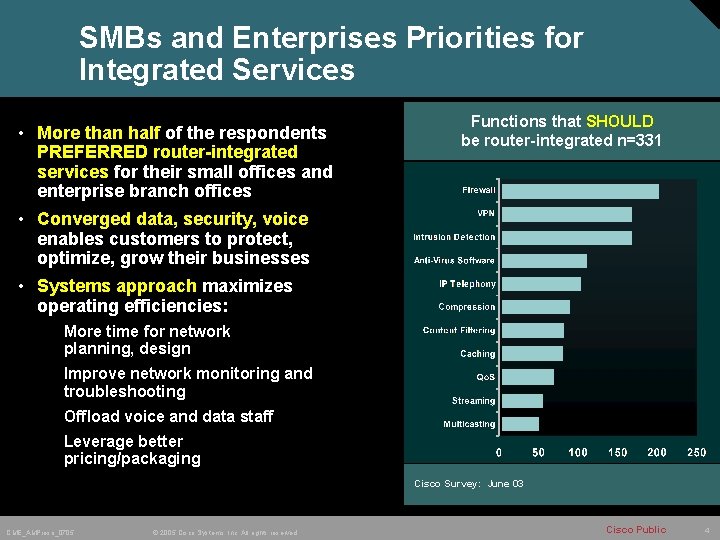
SMBs and Enterprises Priorities for Integrated Services • More than half of the respondents PREFERRED router-integrated services for their small offices and enterprise branch offices Functions that SHOULD be router-integrated n=331 • Converged data, security, voice enables customers to protect, optimize, grow their businesses • Systems approach maximizes operating efficiencies: More time for network planning, design Improve network monitoring and troubleshooting Offload voice and data staff Leverage better pricing/packaging Cisco Survey: June 03 CME_AMPreso_0705 © 2005 Cisco Systems, Inc. All rights reserved. Cisco Public 4
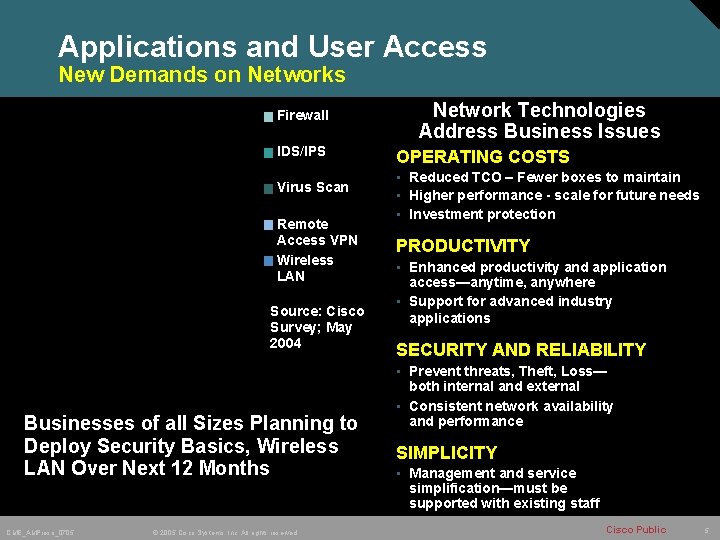
Applications and User Access New Demands on Networks Firewall IDS/IPS Virus Scan Remote Access VPN Wireless LAN Source: Cisco Survey; May 2004 Businesses of all Sizes Planning to Deploy Security Basics, Wireless LAN Over Next 12 Months CME_AMPreso_0705 © 2005 Cisco Systems, Inc. All rights reserved. Network Technologies Address Business Issues OPERATING COSTS • Reduced TCO – Fewer boxes to maintain • Higher performance - scale for future needs • Investment protection PRODUCTIVITY • Enhanced productivity and application access—anytime, anywhere • Support for advanced industry applications SECURITY AND RELIABILITY • Prevent threats, Theft, Loss— both internal and external • Consistent network availability and performance SIMPLICITY • Management and service simplification—must be supported with existing staff Cisco Public 5
Agenda • Branch and Small Office Trends • Considerations When Choosing Branch and Small Office Equipment • Cisco Branch and Small Office Equipment Solutions • Survivability • • Voice, Data, Security • Connectivity Options Voice Survivability Enterprise Deployments SMB Deployments • CME_AMPreso_0705 Summary © 2005 Cisco Systems, Inc. All rights reserved. Cisco Public 6

Considerations when Deploying Branch Office Solutions Corp Office Application Servers WAN Connectivity Services To Internet WAN PSTN Secure Connectivity Security Services VPN Switching & Wi. Fi Branch Office Voice Services Application Acceleration Advanced Mgt CME_AMPreso_0705 © 2005 Cisco Systems, Inc. All rights reserved. Cisco Public 7
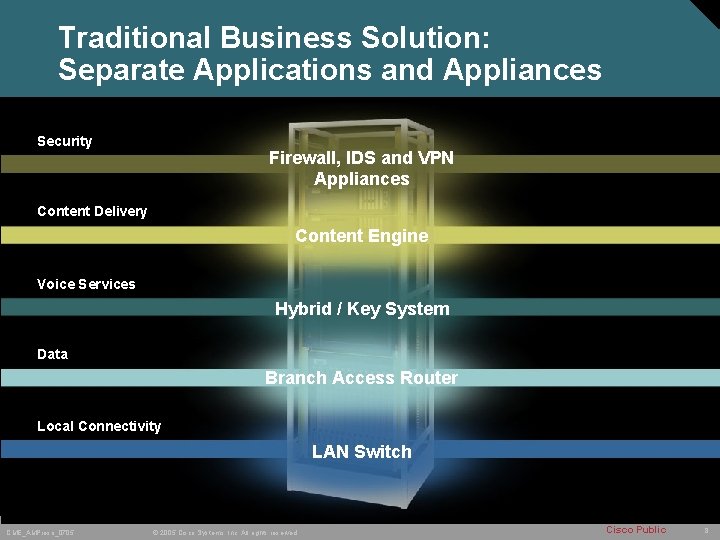
Traditional Business Solution: Separate Applications and Appliances Security Firewall, IDS and VPN Appliances Content Delivery Content Engine Voice Services Hybrid / Key System Data Branch Access Router Local Connectivity LAN Switch CME_AMPreso_0705 © 2005 Cisco Systems, Inc. All rights reserved. Cisco Public 8
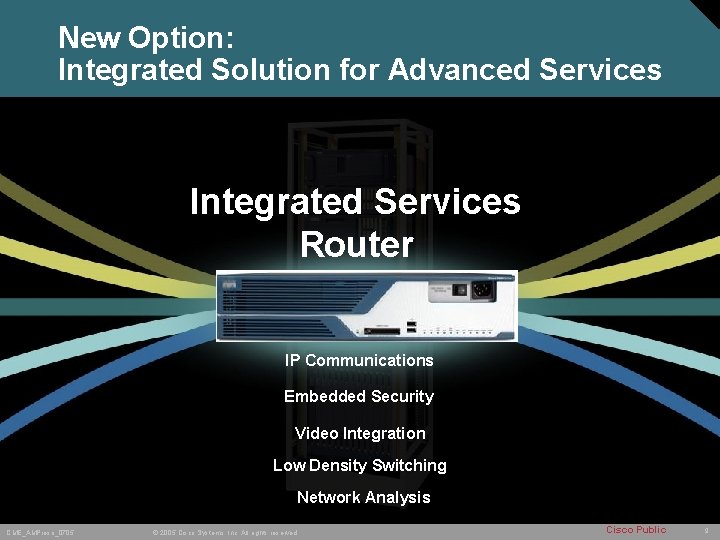
New Option: Integrated Solution for Advanced Services Integrated Services Router IP Communications Embedded Security Video Integration Low Density Switching Network Analysis CME_AMPreso_0705 © 2005 Cisco Systems, Inc. All rights reserved. Cisco Public 9
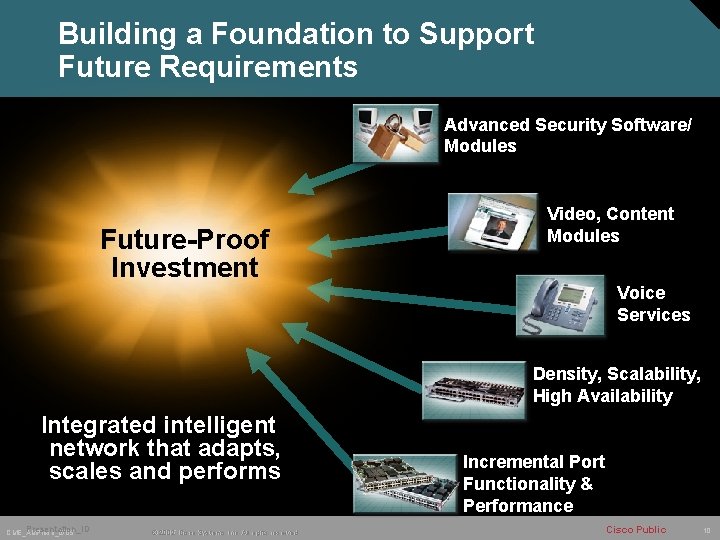
Building a Foundation to Support Future Requirements Advanced Security Software/ Modules Future-Proof Investment Video, Content Modules Voice Services Density, Scalability, High Availability Integrated intelligent network that adapts, scales and performs Presentation_ID CME_AMPreso_0705 © © 2002, 2005 Cisco Systems, Inc. All rights reserved. Incremental Port Functionality & Performance Cisco Public 10
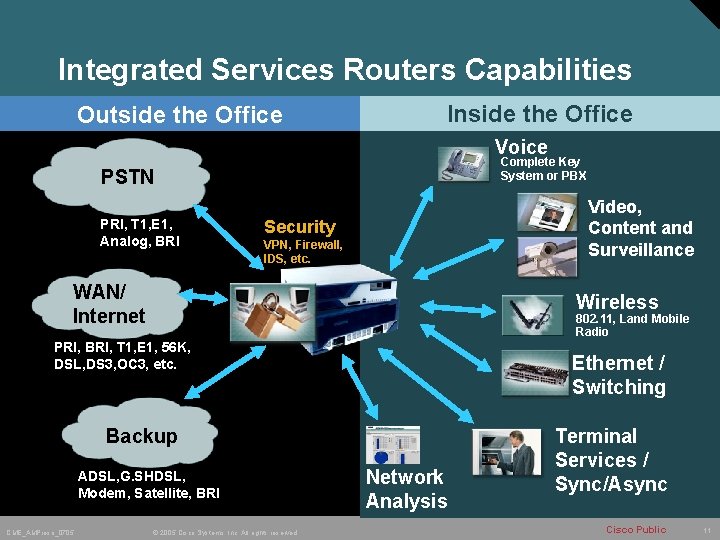
Integrated Services Routers Capabilities Outside the Office Inside the Office Voice Complete Key System or PBX PSTN PRI, T 1, E 1, Analog, BRI Video, Content and Surveillance Security VPN, Firewall, IDS, etc. WAN/ Internet Wireless 802. 11, Land Mobile Radio PRI, BRI, T 1, E 1, 56 K, DSL, DS 3, OC 3, etc. Ethernet / Switching Backup ADSL, G. SHDSL, Modem, Satellite, BRI CME_AMPreso_0705 © 2005 Cisco Systems, Inc. All rights reserved. Network Analysis Terminal Services / Sync/Async Cisco Public 11

Satellite WAN Applications – Two-way IP VSAT Satellite WAN Module (NM-1 VSATGILAT) • Broadband connectivity for Non-Terrestrial WAN Backup services Satellite WAN maintains business continuity & enables disaster recovery during terrestrial outages Supplements Dial/ISDN/DSL backup Over 6 Mb/s from HQ to remote site (‘outbound’) Over 1 Mb/s from remote to HQ (‘inbound’) • High-Speed IP Video Multicast overlay Economical distribution of large content to many sites Satellite Hub / SP Video – live streaming & video-on demand (Vo. D) Terrestrial WAN Software update distribution X Option for 1 -way only mode HQ CME_AMPreso_0705 © 2005 Cisco Systems, Inc. All rights reserved. Backup bandwidth shared by multiple sites via TDMA-based technology optimized for satellite Branch Offices Cisco Public 12
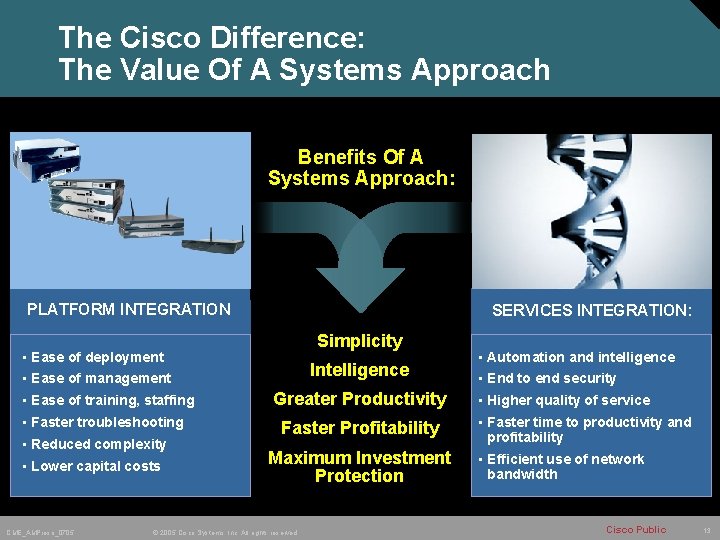
The Cisco Difference: The Value Of A Systems Approach Benefits Of A Systems Approach: PLATFORM INTEGRATION SERVICES INTEGRATION: Simplicity • Ease of deployment Intelligence • Ease of management • Ease of training, staffing • Faster troubleshooting • Reduced complexity • Lower capital costs CME_AMPreso_0705 Greater Productivity Faster Profitability Maximum Investment Protection © 2005 Cisco Systems, Inc. All rights reserved. • Automation and intelligence • End to end security • Higher quality of service • Faster time to productivity and profitability • Efficient use of network bandwidth Cisco Public 13
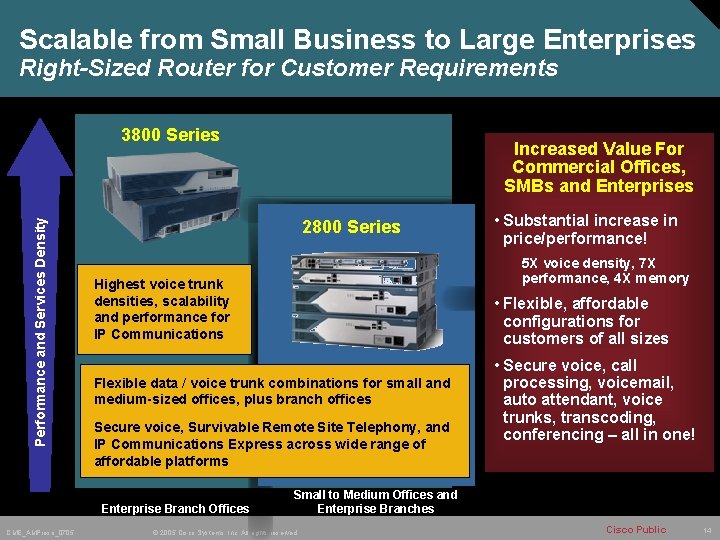
Scalable from Small Business to Large Enterprises Right-Sized Router for Customer Requirements Performance and Services Density 3800 Series 2800 Series • Substantial increase in price/performance! 5 X voice density, 7 X performance, 4 X memory Highest voice trunk densities, scalability and performance for IP Communications • Flexible, affordable configurations for customers of all sizes Flexible data / voice trunk combinations for small and medium-sized offices, plus branch offices Secure voice, Survivable Remote Site Telephony, and IP Communications Express across wide range of affordable platforms Enterprise Branch Offices CME_AMPreso_0705 Increased Value For Commercial Offices, SMBs and Enterprises • Secure voice, call processing, voicemail, auto attendant, voice trunks, transcoding, conferencing – all in one! Small to Medium Offices and Enterprise Branches © 2005 Cisco Systems, Inc. All rights reserved. Cisco Public 14
Agenda • Branch and Small Office Trends • Considerations When Choosing Branch and Small Office Equipment • Cisco Branch and Small Office Equipment Solutions • Survivability • • Voice, Data, Security • Connectivity Options Voice Survivability Enterprise Deployments SMB Deployments • CME_AMPreso_0705 Summary © 2005 Cisco Systems, Inc. All rights reserved. Cisco Public 15
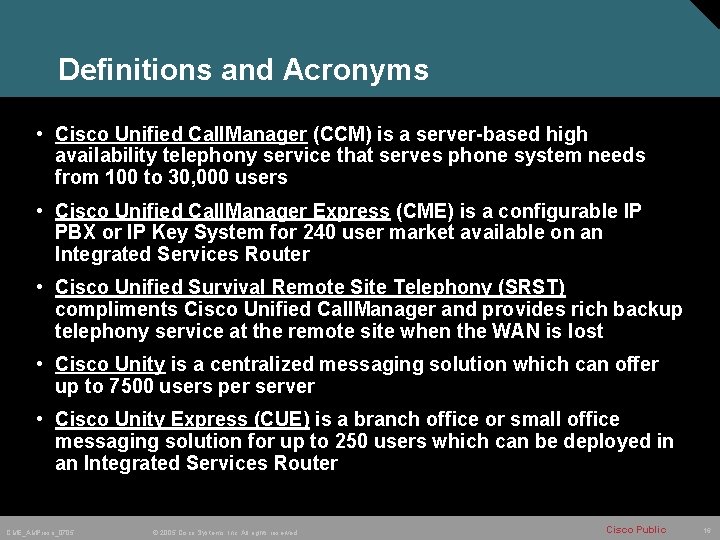
Definitions and Acronyms • Cisco Unified Call. Manager (CCM) is a server-based high availability telephony service that serves phone system needs from 100 to 30, 000 users • Cisco Unified Call. Manager Express (CME) is a configurable IP PBX or IP Key System for 240 user market available on an Integrated Services Router • Cisco Unified Survival Remote Site Telephony (SRST) compliments Cisco Unified Call. Manager and provides rich backup telephony service at the remote site when the WAN is lost • Cisco Unity is a centralized messaging solution which can offer up to 7500 users per server • Cisco Unity Express (CUE) is a branch office or small office messaging solution for up to 250 users which can be deployed in an Integrated Services Router CME_AMPreso_0705 © 2005 Cisco Systems, Inc. All rights reserved. Cisco Public 16
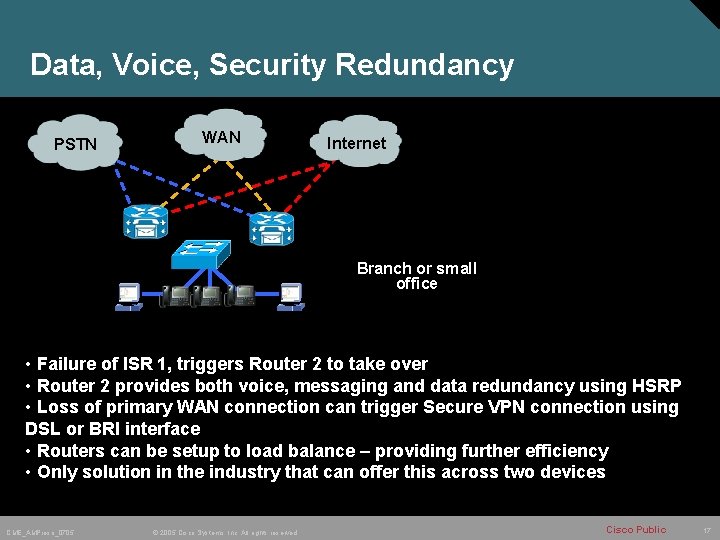
Data, Voice, Security Redundancy WAN PSTN ISR 1 Internet ISR 2 Branch or small office • Failure of ISR 1, triggers Router 2 to take over • Router 2 provides both voice, messaging and data redundancy using HSRP • Loss of primary WAN connection can trigger Secure VPN connection using DSL or BRI interface • Routers can be setup to load balance – providing further efficiency • Only solution in the industry that can offer this across two devices CME_AMPreso_0705 © 2005 Cisco Systems, Inc. All rights reserved. Cisco Public 17
Agenda • Branch and Small Office Trends • Considerations When Choosing Branch and Small Office Equipment • Cisco Branch and Small Office Equipment Solutions • Survivability • • Voice, Data, Security • Connectivity Options Voice Survivability Enterprise Deployments SMB Deployments • CME_AMPreso_0705 Summary © 2005 Cisco Systems, Inc. All rights reserved. Cisco Public 18
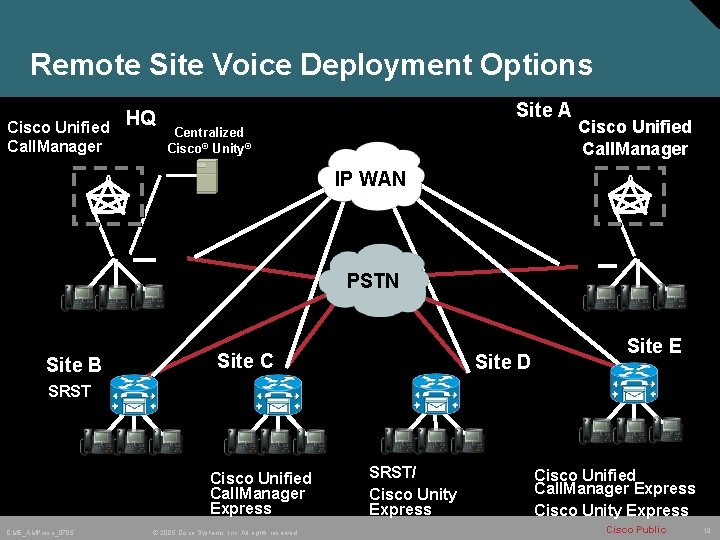
Remote Site Voice Deployment Options Cisco Unified Call. Manager HQ Site A Centralized Cisco® Unity® IP WAN A Cisco Unified Call. Manager A PSTN Site B Site C Site D Site E SRST Cisco Unified Call. Manager Express CME_AMPreso_0705 © 2005 Cisco Systems, Inc. All rights reserved. SRST/ Cisco Unity Express Cisco Unified Call. Manager Express Cisco Unity Express Cisco Public 19
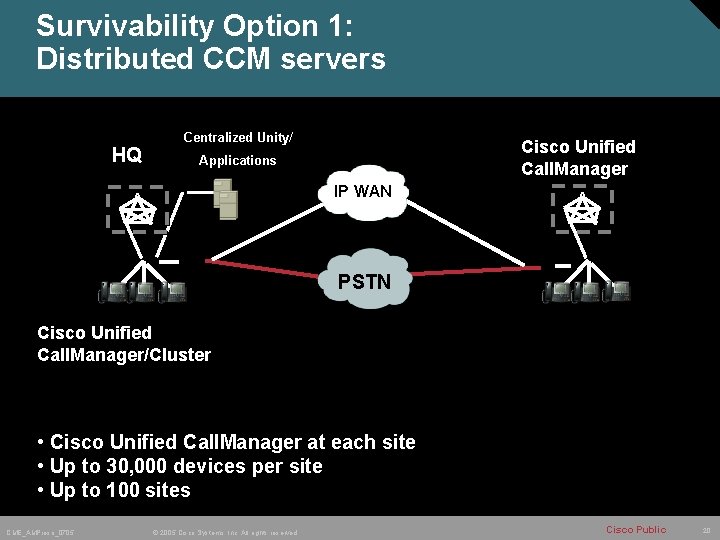
Survivability Option 1: Distributed CCM servers HQ Centralized Unity/ Cisco Unified Call. Manager Applications IP WAN A A PSTN Cisco Unified Call. Manager/Cluster • Cisco Unified Call. Manager at each site • Up to 30, 000 devices per site • Up to 100 sites CME_AMPreso_0705 © 2005 Cisco Systems, Inc. All rights reserved. Cisco Public 20
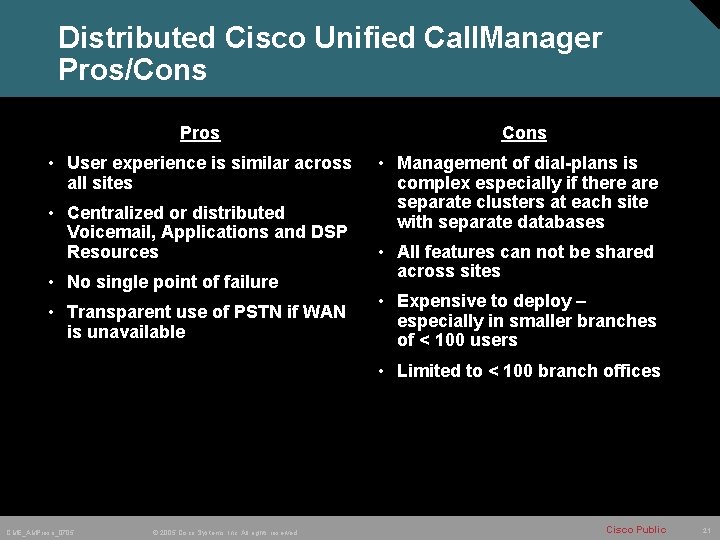
Distributed Cisco Unified Call. Manager Pros/Cons Pros • User experience is similar across all sites • Centralized or distributed Voicemail, Applications and DSP Resources • No single point of failure • Transparent use of PSTN if WAN is unavailable Cons • Management of dial-plans is complex especially if there are separate clusters at each site with separate databases • All features can not be shared across sites • Expensive to deploy – especially in smaller branches of < 100 users • Limited to < 100 branch offices CME_AMPreso_0705 © 2005 Cisco Systems, Inc. All rights reserved. Cisco Public 21
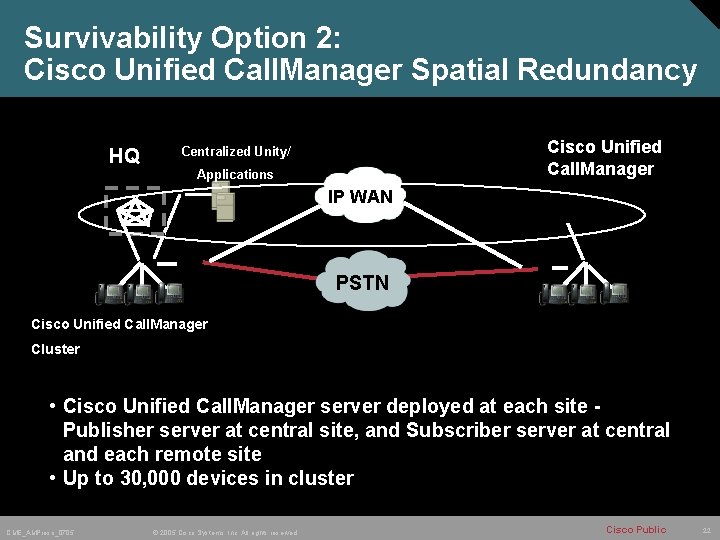
Survivability Option 2: Cisco Unified Call. Manager Spatial Redundancy HQ Cisco Unified Call. Manager Centralized Unity/ Applications IP WAN A PSTN Cisco Unified Call. Manager Cluster • Cisco Unified Call. Manager server deployed at each site Publisher server at central site, and Subscriber server at central and each remote site • Up to 30, 000 devices in cluster CME_AMPreso_0705 © 2005 Cisco Systems, Inc. All rights reserved. Cisco Public 22
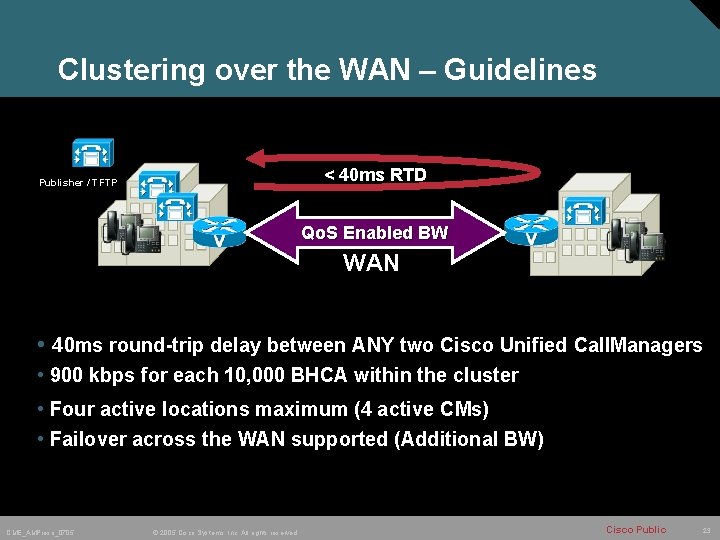
Clustering over the WAN – Guidelines < 40 ms RTD Publisher / TFTP Qo. S Enabled BW WAN • 40 ms round-trip delay between ANY two Cisco Unified Call. Managers • 900 kbps for each 10, 000 BHCA within the cluster • Four active locations maximum (4 active CMs) • Failover across the WAN supported (Additional BW) CME_AMPreso_0705 © 2005 Cisco Systems, Inc. All rights reserved. Cisco Public 23
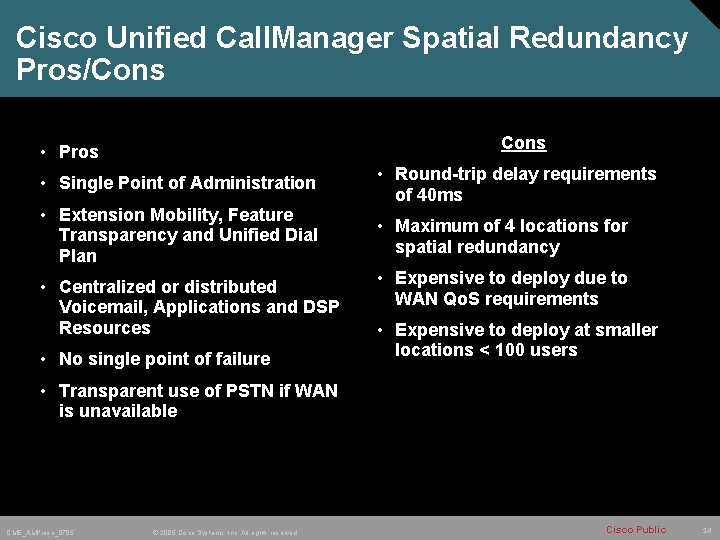
Cisco Unified Call. Manager Spatial Redundancy Pros/Cons • Pros • Single Point of Administration • Extension Mobility, Feature Transparency and Unified Dial Plan • Centralized or distributed Voicemail, Applications and DSP Resources • No single point of failure • Round-trip delay requirements of 40 ms • Maximum of 4 locations for spatial redundancy • Expensive to deploy due to WAN Qo. S requirements • Expensive to deploy at smaller locations < 100 users • Transparent use of PSTN if WAN is unavailable CME_AMPreso_0705 © 2005 Cisco Systems, Inc. All rights reserved. Cisco Public 24
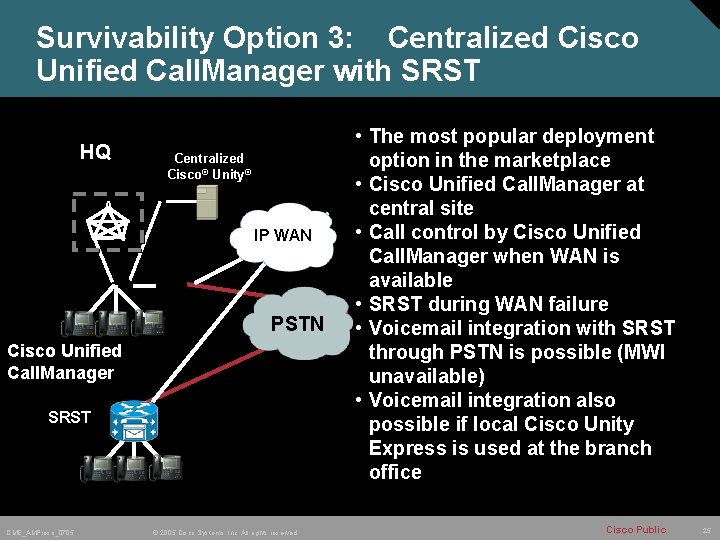
Survivability Option 3: Centralized Cisco Unified Call. Manager with SRST HQ Centralized Cisco® Unity® A IP WAN PSTN Cisco Unified Call. Manager SRST CME_AMPreso_0705 © 2005 Cisco Systems, Inc. All rights reserved. • The most popular deployment option in the marketplace • Cisco Unified Call. Manager at central site • Call control by Cisco Unified Call. Manager when WAN is available • SRST during WAN failure • Voicemail integration with SRST through PSTN is possible (MWI unavailable) • Voicemail integration also possible if local Cisco Unity Express is used at the branch office Cisco Public 25
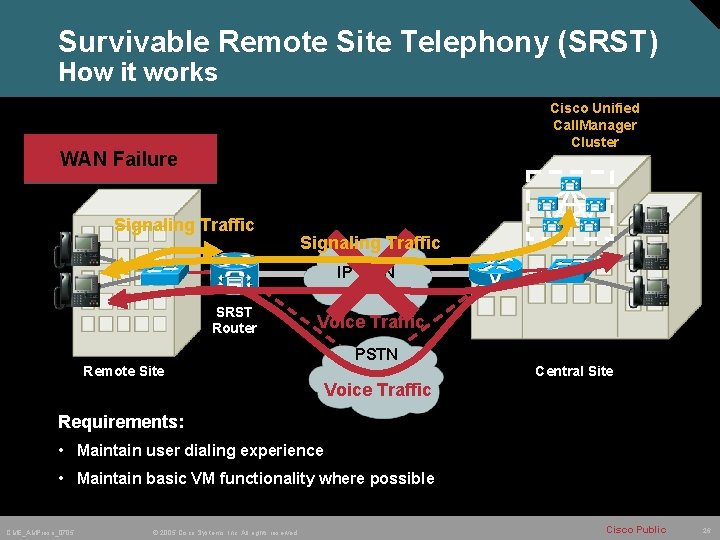
Survivable Remote Site Telephony (SRST) How it works Cisco Unified Call. Manager Cluster Normal WAN Operation Failure Signaling Traffic IP WAN SRST Router Voice Traffic Remote Site PSTN Central Site Voice Traffic Requirements: • Maintain user dialing experience • Maintain basic VM functionality where possible CME_AMPreso_0705 © 2005 Cisco Systems, Inc. All rights reserved. Cisco Public 26
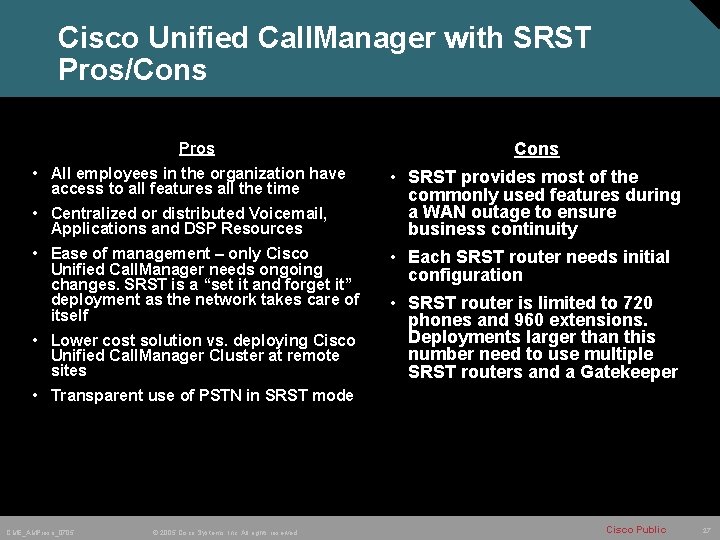
Cisco Unified Call. Manager with SRST Pros/Cons Pros • All employees in the organization have access to all features all the time • Centralized or distributed Voicemail, Applications and DSP Resources • Ease of management – only Cisco Unified Call. Manager needs ongoing changes. SRST is a “set it and forget it” deployment as the network takes care of itself • Lower cost solution vs. deploying Cisco Unified Call. Manager Cluster at remote sites Cons • SRST provides most of the commonly used features during a WAN outage to ensure business continuity • Each SRST router needs initial configuration • SRST router is limited to 720 phones and 960 extensions. Deployments larger than this number need to use multiple SRST routers and a Gatekeeper • Transparent use of PSTN in SRST mode CME_AMPreso_0705 © 2005 Cisco Systems, Inc. All rights reserved. Cisco Public 27
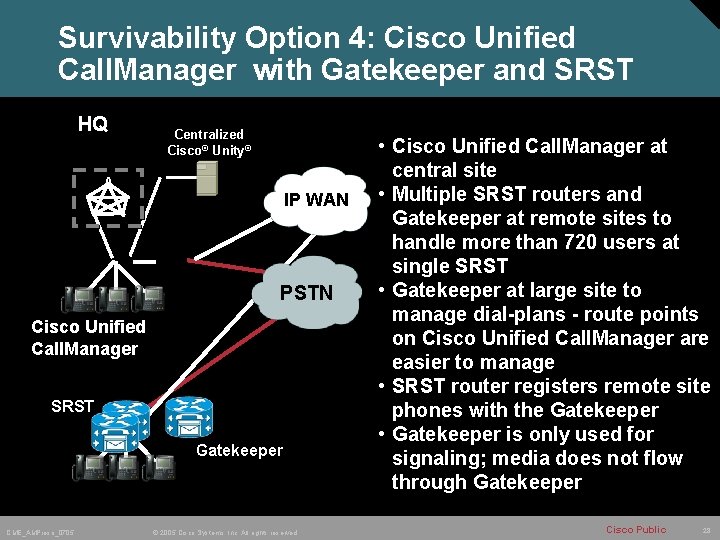
Survivability Option 4: Cisco Unified Call. Manager with Gatekeeper and SRST HQ Centralized Cisco® Unity® A IP WAN PSTN Cisco Unified Call. Manager SRST Gatekeeper CME_AMPreso_0705 © 2005 Cisco Systems, Inc. All rights reserved. • Cisco Unified Call. Manager at central site • Multiple SRST routers and Gatekeeper at remote sites to handle more than 720 users at single SRST • Gatekeeper at large site to manage dial-plans - route points on Cisco Unified Call. Manager are easier to manage • SRST router registers remote site phones with the Gatekeeper • Gatekeeper is only used for signaling; media does not flow through Gatekeeper Cisco Public 28
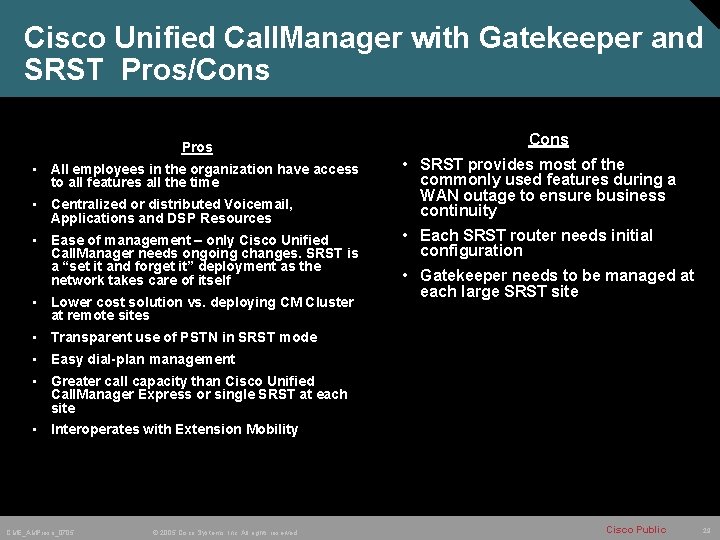
Cisco Unified Call. Manager with Gatekeeper and SRST Pros/Cons Pros • All employees in the organization have access to all features all the time • Centralized or distributed Voicemail, Applications and DSP Resources • Ease of management – only Cisco Unified Call. Manager needs ongoing changes. SRST is a “set it and forget it” deployment as the network takes care of itself • Lower cost solution vs. deploying CM Cluster at remote sites Cons • SRST provides most of the commonly used features during a WAN outage to ensure business continuity • Each SRST router needs initial configuration • Gatekeeper needs to be managed at each large SRST site • Transparent use of PSTN in SRST mode • Easy dial-plan management • Greater call capacity than Cisco Unified Call. Manager Express or single SRST at each site • Interoperates with Extension Mobility CME_AMPreso_0705 © 2005 Cisco Systems, Inc. All rights reserved. Cisco Public 29
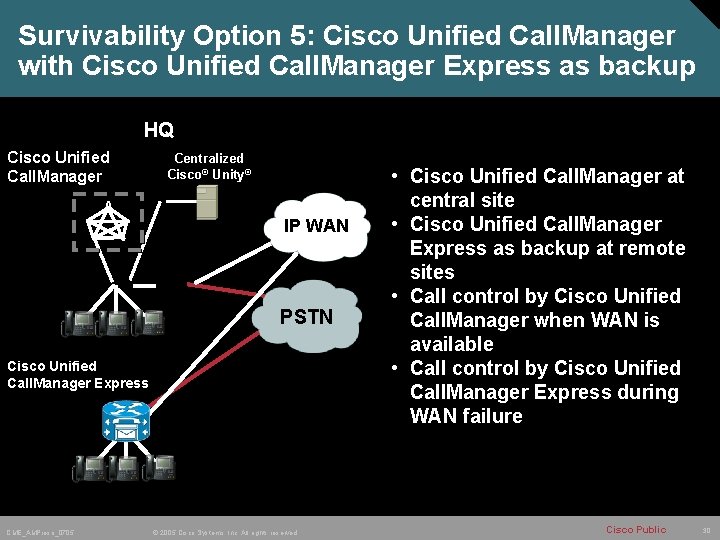
Survivability Option 5: Cisco Unified Call. Manager with Cisco Unified Call. Manager Express as backup HQ Cisco Unified Call. Manager Centralized Cisco® Unity® A IP WAN PSTN Cisco Unified Call. Manager Express CME_AMPreso_0705 © 2005 Cisco Systems, Inc. All rights reserved. • Cisco Unified Call. Manager at central site • Cisco Unified Call. Manager Express as backup at remote sites • Call control by Cisco Unified Call. Manager when WAN is available • Call control by Cisco Unified Call. Manager Express during WAN failure Cisco Public 30
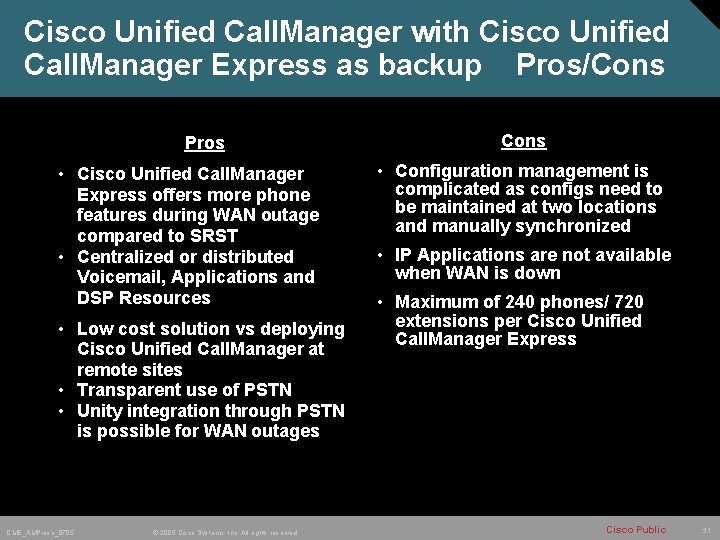
Cisco Unified Call. Manager with Cisco Unified Call. Manager Express as backup Pros/Cons Pros • Cisco Unified Call. Manager Express offers more phone features during WAN outage compared to SRST • Centralized or distributed Voicemail, Applications and DSP Resources • Low cost solution vs deploying Cisco Unified Call. Manager at remote sites • Transparent use of PSTN • Unity integration through PSTN is possible for WAN outages CME_AMPreso_0705 © 2005 Cisco Systems, Inc. All rights reserved. Cons • Configuration management is complicated as configs need to be maintained at two locations and manually synchronized • IP Applications are not available when WAN is down • Maximum of 240 phones/ 720 extensions per Cisco Unified Call. Manager Express Cisco Public 31
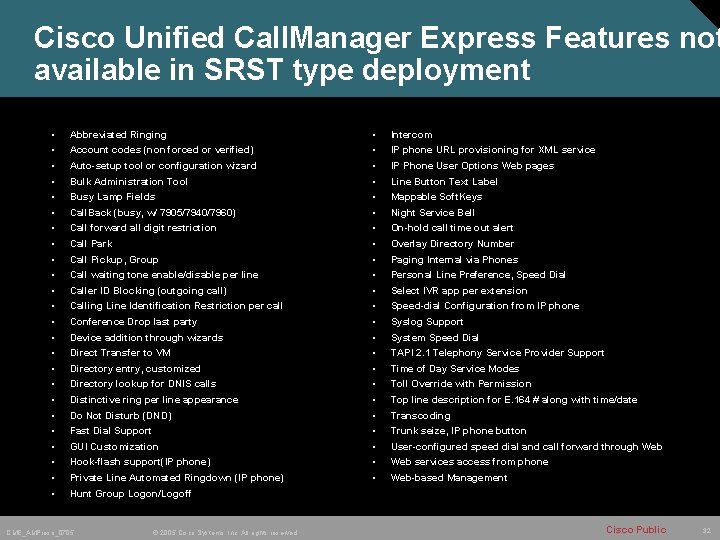
Cisco Unified Call. Manager Express Features not available in SRST type deployment • • • • • • Abbreviated Ringing Account codes (non forced or verified) Auto-setup tool or configuration wizard Bulk Administration Tool Busy Lamp Fields Call. Back (busy, w/ 7905/7940/7960) Call forward all digit restriction Call Park Call Pickup, Group Call waiting tone enable/disable per line Caller ID Blocking (outgoing call) Calling Line Identification Restriction per call Conference Drop last party Device addition through wizards Direct Transfer to VM Directory entry, customized Directory lookup for DNIS calls Distinctive ring per line appearance Do Not Disturb (DND) Fast Dial Support GUI Customization Hook-flash support(IP phone) Private Line Automated Ringdown (IP phone) • • • • • • Intercom IP phone URL provisioning for XML service IP Phone User Options Web pages Line Button Text Label Mappable Soft. Keys Night Service Bell On-hold call time out alert Overlay Directory Number Paging Internal via Phones Personal Line Preference, Speed Dial Select IVR app per extension Speed-dial Configuration from IP phone Syslog Support System Speed Dial TAPI 2. 1 Telephony Service Provider Support Time of Day Service Modes Toll Override with Permission Top line description for E. 164 # along with time/date Transcoding Trunk seize, IP phone button User-configured speed dial and call forward through Web services access from phone Web-based Management Hunt Group Logon/Logoff CME_AMPreso_0705 © 2005 Cisco Systems, Inc. All rights reserved. Cisco Public 32
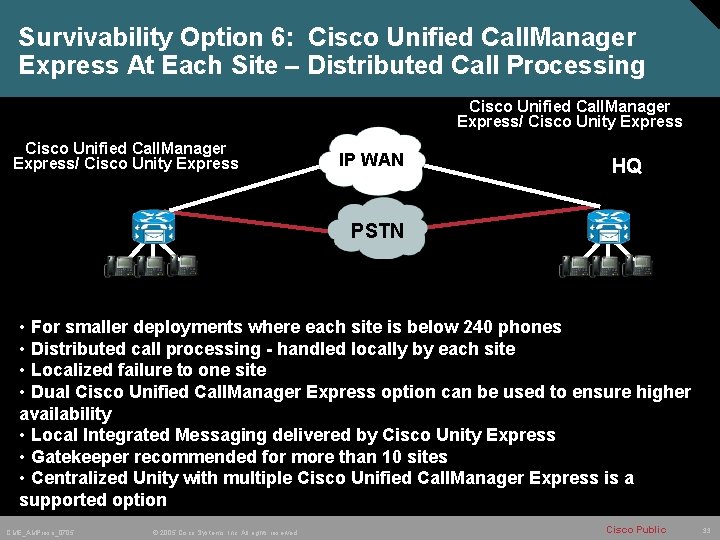
Survivability Option 6: Cisco Unified Call. Manager Express At Each Site – Distributed Call Processing Cisco Unified Call. Manager Express/ Cisco Unity Express IP WAN HQ PSTN • For smaller deployments where each site is below 240 phones • Distributed call processing - handled locally by each site • Localized failure to one site • Dual Cisco Unified Call. Manager Express option can be used to ensure higher availability • Local Integrated Messaging delivered by Cisco Unity Express • Gatekeeper recommended for more than 10 sites • Centralized Unity with multiple Cisco Unified Call. Manager Express is a supported option CME_AMPreso_0705 © 2005 Cisco Systems, Inc. All rights reserved. Cisco Public 33
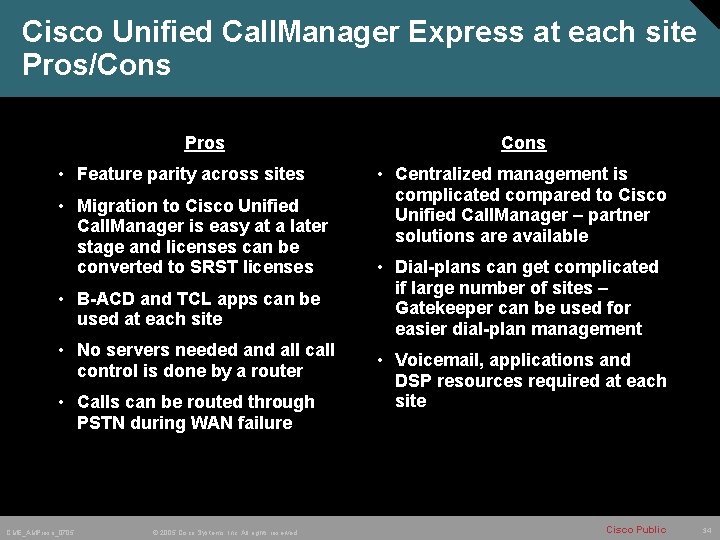
Cisco Unified Call. Manager Express at each site Pros/Cons Pros • Feature parity across sites • Migration to Cisco Unified Call. Manager is easy at a later stage and licenses can be converted to SRST licenses • B-ACD and TCL apps can be used at each site • No servers needed and all control is done by a router • Calls can be routed through PSTN during WAN failure CME_AMPreso_0705 © 2005 Cisco Systems, Inc. All rights reserved. Cons • Centralized management is complicated compared to Cisco Unified Call. Manager – partner solutions are available • Dial-plans can get complicated if large number of sites – Gatekeeper can be used for easier dial-plan management • Voicemail, applications and DSP resources required at each site Cisco Public 34
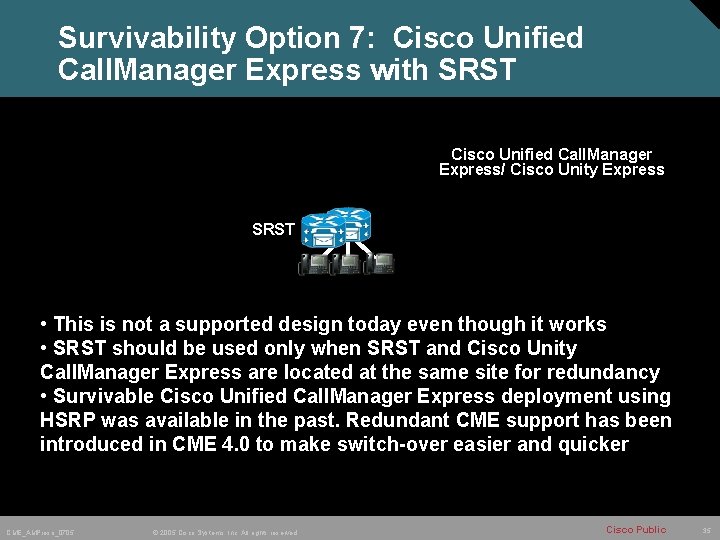
Survivability Option 7: Cisco Unified Call. Manager Express with SRST Cisco Unified Call. Manager Express/ Cisco Unity Express SRST • This is not a supported design today even though it works • SRST should be used only when SRST and Cisco Unity Call. Manager Express are located at the same site for redundancy • Survivable Cisco Unified Call. Manager Express deployment using HSRP was available in the past. Redundant CME support has been introduced in CME 4. 0 to make switch-over easier and quicker CME_AMPreso_0705 © 2005 Cisco Systems, Inc. All rights reserved. Cisco Public 35
Cisco Unified Call. Manager Express with SRST Pros/Cons • Ease of management – only Cisco Unified Call. Manager Express needs to be configured and generic simple config on SRST • Centralized or distributed Voicemail, Applications and DSP Resources • During Cisco Unified Call. Manager Express outages, some features are not available in SRST mode of operation • No voicemail MWI available in SRST mode • Using Dual Cisco Unified Call. Manager Express solution provides full features under failover including MWI CME_AMPreso_0705 © 2005 Cisco Systems, Inc. All rights reserved. Cisco Public 36
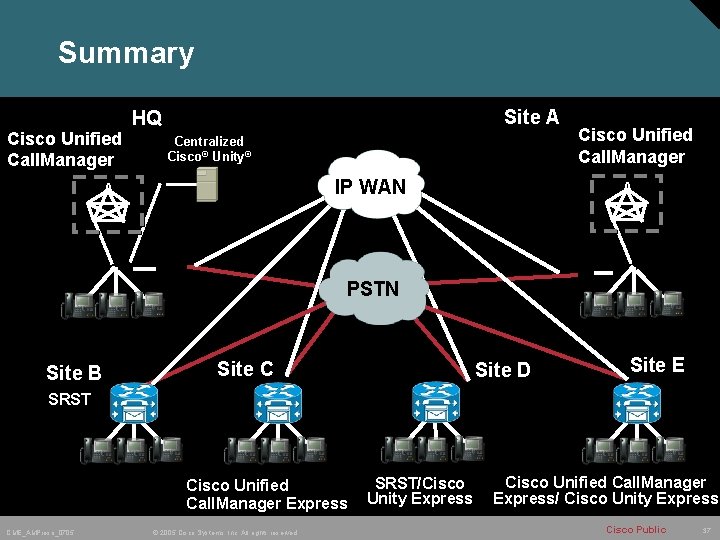
Summary Cisco Unified Call. Manager Site A HQ Centralized Cisco® Unity® IP WAN A Cisco Unified Call. Manager A PSTN Site B Site C Site D Site E SRST Cisco Unified Call. Manager Express CME_AMPreso_0705 © 2005 Cisco Systems, Inc. All rights reserved. SRST/Cisco Unity Express Cisco Unified Call. Manager Express/ Cisco Unity Express Cisco Public 37
Summary • Customers are asking for, and planning on integrating multiple services on their next branch or small office platform • Ensure that the platform you select has the ability to offer the critical services for your business • Cisco 3800 and 2800 Integrated Services Routers offer survivability for Voice, Data, WAN connectivity, Security, Messaging and other services • Different offers for voice survivability allow a customer to choose which one is best for their deployment CME_AMPreso_0705 © 2005 Cisco Systems, Inc. All rights reserved. Cisco Public 38

Thank You Questions and comments? Session Number Presentation_ID © 2005 Cisco Systems, Inc. All rights reserved. Cisco Public 39
- Slides: 39