
Integrating Infection Prevention and Control Programs into the

- Slides: 21
Integrating Infection Prevention and Control Programs into the Ambulatory Care Setting: An Evolving Model Laura Tang, RN With credits to Infection Preventionists from New York University Medical Center: Faith Skeete, RN MS CIC Natalie Fucito, BSN RN CCRN No Financial Disclosures
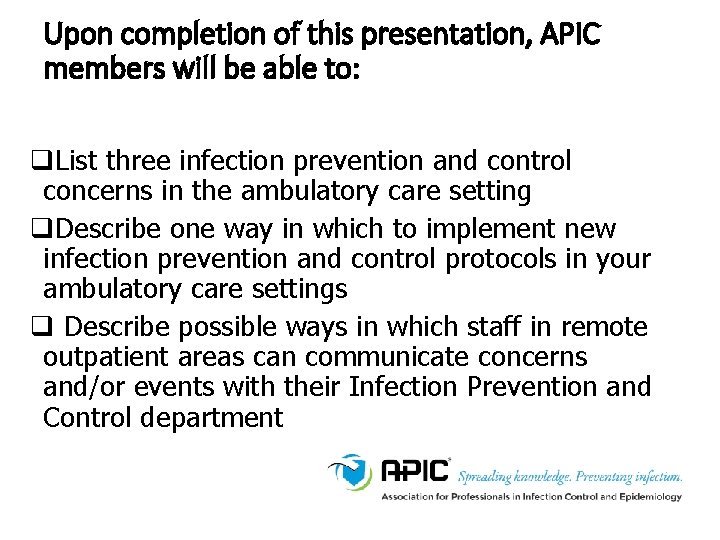
Upon completion of this presentation, APIC members will be able to: q. List three infection prevention and control concerns in the ambulatory care setting q. Describe one way in which to implement new infection prevention and control protocols in your ambulatory care settings q Describe possible ways in which staff in remote outpatient areas can communicate concerns and/or events with their Infection Prevention and Control department 2
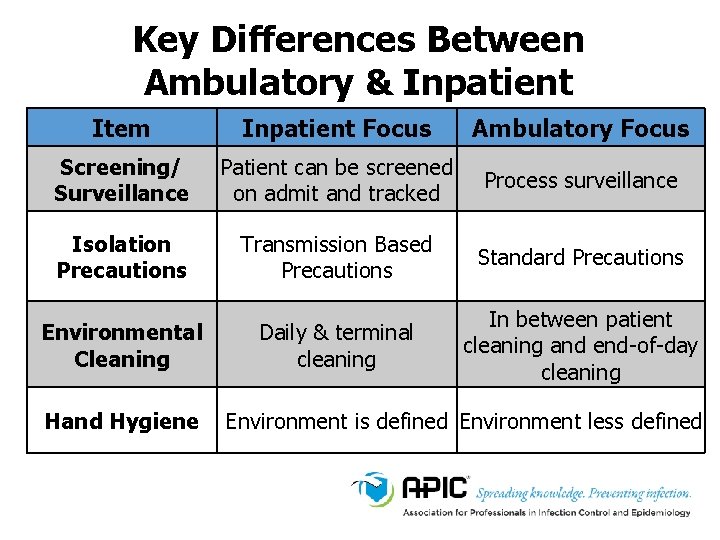
Key Differences Between Ambulatory & Inpatient Item Inpatient Focus Ambulatory Focus Screening/ Surveillance Patient can be screened on admit and tracked Process surveillance Isolation Precautions Transmission Based Precautions Standard Precautions Daily & terminal cleaning In between patient cleaning and end-of-day cleaning Environmental Cleaning Hand Hygiene Environment is defined Environment less defined 3
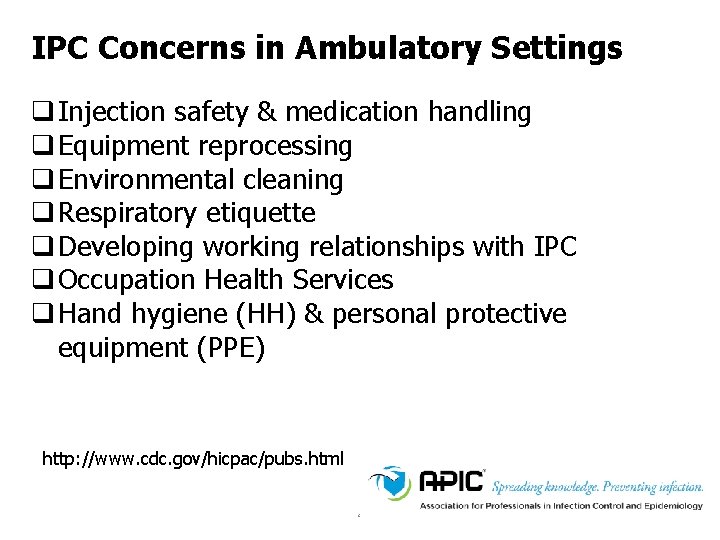
IPC Concerns in Ambulatory Settings q Injection safety & medication handling q Equipment reprocessing q Environmental cleaning q Respiratory etiquette q Developing working relationships with IPC q Occupation Health Services q Hand hygiene (HH) & personal protective equipment (PPE) http: //www. cdc. gov/hicpac/pubs. html 4
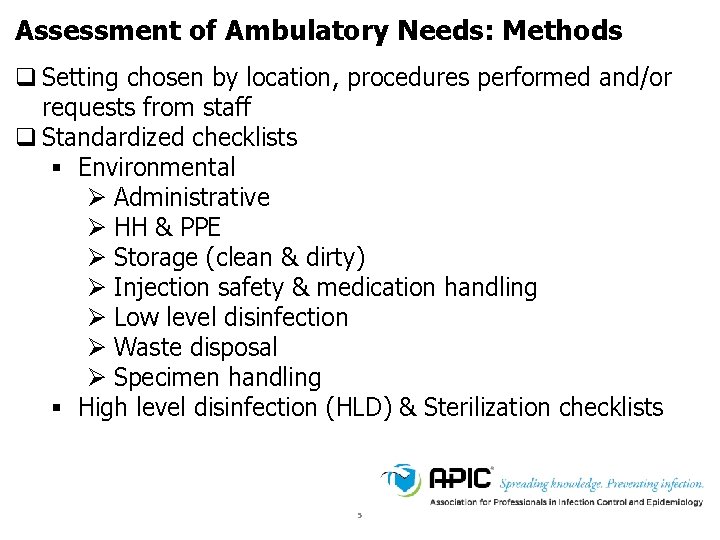
Assessment of Ambulatory Needs: Methods q Setting chosen by location, procedures performed and/or requests from staff q Standardized checklists § Environmental Ø Administrative Ø HH & PPE Ø Storage (clean & dirty) Ø Injection safety & medication handling Ø Low level disinfection Ø Waste disposal Ø Specimen handling § High level disinfection (HLD) & Sterilization checklists 5
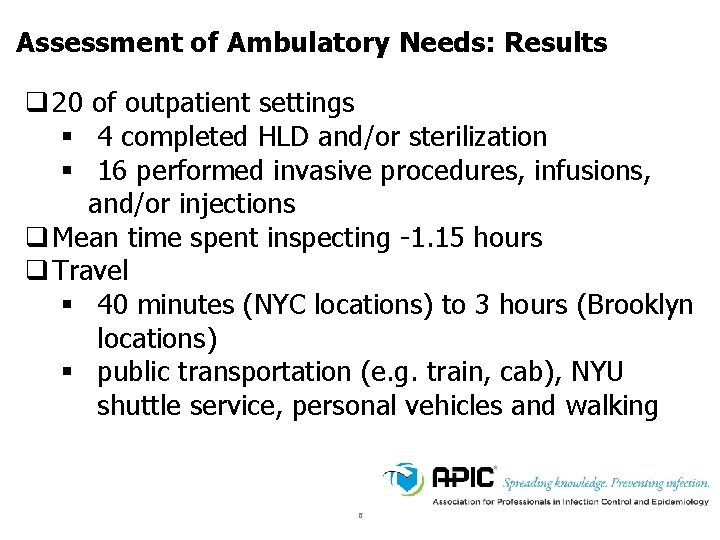
Assessment of Ambulatory Needs: Results q 20 of outpatient settings § 4 completed HLD and/or sterilization § 16 performed invasive procedures, infusions, and/or injections q Mean time spent inspecting -1. 15 hours q Travel § 40 minutes (NYC locations) to 3 hours (Brooklyn locations) § public transportation (e. g. train, cab), NYU shuttle service, personal vehicles and walking 6
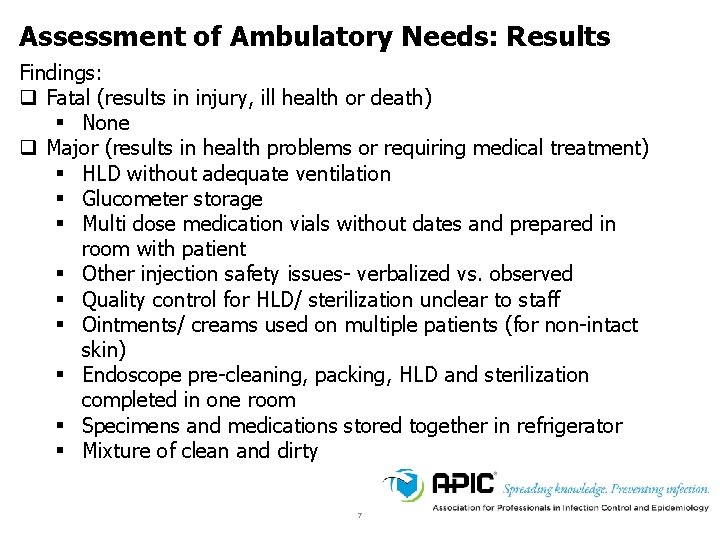
Assessment of Ambulatory Needs: Results Findings: q Fatal (results in injury, ill health or death) § None q Major (results in health problems or requiring medical treatment) § HLD without adequate ventilation § Glucometer storage § Multi dose medication vials without dates and prepared in room with patient § Other injection safety issues- verbalized vs. observed § Quality control for HLD/ sterilization unclear to staff § Ointments/ creams used on multiple patients (for non-intact skin) § Endoscope pre-cleaning, packing, HLD and sterilization completed in one room § Specimens and medications stored together in refrigerator § Mixture of clean and dirty 7
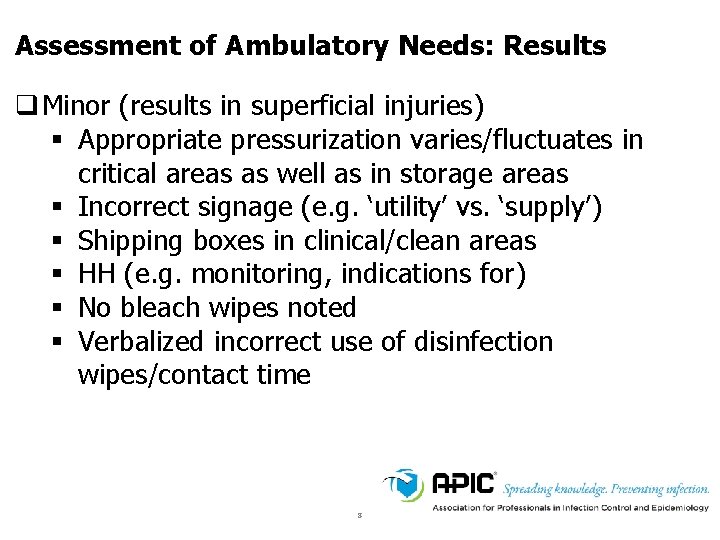
Assessment of Ambulatory Needs: Results q Minor (results in superficial injuries) § Appropriate pressurization varies/fluctuates in critical areas as well as in storage areas § Incorrect signage (e. g. ‘utility’ vs. ‘supply’) § Shipping boxes in clinical/clean areas § HH (e. g. monitoring, indications for) § No bleach wipes noted § Verbalized incorrect use of disinfection wipes/contact time 8
From Assessment to Integration 9
Infection Prevention to Infection Management q. Necessary with the changing landscape of healthcare q. Impossible to take an inpatient approach to the ambulatory world. q. Program management approach to implementing an Infection Control Program in the ambulatory setting § Assessment § Build relationships § Create an environment of safety § Disseminate data § Expand evolve your program 10
Assessment q. Assessment of the current Ambulatory Network included the following: § § § Distributing a needs assessment survey to providers Gathering information from other teams regarding growth, infrastructure, and services offered at various locations Stratifying locations by location and risk 11
Build Relationships q Identify key stakeholders § Environmental Health & Safety § Regulatory § Clinical Compliance § Real Estate and Development § Onsite leadership (Administrative and Clinical) q Communication is key and face time is a must q Work towards a common goal q Identify yourself as a resource 12
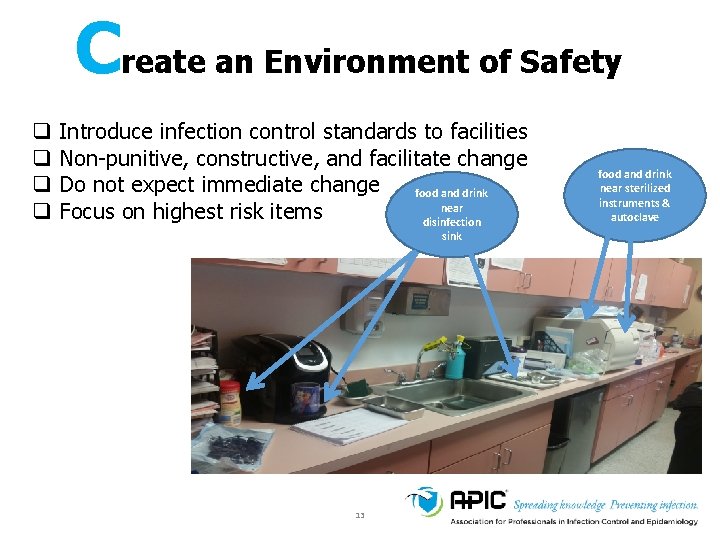
Create an Environment of Safety q q Introduce infection control standards to facilities Non-punitive, constructive, and facilitate change Do not expect immediate change food and drink near Focus on highest risk items disinfection sink 13 food and drink near sterilized instruments & autoclave
Disseminate Data q. Collect data from each visit q. Analyze data q. Disseminate data to key stakeholders q. Elicit feedback q. Collaborate on how to improve 14
Expand Your Program q Take knowledge gleaned through data and subjectively to implement the following: § Emerging pathogen awareness § SSI surveillance § Central line surveillance § New policies and procedures § Antimicrobial Stewardship § Database development § HH monitoring program
Challenges q Knowledge gaps regarding infection control q Physical layout q Inconsistencies between practices q Increased amount of resources and focus requires a change in practice
Wins Meeting new people across your institution Collaborating as a team Scope of impact is immeasurable On the forefront of change in infection control and healthcare q Overall IPC is well welcomed! q Interesting and fun! q q 17
Communication is Key… Promote all forms of communication… q Phone q Text q Email q IPC Webpage/social media page q Sharepoint q Webex/go-to-meeting 18
Conclusion q Implementing an infection control program in your ambulatory care environment requires: § Adequate assessment § Building new relationships § Creating a culture of safety and quality § Data analysis § Expansion to an evolved ICP program q Communication is key. Use your resources to keep the ambulatory world connected to your Infection Prevention and Control Department.
What we know for sure… q The environment of ambulatory care is evolving and requires a thoughtful approach to assessing infection control risks. q Change requires the support of: § Leadership § A dedicated multi-disciplinary team § Additional resources (time and money) q The revolution of healthcare improvement requires an evolution in infection prevention.
With Deepest Appreciation Thank You!