
Integrating Environmental Requirements into a Project LifeCycle Kliss
- Slides: 14
Integrating Environmental Requirements into a Project Life-Cycle Kliss Mc. Neel Director, Environmental and Regulatory Services Steve Birrer Manager, Environmental and Regulatory Services November 29, 2007
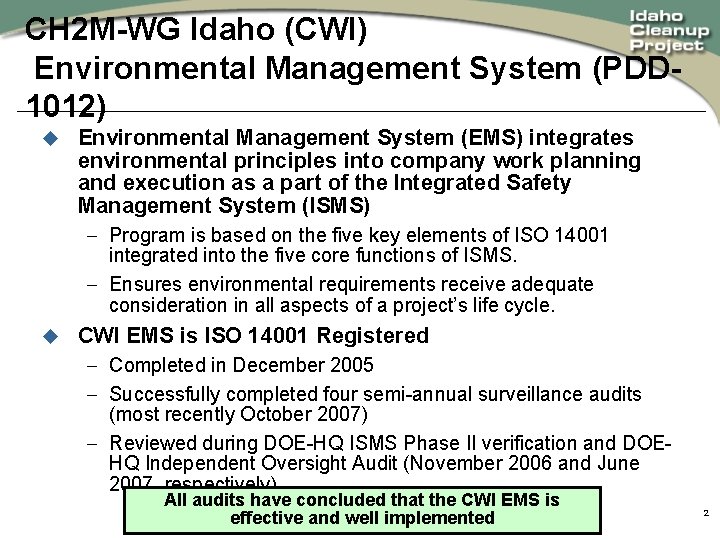
CH 2 M-WG Idaho (CWI) Environmental Management System (PDD 1012) u Environmental Management System (EMS) integrates environmental principles into company work planning and execution as a part of the Integrated Safety Management System (ISMS) - Program is based on the five key elements of ISO 14001 integrated into the five core functions of ISMS. - Ensures environmental requirements receive adequate consideration in all aspects of a project’s life cycle. u CWI EMS is ISO 14001 Registered - Completed in December 2005 - Successfully completed four semi-annual surveillance audits (most recently October 2007) - Reviewed during DOE-HQ ISMS Phase II verification and DOEHQ Independent Oversight Audit (November 2006 and June 2007, respectively) All audits have concluded that the CWI EMS is effective and well implemented 2
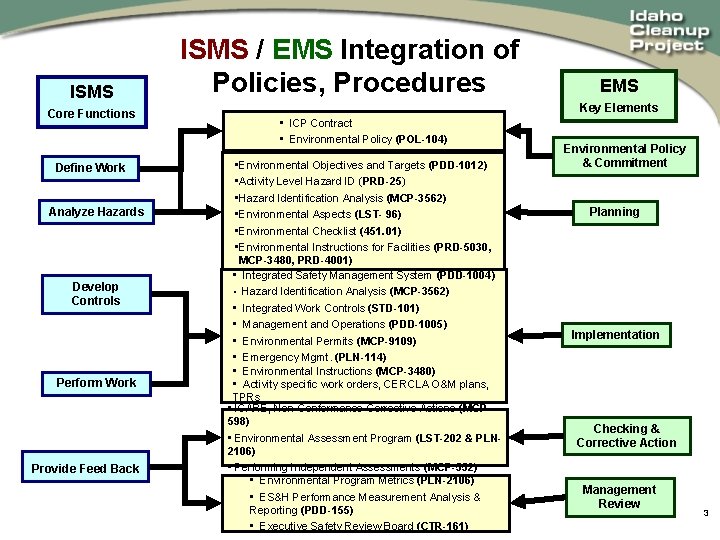
ISMS Core Functions Define Work Analyze Hazards Develop Controls Perform Work Provide Feed Back ISMS / EMS Integration of Policies, Procedures EMS Key Elements • ICP Contract • Environmental Policy (POL-104) • Environmental Objectives and Targets (PDD-1012) • Activity Level Hazard ID (PRD-25) • Hazard Identification Analysis (MCP-3562) • Environmental Aspects (LST- 96) • Environmental Checklist (451. 01) • Environmental Instructions for Facilities (PRD-5030, MCP-3480, PRD-4001) • Integrated Safety Management System (PDD-1004) • Hazard Identification Analysis (MCP-3562) • Integrated Work Controls (STD-101) • Management and Operations (PDD-1005) • Environmental Permits (MCP-9109) • Emergency Mgmt. (PLN-114) • Environmental Instructions (MCP-3480) • Activity specific work orders, CERCLA O&M plans, TPRs • ICARE, Non Conformance Corrective Actions (MCP 598) • Environmental Assessment Program (LST-202 & PLN 2106) • Performing Independent Assessments (MCP-552) • Environmental Program Metrics (PLN-2106) • ES&H Performance Measurement Analysis & Reporting (PDD-155) • Executive Safety Review Board (CTR-161) Environmental Policy & Commitment Planning Implementation Checking & Corrective Action Management Review 3
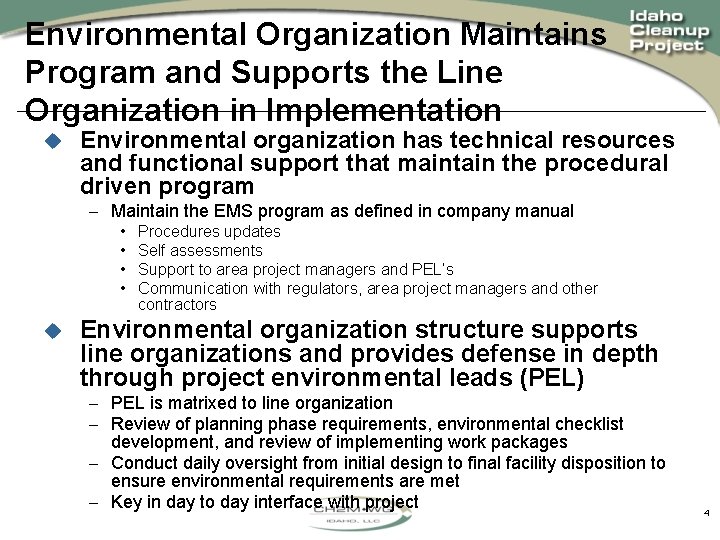
Environmental Organization Maintains Program and Supports the Line Organization in Implementation u Environmental organization has technical resources and functional support that maintain the procedural driven program - Maintain the EMS program as defined in company manual • • u Procedures updates Self assessments Support to area project managers and PEL’s Communication with regulators, area project managers and other contractors Environmental organization structure supports line organizations and provides defense in depth through project environmental leads (PEL) - PEL is matrixed to line organization - Review of planning phase requirements, environmental checklist development, and review of implementing work packages - Conduct daily oversight from initial design to final facility disposition to ensure environmental requirements are met - Key in day to day interface with project 4
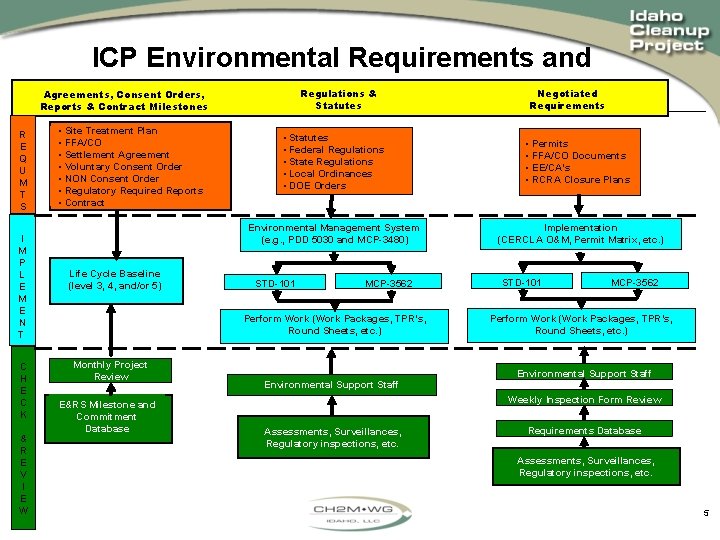
ICP Environmental Requirements and Implementation Regulations & Statutes Agreements, Consent Orders, Reports & Contract Milestones R E Q U M T S I M P L E M E N T C H E C K & R E V I E W • Site Treatment Plan • FFA/CO • Settlement Agreement • Voluntary Consent Order • NON Consent Order • Regulatory Required Reports • Contract • Statutes • Federal Regulations • State Regulations • Local Ordinances • DOE Orders Environmental Management System (e. g. , PDD 5030 and MCP-3480) Life Cycle Baseline (level 3, 4, and/or 5) STD-101 MCP-3562 Perform Work (Work Packages, TPR’s, Round Sheets, etc. ) Monthly Project Review E&RS Milestone and Commitment Database Environmental Support Staff Negotiated Requirements • Permits • FFA/CO Documents • EE/CA’s • RCRA Closure Plans Implementation (CERCLA O&M, Permit Matrix, etc. ) STD-101 MCP-3562 Perform Work (Work Packages, TPR’s, Round Sheets, etc. ) Environmental Support Staff Weekly Inspection Form Review Assessments, Surveillances, Regulatory inspections, etc. Requirements Database Assessments, Surveillances, Regulatory inspections, etc. 5
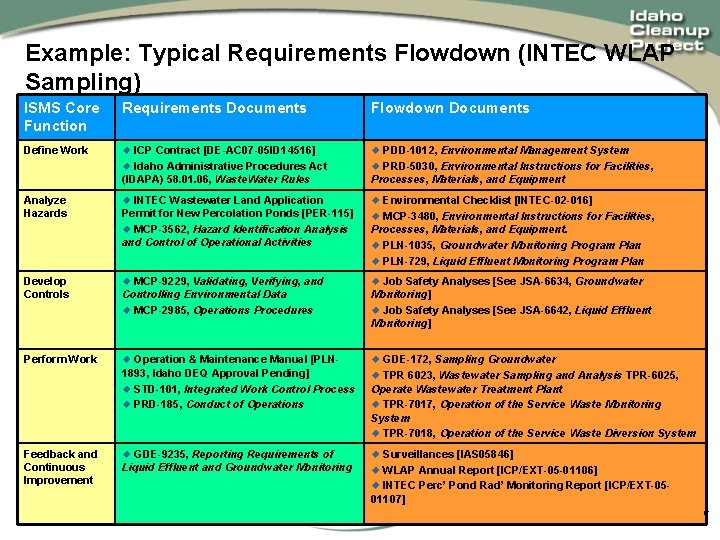
Example: Typical Requirements Flowdown (INTEC WLAP Sampling) ISMS Core Function Requirements Documents Flowdown Documents Define Work u ICP Contract [DE-AC 07 -05 ID 14516] u PDD-1012, Environmental Management System u Idaho Administrative Procedures Act u PRD-5030, Environmental Instructions for Facilities, (IDAPA) 58. 01. 06, Waste. Water Rules Processes, Materials, and Equipment u INTEC Wastewater Land Application u Environmental Checklist [INTEC-02 -016] Permit for New Percolation Ponds [PER-115] u MCP-3562, Hazard Identification Analysis and Control of Operational Activities u MCP-3480, Environmental Instructions for Facilities, Develop Controls u MCP-9229, Validating, Verifying, and u Job Safety Analyses [See JSA-6634, Groundwater Controlling Environmental Data u MCP-2985, Operations Procedures Monitoring] u Job Safety Analyses [See JSA-6642, Liquid Effluent Monitoring] Perform Work u Operation & Maintenance Manual [PLN- u GDE-172, Sampling Groundwater 1893, Idaho DEQ Approval Pending] u STD-101, Integrated Work Control Process u PRD-185, Conduct of Operations u TPR 6023, Wastewater Sampling and Analysis TPR-6025, u GDE-9235, Reporting Requirements of u Surveillances [IAS 05846] Liquid Effluent and Groundwater Monitoring u WLAP Annual Report [ICP/EXT-05 -01106] Analyze Hazards Feedback and Continuous Improvement Processes, Materials, and Equipment. u PLN-1035, Groundwater Monitoring Program Plan u PLN-729, Liquid Effluent Monitoring Program Plan Operate Wastewater Treatment Plant u TPR-7017, Operation of the Service Waste Monitoring System u TPR-7018, Operation of the Service Waste Diversion System u INTEC Perc’ Pond Rad’ Monitoring Report [ICP/EXT-05 - 01107] 6
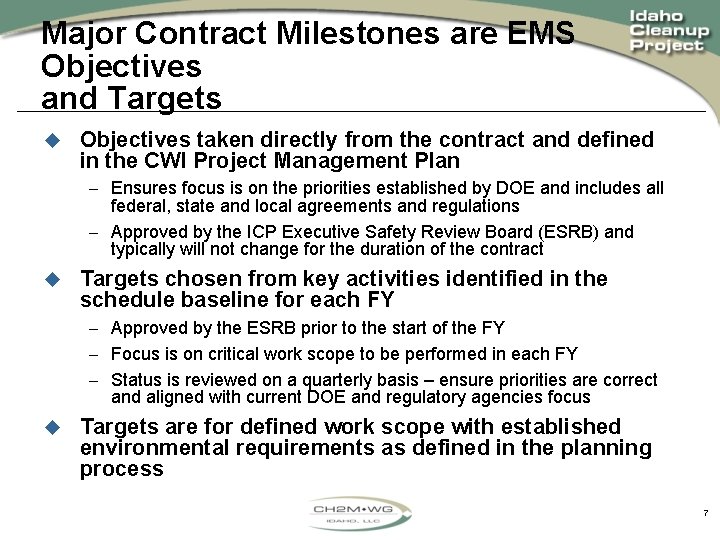
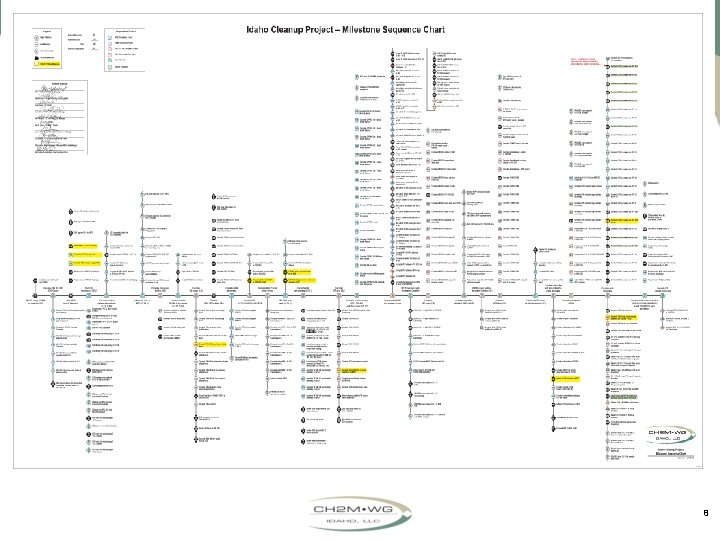
Major Contract Milestones are EMS Objectives and Targets u Objectives taken directly from the contract and defined in the CWI Project Management Plan - Ensures focus is on the priorities established by DOE and includes all federal, state and local agreements and regulations - Approved by the ICP Executive Safety Review Board (ESRB) and typically will not change for the duration of the contract u Targets chosen from key activities identified in the schedule baseline for each FY - Approved by the ESRB prior to the start of the FY - Focus is on critical work scope to be performed in each FY - Status is reviewed on a quarterly basis – ensure priorities are correct and aligned with current DOE and regulatory agencies focus u Targets are for defined work scope with established environmental requirements as defined in the planning process 7
8
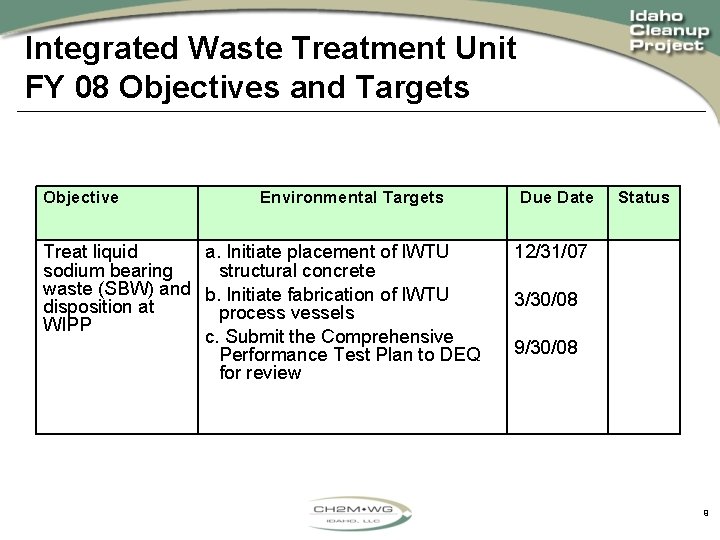
Integrated Waste Treatment Unit FY 08 Objectives and Targets Objective Environmental Targets Treat liquid a. Initiate placement of IWTU sodium bearing structural concrete waste (SBW) and b. Initiate fabrication of IWTU disposition at process vessels WIPP c. Submit the Comprehensive Performance Test Plan to DEQ for review Due Date Status 12/31/07 3/30/08 9
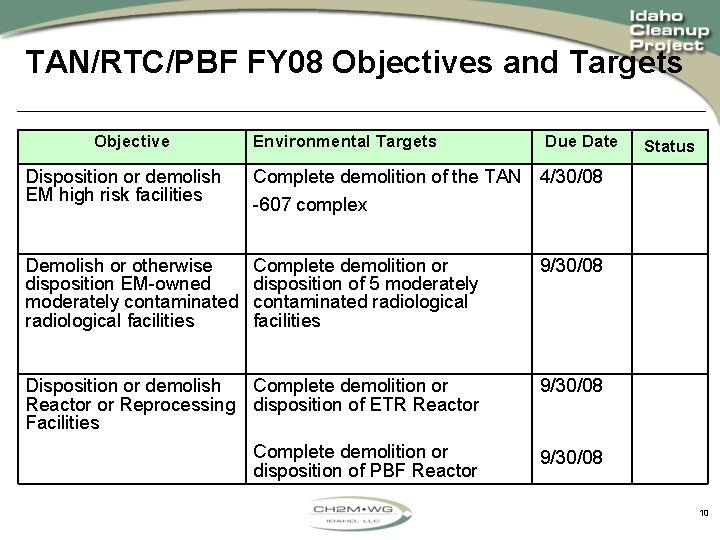
TAN/RTC/PBF FY 08 Objectives and Targets Objective Environmental Targets Due Date Disposition or demolish EM high risk facilities Complete demolition of the TAN 4/30/08 -607 complex Demolish or otherwise disposition EM-owned moderately contaminated radiological facilities Complete demolition or disposition of 5 moderately contaminated radiological facilities 9/30/08 Disposition or demolish Complete demolition or Reactor or Reprocessing disposition of ETR Reactor Facilities 9/30/08 Complete demolition or disposition of PBF Reactor 9/30/08 Status 10
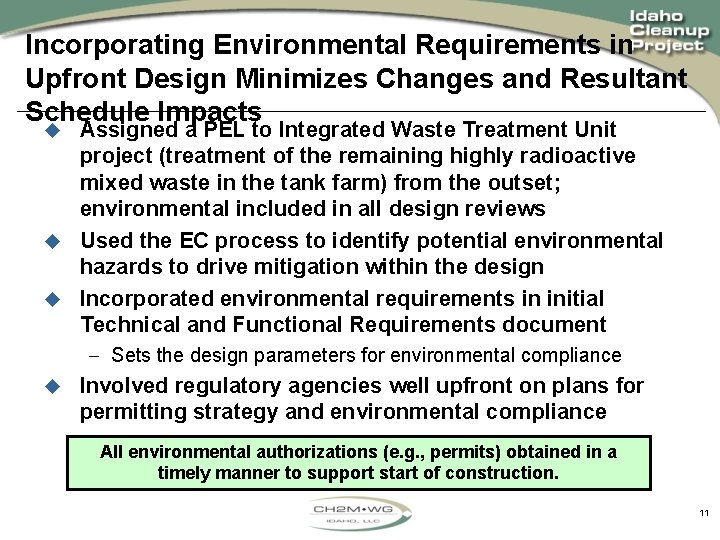
Incorporating Environmental Requirements in Upfront Design Minimizes Changes and Resultant Schedule Impacts Assigned a PEL to Integrated Waste Treatment Unit project (treatment of the remaining highly radioactive mixed waste in the tank farm) from the outset; environmental included in all design reviews u Used the EC process to identify potential environmental hazards to drive mitigation within the design u Incorporated environmental requirements in initial Technical and Functional Requirements document u - Sets the design parameters for environmental compliance u Involved regulatory agencies well upfront on plans for permitting strategy and environmental compliance All environmental authorizations (e. g. , permits) obtained in a timely manner to support start of construction. 11
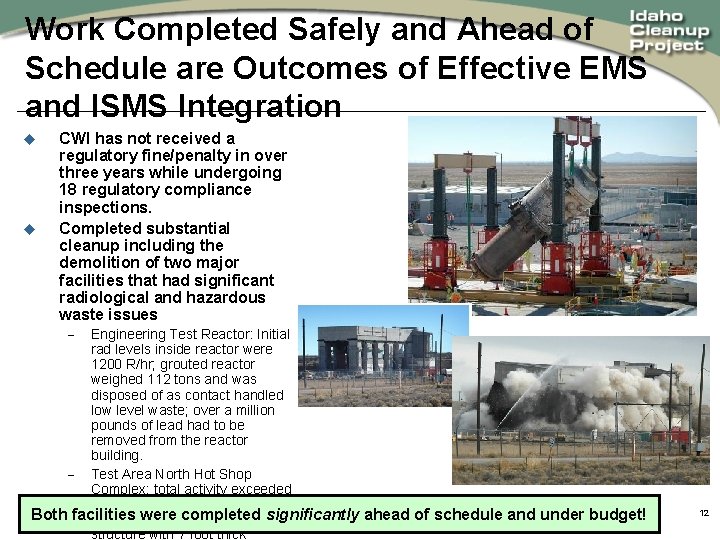
Work Completed Safely and Ahead of Schedule are Outcomes of Effective EMS and ISMS Integration u u CWI has not received a regulatory fine/penalty in over three years while undergoing 18 regulatory compliance inspections. Completed substantial cleanup including the demolition of two major facilities that had significant radiological and hazardous waste issues - Engineering Test Reactor: Initial rad levels inside reactor were 1200 R/hr; grouted reactor weighed 112 tons and was disposed of as contact handled low level waste; over a million pounds of lead had to be removed from the reactor building. - Test Area North Hot Shop Complex: total activity exceeded 75 curies; three concurrent Both facilities were completed significantly ahead of schedule and under budget! RCRA closures; physically large structure with 7 foot thick 12
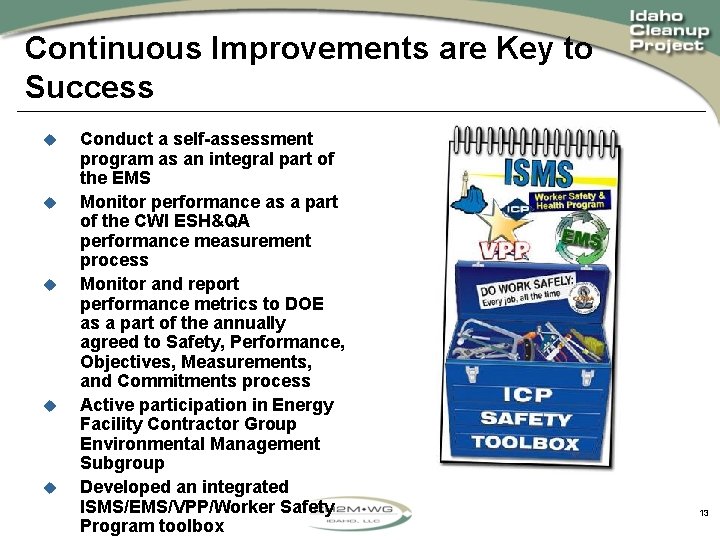
Continuous Improvements are Key to Success u u u Conduct a self-assessment program as an integral part of the EMS Monitor performance as a part of the CWI ESH&QA performance measurement process Monitor and report performance metrics to DOE as a part of the annually agreed to Safety, Performance, Objectives, Measurements, and Commitments process Active participation in Energy Facility Contractor Group Environmental Management Subgroup Developed an integrated ISMS/EMS/VPP/Worker Safety Program toolbox 13
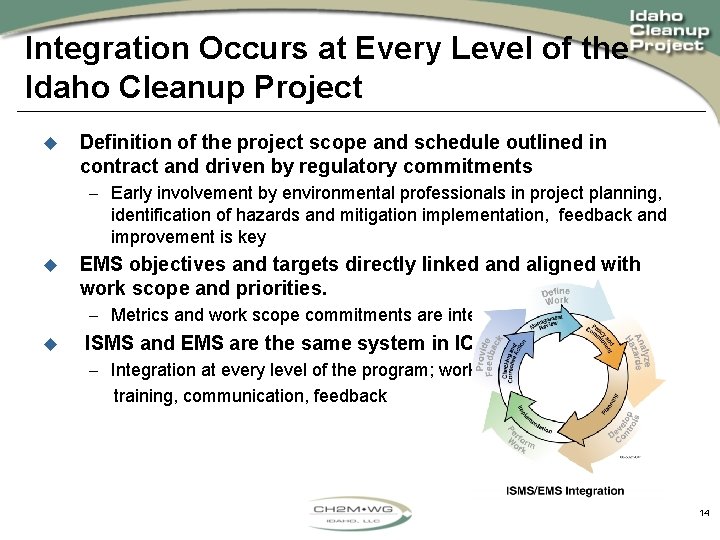
Integration Occurs at Every Level of the Idaho Cleanup Project u Definition of the project scope and schedule outlined in contract and driven by regulatory commitments - Early involvement by environmental professionals in project planning, identification of hazards and mitigation implementation, feedback and improvement is key u EMS objectives and targets directly linked and aligned with work scope and priorities. - Metrics and work scope commitments are integrated u ISMS and EMS are the same system in ICP - Integration at every level of the program; work control, training, communication, feedback 14