
INTEGRATING ECOSYSTEMIC PLAY THERAPY AND THERAPLAY IN THE
- Slides: 16
INTEGRATING ECOSYSTEMIC PLAY THERAPY AND THERAPLAY IN THE TREATMENT OF ATTACHMENT DISORDERS Introduction o Attachment and attachment disorders are of increasing interest to mental health professionals o Problems in attachment relationships lead to • Unmediated distress of infant or child • Which, in turn, negatively affects the attachment relationship in a vicious cycle o Different types of problems • Difficulty soothing infant • Caregiver unavailability or neglect • Inappropriate discipline • Family medical crisis or loss • Job change or change of residence • Natural disaster o Integration of ecosystemic play therapy and Theraplay can help these children and families restore attachment relationships
INTEGRATING ECOSYSTEMIC PLAY THERAPY AND THERAPLAY IN THE TREATMENT OF ATTACHMENT DISORDERS Ecosystemic play therapy o Children’s development important in understanding origins and nature of pathology • Even brief periods of stress or disruption can have significant negative effects on development • Treatment methods need to be adjusted frequently to accommodate a child’s developmental progress o Integration of experiential and cognitive-verbal interventions • Children at lower developmental levels should receive treatment tilted toward experiential process • Children at higher developmental levels should receive treatment tilted toward cognitive-verbal process • A balance of both types of interventions should be struck with every child
INTEGRATING ECOSYSTEMIC PLAY THERAPY AND THERAPLAY IN THE TREATMENT OF ATTACHMENT DISORDERS Theraplay o Highly experiential play therapy method o Provides corrective attachment experiences o Four modules of Theraplay • • Structuring – focus on organizational behavior Challenging – focus on cognition Engaging – focus on regulatory behavior Nurturing – focus on emotional Integrating Theraplay and ecosystemic play therapy o Combination of experiential and cognitive-verbal interventions with greater emphasis on latter o Therapy more effective when both sides of brain engaged
INTEGRATING ECOSYSTEMIC PLAY THERAPY AND THERAPLAY IN THE TREATMENT OF ATTACHMENT DISORDERS Integrating Theraplay and ecosystemic play therapy (cont. ) o Underlying philosophy • Grounded in phenomenology – all knowledge and its value are relative • Right and wrong evaluated in context • Examine impact of child’s behavior on child and those around him – is behavior problematic in that context? o Personality • Desire to maximize rewards and avoid negative consequences (ecosystemic play therapy) • Drive toward relatedness (Theraplay) • Parent-child relationship most potent organizer of personality (both models) • • Attunement to external cues Attunement to emotional states Infants learn to rely on others Infants learn to self-soothe
INTEGRATING ECOSYSTEMIC PLAY THERAPY AND THERAPLAY IN THE TREATMENT OF ATTACHMENT DISORDERS Integrating Theraplay and ecosystemic play therapy (cont. ) o Pathology • Inability to satisfy basic drives (see earlier) • Disruption of children’s attachment relationships • Disruption of children’s developmental progress o Conceptualizing goal/cure • Maximize child’s ability to get needs met while not interfering with same ability in others • Secure attachment relationship insures against investment in exploiting others’ needs • Resumption of developmental progress • Help parents establish themselves as secure base/safe haven • Attune to child’s needs for coregulation of affect • Change self-representation from negative to positive
INTEGRATING ECOSYSTEMIC PLAY THERAPY AND THERAPLAY IN THE TREATMENT OF ATTACHMENT DISORDERS Integrating Theraplay and ecosystemic play therapy (cont. ) o Role of therapist • • Help child understand the nature of treatment Help to form therapeutic alliance Help child engage in problem solving Theraplay is therapist-directed, whereas ecosystemic play therapy is less therapist-directed • Balance tilts toward cognitive-verbal interventions with developmentally older children o Role of parents • • Assessed Observe initial sessions Mentored on how to engage child optimally Gradually replace therapist in sessions
INTEGRATING ECOSYSTEMIC PLAY THERAPY AND THERAPLAY IN THE TREATMENT OF ATTACHMENT D ISORDERS Pretreatment process o Intake • Standardized questionnaires • Intake interview • Marschak Interaction Method (MIM) • Feedback session o Contracting • Focus on child’s unmet needs • Minimize distressing issues for child • Maximize child’s enjoyment of life • Help parents focus on changing child’s problematic behaviors o Room and toys: • Number and complexity of toys kept to a minimum • Therapist controls access so that child does not use toys for avoidance of engagement
INTEGRATING ECOSYSTEMIC PLAY THERAPY AND THERAPLAY IN THE TREATMENT OF ATTACHMENT DISORDERS Treatment phases o Introduction and exploration o Tentative acceptance o Negative reaction – fear of giving up beliefs and behaviors they rely on to keep them safe o Trusting, growing, working through • Experiential interventions – engagement of right brain • Cognitive interventions – engagement of left brain Interpretive process o Case formulation that includes hypotheses about underlying causes of presenting problem and factors maintaining symptoms and behavior o Develop phenomenologically based treatment contract – how will child’s life improve in treatment?
INTEGRATING ECOSYSTEMIC PLAY THERAPY AND THERAPLAY IN THE TREATMENT OF ATTACHMENT DISORDERS Interpretive process (cont. ) o Develop a series of interpretations that will guide child to a new o o understanding of the problems (based on hypotheses in case formulation) Deliver planned interpretations as opportunities arise in play – observe responses to assess accuracy Help child use insight to problem solve Repeat interpretations to new situations so that child can use new knowledge and skills outside sessions Types of interpretations • Reflections (sessions 1 -8) • Content reflections: “You seem very angry. ” • Motive reflections: “You hit the table to let me know you don’t want me to feed you. ” • Present pattern (sessions 1 -2): “Every time you come into session, you want to be the boss. ”
INTEGRATING ECOSYSTEMIC PLAY THERAPY AND THERAPLAY IN THE TREATMENT OF ATTACHMENT DISORDERS Interpretive process (cont. ) o Types of interpretations (cont. ) • Simple dynamic (sessions 1 -5): “I think you believe Mom won’t do a good job if you don’t tell her what to do. ” • Generalized dynamic (sessions 1 -2): “That is why you hardly ever want your new mom to take care of you or be nice to you. It would mean you weren’t the boss anymore, and then you wouldn’t be safe. ” • Genetic (session 3) – “Because your birth mom never took very good care of you, you decided you needed to be the grownup and do all the taking care of yourself. ” Termination o Refer to treatment contract – lets children know when goals have been obtained o Give four-to-eight-session notice for attachment-disordered children o Generalize attachment to one important adult outside playroom
INTEGRATION OF CHILD-CENTERED PLAY THERAPY AND THERAPLAY Introduction o Reach children in line with developing brains o Nonverbal rather than verbal methods should be emphasized for very young children Rationale for the integrative approach o Two seemingly contradictory approaches – CCPT and Theraplay o Integrating these two approaches is an ideal combination when working with young children • Child might have inner conflicts – CCPT • Child might also have severe attachment problems – Theraplay o CCPT fosters feelings of independence, confidence, strength, and self-knowledge o Theraplay actively helps parents to become more attuned and appropriately responsive to child
INTEGRATION OF CHILD-CENTERED PLAY THERAPY AND THERAPLAY Child-centered play therapy o Therapist is genuinely interested in the child o Therapist experiences unqualified acceptance of the child o Therapist creates a feeling of safety and permissiveness so that o o child can explore and express self completely Therapist is sensitive to child’s feelings and reflects feelings to help child direct self-understanding Therapist believes in child’s capacity to act responsibly, respects child’s ability to solve personal problems, and allows child to do so Therapist trusts child’s inner direction, allows child to lead in all areas of the relationship, and resists the urge to direct the child’s play or conversation Therapist appreciates the gradual nature of therapeutic process and does not attempt to hurry the process
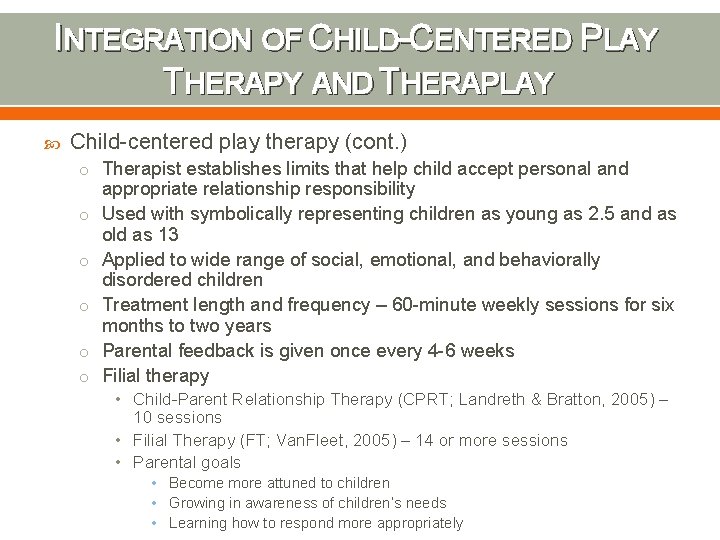
INTEGRATION OF CHILD-CENTERED PLAY THERAPY AND THERAPLAY Child-centered play therapy (cont. ) o Therapist establishes limits that help child accept personal and o o o appropriate relationship responsibility Used with symbolically representing children as young as 2. 5 and as old as 13 Applied to wide range of social, emotional, and behaviorally disordered children Treatment length and frequency – 60 -minute weekly sessions for six months to two years Parental feedback is given once every 4 -6 weeks Filial therapy • Child-Parent Relationship Therapy (CPRT; Landreth & Bratton, 2005) – 10 sessions • Filial Therapy (FT; Van. Fleet, 2005) – 14 or more sessions • Parental goals • Become more attuned to children • Growing in awareness of children’s needs • Learning how to respond more appropriately
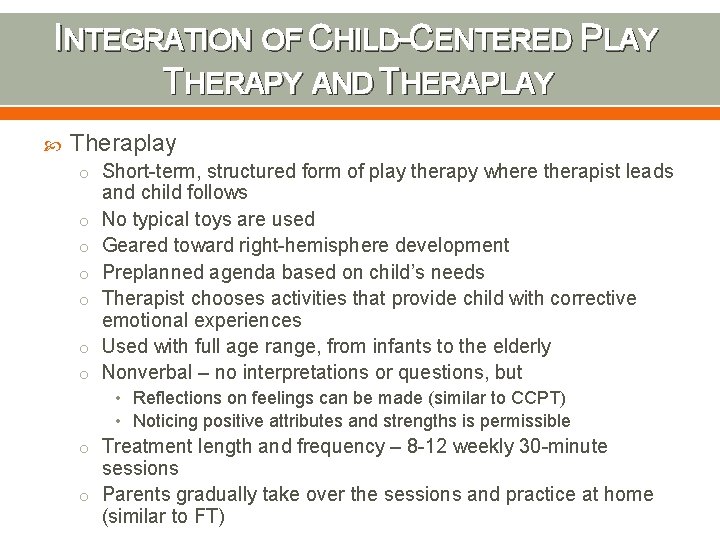
INTEGRATION OF CHILD-CENTERED PLAY THERAPY AND THERAPLAY Theraplay o Short-term, structured form of play therapy where therapist leads o o o and child follows No typical toys are used Geared toward right-hemisphere development Preplanned agenda based on child’s needs Therapist chooses activities that provide child with corrective emotional experiences Used with full age range, from infants to the elderly Nonverbal – no interpretations or questions, but • Reflections on feelings can be made (similar to CCPT) • Noticing positive attributes and strengths is permissible o Treatment length and frequency – 8 -12 weekly 30 -minute sessions o Parents gradually take over the sessions and practice at home (similar to FT)
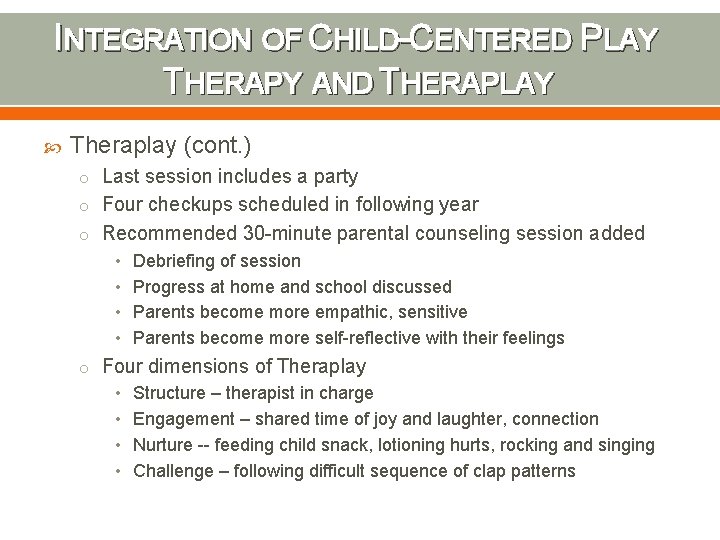
INTEGRATION OF CHILD-CENTERED PLAY THERAPY AND THERAPLAY Theraplay (cont. ) o Last session includes a party o Four checkups scheduled in following year o Recommended 30 -minute parental counseling session added • • Debriefing of session Progress at home and school discussed Parents become more empathic, sensitive Parents become more self-reflective with their feelings o Four dimensions of Theraplay • • Structure – therapist in charge Engagement – shared time of joy and laughter, connection Nurture -- feeding child snack, lotioning hurts, rocking and singing Challenge – following difficult sequence of clap patterns
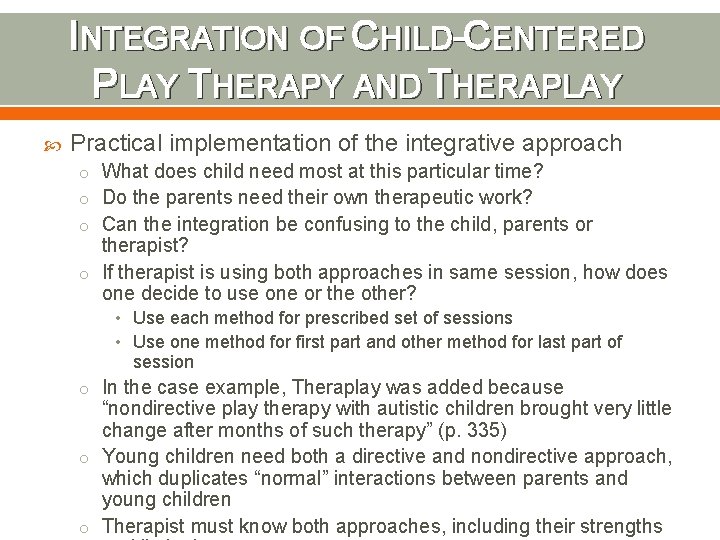
INTEGRATION OF CHILD-CENTERED PLAY THERAPY AND THERAPLAY Practical implementation of the integrative approach o What does child need most at this particular time? o Do the parents need their own therapeutic work? o Can the integration be confusing to the child, parents or therapist? o If therapist is using both approaches in same session, how does one decide to use one or the other? • Use each method for prescribed set of sessions • Use one method for first part and other method for last part of session o In the case example, Theraplay was added because “nondirective play therapy with autistic children brought very little change after months of such therapy” (p. 335) o Young children need both a directive and nondirective approach, which duplicates “normal” interactions between parents and young children o Therapist must know both approaches, including their strengths