
INTEGRATING DRONE TECHNOLOGY IN STEM EDUCATION A CASE


- Slides: 39
INTEGRATING DRONE TECHNOLOGY IN STEM EDUCATION: A CASE STUDY TO ASSESS TEACHERS’ READINESS AND TRAINING NEEDS Dr. Wing Shui Ng 1 July 2019 In. SITE 2019 AN ANINFORMINGSCIENCEINSTITUTECONFERENCEJune 3030 - July 5, 5, 2019 Jerusalem,
Authors Dr. Wing Shui Ng Dr. Gary Cheng The Education University of Hong Kong In. SITE 2019 AN INFORMING SCIENCE INSTITUTE CONFERENCE June 30 - July 5, 2019 Jerusalem,
WHAT WE KNOW AND WHAT WE NEED TO KNOW: LIT REVIEW AND RATIONALE In. SITE 2019 AN ANINFORMINGSCIENCEINSTITUTECONFERENCEJune 3030 - July 5, 5, 2019 Jerusalem,
An Overview of Drone Technology • A drone is an aircraft that does not carry a human operator and is capable of flight with or without human re-mote control. (US Department of Defense) • Developed since World War I to support military force • In the two wars fought by America in Afghanistan and Iraq, drones were extensively used as explosive devices to initiate an attack. In. SITE 2019 AN INFORMING SCIENCE INSTITUTE CONFERENCE June 30 - July 5, 2019 Jerusalem,
Applications of Drone Technology in Daily Life • used as a lifesaver to locate missing persons on a search-and-rescue mission. • penetrates dangerous locations. • delivers objects to a distant location. • helps the police to conduct a search of criminal in a wide area from a top-down view. • aerial photography or videography • drone racing • create a light show using multiple drones • … In. SITE 2019 AN INFORMING SCIENCE INSTITUTE CONFERENCE June 30 - July 5, 2019 Jerusalem,
Applications of Drone Technology in Education • explore the technology embedded in a drone. – in engineering or physics classes • carry out scientific research related to our natural environment. – take aerial photos of the landscape in geologic fieldwork and then to interpret the image to identify the geologic patterns. – explore the meteorological features. In. SITE 2019 AN INFORMING SCIENCE INSTITUTE CONFERENCE June 30 - July 5, 2019 Jerusalem,
Applications of Drone Technology in Education • reinforce the learning in class – instruct a drone to fly in a specific path using a computer program in order to enhance their programming skills • Students were motivated to learn and more engaged in the learning process. In. SITE 2019 AN INFORMING SCIENCE INSTITUTE CONFERENCE June 30 - July 5, 2019 Jerusalem,
Teachers’ Training Needs • The integration of new technology often leads to fundamental questions in the content and pedagogical aspects and even experienced teachers will find it difficult to deal with. • Almost no study can be found in the literature to discuss teachers’ training needs for using drone technology in their teaching. In. SITE 2019 AN INFORMING SCIENCE INSTITUTE CONFERENCE June 30 - July 5, 2019 Jerusalem,
Research Questions • To what extent, do teachers ready to use drone technology in their teaching? • What trainings are required for teachers to apply drone technology in their teaching? In. SITE 2019 AN INFORMING SCIENCE INSTITUTE CONFERENCE June 30 - July 5, 2019 Jerusalem,
METHOD In. SITE 2019 AN ANINFORMINGSCIENCEINSTITUTECONFERENCEJune 3030 - July 5, 5, 2019 Jerusalem,
Method • Case study approach was adopted to collect qualitative data from a specific group of participants. – to understand the case in depth and in its natural setting • Participants – 12 pre-service teachers – All of them did not have any experience to fly a drone prior to this study. In. SITE 2019 AN INFORMING SCIENCE INSTITUTE CONFERENCE June 30 - July 5, 2019 Jerusalem,
Method • Designed-based approach (Koehler et al. , 2004) was adopted to explore the training needs of teachers. • Participants were invited to design lessons with the use of a drone in the teaching process. • The underlying philosophy of a designed-based approach includes – learning-by-doing, – problem-based learning, – collaborative learning. In. SITE 2019 AN INFORMING SCIENCE INSTITUTE CONFERENCE June 30 - July 5, 2019 Jerusalem,
Method • The participants were randomly divided into three groups. • DIY Drone in STEM Education • Programmable Drone in STEM Education • Aerial Photography/Videography in STEM Education In. SITE 2019 AN INFORMING SCIENCE INSTITUTE CONFERENCE June 30 - July 5, 2019 Jerusalem,
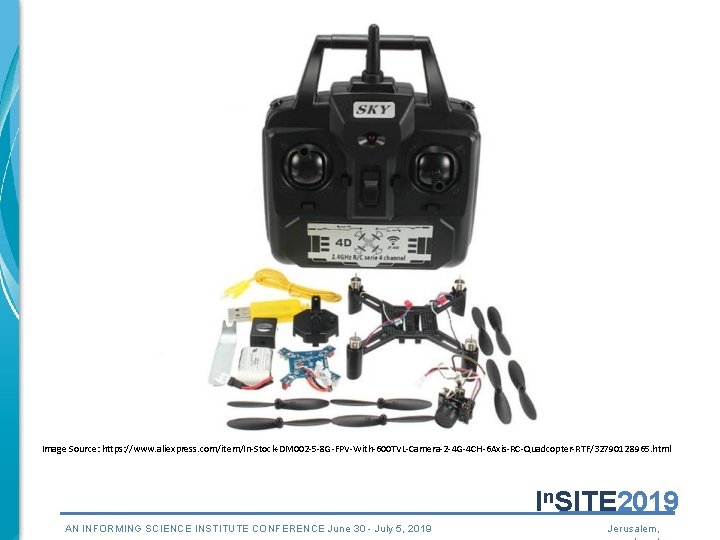
Group 1: DIY Drone in STEM Education • The participants were given a set of drone components with installation instructions. They were requested to study how to assemble the drone from parts and how to fly the drone. This activity aimed to assess the technological knowledge of the participants. • They were required to design a lesson plan for learners to learn the drone technology and to understand the general applications of a drone. In. SITE 2019 AN INFORMING SCIENCE INSTITUTE CONFERENCE June 30 - July 5, 2019 Jerusalem,
Image Source: https: //www. aliexpress. com/item/In-Stock-DM 002 -5 -8 G-FPV-With-600 TVL-Camera-2 -4 G-4 CH-6 Axis-RC-Quadcopter-RTF/32790128965. html In. SITE 2019 AN INFORMING SCIENCE INSTITUTE CONFERENCE June 30 - July 5, 2019 Jerusalem,
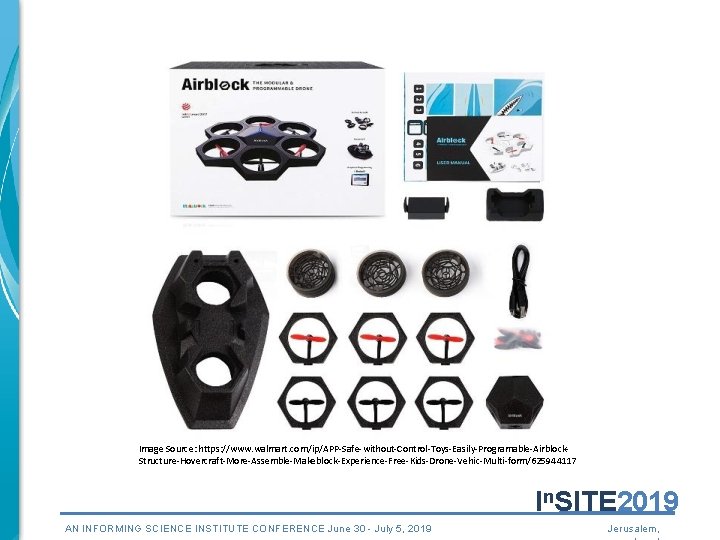
Group 2: Programmable Drone in STEM Education • The participants were given a drone that its flight path could be controlled by a usercreated computer program. • After studying the controlling features of the drone, the participants were required to design a lesson plan for learners to learn computer programming concepts using that drone. In. SITE 2019 AN INFORMING SCIENCE INSTITUTE CONFERENCE June 30 - July 5, 2019 Jerusalem,
Image Source: https: //www. walmart. com/ip/APP-Safe-without-Control-Toys-Easily-Programable-Airblock. Structure-Hovercraft-More-Assemble-Makeblock-Experience-Free-Kids-Drone-Vehic-Multi-form/625944117 In. SITE 2019 AN INFORMING SCIENCE INSTITUTE CONFERENCE June 30 - July 5, 2019 Jerusalem,
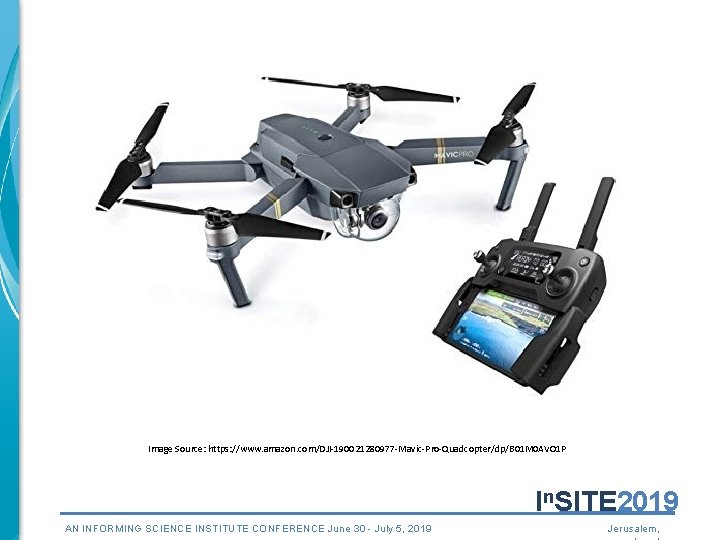
Group 3: Aerial Photography/Videography in STEM Education • The participants were given a drone that equipped with a camera. • This group was required to design a lesson plan that applies the photo/video-taking feature of a drone to support students’ learning in STEM education. In. SITE 2019 AN INFORMING SCIENCE INSTITUTE CONFERENCE June 30 - July 5, 2019 Jerusalem,
Image Source: https: //www. amazon. com/DJI-190021280977 -Mavic-Pro-Quadcopter/dp/B 01 M 0 AVO 1 P In. SITE 2019 AN INFORMING SCIENCE INSTITUTE CONFERENCE June 30 - July 5, 2019 Jerusalem,
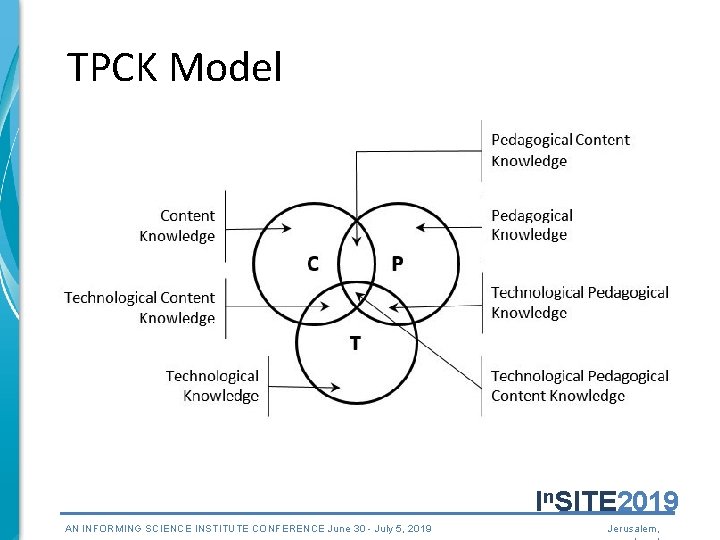
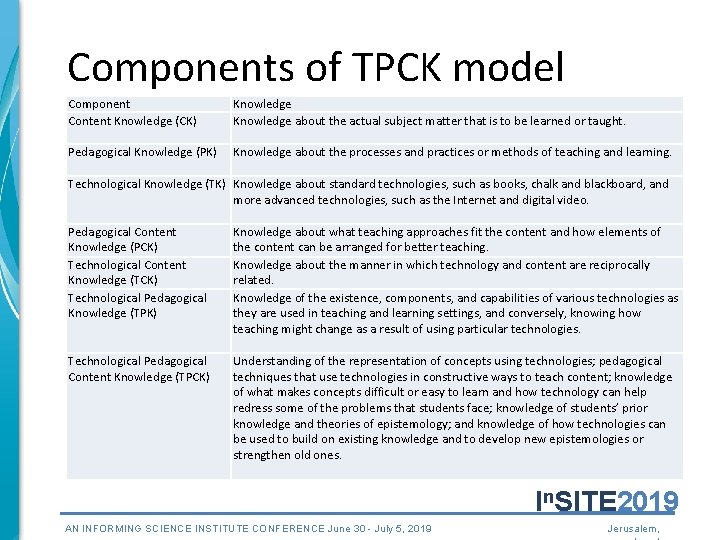
Analytical Framework • Since this study aimed to explore teachers’ readiness to use drone technology in their teaching, • the model of technological pedagogical content knowledge (TPCK) suggested by Mishra and Koehler (2006) was adopted as the analytical framework. In. SITE 2019 AN INFORMING SCIENCE INSTITUTE CONFERENCE June 30 - July 5, 2019 Jerusalem,
TPCK Model In. SITE 2019 AN INFORMING SCIENCE INSTITUTE CONFERENCE June 30 - July 5, 2019 Jerusalem,
RESULTS In. SITE 2019 AN ANINFORMINGSCIENCEINSTITUTECONFERENCEJune 3030 - July 5, 5, 2019 Jerusalem,
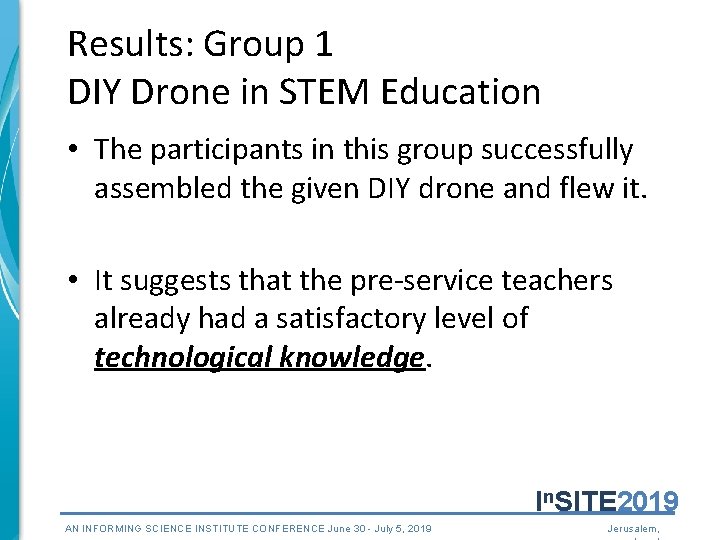
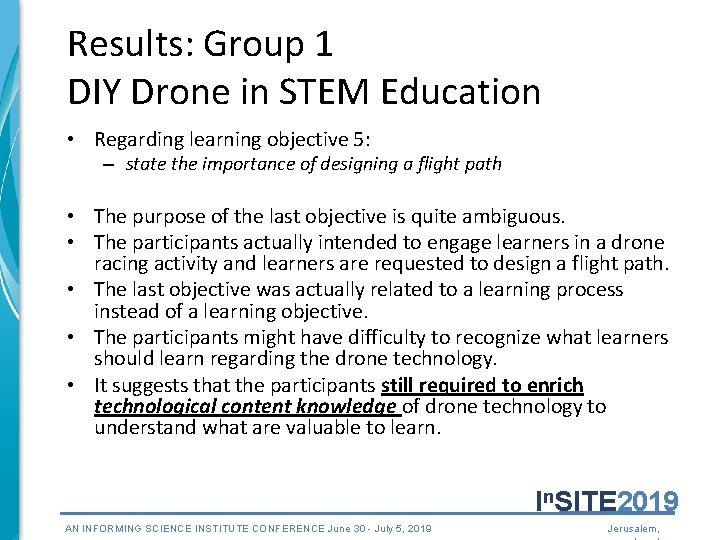
Results: Group 1 DIY Drone in STEM Education • The participants in this group successfully assembled the given DIY drone and flew it. • It suggests that the pre-service teachers already had a satisfactory level of technological knowledge. In. SITE 2019 AN INFORMING SCIENCE INSTITUTE CONFERENCE June 30 - July 5, 2019 Jerusalem,
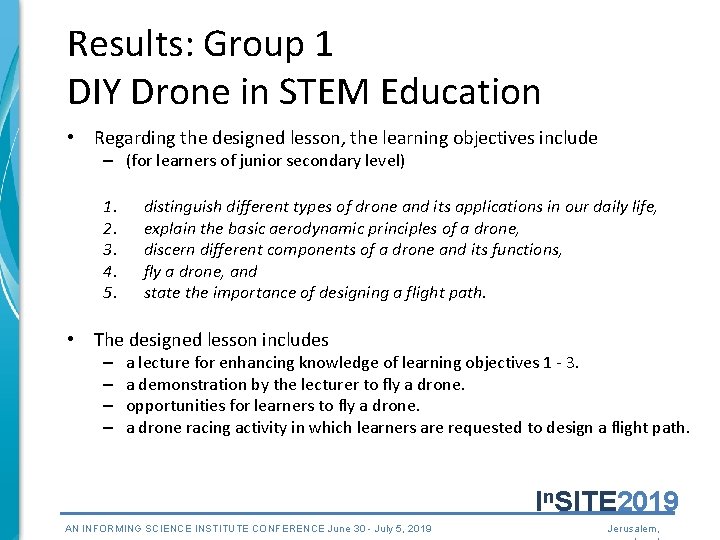
Results: Group 1 DIY Drone in STEM Education • Regarding the designed lesson, the learning objectives include – (for learners of junior secondary level) 1. 2. 3. 4. 5. distinguish different types of drone and its applications in our daily life, explain the basic aerodynamic principles of a drone, discern different components of a drone and its functions, fly a drone, and state the importance of designing a flight path. • The designed lesson includes – – a lecture for enhancing knowledge of learning objectives 1 - 3. a demonstration by the lecturer to fly a drone. opportunities for learners to fly a drone racing activity in which learners are requested to design a flight path. In. SITE 2019 AN INFORMING SCIENCE INSTITUTE CONFERENCE June 30 - July 5, 2019 Jerusalem,
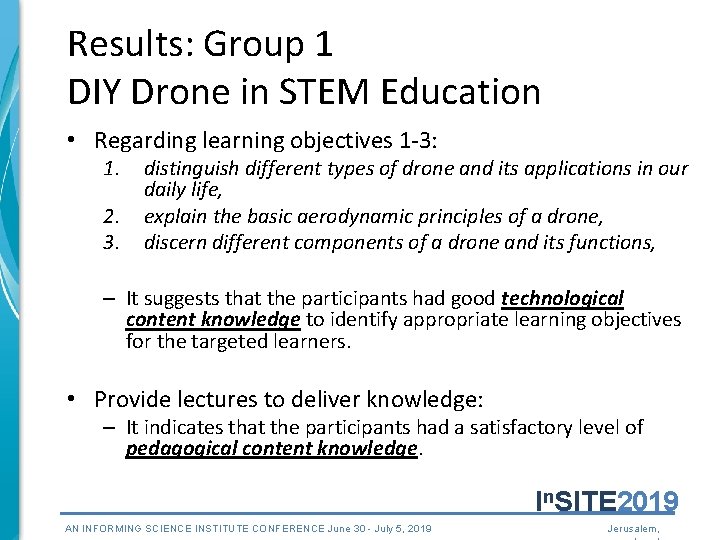
Results: Group 1 DIY Drone in STEM Education • Regarding learning objectives 1 -3: 1. 2. 3. distinguish different types of drone and its applications in our daily life, explain the basic aerodynamic principles of a drone, discern different components of a drone and its functions, – It suggests that the participants had good technological content knowledge to identify appropriate learning objectives for the targeted learners. • Provide lectures to deliver knowledge: – It indicates that the participants had a satisfactory level of pedagogical content knowledge. In. SITE 2019 AN INFORMING SCIENCE INSTITUTE CONFERENCE June 30 - July 5, 2019 Jerusalem,
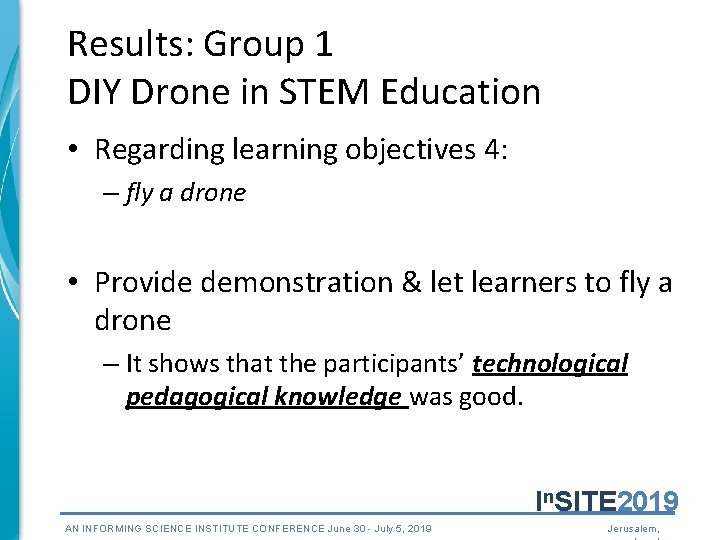
Results: Group 1 DIY Drone in STEM Education • Regarding learning objectives 4: – fly a drone • Provide demonstration & let learners to fly a drone – It shows that the participants’ technological pedagogical knowledge was good. In. SITE 2019 AN INFORMING SCIENCE INSTITUTE CONFERENCE June 30 - July 5, 2019 Jerusalem,
Results: Group 1 DIY Drone in STEM Education • Regarding learning objective 5: – state the importance of designing a flight path • The purpose of the last objective is quite ambiguous. • The participants actually intended to engage learners in a drone racing activity and learners are requested to design a flight path. • The last objective was actually related to a learning process instead of a learning objective. • The participants might have difficulty to recognize what learners should learn regarding the drone technology. • It suggests that the participants still required to enrich technological content knowledge of drone technology to understand what are valuable to learn. In. SITE 2019 AN INFORMING SCIENCE INSTITUTE CONFERENCE June 30 - July 5, 2019 Jerusalem,
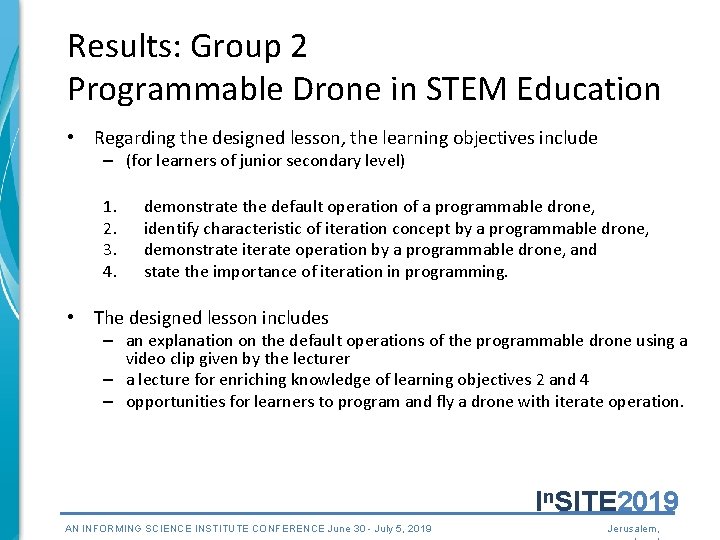
Results: Group 2 Programmable Drone in STEM Education • Regarding the designed lesson, the learning objectives include – (for learners of junior secondary level) 1. 2. 3. 4. demonstrate the default operation of a programmable drone, identify characteristic of iteration concept by a programmable drone, demonstrate iterate operation by a programmable drone, and state the importance of iteration in programming. • The designed lesson includes – an explanation on the default operations of the programmable drone using a video clip given by the lecturer – a lecture for enriching knowledge of learning objectives 2 and 4 – opportunities for learners to program and fly a drone with iterate operation. In. SITE 2019 AN INFORMING SCIENCE INSTITUTE CONFERENCE June 30 - July 5, 2019 Jerusalem,
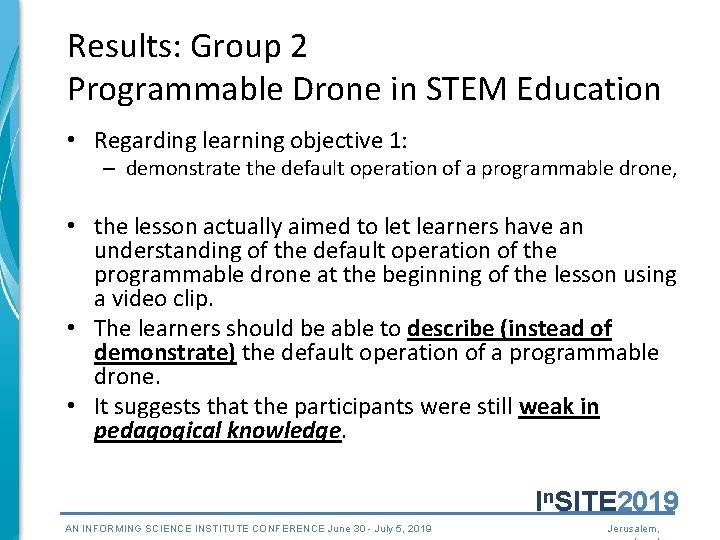
Results: Group 2 Programmable Drone in STEM Education • Regarding learning objective 1: – demonstrate the default operation of a programmable drone, • the lesson actually aimed to let learners have an understanding of the default operation of the programmable drone at the beginning of the lesson using a video clip. • The learners should be able to describe (instead of demonstrate) the default operation of a programmable drone. • It suggests that the participants were still weak in pedagogical knowledge. In. SITE 2019 AN INFORMING SCIENCE INSTITUTE CONFERENCE June 30 - July 5, 2019 Jerusalem,
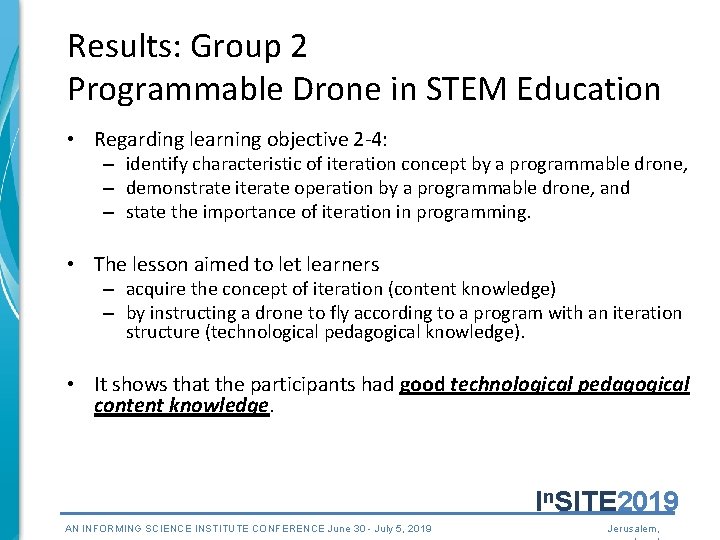
Results: Group 2 Programmable Drone in STEM Education • Regarding learning objective 2 -4: – identify characteristic of iteration concept by a programmable drone, – demonstrate iterate operation by a programmable drone, and – state the importance of iteration in programming. • The lesson aimed to let learners – acquire the concept of iteration (content knowledge) – by instructing a drone to fly according to a program with an iteration structure (technological pedagogical knowledge). • It shows that the participants had good technological pedagogical content knowledge. In. SITE 2019 AN INFORMING SCIENCE INSTITUTE CONFERENCE June 30 - July 5, 2019 Jerusalem,
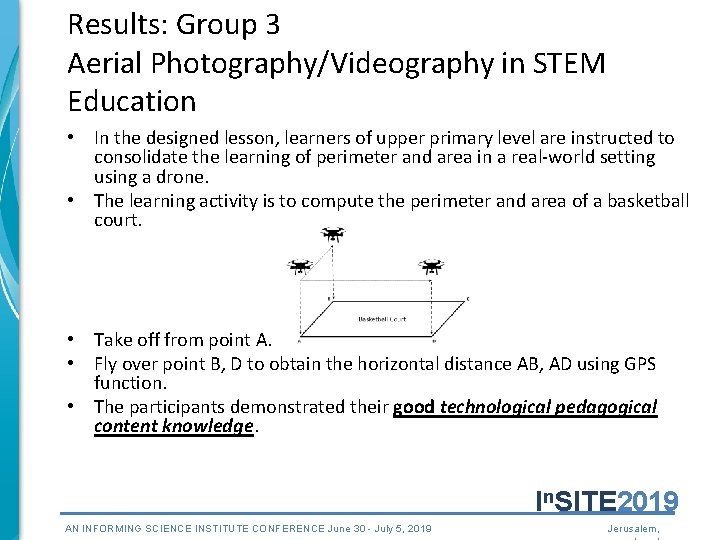
Results: Group 3 Aerial Photography/Videography in STEM Education • In the designed lesson, learners of upper primary level are instructed to consolidate the learning of perimeter and area in a real-world setting using a drone. • The learning activity is to compute the perimeter and area of a basketball court. • Take off from point A. • Fly over point B, D to obtain the horizontal distance AB, AD using GPS function. • The participants demonstrated their good technological pedagogical content knowledge. In. SITE 2019 AN INFORMING SCIENCE INSTITUTE CONFERENCE June 30 - July 5, 2019 Jerusalem,
Results: Group 3 Aerial Photography/Videography in STEM Education • However, there was an inadequacy in the writing of learning objectives of this lesson. 1. 2. 3. 4. 5. 6. measure a figure, calculate the area and perimeter, apply the mathematical concept in real-world, control the drone, develop a technological sense, and attempt to use more technological devices. • The first three objectives could be considered appropriate. • The fourth objective seemed not an appropriate objective since “to control a drone” was actually the learning process of this lesson instead of the ultimate goal. • The last two objectives were very vague and not that relevant. • It suggests that the participants were weak in the content knowledge. In. SITE 2019 AN INFORMING SCIENCE INSTITUTE CONFERENCE June 30 - July 5, 2019 Jerusalem,
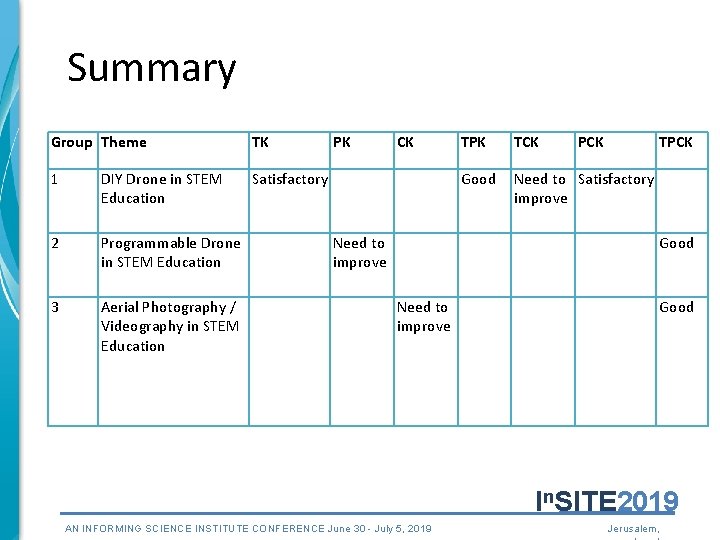
Summary Group Theme TK 1 DIY Drone in STEM Education Satisfactory 2 Programmable Drone in STEM Education 3 Aerial Photography / Videography in STEM Education PK CK Need to improve TPK TCK PCK TPCK Good Need to Satisfactory improve Good Need to improve Good In. SITE 2019 AN INFORMING SCIENCE INSTITUTE CONFERENCE June 30 - July 5, 2019 Jerusalem,
Conclusions • It depends on teachers’ knowledge of the technology and how they appropriately exploit the technology to initiate the change. • The participants (the pre-service teachers) of this study demonstrated – a satisfactory level of competence in the areas of technological knowledge (TK) and pedagogical content knowledge (PCK). – good in technological pedagogical knowledge (TPK) and technological pedagogical content knowledge (TPCK). • These favorable results suggest that the pre-service teachers, to a large extent, have sufficient competence to master the skills and knowledge of drone technology and to integrate it into their teaching. In. SITE 2019 AN INFORMING SCIENCE INSTITUTE CONFERENCE June 30 - July 5, 2019 Jerusalem,
Conclusions – Training Needs • Although the pre-service teachers in Group 1 had quite good overall performance, results show that they still needed to strengthen their technology content knowledge of a drone in order to more accurately identify the appropriate learning objective. • The pre-service teachers in Group 2 occasionally got confused with the pedagogy applied in the teaching process and that stated in the lesson objective. It indicates the need for more training on pedagogical knowledge. • In Group 3, although the pre-service teachers were able to design a lesson with good use of drone technology, they were required to strengthen the subject content knowledge. In. SITE 2019 AN INFORMING SCIENCE INSTITUTE CONFERENCE June 30 - July 5, 2019 Jerusalem,
QUESTIONS? In. SITE 2019 AN ANINFORMINGSCIENCEINSTITUTECONFERENCEJune 3030 - July 5, 5, 2019 Jerusalem,
References • • • Ball, D. L. , Thames, M. H. , & Phelps, G. (2008). Content knowledge for teaching: What makes it special? Journal of Teacher Education, 59(5), 389 -407. https: //doi. org/10. 1177/0022487108324554 Birtchnell, T. , & Gibson, C. (2015). Less talk more drone: Social research with UAVs. Journal of Geography in Higher Education, 39(1), 182 -189. https: //doi. org/10. 1080/03098265. 2014. 1003799 Carnahan, C. , Zieger, L. , & Crowley, K. (2016). Drones in education: Let your students’ imagination soar. Arlington, Virginia: International Society for Technology in Education. Carr, A. A. , Jonassen, D. H. , Litzinger, M. E. , & Marra, R. M. (1998). Good ideas to foment educational revolution: The role of systematic change in advancing situated learning, constructivism, and feminist pedagogy. Educational Technology, 38(1), 5 -15. Retrieved from https: //www. jstor. org/stable/44428442 Department of Defense (2018). DOD Dictionary of military and associated terms. United States. Dronepedia. (2017). Types of drones. Retrieved November 29, 2018, from Dronepedia: https: //dronepedia. xyz/5 -different-types-of-drones Guzey, S. S. , & Roehrig, G. H. (2012). Integrating educational technology into the secondary science teaching. Contemporary Issues in Technology and Teacher Education, 12(2), 162 -183. Retrieved from https: //www. learntechlib. org/p/39130/paper_39130. pdf Jordan, B. R. (2015). A bird’s-eye view of geology: The use of micro drones/UAVs in geologic fieldwork and education. GSA Today, 25(7), 42 -43. https: //doi. org/10. 1130/GSATG 232 GW. 1 Kim, B. -H. (2016). Development of young children coding drone using block game. Indian Journal of Science and Technology, 9(44), 1 -5. https: //doi. org/10. 17485/ijst/2016/v 9 i 44/105175 Koehler, M. J. , Mishra, P. , Yahya, K. , & Yadav, A. (2004). Successful teaching with technology: The complex interplay of content, pedagogy, and technology. Proceedings of SITE 2004 --Society for Information Technology & Teacher Education International Conference (pp. 2347 -2354). Atlanta, GA, USA: Association for the Advancement of Computing in Education. Retrieved from https: //www. learntechlib. org/p/14799/ In. SITE 2019 AN INFORMING SCIENCE INSTITUTE CONFERENCE June 30 - July 5, 2019 Jerusalem,
References • • • Lee, D. (2016). Thermal imaging drones. LAW and ORDER, 20 -22. Retrieved from http: //content. yudu. com/web/y 5 b 2/0 A 2 qjxz/Law. And. Order. May 2016/flash/resources/index. htm? ref. Url=http%2 53 A%252 Fwww. hendonpub. com%252 Flaw_and_order Lee, D. (2018). China’s bungled drone display breaks world record. Retrieved November 29, 2018, from BBC News: https: //www. bbc. com/news/technology-43982522 Mishra, P. , & Koehler, M. J. (2006). Technological pedagogical content knowledge: A framework for teacher knowledge. Teachers College Record, 108(6), 1017 -1054. https: //doi. org/10. 1111/j. 1467 -9620. 2006. 00684. x Murch, A. M. , Paw, Y. C. , Pandita, R. , Li, Z. , & Balas, G. J. (2011). A low cost small UAV flight research facility. In F. Holzapfel, & S. Theil, Advances in Aerospace Guidance, Navigation and Control (pp. 29 -40). Berlin, Heidelberg: Springer. https: //doi. org/10. 1007/978 -3 -642 -19817 -5_3 Pearcy, M. (2015). “They’re always over us” - Teaching about drones. The Social Studies, 106(3), 126 -137. https: //doi. org/10. 1080/00377996. 2015. 1029606 Petrinjak, L. (2016). Using drones to enhance STEM learning. NSTA Reports, 27(8), 8 -9. Preble, B. C. (2015). A case for drones. Technology and Engineering Teacher, 74(7), 24 -29. Retrieved from https: //search. proquest. com/openview/489 aa 60 e 96 ffca 49145034 f 8 a 7087 e 46/1? pqorigsite=gscholar&cbl=34845 Punch, K. F. (2011). Introduction to research methods in education. London: SAGE Publications Ltd. Romano, M. (2014). Drones as lifesavers. The Science Teacher, 81(3), 14. Stohlmann, M. , Moore, T. J. , & Roehrig, G. H. (2012). Considerations for teaching integrated STEM education. Journal of Pre-College Engineering Education Research, 2(1), 28 -34. https: //doi. org/10. 5703/1288284314653 Strimel, G. J. , Bartholomew, S. R. , & Kim, E. (2017). Engaging children in engineering design through the world of quadcopters. Children’s Technology and Engineering, 7 -11. Retrieved from https: //www. iteea. org/Publications/Journals/ESCJournal/CTE-May 2017. aspx In. SITE 2019 AN INFORMING SCIENCE INSTITUTE CONFERENCE June 30 - July 5, 2019 Jerusalem,
Components of TPCK model Component Content Knowledge (CK) Knowledge about the actual subject matter that is to be learned or taught. Pedagogical Knowledge (PK) Knowledge about the processes and practices or methods of teaching and learning. Technological Knowledge (TK) Knowledge about standard technologies, such as books, chalk and blackboard, and more advanced technologies, such as the Internet and digital video. Pedagogical Content Knowledge (PCK) Technological Content Knowledge (TCK) Technological Pedagogical Knowledge (TPK) Knowledge about what teaching approaches fit the content and how elements of the content can be arranged for better teaching. Knowledge about the manner in which technology and content are reciprocally related. Knowledge of the existence, components, and capabilities of various technologies as they are used in teaching and learning settings, and conversely, knowing how teaching might change as a result of using particular technologies. Technological Pedagogical Content Knowledge (TPCK) Understanding of the representation of concepts using technologies; pedagogical techniques that use technologies in constructive ways to teach content; knowledge of what makes concepts difficult or easy to learn and how technology can help redress some of the problems that students face; knowledge of students’ prior knowledge and theories of epistemology; and knowledge of how technologies can be used to build on existing knowledge and to develop new epistemologies or strengthen old ones. In. SITE 2019 AN INFORMING SCIENCE INSTITUTE CONFERENCE June 30 - July 5, 2019 Jerusalem,